Key details for a good riding horse stance by connecting the upper and lower

Chen Man Ching once famously said that he only understood Tai Chi after having a dream in which he had no arms.

It’s a good indication of what you’re looking for in Tai Chi  – which is to “do” everything with the actions of the legs and waist, not the arms. The idea of moving the arms without moving the arms is, of course, contradictory, but that’s the challenge you undertake when you practice Tai Chi.

I found that I didn’t “get” this concept of “no arms” until I really relaxed my lower back and learned to sit correctly in the form. The lower back is the bridge between the upper body and the lower body. If that bridge is not open then goods and services cannot flow between the two different countries.

So, how do we do this in the correct way? I think the key is to be found in how you get into a riding horse posture properly. 

We’re all familiar with the wide-legged riding horse posture. When you start a Tai Chi form you are essentially sitting down into a narrower version of it, but it’s the same kind of stance. 

Let’s formalise what I mean by Riding Horse stance a bit more.

1. Toes point forward. 

2. Knees bent, but not further forward than the toes. 

3. Feet two shoulder widths apart. 

As aways we make sure that our upper body is relaxed (not collapsed) and upright. Just take a moment to focus not he AO joint that I mentioned in my last post, to ensure that your head is in the correct position. Your neck should feel long at the back and the chin slightly tucked at the front, crown going in the upward direction.

Now straighten your legs. This brings you out of a riding horse stance and into a leg triangle stance with straight legs.

We’re going to lower back down into a riding horse, but rather than doing what you normally do, I want you to focus on two things.

1. The knees go forward as they bend.

2. The butt does not move backward as it would if you were going to sit in a chair, but instead you open/relax your lower back so that it sinks downward.

There you go. This should feel like a different sort of riding horse stance to what you’ve normally experienced. That elongated and open feeling in the lower back is what you need to maintain during your Tai Chi form. Without that feeling you cannot connect the upper and lower parts of the body.

Play with it, experiment with it a bit, and then when you’re ready, start your Tai Chi form and as the hands come down and you sink, try and achieve the same feeling.

Then try and keep it for the whole form. If you can do that, then you’ll start to notice that Tai Chi is all about the leg movements, not the arm movements. Your arm movements can start to be directed by the leg and waist movements. 

As it says in the classics:

It is “rooted in the feet,

generated from the legs,

controlled by the waist, and

expressed through the fingers. “

The crucial detail of using the kua and hips in Needle at Sea Bottom

There’s a lot of talk in the internal arts about the “kua”, and how using the kua (as opposed to the hip joints) is central to getting the idea of internal movement in Tai Chi.

So, what is the kua?

A definition from Crane Tiger Tai Chi reads:

Kua refers to the area that extends from the inguinal folds (front of the hip where the leg and body meet) to the crest of the pelvis. It includes the hip joints, the iliopsoas, and adductor muscles as well as the sacrum and the perineum.

I’ve written about the kua several times myself, but I think Ken Gullette’s book (my review is here) does a great job of describing it. To me, moving the kua is about opening and closing the body in the space inside the hip joints. Integrating the opening and closing of the kua into your movement facilitates power moving smoothly from the legs and feet up through the body, or receiving force in the opposite direction and directing it down towards the ground.

Moving “inside” the hip joints allows for very detailed movement and enables you to create and remove space when interacting with an opponent, which has martial application.

However, I think that the focus on the kua in internal arts often risks people ignoring the pivotal (ha!) role of the hip joints. I think the hip joints are actually more important to get right – if you focus on the kua but never think about your hip joints it’s a bit like building the walls of your house without a firm foundation.

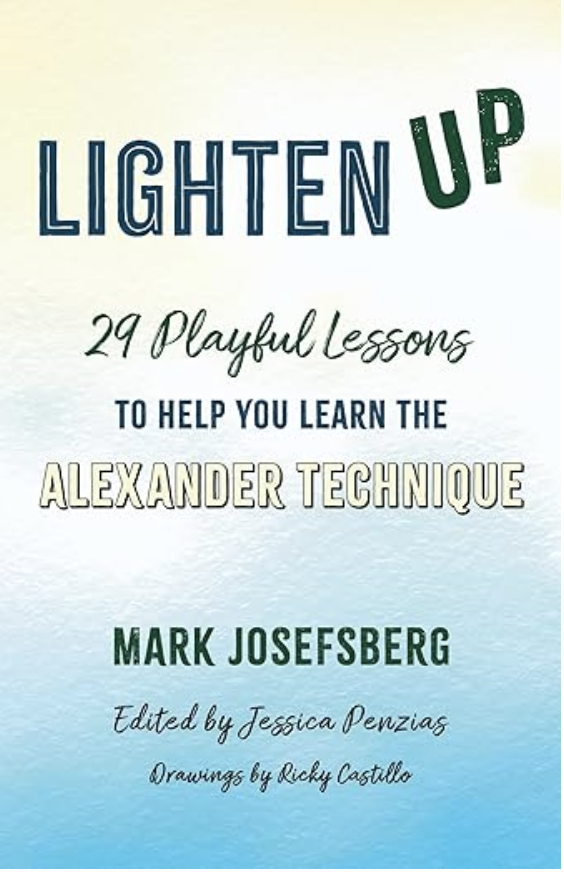
I’ve been reading a great little book called Lighten Up by Mark Josefsberg, which is a humorous description of the Alexander Technique, and only costs £2.50 for the Kindle edition.

It starts off making the great point about the pivotal (ha!) role the hip joint play in actions like sitting, standing, running, walking, bending, etc.. A good point it makes about your hip joints is that they probably aren’t where you think they are. People tend to think that you put your ‘hands on your hips’ that’s where you bend from, when in fact, your hips attach to your legs via a ball and socket joint that is much lower down.

This has real consequences for Tai Chi postures such as “Needle at Sea Bottom”, where you bend forward. If you bend from too high up then you are compromising your spine, and bending from your hip joints is always a bit lower down than you think it is.

Wu Jianquan, Needle at sea bottom

The way I do Need at Sea Bottom is to try and keep my head going “up” away from the spine and bend from the hip joints (where the legs attach to the body) keeping my spine in a straight line. In theory, at least.

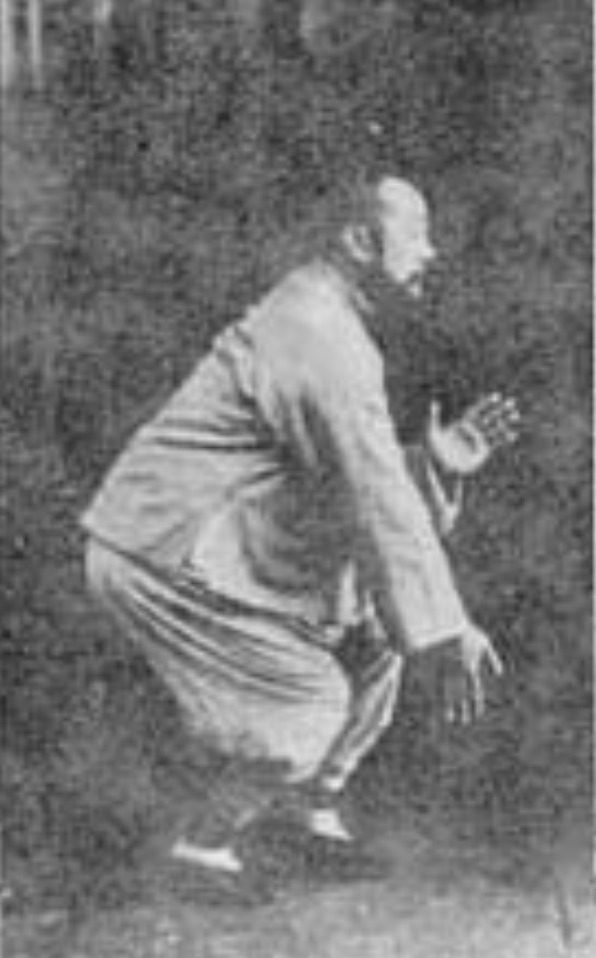
I don’t know who this is, but look at this guy doing it:

To me there are all sorts of problems here – he’s rounding his spine, and the head is kinked at an unnatural angle that isn’t an extension of the spine, in an effort to go too low. I’d rather not go as low as he is, and not compromise my spine like that.

The other point that Mark continually makes in the Lighten Up book I mentioned is to be aware of the AO joint – the atlanto-occipital joint. This is where the head meets the neck, and again, it’s not exactly where you think it will be. Put your fingers in your ears and imagine they are touching. Rotate the head up and down from something on a level with that point – that’s roughly where it is. What you’ll find is that you can look up and down without your fingers moving up or down because you are rotating the head around this point. Now apply that principle to Needle at Sea Bottom and you can see how your head position is meant to be.

Here’s a video of my Sifu Raymond Rand doing the movement correctly, with martial application:

New podcast: Discovering Neijiaquan, with Jess O’Brien

My guest for this episode is Jess O’Brien, author of the book Neijiaquan and co host of the Neijiaquan podcast, which he runs with Isaac Kamins.

Since 1999, Jess has studied extensively under BK Frantzis. Over the years, he has also trained with other, preeminent internal martial artists like Luo De Xiu. He has been active in martial arts since his teens.

In this episode we discuss what drew Jess to the internal arts and how he trained with various different teachers before becoming a student of Bruce Kumar Frantzis.

Is Tai Chi really about relaxation (fangsong)?

I noticed a person on Facebook recently who was trying to make the point that the term Fangsong (放松 relax, unwind, loosen, ease, release, slacken) doesn’t appear in writings about Tai Chi until about 1930, and is therefore a modern idea that we are retrofitting to suit our modern ideas of Tai Chi being all about relaxing. That’s not his argument word for word, but that was the gist of it, anyway.

I’ve heard similar things from other people about how ‘back in the day’ Tai Chi was practiced hard, like a real marital art, until you were exhausted, and that modern training has gone soft in comparison. To those people I would point out that intensity and duration of practice have nothing to do with how you practice. Ask anybody who has practiced ‘standing still and relaxing’ for half a hour in a Zhan Zhuang posture and you’ll find out that practicing relaxing for half an hour in a stressful position is an exhausting, sweaty, business.

But to return to the original point, I would point out that even if you look at one of the oldest writings we have on Tai Chi – the handwritten manuscript of Li Yiyu from 1881 (which is available to read on Brennan Translation) you’ll find the word “relax” appears in the English translation 9 times. That’s not an insignificant amount. (I’ll leave it to the Chinese language experts to search the original Chinese).

You find it in phrases like:

I relax my power, but I do not allow it to collapse. (This has to do with “calm”.)

and

Every movement is a technique of first putting forth strength and then immediately relaxing, yet always there must be continuity from one to other, and there is never to be a departure from the four stages of “begin, develop, transmit, and finish”.

However, if you check out the even earlier 1875 text Explaining Tai Chi Principles, written by Yang BanHou, son of the famous Yang LuChan, you’ll find that he’s right – the phrase “relax” doesn’t appear, even once!

However, just look at one of the things written in the text:

“Power comes from the sinews. Strength comes from the bones. Looking at it purely physically, one who has great strength is able to carry many hundreds of pounds, but this is an externally showy action of bones and joints, a stiff strength. If on the other hand the power of your whole body is used, it may appear you are unable to lift hardly any weight at all, yet there is an internal robustness of essence and energy, and once you have achieved skill, you will seem to have something more wonderful than one who has the stiff sort of strength. Thus runs the method of physical training for self-cultivation.”

It seems pretty clear that he’s talking about relaxation being required for whole body strength.

But getting away from the nitpicking about facts (sorry!) I do think he has a point – there has been a modern re-framing of everything to do with Taoist arts as a kind of therapy for stress and dealing with the pressures of modern living that wasn’t necessarily there in the original arts – especially with Tai Chi.

Tai Chi was created in pretty stressful times, when wars were being fought, the concepts of law and order and justice were malleable depending on how important you were and life could be brutal and short. Taoism emerged at a time that was probably even more dangerous to be alive in! Frankly, I don’t think you expected to live long enough to have to worry about getting stressed! You were probably too busy trying to stay alive and earn a living. Being stressed is something of a modern disease because we live lives of relative comfort and we’ve got nothing truly life threatening to worry about on a daily basis.

The same thing has already happened to yoga.

But, I think we’ll have to live with it, because the hippies who have taken over Tai Chi Chuan do have a very good point – the first step in Tai Chi is to relax, whether you like it or not! You cannot move your body as a unit if parts of it are tense.

In Tai Chi Chuan the body is required to move as a whole unit, connected by fascia, tendons, muscles, etc, with all the joints allowed to move freely during exercise. All the joints are involved to some degree in all movement, so need to be relaxed. The ball-and-socket joints of the shoulders and hips are allowed to move freely. The gliding joints of the ankles and wrists move freely, and the hinge joints at elbows and knees are all allowed to move freely. Finally, the dantian moves freely and controls everything. Tensing the muscles around a joint separates it off from the rest of the organism, meaning that whole body movement is not possible.

And being mentally ‘tense’ is just as much of a problem as being physically tense, since the mind and the body are intimately connected.

Perhaps the emphasis in the original writings on Tai Chi was focused on more lofty philosophical principles, yes, but you will find plenty of admonitions to relax in there, and for good reason. That’s just how Tai Chi works.

The Chen style knee wobble

Master Ren Guangyi’s signature 21 Form has to be one of the clearest examples of the Chen style knee wobble I’ve seen.

You can see the little wobble of the knee he does before he does a fajin in the form. This knee wobble has been the source of seemingly endless debate. Some lineages of Chen style do it, some don’t. Some do it but it’s very minimal, some do it and it’s quite exaggerated. It doesn’t even seem to be a village vs Beijing style thing either.

So, why do it? It’s a way to involve the knee in the generation of power. The best analogy I can think of is that it’s like retracting your fist before you punch, but instead of having to move your fist back (which has certain obvious martial disadvantages), you store power by moving the knee back instead. This obviously requires a conditioned body, where the hand to foot is all connected, so that when one part moves, all parts move. If you just took your average Joe off the street and they did a knee wobble, I don’t think it would do anything for their punching power. In fact, it would probably decrease it. But for somebody who has built that connection over time throughout the body, it has advantages.

Lots of people are convinced that the knee wobble is the route to ruin for your body, that it’s bio-mechanically inefficient and potentially injurious over time with hard training. I can see where they are coming from since you are using the knee as part of a whip-like kinetic chain for which the hinge joint is not well evolved.

But personally I’m not so convinced that, done properly as part of an overall training system, it is bad for the knee, necessarily. I think if you were holding your weight for a long time on a misaligned knee joint then that would be a bigger problem. But the quick flick of a fajin isn’t like that. There are also plenty of things athletes do all the time that I’d say are potentially much more dangerous. It also depends on the person. The knee is a particular weak point in the evolution of the human beings into an upright posture, and being severely overweight is very dangerous to your knee joints. And if I was severely overweight there is no way I’d be flicking my knee joints about like this, so it very much depends on the overall health of the person doing it.

Disclaimer! I’m not an orthopedic surgeon, or a physiotherapist, so I’d suggest getting your medical advice from somebody who is actually medically qualified.

Chen Man Ching’s Tai Chi Method

I don’t feel I’ve written enough about body mechanics recently. I’ve been too busy enjoying myself reviewing books and interviewing people for podcasts, but I guess it’s time I stopped having fun and got back to being serious!

Watching a video of Professor Cheng Man Ching for my recent book review of Yang Short Form, I was struck by how little the Professor used his arms in his Tai Chi form. Take a look:

Sometimes it looks almost like he just gives up as his arms go limp! (Like at 1.20 in the video). This is one of the big criticisms I hear of the Cheng Man Ching form – that it’s a bit limp – but if you look at what his legs are doing it’s a bit like watching a swan on the water – you can’t see anything moving above the water, but beneath it there is a lot going on.

There are plenty of people in the Tai Chi world who disparage Professor Cheng Man Ching and his abilities. They claim that it was really his high level political connections in the exiled Nationalist government in Taiwan that made people praise his Tai Chi, not his actual abilities in the art. However, I think his impact on the Tai Chi world has been undeniably huge, and he attracted a lot of students, many of whom came from other martial arts and were experienced in those arts. I don’t think that would have been possible without some real ability being offered. From watching videos of his form and push hands, his deep rooting in his legs and ability to transfer the ground force into his opponents looks impressive to me. While there is no evidence of him transferring this ability into an actual martial art, he did appear to actually engage people in playful push hands on a regular basis, something a lot of Tai Chi teachers don’t do.

Cheng Man Ching was heard to say that he once had a dream where he had no arms and it was only after that that he felt he understood Tai Chi. That’s what his method looks like to me – the arms don’t matter. He’s sunk very low in his legs all the time, channeling the ground force upwards into his torso, and the arms are almost an afterthought, held up with as little energy as possible. 

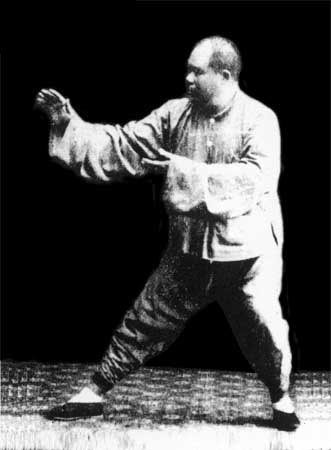
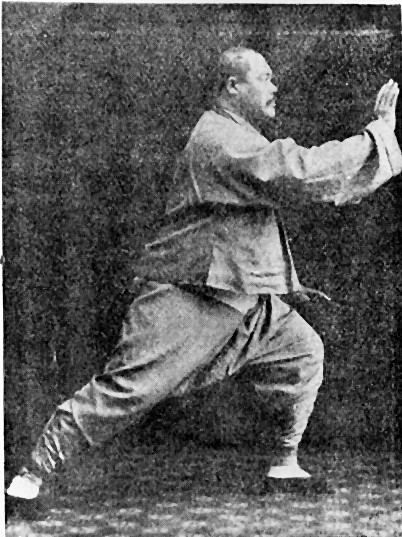
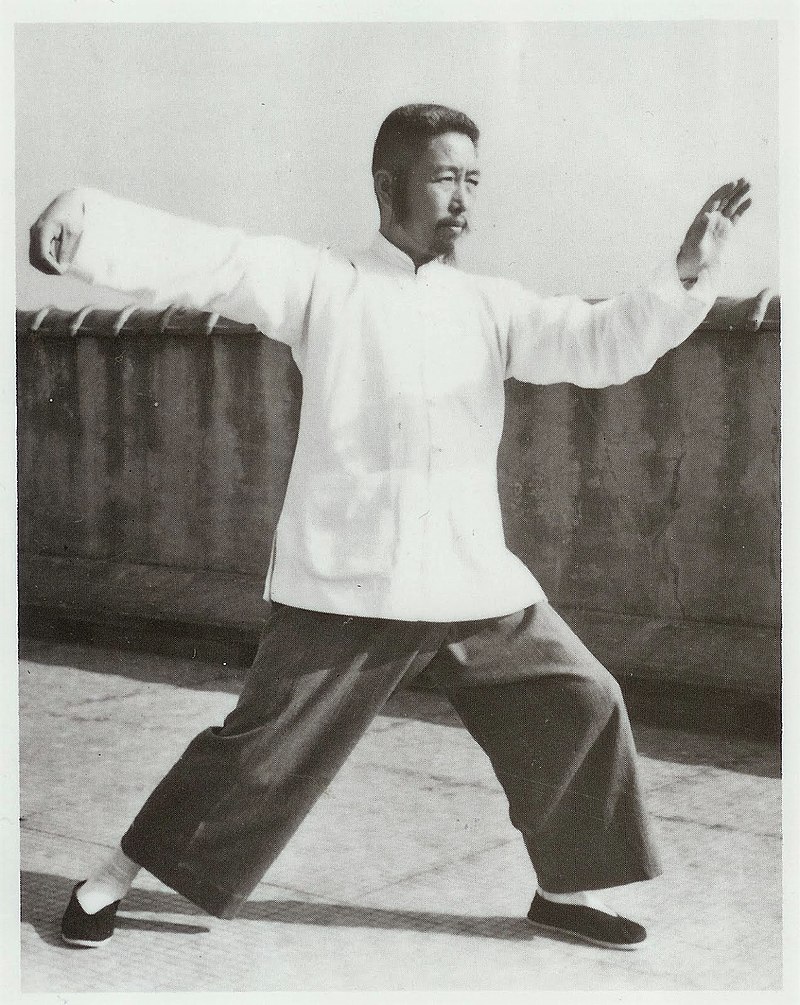
Personally, I can’t say I’m a fan of this method. To me it seems logical that in Tai Chi your body needs to have the sense of being stretched slightly from fingertips to toes at all times. I don’t mean stretched in a Yoga-like way, I mean that the skin needs to feel stretched over the bones and muscles, as if you’re made of rubber. Take a look at a picture from history of Wu Chien Chuan, of Wu style or Yang Cheng Fu of Yang style and I think you can see what I mean.

That way it’s like a guitar string being tightened so that it makes a sound when plucked in the middle. A lax string can’t be played. In Tai Chi that ‘middle’ is your dantien. If you’ve got a slight stretch on your body, from fingers to toes, then you can control movement along the length of this stretch using your dantien, so a movement of the dantien will naturally affect a movement of the extremities, if you let it.

The classics use the analogy of a bow, the most famous line being “Store up the jin like drawing a bow.”

Anybody can feel this stretch by adopting a Tai Chi posture and relaxing and trying to create an expansive feeling, but it gets stronger over time and with repeated practice. A lot of the chi kung exercises that come along with Tai Chi are designed to help you feel this stretch from fingers to toes, and help to make the connection stronger and more usable over time.

Chen Man Ching’s idea of Tai Chi seems different to me. It’s more like he’s got no arms and the jin is stopping in his shoulders, not reaching his hands. At least that’s how it appears to me.

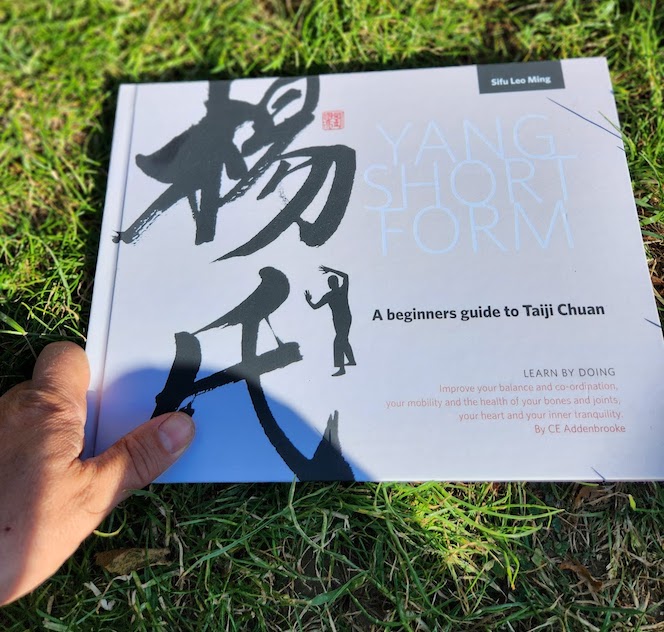
REVIEW: Yang Short form: A beginners guide to Taiji Chuan by Leo Ming and Caroline Addenbrooke

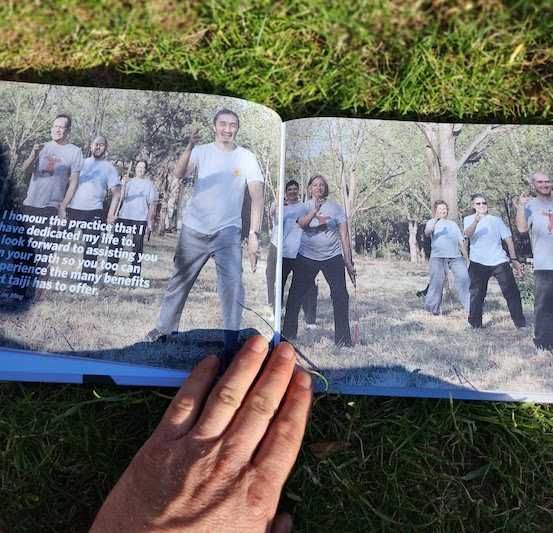
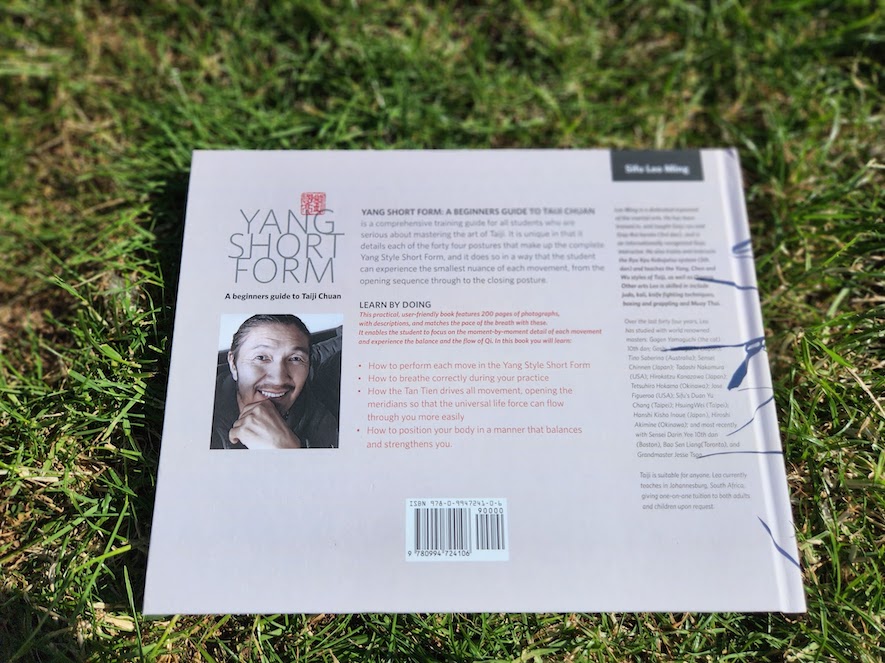
Yang Short Form: A beginners guide to Taiji Chuan, is a beautifully made, hardback coffee-table Tai Chi book, containing a brief section on history and principles of the art, over 200 colour photos mainly for showing you the form, a few verses from the Tao Te Ching to act as inspirational quotes and more.

There’s no denying that at an RRP of £49, it’s expensive. For people wondering why this book costs that much on Amazon (although you could pick it up for 18% less at time of writing), the high production values and hard cover explain the price. Printing in colour is expensive these days.

Sifu Leo Ming is the teacher who appears in the photos, and his student Caroline Addenbrooke is the author.

The main point of the book is to teach you the Cheng Man Ching short form, and if you view the book through the lens of ‘Can I learn a Tai Chi from this book?‘, it succeeds, I just have a few issues with some of the information presented here.

Consider the title

My problems start with the title, “Yang Short Form: A beginners guide to Taiji Chuan“. The Tai Chi form presented in this book is the Cheng Man Ching short form, which is certainly a Yang short form, but it’s a bit of a stretch to call it the Yang short form. People generally call it the Cheng Man Ching Short Form or the Chen Man Ching 37 form, which would have been a more accurate name, since Cheng’s form varies quite significantly from the official Yang form that belongs to the actual Yang family.

Secondly, the use of “Taiji Chuan” awkwardly mixes two different romanisation styles together in a way I’ve never seen done before, making it something of an outlier in the Tai Chi world. Tai Chi is usually either written Taijiquan/Tàijíquán (pinyin) or Tai Chi Chuan/Tai chi ch’üan (Wade-Giles), or shortened to simply “Tai Chi“. I find the decision making process of mixing the two systems together used here to come up with “Taiji Chuan” a bit baffling. Why do that?

Similarly, inside the book there’s a mix of different romanisation styles. Shaolin appears as “Shao-lin”, while changquan appears as “Changquan”, (so they’re happy to use pinyin there…) Dantien appears as “Tan Tien”. But Qi is “Qi”, not “Chi”, and Xingyi is “hsing-i”! I can’t work out the logic. In a way, so long as the system used is internally consistent it doesn’t matter, but it is a bit frustrating.

Finally, “beginners guide” is used in the title without an apostrophe! Well, that is just… wrong.

But, let’s move on from the title of the book and look at what we’ve got here. 

All the history all at once

The history section starts with a pretty safe phrase, “The history of Taiji Chuan is unknown”, and if it had stopped there I think I would have been happy, but it then goes on to tell a version of Tai Chi history anyway that includes every folk tale in the Tai Chi master’s repertoire! It talks about the classic Chan Sanfeng origin story, but also has the Chen village origin story straight afterwards before giving a brief rundown of the current styles of Tai Chi, before then pivoting back further into time and linking Tai Chi to the Shaolin Temple because that’s where “qigong theory” started… If you know anything about the history of Tai Chi you’ll know that these kind of myths are probably just that, myths, but they help the marketing of the art.

There are other problems with the accuracy of information, too – there’s a picture of a statue of Chang Sanfeng in the history section which is captioned “A statue in Chenjiagou depicting the legendary Chang San-Feng”. I thought that didn’t sound right. A quick 5 minutes on Google confirmed that his statue is of Chang, but it’s found (not surprisingly) in the Wudang mountains, not Chen village, as stated. Unless I’m wrong and there are two identical statues, but I don’t think so. The most famous statues in Chen village are the statues of Chen Chanxing and Yang Luchan.

The rundown of the different styles of Tai Chi in existence today is accurate, but if you want a proper investigation of the history of Tai Chi, I’d suggest looking elsewhere.

The section on principles of Tai Chi is also very brief. It’s all the usual advice you find in Tai Chi books about relaxing, centering, evenness and slowness, etc. There’s nothing wrong here, but it’s very surface level.

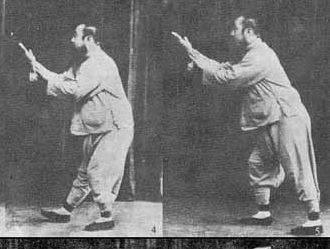
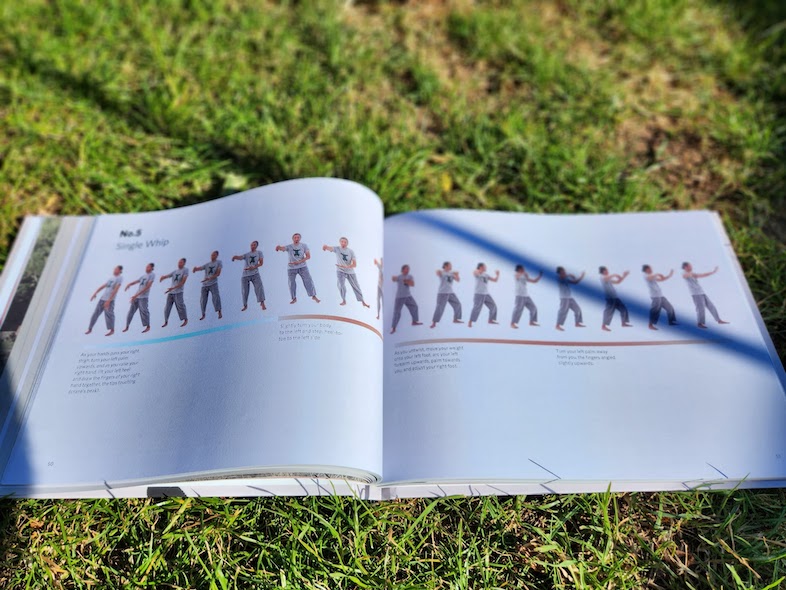
Teaching forms is where Yang Short Form gets it right. The book uses the method of breaking down each move into tiny fragments and showing them next to each other, conveying the sense of movement through the form nicely. As such you can definitely use the book as an aid to memory of this form, or even teach yourself the form from it. Take a look at this example of Single Whip:

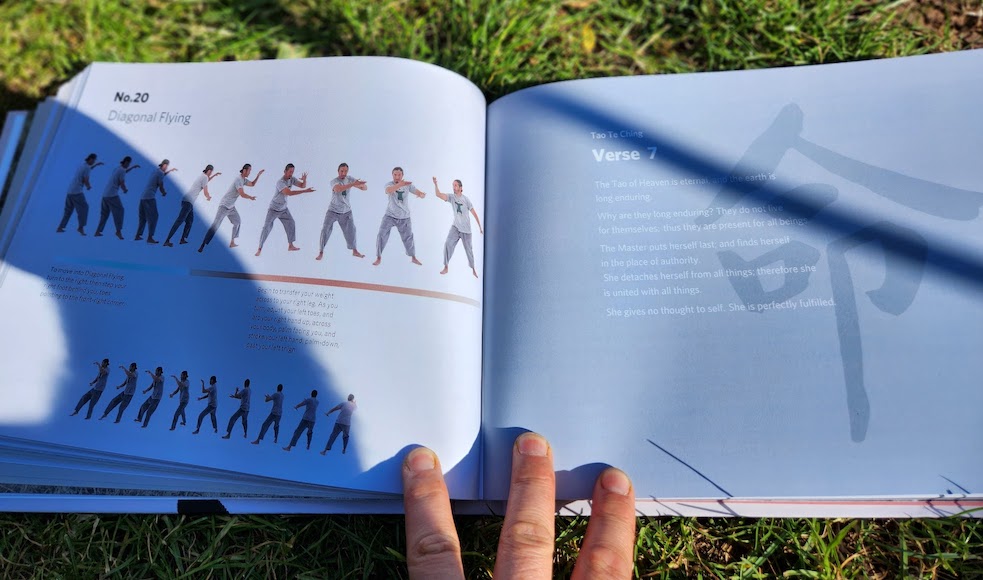
Diagonal Flying:

Of course, Tai Chi purists will say that the choreography of the form is not the important part, and that the body method is vastly more important, however, for better or for worse, the vast majority of Tai Chi practitioners in the world are not looking for a book on that. They are simply trying to learn some movements as a form of exercise for health, and this book will serve them very well.

I don’t do the Cheng Man Ching short form myself, but I have learned it in the past, and as I was looking through the movements it struck me that there were one or two idiosyncrasies presented by Sifu Leo that I hadn’t seen before. I noticed three things in particular:

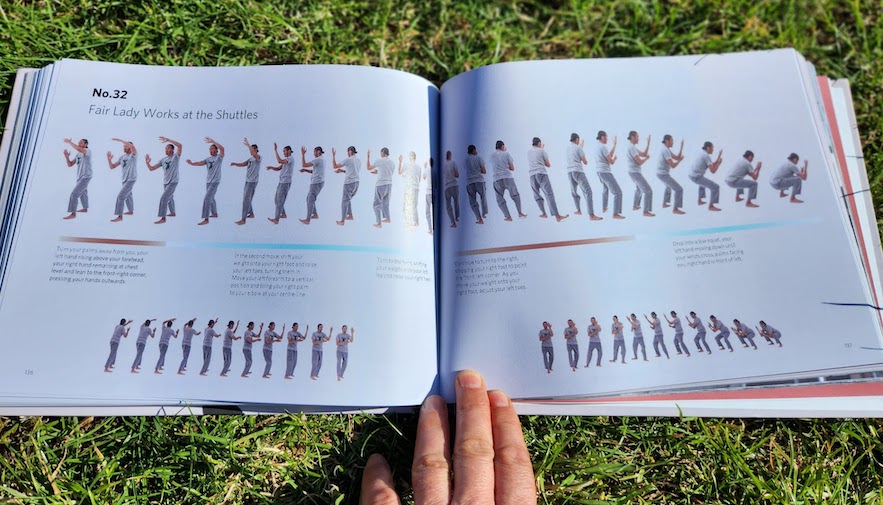
1) A low squat Sifu Leo does as a transition between each ‘Fair Lady Works at the Shuttles’ move: 

2) A front kick/leg raise, he puts into Repulse Monkey.

3) In Golden Pheasant Stands on one leg – he again squats all the way down to the floor between the knee raises.

This struck me as peculiar, so I checked the form against a video of Chen Man Ching, mapping the movements in his video to the ones in the book, and while the forms match (all the movements are here and none have been added), the above curiosities are not performed by Professor Chen Man Ching. 

Also, there are 43 moves in the form shown here, and Chen Man Ching’s form was said to be 37, but I suppose it depends how you count the moves. 

I don’t think these three variations to the Cheng Man Ching form matter that much, but I think it’s safe to say that they are not standard, so I should point them out. It’s also important to note that there are no marital applications or discussion of push hands in the book at all.

Overall, if you practice the Cheng Man Ching short form for health and you want a visual reference to remind you of the moves then this book will fit the bill – it’s beautifully designed and the form is clearly presented. If you’re looking for a scholarly discussion of the history of Tai Chi, or an in-depth dive into the body mechanics, then other books are available.
REVIEW: Chen Taijiquan Illustrated, by David Gaffney & Davidine Siaw-Voon Sim


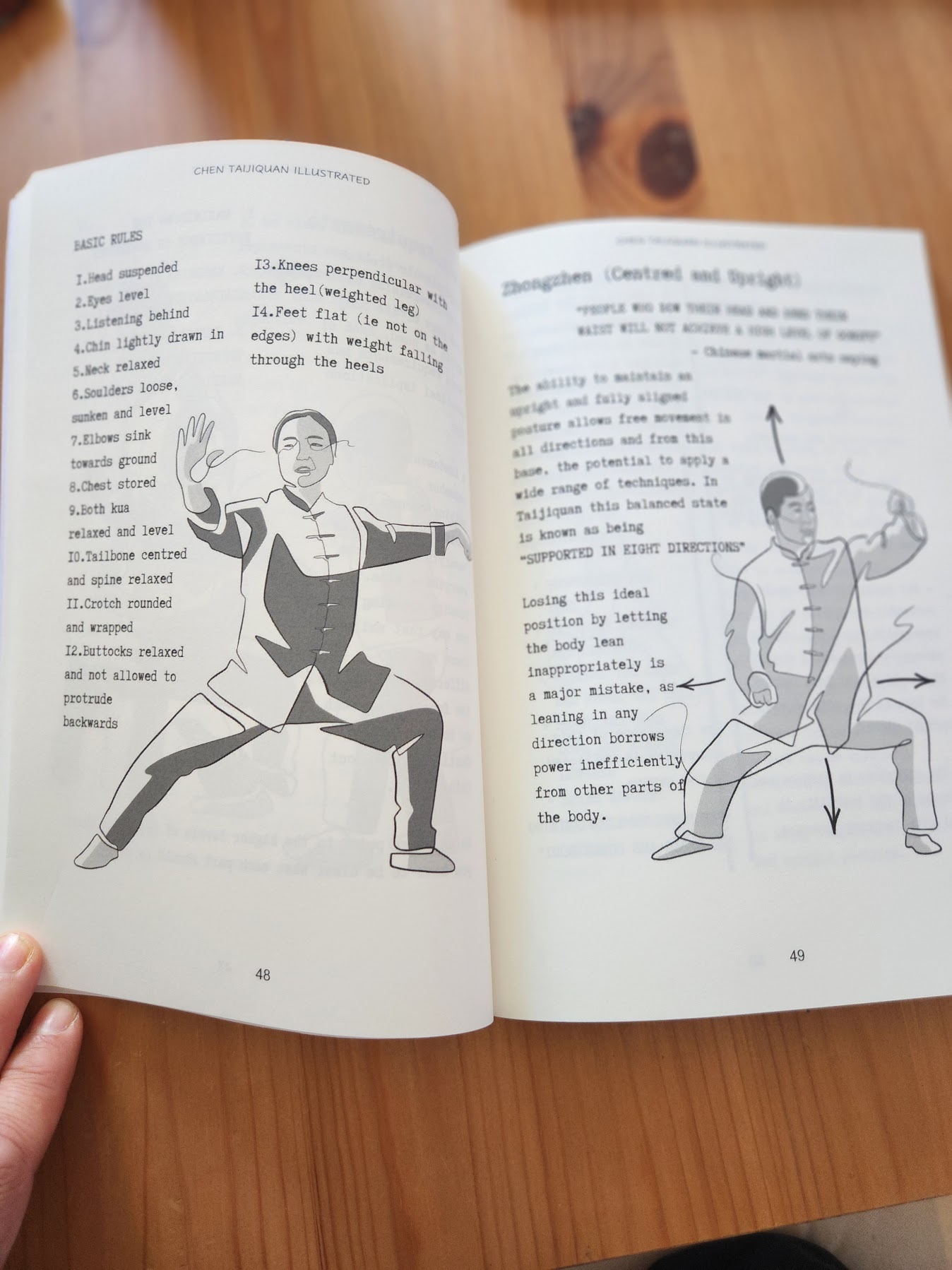
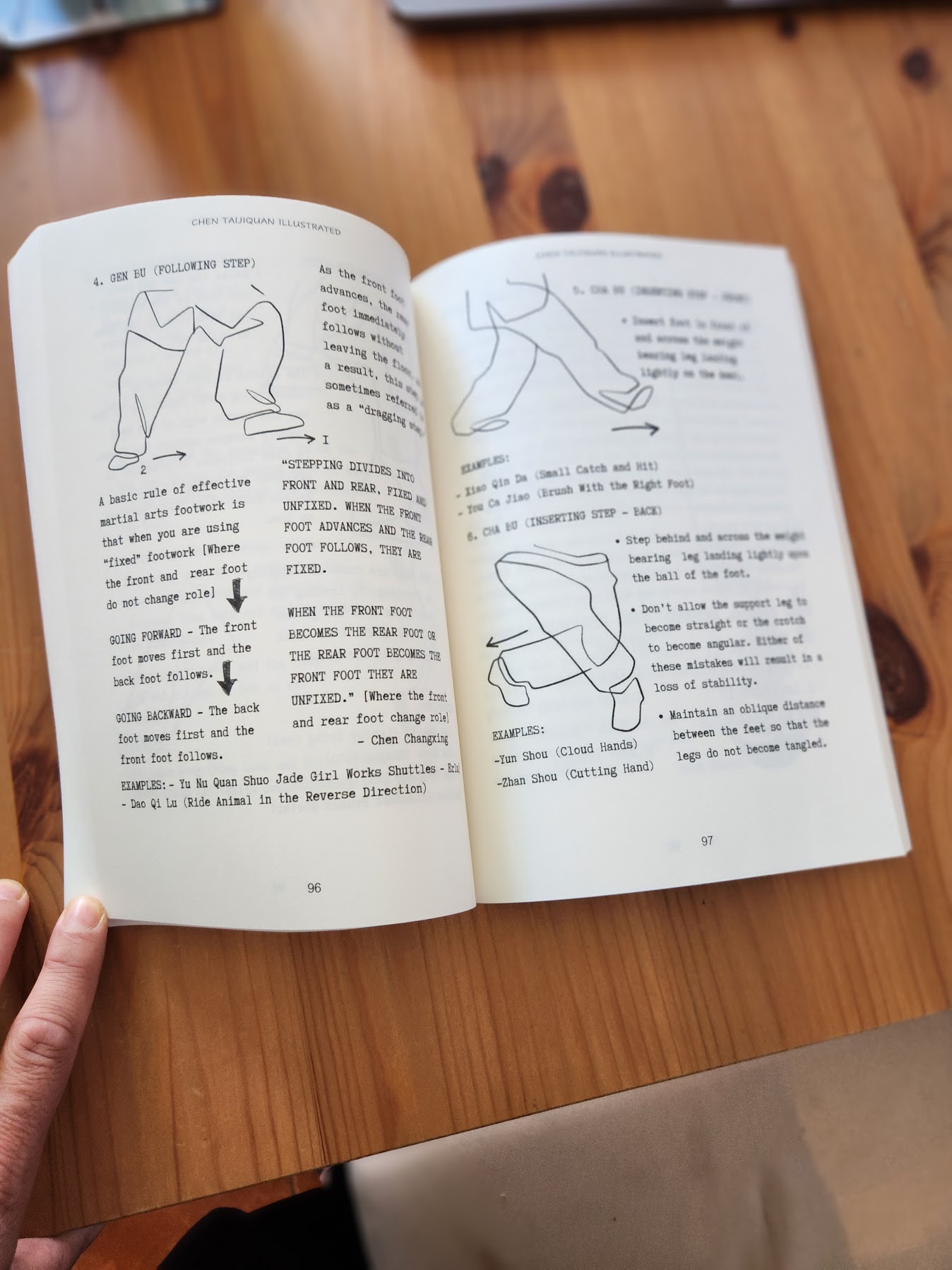
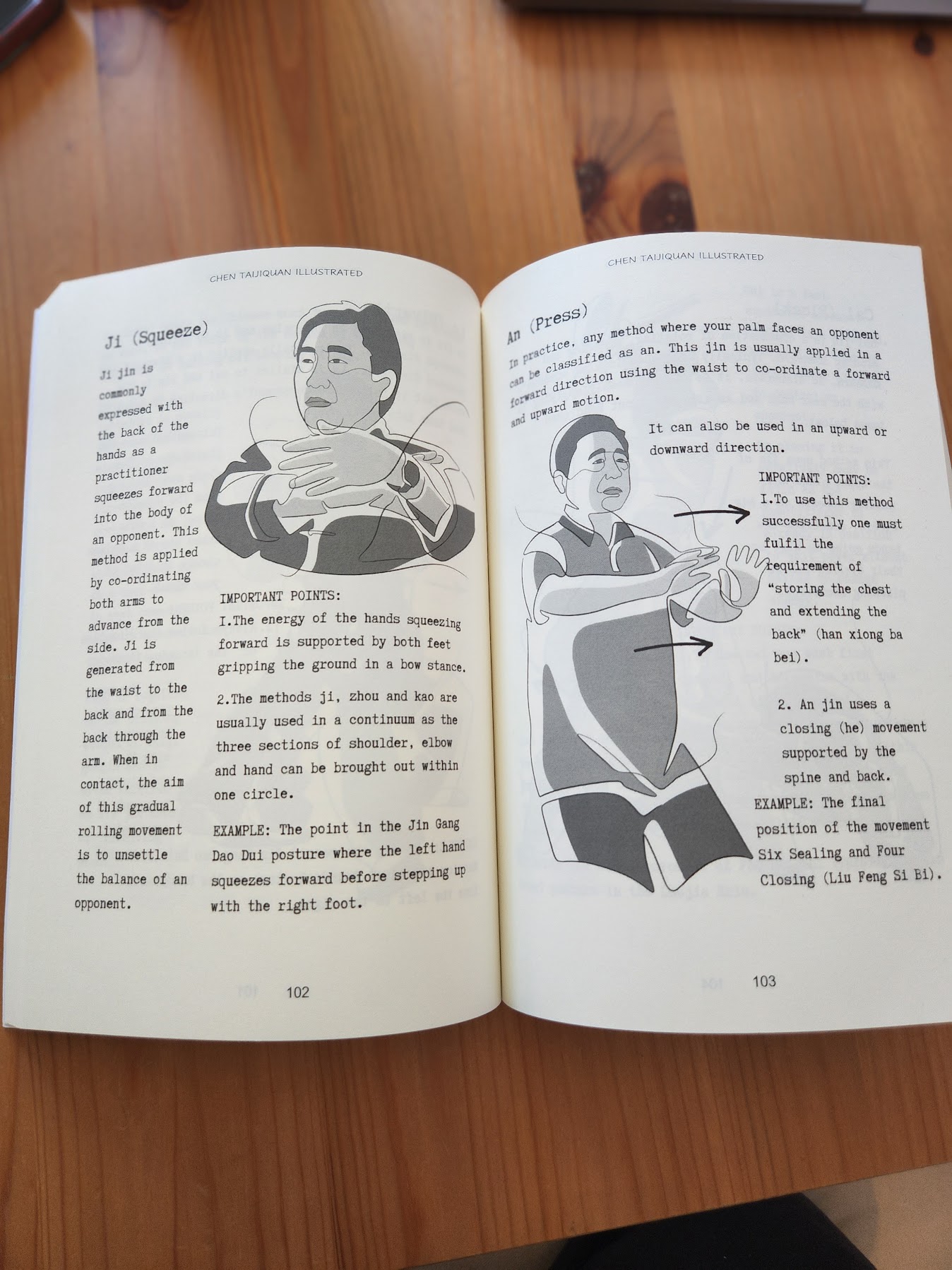
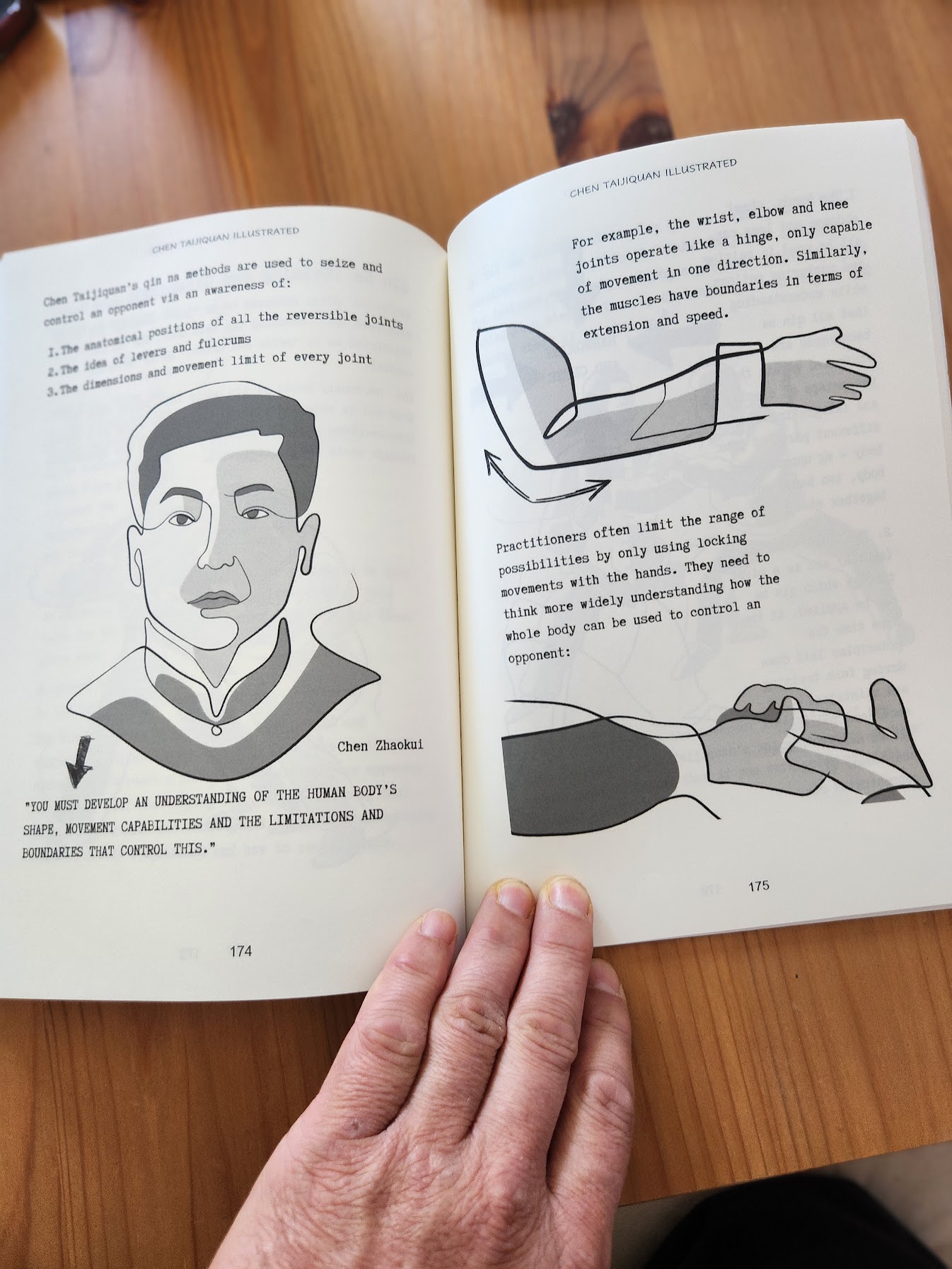
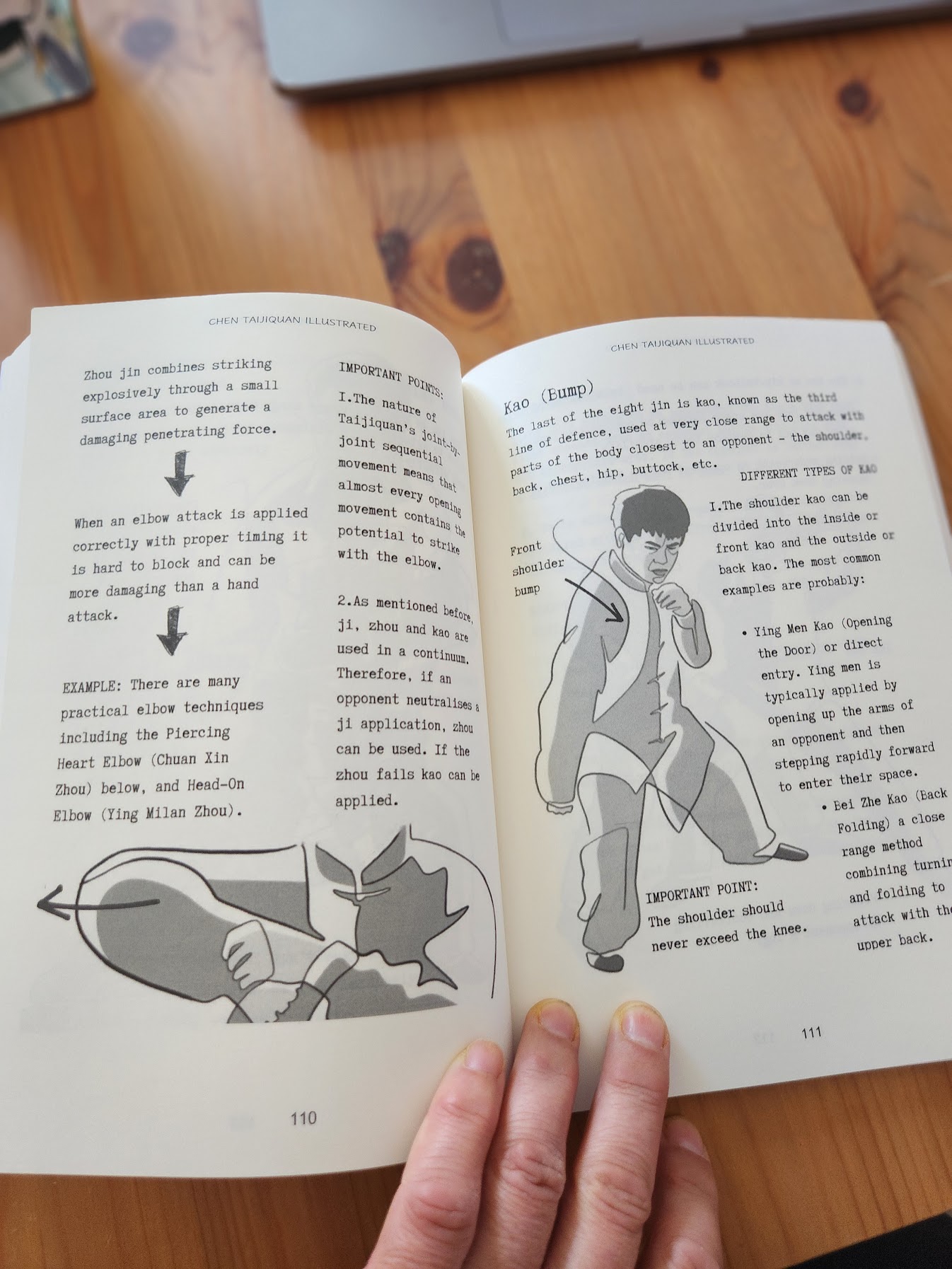
Chen Taijiquan Illustrated is an exploration of pretty much everything that makes up Chen Taijiquan, from principles, and body methods to practical usage and philosophy. But the most notable thing about this Taijiquan book, and the place where we should probably start, are the illustrations, because they are what really separates this book from others of its ilk.

Almost every page here (and there are over 200) has some sort of detailed drawing on it that adds context to the text surrounding it. In fact, the whole book takes the form of a visual notebook, as if you are discovering a secret copy of the best-looking training notes you’ve ever seen. Surrounding the drawings are quotes from the most iconic practitioners in the Chen lineage, past and present, as well as explanations of principles, concepts and requirements of Taijiquan. Take a look and you’ll get the idea:

As you can see, the drawings are mainly done in a stylised cartoon way, which is actually very effective, and it’s pretty clear that these are photographs that have been traced over digitally, to produce the illustration, rather than drawn from scratch. The overall effect is really nice, and refreshingly modern and accessible. 

Because a Taiji master’s posture takes years to develop and is a reflection of their skill, you can learn quite a lot from just looking at it. So, having a drawing based on a real photo gives you the best of both worlds – you get to see the genuine skill of the practitioner on show mixed with the accessibility and visual appeal of an illustration. 

In fact, in a lot of cases you can guess the famous master that the drawing is based on. For example, the book cover shows, I believe, a digital tracing of a photo of Chen Xiaoxing, brother of Chen Xiaowang.

It should be pointed out that not all the illustrations in the book are done to the same high standard, but there are only a few where the quality dips significantly.

Chen Taijiquan Illustrated is split into three sections – Section 1, Body Rules (Shape and energy), Section 2, Practical use/Application and Section 3, Philosophical Roots. Section 3 on philosophy is tiny compared to the massive section two, which consists of a catalogue of pretty much all the practical methods found in Taijiquan – peng, lu, ji, an, listening, sticking, neutralising, push hands, hand methods, leg methods, stepping, chin na, etc. Pretty much everything to do with the Chen style is here!

The initial section on body requirements is very good, and something you can keep coming back to and the book goes into much more detail than you’d expect to find in a basic beginner’s book, which makes me happy. The explanations of the concepts and techniques in the second section can sometimes err towards being more of a catalogue of techniques than an in-depth ‘how to’ of each one, but there is always going to be a limit on how much can be achieved in print, and the illustration of various masters doing the method being discussed speaks volumes in itself, and adds a lot of depth. It’s also nice to see the martial methods of Taijiquan being discussed in detail, something that is also rare to find in a Taijiquan book.

Let’s talk for a moment about what the book doesn‘t include. For a start, there is no attempt to teach a form in this book, which is probably a good thing, as Chen style in particular would be hard to teach in a printed book due to its intricate nature and complex, spiraling movements. Also, there is no history section – personally I’m glad about that, as it’s a massive subject and would require too much space to do it justice, and frankly, it’s been done to death elsewhere, and matters not a jot to your actual practice of the art. If you want to discover the key to “internal movement” then you’ll find good pointers here, but if you really want to delve deeply into subjects like peng, groundpath and internal body mechanics then I’d say you should check out Ken Gullette’s book on the subject. Finally, there’s no mention of weapons here, which are obviously a huge part of the Chen art. The emphasis here is on body methods and bare hand methods only.

Taijiquan is a practical, doing art, not the sort of practice that benefits from too much intellectualism, and the visual nature of the book is great at reminding you of that fact, grounding the concepts and principles in practical reality.

Overall, I think this has to be one of my favourite books on Taijiquan ever produced. This is really one of the most comprehensive collection of training notes you’ll ever come across. And because everything is fitted around pictures, there are no long, boring, passages of text, meaning you can dip in and out at any point. In fact, just picking it up, flicking to a random page and starting to read for a few minutes can easily give you inspiration for your practice that day.

Highly recommended, and while obviously best suited to Chen style practitioners (there’s a lot of discussion of silk reeling), I think a Taijiquan practitioner of any style would get a lot out of it. I certainly did.

The power of connection, with Henry Akins

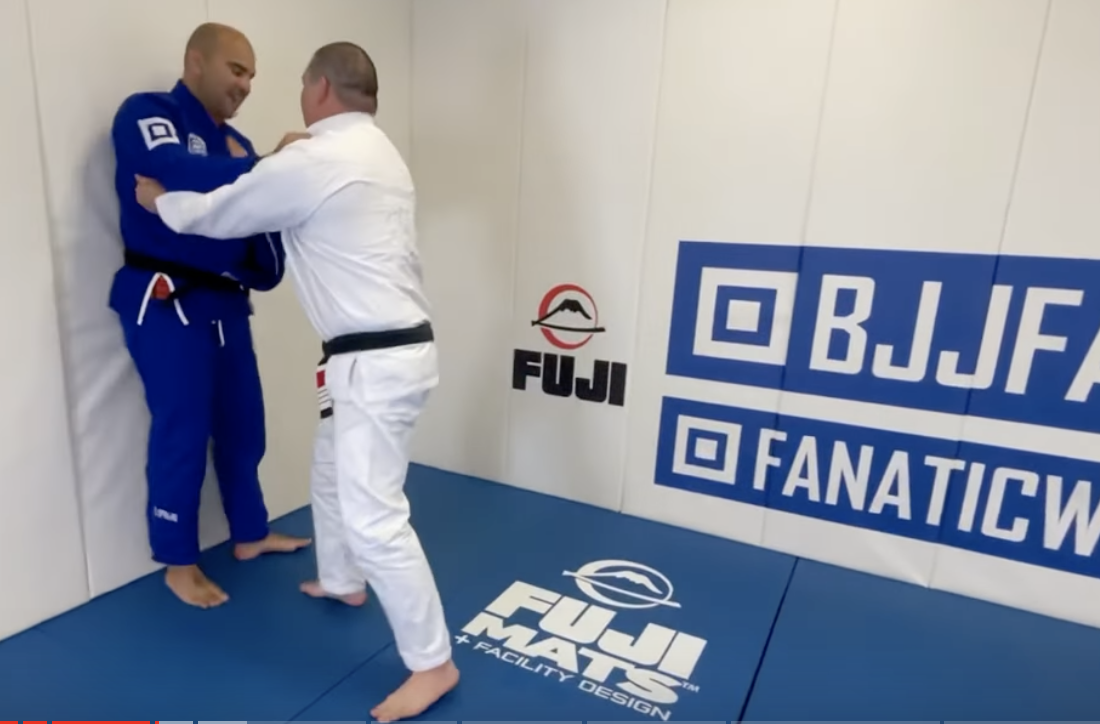
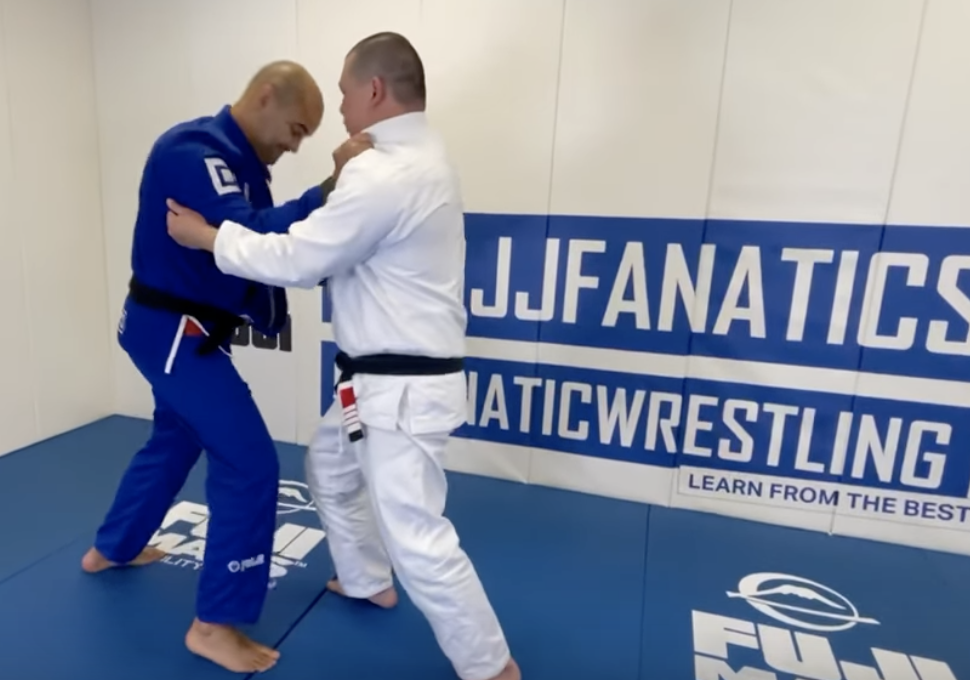
I like it when you can find those rare moments where martial arts seem to cross boundaries and blend into each other. I came across this video recently of Henry Akins explaining the concept of connection in BJJ, as taught to him by Rickson Gracie, and it doesn’t half remind me of Tai Chi…

There’s a lot of talking at the start, but he gets down to action at around the 4 minute mark and starts demonstrating rooting – something that you’ll find being practiced in most Tai Chi classes. These are what you’d see described as ‘simple jin skills’ or ‘jin tricks’ by a lot of Tai Chi experts. And they are what you are supposed to be doing in Tai Chi all the time, when you practice the form and when you do push hands. They’re the root (ha!) of classic phrases from the Tai Chi classics like, “4oz defeats a thousand pounds”.

In fact, a lot of people seem to think that these jin skills alone qualify something as being internal, which is why you see the descriptor, “internal”, being added to the name of a lot of martial arts, like ‘internal Wing Chun’ or ‘internal Karate’.

My take would be that, sure, these are an essential part of the internal package, but they’re not the whole enchilada. For instance, Henry is not doing anything particular with his dantien, and indeed, you don’t need to do anything in particular with your dantien to do these things. But these are still the first few steps to being an internal art.

As you know if you’ve read my blog for a while, I’m a BJJ practitioner myself, so it’s great to see somebody like Henry applying these principles to BJJ. I see it as a path to a version of the art that you can still do as you get older. I don’t think you’re going to be winning any competitions if you dedicate yourself to practicing these jin skills (the power and aggression of youth is pretty darn overwhelming to fight against in competition, particularly if it’s being done by dedicated athletes who train to a level the average guy with a job and two kids can only dream of). All I’m after is something that gives me the edge in friendly, hobbyist rolling and enables me to stay in the game and on the mat for as long as possible. “Do not go gentle into that good night”, as Dylan Thomas put it.


Push it, push it real good

In particular, Henry deals with one of the favourite subjects of Tai Chi – pushing. Henry pushes Bernardo, using power from his legs, not his arms – this is Tai Chi 101 – and then shows how to receive a push by aligning his body so that the push goes into the ground. He, (dare I say it?) tucks his butt, so that the force goes down his legs to the ground, rather than knocking him backwards. This is what you need to be working on in push hands when people push you. N.B. Tucking your butt does not mean adopting a forced and unnatural posture, it just means flattening the lower back and aligning the lower part of your spine with the upper, so that your bum doesn’t stick out.

What I like about this clip is that Henry, coming from a non-Chinese marital art, doesn’t use words like Jin and Qi – he just talks about alignment, relaxing and using the legs and ‘using the ground for support’. It seems much less mystical than the way it is typically presented in Tai Chi, and it goes to show that you can explain a lot of Tai Chi things without having to use words that are nebulous or hard to grasp for the Western mind.

But it’s really the concept of connection that Henry is teaching. As he says, a lot of the time in grappling what you want to do is connect to your opponent to use your techniques, and then learn how to disconnect from them when they try their techniques on you. He sees connection working in three main ways – and this is where I think Tai Chi teachers can benefit from his teaching –

  • Connecting within yourself,
  • Connecting to the opponent
  • Connecting to the ground.

That’s not a bad way to look at grappling at all, and I think it is a good way to help people understand that, when doing push hands, you can’t apply no force at all to the other person in a sort of noodle arms-display of rooting into the ground, because then you have no connection to them. If you move, they don’t move. Instead, you need to apply enough force at all times so that you are connected to their body and through listening (ting) you can feel when it’s time to break this connection too. Think of it a bit like an insect using the surface tension of the water to stay afloat.

Great work Henry, I would buy your instructional on Connection, if only it wasn’t almost $300. 🙂 But thanks for sharing that video above for free. I’ll have to wait for it to come into the ‘daily deal’ section of Fanatics, where they reduce the price. Osss!

If you haven’t already, check out my post on Jin Tricks and Mike Sigman explaining Jin. Both worth a watch.

If you haven’t checked us out on Facebook then please do, and why not give our Instagram page a look too, and our YouTube channel?

What came first in Tai Chi – the philosophy or the techniques?

It’s no secret that Tai Chi is a series of circles. The body opening and closing using circulation motions, like a yin/yang symbol in action. But when you look at a Tai Chi form, you’ve got to wonder, what came first, the techniques or the philosophy? Was Tai Chi created in a moment of philosophical purity and clarity, or was the philosophy simply bolted on to existing military or self-defence techniques (or popular movements from theatrical or religious rituals) that were already as old as the hills?

What I’m wondering is, was there at some point a founder of the art who decided, as a starting point, that he was going to purposely create a martial art based entirely on a philosophy based on the Tai Chi symbol, which would be both the overarching principle and the raw material, out of which martial applications would be fashioned?

Or did the idea of doing things in circles come later, and get added to existing martial techniques, and in so doing, alter them forever?

Well, let’s look at what we know as fact.

Fact 1: Tai Chi does indeed contain nothing but circular movements. I’m sure somebody somewhere can point out a movement in a form that looks linear, but it’s quite possible that the movement is actually being created in a circular way, or it has degraded over time into something else. All we can do here is talk in broad brush strokes. If you look at a Karate form, or a Tae Kwan Do form you see lots of examples of linear movements, that are usually lacking from Tai Chi forms. From this we can conclude that some sort of philosophical idea must have been involved in its creation.

Fact 2: The techniques in Tai Chi forms look a lot like other techniques in other Chinese martial arts forms, so are not in any way unique. If you look at a lot of forms from the Shaolin Temple, or village styles from all over China, you see postures and movements that are very similar to the techniques found in Tai Chi. In a way, there is nothing new under the sun.

When solving a murder, detectives look for two things first – opportunity and motive.

When Tai Chi first appeared in Beijing in the late 19th century it was promoted along with the idea that it had a founder, an immortal Taoist called Chan Sang Feng who had created the art based on his observation (or a dream) of a fight between a crane (or possibly stork) and a snake. And while certain groups (see my last interview with George Thompson) on Wudang mountain still take this story very seriously, and possibly literally, modern scholarship has tended towards the idea that it was a fighting art from the rural countryside (Chen village being the most popular choice for origin) that found its way to Beijing via a young Yang LuChan, who taught it to those at the highest level of influence inside the Forbidden City.

Of course, the shadowy figure of Yang LuChan is never adequately explained, and since he was an uneducated nobody – a rural rube – nobody really made a record of his existence. The story everybody, including all the heads of the various Tai Chi families, follows, (because it’s the story the Chinese government approves of), is that he learned the art in Chen village. But I always wonder about that time in the 1860s when Yang and the very well educated and important Wu brothers were in Beijing, as being a time when Tai Chi could have been invented. The Wu brothers would have known the philosophy on which to hang it, and Yang would have had the martial skills to make it work and turn it into something that could bring the fractured court of the late Ching Dynasty together, bonding over something that was essentially Chinese in the face of constant threat from foreign powers. Yang and the Wu brothers together had both opportunity and motive, and regardless of whether you accept that interpretation of history or not, Tai Chi has been used as a political football ever since, especially by the current government to whom Tai Chi (the world’s most practiced marital art!) represents the ultimate form of soft power, spreading Chinese culture and influence the world over.