The professor

I can’t let the new documentary on Professor Cheng Man Ching, one of the early pioneers of Tai Chi in the West, slip out without giving it a mention on this blog.

chengmanching_sword

Much has already been said about it, so there’s not too much more to add, except that I haven’t seen it yet, and I might blog again after watching it, because it will probably stimulate some thoughts.

Cheng Man Ching is one of those contentious figures who splits opinion. By being one of the very few people in the US publicly teaching Tai Chi in the 1960s, and thanks to the gushing endorsement in books by his student Robert Smith, and his ability to push big, heavy Westoners around with comparative ease, Cheng very quickly achieved a big reputation.


Cheng modified the Yang Tai Chi form he learned from Yang Cheng-Fu, creating one of the first short forms of Tai Chi. His Tai Chi also had a distinctive look compared to his teachers – in (I believe) an effort to stick as closely as possible to the writings of the Tai Chi classics, he changed some of the postures slightly, adopting a more upright body, and a softer hand and arm position. Some would say his Tai Chi was too soft, and his influence is responsible for the typical ‘soft like a noodle’ style of doing Tai Chi often found in the West. But if you watch  him do his form, you can see that he looks solid as hell. He exudes the ‘peng’ quality of energy rising upwards and outwards, and being rooted in the legs.

Undoubtedly he was an example of what happens when a small fish in a big pond suddenly becomes the only fish in a very small pond, but he was also a skilled practitioner of Tai Chi. Of that there can be no doubt. Was he also a world class martial artists? No, probably not. Did his students put him on an unrealistic pedestal? Yes, undoubtedly they did. But that’s what happens with human beings. We’re like that with people we admire.

You can watch the trailer here:

Wave hands like clouds

A look at the Cloud Hands movement of Tai Chi, and what it’s really all about

11_cloudhands

Cloud hands, or ‘wave hands like clouds’ as it’s also known, is one of those classic Tai Chi movements that characterise the art. It’s done in slightly different ways in different Tai Chi styles. Take a look at the variations:

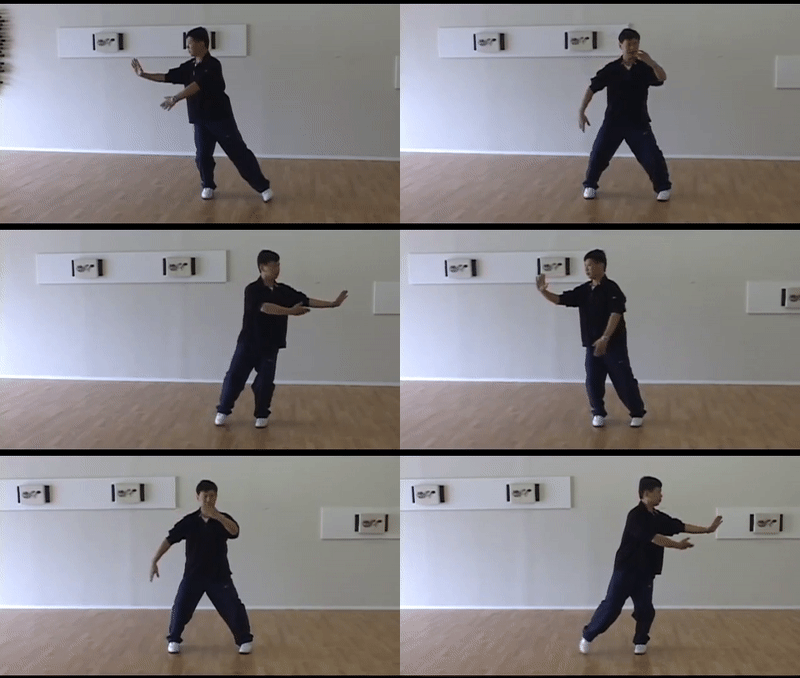
Master Yang Jun, (Yang Cheng Fu, Yang style):

rohras


Master Chen Zhen Lei, (Chen style):

i-wa5

Master Sun Ping, (Sun style):

fwxvnx

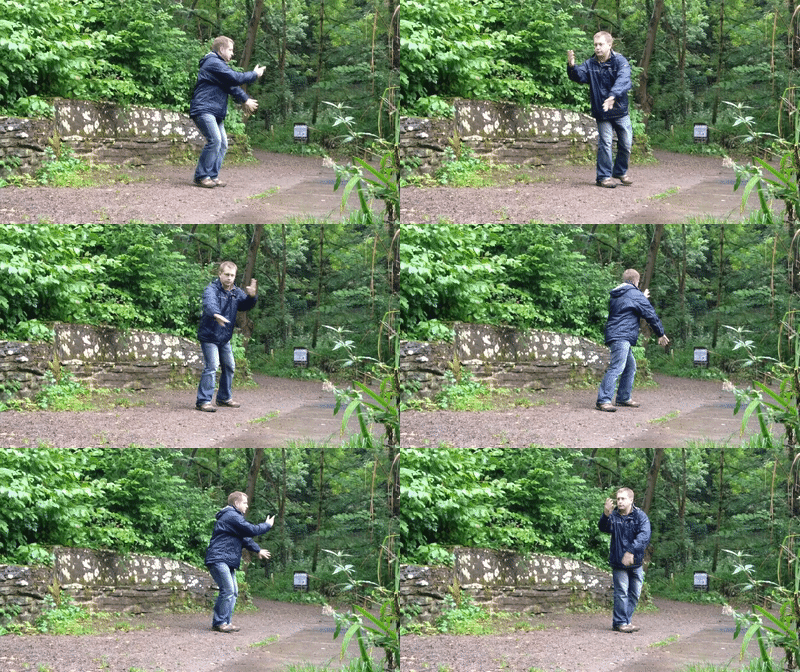
I’m not comparing myself to the masters above, but here’s a GIF of me doing it, since I have that on video I might was well add it to this post:

Me: (Old yang, also called Gu style)
cj6ysk

As you can see, the Yang style is more of a vertical arm block, the Chen style is more of a horizontal elbow strike while the Sun style has the palms facing outwards. It’s a case of different horses for different courses, but  while there are subtle differences between them, they all involve the common theme of stepping to the side while rotating the arms in circular motions (presumably like clouds on a windy day).

Martially speaking, I think of this movement as intercepting an opponent’s strike and throwing the attacker out, or applying a lock to their arm through the action of turning your waist. To the attacker it should feel like they’re putting their hand into a blender – it gets caught up and crushed and it shouldn’t feel easy to retract your arm once it’s trapped.

It’s easy for beginners to make the arms ‘flat’ in this posture – instead they need to be continually projecting outwards. I think of them as being like the antlers of a stag, or the branches of a tree – they grow outwards, and are slightly curved. If you’re going to intercept your opponents strike with this technique, then it’s going to help ‘catch’ their attack if the intent in your arms (your antlers) is to project outwards.

The real lesson of Cloud hands though is to turn the waist. It’s a common mistake to not turn the waist enough in Tai Chi, and I find that, for the beginning student, a breakthrough in this area often only comes about through a study of Cloud Hands as an isolated technique, repeated over and over. Notice that if you removed the stepping from Cloud Hands then it wouldn’t be a million miles away from the stationary silk-reeling exercises that go along with Tai Chi, with one hand performing a clockwise circle and the other an anticlockwise circle. Indeed, performing Cloud Hands repeatedly can serve a similar function to basic Silk Reeling exercises.

As it says in the Tai Chi classics, the body should be directed by the waist at all times, so as you turn from side to side in Cloud Hands (let’s not worry about the stepping for now) your arms should only be moving because your waist is moving. If your waist stops, then your arms should stop too. This especially applies at the crossover points, when you’ve turned all the way to the side and the arms swap position, so that the lower one becomes the upper one, and vice versa. This is the point that beginners usually drop the principle and use some isolated arm movement, instead of keeping it all coming from the waist. It’s usually a revelation to the student here that you need to turn the waist a little more than you think you do to keep it as the commander of the movement – you should feel this using muscles in your lower back you normally don’t reach.

Remember, in Tai Chi you’re looking to continually maintain a connection (a slight pull) from the toes to the fingers, with movement directed by the dantien like the spider at the centre of a web. If you keep this connection (or slight tension) and the waist control at these crucial crossover points in Cloud Hands then you’ll be well on your way to keeping it throughout your whole form performance.

Don’t push the river, listen to it instead

394357757_640

Bruce Lee was onto something with his water analogies…

I recently read the phrase, “Don’t push the river, listen to it instead”, and it resonated deeply with me because it’s a great way of summing up my approach to jiujitsu’s rolling and tai chi’s push hands. The water analogy was famously used by Bruce Lee and also crops up a lot in the Tai Chi classics, for example “Chang Ch’uan [Long Boxing] is like a great river rolling on unceasingly.”

The flow of water is analogous to the flow of energy, or movement, when performing a Tai Chi form, or between two people engaged in a martial activity . In both jiujitsu and tai chi your ultimate goal is to ‘go with’ this flow in such a way that you come out on top. You want the opponent to be undone by their own actions.

In jiujitsu that might mean not using excessive strength to press home a collar choke from mount if your partner is defending it well, and switching to an armbar instead, then switching back to the collar choke (and hopefully getting it) when they defend the armbar.

In push hands it could mean not resisting your partner’s push and using Lu to let it pass you by, then switching to an armbar to capitalise on their over extension.

Of course, this is for when you’re engaged in the ‘play’ mode of both these arts, which is the mental space you need to occupy if you want to get better at either of them. This is the relaxed practice that nourishes the soul. It kind of goes without saying that in competition or in a self defence situation you’d be better off in Smash Mode. But when winning isn’t the only thing that’s important you need to open up your game a little and keep it playful. Or ‘listen to the river’ as the phrase has it. It takes a lot of expertise to be able to be that relaxed in a real situation, but as your experience in the art increase so too should your ability to remain relaxed under increasing amounts of pressure.

Rickson Gracie said, ‘you can’t control the ocean but you can learn to surf’ and that’s the heart of what I’m talking about.

To be aware of the way the river is flowing, and not waste futile energy pushing it in a direction it doesn’t want to go you need a degree of self awareness, and the ability to be aware of the situation you are in. And to get that you need to slow down and stay calm. Or, as the ancient Taoists said:

“Do you have the patience to wait

Till your mind settles and the water is clear?

Can you remain unmoving

Till the right action arises by itself?”
Lau Tzu, Tao-te-Ching

Power your Tai Chi from the inside

How to put the juice into Rollback and Press 

comet-now-343175

Tai Chi contains advancing and retreating movements, combined with circling left and circling right. Of course, in Tai Chi all movements need to be powered by the dantien. That’s easy to say, but on a practical level, how does this work?

One way I like to think about this is that as you retreat you can think about the arm movements being pulled by the dantien and as you advance they are pushed by the dantien. You can think of ‘rollback’ and ‘press’ from the Yang Tai Chi form as being a good example of this. As you shift the weight backwards in rollback you can imagine ropes attached from your dantien to your hands that are gently pulling them as the dantien moves. Rollback is usually performed with a turn of the waist to the side as you do it, so rather than being pulled completely in towards you, the pulling makes the hands go past you and ready to circle into the next movement… which is ‘press’. At this point you can imagine the ropes snap hard and become ‘rods’, which push the hands away, so the ‘press’ is powered by a pushing from the dantien into the hands. It looks like this:


lnbetw

In all of this your shoulder joint is moving, and power is going through it, but the key thing is that it is not the source of the power. The power source is the triangle formed by the two feet, legs, kua and dantien. The power goes through the shoulder to get to the hands, and if you tense the shoulders then you stop the flow.

Of course, these ropes and rods I’m talking about don’t actually exist, but they do give you the idea of a kind of pressure that is either pulling or pushing your arms and hands, which I think is useful. Once you use reverse breathing to pressurise your body you can start to feel this push and pull in the arms and hands. This isn’t imaginary, it’s a genuine feeling.

If you stand in a relaxed stance you can feel the pressurisation that reverse breathing gives you. Pick the classic ‘hold the ball’ Zhuan Zhang position, then stand for a few minutes while doing reverse breathing*.

You need to feel a connection all the way to the fingers and toes that’s connected to the breathing. It should feel like a slight pressure. Then try to get the feeling of pulling that connection in towards the dantien on an in breath and pushing out towards the fingers on an out breath.

The usual disclaimers apply to any type of work with pressure in the body – don’t do anything crazy with the pressure – you don’t want to tear anything in the body, and don’t direct it into your head. That way lies madness, or at least a pretty decent headache 🙂

(* All breathing in Tai Chi is done lower in the body than normal, so that the diaphragm extends downwards when you breath in, as opposed to the chest expanding. In ‘normal’ Tai Chi breathing the abdomen expands as you breathe in, in reverse breathing you change this around so that you contract your abdomen as you breathe in – this creates a kind of pressure in the body, that you can then use to power movement.)

Once you have a handle on the feeling of being pushed and pulled you might like to experiment with a basic arm wave silk reeling exercise – as the arm moves away from you it’s the ‘push’ from the dantien, and as the arm circles back towards you, you are looking for a basic ‘pull’ from the dantien. You need to maintain the pressurised connection at all times.

Here’s Chen Xiao Wang showing some silk reeling exercises – he starts with the basic single arm wave. Unlike me, he’s an actual expert, so pay close attention.


Of course, there’s more going on than this in Tai Chi, but as a basic fundamental it’s a good place to get started. Going back to the example of rollback and press – it’s a good section of the form to work with as both hands move in the same direction. Other Tai Chi movements, like Repulse Monkey for example, are more complex, with one hand going towards you, – a ‘pull’ – and the other going away from you – a ‘push’. Of course, it’s easy to mimic the movement on a surface level, but you need to be doing it from the inside. For now I’ll leave it up to you to think about how Repulse Monkey might work when it’s powered from the dantien.

irp0nt

Obama Tai Chi

The POTUS and FLOTUS know their Single Whip…

3333

The Obamas have a bit of history with Tai Chi. Here’s Michelle Obama giving Tai Chi a try at a high school Tai Chi class as she visited in the Chinese city of Chengdu back in March 2014:


“It is a really stunning type of exercise, and I loved giving it a try,” the first lady wrote in a travel journal posted on the White House website. Press report here.
Well, it seems a bit of this might have rubbed off on her husband, judging from today’s picture of his awkward, misjudged handshake with Cuban President Raul Castro. Just as Obama reached in to shake his hand, Raul lifted Obama’s arm upwards, resulting in what can only be described as a picture-perfect Cheng-Man Ching-style Single Whip. Here’s the video:


My critical analysis would be that there’s a bit of residual tension in his left shoulder, but he deals with his attacker well. 🙂

What is Qi?

When we talk about Qi (Chi) in martial arts, what do we mean?

Chinese as a language can have meanings on different levels. The basic definition of Chi is ‘air’, but in terms of martial arts we’re talking about vital energy that’s intrinsic to the breath. If you put the word “Qi” into a Chinese/English translation you get all sorts of definitions, for different Chinese characters. So, to clarify the character we’re talking about is (in traditional Chinese)

chi

It’s a bit like a picture of a pot of rice over a fire with steam rising upwards. In simplified Chinese it looks like:

qi_air-chinese-character

Unfortunately, “vital energy that’s intrinsic to the breath” still doesn’t help much in terms of understanding what is meant by Qi when we talk about it in martial arts. The most practical way to understand what Qi is, is to take a look at Jin. You can think of Jin is the physical manifestation of Qi. When you manipulate your qi using your mind to do something, you manifest a direction of force in the body – and when the force can be expressed in a direction, without impeding it by tensing your muscles, so that it runs all the way from the feet to the hands, then that is Jin. So, if somebody pushes on your hand, you should be able to create a line of force from your foot to your hand (using your mind) that maintains your position, so that they are effectively pushing into the ground, not your hand. If you push on somebody’s outstretched arm and they feel really strong, like a rock, yet they’re not tensing their muscles then you could say they have “strong qi”.

In the following video Mike Sigman takes you though what Jin is, which should hopefully increase your understanding of what Qi is.

You can see that he’s talking about setting up pathways in the body – if you refer back to my previous post about basic silk reeling movement you can see how the two tie-in together.


The basics of Tai Chi movement

How to move in the Tai Chi way

We’re in a strange situation where the vast majority of people who “do Tai Chi” are performing some kind of elegant, slow-motion movement ritual, but without the required ‘internal’ body movement. There’s not necessarily anything wrong with this, as most of the benefits Tai Chi can give you – like relaxation, better breathing, suppleness, improved general health and flexibility – don’t really require ‘proper Tai Chi movement’. If you’re up and you’re moving then you’re doing your body more good than everybody left on the sofa. This is particularly important for the elderly.

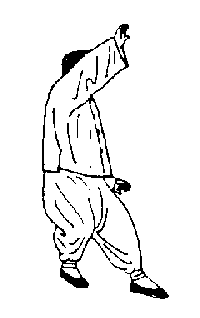
But what do I mean by ‘required internal body movement’? Well, I’m talking about how your body forms the posture of Tai Chi – the movement you use to get into the various postures and flow between them. By default everybody uses a kind of normal human movement – the sort you use when you reach for something in the cupboard, or when you are tidying up a room. You don’t think about it, you just do it. And it’s the same with performing a Tai Chi form. If you’re going to do White Crane Spreads Wings then one hand has to circle up, ending above your head, and the other hand has to circle down, ending near your hip. Like this:

cranetrane

The question is, how did the hands get there?

With ‘normal movement’ we just do it – our brain tells the muscles what to do and they do their thing, in the order and manner they’ve been working in since we were babies.

In Tai Chi we need to repattern the way our body moves to adopt the ‘internal’ model of movement. This involves creating a sense of connection from the toes to the fingers (like you’re wearing a suit), along which you can feel a slight stretch, and then keeping this stretch as you move, while powering and controlling the movement from the dantien and legs, not from the shoulders. In fact, the shoulders shouldn’t be actively doing much at all – they should act as conduits for power, not generators. There are other additives that are used to generate movement, but those are the basics.

It’s a lot easier to practice this sort of movement in a simple controlled way than it is to jump in at the deep end with a Tai Chi form and all the variation it offers. To help you do this, people have created are what have become known as “Silk reeling exercises”.

There are a ton of these on the Internet to watch and follow along with, but like most things of that nature, it’s not the exercise that’s the important thing, it’s how you do the exercise. Luckily, Mike Sigman has recently produced a couple of new videos that not only show the exercise, but also show how you are supposed to do them.

Take a watch, try them out, then see if you can repattern the way you are moving in your Tai Chi form.

Unfortunately, it’s hard to talk about Silk Reeling without getting into some of the style wars within Tai Chi. Silk Reeling is often though of as the preserve of Chen style Tai Chi, and that in other styles of Tai Chi they do something else. You can do you own research on the matter, but the conclusion I’ve come to is that all the various ‘tricks’ that you learn in Tai Chi (like bows, or rotation or sinking and rooting) are all different facets of silk reeling, and you can therefore save yourself a lot of time by just adopting the model wholeheartedly.

Here’s a link to an article on the Yang Family website extolling the virtues of silk reeling and why it’s so useful. I’ll leave you to draw your own conclusions about why it’s up there.

As it says in the article:

“We need to understand the requirement to ‘link everything together’. Not only does moving energy require going through all the joints, it also needs to be sent through the muscles and sinews above and below the joints. This is the function of spiralling silk reeling.”

So, to return to the aforementioned Crane Spreading its Wings – this is how you get your hands to circle up and circle down. Now you just need to go and practice it.

Chen and Yang style Tai Chi, compared, side by side

Yang and Chen style compared on video

This great video is worth coming back to again and again. Obviously, there has been some manipulation – the sequence of each player is paused or slowed down at key moments so that they stay in sync, but it shows how Chen style and Yang style, which initially look quite different, are in fact, variations of the same form.