Don’t put power into the form, let it naturally arise from the form

singlewhip

“Don’t put power into the form let it naturally arise from the form.”

A guy on a discussion forum called Wayne Hansen uses that quote in his signature. I don’t know if this is a famous quote from an old master, or if it’s just something that Wayne thought of himself, but it’s such a great quote, because it’s absolutely true!

I was reviewing somebody’s form recently and the big thing I noticed was that they were trying to put power into the movements, rather than just accepting that the movements on their own are powerful, and don’t need anything extra to make them work. In fact, when you try and make Tai Chi movements powerful, it just messes them up, because you inevitably revert to tense, upper body muscle use, instead of a smooth flow of connected power, talked about in the Tai Chi classics.

(I think I should mention here that I’m not talking about the explosive bursts of power you typically see in Chen style forms. These are different. Instead, I’m talking about the general movements found in Tai Chi, typified by Yang style and it’s variations, which opt for a smooth form with an even pace throughout).

What that quote doesn’t do however is explain how Tai Chi is done, which is pretty standard in Chinese martial arts. Tai Chi is full of these mysterious sayings, which have very little explanation, and are only useful for people who already understand what they mean. So let’s break this one down and see where we get, starting with:

1. Fang song

In Tai Chi we are frequently admonished to fang song or “relax” as we would say in English. We all instinctively know that a relaxed body can be a powerful body.  Think of how heavy a small child can make themselves if they don’t want to be picked up by going all floppy. Similarly, a baby’s grip is surprisingly powerful, but not tense.

Being too tense results in a kind of rigid and brittle strength. It’s strong, but it sacrifices flexibility. This sort of force tends to lie on the surface, like ice on a lake, but break through the surface and it’s nothing but water underneath. In contrast, relaxation can be more like thick sea ice – strong and solid all the way down.

But to be both powerful and relaxed a body also needs to be:

2. Coordinated

On a purely mechanical level that means moving so that the coordinated power of the body arrives together at the same place at the same time. If you can coordinate your body so the legs, hips, torso, and arm are all arriving together in a unified purpose then you can use relaxation to create a kind whole body power that doesn’t rely much on tension at all. But that’s still not the whole story. You also need:

3. Sinking

The next stage is to get used to sinking into the movements. This sinking, which can be described as dropping the weight of the body down into the ground through relaxing, enables power from the ground to rebound up into the hands. It generally moves in an upward and outwards manner, which is the Peng Jin that Tai Chi is famous for. All the movements of Tai Chi need to contain this Peng Jin.

I often read people who criticise sinking as merely “pushing from the legs”. They say that this will just be too slow. To that I’d say, go and ask a boxer if his punches are too slow, because that’s what a boxer does. But more importantly, that’s not what I’m talking about.

It’s true, the legs are very much involved in generating power from the ground, but when you can effectively drop your weight down it’s not a physical movement of pushing from the legs that matters. It’s the internal movement of power that is important, the jin. And the power of the ground arrives in your hands instantaneously, so there’s no delay. It’s not going to be too slow to use.

Once you get used to doing this sinking you can feel it in your form. It requires practice, probably daily practice to get it. But that’s why you do the form every day, right? Every day you are practicing movements where you drop the weight and put the power of the ground in your hands.

Remember, the movements themselves are powerful – you don’t need to add power in. Instead you need to learn to relax, coordinate and sink your ‘energy’.

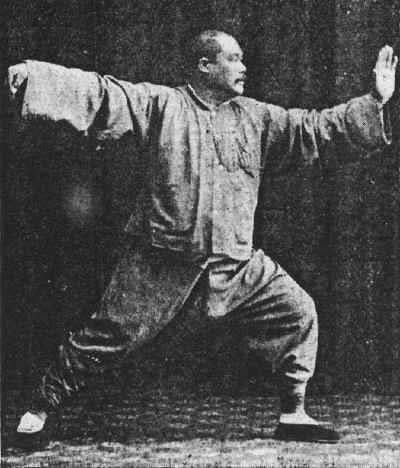
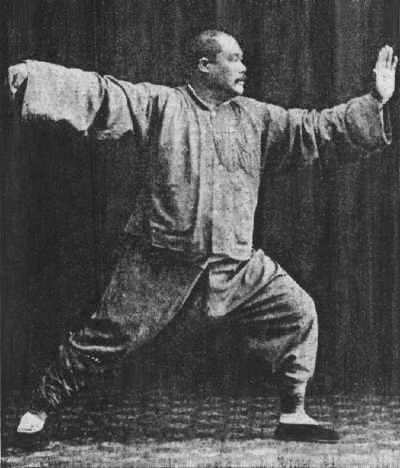
Just look at that picture of the famous Yang style Tai Chi teacher, Yang Cheng Fu. You can see how relaxed he looks and how his weight is sinking down.

He’s got it.

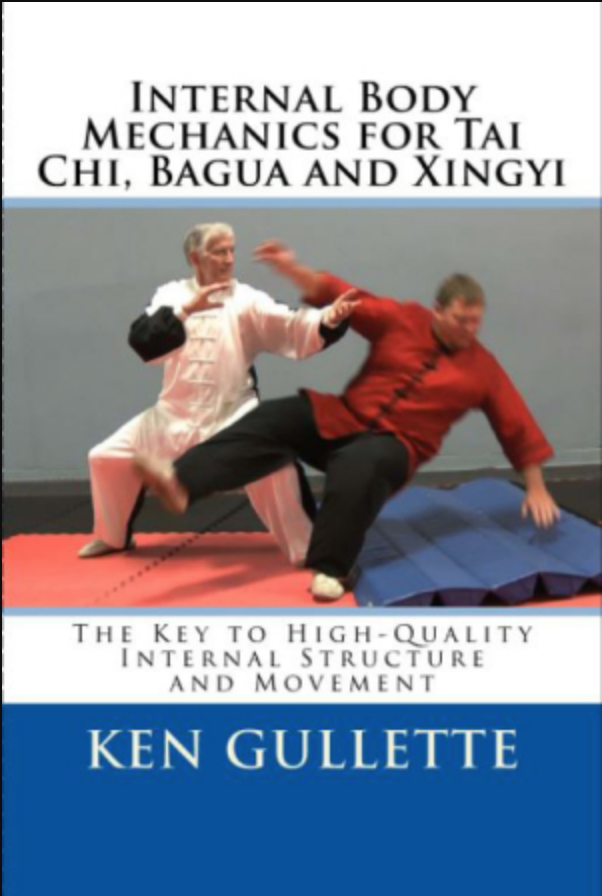
Book review: Internal Body Mechanics for Tai Chi, Bagua and Xingyi, by Ken Gullette

Screen Shot 2018-08-08 at 12.02.27 PM

Anybody who has attempted to learn Tai Chi in any depth instantly realises that the choreography of a form is just that – choreography – and that the devil is in the details. Internal Body Mechanics is all about the details: How you move, what you move and where you move it to.

It’s author, Ken Gullette is a veteran of the Internal arts, having started with Yang style Tai Chi way before China opened up to the West and before the Internet appeared. Over the years he’s trained with some of the best, especially in Chen style. He’s interested in the practical use of the internal arts as actual martial arts, rather than a method of communing with the universe, feeling your Qi or healing your body. While he’s been presenting this information in DVD and video format for years via his website kungfu4u.com, this book is his first attempt to capture the “body mechanics” of the internal arts in print.

Like most Western Tai Chi enthusiasts who started when Tai Chi was just breaking into the West, Ken inevitably ended up going down many dead ends before he could find good quality instruction, which is why he’s written this book. Ken’s ambition is to write a Tai Chi book that is all killer, no filler, which immediately sets him apart from 99% of Tai Chi teachers out there, whose books usually give you a lot of boring history and then try to teach you a form, which is impossible to learn from a book in the first place.

Instead, Ken is going straight to the meat of the matter, for which he deserves recognition and praise. Internal Body Mechanics covers 6 core principles of the internal arts:

  1. Centred stance and Ground path
  2. Maintaining Peng Jin
  3. Use whole body movement
  4. Use spiraling movement of silk reeling energy
  5. Internal movement and the Kua
  6. Dantien rotation

The book is structured so that one chapter leads naturally into the next, so once you’ve grasped one principle you are ready for the next one. The chapter on the Kua, how to open and close the kua, and what it is, is especially good. This is a tricky subject to convey in text and Ken does it through telling stories of training with Chen Xiaowang and quoting what he said to him during form corrections. I felt like I “got it” immediately. So much so, in fact, that when Ken used the posture “Sweep the rider from the horse” to demonstrate how Chen Xiaowang was saying people close the Kua “too much”, I immediately put the book down, tried out the posture and realised I was making the same mistake. There you go Ken – you got me! It’s not often you can instantly improve your Tai Chi and correct your form from reading a book, but Internal Body Mechanics proves it is possible.

The book also comes with a website containing videos of all the techniques and demonstrations that are pictured. Obviously a video is superior, but I found the pictures sufficient to get the points being made… except for the large silk reeling chapter of the book – that is where you’d really need to access the videos to ‘get it’ – especially if you’ve never done silk reeling exercise before. But the videos are not free – you have to pay an additional one-off fee to access them.

Qi and Jin

When you get down to the heart of the matter with Internal arts, I find that you are dealing mainly with two things: Qi and Jin. Because these are initially obscure Chinese terms, that don’t translate easily into English and require thought, experimentation and good teaching to master, they become the initial stumbling blocks for all Tai Chi practitioners. Ken spends a lot of the book dealing with the subject of Jin – with chapters on the ground path and Peng Jin specifically. He covers it really well. There are lots of partner exercises to try out that are illustrated with photos from his DVDs. Jin often accounts for the overly-theatrical demonstrations that Tai Chi ‘masters’ like to do on their overly compliant students at seminars, where they send them bouncing away at the slightest touch. Once you understand how Jin works you can see what is really going on, and it stops being so mysterious. Ken’s book will give you that kind of understanding.

It’s on the subject of chi/qi that I find I depart a little from Ken’s thinking. Ken has little time for mystical thinking on qi. By the time Ken gets to his Dantien rotation chapter he is slaying sacred Tai Chi cows like he works in an abattoir and the concept of qi takes a bolt through the head early on.

“As a 21st-century college educated American who applies critical thinking skills and expects evidence before I cling to a belief, there is no evidence whatsoever that our bodies contain Chi or a Dantien…”  – Ken Gullette

I’d agree with him on the critical thinking, but there’s always the danger of throwing the baby out with the bathwater when this staunchly non-mystical approach is adopted. Especially when it comes to qi.

Is qi a mystic substance in our bodies, as some would like us to believe, or is it just a term that the ancient Chinese used to describe parts of the body that is still functionally useful when learning how to move in non-standard ways?

Ken sees the use of Qi and Dantien as merely useful mental visualization tools, so that’s the approach adopted in the book. He also dismisses the idea that you must control your fascia to control your dantien as “poppycock”. This pleases me, and I raised a wry smile as I’ve got into similar arguments with fascia fanatics on the Internet, who attribute almost magical powers to it. He’s right, of course – you cannot consciously control the movement of your fascia or skin, only muscles (let’s not get into the sticky issue of consciously making the hair on your arms stand on end or subconscious control of body functions). However, you can use your muscles to stretch both skin and fascia (and tendons and everything else)  to create a feeling of connection, and that feeling of connection can be slowly built up into something tangible that you can use to manipulate the body from the dantien area. To me, this is the real meaning of Qi, and means it still deserves its place in the creation of whole body movement.

So, while Ken’s Dantien rotation chapter is purely about manipulating the musculature in the area of the lower abdomen, which of course, it is, I’d also add in that you can also use it to connect to the arms and legs via this “qi” connection, which you can build up over time. I went over this idea in my video series, but anyway, I digress.

Conclusion

Ken’s approach is not that of an almighty Tai Chi teacher who is imparting precious wisdom to you, his lowly disciple, from on high, but rather, a healthy attitude of “we can all learn together” flows through the pages. You never feel like you are being preached at. Instead, you encounter a fellow traveler on the path who is as curious as you are to see what lies ahead. Most importantly, he wants you to avoid the dead ends he’s ended up in.

So, while I find myself at odds slightly with Ken on the issue of how Qi relates to internal body mechanics, I don’t find that stops me enjoying the book and learning from it. In terms of practicing Tai Chi as a martial art, grasping the idea of Jin and how to use the power of the ground in your techniques, not local muscle, is the most important thing, and Ken’s book excels in this respect.

It should also be noted that if you’re a fan of “martial” Tai Chi (like me) then you’ll love this book. It doesn’t teach you any martial techniques (that’s Ken’s next book, apparently) but everything is looked at through a lens of why this body method is useful for combat. I actually find that more valuable.

There’s not much Xingyi and Bagua presented in this book really, so while I appreciate the catch-all requirement of the title will widen the book’s appeal, it’s really focussed on Tai Chi, and Chen style in particular. Sure, the body mechanics of Tai Chi cross over into XingYi and Bagua, but the sayings of Chen Xiaowang to the author are repeated frequently through the book and this is really a detailed explanation of his Tai Chi teachings so I would have been happier if that had been reflected in the title.

Don’t let my minor points of contention put you off. This is one of the most practical books on Tai Chi on the market right now and you need to get it. It annoys me that there aren’t more Tai Chi books like Ken’s around that actually deal with the mechanics of movement that you need to develop for Tai Chi, and I hope that Internal Body Mechanics is the first of a turning tide, because the world needs more Tai Chi books like this one.

Ken’s blog: www.internalfightingartsblog.com

Get this book on Amazon.

Ken Gullette’s new book: Internal body mechanics

Screen Shot 2018-08-08 at 12.02.27 PM.png

A quick heads-up for internal martial artists: Ken Gullette has a new book out that looks really interesting called, “Internal body mechanics for Tai Chi, Bagua and Xingyi”.

I haven’t read it, or even seen a copy, but I thought I’d give it a mention because it looks pretty good. It sounds like it gets straight down to the business of teaching you how to move and dispenses with the usual boring histories and form photos. Ken’s bio of how long he’s trained and who he as trained with looks pretty good too.

In Ken’s own words:

Basically, I wanted to write the book that I wish I had when I began studying the internal arts back in 1987. If I was able to read it back then, it would have saved me many years and thousands of dollars in class fees. Based on some of the martial artists I have met during the past 20-something years, I know there are millions of internal arts students who are not learning these skills.

The six fundamental body mechanics for internal power include:

** Establishing and maintaining the ground path at all times.

** Using peng jin at all times along with the ground path.

** Using whole-body movement — when one parts move, all parts move.

** Silk-Reeling “Energy” — the spiraling movement that adds power to techniques.

** Dan T’ien rotation — guiding the internal strength and power as the body moves.

** Using the kua properly — opening and closing the kua, like a buoy in the ocean, helping the body stay balanced as incoming force changes.

You can find out more details about the book here, and it’s on Amazon US and UK.

Week 5 – moving from the middle.

Here’s week 5 of my course Pulling Earth Pushing Heaven, on mindful Tai Chi movement.

OK, so to recap, we’ve started off looking at building the elastic connection along the channels. We’ve looked at relaxing the lower back and getting the power to come from the lower body. We’ve talked about not compromising the movement in the arms. We’ve added in reverse breathing. Now we’re going to try to keep all that and get the movement to be directed from the middle of the body – the dantien.

Week 5: Moving from the middle.


Week 4 – breathing. Half way through my 8-week Tai Chi course.

Here’s part 4 of the course. This week we focus on breathing. I cover the topics of normal and reverse breathing, then show a couple of different exercises that will get you on the right track for applying the breathing methods to the movement we are working on. Finally, we integrate the breathing into the movement, preserving all the progress we have made so far. Once you get the hang of it those breathing exercises I show are not required anymore, as you should be integrating it into your main exercise.

This week is more subtle than work showed previously. An inner focus will be required. Good luck! I’m happy to answer any questions you have.

My FREE 8-week Tai Chi Notebook course has launched!

Good news! I’ve started filming a short 8-week Tai Chi Notebook course, and you can get it here, for free.

As usual things come together by chance (or maybe a it’s fate) but either way, a friend asked me to show them how to do “this internal stuff“, so I was about to shoot them a simple video on the basics, then I realised that there’s too much to cover in just one video, so I planned out 8. Then I started to get creative and made it look a little bit professional, and the end result is what  you’ve got here – a short YouTube course called Pulling earth, pushing heaven.

In week 1 of the course we cover the concept of “maintain and extend”. Each week will focus on a different aspect until we get to the point where you’ve got the basic idea of “Tai Chi movement”. Of course, this is just ‘foot in the door’ stuff, but I’d like to think that after following along for 8 weeks, and doing it every day, you’d at least have the correct foot inside the correct door. Look out for part 2 next week.