Take a long hard look at yourself, Chinese martial artist

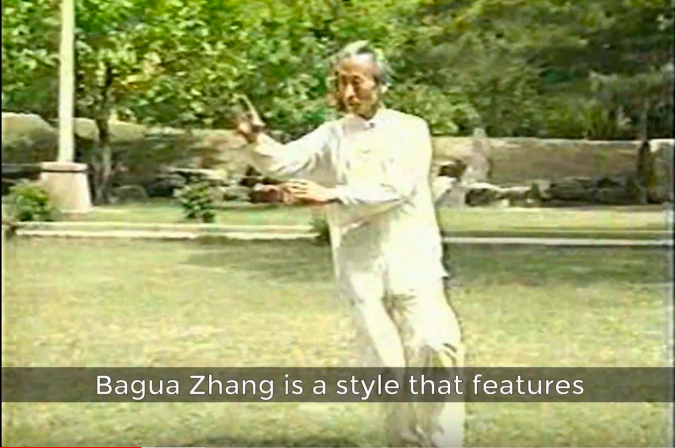
mirror fragments on gray surface with the reflection of a person s arm

Photo by Thiago Matos on Pexels.com

A new video in the long line running ‘Tai Chi master vs MMA guy’ series got posted the other day. Rather than talk about it here straight away I wanted to see what the reaction was from the martial arts community, and boy, it didn’t disappoint!

This whole MMA vs Tai Chi genre was started by the now-infamous Xu Xiaodong who posted the first video showing what happens when a delusional Tai Chi “master” gets in a fight with an MMA guy.

The qualifications for being a “Tai Chi master” these days seem to be that you have:

1) The backing of Chinese state TV, who will post lots of faked videos of you performing magical martial skills.

2) You have a sufficient number of minions and followers to do you bidding.

3) You look the part (silk pyjamas) and have can talk a good talk about your abilities.

Of course, none of these martial abilities are grounded in reality, so when you get in a challenge match with an MMA guy it usually ends quickly and badly for you. Chinese martial arts, particularly Tai Chi, is the focus of the soft power emanated by Beijing and the hyper-nationalistic Chinese government on the global stage. Therefore, publicly humiliating a Tai Chi “master” doesn’t make the MMA guy very popular in China, and Xu Xiaodong has been badly persecuted – his social credit score is now so low that he can’t even travel on trains and his social media accounts keep being deleted.

After the initial video of Xu Xiaodong surfaced he didn’t let the persecution put him off and he kept calling out the masters boasting of their skills on state TV. Challenge after challenge followed. One involved self-proclaimed Tai Chi/Xing Yi Master Ma Bao Guo who had previously paid a retired cage fighter Peter Irving in the UK to perform in a demo video that made him look good, and was boasting that this video was proof he was the real thing.

In this excellent article, Peter recounts the story behind the video.

Here’s the video:

To anybody that knows anything about fighting it’s obvious that Peter is just feeding attacks to Ma who reacts with some twitching responses. The fact that some people thought this was real says a lot about the mentality of minions and followers.

Xu and Ma’s challenge match was all set to go ahead (and would have ended the same way as all the others) but Ma actually called the police on his own challenge match and it was called off!

But Ma Bao Guo wasn’t giving up. At 69 he recently got in a challenge match with a San Da (Chinese kickboxing) guy who was 20 years younger than him. Here’s the video of Ma Bao Guo vs the San Da guy

As expected, it was a shocking display of ineptitude, and as I said, the reactions of the martial arts community have been interesting. Here are a few of the common responses I noticed:

  1. The rebranding of this as MMA vs Tai Chi to fit the narrative.
    The fight is actually between two practitioners of Chinese styles – one is Tai Chi/Xing Yi and the other is San Da, which is a homegrown Chinese kickboxing style. But it instantly becomes “MMA” because it fits the story created so far.
  2. “The Chinese have absolutely ruined kungfu.”
    Hard to argue with this really.
  3. Concern for Ma’s safety.
    This was my first thought – getting knocked out like that at 69 could have been fatal, and will likely have long-term effects.
  4. He needs to be sued for fraud.
    I wonder how many minions and followers he convinced of his nonsense over the years? I wonder what they think of his teachings now? If they gained health benefits are they now invalid?
  5. Why don’t those Kungfu guys that angrily complain about the fraudulent masters’ performance themselves step up to make Kungfu great again?
    It seems like a bit of false reasoning to me. I think the point is that if you are going to claim abilities then you need somebody to test them. Perhaps you need to be more realistic about what you claim? The reason Xu is not challenging 20-year-old kickboxers, is that they’re not claiming magical abilities on state-run TV. And also, it’s usually the old masters doing the challenging!
  6. “I look at someone getting beaten and it has little to do with me or my training.”
    True – exposing the delusional Tai Chi masters doesn’t mean that Tai Chi itself is delusional. If you are honest about what you can and can’t do, then that’s a good thing.

But then we get to number 7, and this is the one that really gets my goat…..

        7. “It says a lot about those that post these clips.”

What???

Aiming your ire at the guy lifting the curtain to show a little old man, not a wizard, behind it is something you’d attribute more to the mad emperor Nero, (who had a habit of shooting dead the bearers of bad news) than the sane and balanced mind of Marcus Aurelius, one of the last ‘good’ emperors of Rome.

The event was done publicly. There were press there with cameras. Ma had clearly arranged for this to be broadcast. And I can bet if (by some miracle) Ma had actually defeated the San Da guy, then heralds of his victory would be celebrated far and wide by everybody who purports to be a Chinese martial artist.

Stop trying to shame people for exposing the bullshit.

You can’t have it both ways. If you do something sportive and public then it remains pubic, regardless of whether you like the outcome. The point of challenge matches is to see what works. Part of the appeal of MMA for me is that it’s on one hand sport, but on the other a long-running public education project about what works in fighting.

I can already feel the voices of those “MMA is not for the street!” guys building as I write this, but you know – screw them. A good answer to that is that if you can’t make your art work with a limited rule set that simulates a real fight as closely as we can make it, how are you supposed to make it work when the other guy isn’t even restricted by those few rules?

San Da, boxing or MMA is a young man’s game. Old masters of whatever martial art it is should really stop trying to engage in it altogether. Putting yourself in a position where you can get knocked out cold at 69 years old is just a terribly bad idea. The implications for what remains of your life are serious. There’s a reason that Muay Thai fighters’ careers usually end in the 20s.

The whole thing was folly.

Ma was delusional for

  1. Thinking that whatever martial skills he had gained from a lifetime of pushing minions, followers, and paid performers, around while wearing silk pyjamas could actually translate into real fighting skills.
  2. Thinking that you could do this at 69 years old.

But human beings are delusional. And in normal life, we can get away with it up to a point because there are no serious consequences. I talked about this in my recent interview on the Martial Arts Studies podcast. My point was that nature is not delusional, which is why the Song Dynasty had such success economically and military thanks to the Li Movement, which aimed to get back to looking at nature for what it is, not what we think it is. That was the point I was making about studying animal methods (that I don’t think my interviewer quite picked up on) that a snake does what a snake does regardless of what human beings think about it, or even better, with no human beings around at all.

Similarly, MMA or San Da or challenge matches bring martial artists into direct contact with nature, or reality, if you like. And sometimes that can be a painful act of recognition.

It should be celebrated, not turned away from. Look it full in the face and learn. As the old martial arts saying goes:

“In martial arts you either win or you learn.”

It’s probably not a good idea to wait until you’re 69 to start learning.

Is there really only one style of Tai Chi?

Time to address some more comments generated by my Whole body movement post. Oliver Gerets writes:

“The body can move/coordinate in an almost unlimited number of ways. These kind of oversimplified comparisons are useless and misleading. There is no general/right way of “whole body movement” in Taijiquan. Every school/lineage is at least slightly different. “

This is an interesting point. Are all the different styles of Tai Chi actually different martial art styles, or are they all one? The generally accepted wisdom on the matter (Chinese government-backed) is that (in theory) there is only one style of Tai Chi. But when you get on the ground, in amongst the weeds, then it’s really hard to see how somebody doing Sun style Tai Chi is doing the same thing as somebody doing Chen style, and how either of them are doing the same thing as somebody doing Yang style. Sure, if you follow the sequence of their long forms, they follow roughly the same order, but the stances are all different and the type of body movement looks different. They might have had the same starting point, but over the years, they seem to have diverged significantly.

Or have they? Let’s return again to the three principles I listed as the essence of Tai Chi whole body movement in my last post.

1) moving from the dantien
2) power up from the ground (jin) – rooted in the feet, expressed by the fingers.
3) coiling and spiraling actions from the dantien out to the extremities and back.

You can argue that these 3 things are happening in all Tai Chi styles. 

giphy-3

Sun style.

giphy-4

Yang style

giphy-5

Chen style


But, the hard truth is that number 1 is not always observed in most practitioners, and number 3, is most often dropped entirely in the styles that don’t start with a letter C in their name.

Is that a bad thing? It’s point 2 that is the most important. Point 2 can be done without point 1 and 3 and you still have a functional martial art. Point 2 is also the thing I see that ties together all the “internal” arts in the most obvious way – Bagua, XingYi and Tai Chi Chuan.

We only have so many hours to train a week. I think you could make an argument that if you want to get anywhere in Tai Chi, then you’re better off spending most of your time working on point 2 anyway.

If you add in points 1 and 3 then you get even better movement. It’s a different type of movement. I think it’s worth investing time in learning points 1 and 3 as well, but make no mistake – it’s a significant investment of time. A good place to start is a simple single arm-waving silk reeling exercise:

Oliver’s final point is:

“There is no sense in moving like a cheetah, only if you want to run in a similar way. Which is not useful as a human being.”

It’s peculiar that he’s written this in a Facebook group (Ancestral Movement) which seems to enjoy looking at the way animals move and what we can learn from them. As mammals, our bodies really aren’t that different. Generally, we all have a spine, 4 limbs and a head.

64b8f401376e3cf8eb012c9de816b3c4

I’m not suggesting that we should pretend to be a horse or a cheetah, but the principles of movement in mammals are shared amongst all species. Even us.

Here’s a review of an Ancestral Movement seminar, if you want to find out more about it.

The Jing Cheng Wushu archives

Screen Shot 2019-12-30 at 9.22.07 AM.pngI just wanted to give a quick shout out to the work Byron Jacobs is doing preserving old Chinese TV performances of Chinese martial art from the 1980s.
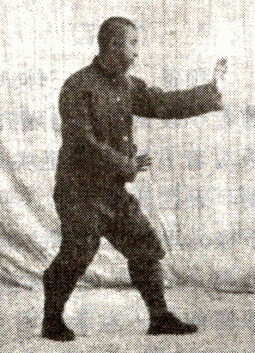
“Jing Cheng Wushu” (京城武术) is a series that ran on Beijing TV in the 80’s. The title “Jing Cheng Wushu” means ‘The Wushu of Beijing’. Each episode focused on a Chinese martial art style popular in Beijing at the time and featured many prominent older generation practitioners, many of whom have passed away since.

He’s done three episodes so far, digitising and adding English subtitles. They are:

XingYi Quan


Bagua Zhang


Taiji Quan


Kung Fu Tea on Sun Lu Tang

sun_lutang-self-portrait-for-publication

There’s a great article over on Kung Fu Tea about the life of one of the most influential Chinese martial artists of all time, Sun Lu Tang.

One of the persistent problems that I see in amateur discussions of “Chinese martial studies” is a lack of understanding of how broad the traditional martial arts really were, and the variety of life experiences that they encompassed.  In fact, rather than discussing China’s martial culture in the singular, it would probably be better to think about these cultures in the plural.  The martial arts never were just one thing, and our experience with the modern “traditional” arts tends to seriously skew our perceptions of the past.

It’s a good read, so sit down with a cup of tea and put your feet up with your laptop.

Link.

Chinese Opera in Glitch

Screenshot 2019-09-29 at 09.43.55.png

Just finished watching series 4 of Glitch. It’s a Netflix show where dead people get reanimated in a rural Australian town (why this happens is a long story).

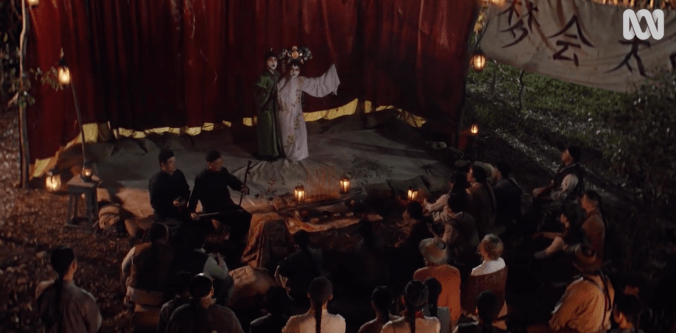
In season 4 a Chinese immigrant who died in the dust and mud of the bush in the 1850s comes back to life.

At the time, Australia was the most multi-cultural place on earth. We see flash backs from his life touring the Chinese camps of the Victorian goldfields performing Opera, which was the pop music of its day.

It’s pretty well done. Here’s some background on the history:

There are several bits in the series where the actor Harry Tseng performs Opera moves that look just like “kung fu”.

These days it’s pretty hard to imagine what life was like over 100 years ago. Some people still have the idea that “Kung Fu” has absolutely nothing to do with Chinese Opera. Clearly it was all part of the same cultural mix.


Gu Ru Zhang style Tai Chi Chuan

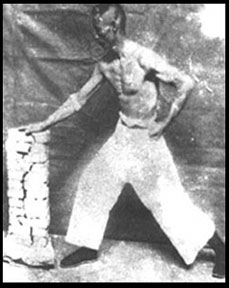
I posted this video of me doing Tai Chi in the rain back in 2012. This is a short form derived from the full long Yang form of Gu Ru Zhang (Ku Yu Chang) the famous “King of Iron Palm” from Hong Kong.

You see the famous picture of him breaking tiles without spacers quite a lot:

guruzhang3B

Gu Ru Zhang

Gu Ru Zhang’s style of Tai Chi is still quite rare. It’s from the Yang family originally, but had some input from his friend Sun Lu Tang, and you sometimes see it incorectly called Sun Style.

Gu published a book in 1936 on Tai Chi called “Tai Chi Boxing”, which you can find translated on the Brenan Translation website.

I’ve done various different styles of Tai Chi, but I always come back to this form. It’s my favourite. Anyway, here’s my video:

The Drunken Boxing podcast. Episode 1 Marin Spivak.

Screen Shot 2019-07-15 at 9.41.12 AM.png

Byron Jacobs, who produced the excellent XingYi San Ti Shi primer I posted recently, has launched a new podcast that’s well worth checking out.

In the first episode, Byron talks to Marin Spivak, Chen Tai Chi disciple of Chen Yu, about what it’s like going to live and train gung fu in Beijing as a Westerner back in the 1990s and 2000s. Both Byron and Marvin made the jump to live and train in Beijing, so they have a good insight into Chinese culture, and particular gong fu culture.

I really liked the discussion of the tangled network of gong fu culture a prospective student has to find their way through in China, and which the average western student has no idea exists at all.

Enjoy. Link.


The birth of Kuo Shu (Guo Shu Guan)

If you practice Chinese martial arts then you need to know your history, and especially what happened in the early 20th century with the Kuo Shu (Guo Shu) movement.

This was before the Wu Shu movement, which came later.

This excellent video by Will from Monkey Steals Peach explains what happened and why, and why Sun Lu Tang became such an important figure in Tai Chi history.


Tai Chi, Baguazhang and The Golden Elixir: Internal Martial Arts Before the Boxer Uprising

415b5-r9u2l

Scott Park Philip’s new Bagua book is out!

As somebody said: “From the sample pages it looks as bonkers and brilliant and polarising as the last one. Better than being boring!

Screen Shot 2019-05-07 at 5.10.25 PM

I’m really looking forward to seeing how he supports his theory (from the back cover) that Baguazhang was created after the failings of the Boxer Rebellion (1900) when the founder of the art, Dong Hai Chuan, died in 1882. I’ve been assured he tackles this point in the book…

If you click the Amazon link above you can click “Look Inside” to read a bit.