The internal qualities of martial arts

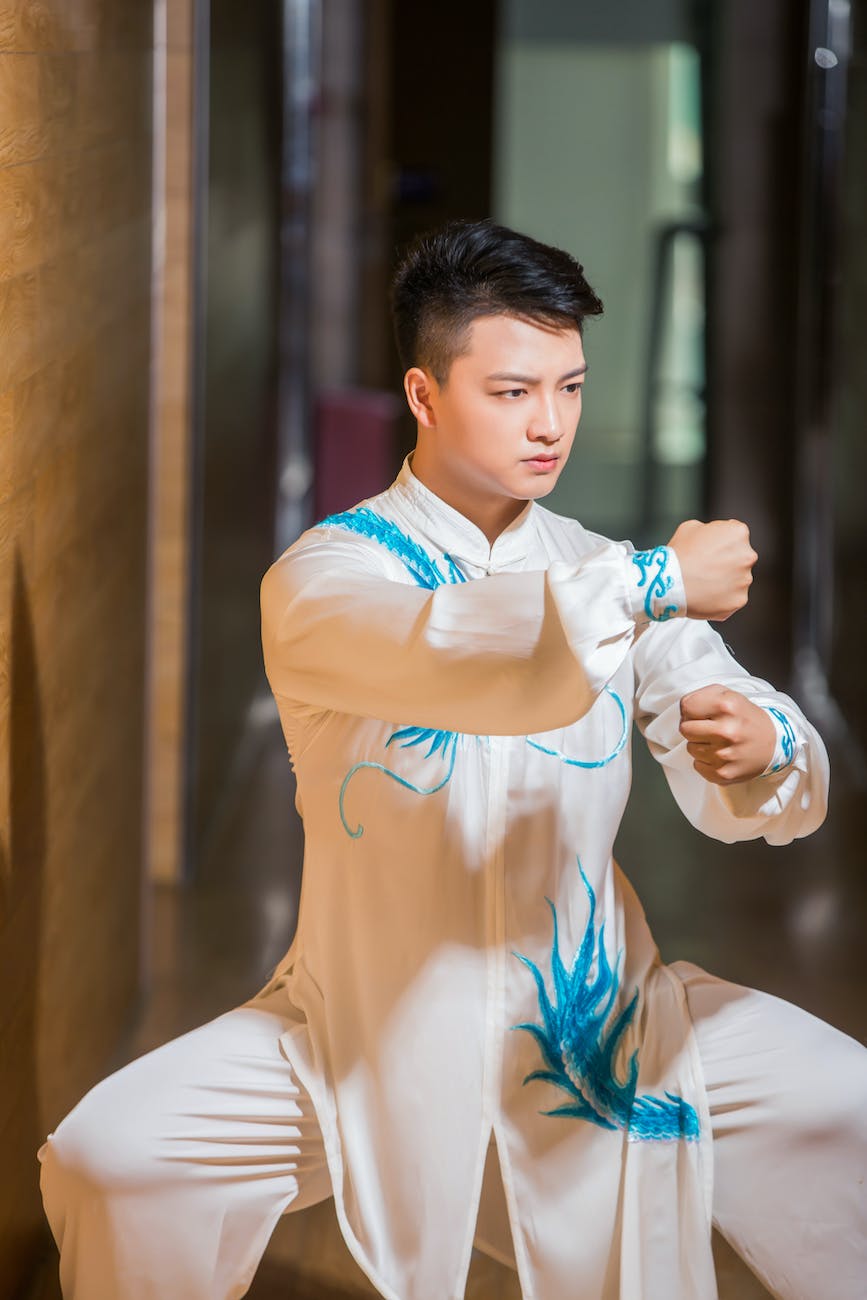
Photo by Thao LEE on Unsplash

One observation I have on ‘internal’ martial arts is that there there is often very little focus on the ‘internal’ qualities to a human being. Or if they do address them then it is, not directly and often in passing.

I’m not talking about things to do with forces, or the body, like Qi, Xin and Jin. Yes, the Yi (intent or mind) is mentioned all the time in the Tai Chi Classics, but it’s always in relation to fighting, or releasing and accepting forces on the body. “Quelle surprise”, you might say, since Tai Chi is a marital art, but if I contrast ‘internal’ martial arts with ‘external’ martial arts for a moment, the discussion there is often on the internal qualities of a human that internal martial arts, ironically, neglect.

I’m talking about things like self-control (temperance), endurance and patience.

The goal of improving these internal qualities has been the goal of practical philosophers since man first decided to ponder his/her existence. I could quote from LaoTzu here, but I find it more explicitly written by the Greek philosophers, particularity the Stoics.

In Chapter 10 of the Greek classic of Stoicism, The Enchiridion, we find:

“On the occasion of every accident (event) that befalls you, remember to turn to yourself and inquire what power you have for turning it to use. If you see a fair man or a fair woman, you will find that the power to resist is temperance (continence). If labour (pain) be presented to you, you will find that it is endurance. If it be abusive words, you will find it to be patience. And if you have been thus formed to the (proper) habit, the appearances will not carry you along with them.”

Epictetus, The Enchiridion

Sure, these internal qualities can certainly be learnt from any martial art, however I find it is the external martial arts that really emphasise them. Many Taekwondo schools use the goal of improving your inner qualities as the main sell in their marketing approach. For example, I just did a Google search for Taekwondo clubs in the local area, clicked on Tiger martial arts, and what do I find written on their website, in all caps, so you can’t miss it?

“WE BELIEVE MARTIAL ARTS IS ABOUT MORE THAN JUST KICKING AND PUNCHING”.

This is followed up with “We give students the focus and confidence to achieve in all areas of their lives.  Yes, you can learn to take care of yourself in dangerous situations, but really it’s about learning to use your mind and body like a martial artist – learn how to control your body and your mind, and you will be set up for life.”

It’s the same with Karate. I did another random search on Karate clubs and found Bristol Karate Academy whose motto is “virtue in industry” from “Virtute et industria” — or by virtue and industry — from the city of Bristol, which dates back to at least 1569. They explain how that relates to the values of their club on their About us page:

“So what does that mean for us?

Virtue (美徳): We have integrity, in our commitment to traditional, effective Karate and integrity in the way that we treat others. We are respectful, fair and aim for high moral standards. We build character, strive for excellence and show courage in the face of challenges.

Industry (勉励): We work hard to reach our goals. We’re diligent and determined to get better at every single training session. We are rigorous in our approach to improvement and dedicated to our own and each other’s development.

Through hard, honest training we become our best possible selves”

Again, while I’m sure they can kick-ass with their karate, the emphasis in their motto is on the internal qualities of a human being. It’s about becoming your best possible self.

I know what you’re thinking – “perhaps it’s about teaching children?” Things like Karate and Taekwondo can be very orientated towards teaching children, and you obviously don’t want to be raising a hoard of little ninjas who have no idea about the moral implications of using their marital arts. However, it’s not just non-Chinese marital arts that have a heavy emphasis on building moral character. Similar ‘external’ Chinese martial arts do too, and those tend to have as much emphasis on adults as children. Also the moral aspects were there right from the beginning in the Southern arts.

Photo by Nikita Belokhonov: https://www.pexels.com/photo/a-boy-participating-in-a-dragon-dance-6673225/

For the history of Southern Chinese martial arts I’d recommend Ben Judkin’s excellent book “The Creation of Wing Chun”. Its tag line is “A social history of the Southern Chinese Martial Arts” because it covers all of them, not just Wing Chun, and particularly Choy Li Fut. When the first professional Choy Li Fut school opened in 1836 a moral education was seen as part of the ethos of the school. The school had 10 rules that had to be followed at all times:

Ten Points
1 Seek the approval of your master in all things relative to the school.
2 Practice hard daily.
3 Fight to win (but do not fight by choice).
4 Be moderate in sexual behavior.
5 Eat healthily.
6 Develop strength through endurance (to build a foundation and the ability to jump).
7 Never back down from an enemy.
8 Practice breathing exercises.
9 Make the sounds (“Yik” for punches, “Wah” for tiger claws, “Tik” for kicks).
10 Through practice you cannot be bullied.

Wing Chun also initially had a similar set of rules. I’ve written before about Choy Li Fut’s 10 rules and Wing Chun’s 9.

While some of the rules are to do with body use, like making sounds on punches, others are more moral, like being moderate in sexual behaviour. And also eating healthy is a rule! Can you imagine going to a Tai Chi class or a Xing Yi class today and being told that healthy eating is now a rule, and if you don’t follow it, you’re out? In fact, I’d go as far to say that many internal martial arts teachers were renowned for hard drinking and over eating!

(It should be noted that Bak Mei tended to not have this moral emphasis. Reasons for this are explored in the book.)

Moving forward in time and changing locations to Brazil… Carlos Gracie also created a set of rules called the 12 Commandments when he started Brazilian Jiujitsu as an offshoot of Judo.

1 Be so strong that nothing can disturb the peace of your mind.
2 Talk to all people about happiness, health, and prosperity.
3 Give to all your friends the feeling of being valued.
4 Look at things by the enlightened point of view and update your optimism on reality.
5 Think only about the best, work only for the best, and always expect the best.
6 Be as just and enthusiastic about others victories as you are with yours.
7 Forget about past mistakes and focus your energy on the victories of tomorrow.
8 Always make those around you happy and keep a smile to all people who talk to you.
9 Apply the largest amount of your time on self-improvement and no time in criticizing others.
10 Be big enough so you can feel unsatisfied, be noble enough so you can feel anger, be strong enough so you can feel fear, and be happy enough so you can feel frustrations.
11 Hold a good opinion about your self and communicate that to the world, but not through dissonant words but through good works.
12 Believe strongly that the world is in your side, as long as you stay loyal to the best of yourself.

Carlos Gracie

These are mainly forgotten about these days and I’ve noted before that a lot of them were borrowed from somewhere else but they are almost exclusively about internal qualities of a human being.

If you contrast these sorts of rules to what you find in “internal” marital arts schools, well first of all, there are usually no set rules like this at all! Secondly, we tend to look to the classics for our ancient sayings, and finding moral instruction in them is like finding a needle in a haystack. Instead you find simile – for example, “be still like a mountain and move like a great river” from the Tai Chi classics, or philosophy from the Xing Yi classics like The 10 Theses of Yue Fei:

“From the beginning, that which is discrete must have its unification.
The divided must be combined. 
Therefore, between heaven and earth, all that is disordered has its abode, all the thousand branches and the confusion of then thousand endings, all have their origin.
This is because one root divides into ten thousand branches, and ten thousand branches all belong to one root.
These events are natural“.

– The Thesis of Integrity

Or you find descriptions of body use and strategy.

The jin should be
rooted in the feet,
generated from the legs,
controlled by the waist, and
expressed through the fingers. 

The Tai Chi Classic.

What you don’t find a lot of is moral instruction or a reflection on the internal qualities of a martial artist that you find emphasised right up front in external schools.

So, why is this? Good question. One possible answer could be that ‘external’ arts historically coming from the Shaolin Temple (in the usual origin myth, at least) always had a Buddhist religious and therefore moral aspect to them. The internal arts in contrast tended to evolve out of the (violent and bloody) countryside, or they evolved from a Taoist approach to life, which was less prescriptive.

I don’t know – what do you think? What explains the internal/external difference? Let me know in the comments.
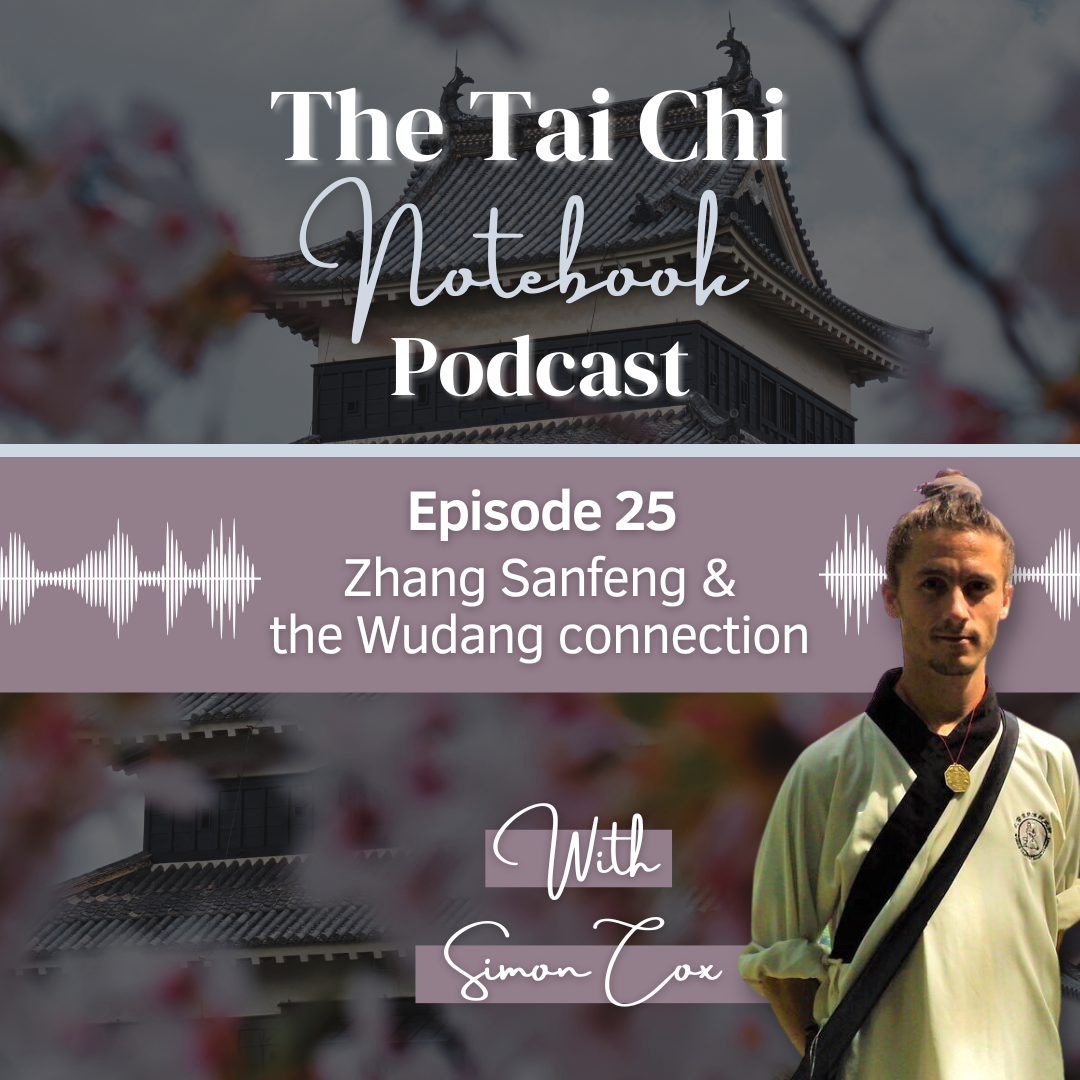
NEW PODCAST Simon Cox on Zhang Sanfeng and the Wudang connection to Tai Chi

New podcast! My guest today is Simon Cox, who co runs the Okanagan Valley Wudang with his wife Brandi in Penticton, British Columbia.

Simon and Brandi spent six years living and training in China under master Yuan Xiu Gang at the Wudang Daoist Traditional Kung Fu Academy. While there they studied Kung Fu, Tai Chi, Qi Gong, meditation, herbal medicine, Daoist music, and ancient and modern Chinese language.

After returning to the West, they started a Kung Fu school and community group in Houston Texas, where Simon was working on his PhD in Chinese and Tibetan mysticism at Rice University. At the end of 2019, they moved up to the Okanagan Valley and began sharing Wudang teachings with the local community.

What I really wanted to get at with Simon was an elucidation on his article about Zhang Sanfeng – exactly who was this mysterious Taoist immortal who is often credited as the founder of Tai Chi Chuan? I also wanted to find out more about Wudang mountain, and where its martial arts really come from. I hope you enjoy are conversation!

Is Tai Chi really about relaxation (fangsong)?

I noticed a person on Facebook recently who was trying to make the point that the term Fangsong (放松 relax, unwind, loosen, ease, release, slacken) doesn’t appear in writings about Tai Chi until about 1930, and is therefore a modern idea that we are retrofitting to suit our modern ideas of Tai Chi being all about relaxing. That’s not his argument word for word, but that was the gist of it, anyway.

I’ve heard similar things from other people about how ‘back in the day’ Tai Chi was practiced hard, like a real marital art, until you were exhausted, and that modern training has gone soft in comparison. To those people I would point out that intensity and duration of practice have nothing to do with how you practice. Ask anybody who has practiced ‘standing still and relaxing’ for half a hour in a Zhan Zhuang posture and you’ll find out that practicing relaxing for half an hour in a stressful position is an exhausting, sweaty, business.

But to return to the original point, I would point out that even if you look at one of the oldest writings we have on Tai Chi – the handwritten manuscript of Li Yiyu from 1881 (which is available to read on Brennan Translation) you’ll find the word “relax” appears in the English translation 9 times. That’s not an insignificant amount. (I’ll leave it to the Chinese language experts to search the original Chinese).

You find it in phrases like:

I relax my power, but I do not allow it to collapse. (This has to do with “calm”.)

and

Every movement is a technique of first putting forth strength and then immediately relaxing, yet always there must be continuity from one to other, and there is never to be a departure from the four stages of “begin, develop, transmit, and finish”.

However, if you check out the even earlier 1875 text Explaining Tai Chi Principles, written by Yang BanHou, son of the famous Yang LuChan, you’ll find that he’s right – the phrase “relax” doesn’t appear, even once!

However, just look at one of the things written in the text:

“Power comes from the sinews. Strength comes from the bones. Looking at it purely physically, one who has great strength is able to carry many hundreds of pounds, but this is an externally showy action of bones and joints, a stiff strength. If on the other hand the power of your whole body is used, it may appear you are unable to lift hardly any weight at all, yet there is an internal robustness of essence and energy, and once you have achieved skill, you will seem to have something more wonderful than one who has the stiff sort of strength. Thus runs the method of physical training for self-cultivation.”

It seems pretty clear that he’s talking about relaxation being required for whole body strength.

But getting away from the nitpicking about facts (sorry!) I do think he has a point – there has been a modern re-framing of everything to do with Taoist arts as a kind of therapy for stress and dealing with the pressures of modern living that wasn’t necessarily there in the original arts – especially with Tai Chi.

Tai Chi was created in pretty stressful times, when wars were being fought, the concepts of law and order and justice were malleable depending on how important you were and life could be brutal and short. Taoism emerged at a time that was probably even more dangerous to be alive in! Frankly, I don’t think you expected to live long enough to have to worry about getting stressed! You were probably too busy trying to stay alive and earn a living. Being stressed is something of a modern disease because we live lives of relative comfort and we’ve got nothing truly life threatening to worry about on a daily basis.

The same thing has already happened to yoga.

But, I think we’ll have to live with it, because the hippies who have taken over Tai Chi Chuan do have a very good point – the first step in Tai Chi is to relax, whether you like it or not! You cannot move your body as a unit if parts of it are tense.

In Tai Chi Chuan the body is required to move as a whole unit, connected by fascia, tendons, muscles, etc, with all the joints allowed to move freely during exercise. All the joints are involved to some degree in all movement, so need to be relaxed. The ball-and-socket joints of the shoulders and hips are allowed to move freely. The gliding joints of the ankles and wrists move freely, and the hinge joints at elbows and knees are all allowed to move freely. Finally, the dantian moves freely and controls everything. Tensing the muscles around a joint separates it off from the rest of the organism, meaning that whole body movement is not possible.

And being mentally ‘tense’ is just as much of a problem as being physically tense, since the mind and the body are intimately connected.

Perhaps the emphasis in the original writings on Tai Chi was focused on more lofty philosophical principles, yes, but you will find plenty of admonitions to relax in there, and for good reason. That’s just how Tai Chi works.

Simon Cox on Zhang Sanfeng and the history of Tai Chi Chuan

The article On the Historical Mystery of Zhang Sanfeng by Simon Cox, on the history of Tai Chi Chuan and its connection to Zhang Sanfeng is great. I’ll just quote a couple of paragraphs from near the end, but recommend you read the whole thing for context:

It seems like Tai Chi was really a Republican era (1912-1949) category that became a sort of umbrella term for various Chinese martial arts that are practiced slowly, containing such multitudes as the ancient martial arts of Chen village, the later arts of the Yang family, and the weird things people were doing at Wudang, in Zhaobao village, and even the government-created variations on these styles.  From this view, asking which style started it all is rather meaningless.  The historical connections simply aren’t there.  From the densest of historical positions, there is no evidence anyone practiced anything called Tai Chi Fist before the 20th century. It arises as a high prestige category in the context of post-Qing Chinese nationalism. Every slow-ish martial art in China seems to have been automatically re-branded as a form of Tai Chi.

According to the Yang Family oral tradition, Yang Luchan 杨露禅 (1799-1872), the founder of the style, called his art variously Cotton Fist 綿拳 or Transforming Fist 化拳, and it was only during his time in Beijing that a Confucian scholar Weng Tonghe 翁同龢 (1830-1904) witnessed him demonstrating his style and wrote a poem about how it embodied the principles of Tai Chi.  According to this oral tradition it was after this event that the art came to be known as Tai Chi Fist.  This story was first published in the 1930’s and is almost certainly apocryphal.  But even if we take it at face value, we arrive at the inevitable conclusion that Tai Chi Fist was an appellation applied first to Yang family martial arts and then later, during the first decades of the 20th century, expanded to include Wudang and Chen styles.

Simon Cox – On the Historical Mystery of Zhang Sanfeng

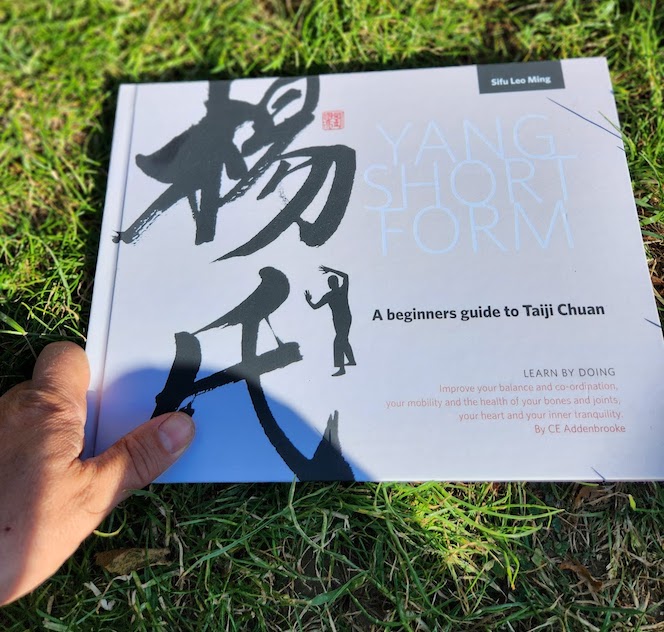
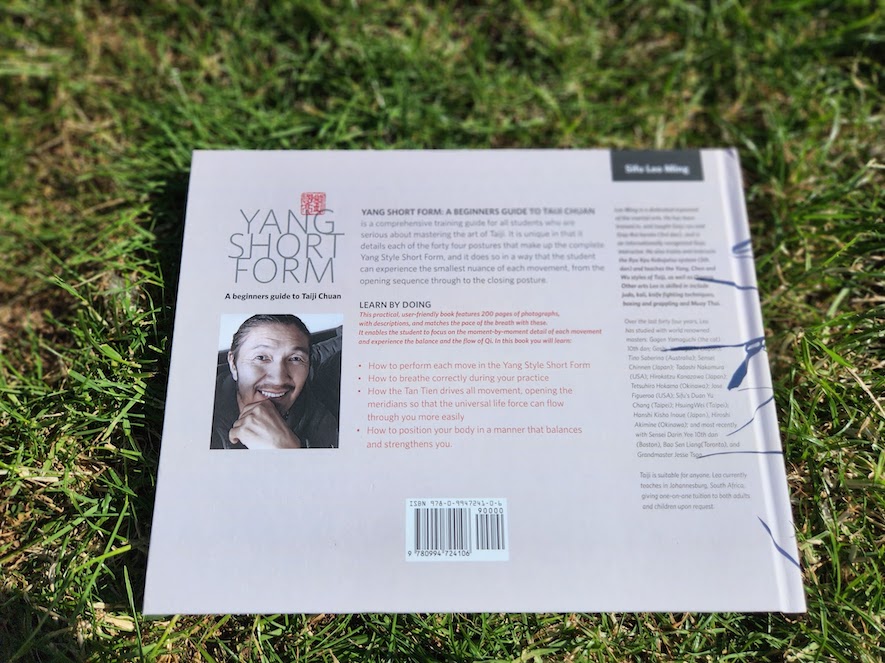
REVIEW: Yang Short form: A beginners guide to Taiji Chuan by Leo Ming and Caroline Addenbrooke

Yang Short Form: A beginners guide to Taiji Chuan, is a beautifully made, hardback coffee-table Tai Chi book, containing a brief section on history and principles of the art, over 200 colour photos mainly for showing you the form, a few verses from the Tao Te Ching to act as inspirational quotes and more.

There’s no denying that at an RRP of £49, it’s expensive. For people wondering why this book costs that much on Amazon (although you could pick it up for 18% less at time of writing), the high production values and hard cover explain the price. Printing in colour is expensive these days.

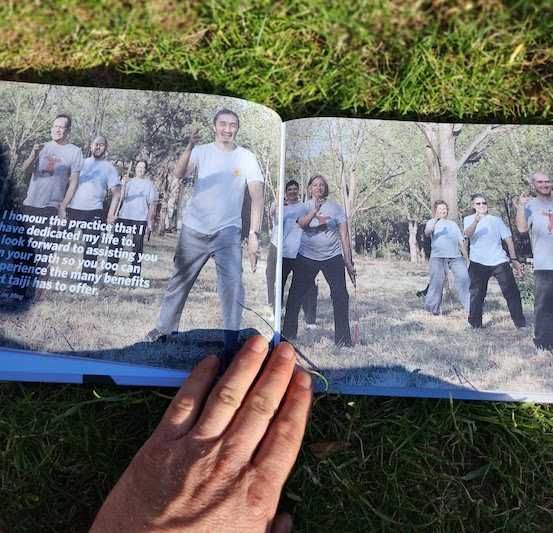
Sifu Leo Ming is the teacher who appears in the photos, and his student Caroline Addenbrooke is the author.

The main point of the book is to teach you the Cheng Man Ching short form, and if you view the book through the lens of ‘Can I learn a Tai Chi from this book?‘, it succeeds, I just have a few issues with some of the information presented here.

Consider the title

My problems start with the title, “Yang Short Form: A beginners guide to Taiji Chuan“. The Tai Chi form presented in this book is the Cheng Man Ching short form, which is certainly a Yang short form, but it’s a bit of a stretch to call it the Yang short form. People generally call it the Cheng Man Ching Short Form or the Chen Man Ching 37 form, which would have been a more accurate name, since Cheng’s form varies quite significantly from the official Yang form that belongs to the actual Yang family.

Secondly, the use of “Taiji Chuan” awkwardly mixes two different romanisation styles together in a way I’ve never seen done before, making it something of an outlier in the Tai Chi world. Tai Chi is usually either written Taijiquan/Tàijíquán (pinyin) or Tai Chi Chuan/Tai chi ch’üan (Wade-Giles), or shortened to simply “Tai Chi“. I find the decision making process of mixing the two systems together used here to come up with “Taiji Chuan” a bit baffling. Why do that?

Similarly, inside the book there’s a mix of different romanisation styles. Shaolin appears as “Shao-lin”, while changquan appears as “Changquan”, (so they’re happy to use pinyin there…) Dantien appears as “Tan Tien”. But Qi is “Qi”, not “Chi”, and Xingyi is “hsing-i”! I can’t work out the logic. In a way, so long as the system used is internally consistent it doesn’t matter, but it is a bit frustrating.

Finally, “beginners guide” is used in the title without an apostrophe! Well, that is just… wrong.

But, let’s move on from the title of the book and look at what we’ve got here. 

All the history all at once

The history section starts with a pretty safe phrase, “The history of Taiji Chuan is unknown”, and if it had stopped there I think I would have been happy, but it then goes on to tell a version of Tai Chi history anyway that includes every folk tale in the Tai Chi master’s repertoire! It talks about the classic Chan Sanfeng origin story, but also has the Chen village origin story straight afterwards before giving a brief rundown of the current styles of Tai Chi, before then pivoting back further into time and linking Tai Chi to the Shaolin Temple because that’s where “qigong theory” started… If you know anything about the history of Tai Chi you’ll know that these kind of myths are probably just that, myths, but they help the marketing of the art.

There are other problems with the accuracy of information, too – there’s a picture of a statue of Chang Sanfeng in the history section which is captioned “A statue in Chenjiagou depicting the legendary Chang San-Feng”. I thought that didn’t sound right. A quick 5 minutes on Google confirmed that his statue is of Chang, but it’s found (not surprisingly) in the Wudang mountains, not Chen village, as stated. Unless I’m wrong and there are two identical statues, but I don’t think so. The most famous statues in Chen village are the statues of Chen Chanxing and Yang Luchan.

The rundown of the different styles of Tai Chi in existence today is accurate, but if you want a proper investigation of the history of Tai Chi, I’d suggest looking elsewhere.

The section on principles of Tai Chi is also very brief. It’s all the usual advice you find in Tai Chi books about relaxing, centering, evenness and slowness, etc. There’s nothing wrong here, but it’s very surface level.

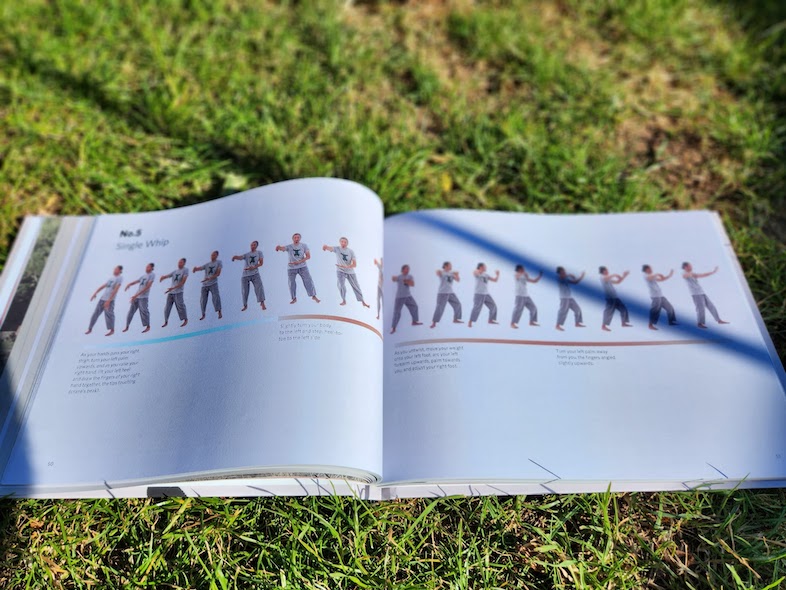
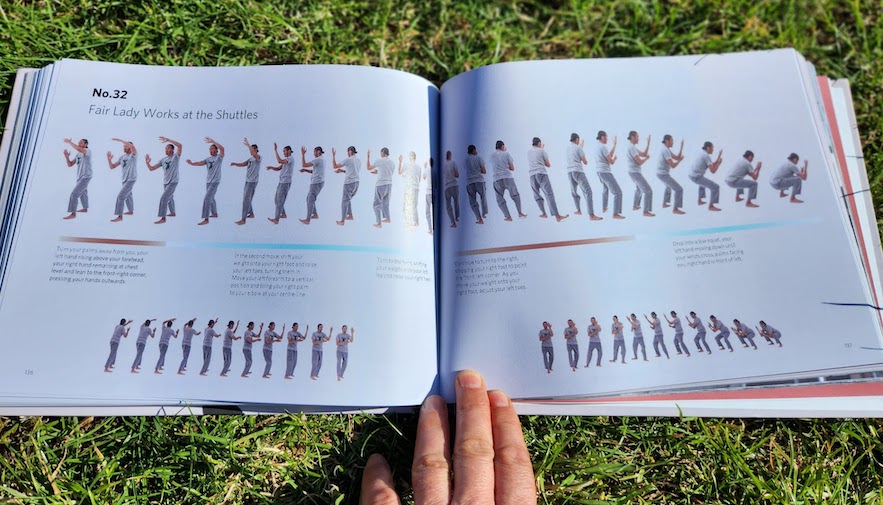
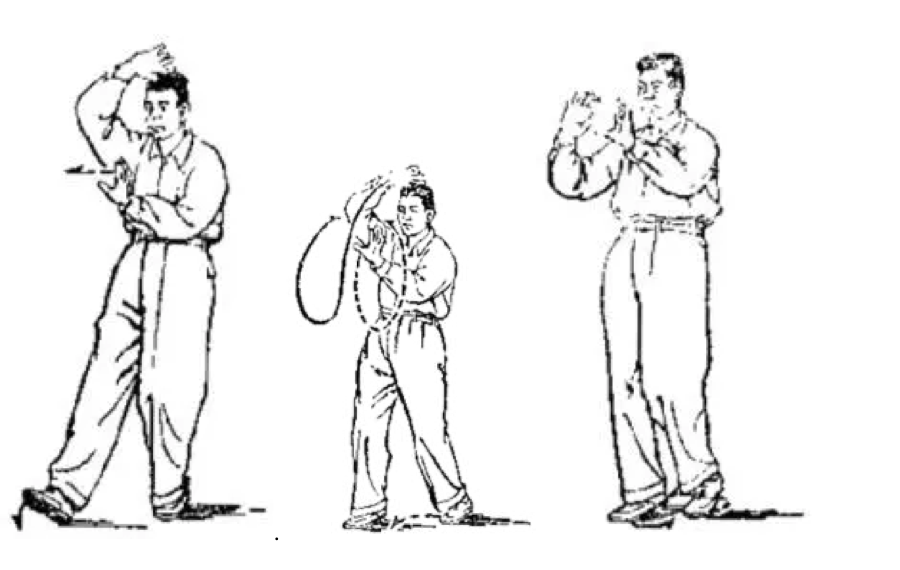
Teaching forms is where Yang Short Form gets it right. The book uses the method of breaking down each move into tiny fragments and showing them next to each other, conveying the sense of movement through the form nicely. As such you can definitely use the book as an aid to memory of this form, or even teach yourself the form from it. Take a look at this example of Single Whip:

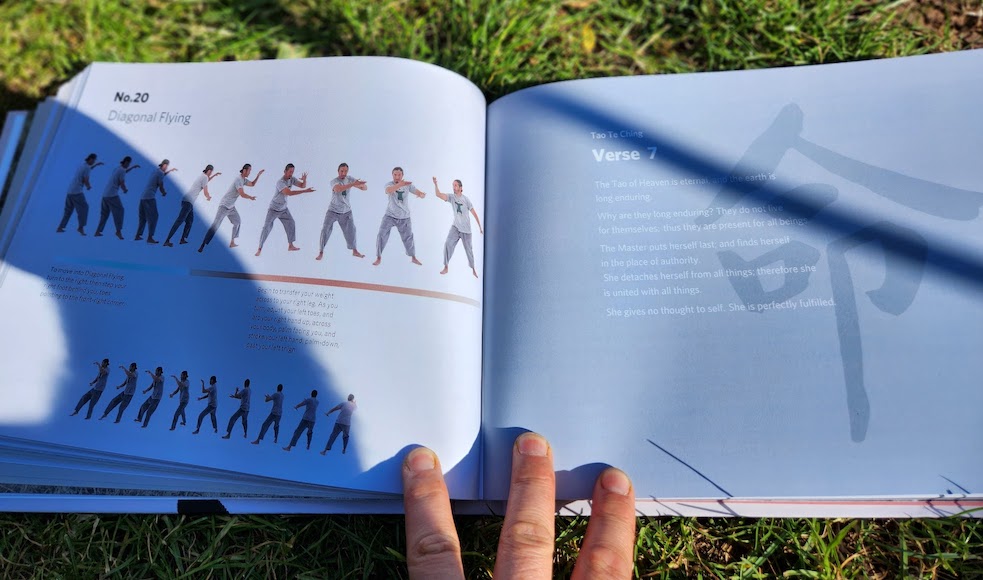
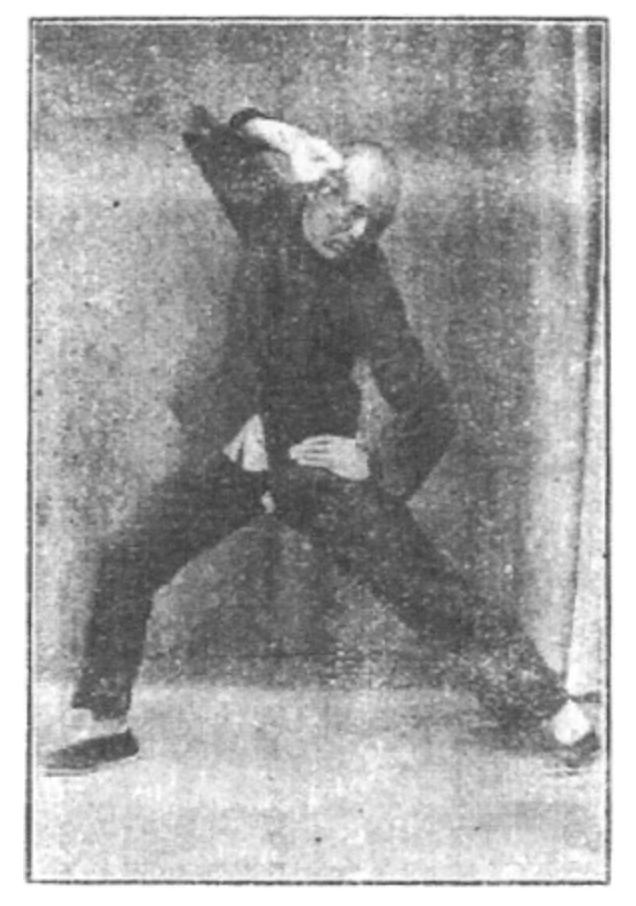
Diagonal Flying:

Of course, Tai Chi purists will say that the choreography of the form is not the important part, and that the body method is vastly more important, however, for better or for worse, the vast majority of Tai Chi practitioners in the world are not looking for a book on that. They are simply trying to learn some movements as a form of exercise for health, and this book will serve them very well.

I don’t do the Cheng Man Ching short form myself, but I have learned it in the past, and as I was looking through the movements it struck me that there were one or two idiosyncrasies presented by Sifu Leo that I hadn’t seen before. I noticed three things in particular:

1) A low squat Sifu Leo does as a transition between each ‘Fair Lady Works at the Shuttles’ move: 

2) A front kick/leg raise, he puts into Repulse Monkey.

3) In Golden Pheasant Stands on one leg – he again squats all the way down to the floor between the knee raises.

This struck me as peculiar, so I checked the form against a video of Chen Man Ching, mapping the movements in his video to the ones in the book, and while the forms match (all the movements are here and none have been added), the above curiosities are not performed by Professor Chen Man Ching. 

Also, there are 43 moves in the form shown here, and Chen Man Ching’s form was said to be 37, but I suppose it depends how you count the moves. 

I don’t think these three variations to the Cheng Man Ching form matter that much, but I think it’s safe to say that they are not standard, so I should point them out. It’s also important to note that there are no marital applications or discussion of push hands in the book at all.

Overall, if you practice the Cheng Man Ching short form for health and you want a visual reference to remind you of the moves then this book will fit the bill – it’s beautifully designed and the form is clearly presented. If you’re looking for a scholarly discussion of the history of Tai Chi, or an in-depth dive into the body mechanics, then other books are available.

More thoughts on elbows and the classics of Tai Chi and Xing Yi

From  http://chentaijiquanworld.blogspot.com/ we find this nice quote about Chen Taijiquan:

“The, at first sight, seemingly humorous Chenjiagou saying to “always keep an egg under your armpit” reflects the importance of not allowing the upper arms to become stuck to the side of the body.

This idea of always keeping a space under the armpit is something I’ve heard said in other styles of Tai Chi as well, and it fits in very well with the idea of “Peng all over the body” that you’re aiming for in Taijiquan, that kind of “inflated like a balloon, but also soft, springy and heavy” feeling. 

Taijiquan, with armpit gaps. Photo by Stephen on Pexels.com

But how does that relate to the question I was looking at recently about the issue of where the elbows should be in Xing Yi? “The elbows never leave the ribs” is a line from the Xing Yi classics* (more of that later) that has caused a lot of arguments between practitioners on its interpretation and meaning. 

And when you compare it to the previous saying about the armpit from Chen Village, it’s basically the complete opposite advice! And yet, both Taijiquan and Xingyiquan are said to be internal arts, and part of the same family. So, is the advice about the elbow a crucial element, as fundamental as, say, aligning the Bai Hui point (the crown) with the spine? Or is this more of a piece of strategic advice to do with the fighting style of Xingyiquan, and not anything to do with its fundamental body method?

Let me throw in a curve ball here and switch arts to BJJ. “Glue your elbows to your ribs” is something I say to my students in BJJ all the time when they are on the bottom defending a position like side control, knee on belly or mount.

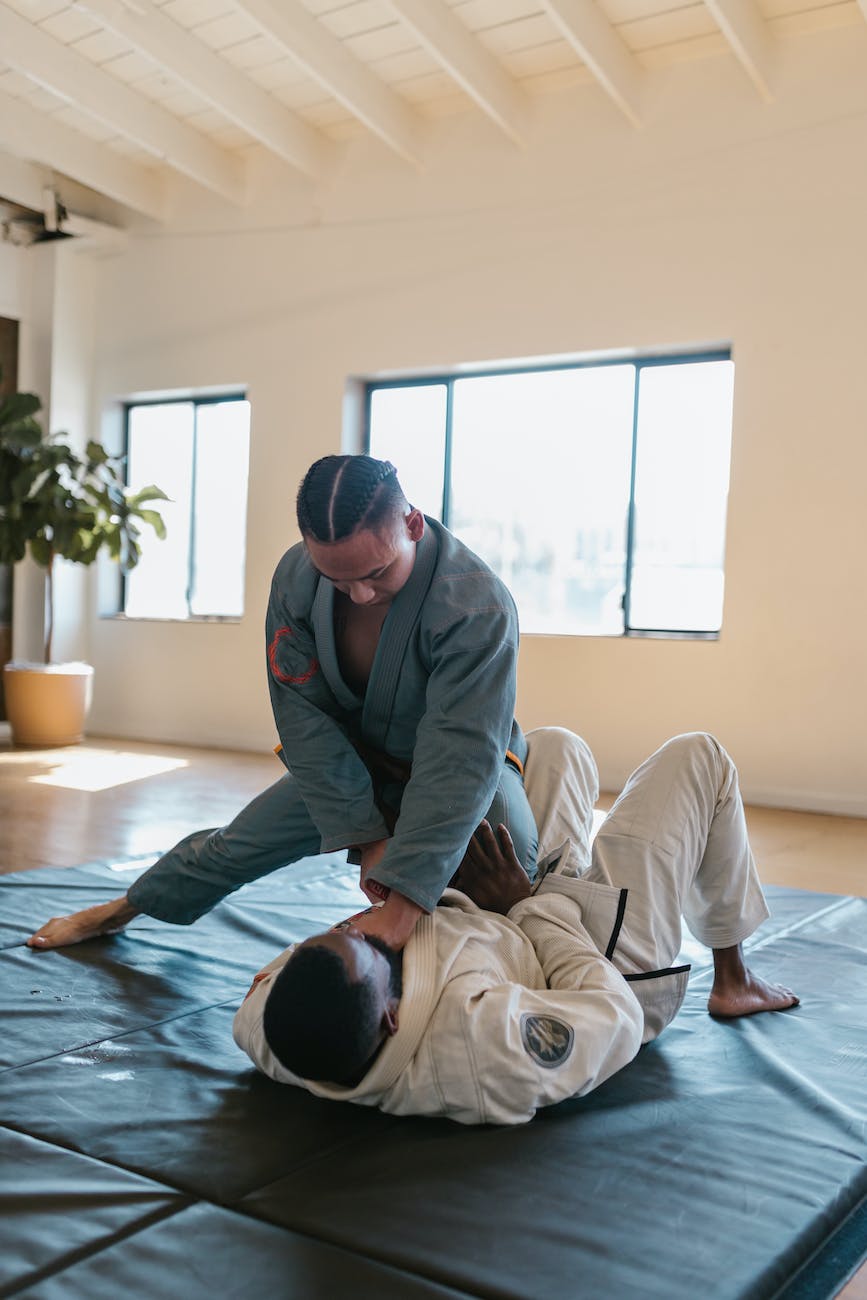
Knee on Belly in BJJ. Photo by RDNE Stock project on Pexels.com

If you let your opponent separate your elbows from your ribs in that position then only bad things can happen, so it’s great advice. Normally after I submit somebody new in BJJ I stop to explain to them how I did it, so we can turn it into a learning moment. 9 times out of 10 my explanation starts with “it started when you let me into the space under your armpit”. However, it would be ludicrous to make it into a hard and fast rule, to suggest that you should never let the ribs leave the armpit at any moment in BJJ. There are plenty of other times in BJJ where you need to pull with your arm, and you can’t do that fully without separating your elbow from your ribs.

* And let’s also decide on what constitutes a “classic” in Xing Yi. My own teacher only considered the 10 Thesis of Yue Fei  to be the classic writings in Xing Yi. Most of what people call the Xing Yi classics today are, in fact, writings created in the early 20th century when there was a publishing boom in martial arts manuals (See Chinese Martial Arts Training Manuals: A Historical Survey by Kennedy and Gau), and are based on the original Yue Fei writings anyway. For Xing Yi it started with Sun Lu Tang’s 1915 A Study of Xing Yi Boxing.

In the preface to his manual Sun says (Translation by Brennan), “While once at Bai Xiyuan’s home in Beijing, I got to see one of the Yue Fei manuals, not an original copy of course, but a handwritten copy made by someone in a later generation. It was not very detailed and unfortunately contained no explanations of its terminology, only the barest of text from beginning to end. I was suddenly inspired by this, immediately wishing to provide more complete information, even though I was fully aware that my level of learning and skill was superficial, and without being tempted to make anything up [in order to fill information gaps]. I secretly made my own copy and then deeply studied it, going through it posture by posture until bit by bit I had built up the material to make this book. There is no decorative language in it at all, for in my studies I have not dared to hold on to even the slightest exaggerations. Wherever flaws are found within my work, I hope my comrades will correct me, for which I would be very appreciative.

  – sincerely written by Sun Fuquan [Lutang] of Wan County, Baoding, 1915, 1st month, 15th day”

In his manual Sun has a chapter called “The Essentials of Practice” in which we find the advice about elbows and ribs. (Translation by Brennan)

“ESSENTIALS OF PRACTICE
The essentials of practice in Xingyi Boxing: 1. Sink your waist. 2. Shrink your shoulders. 3. Hollow your chest. 4. Press. 5. Lift. 6. Horizontal and vertical should be clearly understood. 7. Lifting, drilling, dropping, and overturning should be clearly distinguished.
  …
  Your head presses up during drilling, then shrinks back during overturning. Your hands lift during drilling, then drop during overturning. Your foot lifts during drilling, then drops during overturning. Your waist lifts during drilling, then drops during overturning. [from the Xingyi Boxing Classics:] “In lifting there is a horizontal aspect, but it is invisible [because it appears to be only upward]. In dropping there is a vertical aspect, but it is invisible [because it appears to be only forward].”
  Lifting is going out and dropping is striking, but when lifting is also striking, dropping is still striking. Strike with lifting and dropping, like the overturning waves of water, which are lifting and dropping. Regardless of lifting and dropping, drilling and overturning, going and coming, it should always be that your elbow does not leave your ribs and your hand does not veer off from your centerline.
  These are considered to be the essentials in Xingyi Boxing. Knowing these, the right path in the art will be obtained.“

But you can see that even in this passage, Sun is quoting the older “Xing Yi Boxing Classics”. So, you have to start to wonder, how old is the advice that the elbows do not leave the ribs, really? I know some styles maintain that their “quan pu”, ancient collection of classic handwritten writings their family possesses has this advice in. At least with Sun’s work we have a published date we can be sure of. 

Photo by George Sharvashidze on Pexels.com

But this also brings up the question of how much we dedicate ourselves to following the literal words of “the classics” to the letter. How much freedom are we allowed in our martial art? Were the classics intended to be a kind of set in stone, unwavering, set of rules to be followed on pain of death? The ancient writings of the founders always tend to take on this weight that gets heavier over time. If they’d been written a year ago, would we treat them with the same reverence? There are hard line Christians who treat every word of the Bible as the word of God, never to be questioned, and there are more modern progressive Christians who interpret the words in the Bible into a modern context, or see them as simply stories designed to teach an idea, and not to be taken literally.

So, the question still lingers, like a bad smell. 

Where do you put your elbows in Xing Yi? 

I think the best answer I’ve found so far is…..

“in between your shoulders and your wrists”.

What came first in Tai Chi – the philosophy or the techniques?

It’s no secret that Tai Chi is a series of circles. The body opening and closing using circulation motions, like a yin/yang symbol in action. But when you look at a Tai Chi form, you’ve got to wonder, what came first, the techniques or the philosophy? Was Tai Chi created in a moment of philosophical purity and clarity, or was the philosophy simply bolted on to existing military or self-defence techniques (or popular movements from theatrical or religious rituals) that were already as old as the hills?

What I’m wondering is, was there at some point a founder of the art who decided, as a starting point, that he was going to purposely create a martial art based entirely on a philosophy based on the Tai Chi symbol, which would be both the overarching principle and the raw material, out of which martial applications would be fashioned?

Or did the idea of doing things in circles come later, and get added to existing martial techniques, and in so doing, alter them forever?

Well, let’s look at what we know as fact.

Fact 1: Tai Chi does indeed contain nothing but circular movements. I’m sure somebody somewhere can point out a movement in a form that looks linear, but it’s quite possible that the movement is actually being created in a circular way, or it has degraded over time into something else. All we can do here is talk in broad brush strokes. If you look at a Karate form, or a Tae Kwan Do form you see lots of examples of linear movements, that are usually lacking from Tai Chi forms. From this we can conclude that some sort of philosophical idea must have been involved in its creation.

Fact 2: The techniques in Tai Chi forms look a lot like other techniques in other Chinese martial arts forms, so are not in any way unique. If you look at a lot of forms from the Shaolin Temple, or village styles from all over China, you see postures and movements that are very similar to the techniques found in Tai Chi. In a way, there is nothing new under the sun.

When solving a murder, detectives look for two things first – opportunity and motive.

When Tai Chi first appeared in Beijing in the late 19th century it was promoted along with the idea that it had a founder, an immortal Taoist called Chan Sang Feng who had created the art based on his observation (or a dream) of a fight between a crane (or possibly stork) and a snake. And while certain groups (see my last interview with George Thompson) on Wudang mountain still take this story very seriously, and possibly literally, modern scholarship has tended towards the idea that it was a fighting art from the rural countryside (Chen village being the most popular choice for origin) that found its way to Beijing via a young Yang LuChan, who taught it to those at the highest level of influence inside the Forbidden City.

Of course, the shadowy figure of Yang LuChan is never adequately explained, and since he was an uneducated nobody – a rural rube – nobody really made a record of his existence. The story everybody, including all the heads of the various Tai Chi families, follows, (because it’s the story the Chinese government approves of), is that he learned the art in Chen village. But I always wonder about that time in the 1860s when Yang and the very well educated and important Wu brothers were in Beijing, as being a time when Tai Chi could have been invented. The Wu brothers would have known the philosophy on which to hang it, and Yang would have had the martial skills to make it work and turn it into something that could bring the fractured court of the late Ching Dynasty together, bonding over something that was essentially Chinese in the face of constant threat from foreign powers. Yang and the Wu brothers together had both opportunity and motive, and regardless of whether you accept that interpretation of history or not, Tai Chi has been used as a political football ever since, especially by the current government to whom Tai Chi (the world’s most practiced marital art!) represents the ultimate form of soft power, spreading Chinese culture and influence the world over.

T’ai Chi magazine, AI and punching bags

Sometime back in the early 2000s I had an article published in what was, at the time, the premier Tai Chi magazine, T’ai Chi Magazine. It was American, but you could find it in the UK in newsagents like WHSmiths and in martial arts shops. I was reminded of it recently and dug it out of my archive. Here it is! I looked a lot younger back then…

I remember being really excited that I got this article published. It’s hard to imagine now, but beyond your instructor or random seminar big wig in your town, T’ai Chi Magazine was one of the only ways to get information about Tai Chi before the Internet took over everything. It was run by its Editor, Marvin Smalheiser, who sadly passed away in 2016.

Whenever you dig out something from the past it’s a good opportunity to reflect on how things have changed. T’ai Chi Magazine was run to a pretty high standard, the images it published were always good, and many of them were in colour. The articles were generally of the interview type and provided a little glimpse into the T’ai Chi world for fanatic followers, who would look at the articles for hours, trying to work out what a particular pose could be for, or how the featured practitioner was doing something. Then VHS video came along and made still images irrelevant, since you could actually see the applications being done (a lot of the pages in T’ai Chi Magazine were dedicated to advertising VHS videos of forms and styles, mainly from China). And later online video sites like YouTube came along and made VHS look antiquated.

Considering the latest developments in AI it looks like our future will consist of an AI-generated person teaching us Tai Chi forms with no credit to the sources it stole it from, and probably teaching the moves wrong anyway. I’m not sure that technology is always moving us forward. You can imagine the fear that the first Tai Chi instructors had that if they put images of their form in a book it could be stolen from them. These days, it’s not only going to be stolen by AI, but it’s going to be manipulated into something else entirely!

You can imagine the prompts now:

“Alexa, teach me a Tai Chi form that lasts for 10 minutes and exercises all my major muscle groups”.

“Sure, here you go Graham.”

A video (or hologram?) of Alexa will then start teaching you some ‘follow along’ series of Tai Chi movements it’s magicked up out of thin air, with no credit to where it got them from, and slightly wrong.

And the worst thing will be, it’s probably exactly what people want.

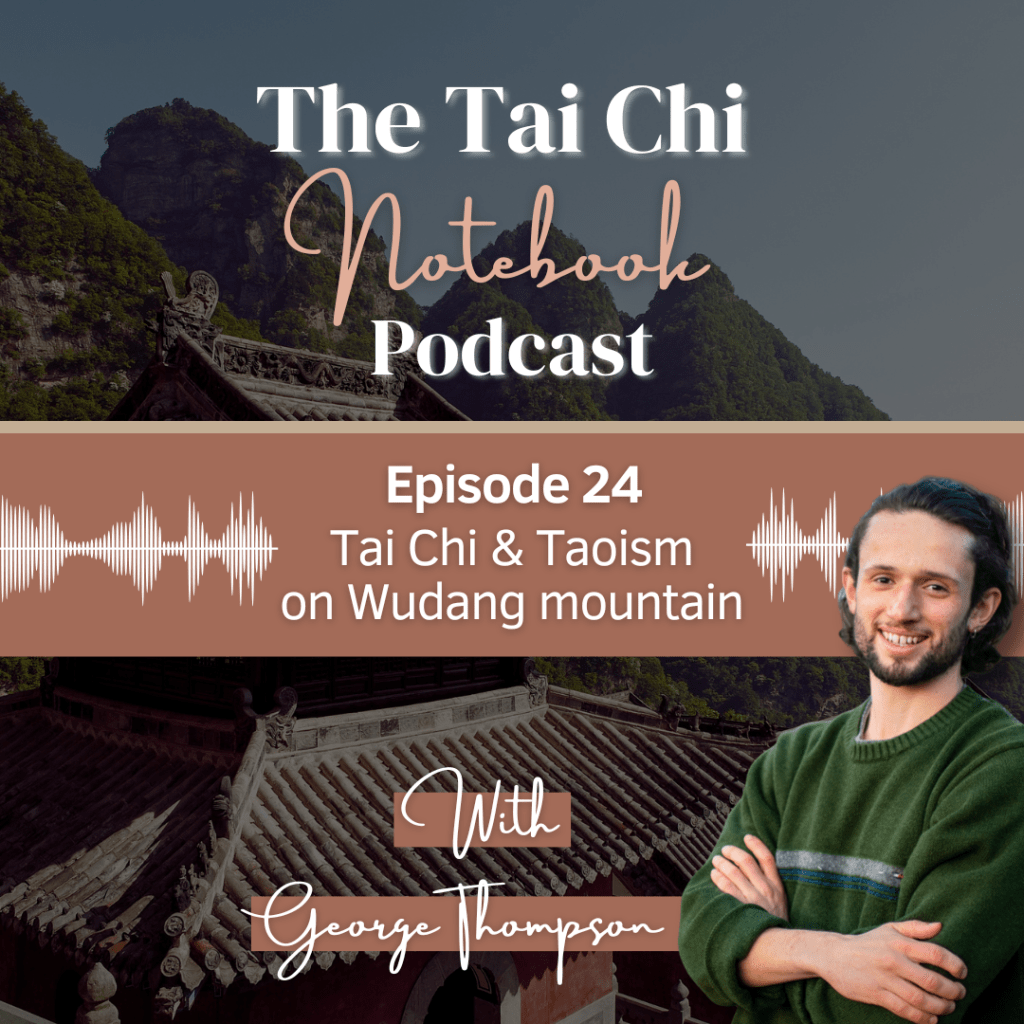
Ep 24: George Thompson on Tai Chi and Taoism from Wudang mountain

George Thompson is a film maker and Tai Chi teacher who studied on Wudang Mountain in China under Master Gu.

His videos at https://www.youtube.com/@George-Thompson have been watched by over 15 million people and has over 200K subscribers. He runs the Wayfinder Academy at https://www.wayfinder.academy through which he teaches online courses for balanced living.

In this episode I ask George what it is like to live and train Tai Chi on Wudang Mountain, what Wudang Tai Chi is like and what lessons he’s learned from Taoism.

You too can learn from George’s teacher, Master Gu, 15th generation of Wudang Sanfeng Pai of Wudang mountain via his online learning site at https://www.taoistwellness.online/

Click on the 7 day trial option, then use the coupon code TAICHINOTEBOOK when you sign up and you’ll get a lifetime 8% discount. That’s equivalent to one free month a year!

You can get a similar discount from George’s website https://www.wayfinder.academy/ using the same discount code TAICHINOTEBOOK when you sign up.

Podcast.

Happy World Tai Chi and Qigong day (for yesterday)!

Yesterday was World Tai Chi and Qigong day (note the crazy mix of Wade-Giles and Pinying Romanisation going on there!)

So, I hope you celebrated the day by doing some sort of practice somewhere. I saw a couple of posts in my feed showing groups practicing Tai Chi in the park. Here’s one taken by Donald Kerr of Spinning Dragon Tao. Check out his YouTube channel.

Just a group of people getting together and peacefully practicing Tai Chi. Given the state of the world today, that’s no small thing.