(How to) Move from the centre

Let’s get this thing moving!
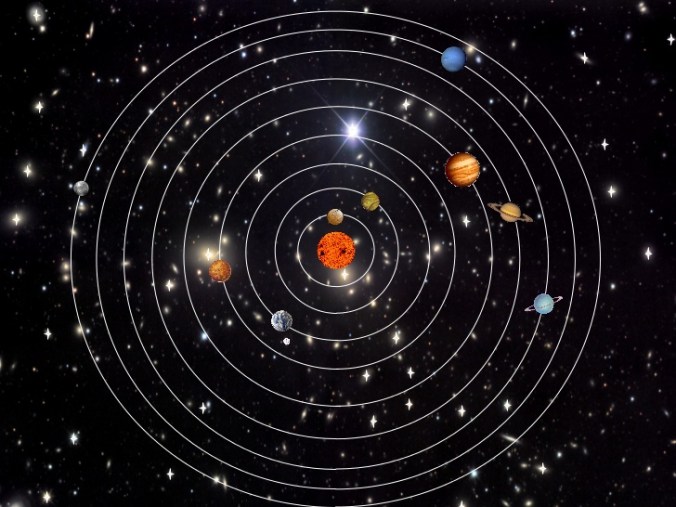
solar-system-fully-animated-1-728


It’s pretty well established now that you need to ‘move from the centre’ in Tai Chi – (or ‘center’ if you’re American). But what is the centre?

In the ‘internal’ model of moving the body in Chinese martial arts, the centre is expressed as the ‘Dan Tien’, the point roughly an inch below the navel and 2 inches in from the surface. This is where you put your mental focus to move your body from. So, rather than the arm movements coming from the shoulders they come from the torso, which is turned by moving the waist, which is, in turn, powered by moving the dantien. So it all works together, but with the movement coming from the dantien.

The problem with moving from the centre like this is that you can do it roughly correctly and your movements will still be flat (for want of a better word) and lacking power. Sadly, most of the Tai Chi you see demonstrated is like this. I could post a video, but it would seem like picking on somebody, so I won’t – but just search YouTube for Tai Chi videos and ask yourself if they look powerful or not. It’s far too easy to have the dantien ‘floating’ on top of the hips, so that the legs are just propping it up, rather than being involved. To make the movements truly powerful you need to get the legs involved.

As it says in the classics, the jin (power) should be…

“rooted in the feet,
generated from the legs,
controlled by the waist, and
manifested through the fingers.”
If you imagine a triangle drawn from the two feet up to the dantien, that’s the power source of Tai Chi. So, as the dantien turns, so the legs need to spiral in and out to help support the movement and transfer this spiral force to the rest of the body.

Chen Xiao Wang explains it very well in this video. After talking about the legs and rotating dantien he goes on to talk a lot about Qi and Yin and Yang, which can be confusing, but just concentrate on what he says at the start for now about the legs working with the dantien to power the arms.

Of course, there’s more to it, which he goes on to discuss, but that’s for another time.

Stand like a balanced scale

On being upright

Harmonious movement.

This Alexander Technique article on staying upright brought back some thoughts I have on Tai Chi, and being upright, that I thought I’d share.

Being balanced is a big deal in Tai Chi. I mean, if you’re going to move that slowly through a set of movements, you might as well make sure you are on balance while you do it, right? But what exactly is ‘balanced’ in a Tai Chi sense? The Tai Chi classics famously advise: “Stand like a perfectly balanced scale and move like a turning wheel” whilst also “Don’t lean in any direction; suddenly appear, suddenly disappear.” Of course, what is meant by those words is open to interpretation.

Being ‘upright’ is a bit of a contentious subject in Tai Chi as some styles advocate an active ‘lean’ in their forward postures, yet because there’s a staight line between foot and head they see it as still being balanced.

In terms of fighting, it’s hard to do a jab without a bit of a lean, so unless you want to start off your sparring career by fighting like a robot with your chin up, ready to be knocked out, I’d advise going with the protection that a slightly-leaning fighter’s stance offers:

Bruce Lee showing his lead straight.

Bruce Lee showing his straight jab

…. that is, until you are really comfortable with it. Then you can make it your own. For instance, take a look at the stance of current interim Featherweight UFC champion Connor McGreggor.

Beautiful counter punching from McGreggor.

See how ‘upright’ he is? It enables him to move fluidly and counterpunch very effectively. He knows when to lean, and when not to. In fact, I’d say he’s perfectly embodying the words “Stand like a perfectly balanced scale and move like a turning wheel” and “Don’t lean in any direction; suddenly appear, suddenly disappear.”

Was this what the authors meant when they wrote the Tai Chi classics? Who knows. They were written in another time and another place, by gentlemen who may have had no connection with what would be known as ‘prize fighters’ in their day. They might, even, have looked down on them as mere pugilists, existing on a lower strata of society. It’s impossible to say, but if you look at what remains inside the family lineages of Tai Chi – the Yangs, the Chens – then it seems to have no connection to two men duelling with gloves on. Only some branches of the Wu style seems to have branched off in this direction. But this is another topic, for another time.

Either way you look at it, a head that’s directed upwards (and by which I mean, suspended as if by a thread from your crown, not by looking upwards) offers you the most options in terms of mobility because the body is free to move. You are aligned with gravity.

Watch Systema expert Vladimir Vasiliev move and you can see the same thing.

He ducks his head when he needs to, but notice how ‘upright’ he is most of the time?

To go back to that article I kicked off with for a second:

“We tend to be overly forward oriented just because of the fact that most of what we do all day is in front of us. Then there is the tendency to be future focused on all the things that have to get done instead of being present with what you are doing as you are doing it. With these two things in mind, you can easily understand how you can lose a sense of the back of yourself as you get pulled forward.”

I notice this. I work at a computer all day, and occasionally notice that my head is always being pulled forwards into the work I do (writing). It takes a bit of mental effort to bring myself back into the present and my posture back to being directed ‘up’ as I sit, not slouching or drawn forward.

When you sit in a meditation posture long enough you start to notice your habitual tendency to lean forward. It’s subtle. When you sit ‘back’ into your hips and align your head over your hips you really notice how you can rest in your structure with less effort. The whole body can relax into the present moment.

I notice it in my Tai Chi, too. It takes strong awareness to be able to stay ‘upright’ doing the form. My habit is to slump. My challenge is to stay upright.

The uncarved block

Simple is effective

Know honour,
Yet keep humility!
Be the valley of the universe!
Being the valley of the universe,
Ever true and resourceful,
Return to the state of the uncarved block.

Tao Te Ching, chapter 28

Sometimes we just make it all too complicated, and we forget the wisdom of the uncarved block. This video is taken at a Dennis Jones seminar, showing how to apply martial arts to real self defence. Basically, he’s most concerned with positioning himself (movement) and then delivering all his power to the desired target in one go.

I like the way he’s taken his art (Karate) and looked at what the kata is telling you about movement, and not taking the moves as literally the only way you have to do it.

The mother of all movement

How one thing leads to another

16

Teaching today’s lesson we strayed into the martial applications of one move the student was having a hard time getting just right. It was a transition move between two recognisable postures, a kind of spiral action of both hands around a circle. In reality of course, there are no fixed postures, and no transitions between them, but when teaching beginners you have to start somewhere, so we did.

To help him get the idea of the way the hands move I showed him an application – “punch me”, I said. I deflected his punch with my left, reached through to the back of his head with my right and spiraled my hands to bend him over, ready for a knee to the temple or to be flipped right over. After we’d worked on this for a bit and he’d ‘got it’, I had to then explain that there was no one application for each move. When you break it down, the move in the form doesn’t work exactly like that application I showed (you have to reach in deeper to get your hand around the back of their head than the way you do it in the form, for example), but you can easily see how it’s the same thing really.

Each move in the form is the mother, and the applications are the children – each one subtly different. I can come up with a lot of applications for each move. For this one I had a strike, a choke, a throw, etc, all with slightly different emphasis. It’s endless, really.

After you’ve delved around in a few applications you need to come back to the mother movement, the one that gives birth to them all.

The road less traveled

What I’m actually teaching is…

The road less traveled

The road less traveled

“He stood about 20 yards away from me, and I closed my eyes and I could feel the power of his chi coming out of him, pushing me over”

So said my latest Tai Chi student, as we were talking about what styles of Tai Chi he had done before. I just sighed and said “Sorry, but I don’t do any of that. Derren Brown can do it very well though…” and carried on with the lesson, never returning to the subject of Chi again. He didn’t seem to mind. In fact, he seemed to quite enjoy the focus on correct movement – it seemed rather new to him…

I only teach on a one-to-one basis these days. It’s much easier format than teaching a whole class of people, all at different levels, and you can really drill down into what needs to be worked on right now with the student for them to improve. Most of the people I teach are complete beginners, which is fine, but occasionally I’ll get somebody who has had some previous Tai Chi experience, as was the case here. In general, this is more fun, since I can usually ramp up the amount of detail in what I’m teaching. However, it can throw up a few curve balls, like the above.

I often wonder what will happen when I refuse to go down the road of “chi tricks” with new students in conversation or teaching. Will they decide I’m not the enlightened Chi Master they were searching for, and leave disappointed? Will they think I don’t have the ‘real thing’ (whatever that is)?

In the end I’ve decided not to worry about it. I just teach what I know I can do, and leave it at that. It’s up to them if they want to say. They usually do.

Towards the end of the lesson (which went really well, actually) I remember saying “what you’re trying to do here is to learn to use your body’s natural power, through the movements of Tai Chi. The co-ordinated, natural power of the body in motion, which we call ‘sung jin’ or ‘relaxed force’. You don’t need to get too attached to the movements themselves – they’re just examples – it’s what they’re trying to teach you that’s important.”

I think that sums it up nicely.

The Tai Chi magician

Woo! Everywhere is Woo!

Tai Chi, like all other traditional martial arts, contains some aspect of performance, show or magic trick. See my previous post about meeting Scott Phillips for more on this idea, but in short, public demonstrations for entertainment have always been a part of the traditional Chinese martial arts. Martial arts street ‘buskers’ doing gymnastic performances, kung fu schools doing en masse demonstrations of their skills, the Shaolin Monks touring the world with their concrete-breaking, skull-cracking performances, etc… The list goes on.

In Tai Chi the publicly-expected demonstration of skill has turned into something more subtle and suitably ‘Taoist’ than merely breaking concrete blocks, or wooden boards. It seems to come down to a ‘master’ figure demonstrating how far he can push a student back with a very light touch, and while it may not be explicitly stated, the assumption is that the master is demonstrating his Chi Power. Sometimes touch is not even necessary and it is done through thin air by the master merely waving his hands at the student. The bigger the reaction of the student then the better the master, or so the unspoken rule seems to go.

Yes, there can be some functional use to this sort of pushing demonstration as a teaching aid. From the students point of view they get to feel what it’s like when somebody with skill puts hands on them and pushes them backwards. Ideally, from a Tai Chi perspective, it should feel different to a muscular, forceful push. It’s not much use as a self-defence technique, but it’s good for demonstrating the type of force you want to be developing in Tai Chi – using the force of the ground via the legs, controlled by the waist and channeled into the hands. It’s a smooth type of effortless power, rather than using the shoulders or back to do a muscular ‘stiff’ sort of push. The difference is subtle and getting hands-on with your teacher is essential if you’re ever going to learn what it is, because you need to feel what it is not, too.

The problem arrises when when the student’s reactions become hyped up in public. In an effort to not let their teacher lose face they can start to over-react to the push. They start to stiffen their arms, and straighten their legs, resulting in a curious type of ‘hop’. It’s not like an agreement was explicitly made before the demonstration that the student should have a big reaction, it’s more that he starts to subconsciously over-egg his response so he doesn’t make his teacher look bad. Anybody who has taught a group of people Tai Chi will be familiar with this phenomenon. Whenever my students tried to ‘fall over’ for me in a demonstration I always reprimanded them and tried to get them to stop ‘helping’ me do the demonstration, and just act like a normal attacker.

On the other side of the coin, you could decide to view these kind of demonstrations as a simple magic trick. A magician (the teacher) is showing a magic trick, and you all know it’s not real, so just enjoy it for the spectacle it is.

At The Fajin Project Facebook group a chap called Stuart Shaw, seems to have no patience for the Tai Chi magician. He’s done some brilliant breakdowns of how various ‘masters’ of Tai Chi do their tricks (he calles them “Woo Woo”). You might have to join the group to view the videos, but I’ll try and link to them below. Why watch it? Well, if your Tai Chi teacher does this stuff to you, then it’s worth being aware of what’s really going on:

>> Woo Fajin Analysis — Adam Mizner Jalapeños <<

>> Analysis of Woo-Fajin << Michael Phillips

>> Analysis of Woo-Fajin – Seated Push Trick << Chee Soo

>> Woo Fajin Analysis – Huang Shyan vs. Liao Kuangcheng <<

The best way to stay on a sinking ship

Alignment matters, but not that much

We talk a lot about alignment in Tai Chi, but often this is done by looking at a static posture. The hip is aligned with the shoulder here, the elbow aligns with the knee here, etc… We do this because it’s easier to do it this way, but we should never forget that alignment is something that happens as you move.

Biomechanist Katy Bowman discusses this often ignored movement aspect of alignment in the first episode of the Katy Says podcast.

Give it a listen. I particularly like the analogy that ergonomics is the best way to stay on a sinking ship.

Using your opponent’s force against them

A neat twist on an old idea…

From the Treaste on Tai Chi Chuan 

“When the opponent is hard and I am soft,
it is called tsou [yielding].”

The idea of yielding to overcome is the main combat strategy of Tai Chi Chuan, but there are various ways of thinking about this idea. It’s another way of saying to use your opponent’s strength against them. Recently I found another way of thinking about this that you might find useful.

From Buckling the Crippler 

“In the martial arts, there is often talk of taking the opponent’s strength and using it against him, but normally this is illustrated in books and films with a woman performing a judo throw on a male aggressor. But I contend that there is no better example of using and opponent’s strength against him than drawing him onto your blows and having him double the force for you.”

The value of An “Push” in Tai Chi

Don’t push me!

One of the things that get belittled about Tai Chi Chuan so much is the amount of pushing that goes on. From the point of view of other martial arts it’s impossible to look at people struggling for years to effectively push somebody away in the most relaxed way possible and not wonder if they’ve missed the point of martial arts entirely.

Tai Chi push

Of course, the standard answers to this type of criticism are that “if you can push, you can hit!”, “it’s just a training tool”, “it’s so nobody gets hurt”. This may all be true, but there never seems to be any hitting going on, long after the ability to push has been acquired.

Perhaps another way to look at it is that pushing, far from being an ineffectual tool in the fighters arsenal, is actually a very valuable skill to acquire. Read this article  about the famous kick-boxer, Giorgio Petrosyan. The summary is, he uses the push technique effectively to counter pretty much all offense that’s thrown his way.

Pushing the opponent away.

Perhaps Tai Chi needs to reclaim its “push” as just what it says on the tin – a push – and stop trying to pretend it’s for something else. Because, frankly, it’s pretty damn useful.

It’s interesting that a lot of Tai Chi people have Push “An” as a downward push – almost like a takedown done from a push, but without the leg trip. I’m dubious about this – I don’t think it works well beyond the Master’s doe-eyed students. Looking at the motion of any Tai Chi form, you can see that the motion of An is up, up, up and away. I’d suggest that’s how it’s meant to be used. I think some of the ‘push down’ is to crowbar Tai Chi into a philosophy.

The absurdity of Single Whip

Yes, it’s pretty absurd

/home/wpcom/public_html/wp-content/blogs.dir/a6c/3733799/files/2014/12/img_0635.jpg

This is the ‘end point’ of the Single Whip posture. Like many, if not all, the postures in a Taichi form, it doesn’t look much like something you’d see in a fight. Why is this?

Even when demonstrated by the practical, hardcore, or no-nonsense tribe of Tai Chi practitioners, it’s a pretty absurd fighting application. That’s just my opinion, so feel free to reject it, but to be honest, a lot of Chinese martial art is pretty absurd, when it comes to fighting applications (“Monkey steals the peach!”, anyone?) Even the ruthlessly practical styles have a few applications that are aways on the edge, but anyway…

I was picking up on this old post from internal strength adept Mike Sigman:

“Silk-Reeling and the Taiji of Yin-Yang

There are two basic martial-arts postures in Asian martial-arts: Open and Close. In “Close” there is stress inward along the front of the body and the inward parts of the limbs; the knees and elbows and the joints bend and are generally under contractile forces of the front. Wing Chun’s basic stance, Uechi Ryu karate’s basic stance, “Play PiPa” (in Taiji), the closed aspect of “Squatting Monkey” (in Dai Family Xinyi), and in many other martial arts can be found variations of the Closed position of stances.

In “Open” the expansive forces from the back of the body and the outsides of the limbs pull the knees and elbows outward and the body lengthens, joints opening. Postures like “Single Whip” exemplify Open. In classically correct postures there is always a balance of the forces of Close and Open or Yin and Yang.”

So, if the point of practicing a Tai Chi form is to get used to going from open to closed in a sequence of postures, perhaps it becomes less relevant what those postures are. Of course, this implies that the form isn’t really for fighting, and that it’s for teaching a body method, which you then use in fighting… which means that the “fighting” probably doesn’t look any different to regular “fighting”, whatever that may be….

If you want to go from close to open then why not create a nice series of postures rather than simply repeat the same movement over and over. That way you get used to doing it in a good variety of positions.

Anyway, food for thought.