Here’s part 7 of my 8-week Tai Chi course. This week we look at the negative circle and experimenting with making our circles smaller while trying to keep the connection we’ve built up already.
Here’s part 7 of my 8-week Tai Chi course. This week we look at the negative circle and experimenting with making our circles smaller while trying to keep the connection we’ve built up already.
Mike Sigman posted a video on how to use the power of the ground in your movements recently and it’s one of the best explanations I’ve seen. I’ve shared it below. It’s a simple concept to understand (but hard to do under pressure) so I think this can be applied to any martial art.
I like videos like this because they take a lot of the mystery out of Asian martial arts. Quite often you’d need to be training in a system for a number of years before you were taught these concepts, mainly due to a traditional culture of secrecy. In contrast, Mike’s approach is to start with these concepts right at the beginning of your training, so you don’t go off on the wrong track. Take a look:
Happy Father’s Day! (UK version  )
)
To celebrate Father’s Day I’ve got my oldest son in this episode, providing a bit of feedback for me to work with. This week we look at the role of the mind in directing forces to your feet (the ground) and sending them back out
Here’s part 4 of the course. This week we focus on breathing. I cover the topics of normal and reverse breathing, then show a couple of different exercises that will get you on the right track for applying the breathing methods to the movement we are working on. Finally, we integrate the breathing into the movement, preserving all the progress we have made so far. Once you get the hang of it those breathing exercises I show are not required anymore, as you should be integrating it into your main exercise.
This week is more subtle than work showed previously. An inner focus will be required. Good luck! I’m happy to answer any questions you have.
I just wanted to say a few words about natural movement, and what we mean by it in Chinese martial arts, before I post part 4 of my 8-week course on Tai Chi movement on Sunday.
If you’ve been following the videos you’ll notice that I did a kind of ‘universal’ open and close exercise in part 1, which cycles between two phases
Open:
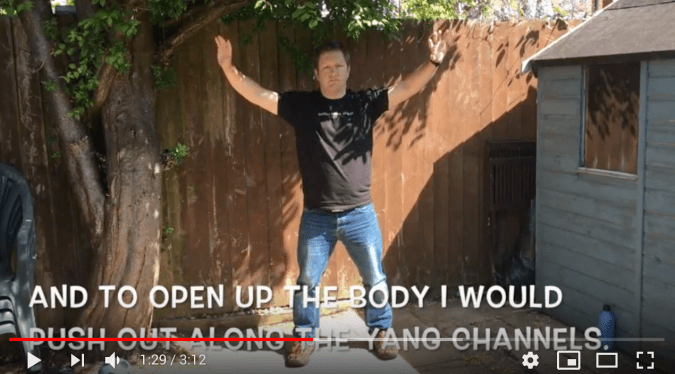
and close:
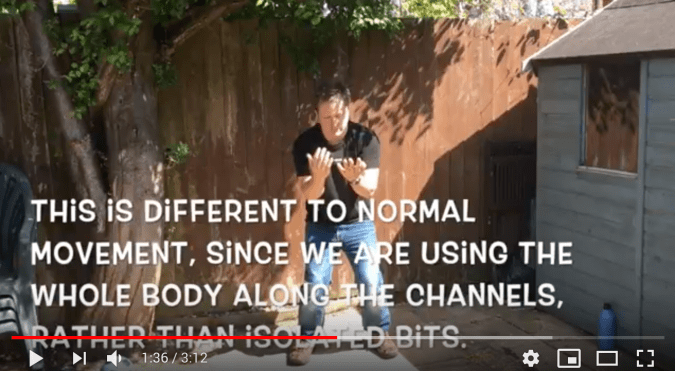
From: https://www.youtube.com/watch?v=fV3DaNZz3hI
If you’ve been following up to week 3 you’ll know by now that it’s not a case of just mimicking these postures – you need to be going into and out of them using the elastic connection you’ve been developing by doing the arm circle exercise.
You can see these open and close postures in nature all the time, in movement – when a squid or octopus swims it kind of pulses between open and close.
Octopus:
Open:

Close:
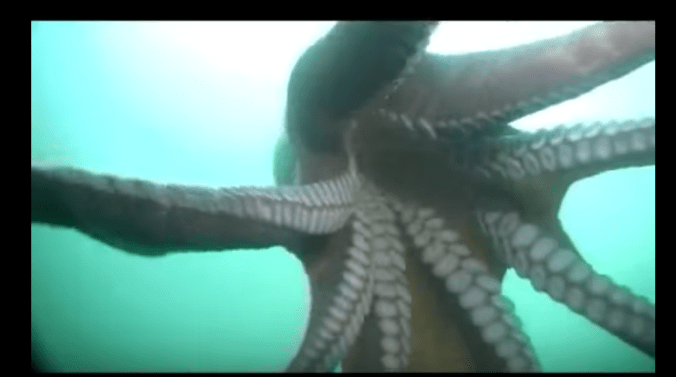
From: https://www.youtube.com/watch?v=oxawhfXGGt8
The classic example in the animal world is the Cheetah, since it’s the most majestic animal when it comes to running. It cycles between open and close quite obviously too, which helps.
Cheetah:
Open:
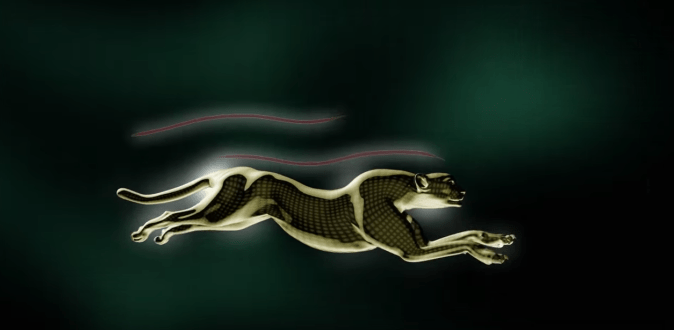
Close:

From: https://www.youtube.com/watch?v=V8vejjVgIHg
In the Chinese martial arts, all the ‘internal’ martial arts like Bagua, XingYi and Tai Chi should be using open and close. The martial art that best exemplifies it though is XingYi, as all the 5 element fists go through a very obvious open and close cycle.
For example, in Pi Quan:
Closing:
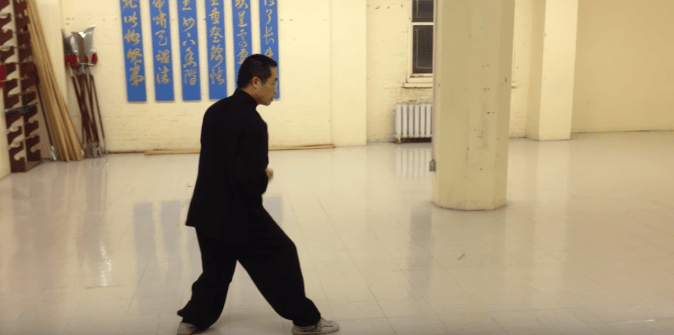
Opening:

Closing:

from: https://www.youtube.com/watch?v=9HNML_k9a-s
When we say “natural movement” is used in internal arts, this is what is being talked about.
Of course, you can use the open and close sequence in everyday life too. Just yesterday I was kicking a ball about with my kids in the park and I started to play around with open and close as I kicked the ball, rather than just doing it with my leg in isolation. When you use open and close your whole torso and back get involved – I was quite surprised by how much extra power and direction I could give the ball when I started to use open and close to kick it. Like everything, it starts off big and clumsy and first, but you soon learn to remove the excess movement and refine it.
Look out for part 4 on Sunday when we’ll be taking a look at how breathing factors into the whole thing.
Good news! I’ve started filming a short 8-week Tai Chi Notebook course, and you can get it here, for free.
As usual things come together by chance (or maybe a it’s fate) but either way, a friend asked me to show them how to do “this internal stuff“, so I was about to shoot them a simple video on the basics, then I realised that there’s too much to cover in just one video, so I planned out 8. Then I started to get creative and made it look a little bit professional, and the end result is what you’ve got here – a short YouTube course called Pulling earth, pushing heaven.
In week 1 of the course we cover the concept of “maintain and extend”. Each week will focus on a different aspect until we get to the point where you’ve got the basic idea of “Tai Chi movement”. Of course, this is just ‘foot in the door’ stuff, but I’d like to think that after following along for 8 weeks, and doing it every day, you’d at least have the correct foot inside the correct door. Look out for part 2 next week.
This is a great video from Forrest Chang showing what Jin is in Chinese Martial Arts and how it can be used.
As he explains in the video, he calls these “stupid jin tricks” because they’re the sort of thing a teacher would look at you like you’re stupid if you asked him to do them. Somebody trained in internal martial arts should just be able to do these.
There is another thing that’s worth pointing out that he doesn’t explicitly state, but which should be obvious – there’s one jin.
All the early books on Tai Chi that came out in the 80s started listing all these different Jins, and I think that’s lead to a lot of misunderstanding that they are all separate things – when in reality there is one Jin in Chinese martial arts, and lots of ways of using it.
Once you’ve got a handle on what he’s doing it’s worth watching videos of famous teachers of Chinese Martial Arts and trying to analyse what they’re doing from a Jin perspective. I find their own explanations are often not very clear, so it’s better just to watch what they’re actually doing:
Chu Shong Tun (Wing Chun)
Sam Chin (Zhong Xu I LIq Chuan)
Adam Mizner (Tai Chi)
Great video by Chen Zhaosen on putting the internal into your Taijiquan practice so that it becomes Taijiquan not Taiji Gymnastics. Of course, it should already have been there, but we all know that already, right? 🙂 The secrets are all here, hidden in plain sight. Chen Zhaosen on breathing:
Master Chen Zhaosen is a highly accomplished Tai Chi master from Chenjiagou (Chen Village) in China. Here is his “old form routine number 1”.
If we think of ‘basic Jin’ as being the ability to direct the solidity of the ground through the body, from the feet up to the hands, then there are four basic directions we can use this power in.
And since you can go away from the body and towards the body on both the x and z axis (to the sides and in front and behind), that makes 6 directions in total.
Here’s Mike Sigman explaining the 6 directions and Jin:

Here’s a seminar clip I came across recently of the legendary Rickson Gracie teaching in Tokyo, Japan this year. He’s going over concepts that should be familiar to Tai Chi people, or in fact anybody who has a deep understanding of Chinese martial arts. It’s the concept called “jin” – often translated as refined force. It’s using the power of the ground, transmitted through a relaxed (“sung”) body to produce an unusual strength that isn’t reliant on excessive muscle use (“li”).
Jin is talked about all the time in the Tai Chi Classics, most notably on the issuing of force with the famous phrase:
The jin should be
rooted in the feet,
generated from the legs,
controlled by the waist,
and expressed through the fingers.
What’s interesting to me is why it’s only really Rickson Gracie (and his students) who talks about and demonstrates this stuff in BJJ? Did he find it elsewhere and integrate it, or was it always there if you had eyes to see it?
Anyway, here’s his workshop:

