Internal power and the 3 internal harmonies: Going beyond words like Xin, Yi and Qi to direct experience

Almost by accident I watched Onama vs Landwher from UFC: Marlon Vera vs Dominick Cruz this morning and heavens above, that was one hell of a fight! Possibly the fight of the year. I’ve no idea how you’d score it. Landwher won by decision, but it was possibly the MMA fight of the year. Wild exchanges throughout with both fighters being so tired they could hardly stand up, but somehow kept going. It looked like they both had almost beyond the levels of human endurance, going from looking so tired they could barley move to pulling off flashy 3 move combinations.

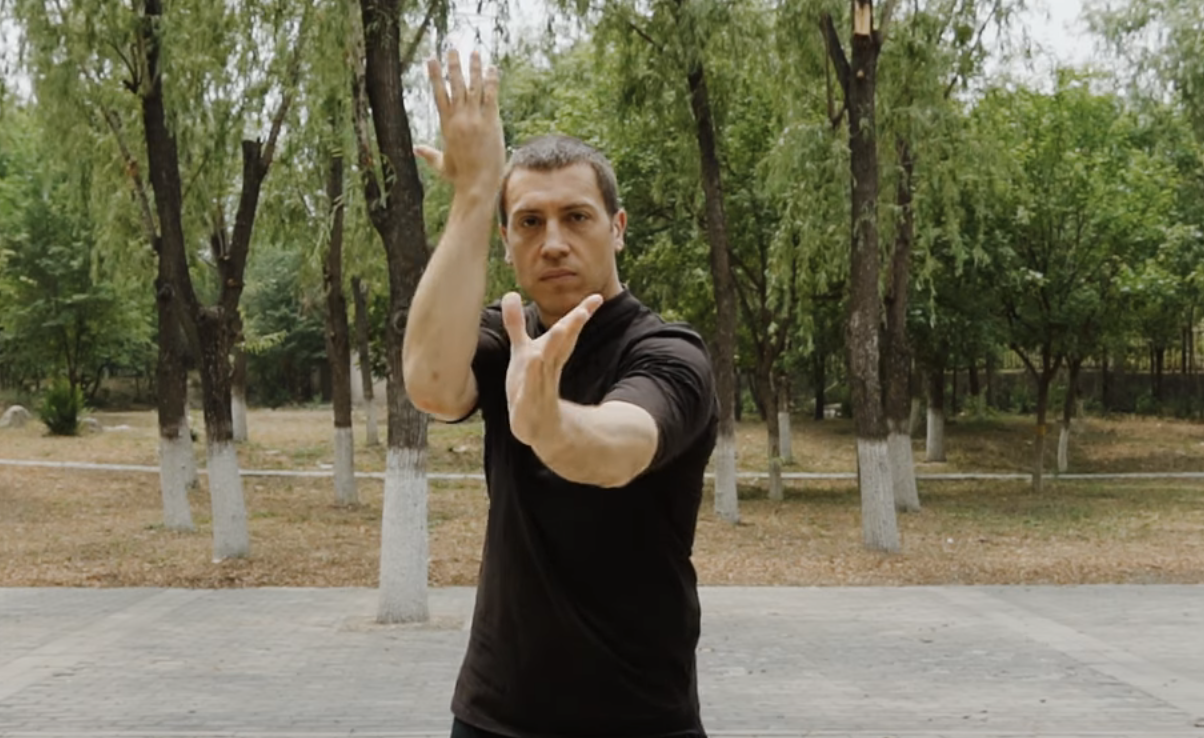
You could almost see their spirit rising within to propel them on. It reminded me of all the phrases about the internal harmonies (san nei he) that we use in the Internet arts. The Xin (heart) leads the Yi (intention/mind), the Yi leads the Qi (energy to work) and the Qi leads the Li (physical movement). Initially this seems rather simplistic, say if you want to do something like make a cup of tea then you first have a desire to do it (heart) that travels to the brain (yi) that decides and then it ends up in a physical movement (li) and you find your feet moving you towards the kettle.

But that process happens automatically in humans and all animals, so why do we need to make a big deal of it and describe all the parts that build up to making an automatic process happen?

It’s often explained as putting the intention and will (the brains and heart) behind the movement. You can do things with a sense of purpose, or you can do them absent mindedly. In the internal arts, like Xing Yi, Bagua and Tai Chi, your actions need to have a sense of purpose. Your mind needs to be on the job, not half engaged. That’s one reason, but I think there’s more to these internal harmonies than just this.

I remember in BJJ training sometimes being so exhausted it was like my mind left my body and I became somewhat detached from my surroundings. It’s at moments like that that you start to be able to feel your “spirit” or mind as an identifiable thing. Through a sheer act of will you can force your mind to not give up and get back to the job and it can give you the energy you need to carry on fighting. That’s what I saw happening in Obama vs Landwher. A sheer force of will was being used to make them continue – their internal was leading the external.

Frankly, most people training only internal arts without hard sparring pay a lot of lip service to the internal co-ordinations, but do they ever reach an intensity of training where they can actually feel these things as tangible elements?

I’m not saying that you need to get an an MMA cage to experience your internal state under extreme physical stress before you have any idea what it is, but you can experience it in a safer way through things like Jiujitsu. Maybe Systema, too. Just some food for thought, and another reason why I think all Tai Chi instructors who re physically able should try and get a blue belt in BJJ if they are teaching the art beyond the health aspects.

There’s a risk, when reading this that people might think that using your Yi, or Xin in Tai Chi technique simply means to furrow you brow, put on a mean face, stare hard at something, get really tense and act like you really mean it, man. Because that’s not it either. That’s not what using “martial intent” or Yi means in internal arts at all. If I see people practicing internal arts like that I think it’s just bad karate. Not that there’s anything wrong with karate, of course.

Your internal state can be serious, but come from a place of calm. It’s a strange contrast between being expansive, yet laser focused, like the eyes of an eagle who is high up in the sky looking for prey. He’s taking in all his surroundings, but can pinpoint down on a single point when required. That’s using the 3 internal harmonies properly.

I think this is a Kite, not an Eagle, but you get the idea. Photo by Flo Maderebner on Pexels.com

The Tai Chi classics say:

To fajin,
sink,
relax completely,
and aim in one direction!

There it is – the (sung) relaxed body is the first requirements, once you have it you can ‘point your mind’ in the direction you want your power to go, so that the internal movement matches the external movement. When the inner and outer harmonise together, then you have internal power.
Can traditional masters beat MMA?

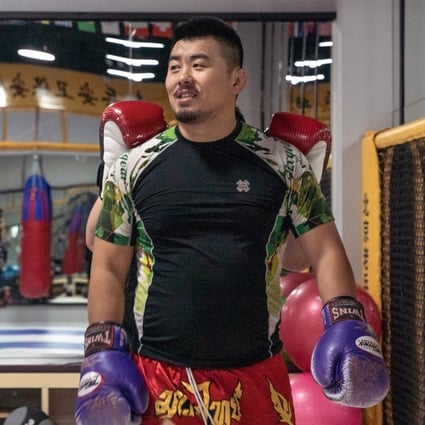
Friend of the Notebook, Byron Jacobs, who runs the Mu Shin Martial Culture Youtube channel and the Hua Jin Online Learning Program for Xing Yi and Baguazhang, just posted this monologue about Xu Xiaodong and the challenge matches that happened between him and various (self proclaimed) Chinese martial arts masters.

Now we’re a few months/years away from the high point of the Xu Xiaodong controversy it’s good to get a reasonable perspective on the matter from somebody who actually knows him and moves in the same martial arts circles in China.

It’s quite a long talk, but you can think of it like a podcast and listen to it while you’re doing your conditioning exercises. Wait, you are still doing those, right? 🙂

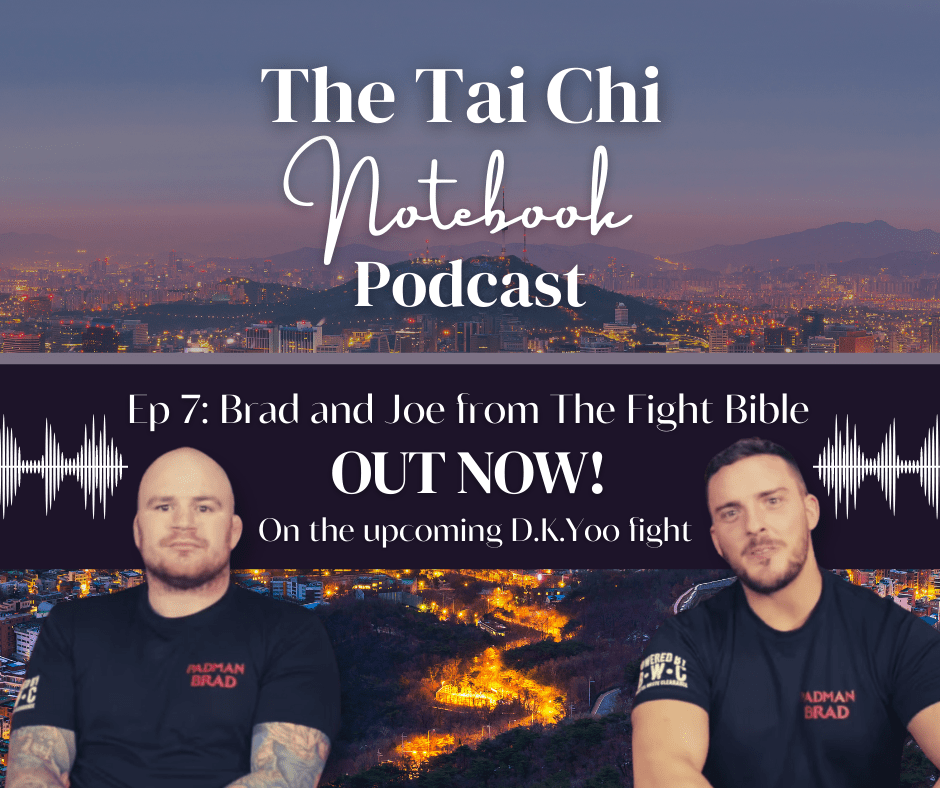
Special podcast edition: Brad and Joe from The Fight Bible on Brad’s upcoming fight with D.K.Yoo

Hello and welcome to a special bonus edition of the Tai Chi Notebook. This time I’m interviewing Joe and Brad from The Fight Bible, a popular YouTube martial arts channel.

I used to train jiujitsu with Brad back in the day, before he went on to become a UFC fighter, so I’ve known him for years. Brad is retired from the UFC now, but he recently accepted a fight offer from the famous D.K. Yoo, who teaches martial arts seminars all over the world. The fight is scheduled to happen on December 4th on pay-per-view here:

Brad and Joe are flying off to South Korea in just a few days for a boxing match that looks set to make a huge impression on the martial arts scene. 

So, let’s find out how it all happened, how Brad’s training is going and what the boys think is going to happen on December 4th.

Criticising solo forms – again

In this post I want to ask a question. I’m going to give an answer too, so the question is slightly rhetorical, but I think it needs to be asked.

“Why do internal martial artists spend so much of their time criticising each other’s solo forms?”

Let’s break this down – firstly, is this statement true?

I’ll give you one recent example to act as a poof of the statement:

As somebody who has been involved in discussing internal martial arts on the Internet since around the year 2000 I can attest that this happens all the time. In fact, I would say that it’s the majority of the discussion is of this nature.

You don’t need to watch the whole video. It’s long, boring, petty and doesn’t display a particularly high level of etiquette or skill.

It’s essentially one Chinese martial artist ciricising another Chinese martial artists for the same thing over and over, which is sticking his elbow out a bit too much. I know! The horror!

Ok, he probably has a point, but you could easily turn this around and criticise all the mistakes that the tall skinny guy is making too.

The question I have is why did he make this? Why must internal arts people spend all their time criticising each other’s solo forms?

Look at other martial arts – especially the ones that have a sporting side. They don’t tend to do this. MMA people do not do this,

With internal arts it’s an endless debate on degree of uprightness, too much or not enough opening of the kua, level of relaxation, sinking enough or not enough, degree of the knee flextion, etc. The list goes on…

But ok, here’s my caveat. Internal arts are obsessed over these details because they matter. The amount of opening and closing of your kua dictates the amount of power you can produce, and the quality of your movements. The position of your elbow has a direct connection to whether you can produce whole body power or not.

But nobody has the same set of rules that these things are being judged by. In theory, there should be a standard set of rules, but in reality, different styles do things in different ways, and always will. I’m more inclined to think that obsessing over details of solo forms is a bit of a trait of internal arts and less valuable than seeing what a practitioner can do in application/sparring.

The language of internal arts is also based on the same ideas. People go to their Tai Chi teacher to get corrected. The language itself is kind of negative. Nobody talks like this is in sports. You spend time with a good boxing coach and get improved.

But, what do you think?

Podcast Ep 4: Discover the link between martial arts and Shamanism with Damon Smith

What is Shamanism? And how does it relate to martial arts? In this episode I catch up with my old, friend and teacher Damon Smith to answer some of these questions.

Damon is an incredibly experienced martial artist with a background in various Japanese and Chinese arts including Karate, Kempo, Xing Yi, Baji and Choy Lee Fut. And those are just a few of the arts he’s pursued to a very high level.

But despite being a great martial artist Damon’s true love has always been Shamanism.

And while he’s no stranger to banging a drum, Damon’s shamanism is not the hippy dippy sort of practice you might associate shamans with, instead it’s a very down to earth and practical art, much like the martial arts he does.

In this episode we talk about the link between martial arts and shamanism, and where the crossovers lie.

Podcast Episode 2: Byron Jacobs on Beijing martial arts

Episode 2 of the Tai Chi Notebook podcast is out!

Byron Jacobs is a teacher of Xing Yi and Bagua based in Beijing, China. He’s a student of the famous Shifu Di Guoyong and is heavily involved in the martial arts scene in Beijing. As well as training traditional martial arts he’s also a BJJ practitioner and competitor.

If you’d like to be taught by Byron in the arts of Xing Yi and Bagua, then he has an online learning platform available .

In this wide ranging discussion we talk about training Xing Yi, Bagua and Tai Chi and whether Wu Shu will ever get into the Olympics. We also find out what it was like to train martial arts in Beijing during the Corona virus pandemic, and what the Chinese BJJ and MMA scene is like.

Show notes
—————

(9.45)
Byron’s Hua Jin Online learning platform
https://www.patreon.com/mushinmartialculture

(15.22)
Byron’s Mu Shin Martial Culture YouTube channel
https://www.youtube.com/channel/UCg_V6eznSvYOFz2naGlgRpg

(47.05)
DQ’d for Kicking TOO HARD? – Doctor Reacts to Olympic Karate Controversy and Knockout Science
https://www.youtube.com/watch?v=6QFxxM3QOws

(1.05.30)
Speed passing by Rafa Mendes
https://www.youtube.com/watch?v=Qu_9Lcdrh_w

(1.18.11)
Ku Yu Chang (Guruzhang’s) Yang style Taijiquan:
A STUDY OF TAIJI BOXING by Long Zixiang
https://brennantranslation.wordpress.com/2018/03/30/the-taiji-manual-of-long-zixiang/

(1.23.00)
Stand Still Be Fit by Master Lam Kam Chuen
https://www.youtube.com/user/StandStillBeFit

You can find it on all the usual places you find podcasts – search for The Tai Chi Notebook on Apple podcasts, Spotify, etc.. or here’s a link:

Spotify
Apple
Web

The current state of martial arts, with Dan Hardy

I’ve been listening to, and really enjoying, Dan “The Outlaw” Hardy’s recent interview on the Raspberry Ape podcast. With a background in traditional martial arts, Dan was a pro MMA fighter and official UFC commentator.

Warning! It’s long. Over 3 hours, in fact, it’s almost 4 hours long.

The issue of how long a podcast should be is always a contentious one – you hear a lot of people say it should be as long as a commute to work, so 20 minutes to half an hour, but I have no objections to something like this one, which weighs in at over the 3 hour mark. I’m an adult – I can handle the idea of not listening to something all in one go.

Dan has a lot to say about the current state of the UFC, MMA, traditional martial arts, combat sports, capitalism, the old days, growing up and more. It’s quite a run through of various related topics. His thoughts on self defence, violence and the place of MMA in society I thought were particularly interesting.

Give it a listen – just not in one sitting!

Pressure point striking is back!

Dim mak, pressure points, high kicks and nerve strikes! Along with permed hair, styled into a mullet, and blue jeans, these were part of the staple diet of kung fu magazines in the 1980s and 1990s. But pressure point striking quickly became something of a running joke once people found out that it couldn’t be applied in a real fight, you know, when somebody was actually trying to punch your face in, not just when they were standing in front of you passively in the dojo, happily waiting for you to strike their Gallbladder 15 or Lung 4 points.

The reputation of pressure point striking wasn’t helped by the many obvious charlatans peddling their fake pressure point striking systems on DVD and on seminar circuits. These ‘masters’ tended to only demonstrate their skills on their own gullible students, and they rarely seem to work on other people, who hadn’t been brainwashed to think they were the second coming. 

But while falling foul of reality, pressure point striking carried on a healthy second life in the fantasy-based genre of martial arts movies. For example, Crouching Tiger, Hidden Dragon had a great scene where one of the fighters is almost instantly paralysed by some quick pressure point tomfoolery until he can be released by yet more pressure point touching.

And in Kill Bill: Volume 2, the late David Carridine famously succumbed to Bak Mei’s legendary 5 point palm exploding heart technique, delivered deliciously by Uma Thurman. 

Even as recently as 2021, in the Marvel TV series, Falcon and the Winter Soldier, homage was paid to the pressure point movie trope with a body-popping sequence that made the Winter Soldier’s metal arm suddenly detach from his shoulder and fall to the floor with a clank, turning him from super soldier into one-armed bandit with one simple cheat code.

However, if you ignore the mystical nonsense surrounding pressure point striking you’ll find that it is actually based on some pretty sound scientific principles. In a recent UFC 252 match Anthony Smith seemed to paralyse Jimmy Crute’s leg with a well-delivered calf kick. 

After the kick, Crute’s leg seemed to be unable to function in a way that was almost comical. Crute bravely tried to fight on, but his leg was so unusable after the strike that the ring doctor waved the fight off when he was unable to walk in a straight line properly between rounds. I’m sure I heard Pak Mei chuckle quietly to himself in his grave when it happened.

So how was this possible? The answer lies in nerves. 

As orthopedic surgeon Dr Lucius Pomerantz explains, on his YouTube channel, the phenomenon is called Drop Foot, and it’s what happens when the peroneal nerve sustains an injury. “When a nerve does not work the muscles that it innervates do not receive messages from the brain. When the peroneal nerve is injured the muscles that raise the foot at the ankle do not work – the foot drops down. Simply walking can be extremely difficult without the ability to raise the foot.”

So, there you have it. A pressure point strike achieved via a calf kick in MMA! I’m glad pressure points are making a comeback, and I hope we’ll see more of them in the future.

I just hope the permed mullet doesn’t make a comeback as well.