Tao Te Ching, chapters 8 and 61


51b4nahi0bl-_sx258_bo1204203200_

I was giving the Tao Te Ching the cursory glance I occasionally give it recently. I’ve got the copy shown above. I usually flick to a random chapter, read it three times and ponder it deeply. Well, as deeply as I am able to. I landed on chapter 61, and the next day I landed on chapter 8. These two seemed to be linked in theme, so I thought I’d say something about them.

Incidentally, I really like the Stephen Mitchell translation. I’ve no idea how accurate it is compared to the Chinese, but all translation seems to involve some interpretation, and I like the way he’s done it.

Here’s chapter 61:

61

When a country obtains great power,
it becomes like the sea:
all streams run downward into it.
The more powerful it grows,
the greater the need for humility.
Humility means trusting the Tao,
thus never needing to be defensive.

A great nation is like a great man:
When he makes a mistake, he realizes it.
Having realized it, he admits it.
Having admitted it, he corrects it.
He considers those who point out his faults
as his most benevolent teachers.
He thinks of his enemy
as the shadow that he himself casts.

If a nation is centered in the Tao,
if it nourishes its own people
and doesn’t meddle in the affairs of others,
it will be a light to all nations in the world.


and chapter 8:

8

The supreme good is like water,
which nourishes all things without trying to.
It is content with the low places that people disdain.
Thus it is like the Tao.

In dwelling, live close to the ground.
In thinking, keep to the simple.
In conflict, be fair and generous.
In governing, don’t try to control.
In work, do what you enjoy.
In family life, be completely present.

When you are content to be simply yourself
and don’t compare or compete,
everybody will respect you.


So, firstly let’s look at the imagery of water, one of the classic symbols of the Yin side of the Taiji diagram. Both chapters use water as a metaphor for the correct way of acting or being in the world.  It’s a theme that repeats through the Tao Te Ching, and also throughout the history of Asian martial arts, even in modern times. I’m thinking of Bruce Lee in the infamous interview where he says “Be water, my friend!”


I was reading another article about Wing Chun today by Ben Judkins, which also expanded upon this idea of softness overcoming strength, and how this idea has permeated Asian martial arts:

Early reformers in martial arts like Taijiquan (Wile 1996) and Jujitsu sought to shore up their own national identities by asserting that they brought a unique form of power to the table.  Rather than relying on strength, they would find victory through flexibility, technique, and cunning (all yin traits), just as the Chinese and Japanese nations would ultimately prevail through these same characteristics.  It is no accident that so much of the early Asian martial arts material featured images of women, or small Asian men, overcoming much larger Western opponents with the aid of mysterious “oriental” arts.  These gendered characterizations of hand combat systems were fundamentally tied to larger narratives of national competition and resistance (see Wendy Rouse’s 2015 article “Jiu-Jitsuing Uncle Sam” .

but as the author notes, the situation is often muddied

Shidachi appears to have had little actual familiarity with Western wrestling.  It is clear that his discussion was driven by nationalist considerations rather than detailed ethnographic observation.  And there is something else that is a bit odd about all of this.  While technical skill is certainly an aspect of Western wrestling, gaining physical strength and endurance is also a critical component of Judo training.  Shidachi attempted to define all of this as notbeing a part of Judo. Yet a visit to the local university Judo team will reveal a group of very strong, well developed, athletes.  Nor is that a recent development.  I was recently looking at some photos of Judo players in the Japanese Navy at the start of WWII and any one those guys could have passed as a modern weight lifter.  One suspects that the Japanese Navy noticed this as well.

But while the idea of the soft overcoming the hard has already fallen to the level of a cliché, especially when it comes to martial arts, and mixed with political ideas, should we ignore it as a way of being in the world?  I’d say not. It does point to a truth.

Anyone with any familiarity in martial arts is aware of the feeling of having to ‘muscle’ a technique to make it work, as opposed to executing a clean technique based on good leverage. This points towards what I think these chapters of the Tao Te Ching are talking about.

When it comes to Tai Chi one of the hardest things to grasp about the techniques exemplified in the forms is that they shouldn’t necessarily feel powerful to you as you do them. My teacher often uses this phrase: “…if you feel it then they don’t – you want them to feel it, not you“.

If you can give up the need to control and struggle with a situation, then you can relax and access your own inner power. See what acliché that statement sounds like already? It sounds like one to me as I wrote it, but I guess all cliches were probably based on something real, otherwise, they wouldn’t be a cliché.

In Chinese martial arts that sweet spot between doing and not doing (to bastardize some more Taoist terminology) is called Jin. I’ve written a bit about that before:

The 6 directions and Jin

Rickson Gracie using Jin

Mike Sigman on basic Jin

Jin in Chinese martial arts (and tennis)


Labels like ‘internal’ do matter in martial arts

pexels-photo-312839.jpeg

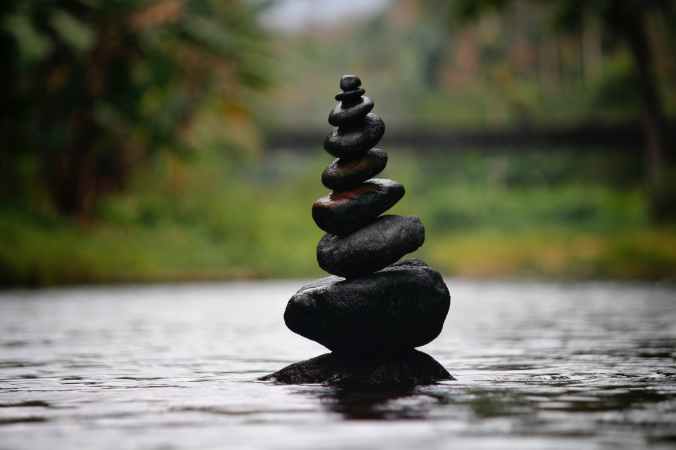
It’s quite ‘Zen’ and deconstructionist to talk about labels not mattering. But over long years I’ve come to the conclusion that labels (for martial arts) exist in the world because they do matter. If they didn’t matter (to whatever extent) then they wouldn’t exist.

I was reading recently (an idea from Mike Sigman) that the best way to view a martial art with regard to the question of “How internal is this?” is as a sliding scale of 1 through 10 from just using local muscle on the left (0-1), through to external martial arts in the middle (5) that use Jin (ground force) to some extent, on to internal martial arts at the end (10 being the highest) that use full dantien control of movement.

I’d put things like Wing Chun or Karate that go beyond just using basic movement in the middle of the scale. These things often get called the true ‘internal’ versions of the arts, but they don’t really use the dantien. The official version of Yang style Tai Chi that you see done by Yang Jun I don’t think is a full 10 either – it just doesn’t use the datien for full control all the time. I think Chen style Tai Chi would be a 10 – of course, that’s the theory. Most practitioners would be bottom to middle of the scale at best.

There was some talk recently on internal aspects in arts like BJJ. I think BJJ and Judo have the potential for being in the middle of the scale – some Jin usage. Often this is what you see termed as ‘invisible jiujitsu’. I think that’s exactly what you need for groundwork (and for fighting generally) – beyond that it’s a case of returns vs time spent. If you want to make your living as a pianist you don’t need to become a master of the very hardest pieces of classical music. It’s almost irrelevant. Of course, if you want to devote your life to it then, it’s your life and it’s a world of discovery.

“You’re really tight” is meaningless

pexels-photo-356053.jpeg

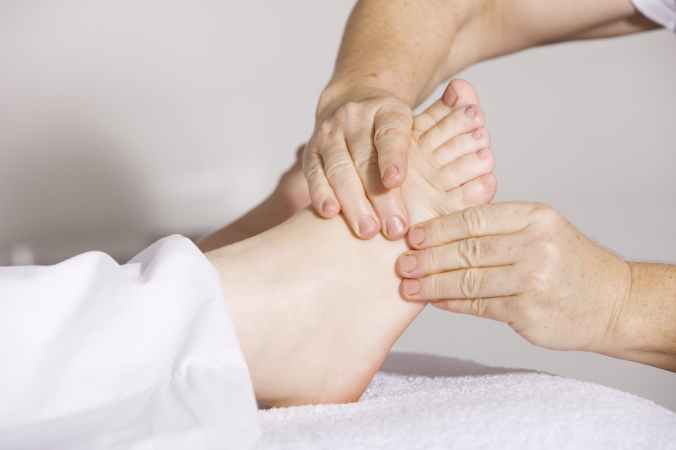
I found this article recently that I thought was pretty interesting. It’s about massage and the often used phrase “you’re really tight” by therapists.

Statements like “you’re really tight” are a bit of a verbal tic, something automatic — even expected — that massage therapists to say to pass the time and make conversation with clients. Tightness doesn’t even actually have a clear meaning.3 In this context, it is trivial and harmless.

Being “Sung” (translated as “relaxed”) is one of the things we get told to do all the time in Tai Chi, and it’s open to a lot of misinterpretation. Really, what it’s talking about is not overly tensing muscles, so that the power of an incoming force can be directed to the ground without the muscles taking the load. If you can get the ground to take the load then your muscles are free to do other things.


Review: The Taijiquan & Qigong Dictionary (Angelika Fritz, 2017)

IMG_3425

It’s impossible to study Taijiquan or Qigong without butting up against a barrier of confusing Chinese terms like Yi, Jin and Qi. Frustratingly, they seem impossible to do without because they often don’t have a direct English translation, or because people simply like to keep a connection to the Chinese origins. This can make anybody’s initial attempts to read up on the new Taijiquan class they’ve just started a bit of a struggle. Of course, you can look these things up on the Internet in a matter of seconds, but The Taijiquan & Qigong Dictionary by Angelika Fritz is (as the name suggests) is a printed collection of all those terms, pulled together in one publication, so you have easy access to them without the need to be online.

“Even though I can search and find anything online these days”, says Angelika in the introduction, “I like to have a real book in my hands”.

That’s the essence of The Taijiquan & Qigong Dictionary. It’s a slim volume at 132 pages, and quite small at 140x210mm (it’s P5 size, which is a Canadian paper size similar to A5 in the UK ), which makes it handy to put in a bag to carry with you.

You’ll find it contains names of Taijiquan moves in both English and Chinese, like “Hidden Thrust Punch/Yan Shou Gong Quan”, names of famous practitioners of the art, like Fu Zhongwen and parts of the body mentioned in connection to QiGong, like the Gallbladder, which don’t have a medical description, just  “Yang organ associated with the element wood”.

The definitions are straightforward and to the point, but perhaps too straightforward at times. For instance, the aforementioned Fu Zhongwen is described simply as “one of the creators of the Taijiquan 24 form”, which is true, but he was more famously a disciple of Yang Cheng-Fu. Perhaps the brevity cuts down on the possibility for conjecture to creep in though, as it’s hard for anybody to agree on anything in the Taijiquan world.

I’ve found The Taijiquan & Qigong Dictionary really useful to have next to my computer when writing blog posts and I need to double-check the spelling of a Chinese word. Fuller explanations of the terms would have been welcome, but as a quick reference, it’s hard to beat.

You can buy The Taijiquan & Qigong Dictionary on Amazon.

Angelika runs the Qialance blog.

Mike Sigman on basic Jin

When you see videos of Chinese martial arts masters bouncing people back a fair distance with a very light touch (YouTube is full of them) then unless the opponent is just taking a dive (as usually found in Aikido) what you are seeing is usually an example of ‘Jin’. Jin is not unique to internal Chinese martial arts like Tai Chi Chuan – all Chinese martial arts use Jin to greater or lesser extent. Or perhaps they had it at one time, and it was lost over time. Inevitably, things get lost over time.

It’s got to the stage now that if somebody shows Jin skills then it’s assumed they have been added in as a new “internal” version of said martial art by a special master. When you see somebody who is now doing an ‘internal’ version of martial art X (Wing Chun seems a popular choice at the moment) what the master usually shows is basic Jin done with very little explanation.

So, what is basic Jin? This and other questions like it will be answered by Mike Sigman in this handy video.

Jin in Chinese martial arts (and tennis)
wushu20was20one20of20eight20sports20in20the20frame20for20tokoy20202020inclusion20but20missed20out20along20with20bowling20and20squash

Looking at Chinese martial arts from our stand point in today’s modern world is very confusing. There are so many styles – so many different approaches and so many different theories of its evolution. In fact, it’s bewildering!

Human beings like patterns. It’s our nature to see patterns in things. So, naturally, we start to classify these myriad arts in different ways – Northern or Southern is a popular way to do it since you can generalise some characteristics about each branch. Internal and External is another way to do it. So is ‘long range’ and ‘short range’. And so on.

Without exception, however, all these classifications ultimately break down. They’re good for talking in the general sense, but once you dig down into individual cases it soon becomes a little murkier. For instance, you’ll find a style that is known as a ‘kicking style’ has a few punches in one of its forms. A style that is ‘long range’ actually contains quite a few short range techniques in one of its obscure forms, and so on.

But perhaps there is one all encompassing thing we can say about the subject. All Chinese martial arts make use of Jin ‘refined strength’ to great or lesser extent. Now, as always, language is a problem. It would be foolish to suppose that what a professional boxer is doing isn’t a highly refined method of punching. Of course, it is. In fact, under boxing rules, it’s obviously the best way to punch. Secondly, which ‘Jin’ are we talking about? A lot of Chinese martial arts have a long list of ‘Jins’ that they contain and practice, so which one do I mean? Also, a lot of them also don’t even use the word at all.

What I mean is using the ground as a path to power, rather than your physical structure or power derived primarily from your local muscle use. This is my definition of “basic jin”.

Obviously we need to use our muscles to stand up at all, but in the case of punching, for example, most punches originate from the shoulder. In contrast, I’m talking about using the power from the ground and bypassing the shoulder as a generator of power completely when punching. Instead, the shoulder switches function to a transmitter. for the power coming up from the ground.

So, how do you do this?

Well, let’s start in the most sensible place – Tennis. 🙂

It should be no surprise that if this method of using force exists and can be done by humans, then its use isn’t limited to martial arts. I’ve noticed recently that sports coaches are starting to catch on to these Tai Chi, or Chinese Martial Arts, concepts these days. Watch the following video:

Now, while he doesn’t explain what’s happening much, he’s getting across the concept of pushing down into the ground to increase the upward force that bounces back. If your body is relaxed (‘Song’) then this is upward rebound of force can be utilised as power.

From www.feeltennis.net/ground-force-for-power/

ground-force-tennis

By “sending the force” downward – which you can see on the weighing scale – you can generate more upward force.

This is the basic mechanics for the Tai Chi “Push” you see demonstrated so often. Instead of pushing into the person you first push ‘down’ from the dantien into the ground and use the rebound force as the power generation.

cheng-man-ching20

It requires a relaxed frame – which is the “Song Jin” of Tai Chi Chuan. The more you can push ‘down’ from the dantien, the more force you can exert back up. Try it!

To return to my subject about Jin in Chinese martial arts. The Tai Chi example above is what I’d call a very ‘pure’ example of using the ground force. Tai Chi specialises in this very relaxed ‘song’ way of doing it. Other Chinese martial arts use different postures and different methods and can augment the pure ground force with specific trained muscle use in various ways – which is one of the reasons you see the characteristic rounded back in Southern Chinese marital arts. You could called these a type of ‘muscle jin’.

I found a video recently that I thought really showed this ground force being very nicely used in Wing Chun. It’s by a master called Chu Song Tin, who is now sadly deceased. I posted it on a discussion forum and it got me in some very hot water, as I’ll explain below.


In the video he says the following:

“now let my force go to the ground,…. don’t fight me by pulling up.”

“now it’s going down to his feet(i.e the ground)”

“if i use strength to push on him and he use strength to fight me.”

“now pull up, and can you feel it in your shoulder? and this way the force can’t go down to his feet.”

Now, it turns out that CST didn’t ever use the word “Jin” to describe what he was doing – he created his own term “nim tao”, and if you suggest that what he was doing was Jin… then people in his lineage will get really upset with you because you don’t have the necessary lineage to comment and it is disrespectful if you do. It becomes a lineage and politics game and there’s no way to really get anywhere once that happens, better to just yield.

According to the next video, CST never felt he could adequately describe what he was doing, which I find really interesting. His students have kept the lineage alive and if the following video is to be believed are still trying to work out exactly how he did it.

I’m happy that they’re continuing the research, and I don’t really have any desire to get involved in the politics of lineage, but my question would be, if it isn’t ground force, then what is it?

“The rotation of the waist/pelvic region is like the turning of a wheel on an axle”

85249423_boltwinning_getty

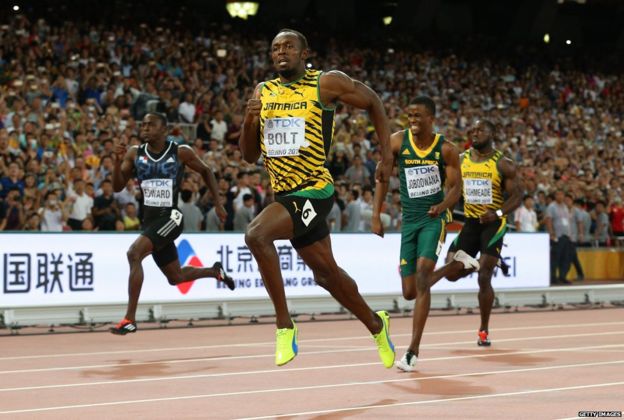
I ran (ha!) across this article by Sam Wuest, thanks to the Steve Morris Facebook page. It’s a really interesting look at how Usain Bolt is the fastest man alive despite not conforming to accepted wisdom on running mechanics.

It turns out Mr Bolt makes clever use of waist rotation when he runs, in contrast to the normal admonitions to reduce rotational movement and increase forward and back movement you’ll get from a lot of running coaches.  By turning his waist in coordination with the running motion Mr Bolt is creating a longer lever to the floor, and everybody knows that longer levers create more power than shorter levers over the same distance.

There’s a famous line in the Tai Chi Classics that goes “The waist is like the axle and the ch’i is like the wheel“.  At one point in the article, Sam Wuest says

“The rotation of the waist/pelvic region is like the turning of a wheel on an axle. The hip joints are rotating around the imaginary centerline of your body parallel to your spine at about the elevation of the sacrum. It is not a perfect rotation, as the free leg hip will come through higher than the support leg’s hip if the lateral chain is firing correctly.  Perhaps it would be better described as a rolling rotation. Which brings us to reason #2 of why this piece of technique is important.”

Sounds familiar, doesn’t it? Reason #2 is interesting too:

Reason #2: Better Muscle Sequencing/Activation

Often, those that rotate better whilst sprinting will look smooth and relaxed. Their strides won’t just look longer, they’ll look more relaxed.  Think of Carl Lewis’ famously effortless stride.  This is how we are designed to move – the center moves first, then the extremities follow, much like a whip.

The muscles around the pelvis have high muscle-to-tendon ratios (force producers) while the extremities have relatively much more tendon and elastic structures (force amplifiers). In a correctly aligned body, a small movement of the waist can produce large amounts of force elsewhere in the body.

This sounds awfully close to the Tai Chi idea of the dantien as a nexus of muscular and tendon power in the body.

As somebody interested in muscle tendon channels and their effect on movement and silk reeling exercises from Tai Chi I can see the correlation here. Tai Chi uses the same principle of movement coming from the centre (the dantien) and that controlling the movement of the extremities through elastic tissue. We usually think of this sort of movement as having to be learned, rather than occurring naturally, however it appears to be exhibited in high-level athletes, as we see in the article linked to above. Are they just naturally doing it? Have they tapped into the way the body is designed to move? Have they stumbled upon it, or have they had to learn to move this way on purpose?

Thoughts on Push Hands, by Mike Sigman

66702

Mike posted his thoughts on push hands recently on the 6H forum. I really liked what he wrote, so I’ve received permission from him to post it here as a guest blog post. Enjoy!

Thoughts on Push Hands
-M. Sigman.

Push Hands is designed as a way to practice using jin with and against a partner. The four jin directions are Up, Toward the Body, Away from the Body, and Down …. or Peng, Lu, Ji, An, respectively. You first learn to use jin in your own movements by learning forms, traditionally in Chen Village, before you begin learning to use that jin with a partner. Since most people claiming to do Taijiquan can’t really use jin skills while simply moving themselves, it is obvious that most “push hands” is usually more about some vague competition than it is about continuous jin skills. The closest most people get to jin skills is usually a sudden, impulsive tossing away of their opponent.

Beginning push hands involves the persistent use of push-hands patterns so that people can practice long periods of attempting to move while maintaining jin in the four directions of Peng, Lu, Ji, An. That’s why it’s such an eye-roller to hear some tournament rowdy say something like, “Oh, I don’t do patterns … I just do free-style”.

So basically, push hands is about Peng, Lu, Ji, An more than anything. It’s about practicing jin and imbuing jin in your body’s movements at all times. Arm/hand techniques, dramatic uprootings, etc., are nice, but they miss the point of what push-hands is really about.

I asked a teacher of mine (a student of Feng Zhiqiang’s) once “what is the philosophy of Taijiquan as a martial-art?”. Stupid question, but I asked it anyway. He responded to me: “The philosophy of Taijiquan is to crash through to the opponent’s center and kill him”. Of course he meant that half in jest, but it’s still true and it’s also the general philosophy of almost any martial-art. In much of the push-hands we see there is a lot of maneuvering at arms’ distance from the opponent, looking for a way to effect a technique or push on the opponent … you seldom see someone simply slip through the arms and apply a massive Kao to the opponent. That’s considered a “no-no” by many people, but since I see so many people do so many “no-no’s” already, I just get confused. If my partner is not doing good push-hands, adhering to the technical aspects, why should I waste time accommodating his not-so-good push hands? I think more people should think more about “what is push hands really about?”.

There are many things you can focus on while doing push hands: throws, joint-locks, “winning”, and so on. I tend to focus foremost on jin and using jin through all of my movements. I am not fully successful yet, but I keep working on it.

If you are moving your arms, you want to look for areas where you slipped into muscle and try and correct that area back toward good jin. You want to check your movement in terms of Open and Close and whether you are using the dantian to move or whether you suddenly went into an arms-only mode for a second. Moving with the dantian is what reeling-silk is about and that’s why reeling-silk movement is the core/basic of Taijiquan.

You want to not provide any resistance for your partner to push against, if possible … but that’s not always possible, so while I focus on that avoidance of resistance, I also enjoy practicing letting my partner push me. As I’ve said in the past, I often/usually will maintain a peng-jin direction that is upward and in a direction that will off-balance my partner if he pushes me. I don’t necessarily do the up-jin thing all the time, but I do it enough that it is an easily-accessed tool that is sort of second-nature.

Most of all I enjoy a casual interplay (win-some, lose-some is best for everyone, I think) where I make it a game to see if I can apply an effective jin response against any push my partner can manage to slip in. I don’t care if I lose some … the idea is to get better and better, so I “invest in loss”.

It’s a fun game to allow an opponent to push you and see if your jin skills are good enough to turn the tables simply by making his own push defeat himself. I would recommend and suggest that this strategy will get people away from always trying to win while at the same time giving them a true skill-set of actual Taijiquan.

I remember a comment from a Chinese friend of mine who was challenged in a nasty way to do some push hands. He looked at the guy and said, “No, let’s fight. Push-hands is just for exercise”.


If you liked this post you might also like:

Internal Judo

In Tai Chi you have to go down to go up

The basics of Tai Chi movement

Defining Tai Chi Chuan

My story – to BJJ from Tai Chi

Graham 2

Rick Matz of Cook Ding’s Kitchen blog asked me to write a little thing about my story and how my Tai Chi and BJJ fit together, so I did! Unfortunately, it turned out to be quite a big thing. In fact, it’s a bit of an essay.

You can read the whole article here.

Have I summed up all the ways that Tai Chi and BJJ fit together? Not at all. There’s still much more to tell, but I hoped I’ve shined a light on to a part of it for you.

Here’s a quote:

“Learning Tai Chi is a constant process of having your mistakes pointed out to you, trying to correct them, then moving on to the next thing. The key to getting good at BJJ is similar – you don’t want to focus on winning, since you end up muscling things instead of being technical and correct. But just like in Tai Chi, it’s learning from your mistakes that matters.”

You might also like my previous article on Tai Chi, BJJ and Rickson Gracie.