I was observing the usual argument/discussion between two people about ancient Chinese words like Yi and Qi that frequently happen in Tai Chi circles, and it was going down a familiar route..
“Don’t lecture me! I read classic Chinese and Yi means ‘idea’ and Qi means ‘movement’.”
“Really? Wang Yongquan wrote ‘To mobilize Qi, you create an empty space, by Soong and a light Yi to empty the area. The differentiation of yin and yang is what makes Qi flow.”
“Seems quiet different then…”
Confused! Photo by Oladimeji Ajegbile on Pexels.com
And on and on and on…
Recently I had a conversation with a very experienced Chinese martial artist (it will be released as a podcast soon, don’t worry) about how these things are trained in Asia vs how we do it in the West.
He made the point that in the West we have to understand something intellectually before we will do it. i.e. we have to know we’re not wasting our time, that we will get something out of this. It has to ‘make sense’. And we usually ask loads of questions before even trying it. In contrast, in Asia, there is a lot less questioning and a lot more doing. You just do it. If you’re doing it wrong you hope your teacher will notice and put you on the right track. But generally you just keep doing it secure in the knowledge that eventually you will get it. It’s all in the feel. If you have the feel right, then you are doing it. End of story.
Nowhere is this distinction between the Eastern and Western approach more clearly represented that on discussion forums about Tai Chi that are full of Westerners. We love to argue about what these ancient concept and words like Qi, Yi and Xin really mean. As if one day we will arrive at the ultimate answer. It seems we can’t get enough of it.
But here’s the secret: it doesn’t matter how you define these words, what concept or theory you use for their implementation, or how well you read Classical Chinese from the Ming Dynasty. What matters is – can you do it?Can you show it to me?
If I said, “Show me your Yi. Let me feel your Jin” Could you do it?
If you can then it doesn’t matter wether you define Yi as “idea”, “mind” or “intent”. I’m sure we’re all familiar with the famous phrase coined by Polish-American scientist and philosopher Alfred Korzybski, who gave a paper in 1931 about physics and mathematics in which he wrote that “the map is not the territory” and that “the word is not the thing”, encapsulating his view that an abstraction derived from something, or a reaction to it, is not the thing itself.
So, all these online arguments about Qi and Yi, are effectively pointless. They are map, not territory. However, I do think that a little intellectual understanding can be useful. Especially if it stops you asking questions long enough to just practice. Also, there’s always this temptation to think that if I can just understand something perfectly, or write it down in the perfect, most simple way, then eventually everyone will go “Yes! That’s it!”
Anyway, as I was practicing this morning a thought popped into my head which I thought felt right, so I thought I’d write down and share it:
“Yi is the direction you’re sending your mind in, and the Jin follows.”
To me, Yi is always about a direction. And it is directed. It’s the opposite of a vague, warm, fuzzy haze. It has a steadfastness and a focus. There. Did that help? Or did it just make you more confused. Answers in the comments section please. If you have your own pithy phrase to summarise a concept as subtle as Yi that works for you, then feel free to add it below.
I’ve written before about Yi in Tai Chi Chuan. So, you can have a read of that too.
A sphere is one of the strongest shapes regardless of the direction of force. Photo by Laura Tancredi on Pexels.com
I wanted to talk today about the concept of the Tai Chi ball, or more accurately, Tai Chi sphere. While it might sound simple, I think it’s really an advanced concept because it’s taking the Tai Chi teachings out of the realm of specifics, of things like ‘relax that shoulder’, ‘move that foot’, ‘drop that elbow’, ‘align that hip’, etc…, and into the realm of concepts, which are much harder to pin down into physical details.
The Tai Chi Classics talk about Tai Chi being circular a lot. For example, it says:
“The postures should be rounded and without defect, without deviations from the proper alignment; in motion, your form should be continuous, without stops and starts.”
At a certain point the position of the hands and feet and other body parts in Tai Chi gets subsumed by the general sense of keeping your body and all your movement rounded, like a ball. (Newsflash: despite a thousand form corrections from seminar masters, the exact position off your hands isn’t what’s important.)
What’s important in Tai Chi is that your body is creating a ball-like structure, with ‘you’ at the centre. That’s what determines if you hands and arms are in the correct position, not angles and degrees. If you are making a sphere with your movement and body, then everything will be in the right place, and if you aren’t, it’s not.
The advantage of creating a sphere is that force can comes in and be rolled off without too much interference and muscular tension. A sphere is a Tai Chi symbol write large, in 3 dimensions.
The Tai Chi Classics talk about Tai Chi Chuan being circular. Photo by Sindre Stru00f8m on Pexels.com
The idea of separating empty and solid in the body goes hand in hand with creating a Tai Chi sphere. In fact, I don’t think you can do it successfully without a separation of empty and solid – or yin and yang – in the body.
But here’s the kicker. You can’t just decide one day to do this practice. You can’t go outside right now and do you form and decide to make your Tai Chi like a sphere because it will be meaningless. Instead, it’s a situation where you gradually discover, after many years of practice, that Tai Chi is like a sphere. One day you’re practicing and you suddenly notice it, and bang! Your Tai Chi will never be the same again. It’s like that famous picture that looks a bit like an old man but isn’t:
You either know or you don’t! Can you see what this is a picture of?
Most people are unable to see what that is actually a picture of at first glance, but once you get it, no amount of me trying to persuading you otherwise will prevent you from knowing exactly what it is.
It’s the same with the Tai Chi sphere. Your Tai Chi has always been a sphere, you just didn’t know it, until one day you did, and then it was suddenly obvious to you.
Referring to the Tai Chi Classics can help your practice. Photo by RODNAE Productions on Pexels.com
I’m writing this as a kind of follow up to my previous article on 3 views of qi in Tai Chi. That article contained the 3 different things I think people really meant when they talk about qi in Tai Chi. This article aims to do the same thing with yi. I don’t consider myself an authority on either matter, but I have had some skin in the Tai Chi game for a while now, and I’ve read enough of other people’s writings to come to some conclusions about what I think they’re talking about. Hopefully you’ll find these definitions helpful, and I’d be interested to hear your thoughts in the comments section.
Yi gets a few mentions in the Tai Chi Classics, and is usually translated into English as “intent”, or “mind-intent”, a translation which I think can be problematic because there are at least 3 different things that people mean when they say “intent” in Tai Chi, and while the three are obviously related, they’re also quite distinct from each other.
Before we get into the definitions, let’s have a look at what the Tai Chi Classics have to say about yi:
The most quoted line regarding Yi is in the Tai Chi Classic: “All movements are motivated by yi, not external form”, which can also be translated as “use the mind, not force”. In no.6 of Yang Cheng-Fu’s 10 important points he says:
“6.) Use the mind instead of force. The T’ai Chi Ch’uan Classics say, “all of this means use I [mind-intent] and not li.” In practicing T’ai Chi Ch’uan the whole body relaxes. Don’t let one ounce of force remain in the blood vessels, bones, and ligaments to tie yourself up. Then you can be agile and able to change. You will be able to turn freely and easily. Doubting this, how can you increase your power?”
So, here the emphasis is on relaxing and not using “force”, but why? And What does that mean? I will explain later.
Interestingly, right after that line, the Tai Chi Classic then goes on to say:
“If there is up, there is down; when advancing, have regard for withdrawing; when striking left, pay attention to the right.
If the yi wants to move upward, it must simultaneously have intent downward. “
Definition 1: Martial intent
Given the lines quoted in the Tai Chi classics above I find it strange that the most common interpretation of yi in Tai Chi is as a kind of martial intent. Here intent is “your intent to do something”, and in Tai Chi people generally mean a martial intention that needs to be contained within every particular posture or movement. So, for example, when you do the ward off movement, you need to have the intention of deflecting a blow away. If you movement lacks that intention, it is said to be empty.
Now this may all be true, and not knowing the martial applications of a movement inevitably leads to it becoming too abstract and unfocused, but this understanding of ‘intent’ is clearly not what is being talked about in the Tai Chi Classics when it admonishes us to “use the mind, not force”. If all it meant was to have a martial intention behind the movements, then it’s impossible to see how that can match up with lines from the classics like:
“If the yi wants to move upward, it must simultaneously have intent downward.”
What has that got to do with martial intent?
Clearly this is talking about something else. Yes, a martial spirit is obviously important for Tai Chi, and some Chinese teachers refer to an “eye spirit” which his making sure you are focused and looking in the right place in form performance, and you look like your actions are martially proficient, but I don’t really think this is what is specifically meant by yi in the Tai Chi classics.
Definition 2: A line of intent from the ground up
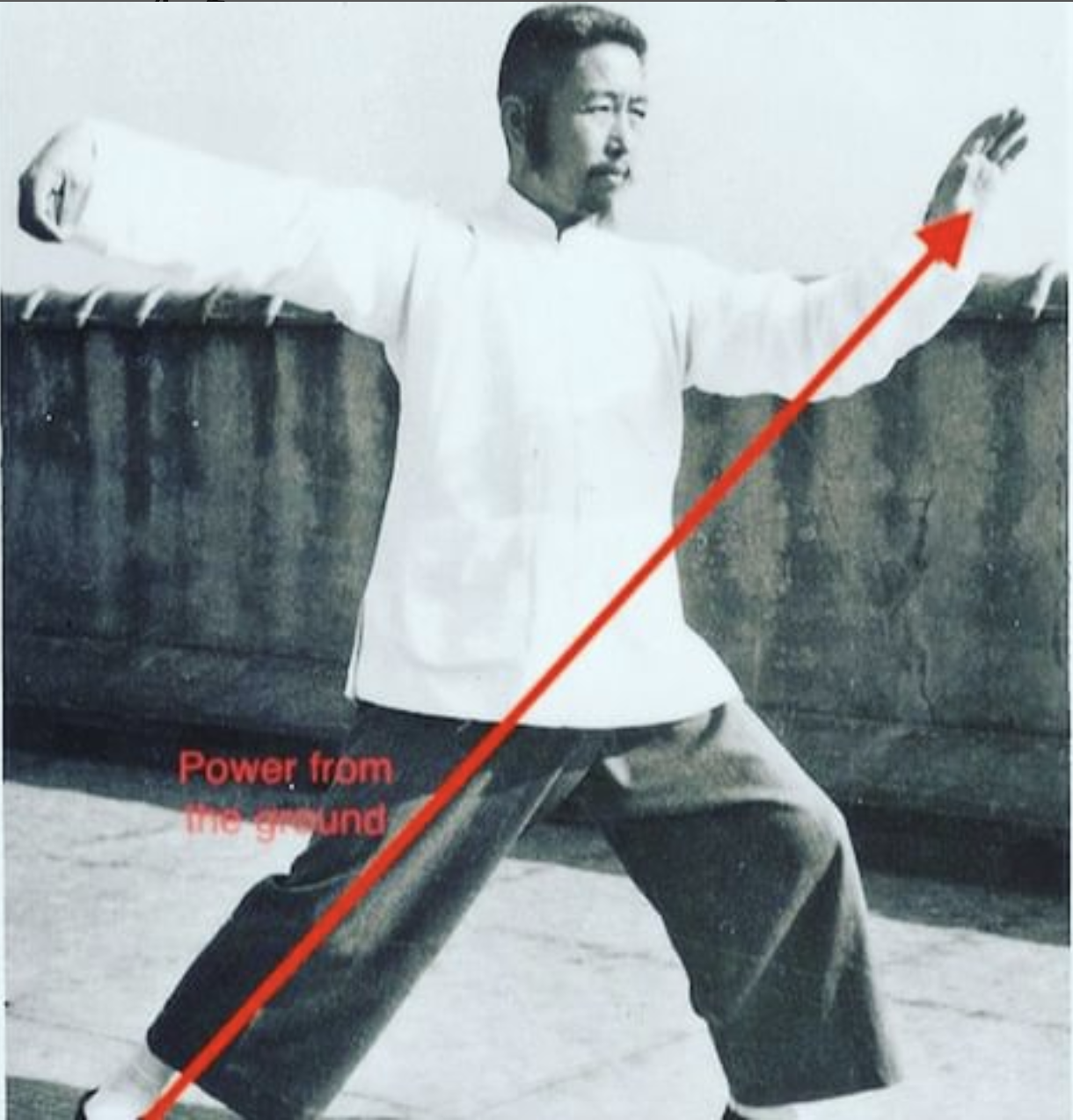
The second way that people refer to intent in Tai Chi is as a line of force, usually from the ground to the point of contact with the opponent. The idea in Tai Chi is to bring the solidity of the ground to your point of contact with the opponent. How do you do this? Well, firstly by relaxing, so that your body can function as a whole, connected, unit, and then by feeling a line of connection from the point where you contact your opponent (in push hands that would be your palm or wrist) directly to your foot (the part of you that is closest to the ground). By imagining the force of your opponent going straight down to the ground in a straight line from your palm to your foot then you can make use of jin – which is a force obtained from bringing the solidity of the ground to the point of contact with your opponent. This jin force stands in contrast to the normal force of the body produced by exerting your muscles, which the Chinese call li. Of course, muscles are involved in generating jin (otherwise you’d collapse not he ground), but they kept as neutral and relaxed as possible, so that excess force is avoided.
If you send force from the ground to your point of contact with your opponent, using jin, you can bounce them back off you.
Of course, you cannot be thinking of the ground if you want to project somebody away from you. Your work in creating the path to the ground is already done – in the bow analogy this is the drawing of the bow. All that remains now is to fix a direction and release the arrow:
As it says in the classics:
“Release the chin like releasing the arrow.
To fajin [discharge energy], sink, relax completely, and aim in one direction!”
This use of Jin fits in better with the lines in the classic that say
“If the yi wants to move upward (i.e. bounce your opponent back) it must simultaneously have intent downward. (i.e. you imagine a line of force to the ground).
(N.B. this straight line of force obviously goes through empty space, so it’s not the actual line any force from the ground will take, but it’s a case of your mind having the overall goal in mind, and your body filling in the details on a kind of subconscious level.)
Definition 3: A part of the mind
This definition is about yi being a part of your mind and the hardest to put into words. Obviously, definitions 1 and 2 also involve using the mind, so you can see how all 3 definitions are kind of wrapped up in each other.
In everyday life when you want to do something, like say pick up a pen or bring a cup of tea to your lips, the idea to do it appears in your head before the physical action takes place.
In internal arts the 6 harmonies get a lot of press. Of these 3 relate to the physical body, and 3 relate to the internal make up of the person. In the West we tend to have one word “mind” to relate to all the different and distinct parts that the Chinese have words for, like xin, shen and yi, but the three internal harmonies (san nei he) are:
1) The heart (Xin) harmonises with the intention (yi).
2) The intention (yi) harmonises with the chi.
3) The chi harmonises with the movement (li).
The heart mind (Xin) is related to our desire to do something, the yi (intent-mind) is the part of our mind that makes things happen on a subconscious level. When you pick up the cup to bring it to your lips you don’t think “hand move to cup, fingers wrap around handle”, etc.. It just happens because your intent-mind is taking over, based on what you desired to happen. The intent-mind is therefore a kind of subconscious process.
Now, going along with the idea that there are these different parts of our mind that exist as separate entities comes the idea that we can train these separate entities in isolation to gain a deeper ability with them. So, for example, by repeated practice of a Tai Chi form (or Zhan Zhuang standing practice), in which we are trying to access the subconscious intent-mind, rather than brute force, to perform action we might, in fact, get better at it and develop some ability that ‘normal’ people who lack this cultivation don’t have. It’s an interesting idea!
A good starting point for developing this intent-mind is Zhan Zhuang standing practice. One common practice is to stand in the ‘hugging a tree’ posture and try and get the mental sense that your hands are expanding outwards, yet without physically moving them. You are cultivating your intent-mind when you do this. This is starting with just one direction, but in standing practice people often talk about training 6 directions at once.
When performing a Tai Chi form it’s obvious that you are dealing with moving energy (in a physical sense) in different directions. If you can utilise your mind to “think” in these directions then you can start to train your yi, and it can start to feel like your movements are generated by yi and not by physical force.
Conclusions
It’s not easy to talk about what is meant by yi in Tai Chi, but hopefully I’ve provided you with some good starting points and ideas. I’ll repeat again my assertion that the three definitions I’ve given are all important parts of the practice that makes up Tai Chi Chuan and all inter-related. And while yi may be tricky to describe, it is of utmost importance to all the internal arts. There is a line from the Xing Yi classics that goes:
“There is nothing but structures and nothing by qi”
On hearing this line I remember my Tai Chi teacher saying “Oh, that’s good, I like that, but I’d change it to:
There is nothing but structures and nothing by yi”.
Structure and intent. When it comes right down to it, that’s all the internal arts are made up of. That’s how important yi is.
Somebody posted a quote by (founder of Yi Quan) Wang Xiang Zhai from his 1940s interview containing his thoughts on Tai Chi. It is pretty clear, unambiguous and to the point. Have a read:
Wang Xiang Zhai on Taijiquan (from an early 1940’s interview):As masters of the original Taijiquan, I should recommend the Yang brothers Shouhou and Chengfu. They are my friends, and I know that their Taiji has some knowledge of mechanics. But out of one hundred students, not even one gains its essence…and even then, it is still one-sided, because the skills of intuitive perception died out a long time ago. Originally, Taiji consisted of three fists, Wang Zongyue changed it into thirteen postures, and it was later embellished into as much as one hundred and fifty postures. This is the cause of the distortion.Sticking to mechanical movements, seeking beautiful postures and mistaking it for the glory of martial arts…that is terrible. Such a person cannot comprehend boxing for life. If a man of insight sees such a performance, he will feel sick for ten days.As a means of health preservation, Taijiquan restrains the spirit, and brings discomfort to its practitioner. For combat, it harms the practitioner’s limbs and trunk, and causes a useful body to become a mechanical and stiff thing…it’s nothing more than a waste of time.As for the training method—a punch with the fist here, a slap with the palm there, a kick to the left, and another one to the right—it is pitiful and laughable.As for dealing with an enemy in a fight: please do not even consider it. So ruined is this boxing that it has become useless. There are many more things, but I feel embarrassed to say them.
He doesn’t think much of Tai Chi, but there are some things to consider.
Wang was building a brand – Yi Quan – in a commercial setting. Setting out how you are different to/better than your competition is the first stage of building a brand.
2. This “three old fists” idea of history I don’t put much stock in. I think it’s a reference to the three old fists of Xin Yi (info on Jarek’s website), which he is therefore assuming as the origin of Tai Chi Chuan, but there’s not much of a link there that I can see. Or if there is, it’s very tenuous.
3. I think he’s criticising the Tai Chi training method, more than the art. He seems to hold the Yang brothers in high regard, but it’s their students and training methods he thinks are flawed. Wang was never a fan of forms training.
4. I think we need to consider what was happening in China in 1940. China has never (and still doesn’t) had a free press. If this was published it would conform to the political direction of the day.
From Wikipedia:
“In 1940, the Japanese set up the collaborationistWang Jingwei regime, with its capital in Nanking, which proclaimed itself the legitimate “Republic of China” in opposition to Chiang Kai-shek’s government, although its claims were significantly hampered due to its being a puppet state controlling limited amounts of territory.
The United Front between the Kuomintang and the CCP had salutary effects for the beleaguered CCP, despite Japan’s steady territorial gains in northern China, the coastal regions and the rich Yangtze River Valley in central China. After 1940, conflicts between the Kuomintang and Communists became more frequent in the areas not under Japanese control. The Communists expanded their influence wherever opportunities presented themselves through mass organizations, administrative reforms and the land- and tax-reform measures favoring the peasants and, the spread of their organizational network, while the Kuomintang attempted to neutralize the spread of Communist influence. Meanwhile, northern China was infiltrated politically by Japanese politicians in Manchukuo using facilities such as the Wei Huang Gong.”
So while all this conflict with Japan is going on I think the general trend is towards westernising and modernising China, leaving behind the older traditions that had held China back. This interview – looking towards newer scientific methods of martial arts – is in keeping with that trend. Japan was also very into adopting western military methods and building an empire, like the British had.
5. Both Yang Shao-Hou and Yang Cheng-Fu died in 1936, yet Wang is talking about them as if they are still alive in the 1940s, so something doesn’t add up. This interview is either doctored, or was done a long time before it was published in the 1940s.
6. You can get a better idea of his larger themes by reading the whole interview.
Byron Jacobs is a teacher of Xing Yi and Bagua based in Beijing, China. He’s a student of the famous Shifu Di Guoyong and is heavily involved in the martial arts scene in Beijing. As well as training traditional martial arts he’s also a BJJ practitioner and competitor.
In this wide ranging discussion we talk about training Xing Yi, Bagua and Tai Chi and whether Wu Shu will ever get into the Olympics. We also find out what it was like to train martial arts in Beijing during the Corona virus pandemic, and what the Chinese BJJ and MMA scene is like.
I seem to have entered a little phase of practicing Tai Chi in the morning then immediately doing some Xing Yi straight afterwards. I’ve never really been into doing Tai Chi especially slowly, as some people seem to love to do, but the contrast with Xing Yi straight after has really accented the speed differences, and it’s made me think about the strategy of each art.
Reflecting on the reflections at today’s practice spot.
Tai Chi forms are performed much more slowly than Xing Yi links. We all know that Tai Chi should be done slow-ish, but how fast should Xing Yi be? Because it’s an “internal art” (check out my podcast for some thoughts on what that means) people often think that Xing Yi should be done relatively slowly too. My teacher recalled to me a story of one of his teachers who would always shout at them “Faster! Faster!”, whenever they did Xing Yi. The rule was, the faster, the better. They could never be quite fast enough to satisfy him.
Xing Yi works as an intercepting art – ideally you want to be attacking inside the opponent’s attack. It’s a very different approach to standing your ground and trading blows with an opponent. Once you’re ‘inside’ their attack you want to keep on pressing forward, which is why Xing Yi ‘forms’ are generally done in a straight line. The hardest thing is getting that inside position, but once you’ve got it you don’t want to give it up until you’ve got in several decisive blows, all the while moving forward with full body connection. Nobody said it was an easy strategy to achieve, but that is the strategy.
Doing Xing Yi quickly helps you develop that fast footwork you need to rush forward when required, without falling into disaray. It says in the Xing Yi classics somewhere that when standing you want to stand like a mountain – solid, unmoving, but when it’s time to move you want to move like the sound of thunder or a landslide.
Tai Chi – at least the Yang style and its sub-styles – in contrast seems more interested in doing as little work as possible. Relaxing, using natural body motions and letting your body weight do the work are the order of the day.
When you do Tai Chi you shouldn’t really be getting out of breath*, when you do Xing Yi you should. As such the two arts compliment each other nicely.
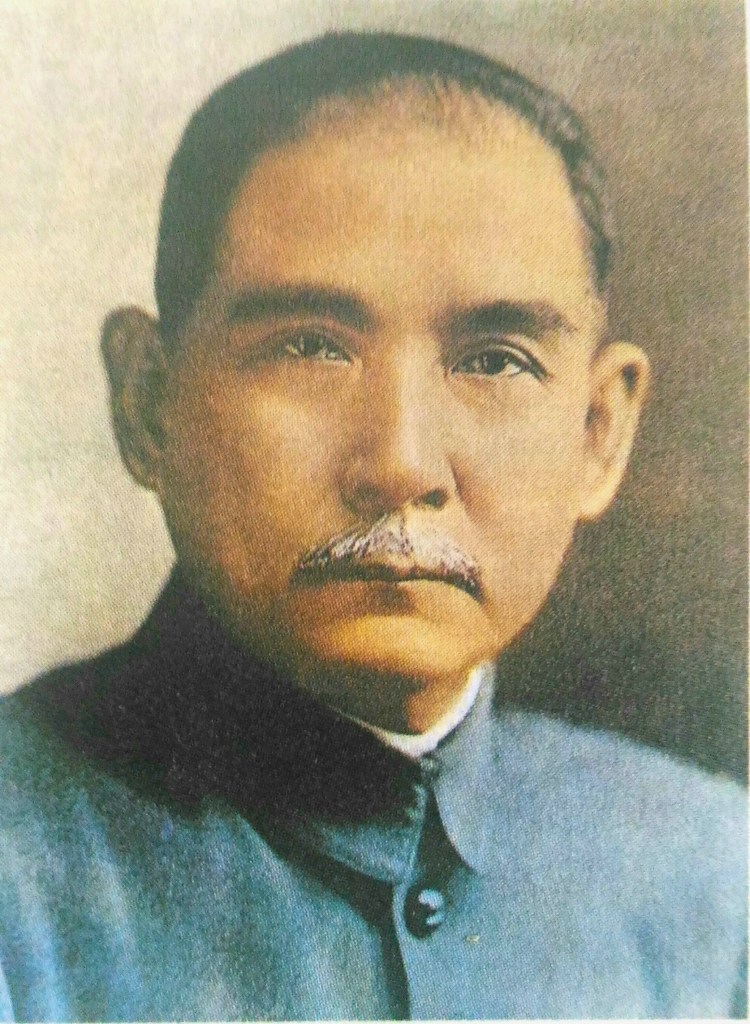
Sun YatSen, the provisional first president of the Republic of China and the first leader of the Kuomintang the Nationalist Party of China.
In our last look at Tai Chi for a while, we examine the context of the times in which Chen Zhaopei and Chen Fake became prominent for their martial arts in Beijing, and then at a national level, joining the wave of commerciality that had been originally instigated by the legacy of Yang Luchan and the Wu brothers. In addition we explain why the forms are similar in general order between the Yang/Wu and Chen lineages.
Here’s some Chen Canon Fist (mentioned in the podcast episode, posted here as a visual reference) – – under the Heretical Hypothesis this would be representative of the “original stuff” of the Chen village. Everybody is free to make their own mind up 🙂
Here’s an interesting criticism of the Heretics Hypothesis from blog reader Tom:
“I’ve enjoyed Damon’s monologues in this series on taiji. I think people understand the history given is just Damon’s interpretation, unsourced. The unfortunate part of the narrative is that some key assertions are made that are not true. Wu Yuxiang met Yang Luchan in Yongnian County before Yang went to Beijing. We actually don’t know whether WYX ever went to Beijing. WYX’s older brother did have a position of some importance in the Qing imperial administration, but it was at the county level as a magistrate. There is no extant written record, in a bureaucracy of exhaustive written records, of any of the Wu brothers in Beijing during this time. By contrast, we do have references for YLC appearing in Beijing and being called in to demonstrate at a banquet being held at the mansion of the wealthy Zhang family, purveyors of pickles to the Imperial court (and connected to the Wu brothers …. Damon should look at the sources available for this connection, because it helps support his thesis more clearly than what he’s established only by inference so far).”
There’s a lot to unpack there. So let’s start at the top:
“Wu Yuxiang met Yang Luchan in Yongnian County before Yang went to Beijing.”
This could very well be true. It’s a reasonable point – Wu Yuxiang and Yang could have met in Yongnian, and the Heretical Hypothesis plan (of using Tai Chi to bind together the fractured Imperial Court over something essentially ancient, Chinese and unifying in the face of the world-shaking contact with foreign aggression, which the Ching seem utterly unprepared for) could have been hatched earlier, with Wu Yuxiang and his brothers, who then, using the Ching patronage system, fund the introduction of Yang LuChan to Beijing elites.
Wu’s brothers both wrote texts on Tai Chi Chuan that only surfaced in the 1930s – see Lost Classics from the Late Ching Dynasty’s by Douglas Wile – so they are both implicated in the invention of Tai Chi Chuan myth, as well as their more famous brother Wu Yuxiang.
It’s ironic that Wu YuXiang is the famous brother by today’s standards, but at the time it was Wu ChengChing who was the famous one, having passed the very highest Civil Examinations. This is why there is no official record of Wu Yuxiang anywhere (as Wile notes on page 16) – he was simply not important enough. And if even he is not important enough, then there is zero chance of Yang LuChan – a low-class person ever being mentioned in an official record. Which brings us to Tom’s line:
“There is no extant written record, in a bureaucracy of exhaustive written records, of any of the Wu brothers in Beijing during this time.”
So, that’s not surprising for Wu YuXiang, since there are no written records of him anywhere – “to official historians he does not exist” – as Wile says.
However, that doesn’t mean he wasn’t in Beijing at some points. Here’s something to consider. A lot of people attribute the “small frame” of Wu (Hao) style Tai Chi to the limited movement available in Court Dress.
A quote from that article: “The Yang Small Frame which comes down to us from Wu Chien Quan has little resemblance to Wu Yu Xiang’s small frame and the primary reason for the origin of that form was the Imperial Court Dress which hampered movement.”
Royal Court Dress, Ching Dynasty.
If Wu Yu Xiang wasn’t in Beijing he wouldn’t have been wearing Court Dress.
Regarding his brothers we can be more sure:
The Jinshi (highest Confucian) exam that Wu Chengching passed could only be taken in Beijing if you were from Hebei Province – it wasn’t held in any other location, and final preparation for it wasn’t done in any other location. Wu Chengching records in his chronological autobiography that he passed that exam in 1852, after Yang LuChan moved to Beijing. He was then assigned to be a district magistrate. (Wile, Tai Chi Touchstones, page 180).
Wu Chengching wasn’t just any old magistrate – he was one of a small handful of elite magistrates ruling the counties of China’s heartland, and based in an area of huge strategic importance militarily speaking. I can’t see any way he would get into that position without strong/long-standing links to the Imperial Court in Beijing.
I think we can say that the Wu brothers had strong connections in Beijing, and Wu Chengqing couldn’t have got into his elevated position anywhere other than Beijing. When he moved to Wuyang in 1854 (four years after YLC settled in Beijing), there was no one local who outranked him – his immediate superiors were based in Beijing all the time, and he would have been expected to report to them frequently. To pass Jinshi he would have needed the support of his extended family, including Wu Yuxiang – it was a decision you had to make – to become a magistrate you had to go “itinerant” – you go wherever the government sends you.
But even so, I don’t think the physical location of Wu Yuxiang, or his brothers affects the overall Heretics Hypothesis very much – the Confucian officials were moved around a lot.
Key to the argument is the idea that “anything at all like Tai Chi” could not have existed in that region until after 1850 – and it doesn’t matter who was/wasn’t involved, because the kind of thing that Tai Chi is, is a modern idea that arose through China’s contact with the West.
Nothing comes from nothing, so for the Yangs and Wu brothers to have concocted Taijiquan (according to the Heretics Hypothesis) it must still have been made from Yang LuChan’s genuine martial skill. The postures of Yang style share a lot in common with various Northern Chinese martial arts. Changquan (long boxing) is often quoted as something Yang LuChan practiced in childhood, but again, this seems to be purely anecdotal. That doesn’t mean it’s not true of course.
A martial art popular in the region Yang came from was Hong Quan. A video surfaced recently that showed some traditional Hong Quan. It’s interesting to watch because I think it’s a good example of the type of martial art that would have been around at the time of Yang LuChan.
The description offered with the video says: “Here is the Xiao Hong Quan of Mogou Village. Mogou is to the east of Dengfeng and has practiced Hong Quan for hundreds of years.”
Hong Quan was very popular during the reign of Emperor Daoguang, which would be the Emperor immediately before Xiangfeng, who was emperor when YLC went to Beijing in the 1850s.
Out of interest, at a cursory glance I can see at least four Tai Chi Chuan techniques I recognise in that Hong Quan form presented – wave hands like clouds, snake creeps down (low single whip), bend bow to shoot tiger, and lotus kick. It’s hard to spot because it’s quite fast. But I’d hazard a guess that you’d probably find those same general techniques in lots of northern martial arts, like Chang Quan, as well.









 The Tai Chi Notebook