Making up your own forms – it’s not as easy as you think

I had an interesting comment on my last post that made me think about the whole idea of making up your own forms (or Tao Lu) – in Tai Chi, Xing Yi, or whatever.

I’ve tried to do this over the course of several years and I’ve come to a few conclusions about it, which I’ll elaborate on here. Firstly, it’s hard. Making up new forms is not as easy as you think. But secondly, it depends what martial art you are making up a form in.
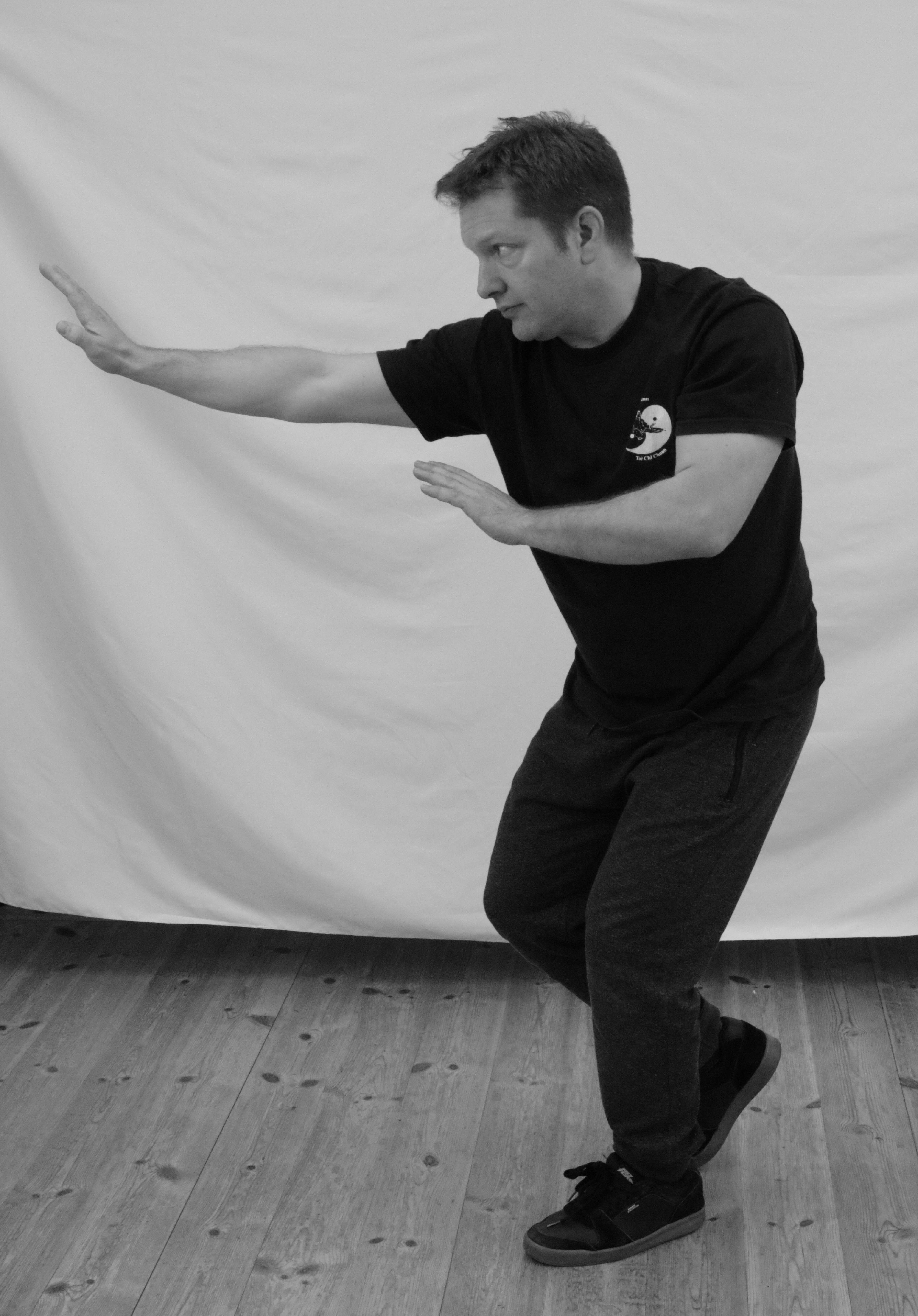
Author, performing Xini Yi Chicken (Ji) posture

If your martial art has forms that are constructed like lego bricks that can be slotted together in any order and still seem to work then it’s pretty simple to concoct a new form. Xing Yi is a good example of a martial art that has this quality. I was always told never to call Xing Yi tao lu by the English name “forms” because the correct term was lian huan which means “linking sequence” for this very reason.

The idea, (in our Xing Yi at any rate), is that all the links you learn are just examples, and you need to be constantly moving towards being able to spontaneously vary them as required, and then ultimately spontaneously create them. This idea has become heretical in the modern Xing Yi world to a large extent because modern Xing Yi has lost a lot of this spontaneous feel it used to (I admit that’s a subjective point) have, and things have become set in stone – forms that were once supposed to be fluid and flexible have become fixed and rigid. Forms of famous masters from the past now tend to be fixed forever. When words like “orthodox” start appearing to describe something you know it’s already dead, or on the way to dying.

But of course, anybody can make up a form, but is it any good? That’s a different matter. And it usually depends on the person doing it, not the moves themselves. With Xing Yi animals you can also ask the question – can I see the character of the animal being used coming out through the moves?

With Tai Chi I find it a lot harder to make up a form. Tai Chi’s approach to a form is quite different to Xing Yi, or other Kung Fu styles. The Tai Chi form tends to be a highly crafted piece of work that has been honed to perfection over many years. It is fixed because you need to be able to forget about the moves and concentrate more on what’s inside. It helps to do that if you don’t have to worry about what’s coming next because you’ve done it so many times that you can let go of that part of your brain and let it be aware of other things.

Tai Chi forms tend to start and finish in the same place for this reason. Usually, anyway. While long forms don’t tend to be balanced on left and right, a lot of the more modern, shorter forms make more of an effort to balance left and right movements.

If you understand Tai Chi and how to ‘pull’ or direct the limbs from the dantien movement then, sure you can make up your own Tai Chi forms, however, there is almost zero history of doing this in Tai Chi circles and it’s not really encouraged. I think this is because Tai Chi has push hands, which can be used as a kind of free-form expression of Tai Chi, completely away from the form and in contact with a partner to give you something to respond to, which is the whole strategy of Tai Chi Chuan, at least according to the Tai Chi Classics it is. To ‘give up yourself and follow the other’ you have to be spontaneous. There’s no other choice!

So, to conclude. I think that’s it’s in its application where the spirit of improvisation and spontaneity can be found in Tai Chi, not in the forms. I don’t think Tai Chi is particularly concerned with creating endless variations of forms and patterns like Xing Yi is, at all. Xing Yi, having a weapons starting point, doesn’t use this hands-on feeling and sensitivity to get started with spontaneity. Instead, it likes to create patterns, then vary them endlessly. Of course, you work with a partner when required, but it’s a different approach. Which is all quite natural, as these are two different martial arts, created by entirely different groups of people in a different locations and time periods.

You might like our Heretics history of Tai Chi and Xing Yi for more on that.
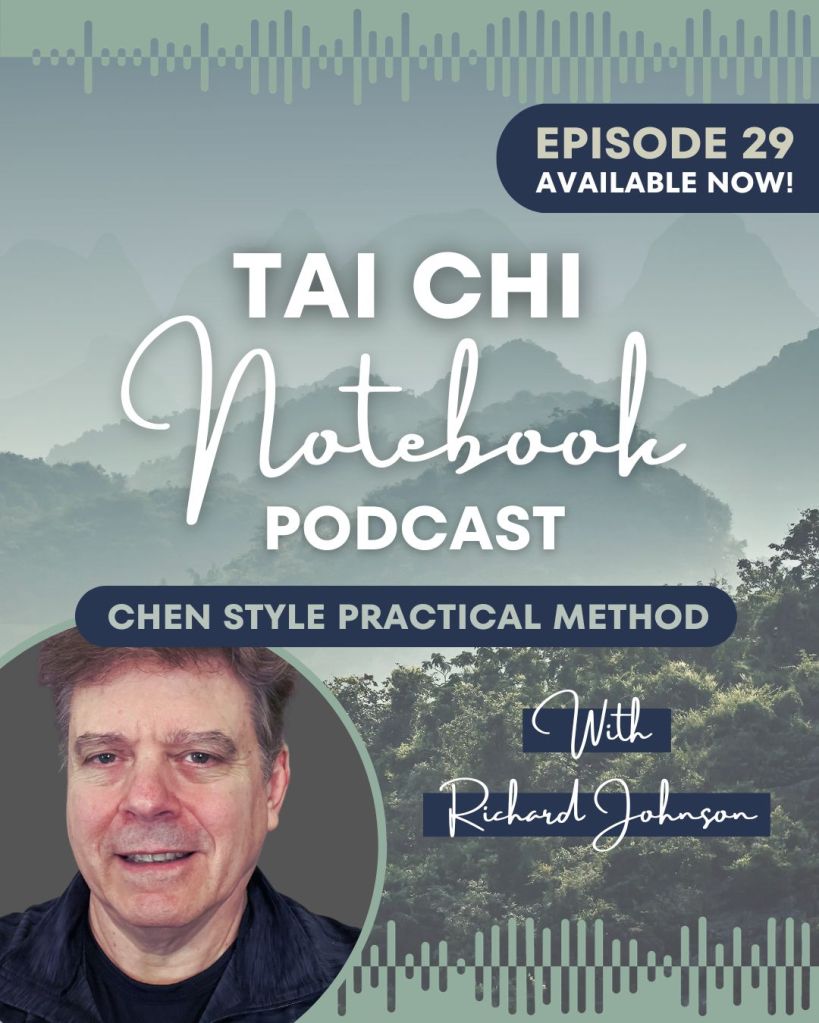

New podcast! Richard Johnson on Chen Style Practical Method

This month’s podcast guest is Richard Johnson a long-time student of Joseph Chen of Chen Style Practical Method.

As well as a Tai Chi practitioner and teacher, Richard is a full time movement coach working with athletes, so he brings an appreciation of athletic movement to his views on Tai Chi.

In our discussion Richard delves deeply into the internal workings of the Chen Style Practical Method and we talk a lot some interesting movement principles based around rotation. We also talk about how the Practical Method is different to the Chen Village style of Tai Chi.

Enjoy the podcast. You can get in touch with Richard using his email address ⁠trukinetix at gmail.com⁠

Sinking the Qi and rooting in the foot

How does rooting work in Tai Chi?

In the Tai Chi Classic it says:

The jin should be
rooted in the feet,
generated from the legs,
controlled by the waist,
and expressed through the fingers. 


This does present something of a dilemma – how can we both be rooted in the feet but also controlled by the waist, let alone also generated by the legs?

In the Treatise on Tai Chi Chuan, the classic says “Sink the chi to the dantien.”

This sinking is related to the pulling in action of the muscle tendon channels that are usually associated with the contraction (closing) phase of opening and closing – usually while breathing in. The breath sinks to the dantien area, and combined with correct mental focus, this should make the dantien area feel full as you breathe in.

This pressurised feeling in the dantien is also the pressurised feeling at soul of the foot. You could think of it as squeezing the pressure from the dantien down to the foot, but you really don’t need to do that, as it should be instantaneous, since they are the same thing.

With the exhale, the pressure pushes up, through the legs, up the back and out to the extremities including the head. It’s a continual cycle of store and release.

You could call this the internal side of Tai Chi, but really, it’s just the way Tai Chi works, rather than a particular side of it.

Simon Cox on Zhang Sanfeng and the history of Tai Chi Chuan

The article On the Historical Mystery of Zhang Sanfeng by Simon Cox, on the history of Tai Chi Chuan and its connection to Zhang Sanfeng is great. I’ll just quote a couple of paragraphs from near the end, but recommend you read the whole thing for context:

It seems like Tai Chi was really a Republican era (1912-1949) category that became a sort of umbrella term for various Chinese martial arts that are practiced slowly, containing such multitudes as the ancient martial arts of Chen village, the later arts of the Yang family, and the weird things people were doing at Wudang, in Zhaobao village, and even the government-created variations on these styles.  From this view, asking which style started it all is rather meaningless.  The historical connections simply aren’t there.  From the densest of historical positions, there is no evidence anyone practiced anything called Tai Chi Fist before the 20th century. It arises as a high prestige category in the context of post-Qing Chinese nationalism. Every slow-ish martial art in China seems to have been automatically re-branded as a form of Tai Chi.

According to the Yang Family oral tradition, Yang Luchan 杨露禅 (1799-1872), the founder of the style, called his art variously Cotton Fist 綿拳 or Transforming Fist 化拳, and it was only during his time in Beijing that a Confucian scholar Weng Tonghe 翁同龢 (1830-1904) witnessed him demonstrating his style and wrote a poem about how it embodied the principles of Tai Chi.  According to this oral tradition it was after this event that the art came to be known as Tai Chi Fist.  This story was first published in the 1930’s and is almost certainly apocryphal.  But even if we take it at face value, we arrive at the inevitable conclusion that Tai Chi Fist was an appellation applied first to Yang family martial arts and then later, during the first decades of the 20th century, expanded to include Wudang and Chen styles.

Simon Cox – On the Historical Mystery of Zhang Sanfeng

Chen Man Ching’s Tai Chi Method

I don’t feel I’ve written enough about body mechanics recently. I’ve been too busy enjoying myself reviewing books and interviewing people for podcasts, but I guess it’s time I stopped having fun and got back to being serious!

Watching a video of Professor Cheng Man Ching for my recent book review of Yang Short Form, I was struck by how little the Professor used his arms in his Tai Chi form. Take a look:

Sometimes it looks almost like he just gives up as his arms go limp! (Like at 1.20 in the video). This is one of the big criticisms I hear of the Cheng Man Ching form – that it’s a bit limp – but if you look at what his legs are doing it’s a bit like watching a swan on the water – you can’t see anything moving above the water, but beneath it there is a lot going on.

There are plenty of people in the Tai Chi world who disparage Professor Cheng Man Ching and his abilities. They claim that it was really his high level political connections in the exiled Nationalist government in Taiwan that made people praise his Tai Chi, not his actual abilities in the art. However, I think his impact on the Tai Chi world has been undeniably huge, and he attracted a lot of students, many of whom came from other martial arts and were experienced in those arts. I don’t think that would have been possible without some real ability being offered. From watching videos of his form and push hands, his deep rooting in his legs and ability to transfer the ground force into his opponents looks impressive to me. While there is no evidence of him transferring this ability into an actual martial art, he did appear to actually engage people in playful push hands on a regular basis, something a lot of Tai Chi teachers don’t do.

Cheng Man Ching was heard to say that he once had a dream where he had no arms and it was only after that that he felt he understood Tai Chi. That’s what his method looks like to me – the arms don’t matter. He’s sunk very low in his legs all the time, channeling the ground force upwards into his torso, and the arms are almost an afterthought, held up with as little energy as possible. 

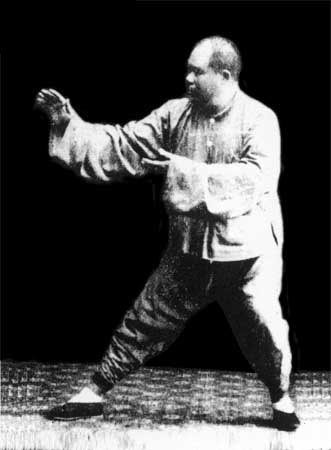
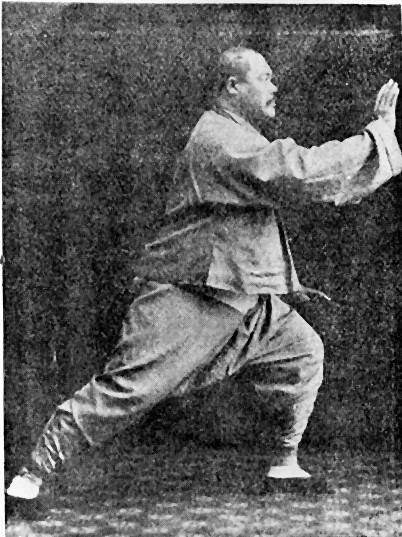
Personally, I can’t say I’m a fan of this method. To me it seems logical that in Tai Chi your body needs to have the sense of being stretched slightly from fingertips to toes at all times. I don’t mean stretched in a Yoga-like way, I mean that the skin needs to feel stretched over the bones and muscles, as if you’re made of rubber. Take a look at a picture from history of Wu Chien Chuan, of Wu style or Yang Cheng Fu of Yang style and I think you can see what I mean.

That way it’s like a guitar string being tightened so that it makes a sound when plucked in the middle. A lax string can’t be played. In Tai Chi that ‘middle’ is your dantien. If you’ve got a slight stretch on your body, from fingers to toes, then you can control movement along the length of this stretch using your dantien, so a movement of the dantien will naturally affect a movement of the extremities, if you let it.

The classics use the analogy of a bow, the most famous line being “Store up the jin like drawing a bow.”

Anybody can feel this stretch by adopting a Tai Chi posture and relaxing and trying to create an expansive feeling, but it gets stronger over time and with repeated practice. A lot of the chi kung exercises that come along with Tai Chi are designed to help you feel this stretch from fingers to toes, and help to make the connection stronger and more usable over time.

Chen Man Ching’s idea of Tai Chi seems different to me. It’s more like he’s got no arms and the jin is stopping in his shoulders, not reaching his hands. At least that’s how it appears to me.

4oz deflects 1000lbs

The Yang Family Secret Transmissions book contains a number of writings that are seen as additions to the main Tai Chi Classics documents.

Amongst the documents is “The Song of Pull down”. “Pull down” is the name of one of the ‘8 energies of Tai Chi’, there’s a song, meaning verse, for each of the energies in the book. Here’s the Pull Down song:

The Song of Pull-Down

How can we explain the energy of Pull-down?
Like weighing something on a balance scale,
We give free play to the opponent’s force
whether great or small.
After weighing it we know its lightness
or heaviness .
Turning on only four ounces,
We can weigh a thousand pounds .
If we ask what is the principle behind this,
We discover it is the function of the lever.

The verse is not talking about something mystical, it’s quite clearly talking about the principle of leverage. A lot of Tai Chi people don’t like the idea that ‘Pull down’ might be about something as mundane as leverage, which is found in all other martial arts. Well, tough! The verse is clearly talking about leverage.

You’ll see the reference to four ounces moving a thousand pounds in this verse. This also appears in the ‘Treatise of Tai Chi Chuan’, one of the main Tai Chi classics, where it says:

“From the sentence “A force of four ounces deflects a thousand pounds”
we know that the technique is not accomplished with strength. “

Treatise of Tai Chi Chuan

Leverage, of course, is different to pure strength. As Archimedes said about leverage:

“Give me a place to stand on, and I will move the earth.”
(quoted by Pappus of Alexandria in Synagoge, Book VIII, c. AD 340)

By using leverage you can significantly increase the amount of power you can generate. The martial arts that will teach you the most about leverage are all grappling arts – Shuai Jiao, Judo, BJJ, etc..

For an example of leverage in marital arts – look how much pressure is required to break the elbow at the end position of an armbar in BJJ – you could say that it’s about….. 4 oz.

When looking for the energy of Pull Down in the Tai Chi form you find it all over the place. A classic posture its used in is the Raise hands/ Play Guitar type of movements. Here you hold the wrist and elbow of the attacker, and apply pressure to hyperextend the arm. Again, this is another example of leverage.

Raise Hands, Yang Cheng-Fu

My Tai Chi teacher tends to call the energy “shock” rather than “Pull down”, but its application is the same. It’s a short sharp jolt to the system that usually has the effect of getting you up on your toes, or moving forward or backwards whether you want to or not. And the only way to do that to somebody, without being significantly stronger than them, is through the use of leverage.

Look out for the movement in the video where he pulls the attacker’s arm down to uproot him and says “this is shock” (around the 1 minute mark).

Now, all these different applications of ‘pull down’ or ‘shock’ energy looked very different to each other, however, they’re all applications of the same principle – leverage. The technique can look very different, but the principle (or as Led Zeppelin would say, the song) remains the same.

Feet-together postures in Taiji (Tai Chi) and Xing Yi

I’ve always been curious about the postures in martial arts forms where both feet are together, because these postures don’t look very martial at all. In fact, it’s hard to imagine why you would want to use a stance like that in a fight, and yet we find them in a lot of Tai Chi forms:

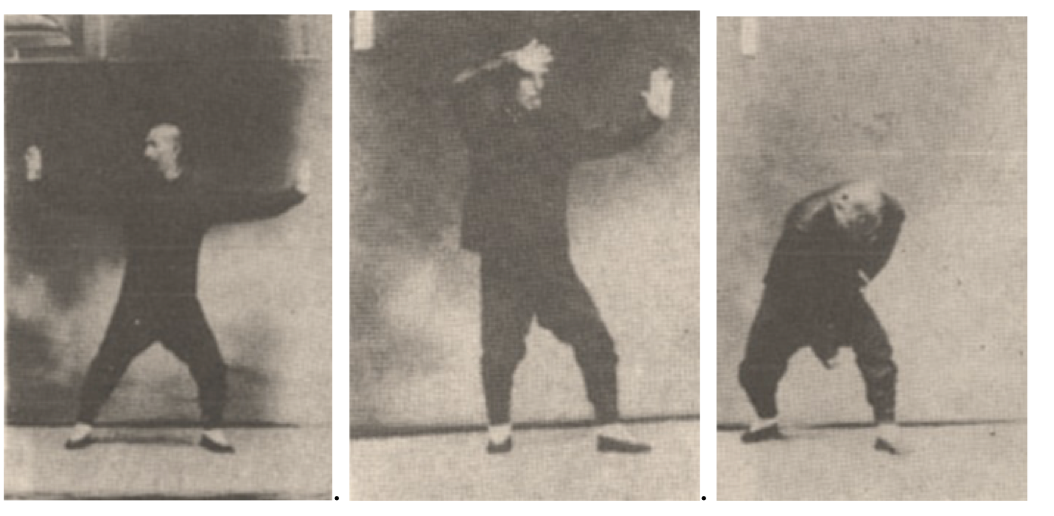
From: Sun Lu Tang, A Study of Taiji boxing, 1921

From: Long ZiXiang, A study of Taiji boxing 1952

Here’s an example of the posture in application in Taiji performed by my teacher Sifu Raymond Rand:

Sifu Rang, Brush Knee, Twist Step.

It seems to be mainly Taiji lineages that have some influence from Sun Lu Tang that do this the most. A lot of people attribute the distinctive ‘feet together’ postures he used to his prior training in Xing Yi, and there could be some truth to this. Xing Yi does have ‘feet together’ postures quite a lot.

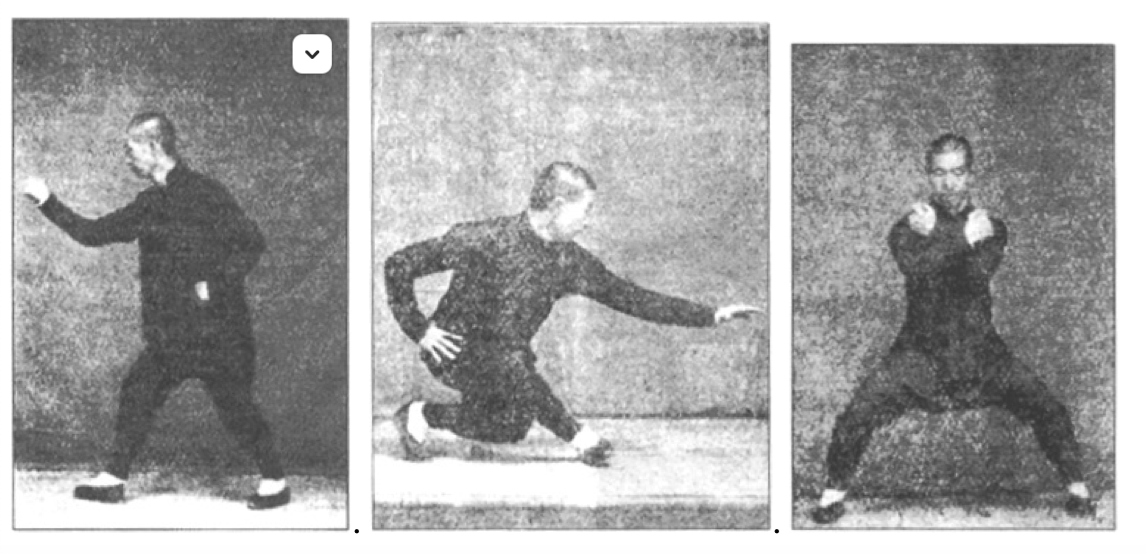
Sun Lu Tang showing a selection of postures from , A Study of Xing Yi Boxing, 1915

Of course, the root of Xing Yi is spear fighting, but the modern interpretation of the art is heavily biased towards bare hand training, and this creates a misleading impression. Think about it – if you were at at least one spear length away from your opponent the risk of being tackled to the ground because your feet are together would be greatly reduced. You’re now free to use the power generation advantages that can be gained by letting both feet come together, which is handy when you are holding a heavy object, like a spear.

If you watch this excellent video of Xing Yi spear technique by Byron Jacobs you’ll see that he doesn’t hang out with his feet together all the time, but occasionally he uses the feet together moments for power generation (and of course, also standing on one leg for range advantage and manoeuvrability in a way that makes sense with weapons).

Video:

Example feet together transitional posture:

Byron Jacobs of Mushin Martial Culture

In Xing Yi the most famous example of the ‘feet together’ posture is the Half-Step Beng Quan. Here the back foot stepping up to meet the front foot in place creates a powerful closing action of the body, kind of like a door slamming.

From: Selected subtleties of the Xing Yi Boxing art, by Liu Dianchen [1921]

So, is this the origin of ‘feet together’ postures in Taiji forms? Quite possibly. However, there is one more thing to consider. After first learning Xing Yi, Sun Lu Tang learned his Taiji from Hao Weizhen 1849–1920, who learned from Li Yiyu 1832–1892, who learned from one of the Wu brothers, Wu Yuxiang 1812–1880 who had learned directly from Yang Luchan 1799–1872 and also sought out Chen Qingping 1795–1868 who he learned from in Zhaoboa village.

It’s often thought that the distinctive stepping seen in Sun style Taiji, where the back foot is often lifted and brought up close to the front foot, is a consequence of Sun’s prior Xing Yi training. This makes sense as part of the narrative created as part of the Sun Style Taiji brand, which is that he incorporated his earlier Xing Yi and Bagua training into his Taiji style. However, if you look at the Wu (Hou) style he learned, it already had this distinctive stepping in it.

For example:

From: Wu Yuxiang style Taiji Boxing by Hao Shaoru

While the feet don’t go completely together as much, if at all, in Wu(Hao) style, they are very close together for a lot of the time. Watch this video for an example of the form in action:

One theory about why this is is that Wu Yuxiang was a member of the Imperial Court at the end of the Ching Dynasty, and was therefore expected to wear traditional court dress, which restricted the stepping.

I think you can see that influence extending into Sun Lu Tang’s Taiji, which makes sense since he learned from this lineage.

Finally, I should note that thought this post I don’t want to create the impression that all the steps in either Xing Yi or Taiji performed by Sun Lu Tang are small or restricted. He also had plenty of wider postures in his arts too, for example.

Xing Yi:

Taiji:

However, compare it to postures found in other styles of Taiji whose practitioners didn’t have to wear court dress:

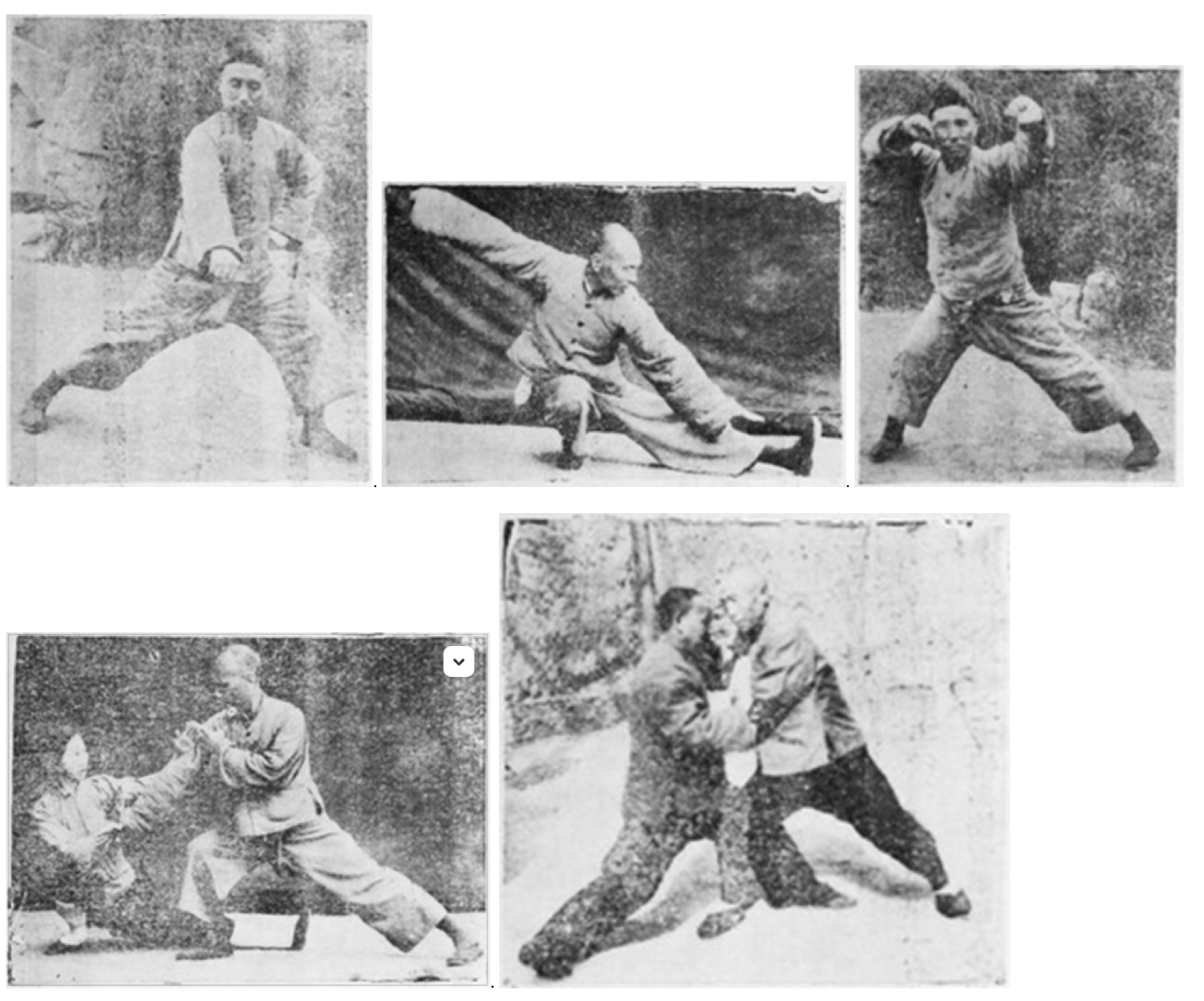
Chen Ziming for example:

From: The inherited Chen family boxing art, Chen Ziming

Calling out Bullshido

Fantasy or reality?

I’ve been involved in a lot of discussions recently (and for years!) about what in Chinese martial art is fantasy and what is real. Realness, keeping it real, being truthful, whatever you want to call it, it is seen as a big deal. The question of the essential realness of a technique, a style or a whole person’s lineage, cuts to the heart of the matter, always.

Discussions of these types have flourished along with the growth of online video and the means to talk about these videos online. These discussions usually go along the line of:

1) A famous practitioner puts up a clip of himself (it’s usually always a male) demonstrating something visually impressive on a student. The purpose of the clip is self promotion for fame or seminars or online teaching material. Maybe they show a student go flying through the air from the lightest of touches, or they resist a strong push without any visible effort – you know the sort of thing.

2) Somebody comments and goes – “that’s bullshit!”

3) All hell breaks loose in the comments section between rival sections.

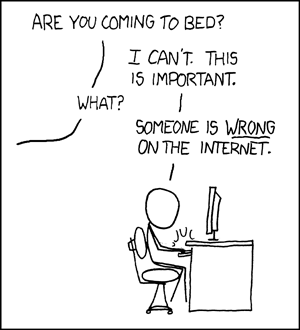
I can understand the strong urge to want to point these things out. I get involved in these things too. Sometimes I see something that is such obvious nonsense I can’t help but point it out. It’s like this old XKCD cartoon that is funny because it’s true:

The argument is logical: There are so many good things in Chinese martial arts and the fantasy stuff is damaging to that. And it’s therefore up to us to call out the fantasy, not accept it. If we don’t then we just invite ridicule, especially from other martial artists.

However, even when that attitude is adopted I see people tend to be more interested in calling out the fantasy stuff that other people do, or that is in other styles, not their own! And never in anything they do themselves or their teachers do. We all have our own blind spots and biases.

But I’ve been thinking differently about this issue recently…

When you look into the close connection between martial arts and street theatre, or opera troops and (as technology progressed) Kung Fu movies, it’s impossible not to conclude that showbiz (for want of a better word) has always been connected in some way with Chinese martial arts from the very beginning.

That doesn’t mean that Chinese martial arts masters of old weren’t bad ass. They were bad ass! But they also knew how to perform Lion Dance, or put on a show at New Years, or impress a prospective student with a. few tricks if they had to. These things were so interconnected in Chinese culture that it seems impossible to separate them (although successive Chinese governments gave it a good go throughout the 20th century).

Showbiz has always been there in Chinese martial art. It’s what makes amazing movie fight scenes like this one from The Grand Master possible:

Beauty, artistry, story telling. It’s all there. It’s using “real” techniques from martial arts and presenting them in a hyper-real, perfected, way.

Of course, the problem comes when people get conned into believing that the hyper-real is the real and that can take people to some very weird places, involving cult-like practices, exploitation and usually a lot of money being handed over. That’s where the problems start for me.

There are no easy answers, but I think that viewing some of these things that are not quite real as merely a part of the showbiz side to Chinese martial art, is perhaps an easier way to deal with it.

For instance, what is going on in this clip with Chen ManChing bouncing people around?

I can imagine a lot of Chen style Tai Chi people getting upset about that, as the sort of nonsense that doesn’t tend to happen in their style… and yet, what’s going on in this clip:

Is it as bad? Is it worse, even?

I don’t know.

It might just be easier to look at both these clips say,

“It’s just showbiz”, and shrug your shoulders and laugh.

Thoughts on Chen Taijiquan Illustrated #1 – Yang style vs Chen style

The newest addition to my collection!

My copy of Chen Taijiquan Illustrated arrived, and I’ve almost finished it. It’s an easy read since the word count isn’t very high – it’s essentially a series of high quality training notes, illustrated, which I think really helps to convey the message in a way that text alone cannot. I’m not going to do a full review for a while, I’m going to let the book sink in first, but I might do a series of posts on ideas it has sparked in me.

Here’s the first one.

The thing I wanted to talk about today was how similar Chen style (as described in this book) is to Yang style. I think a Yang stylist would get almost as much out of this book as a Chen stylist. While the content and methods described in the book all clearly derive from Chen style, as do the illustrations, I’d say 90% (or more) of what’s described here is exactly the same as Yang style.

So what’s different? Bits and bobs on silk reeling, some stepping methods and stance details and the bits on fajin. But even then, they’re not something alien to a Yang stylist, and would be easily within reach of anybody who wanted to take their practice in that direction.

What’s the same? The emphasis on posture is really good here – how to round the back, contain the chest, round the kua, the eight energies, the 5 steps, push hands strategy and training methods, quotes from the classics, being centred and upright, rooting, the dantien, martial applications, etc.

What was I surprised not to find more of? Opening and closing using the 5 bows, and empty and solid. Perhaps more on using the force from the ground… There are mentions of these things throughout, but the book never really goes deeply into them. Perhaps it was too complex for the illustrated book-based approach? There’s only so much you can fit in one book, and there’s plenty of content here.

However, the emphasis on the body requirements of Tai Chi, and explanation of why these things are done, is excellent and transfers effortlessly across Tai Chi styles. It’s reminded me a lot how similar Yang style and Chen style are ‘under the hood’, so to speak. I wrote a post recently where I talked about them being similar but different. I still kind of think that. My view is that at some point Chen style incorporated the ideas contained in “Taijiquan” wholesale from Yang Luchan’s lucrative teaching business in Beijing into its larger, pre-existing, village style (which was more militia fighting and weapons-based) – it absorbed it whole – a bit like a whale swallowing a smaller fish. It was easy because all Chinese styles are similar to some extent. But of course, this means that the Yang style is still there inside Chen, and it’s impossible not to see how ‘almost the same’ they are when reading this book. (I think the spiraling and silk reeling stuff was from the pre-existing Chen style). Your opinion may be different. Food for thought!

New book alert! Chen Taijiquan Illustrated

Thanks to Ken Gullette at Internal Fighting Arts I just caught wind of this new book that’s just come out called Chen Taijiquan Illustrated. I had a quick look on Amazon using the “Look Inside” feature and the illustrations look fantastic. It looks like it’s designed to be halfway between an instruction manual and a comic. It’s a very cool style that’s quite unlike any Tai Chi book I’ve seen before.

Chen Taijiquan Illustrated – available now!

I think that often Tai Chi books, with pages after pages of printed text, can be a bit off putting for people who are learning an art that is all about feel, movement and “doing it”, not “reading about it”. And when they do have photographs in them they are often black and white and a bit dull and lifeless. So, for the visual learners out there, I think the colourful and imaginative approach found in Chen Taijiquan Illustrated will work very well.

Here’s an example:

An extract from Chen Taijiquan Illustrated by David Gaffney and Davidine Siaw-Voon Sim

Here’s another thing: Looking at the contents page, this is the first Tai Chi book I’ve seen that mentions the concept of Man, which translates as Slowness, apart from the book written by my Tai Chi teacher. Man is a concept my teacher talks about a lot, and it’s nice to see it mentioned in another Tai Chi book – I was starting to think that it was a concept that was unknown to the rest of the Tai Chi world!

Tai Chi Chuan a comprehensive training manual by Raymond Rand

Obviously everybody and their dog knows that Tai Chi is done slowly, but Man is more of a mental quality than a reference to the speed of the form. It can be thought of as “not rushing”. The speed you are moving at is irrelevant to the concept of Man, but if you want to acquire the ability of Man then the best way is by slowing the form down and focusing on keeping your mind on what you are doing. Whenever you find your mind wandering off you just stop the form (no matter how far through it you are) and start again. After a few weeks or months you’ll find you are much better at staying focused on your form than you were before. By adopting the qualities of “not rushing” you open up the headspace required to be aware of other things going on, things that you would simply miss otherwise. I’ve written about not rushing before.

At £16 Chen Taijiquan Illustrated is not particularly expensive for a colour book either. And I’d love it if there was a book on Brazilian Jiutjisu that was written and illustrated in the same manner because I think it would also benefit from this approach. Incidentally, there was a good book written about Brazilian Jiujitsu recently, that has colour photos (and very nice ones too) that I still dip into now and again called Nonstop Jiujitsu, by Stephan Kesting and Brandon Mullins. I reviewed it on my blog recently, so check out my review.

Nonstop Jiujitsu by Brandon Mullins and Stephan Kesting

I’ve ordered my copy of Chen Taijiquan Illustrated so will review it at some point in the future.