Tai Chi whole-body movement revisited

gray dragon statue

Photo by Pixabay on Pexels.com

So, my last post on what ‘whole body movement’ means in Tai Chi Chuan got some interesting reactions on the interwebs. I thought answering the comments might make a good subject for a few more articles. So let’s get going with the first of them.

On the Ancestral Movement group, Andrew Kushner writes:

“Whole body motion” is a lousy coaching cue. It neither helps people move more correctly nor is it an accurate description of what’s going on. It is possible to have “whole body motion” with only one limb moving apparently, and it is also possible to have the entire body involved but still ‘disconnected’ from an IMA perspective.

In fact this is the case with most athletic movements. Do you really think boxers and judoka don’t involve their whole body when they go to express power?

Firstly, yes, I’d agree that ‘whole body motion’ is a bad coaching cue, since it is so undefined. That’s really what my post was about – how there are different possible interpretations of what whole-body motion could mean, and what it actually means in the context of Tai Chi Chuan. Like most of the writings in ‘the classics‘, Yang Cheng Fu’s 10 important points is only useful if you already know what he’s talking about. Which makes them good as reminders, but rubbish as coaching cues.

The second point about boxers and judokas is interesting. Yes, I agree that boxers and judoka involve their whole body when they go to express power. But they do it in a different way to Tai Chi Chuan practitioners. Or at least they generally do. Sure, you could do both boxing and judo with a Tai Chi Chuan type of whole-body power, if you wanted to. But in Tai Chi you want to use as little physical effort as possible to get the job done. It’s difficult to even understand what that means and even hard to actually do it. Tai Chi movement is subtle and tricky and there’s no real incentive to train that way in combat sports where results matter and there are quicker, easier ways to get them.

boxers inside a ring

Photo by Sides Imagery on Pexels.com

It’s not like boxers don’t use their legs when throwing a punch. Of course, they do, but do they do it in the exact way we do in Tai Chi Chuan? I don’t think so. Let’s remind ourselves what the Tai Chi Chuan way of moving is again –

1) moving from the dantien
2) power up from the ground (jin) – rooted in the feet, expressed by the fingers.
3) coiling and spiraling actions from the dantien out to the extremities and back.

That’s difficult. A strong, athletic 20-year-old in Judo can fire his hips into a throw with more than enough speed and power to get the job done. It doesn’t need to have all come from the ground to work.

“Second, there is more in common between the “robot dance” and CIMA than Graham acknowledges. It wasn’t until I learned other ways of moving e.g. Systema and dance that I realized just how blocky and ‘robotic’ the CMA’s are at their core, even flowy and ‘natural’ looking ones like taiji. In fact I think a lot of their power derives from this similarity — simple movements done well.

Still for all the similarities there are important differences between CMA and the robot dance, so it is instructive to consider what those might be.”

That’s interesting. I don’t know what Andrew’s individual experience of Chinese Martial Arts has been, but I’m always a bit wary of using my individual experience to generalise and speak for all of Chinese Martial Art. It’s a very broad church and it contains pretty much every possible version of movement you can imagine.

Is he talking about modern Wu Shu training? The 1920s GouShu experiment that got exiled off to Taiwan? The pre-twentieth century martial arts that were forced underground? Wrestling styles?

I guess, compared to Systema any martial art could be called ‘blocky’ and ‘robotic’ since Systema has no routines or patterns and has no stance, just the four pillars: movement, breath, posture and relaxation. It also looks utterly ridiculous at times. I’m actually not adverse to Systema at all and I think there’s some great stuff in there. I’ve got a good friend who is a teacher and I do want to check out his class sometime. (But it would mean time spent not doing Jiujitsu, and that’s a serious consideration, so some tough choices will have to be made!)

On balance I think there is some merit in Andrew’s criticism of CMA here. A lot of it is just a lot of forms. But again, it depends on how you train it. Are you just training forms for forms sake? I think a lot of Chinese martial arts is like this. I’ve never been attracted to systems that had a lot of forms. A form for this, a form for that. I think that misses the point entirely.

I think of ‘forms’ as being like the raft in the parable of the Buddha crossing the river.

But then Andrew flips it around and praises “Simple movements done well” I think this references to things like XingYi, which has 5 fists as its base. These are quite often practiced over and over, for years. until you get very good at them. Personally, that approach didn’t appeal to me. I found the more varied animals much more interesting to practice and also more alive, less robotic, more spontaneous and useful for actual sparring. I think that’s where real power of Chinese Martial Art lies – not in practicing simple thing over and over, but in not getting too fixed down into any particular method or technique and keeping things fluid and “in the moment”.

But each to their own.

Tai Chi: One part moves, all parts move

pexels-photo-62376.jpeg

Photo by Snapwire on Pexels.com

I’ve been thinking of the way to describe what ‘whole body movement’ means in Tai Chi. The problem is describing a specific feeling, or body movement using words, which leaves the meaning open to interpretation and misunderstanding.

In Yang Cheng-Fu’s Ten Important Points, No. 7 says:

“7.) Coordinate the upper and lower parts of the body. The T’ai Chi Ch’uan Classics say “the motion should be rooted in the feet, released through the legs, controlled by the waist and manifested through the fingers.” Everything acts simultaneously. When the hand, waist and foot move together, the eyes follow. If one part doesn’t follow, the whole body is disordered.”

This is an expanded version of the more condensed and often heard phrase: “One part moves, all parts move”. But it’s also misleading.

If you take the line “Everything acts simultaneously” at its literal meaning you don’t have Tai Chi movement. You have robot dancing.

Now don’t get me wrong. I like robot dancing as much as the next Peter Crouch fan, but it’s not Tai Chi. When you see a performer doing the robot dance she often swivels the waist sideways, or dips the hip with the arm locked to the body. With the dip the whole torso and arms all move downwards together, simultaneously. Something like this:

giphy

It’s fairly obvious that this is not what is meant by Yang Cheng Fu when he says to move the body parts simultaneously, and yet I do see people falling into this trap quite often. They obviously had no intention to set out moving like a robot, but when the brain gets the idea that the body must move as a unit, the resultant expression can often end up far from the mark.

Instead, the way the body moves in Tai Chi should be more like ripples emanating from a stone dropped in a lake. The central point is the dantien. The waves begin there and ripple out to the extremities (feet, head and hands).

giphy-1

When you move, the dantien moves first, and the rest of the body follows in a coordinated action, almost as if dragged by the dantien. It is loose, connected, relaxed and powerful, rather than stiff, jerky and ’empty’.

The parts of the body don’t all move together at exactly the same time, otherwise you’ll end up like a robot. Instead, you want to be more like the way an animal moves. Animals demonstrate some of the best, most graceful, full-body, co-ordinated movement you’ll ever see.

The Cheetah is the classic one that’s used to illustrate open and close in the body, but also the directed head position. Just look at how the head helps with the coordination when running here:

giphy-2

While we run with a torso held in the vertical plane and the Cheetah runs with the torso in the horizontal plane, the head position remains key.

Point 1 of Yang Cheng-Fu’s 10 Important Points is:

1.) Head is held upright to let the shen rise to the top. Don’t use li, or the neck will be stiff and the chi and blood cannot flow through. It is necessary to have a natural and lively feeling. If the spirit cannot reach the headtop, it cannot raise.

In the Cheetah, the engine is the dantien area. The torso does big opening and closing movements as it sprints and the head points the way, keeping the spine flexible, but extended.

Be less robot, be more Cheetah.

Tai Chi’s Rollback: A deep dive

photo of night sky

Photo by faaiq ackmerd on Pexels.com

Split, like Rollback, is one of Tai Chi’s 8 energies. It’s also one of the most commonly found of the 8 energies in the Tai Chi form. Almost every technique you see in Tai Chi Chuan (Taijiquan) uses Split energy to a greater or lesser degree.

I’ve seen Split described as spiral energy, a takedown or a breaking force. But all of those things miss the point – they describe its effects, not what it really is.

Split is really the energy of two things moving in opposite directions. If you move two things in a circle in opposite directions you create a spiral. When you do applications on somebody with spiral actions the result is usually a takedown. And you can’t break any joint without directing force in two different directions. For example, if you kick somebody’s leg it’s unlikely to break unless that leg is locked against something that doesn’t move, like say, the ground.

This brings us on to how Split is applied in Tai Chi Chuan.

In Tai Chi you want your hands to be clearly differentiated from each other. One hand needs to be active, the other passive. One empty, and the other solid. One Yin, one Yang. If you don’t do this then you enter a state known as being double weighted. As it says in the classics:

Sinking to one side allows movement to flow;
being double-weighted is sluggish.

Anyone who has spent years of practice and still cannot neutralize,
and is always controlled by his opponent,
has not apprehended the fault of double-weightedness.

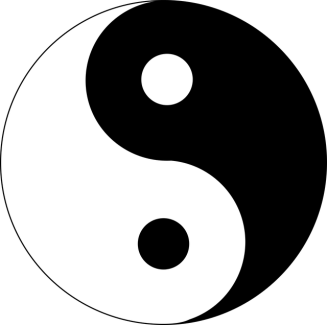
To avoid the fault of double-weightedness, which hand is the yin one and which is the yang one must change continually and ceaselessly as you go through the movements of the Tai Chi form. Tai Chi Chuan should always be in a state of change, just like the Tai Chi symbol itself is.

yin-yang-2024615_640

Image by Pixabay.


If it’s not in a state of change then it’s stuck. Calling something double-weighted is another way of saying that it’s stuck.

Split is usually applied along with another of the 8 energies. One example I wanted to look at today is Rollback. Rollback, or Lu energy, is the most yin of all Tai Chi’s 8 energies. It’s almost the absence of energy. When being confronted with active Yang energy, Lu is the energy of retreating or yielding. Its movement is usually inwards.

The technique called Rollback in the Tai Chi form gets its name from Lu energy, but also mixes in a bit of Split energy.

If you look at this picture of Yang Cheng Fu doing Rollback you can see the differentiation in his hands.

ycf_roll_back

This left hand is withdrawing and pulling, but his right hand is pressing downwards.

In the action of Rollback your left-hand starts off as the active one with a guiding pull on the attacker’s wrist, but the right one then takes over as the active hand with a strong pressing down action onto the attacker’s elbow area.

I found a really old video of me doing rollback in push hands, so you can see what I mean:

giphy

At the start of the motion my left hand is the active one, then the right hand takes over with the pressing down movement.

Throughout the whole Tai Chi form, you should be aware of this interplay of energy between not just the palms but the other parts of the body too. If you can notice it in the palms, with one hand being the active one and the other the passive one, and then exchanging positions, you can start to notice it in the feet, the legs and so on.

Once you can do this over the whole body then you can distinguish yin and yang throughout your form and you will no longer be at the risk of exhibiting double weighting.


Shen, Xin, cats and the Tai Chi classics

brown tabby cat

Photo by Immortal shots on Pexels.com

In this post I’m continuing with my current theme of the mind and Tai Chi Chuan.

Animals don’t “think” like we do most of the time. I bet you could argue that the species known for problem-solving like crows, chimpanzees, dolphins and dogs do their fair share of thinking, but in my previous post I was describing a state where you are doing Tai Chi without thinking. Just being.

You can see it in their eyes. Just look at that cat above. Cats are great examples of this, because they are around us often they’re easy to observe, but if you can observe animals in the wild you’ll see that they are in this state most, if not all, of the time.

There are various references to cats in the Tai Chi classics.

“The Form is like that of a falcon about to seize a rabbit,
and the shen is like that of a cat about to catch a rat.”

Shen, we can loosely translate as spirit, but if you just substituted the words “inner state” there instead I think it would better equate to what the author was trying to convey, but he or she did did say Shen for a reason, as we shall see.

The word “Spirit” in English is tied up with all sorts of (organised) religious connotations which get in the ways and are not helpful.

A better understanding of what is meant by Shen would perhaps be, ‘underlying spirit of nature’. The part of you that is connected to this underlying spirit of nature is known as the Xin in Chinese. If it’s aligned with nature your Xin can produce your Yi (intention), which in turn can produce the physical movement (Qi) which in turn produces action (Li) all working in harmony with nature. You and your environment are one, working and acting together.

There are various versions of this ‘working in harmony with nature’ sequence written about in old Chinese writings – the Xin harmonises with the Yi, the Yi harmonies with the Qi and the Qi harmonises with Li being the most common and also forming the 3 internal harmonies of the famous Lie He, the 6 harmonies with are written about in all sorts of Chinese martial arts.

My Xing Yi teacher, Damon Smith did a whole podcast episode about the word “spirit” and what it means in Asian traditions connected to shamanism, which I find helpful in understanding. I would listen to the whole thing, but around the 8-minute mark he talks about this sequence and how Shamans use it to act in harmony with nature in their own lives or when practicing shamanism:


Cats and the Tai Chi classics

To me, the section of the classics that says “The Form is like that of a falcon about to seize a rabbit, and the shen is like that of a cat about to catch a rat”, alludes to the idea that on the outside the victory in combat may look overwhelming and great – like that of the falcon seizing a rabbit triumphantly, but on the inside, you need to be quiet and calm and in harmony with nature – the exact qualities you can see in a cat patiently stalking a rat.

Of course, the flacon is like that on the inside when catching a rabbit, but it’s not easy to see on the outside. Human-loving cats, however, are easier to observe.

A cat crops up somewhere else in the Tai Chi classics too:

“Walk like a cat.”

That doesn’t mean get down on all fours, it means to adopt the same mental qualities as mentioned earlier to your stepping. Don’t just rush in blindly or recklessly: be calm, patient and at one with your environment.

Remember, as it says in the classics:

“All movement is motivated by Yi and not by external form”.

But perhaps Bruce Lee said it best in Enter the Dragon:

“Don’t think! Feel!”


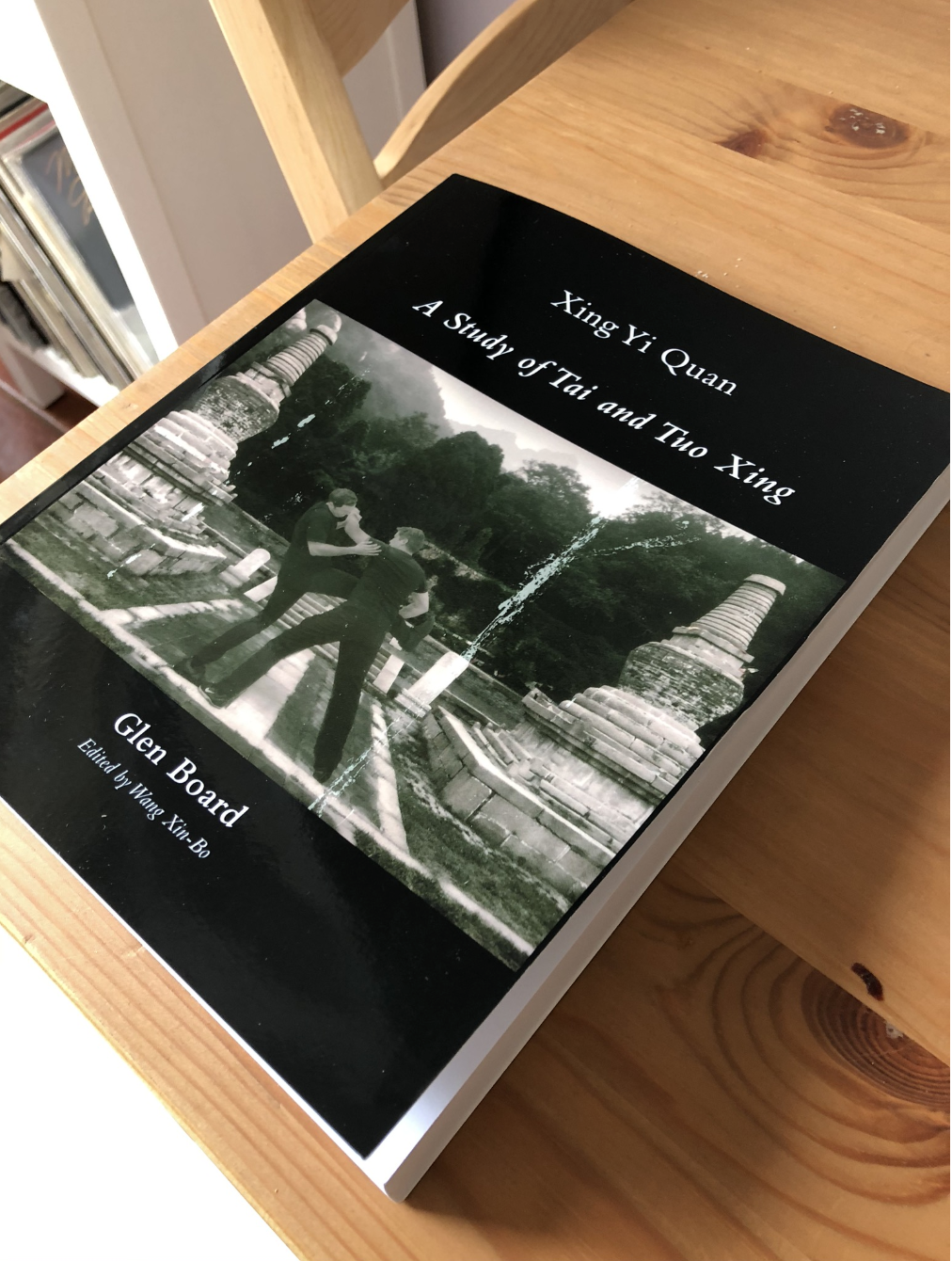
Xing Yi Quan, a study of Tai and Tuo Xing, a review

I finally got myself a copy of my friend Glen Board’s new Xing Yi book: Xing Yi Quan: A study of Tai and Tuo Xing. It arrived in the post today:

Screen Shot 2019-10-21 at 12.54.15 PM.png

UK link to Amazon.

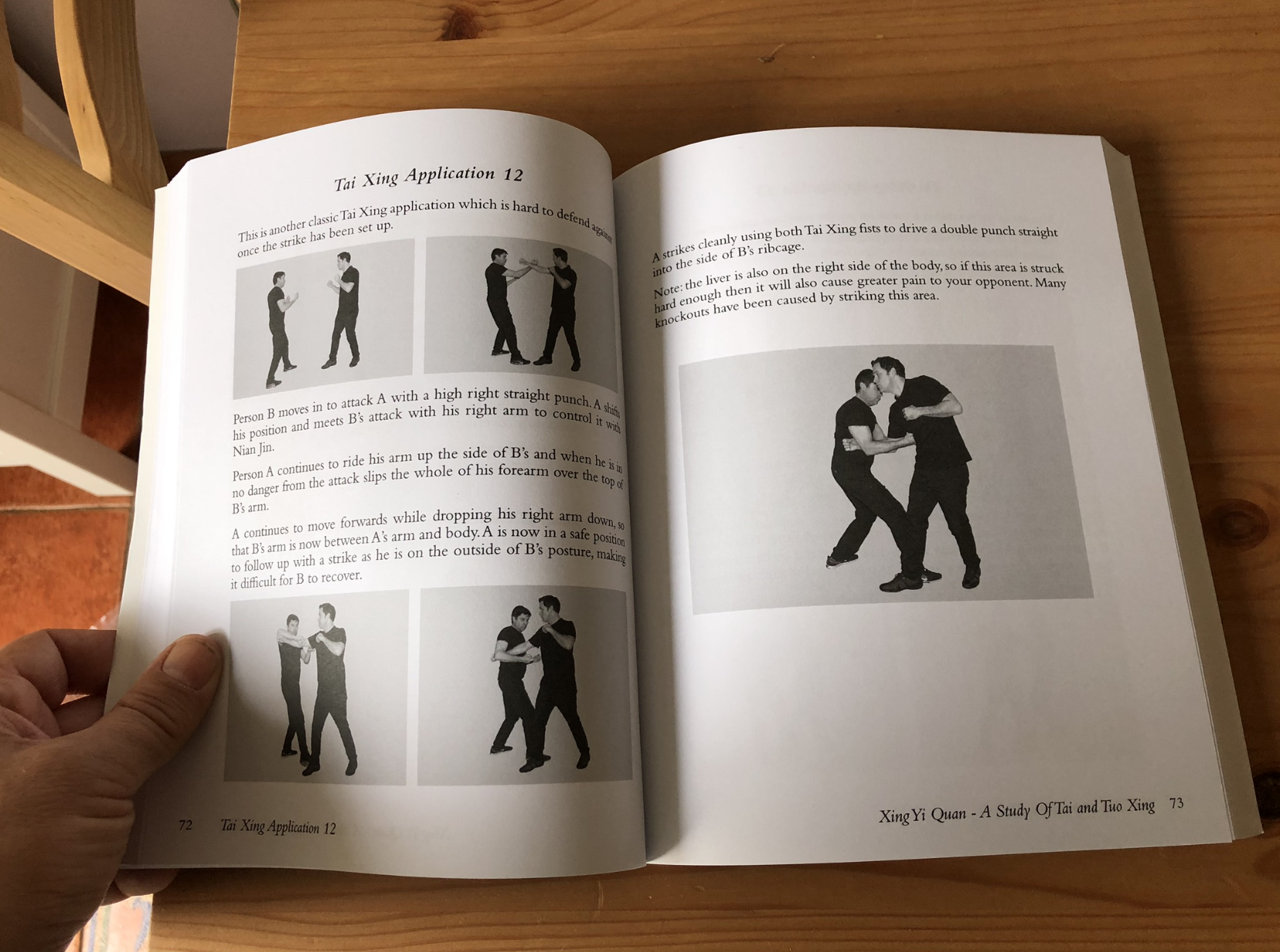
Firstly, the book looks great. It’s thick, there are a lot of photos, some of which are colour, but most are black and white. They’re well taken and it’s easy to see what’s happening. In terms of content, there is lots of historical information about how Xing Yi was created in the book and the philosophical and martial ideas that lie behind it, but there’s also lots of very practical real-world applications of the movements shown as well. Glen even covers that tricky subject of how Qi is used in Xing Yi Quan as well as taking in the Xing Yi Classics, San Ti Shi and weapons. It’s a pretty hefty volume.

The real focus of the book though is on two of Xing Yi’s 12 animals: Tai and Tuo, but it also covers an awful lot of general Xing Yi theory. The inclusion of a full translation of the two most important Xing Yi classics writings – the Classic of Unification and the Classic of Fighting, from Yue Fei’s 10 Important Thesis – is particularly welcome. As is the inclusion of an Appendix on the I Ching, which explains the 8 trigrams and how you can use them to post-analyse martial arts movements or situations in Xing Yi Quan.

Full disclosure: Glen and I have the same Xing Yi teacher and this book follows on from my Xing Yi teachers first attempt to write a book on each of the Xing Yi animals. He only got as far as Bear Eagle, before stalling on Snake. So, it’s good to see that Glen has picked things up in our lineage and got something into print on a couple more of the animals. I’d like to see him do the same thing for Horse and Snake (if you’re taking requests Glen? 🙂 )

(You might also like the podcast series I’ve been doing with Damon on the history of Xing Yi).

Tai and Tuo

Tai is a fly-catching bird from Asia with a long tail. It’s sometimes referred to as “Phoenix” in English. It’s quite an agile little bird that’s good at evading predators by using its long tail to confuse the attacking bird and also good at catching insects in flight. As you’d expect, there are a lot of changes of direction and spiraling type actions amongst its martial applications.

Tai uses a special fist formation to strike with where you protrude the middle finger knuckle ahead of the others when you form a fist. You use it to strike with in the same way that a “Phoenix-eye fist” can be used in Shaolin arts to strike with. The book explains all these aspects of Tai.

Tuo is the Chinese Crocodile. (Also known as Chinese Alligator). Sometimes you see Xing Yi people call it “Water lizard”, but come on people – just put the pieces together 🙂

Tuo doesn’t have any specific fist shapes, but emphasizes the ambush nature of the crocodile when hunting. It also makes use of the side to side rolling action that a crocodile performs when trying to drown and rip apart any prey it has captured in its jaws.

The book has a linking sequence (a form) for each animal as well as applications of the movements in a huge amount of detail. There are 31 applications shown for Tai and 22 for Tuo with photographs of the steps involved in each. They’re all bare-hand applications rather than weapons applications, but that’s fine by me.

Overall I’d say that this book is one of the most accessible and practical books you’ll find on Xing Yi Quan. It doesn’t matter if you’re new to the art or pretty experienced – you’ll find something new here to pique your curiosity. If you’ve got any interest in the art of Xing Yi Quan at all then I’d suggest you get yourself a copy, because you’ll really enjoy it.

Here are some photos of what it looks like inside:

Screen Shot 2019-10-21 at 1.12.05 PM
Screen Shot 2019-10-21 at 1.12.16 PM
Screen Shot 2019-10-21 at 1.11.38 PM

Buy this book on Amazon: UK link to Amazon.

Tai Chi should be heavy, like a stone


samuel-castro-0-L3vTLT7E4-unsplash.jpg

Move your hips! Photo by: Samuel Castro

One of the most frequent things you hear in BJJ is “move your hips“.

Brazilian teachers tend to say “escape your hips“. Which is an odd-sounding translation of presumably something that sounds better in Portuguese. In American and English it usually gets turned into “hip escape“, as in, “do a hip escape here“, “it’s not working because you need to hip escape more“.


We hip escape up and down the gym as a warm up (also known as “shrimping”) because it’s a fundamental movement you need to have in your tool box that you can pull out without having to think about it.

But why? What is it? Simply put: It’s designed to create more space between you and your opponent on the ground.

You can use hip escapes for escaping bad positions like side control and mount. But it also has benefits for attacks too. Basically a good rule of thumb is that if what you’re doing isn’t working try doing a hip escape and doing it again. The change of angle and leverage will probably fix it.

Now we know what a hip escape is, let’s get to the point of all this.

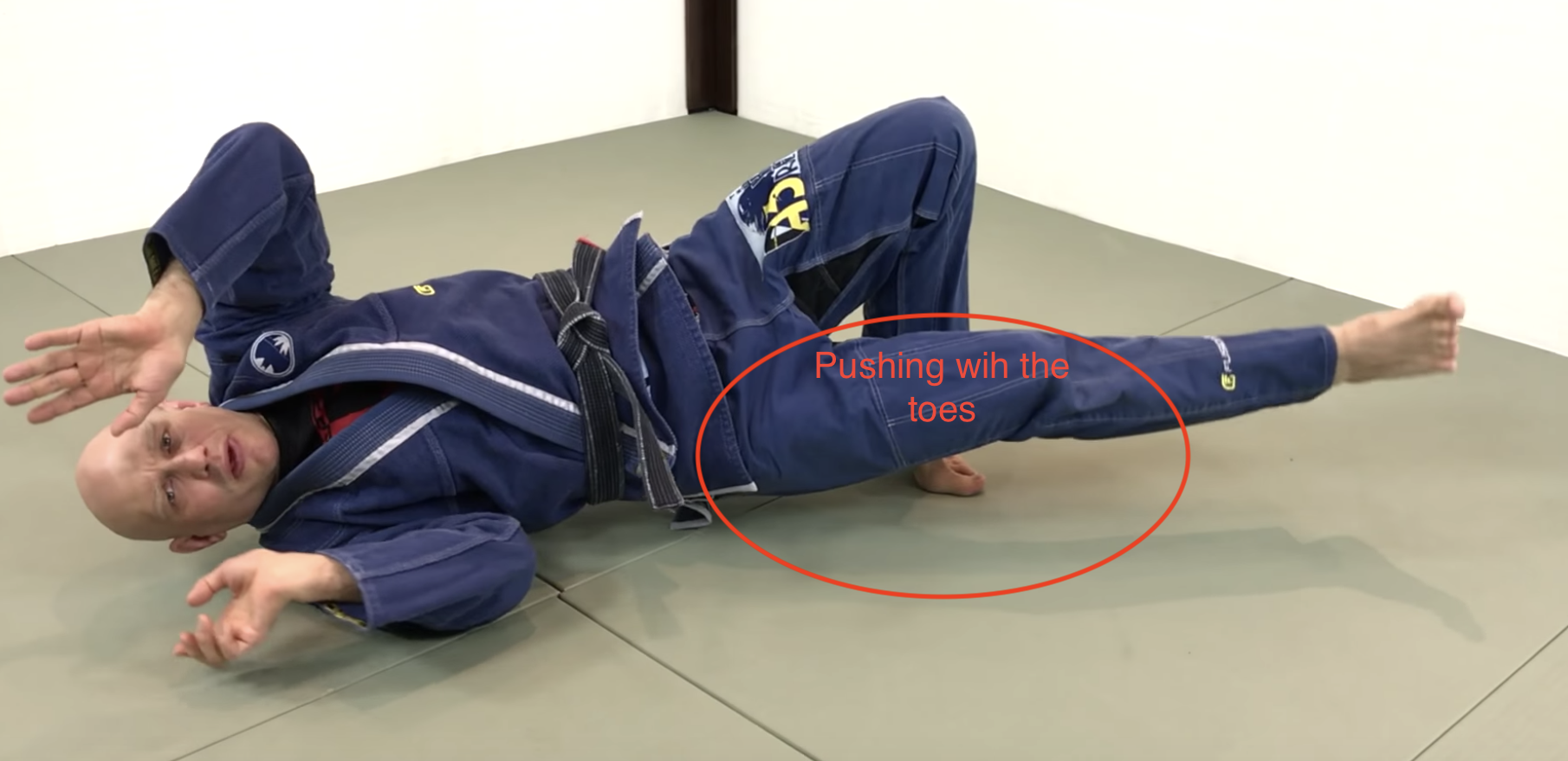
When we say “move your hips” that’s not the part of the body that you need to move from. If you just moved from your hips you’d never go anywhere.  You’d just spasm on the floor like a dying fly having its last buzz. What you actually need to do is push with your toes and feet on the ground so that your hips move.

Screen Shot 2019-09-26 at 11.12.11 AM.png

Your hips moving is the result of the action, not the action itself.

Which brings me onto Tai Chi Chuan and the dantien (the lower abdomen area of the body).

All wise and knowledgeable Internet-enabled Tai Chi practitioners know that we need to “move from the dantien” in Tai Chi Chuan. (This is the supposed secret to Tai Chi that you get told by your wise master only after you have paid the required tuition fees for a number of years. 🙂 )


800px-cheng_man-ching

Cheng Man Ching, Single Whip posture.

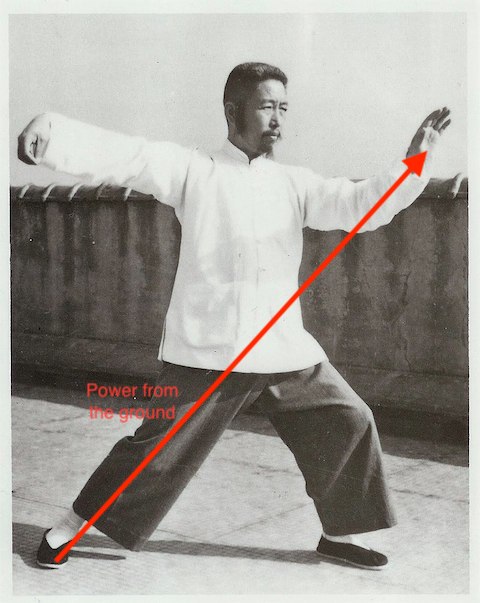
But again, where does the action originate? I would say that, just as in JiuJitsu, you don’t actually “move from the dantien” by originating action there. Your dantien moves, but it’s your foot that provides the impetus. Your foot pushing against the ground is where the ‘power’ comes from in Tai Chi Chuan.

(A side note here for the Order of Advanced Tai Chi Wizards of the Internet: When you get this concept of the power from the ground you will find that you can actually originate the movement in the dantien as a kind of dropping force that is then rebounded from the ground, so it’s less of a push with the legs. File this under “advanced” if it makes no sense right now and come back to it later).

What Tai Chi Chuan specialises in is transmitting this power to the extremities without interfering with it as much as is humanly possible. We know that in Tai Chi we need to be relaxed (song), which seems like the last thing you’d want to be if you have to hit something hard, but there is a method in the madness.

In Tai Chi Chuan you are trying to transfer that power – the ground reaction force – from your foot all the way to your fingers as smoothly as possible and directing it with the dantien. This is called ‘threading a pearl through the 9 crooked gates‘ in the Tai Chi classics. The gates here are the joints of the body. All the breaks in connection between your foot and fingers are the points where power leaks out. Usually we cover these things up by using muscular strength to get by – you can spend years fooling yourself with this, and it’s a very hard habit to stop.

basecheng

Points of interest, where we generally mess this up, are the lower back (keep it open) and the shoulders (stop using them as a power source). The whole body should be Song.

‘Relaxed’ doesn’t mean light and floaty. It means heavy and rooted like a stone.


The concept of ‘flow’ in martial arts

photo of man on his boat during daytime

Photo by KML on Pexels.com

Tai Chi is infused with the concept of flow, but what does that actually mean? What does ‘flow’ mean in this context?

We are used to seeing Tai Chi practitioners in parks performing graceful, flowing movements. In fact, that’s what we expect to see whenever somebody mentions “Tai Chi”, but as usual, it’s what’s underneath the water that matters, not what we see on the surface.

The Tai Chi classics state:

Chang Ch’uan [Long Boxing] is like a great river
rolling on unceasingly.”

This points to the continuous nature of Tai Chi boxing. Techniques don’t really start and stop, they all merge into one continuous movement.

Sun Lu Tang 2014-12-11 15-54-12

Sun Lu Tang, Tai Chi.


Acquiring this skill in the Tai Chi form is actually quite difficult. For a start, people tend to speed up or slow down during a form performance. They speed up on the bits they like and slow down on the bits they find hard.

Another common fault is posturing – pausing serenely in postures that are being held, if only for a moment. It’s equal and opposite infraction is too much merging – movements get mushed into each other without one finishing properly before the other begins.

I’d say it takes a good few months of continual practice, focusing on just continuity, to iron these faults out of a Tai Chi form

The deeper lesson in continuous movement is that you are constantly recycling the ‘energy’ in the form. When you break a movement, or stop, you are not keeping everything flowing, and you lose the power of momentum. They fall flat.

This links back to the idea of Yin and Yang being in constant flux, with change as the only constant. These ideas are as old as the hills, but find their expression most often in Taoist thought.

In a recent TED talk Adrien Stoloff looks at what Wuwei (The Taoist concept of non-action, and flow) mean.

Adrien discusses flow and wuwei, and how recent research in cognitive neuroscience suggests what may be happening in the brain when we experience flow or wuwei. Adrien Stoloff is a doctoral candidate in Asian Religious Traditions. He is interested in Chinese religious beliefs and practices from the late Warring States period to the Early Han Dynasty (approximately 5th-2nd centuries BCE). Specifically, Adrien’s research focuses on the Classical Daoist phenomenon of wuwei. Translated as “effortless action,” wuwei is a state of being in which one acts effortlessly yet efficiently in a given situation. His dissertation project uses an approach informed by tools in the field of religious studies – textual and historical analysis – as well as by the fields of philosophy and cognitive science:


The dance/fight game

If there’s one martial art that really emphasises the concept of ‘flow’ then it’s Capoeira. The Brazilian dance/fight martial art where two participants enact a kind of spontaneous, improvised martial dance set to music.

Clearly your connection to the other person in Capoeira transcends the physical connection we find in Tai Chi push hands, and it has to be in place or you end up with a foot to the face. That’s Tai Chi’s Ting Jing (Listening energy) on steroids.

Even as an outsider to Capoeira, I can tell when the practitioners are connected to each other, and when they’re not. When the focus is more on athletic ability and directed inwards the two practitioners don’t seem to melt together into one dance – they retain their separate selves. The type of Capoeira I like to watch is where the two practitioners become one – responding and reacting in real time to each other.

And of course, with the rhythm of the music and a focus on connecting there’s all the potential for it to cross over into ‘spirit dance’, where you connect to the wider environment.

I looked for some beginner capoeira videos recently and found these which I thought presented some basic moves that I could copy. I had a go at this video below this morning and I was surprised by how difficult (but also fun) even these ‘basic’ moves are.

I mean, I can do it badly. Anybody can do it badly. But trying to do it with the smoothness and flow that the practitioner demonstrates above is a different matter.

If you wanted to get more ‘flow’ in your movement, I think this could be a good place to start.

Tucking the tailbone in Tai Chi Chuan

women s white top and orange floral skirt

Photo by Samuel Silitonga on Pexels.com

There’s a lot of debate about “tucking the tailbone” in Tai Chi. Some people are big exponents of ‘tucking’ or centring the pelvis, which removes the curve of the lumbar spine. Other people prefer a more ‘natural’ lower back which has more of an inward arc.

For me, it’s not that either of these positions are wrong in Tai Chi, it’s that the idea of holding your spine in a fixed position that is wrong.

If I see anybody practising Tai Chi with a fixed, ‘held’, lower back shape I think it’s just time to sigh and move on.

The lower back is part of the dantien area. This area must be relaxed and free to move.

By far the most common way people hold the spine in this position with tension is with an inward curve. If you see a curved-in back then this area is not relaxed. It might be more aesthetically pleasing but there is no way to connect the power of the ground and legs through the dantien area like this – it’s essentially cut off from that power.

Sure, you can generate power in other ways, but unless you relax the lower back power can’t be transferred from the ground.

Xing Yi is the oldest of the ‘internal’ martial arts. If you look at videos of a precursor art to Xing Yi, called Dai family Xin Yi Lie He, you can see their art has an exercise called squatting monkey as its foundation practice. Look at how it bows and unbows the spine. There’s a lot of flexibility being trained here.

These exercises are like basic, large frame, training exercises for conditioning the muscles and tendons of that area, and the movement can become a lot smaller in usage.

If you’re a Tai Chi practitioner you don’t need to start doing Squatting Monkey practice. I’m not saying that, but you do need to start paying attention to your lower back as you do whatever exercises you are doing – form, Pa Tuan Chin, Silk Reeling, Chi Kung, etc…

Ask yourself what your lower back is doing. Am I holding tension in it? (Here’s a big clue – you are!) and how should I release it? How about when walking around town, or pushing a trolley in Sainsbury’s? You’ll be surprised by how often we hold tension in this area.

Next think about the role of breathing and how it relates to the lower back. If we are doing deep diaphragmatic breathing (which makes the abdomen swell) then it should also be expanding at the back of the abdomen too.  Ask yourself, do you have any flexibility here when you breathe in?

If not, then you know what to do.


Lightness in Taijiquan – walking like a cat

animal world attention branch cat

Photo by Pixabay on Pexels.com

My post the other day about sinking in Taijiquan seems to have hit the right note, judging by how many shares it got on Facebook, so I thought I should also talk about its opposite – lightness.

Lightness is an equally important quality in Taijiquan. The Yang to the Yin of sinking.

Yin and Yang

One of the contradictions of Tai Chi is that you are required to sink and be light at the same time. It’s not meant to be some sort of Zen Koan, like “imagine the sound of one hand clapping”. Instead, it’s meant to be the way you carry yourself in the form, in push hands and in sparring. These two qualities are a pair that work together, mutually supporting each other.

If you look at the classics of Tai Chi there are frequent references to being light, nimble and agile.

For example,

The Tai Chi Classic:

In motion the whole body should be light and agile,
with all parts of the body linked
as if threaded together.”

The Treatise on Tai Chi:

“A feather cannot be placed,
and a fly cannot alight
on any part of the body.”

From The Exposition of Insights:

“When the ching shen is raised,
there is no fault of stagnancy and heaviness.
This is called suspending the headtop.”

and

“Walk like a cat.”

From Song of the 13 postures:

“To make the whole body light and agile suspend the headtop.”

singlewhip

Yang Cheng Fu – light and nimble, even for a big man.


There are various clues here as to how lightness is performed in Tai Chi Chuan. The first thing to note is that there’s a lot of reference to ‘suspending the headtop’. Here the classics are referring to keeping your head upright and not leaning, and the feeling of being suspended from the crown point at all times.

The crown point is where the fingertips of your index fingers meet if you put your thumbs on top of your ears and try and touch your index fingers together over the top of your head.

Your body should be organised as if it is suspended from this point. It’s the point that medical skeletons are suspended from, which indicates how it aligns the spine nicely. E.g.

skeleton


The crown point is actually a lot further back on the head than most people think it is. When you try and suspend the head from a point further forward on the skull (as most people instinctively do) then you end up lifting the face, shortening the neck and making the chin jut forward. This is wrong and will make your movement worse.

Done correctly, ‘suspended the head’ should result in the chin being tucking in slightly, and the neck lengthening. But again, don’t use force to achieve this. Find your balance in nature. If you hit on the correct point to suspend from, then everything will just slot into place and feel good.

The correct alignment of the head will free up the spine to move, and hey, guess what – your movements can be lighter and more agile.

Combined with the previous advice on sinking, the upward pull on the spine that correct head position will create acts as a counterpoint to the relaxing downwards and your connection to the earth. The feeling is that you’re being lifted slightly and pulled down slightly simultaneously as you perform the form.

Lighter stepping

Another thing to note is your stepping. There are various exercises in Chinese martial arts for making your stepping light and agile – some people practice on wooden poles raised above the ground, others stepping between terracotta plant pots. All these exercises are designed to make your stepping light.

My own teacher recommended the use of ankle weights. You alternated between periods of wearing the ankle weights during the form only, and taking them off to do the form, so you wore them at all other times of the day.

This required a big commitment, and I used to get some funny looks at work(!) but the resultant lightness of stepping made a difference to my movement and my form.

Lightness in daily life

It should also be noted that lightness refers also to your attitude to practice. Tai Chi shouldn’t feel like drudgery. When you go outside to practice put a spring in your step. You’re spending time in nature doing something you enjoy. There’s no need to drag your feet.

Look at animals in nature for inspiration.

Walk lightly, smile brightly.

Sinking in Taijiquan

black and white waves close up view circle

Photo by Skitterphoto on Pexels.com

I generally try to avoid telling people to “sink” in Tai Chi for the simple reason that they usually try to physically lower themselves in the postures, inevitably resulting in using too much force and sticking out their butt, or putting their knees at an odd angle.

Sure, you do need to have a lower-than-normal-standing posture, so you can relax the lower back and centre the coccyx, but when people start to get uncomfortably low (usually combined with too much tucking of the hips) that’s when things break down.

I was doing some push hands recently, and I was trying to work on the idea of reacting to being pressured with a push with the action of sinking as your initial response rather than by trying to do something with their push.

Taoist non-action

By sinking I mean internally sinking – letting go of tension and letting it all drop, rather than by physically lowering yourself. In a way – it’s a kind of non-action. You’re taking something away rather than adding it to the situation. If you can do that then the tension that is created between you and your partner – the pressure – when they start to get too close with their push just dissipates, and the right action arises spontaneously by itself. It’s easy to redirect them because you have ‘got underneath them’.

screen-shot-2017-02-21-at-22-54-10

Sun Lu Tang

It’s a difficult concept to grasp. It reminds me a lot of reading the Tao Te Ching, the Taoist classic of the way and its power. The Tao Te Ching constantly advises us to take the path of no resistance, which initially seems like a passive response to a situation, but when done skillfully, is anything but.

By taking ‘you’ out of the conflict, it can often resolve itself, and usually in your favour.

“Therefore the Master
Acts without doing anything
And teaches without saying anything.
Things arise and she lets them come;
Things disappear and she lets them go.
She has but doesn’t possess,
Acts but doesn’t expect.
When her work is done, she forgets it.
That is why it lasts forever.”


Related stories on this blog:

Is Taijiquan Taoist?

Wu Wei – the art of doing without doing

Don’t push the river, listen to it instead