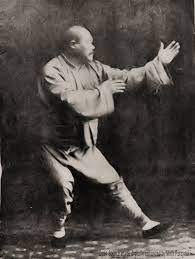
REVIEW: Dragon Body, Tiger Spirit: A translation and explanation of the classic texts of Xingyi Quan, by Byron Jacobs

Xing Yi is one of the oldest Chinese martial arts that is still practised today, and so naturally it has attracted a large variety of writings over the hundreds of years of its existence. These various writings can be found scattered about in different lineages and books, but now Byron Jacobs has collected them together in one weighty tome – Dragon Body, Tiger Spirit – and included not only the original Chinese texts, but also his own English translation and commentary on them.

Originally from South Africa, Byron is a student of Di Guoyong of the Hebei lineage of Xing Yi, and lives and trains in Beijing.  At one time he was a member of the technical committee of the International WuShu Federation, so he has been able to meet and talk to practitioners of other martial arts and Xing Yi lineages. He runs the Mushin Martial Culture website that offers online tuition, as well as provides excellent YouTube videos on all aspects of Chinese martial culture, history and practice.

(Full disclaimer for this review: I’ve known Byron for years, and while we’ve never met in person I’d consider him a friend. He’s been a guest on my podcast and I’ve been on his.)

The cover

Being interested in design, I always like to spend a bit of time talking about the cover of a book in my reviews, but in this case it’s not really an indulgence because discussion of the cover is properly warranted. Not only is it well designed but it contains a fully colourised reproduction of the famous black and white photo of Xing Yi masters Guo Yunshen and Che Yizhai, taken when Guo visited Che’s martial arts school. Now, since this is the only picture that can reliably be said to exist of Guo Yunshen, it has always been treasured by practitioners in the Hebei lineage of Xing Yi, of which I would count myself as one. Colourising the famous photo is an audacious and brilliant idea. The colours and shading on the faces in particular all look natural and really bring Xing Yi to life as a living breathing art practised by real people, rather than an ancient art lost to history. Did Guo Yunshen actually wear blue robes? I don’t know, but he looks great in them.

Incidentally, the photo is misleading, because the martial arts display Che and Guo are watching is definitely not Xing Yi. Che and Guo are the seated older gentlemen in the centre, watching two performers of what looks like a more Shaolin-derived art, or even a theatrical performance. The stage they are sitting on, complete with performers doing martial arts, and a painted city background behind them makes the whole thing look very much like a Chinese theatre.

What’s inside

The meat of Dragon Body, Tiger Spirit is the collection of all the classic writings on Xing Yi, including a lot of the stuff that came out during the Republican-era martial arts manual-writing craze, as well as older material. Everything is provided in original Chinese characters first, then as a translation into English and finally there is a commentary by Byron which explains what the classic is about. For me the most important classics in the Xing Yi corpus are Yue Fei’s 10 Thesis, since these are amongst the earliest writings on Xing Yi, and a lot of the other writings are based on these, but rest assured they’re included here. In fact, there’s everything you could want, including the Five Elements Poems, Cao Jiwu’s Key extracts of the 10 methods, the 12 animals poems and more. There’s also a section called “Nei Gong Four Classics”, which is a supplementary text included from the Song style lineage of Xing Yi. The classics are bookended with two different sections – the book starts with a short article about the history of Xing Yiquan, written by Jarek Szymanski, which aims to dispel some of the myths that have built up around the art, and ends with some well-researched biographies of famous Xing Yi masters written by Byron. As a practitioner of Xing Yi you’ll find these biographies useful because the names of old masters often crop up in Xing Yi discussion.

I can’t speak for the quality or accuracy of the translations themselves since I’m not a Chinese writer or speaker, however my impression through comparing Byron’s translation here to others is that Byron has used his martial arts knowledge, and specific Xing Yi knowledge to present what he thinks the real message that the classics are trying to be convey is, rather than go for a literal translation each time. This is the best way to approach martial arts texts, as often a literal translation will sound nonsensical, and  just make an English speaker scratch his or her head.

Having the actual text of the classics all gathered together in one place is an invaluable resource for any Xingyi Quan practitioner. That alone makes the book worth getting, but what really tips the balance is Byron’s commentary. He’s always clear, down-to-earth and practical. He does his best to interpret old texts that can often be esoteric and difficult to understand into something that makes sense to practitioners living in this day and age. Apparently, this book took him 10 years to complete, and you can see why. He must have spent a long time agonising over his translations and commentary before committing to a final version – nothing here seems rushed, hurried or half-baked. Everything has been carefully considered.

The casual reader, or beginner in Xing Yiquan, needs to be aware that this is not a “how to” manual – a lot of the Xing Yi classic are about things like endlessly dividing the body into sections and saying how one part works with another, which is not much use to you if you just want to learn how to do a Bengquan. They are full of things like “the eyes connect to the liver, the nose connects to the lungs” – i.e. things that aren’t that much use for practical application. There is a lot of this stuff to wade through if you are going to read the book from start to finish in full. However, having said that, Byron’s commentary on the 5 Element poems (the section of the book that deals with the Xing Yi 5 Element Fists – Pi, Beng, Zuan, Pao and Heng) is so detailed and practical that it does almost function as a bit of a How To. If you are in the process of learning Xing Yi you’ll find this section invaluable. You’ll learn where to put your elbow, fist, feet and how to move your body. And there’s a picture of Byron performing each fist, too. 

I did find myself having small differences of opinion with Byron’s commentary on occasion, but it’s always over very small details or emphasis, and it feels like nit-picking to list them all, but I think it highlights an important point, which is that translation relies on interpretation and because we come from different lineages of Xing Yi I think it’s only to be expected that we’d have slightly different ways of looking at the odd thing. And you too, dear reader, will probably have small differences too, if you are already a Xing Yi practitioner. If there weren’t small differences between lineages, then there wouldn’t be different styles of Xing Yi in the first place. 

My favourite part

For me the best part of this book is the 12 animals section. I’ve always found the 12 animals to be the most fun part of Xing Yi, and if you’re a fellow 12 animals fanatic like me then you’ll love this section. It’s also the largest section of the book, and is illustrated with pictures of the animals being described. For each animal there is a poem written by Byron’s own teacher Di Guoyong, followed by a discourse on the animal written by Xue Dian, taken from his 1929 Republican-era manual “Discourse on Xing Yi Quan” (which was written at a time when it had become popular to include aspects of Chinese philosophy and medicine in martial arts writings). Byron translates both and provides his own commentary. There’s such limited writing about Xing Yi animals available that it’s fantastic to hit such a rich vein of Xing Yi animal discussion. My experience has been that every lineage of Xing Yi has slightly different ideas about what a few of the 12 animals are, particularly “Tai” (which gets called everything from hawk to ostrich and phoenix) and “Water lizard” which gets called a turtle, an insect or a crocodile by some. The view presented here is Di Guoyong and Xue Dian’s (amongst many others), that Tai is a small hawk and Water lizard is a mythical creature being one of the 9 sons of the dragon that had a turtle’s shell.

It’s the spirits of these animals that infuse all Xing Yi practice – even if you’re doing the 5 elements or SanTi, you are still admonished to observe ‘bear shoulders’, ‘tiger head embrace’, ‘dragon body’, ‘eagle claw’, and ‘chicken leg.’ So, it’s great to see such a large section of the book, which gets its name from the dragon and the tiger, devoted to them. Di Guoyong’s poems and Byron’s commentary here are especially valuable, particularly in regard to the intent and particular features of each animal.

Should you buy?

As always with Chinese martial arts classics, these are not writings you read through once and put on the shelf, having absorbed all their insights. Instead, you need to return to them again and again over the course of your life and dip in and out. You’ll find this reinvigorates your Xing Yi practice and each time you re-read the same section you’ll discover new insights. Picking the book up and turning to any page, it’s not hard to find something to be inspired by and to get you motivated to go outside and practice.

If you are a Xing Yi practitioner then having everything here in a single book will prove invaluable to you and Byron Jacobs has done every practitioner a great service by completing his magnum opus. Even if you are a Tai Chi practitioner, I’d still say you should get this book, as many of the ideas contained in all internal arts found their first flourshings of life in Xing Yi and the Xing Yi classics. Highly recommended.

Rating: 5/5

Where to buy::

Amazon UK

Amazon US

Direct from Mushin Martial Culture

If you want to find out more about the book then I’d recommend listening to Byron’s interview about this book on Ken Gullette’s podcast

You can also buy a reproduction of the cover photograph from Byron’s Mushin Martial Culture website.
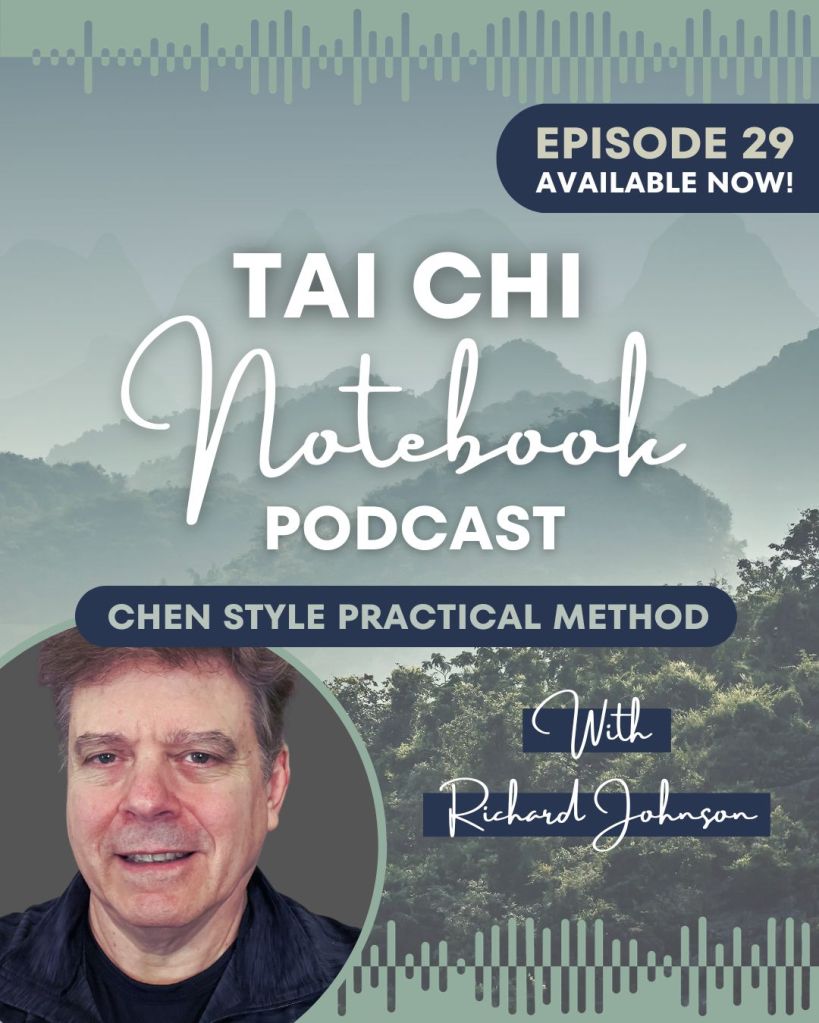
New podcast! Richard Johnson on Chen Style Practical Method

This month’s podcast guest is Richard Johnson a long-time student of Joseph Chen of Chen Style Practical Method.

As well as a Tai Chi practitioner and teacher, Richard is a full time movement coach working with athletes, so he brings an appreciation of athletic movement to his views on Tai Chi.

In our discussion Richard delves deeply into the internal workings of the Chen Style Practical Method and we talk a lot some interesting movement principles based around rotation. We also talk about how the Practical Method is different to the Chen Village style of Tai Chi.

Enjoy the podcast. You can get in touch with Richard using his email address ⁠trukinetix at gmail.com⁠

The number 1 mistake people make in Tai Chi push hands and how to fix it

I got to meet up with a local Tai Chi instructor recently, and it was a good chance for me to do some hands-on work in push hands. One of the things working with somebody else at Tai Chi, as opposed to the endless solo practice that mainly makes up the art, brings up is the question of range.

Range is an interesting one in Tai Chi. You actually need to be in really close for Tai Chi to work. I think this is one of the things that has been forgotten along with the martial aspects of the art. I very rarely find another Tai Chi person who is comfortable working at the correct range.

How to fix your range

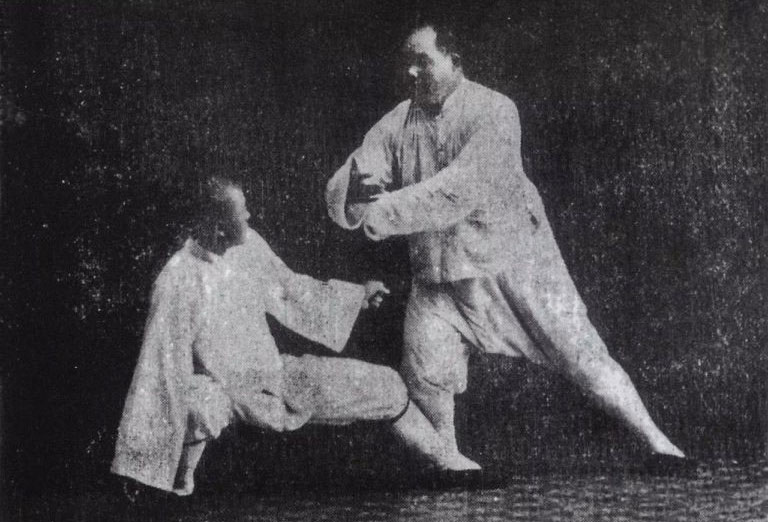
To get the correct range your front foot should be one fists-width apart from your opponents foot on the horizontal axis and your front toes should be roughly matching the back of heel. His front toes are then roughly matching your heel. (Look at the foot position in the photo).

This distance feels uncomfortably close to do any sort of combat actions to most people, however, this is where Tai Chi lives. At this range you will need to use subtle movements of the kua and rotation of the body to neutralise your opponent’s force, and it takes some practice. You also need to make use of Ting – or “listening” because you are definitely within punching range here, but from here you can go even closer (body to body) and turn it into wrestling if so desired, which will protect you from punches.

At the correct distance the Tai Chi techniques will work. When you are further out, they won’t work so well at all. So, this is where you should be when practicing push hands.

When it comes to actually fighting, I’m not suggesting you should “hand around” in this range, because that will just get you clipped. However, you do need to move into this range to do all the good stuff that the Tai Chi Classics talk about – controlling your opponent, knowing him before he knows you, etc. I think a lot of the time that Tai Chi fighting is described as “bad kick boxing” it’s because of the range being used. People stay too far out and pot shots at each other. Kick boxing is perfect for this range.

More of my writing on push hands:

REVIEW Martial Art Essays from Beijing, 1760

By Michael A. DeMarco, MA

Amazon link (UK)
Amazon link (US)

Martial Art Essays from Beijing, 1760, presents 64 essays written by Yang Mingbin, a painter in the Royal court of the Ching dynasty. Or does it? As well as being a painter, Yang was also a martial artist and the papers are his thoughts on his martial practice, except that Yang Mingbin never actually existed, and the work is entirely a fictional piece of writing by the modern author, Michael A. DeMarco. DeMarco is a Tai Chi practitioner who used to publish the peer-reviewed quarterly Journal of Asian Martial Arts

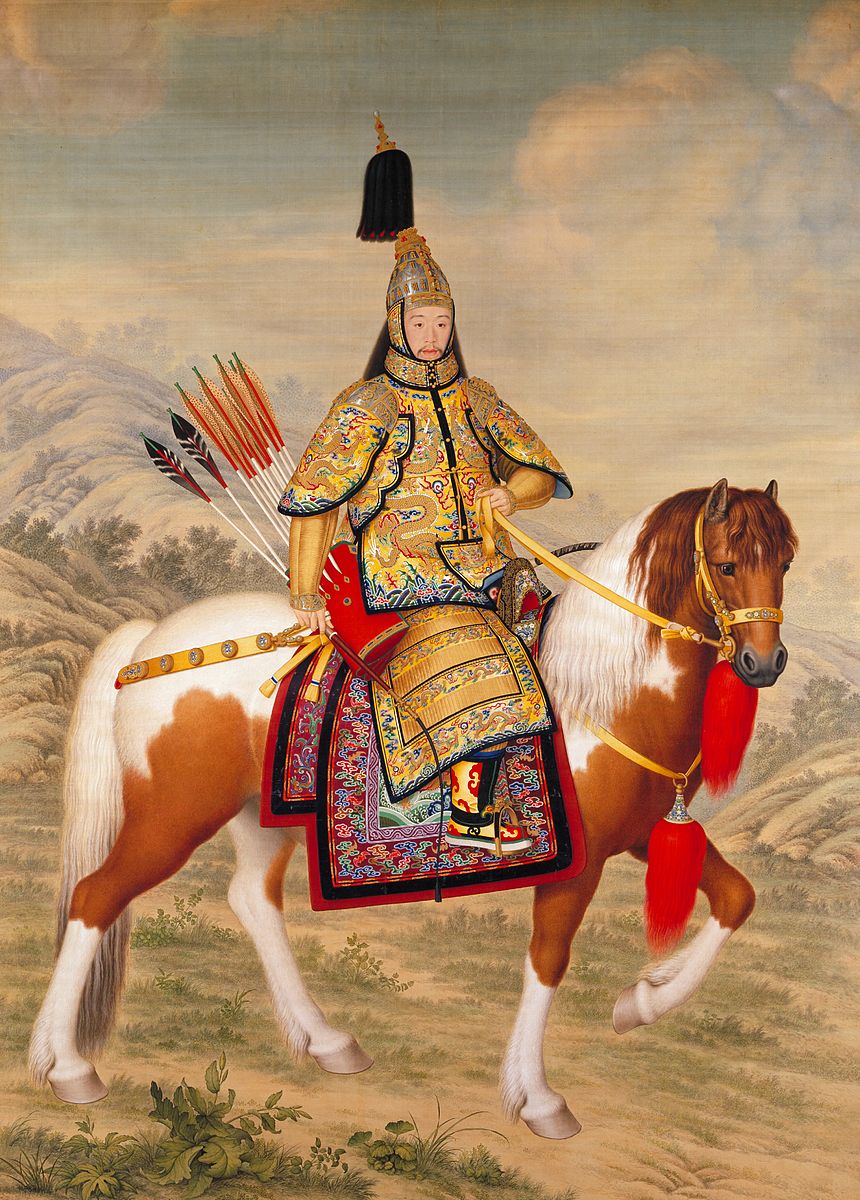
Yang Mingbin’s place in history is well researched, and surrounded by genuine historical figures such as Giuseppe Castiglione (1688-1766), a real Jesuit priest who was a painter in the Royal court in Beijing, and was responsible for influencing the Chinese style of painting of the era with western Renaissance ideas. You’ve likely seen some of his paintings before, such as the famous one of the Emperor Qianlong in ceremonial armour.

The Qianlong Emperor in Ceremonial Armour on Horseback Giuseppe Castiglione  (1688–1766)

So, the conceit here, then, is that you’re being asked to imagine what it would have been like if Giuseppe had had a friend in the court – another painter – who was also a martial artist, and what would happen if we had recently found a copy of his notes on martial arts. It’s a thought experiment, that the author begs your indulgence in as you read along.

Initially it works, because the historical setting feels authentic, but once we get into the actual meat of the book (Minben’s 64 martial arts essays), we find that Yang Minben writes exactly like a 21st century American who practices Tai Chi would write, rather than like somebody actually living in 1760 in China would! 

Actual martial arts writings from that period in history tend to be functional, pithy and less verbose. Worse, Mingben’s text often uses modern conventions, for example, (p63), 

Dive into a swift flowing river and swim against the current. Keep swimming, but gradually change the direction – 0 to 45 degrees, to 90 to 135, then to 180 – finally swimming directly with the current.

Would a Chinese person writing in 1760 have described this using degrees?

And things get very odd when, on p97, Minben writes, “between 1775 and 1779, Qing troops stabalized the northern and western boundary of Xingjang province, harshly squelching the rebellion in the area occupied by the Mongolic Zunghar tribe.” 

How is Minben writing about events that happened in 1779 when the current date is supposed to be 1760? 

That’s not to say there aren’t interesting things to learn here. I enjoyed the discussion of the Neo-Confucian scholar Zhu Xi and the concept of Li, the calligraphy analogies and the references to Lao Tze and Chuang Tzu. But if the author wants us to enter into his historical conceit, then I think it helps if the writing is consistent with the time period. I would have also liked to have heard more accounts of what Beijing was like in 1760. That would have helped build the illusion – city life, how business was done, what the pervading political climate was like, what the fashions were, what the gossip was – what was happening in Royal Court?

You could argue that since all of this is imaginary anyway, perhaps we do not need to make a big deal out of it? DeMarco’s writings are a collection of modern philosophical musings designed to be easily read and understood by the modern Tai Chi crowd and that draw in frequent references to the Daodejing and analogies with calligraphy and painting. I quite enjoyed them, but if you are looking for something that reads like the real classic writings on martial arts, you’ll be disappointed. However, if you’re after something a little easier to read and that inspires you to practice Tai Chi more, then you’ll find it here. 

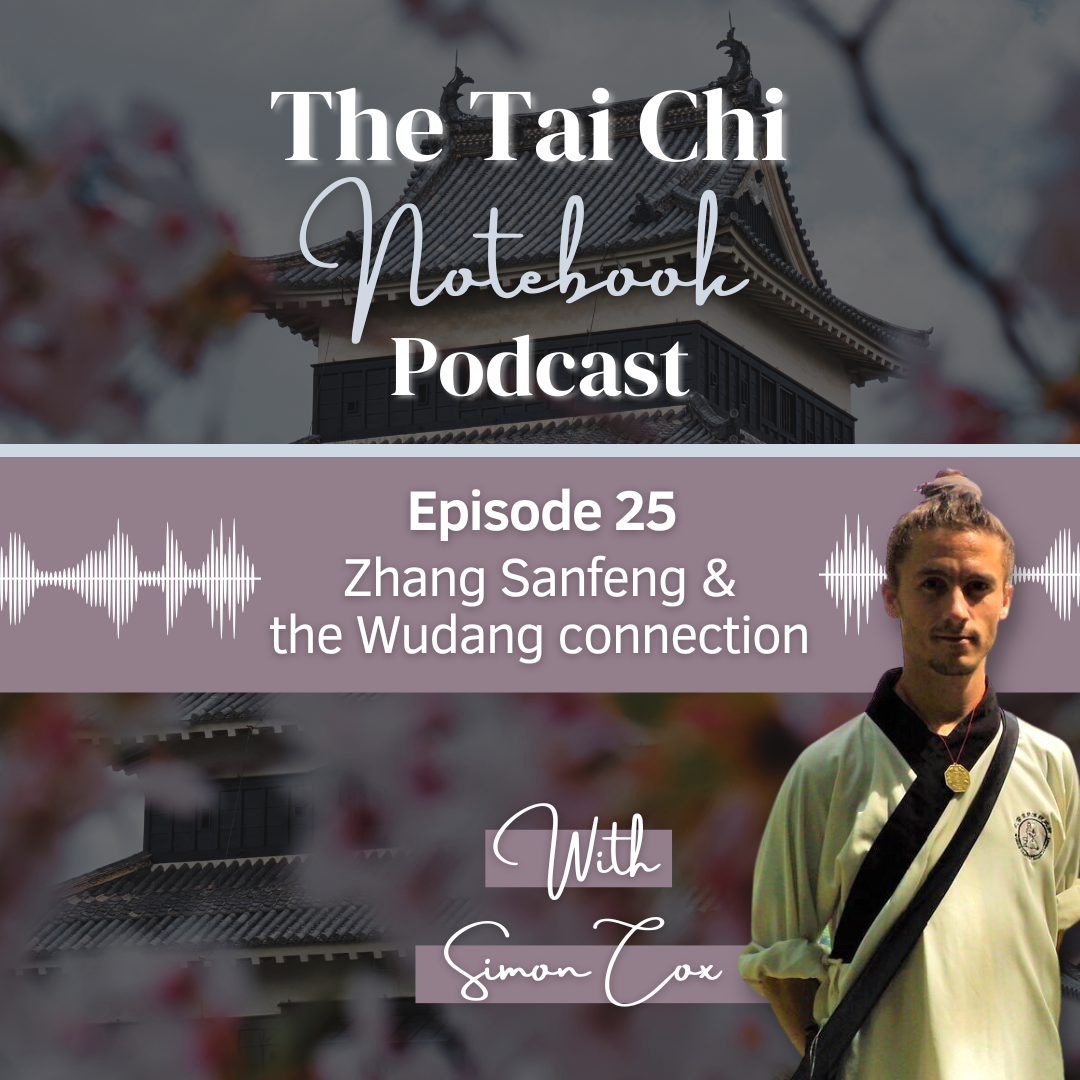
NEW PODCAST Simon Cox on Zhang Sanfeng and the Wudang connection to Tai Chi

New podcast! My guest today is Simon Cox, who co runs the Okanagan Valley Wudang with his wife Brandi in Penticton, British Columbia.

Simon and Brandi spent six years living and training in China under master Yuan Xiu Gang at the Wudang Daoist Traditional Kung Fu Academy. While there they studied Kung Fu, Tai Chi, Qi Gong, meditation, herbal medicine, Daoist music, and ancient and modern Chinese language.

After returning to the West, they started a Kung Fu school and community group in Houston Texas, where Simon was working on his PhD in Chinese and Tibetan mysticism at Rice University. At the end of 2019, they moved up to the Okanagan Valley and began sharing Wudang teachings with the local community.

What I really wanted to get at with Simon was an elucidation on his article about Zhang Sanfeng – exactly who was this mysterious Taoist immortal who is often credited as the founder of Tai Chi Chuan? I also wanted to find out more about Wudang mountain, and where its martial arts really come from. I hope you enjoy are conversation!

More thoughts on elbows and the classics of Tai Chi and Xing Yi

From  http://chentaijiquanworld.blogspot.com/ we find this nice quote about Chen Taijiquan:

“The, at first sight, seemingly humorous Chenjiagou saying to “always keep an egg under your armpit” reflects the importance of not allowing the upper arms to become stuck to the side of the body.

This idea of always keeping a space under the armpit is something I’ve heard said in other styles of Tai Chi as well, and it fits in very well with the idea of “Peng all over the body” that you’re aiming for in Taijiquan, that kind of “inflated like a balloon, but also soft, springy and heavy” feeling. 

Taijiquan, with armpit gaps. Photo by Stephen on Pexels.com

But how does that relate to the question I was looking at recently about the issue of where the elbows should be in Xing Yi? “The elbows never leave the ribs” is a line from the Xing Yi classics* (more of that later) that has caused a lot of arguments between practitioners on its interpretation and meaning. 

And when you compare it to the previous saying about the armpit from Chen Village, it’s basically the complete opposite advice! And yet, both Taijiquan and Xingyiquan are said to be internal arts, and part of the same family. So, is the advice about the elbow a crucial element, as fundamental as, say, aligning the Bai Hui point (the crown) with the spine? Or is this more of a piece of strategic advice to do with the fighting style of Xingyiquan, and not anything to do with its fundamental body method?

Let me throw in a curve ball here and switch arts to BJJ. “Glue your elbows to your ribs” is something I say to my students in BJJ all the time when they are on the bottom defending a position like side control, knee on belly or mount.

Knee on Belly in BJJ. Photo by RDNE Stock project on Pexels.com

If you let your opponent separate your elbows from your ribs in that position then only bad things can happen, so it’s great advice. Normally after I submit somebody new in BJJ I stop to explain to them how I did it, so we can turn it into a learning moment. 9 times out of 10 my explanation starts with “it started when you let me into the space under your armpit”. However, it would be ludicrous to make it into a hard and fast rule, to suggest that you should never let the ribs leave the armpit at any moment in BJJ. There are plenty of other times in BJJ where you need to pull with your arm, and you can’t do that fully without separating your elbow from your ribs.

* And let’s also decide on what constitutes a “classic” in Xing Yi. My own teacher only considered the 10 Thesis of Yue Fei  to be the classic writings in Xing Yi. Most of what people call the Xing Yi classics today are, in fact, writings created in the early 20th century when there was a publishing boom in martial arts manuals (See Chinese Martial Arts Training Manuals: A Historical Survey by Kennedy and Gau), and are based on the original Yue Fei writings anyway. For Xing Yi it started with Sun Lu Tang’s 1915 A Study of Xing Yi Boxing.

In the preface to his manual Sun says (Translation by Brennan), “While once at Bai Xiyuan’s home in Beijing, I got to see one of the Yue Fei manuals, not an original copy of course, but a handwritten copy made by someone in a later generation. It was not very detailed and unfortunately contained no explanations of its terminology, only the barest of text from beginning to end. I was suddenly inspired by this, immediately wishing to provide more complete information, even though I was fully aware that my level of learning and skill was superficial, and without being tempted to make anything up [in order to fill information gaps]. I secretly made my own copy and then deeply studied it, going through it posture by posture until bit by bit I had built up the material to make this book. There is no decorative language in it at all, for in my studies I have not dared to hold on to even the slightest exaggerations. Wherever flaws are found within my work, I hope my comrades will correct me, for which I would be very appreciative.

  – sincerely written by Sun Fuquan [Lutang] of Wan County, Baoding, 1915, 1st month, 15th day”

In his manual Sun has a chapter called “The Essentials of Practice” in which we find the advice about elbows and ribs. (Translation by Brennan)

“ESSENTIALS OF PRACTICE
The essentials of practice in Xingyi Boxing: 1. Sink your waist. 2. Shrink your shoulders. 3. Hollow your chest. 4. Press. 5. Lift. 6. Horizontal and vertical should be clearly understood. 7. Lifting, drilling, dropping, and overturning should be clearly distinguished.
  …
  Your head presses up during drilling, then shrinks back during overturning. Your hands lift during drilling, then drop during overturning. Your foot lifts during drilling, then drops during overturning. Your waist lifts during drilling, then drops during overturning. [from the Xingyi Boxing Classics:] “In lifting there is a horizontal aspect, but it is invisible [because it appears to be only upward]. In dropping there is a vertical aspect, but it is invisible [because it appears to be only forward].”
  Lifting is going out and dropping is striking, but when lifting is also striking, dropping is still striking. Strike with lifting and dropping, like the overturning waves of water, which are lifting and dropping. Regardless of lifting and dropping, drilling and overturning, going and coming, it should always be that your elbow does not leave your ribs and your hand does not veer off from your centerline.
  These are considered to be the essentials in Xingyi Boxing. Knowing these, the right path in the art will be obtained.“

But you can see that even in this passage, Sun is quoting the older “Xing Yi Boxing Classics”. So, you have to start to wonder, how old is the advice that the elbows do not leave the ribs, really? I know some styles maintain that their “quan pu”, ancient collection of classic handwritten writings their family possesses has this advice in. At least with Sun’s work we have a published date we can be sure of. 

Photo by George Sharvashidze on Pexels.com

But this also brings up the question of how much we dedicate ourselves to following the literal words of “the classics” to the letter. How much freedom are we allowed in our martial art? Were the classics intended to be a kind of set in stone, unwavering, set of rules to be followed on pain of death? The ancient writings of the founders always tend to take on this weight that gets heavier over time. If they’d been written a year ago, would we treat them with the same reverence? There are hard line Christians who treat every word of the Bible as the word of God, never to be questioned, and there are more modern progressive Christians who interpret the words in the Bible into a modern context, or see them as simply stories designed to teach an idea, and not to be taken literally.

So, the question still lingers, like a bad smell. 

Where do you put your elbows in Xing Yi? 

I think the best answer I’ve found so far is…..

“in between your shoulders and your wrists”.

Are all Chinese martial arts really ex-military arts?

I think this post is perhaps a little half formed, but I want to get on to writing up my last lesson with Bear, so I’m going to put it out as is. Let the pieces fall where they may…

An interesting new video has been released by Will (a recent guest on my Tai Chi Notebook podcast) about his recent visit to Taiwan where he got to talk to various Taiwanese martial arts masters. It’s the start of a series and it looks like it’s going to be great – Will gets to walk down the smokey back alleys of Taiwan to find the martial artists and martial arts schools in Taiwan you wish you could. What’s not to like? Watch it here:

The blurb reads: “In the first episode, I meet up with my friend John Eusebio @longfistmantis to visit the bookstore of Liu Kang Yi. Mr Liu’s bookstore, Wuxue Shuguan has a huge collection of martial arts books, in both Chinese and English, and he has also spent decades collecting old and rare manuscripts. In this video he shares his insights on the development of martial arts from a military combat art, to an integrated system of both combat and health practice, as we see it today. He also shows us a copy of the Bubishi, the foundational manual of Okinawan Karate.”

Mr Liu talks about internal training, and how it relates to strengthening the tendons and fascia of the body, so that it can toughen and that can lead to more strength “qi” in the body. This all seems fairly accurate to me. (There’s discussion to be had about whether these methods were always a part of Chinese marital arts, or added in later from a different tradition, but that’s by the by). Then he talks about the 3 phases of development of Chinese martial arts, which is the part I wanted to pick up on.

To paraphrase, he says, the first is only martial training and not cultivating: it’s pure combat. No focus on health. This is the military period. The second is once it entered the civilian population. They train both combat and cultivate health, but separately, developing things like Yijinjing and Baduanjing. The third evolution was to combine combat and health, to bring both aspects together. Taijiquan is a good example of this.

Now, this is not a bad way of looking at the evolution of Chinese martial arts, but I think it’s a bit reductive, and crucially, it misses out a lot of other influences.

It’s a view that is not dissimilar to Peter Lorge’s in the book Chinese Martial Arts: From Antiquity to the Twenty-First Century which is that marital arts were all originally military arts and over time were simply dispersed from the army into civilian life.

Lorge’s position is laid out clearly in the introduction to his book starts with this:

I actually really enjoyed Peter’s lecture about the history of Chinese martial arts at the Martial Arts Studies conference 2017, but it seems that both Mr Lorge and Mr Liu both view Chinese martial arts as a kind of offshoot of military training, and nothing more, and in both cases the subject doesn’t even seem to be up for debate, it’s just presented as self obvious. The parallel between both of them is that they are relying only on written sources as their research into the matter. In fact, a lot of the cultural traditions of ‘common folk’ were not recorded, since writing belonged to the upper classes.

Now, I’ll admit, there can be no doubt that the intermingling of civilian and military life had a massive influence on martial arts practiced by people in villages, particularly after the Ming Dynasty army was disbanded and returned to civilian life after its defeat by the invading Manchu’s, who seized control of Beijing in 1644. Xing Yi in particular is one of the martial arts that traces its origins to that event, to military methods kept alive by ex soldiers who were now civilians who had had their weapons taken away. A review of Xing Yi’s existing methods and techniques today reveals a clear bias towards methods that work with a spear, which would have been the dominant weapon in the military for soldiers, and also a concern for facing an attacker who is in front of you, not to the side, which is another feature of military arts. However, most other Chinese marital arts are more biased towards barehand actions than weapons, contain sometimes elaborate sequences that would appear to be more at home on a stage than in a street fight, or involve making specific hand gestures or actions that hint at a ritual quality, that it’s clear, to me at least, that something more is going on here. Rather than just military methods being translated into personal self-protection methods, we are seeing other influences.

In China, there is a long history of martial arts being used in religious ritual, festival culture, spirit possession, street entertainment, Xiqu (Chinese theatre) and Wuxia (which literally means “martial heroes”, a genre of Chinese fiction concerning the adventures of martial artists in ancient China). I think those traditions have as much influence on the martial arts passed down to us today as the military does, and in a lot of cases, more. But, if you mention this to proponents of the “pure pugilism” brand of martial artist, they usually try and explain to you that all these things came out of marital arts. i.e. martial arts came first, and the dance/performance/theatre/ritual, etc came second. In fact, Lorge argues exactly this at 43.00 minutes in his lecture (which I still enjoyed!), despite cataloging wrestling going back centuries as pure entertainment for the Royal Court. This attempt to explain away the obvious flaw reminds me of when people present funky martial applications to form movements that clearly don’t look like marital movements. There are some frankly ridiculous martial application out there from well know teachers who, rather than just admitting that there’s no real martial application of this move that makes any sense, come up with something that just looks silly.

I’ve talked to a lot of martial artists on my podcast (20 episodes so far!) and I quite often broach this subject to see what kind of reaction I get, and I’ve found that the martial artists who live in Asia, or have lived there for some time, tend to have no problem with the idea that Chinese martial arts is a broad church of methods derived from various traditions. It tends to be the people outside of that culture who have a problem with what they’re learning not being a super-deadly killing art created for one purpose only – to be the best fighter! I suppose it’s because so many of these cultural traditions are still alive and well in Asia today that it’s hard to deny their existence. Just look around you. Martial arts training halls tend to have shrines in them where incense is burned as part of a religious ritual. Or the martial arts school participates in local religious festivals by enacting Lion and Dragon Dance routines, or giving a demonstration of martial arts. Or there is a semi-religious ceremony involved in becoming an indoor disciple, etc.

I think two things are going on here. First there’s a reaction against the modern Chinese trend of turning marital arts into a gymnastic demonstrations instead of fighting arts, and secondly there’s a reaction against the modern trend for making Chinese martial arts appear as spiritual and mystical in the same way Yoga is.

As Charles Holcomb wrote in 1990 , “Everywhere in China the martial arts either present themselves in the guise of simple exercises or are shrouded in arcane religious mysteries. Western enthusiasts often feel impelled to strip away these religious trappings and construct a version of the martial arts that is neither simple gymnastics nor religion, but emphasizes true hand-to-hand combat skills. The question remains, is this an authentic understanding of the martial arts?” [1]

I think that process of trying to present the martial arts as true hand-to-hand combat skills is very much alive and well today, I mean, its probably what most people are looking for when they start Kung Fu. I certainly was. But I think it’s also something of a reaction to the introduction of Chinese martial arts to the West, which came off the back of the Kung Fu TV series (which presented martial arts as mystical from Shaolin monks) and followed off the back of mystics like Alan Watts who presented a very counter culture sort of take on Eastern religion.

While there’s nothing wrong with that, my feeling is that it misses out on the wider, and weirder, historical context of the arts we practice today. They’re a rich blend of various traditions, and we should treat them as such.

[1] Theater of combat: A critical look at the Chinese martial arts by Charles Holcombe, Historian. Vol. 52 No. 3 May.1990. Pp. 411-431 Copyright by Michigan State University Press

[2] Photo by Kevin Jackson on Unsplash

4oz deflects 1000lbs

The Yang Family Secret Transmissions book contains a number of writings that are seen as additions to the main Tai Chi Classics documents.

Amongst the documents is “The Song of Pull down”. “Pull down” is the name of one of the ‘8 energies of Tai Chi’, there’s a song, meaning verse, for each of the energies in the book. Here’s the Pull Down song:

The Song of Pull-Down

How can we explain the energy of Pull-down?
Like weighing something on a balance scale,
We give free play to the opponent’s force
whether great or small.
After weighing it we know its lightness
or heaviness .
Turning on only four ounces,
We can weigh a thousand pounds .
If we ask what is the principle behind this,
We discover it is the function of the lever.

The verse is not talking about something mystical, it’s quite clearly talking about the principle of leverage. A lot of Tai Chi people don’t like the idea that ‘Pull down’ might be about something as mundane as leverage, which is found in all other martial arts. Well, tough! The verse is clearly talking about leverage.

You’ll see the reference to four ounces moving a thousand pounds in this verse. This also appears in the ‘Treatise of Tai Chi Chuan’, one of the main Tai Chi classics, where it says:

“From the sentence “A force of four ounces deflects a thousand pounds”
we know that the technique is not accomplished with strength. “

Treatise of Tai Chi Chuan

Leverage, of course, is different to pure strength. As Archimedes said about leverage:

“Give me a place to stand on, and I will move the earth.”
(quoted by Pappus of Alexandria in Synagoge, Book VIII, c. AD 340)

By using leverage you can significantly increase the amount of power you can generate. The martial arts that will teach you the most about leverage are all grappling arts – Shuai Jiao, Judo, BJJ, etc..

For an example of leverage in marital arts – look how much pressure is required to break the elbow at the end position of an armbar in BJJ – you could say that it’s about….. 4 oz.

When looking for the energy of Pull Down in the Tai Chi form you find it all over the place. A classic posture its used in is the Raise hands/ Play Guitar type of movements. Here you hold the wrist and elbow of the attacker, and apply pressure to hyperextend the arm. Again, this is another example of leverage.

Raise Hands, Yang Cheng-Fu

My Tai Chi teacher tends to call the energy “shock” rather than “Pull down”, but its application is the same. It’s a short sharp jolt to the system that usually has the effect of getting you up on your toes, or moving forward or backwards whether you want to or not. And the only way to do that to somebody, without being significantly stronger than them, is through the use of leverage.

Look out for the movement in the video where he pulls the attacker’s arm down to uproot him and says “this is shock” (around the 1 minute mark).

Now, all these different applications of ‘pull down’ or ‘shock’ energy looked very different to each other, however, they’re all applications of the same principle – leverage. The technique can look very different, but the principle (or as Led Zeppelin would say, the song) remains the same.

Alan Watts – The Principle of Not Forcing

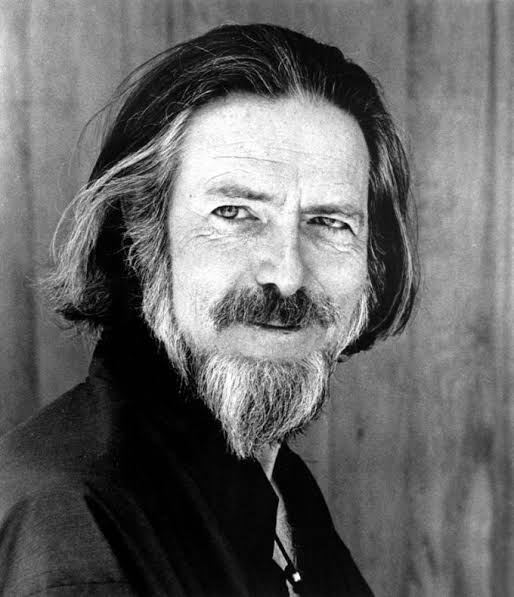
Alan Watts – what a guy! As the public philosopher entertainer de jour he spearheaded the Eastern spirituality movement of the 60s that took America by storm and forever gave Tai Ch its hippy associations. The lectures on Eastern religions, particularly Zen, he did for a local radio station in California have provided endless motivational video fodder for advertising-packed YouTube videos, and they’re all very good. For example:

He had such a good speaking voice, and could articulate mystical ideas, particularly the idea that existence was simply consciousness playing an eternal game of hide and seek with itself, in ways that Westerners could understand. Of course, the downside of that after you die your words get used to advertise all sorts of things you may or may not have been in favour of. For example, he’s currently doing a voice over for a company selling cruises on UK TV at the moment. I’m not sure what the old guy would have thought of that, but there you go. That’s life! It’s never what you expect it to be.

I’ve heard people say that Alan Watts was a good communicator, but a poor example of the Taoist ideas he espoused. This is mainly because he was an alcoholic who died at the relatively young age of 58 due to related health complications. However, if I look at the 60’s popular philosopher entertainers like Alan Watts and Joseph Campbell, they’re so much more interesting and interested in their ideas than today’s sorry crop of pitiful, grifting, sophists like Joe Rogan, Scott Adams and Jordan Peterson. All of them are usually trying to convince you of some terrible conspiracy theory with one hand while selling you something with the other. At least Alan Watts had enough self respect to be dead before he started trying to sell me cruises!

I saw one of Alan Watts’ videos on YouTube recently, that sparked a few ideas in me. It was to do with the Taoist idea of Wu Wei. It’s called “Alan Watts – The Principle of Not Forcing”

“Not forcing” is Alan’s translation of the Taoist idea of Wu Wei, which is usually translated as “not doing”, or “doing nothing”, however Alan’s translation is much better for martial application. In martial arts, like Tai Chi, it is forcing things that is bad. Alan even mentions Judo in his explanation above. 

In English, the idea of doing nothing sounds too passive. Tai Chi isn’t passive. You can’t do a marital art by doing nothing, so I much prefer the translation of “not forcing”. It’s what we aspire to in Jiujitsu as well as Tai Chi. If you feel like you have to force techniques to work in Jiujitsu then it’s not the right way. It might be required in a time-limited competition, but the Gracie family were always famous for not wanting time limits on their matches, mainly because, with their hyper-efficient style of Jiujitsu, they knew they could survive longer than their opponent, exhausting them in the process. When you are forcing things to work you are burning energy, and wearing yourself out.

I think different styles of Tai Chi might look at this situation differently though. Yang style, and its derivatives tend to effortlessly breeze through the form. The emphasis is on efficient, continuous movement and relaxation. And while it may look effortless, you feel it in the legs, even if you are not visibly out of breath. Chen style seems to want to work a little harder. The stances are lower, there are occasional expressions of speed, power and jumping kicks. But there is still that emphasis on being like a swan moving through the water – graceful up top, but the legs doing all the hard work below the surface.

But regardless of style, all Tai Chi forms follow the same principle: Wu Wei.

Tai Chi Notebook Podcast Episode 15 – Centre the Dragon: Tai Chi Talk with Ken Gullette and Graham Barlow

In this episode of the Tai Chi Notebook podcast I’m teaming up with Ken Gullette, to answer the kind of questions that Tai Chi teachers get asked all the time.

YouTube version for people who, er, like YouTube?

Ken is an all-round good guy and owner of the Internal Fighting Arts website where he teaches the arts of Xing Yi, Bagua and Tai Chi at a very reasonable monthly cost. Check him out at www.internalfightingarts.com

Ken is a Chen style guy, and I’m a Yang style guy so it’s no surprise we have slightly different views on a lot of different topics, but that’s part of the fun of it all.

And if you’d like to help out my podcast then you can now become a friend of the Tai Chi Notebook on Patreon. Head over to Patreon.com/taichinotebook and you’ll be able to get a downloadable version of the podcast as well as support my work and get exclusive articles.

If you’ve got any comments on what we say then send them in – we’d love to hear from you!