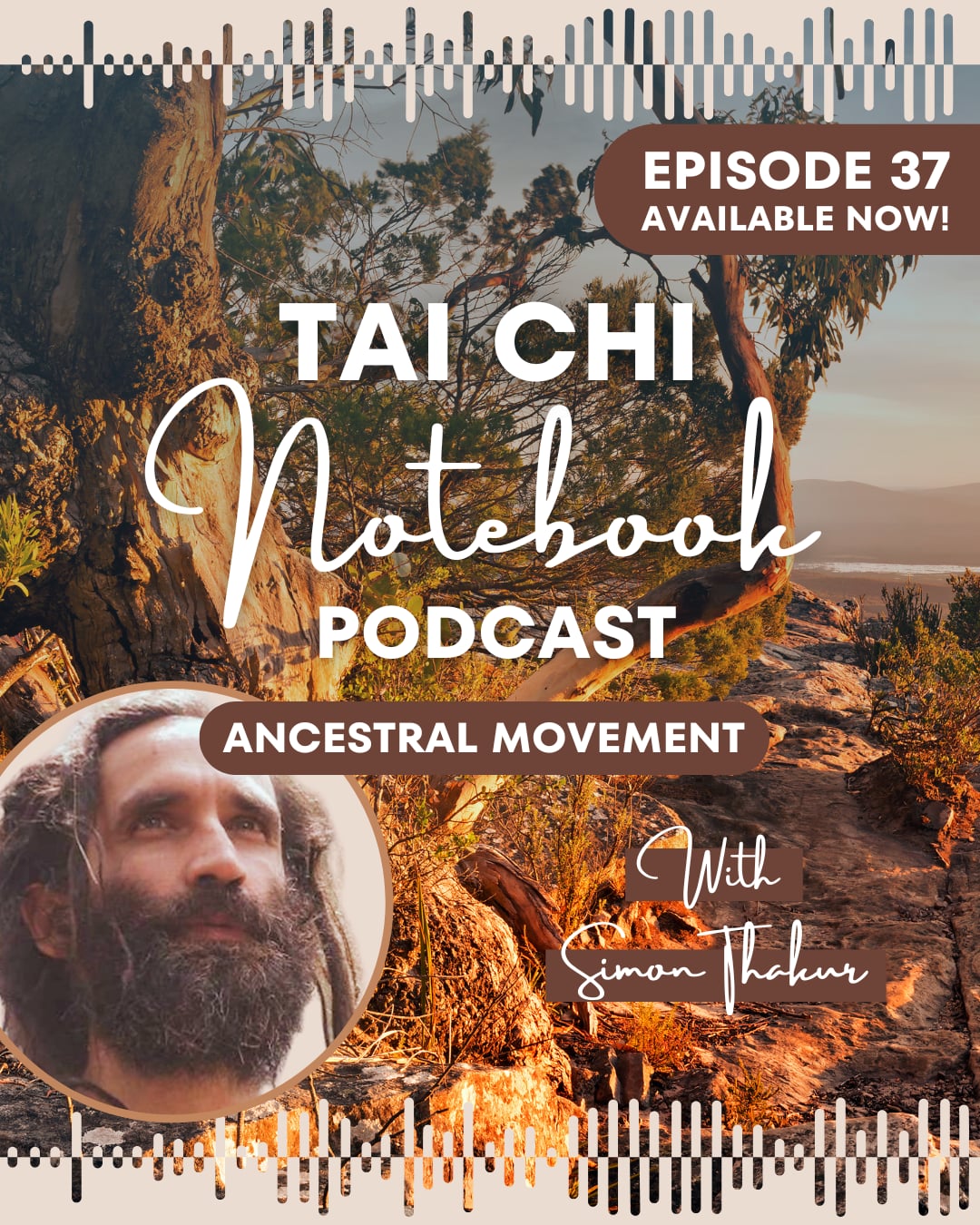
Simon Thakur is the founder of Ancestral Movement, “An ecological approach to movement and mind-body practice, exploring ancient ancestral patterns of movement and awareness built into our bodies, rediscovering the power, grace and ease of natural movement and our bodies’ innate connection to the rest of the living world.”
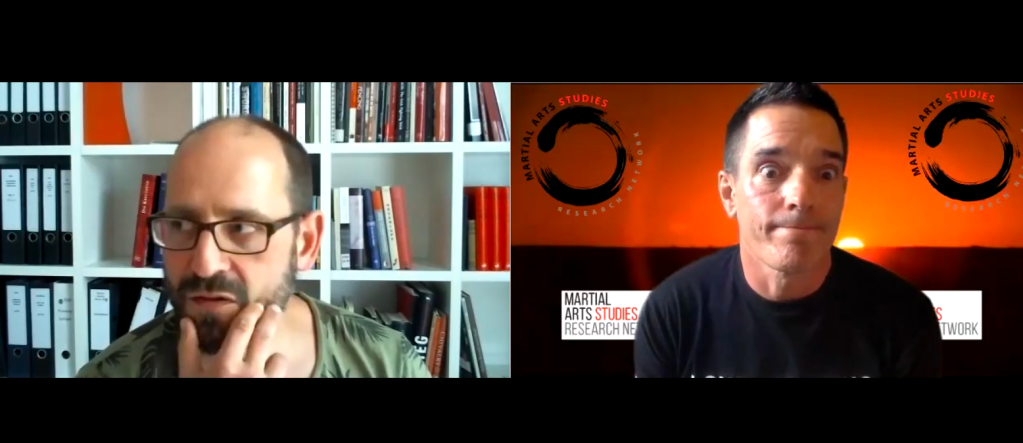
In this episode we talk about many subjects including Yoga, Chinese Martial Arts, Brazilian Jiu-Jitsu, Tai Chi, Shamanism and more!
One observation I have on ‘internal’ martial arts is that there there is often very little focus on the ‘internal’ qualities to a human being. Or if they do address them then it is, not directly and often in passing.
I’m not talking about things to do with forces, or the body, like Qi, Xin and Jin. Yes, the Yi (intent or mind) is mentioned all the time in the Tai Chi Classics, but it’s always in relation to fighting, or releasing and accepting forces on the body. “Quelle surprise”, you might say, since Tai Chi is a marital art, but if I contrast ‘internal’ martial arts with ‘external’ martial arts for a moment, the discussion there is often on the internal qualities of a human that internal martial arts, ironically, neglect.
I’m talking about things like self-control (temperance), endurance and patience.
The goal of improving these internal qualities has been the goal of practical philosophers since man first decided to ponder his/her existence. I could quote from LaoTzu here, but I find it more explicitly written by the Greek philosophers, particularity the Stoics.
In Chapter 10 of the Greek classic of Stoicism, The Enchiridion, we find:
“On the occasion of every accident (event) that befalls you, remember to turn to yourself and inquire what power you have for turning it to use. If you see a fair man or a fair woman, you will find that the power to resist is temperance (continence). If labour (pain) be presented to you, you will find that it is endurance. If it be abusive words, you will find it to be patience. And if you have been thus formed to the (proper) habit, the appearances will not carry you along with them.”
Epictetus, The Enchiridion
Sure, these internal qualities can certainly be learnt from any martial art, however I find it is the external martial arts that really emphasise them. Many Taekwondo schools use the goal of improving your inner qualities as the main sell in their marketing approach. For example, I just did a Google search for Taekwondo clubs in the local area, clicked on Tiger martial arts, and what do I find written on their website, in all caps, so you can’t miss it?
“WE BELIEVE MARTIAL ARTS IS ABOUT MORE THAN JUST KICKING AND PUNCHING”.
This is followed up with “We give students the focus and confidence to achieve in all areas of their lives. Yes, you can learn to take care of yourself in dangerous situations, but really it’s about learning to use your mind and body like a martial artist – learn how to control your body and your mind, and you will be set up for life.”
It’s the same with Karate. I did another random search on Karate clubs and found Bristol Karate Academy whose motto is “virtue in industry” from “Virtute et industria” — or by virtue and industry — from the city of Bristol, which dates back to at least 1569. They explain how that relates to the values of their club on their About us page:
“So what does that mean for us?
Virtue (美徳): We have integrity, in our commitment to traditional, effective Karate and integrity in the way that we treat others. We are respectful, fair and aim for high moral standards. We build character, strive for excellence and show courage in the face of challenges.
Industry (勉励): We work hard to reach our goals. We’re diligent and determined to get better at every single training session. We are rigorous in our approach to improvement and dedicated to our own and each other’s development.
Through hard, honest training we become our best possible selves”
Again, while I’m sure they can kick-ass with their karate, the emphasis in their motto is on the internal qualities of a human being. It’s about becoming your best possible self.
I know what you’re thinking – “perhaps it’s about teaching children?” Things like Karate and Taekwondo can be very orientated towards teaching children, and you obviously don’t want to be raising a hoard of little ninjas who have no idea about the moral implications of using their marital arts. However, it’s not just non-Chinese marital arts that have a heavy emphasis on building moral character. Similar ‘external’ Chinese martial arts do too, and those tend to have as much emphasis on adults as children. Also the moral aspects were there right from the beginning in the Southern arts.
For the history of Southern Chinese martial arts I’d recommend Ben Judkin’s excellent book “The Creation of Wing Chun”. Its tag line is “A social history of the Southern Chinese Martial Arts” because it covers all of them, not just Wing Chun, and particularly Choy Li Fut. When the first professional Choy Li Fut school opened in 1836 a moral education was seen as part of the ethos of the school. The school had 10 rules that had to be followed at all times:
Ten Points 1 Seek the approval of your master in all things relative to the school. 2 Practice hard daily. 3 Fight to win (but do not fight by choice). 4 Be moderate in sexual behavior. 5 Eat healthily. 6 Develop strength through endurance (to build a foundation and the ability to jump). 7 Never back down from an enemy. 8 Practice breathing exercises. 9 Make the sounds (“Yik” for punches, “Wah” for tiger claws, “Tik” for kicks). 10 Through practice you cannot be bullied.
While some of the rules are to do with body use, like making sounds on punches, others are more moral, like being moderate in sexual behaviour. And also eating healthy is a rule! Can you imagine going to a Tai Chi class or a Xing Yi class today and being told that healthy eating is now a rule, and if you don’t follow it, you’re out? In fact, I’d go as far to say that many internal martial arts teachers were renowned for hard drinking and over eating!
(It should be noted that Bak Mei tended to not have this moral emphasis. Reasons for this are explored in the book.)
Moving forward in time and changing locations to Brazil… Carlos Gracie also created a set of rules called the 12 Commandments when he started Brazilian Jiujitsu as an offshoot of Judo.
1 Be so strong that nothing can disturb the peace of your mind. 2 Talk to all people about happiness, health, and prosperity. 3 Give to all your friends the feeling of being valued. 4 Look at things by the enlightened point of view and update your optimism on reality. 5 Think only about the best, work only for the best, and always expect the best. 6 Be as just and enthusiastic about others victories as you are with yours. 7 Forget about past mistakes and focus your energy on the victories of tomorrow. 8 Always make those around you happy and keep a smile to all people who talk to you. 9 Apply the largest amount of your time on self-improvement and no time in criticizing others. 10 Be big enough so you can feel unsatisfied, be noble enough so you can feel anger, be strong enough so you can feel fear, and be happy enough so you can feel frustrations. 11 Hold a good opinion about your self and communicate that to the world, but not through dissonant words but through good works. 12 Believe strongly that the world is in your side, as long as you stay loyal to the best of yourself.
Carlos Gracie
These are mainly forgotten about these days and I’ve noted before that a lot of them were borrowed from somewhere else but they are almost exclusively about internal qualities of a human being.
If you contrast these sorts of rules to what you find in “internal” marital arts schools, well first of all, there are usually no set rules like this at all! Secondly, we tend to look to the classics for our ancient sayings, and finding moral instruction in them is like finding a needle in a haystack. Instead you find simile – for example, “be still like a mountain and move like a great river” from the Tai Chi classics, or philosophy from the Xing Yi classics like The 10 Theses of Yue Fei:
“From the beginning, that which is discrete must have its unification. The divided must be combined. Therefore, between heaven and earth, all that is disordered hasits abode, all the thousand branches and the confusion of then thousand endings, all have their origin. This is because one root divides into ten thousand branches, and ten thousand branches all belong to one root. These events are natural“.
– The Thesis of Integrity
Or you find descriptions of body use and strategy.
The jin should be rooted in the feet, generated from the legs, controlled by the waist, and expressed through the fingers.
What you don’t find a lot of is moral instruction or a reflection on the internal qualities of a martial artist that you find emphasised right up front in external schools.
So, why is this? Good question. One possible answer could be that ‘external’ arts historically coming from the Shaolin Temple (in the usual origin myth, at least) always had a Buddhist religious and therefore moral aspect to them. The internal arts in contrast tended to evolve out of the (violent and bloody) countryside, or they evolved from a Taoist approach to life, which was less prescriptive.
I don’t know – what do you think? What explains the internal/external difference? Let me know in the comments.
I’ve been meaning to read the story of Matthew Polly’s time spent training at the famous Shaolin monastery for years, but I finally got around to it recently thanks to my Audible.co.uk subscription*. And what a great read it is! I’m sure we can all identify with the teenage Polly, unsure of himself and his place in the world, who falls under the spell of Kung Fu and decides to dedicate his life to the pursuit of it as some kind of escapism from the pressures and fakeness of the modern world. To Polly, Kung Fu represented something sublime, pure and otherworldly that actually meant something. But unlike most of us, he did more than just dream about it, he actually went to Shaolin and lived there for almost a year, at a time when there was no Internet, no easy way to get there and China had only recently opened up to foreigners, so most Chinese people had never even seen a Laowai in the flesh before.
Polly’s story could best be summed up as a sequence of misadventures punctuated by moments of sublime martial arts inspiration. He manages to get into all sorts of scrapes involving accidentally offending senior party officials, being entered into a tournament against a San Da champion and hilarious misadventures with the opposite sex. Part Bill Bryson-style travelogue, and part kung fu geek-out, this is a rewarding, even emotional, look into what the Shaolin monks were really like in the 1990s, just as their international fame as stage performers was starting to spread and take over from the mystical image everybody had of them from the Kung Fu TV show. (Interestingly, at one point Polly watches the Kung Fu TV show with the monks who laughed their heads off at the idea of burning a dragon and tiger into your arms by lifting a hot anvil and dropping it into the snow – “why would you do that???”)
What you really get from this book is a sense of what the Shaolin monks are really like back then, and how much more human, relatable and down to earth they are compared to the lofty ideas we all have of them. It answers all the big questions like, how good are they at actually fighting, how seriously they take the “monk” side of their lives and how they train iron first, arm, head and even iron crotch.
The little snatches of Chinese you pick up by reading the book are also a hidden bonus and bring the characters to life marvellously. By the end of the book you feel like they are your friends and you know them just as well as Polly did. Anybody who likes this blog would love this book. Recommended.
N.B. The cover with a monk holding a Burger King bag is representative of the idea of American values seeping into China, but a little misleading as there were no Burger Kings in China then, and certainly nothing like that in the rural backwater of the Shaolin village.
*Like a number of other books, American Shaolin is included in the cost of an Audible subscription, so if you are a subscriber you get it free.
I think this post is perhaps a little half formed, but I want to get on to writing up my last lesson with Bear, so I’m going to put it out as is. Let the pieces fall where they may…
An interesting new video has been released by Will (a recent guest on my Tai Chi Notebook podcast) about his recent visit to Taiwan where he got to talk to various Taiwanese martial arts masters. It’s the start of a series and it looks like it’s going to be great – Will gets to walk down the smokey back alleys of Taiwan to find the martial artists and martial arts schools in Taiwan you wish you could. What’s not to like? Watch it here:
The blurb reads: “In the first episode, I meet up with my friend John Eusebio @longfistmantis to visit the bookstore of Liu Kang Yi. Mr Liu’s bookstore, Wuxue Shuguan has a huge collection of martial arts books, in both Chinese and English, and he has also spent decades collecting old and rare manuscripts. In this video he shares his insights on the development of martial arts from a military combat art, to an integrated system of both combat and health practice, as we see it today. He also shows us a copy of the Bubishi, the foundational manual of Okinawan Karate.”
Mr Liu talks about internal training, and how it relates to strengthening the tendons and fascia of the body, so that it can toughen and that can lead to more strength “qi” in the body. This all seems fairly accurate to me. (There’s discussion to be had about whether these methods were always a part of Chinese marital arts, or added in later from a different tradition, but that’s by the by). Then he talks about the 3 phases of development of Chinese martial arts, which is the part I wanted to pick up on.
To paraphrase, he says, the first is only martial training and not cultivating: it’s pure combat. No focus on health. This is the military period. The second is once it entered the civilian population. They train both combat and cultivate health, but separately, developing things like Yijinjing and Baduanjing. The third evolution was to combine combat and health, to bring both aspects together. Taijiquan is a good example of this.
Now, this is not a bad way of looking at the evolution of Chinese martial arts, but I think it’s a bit reductive, and crucially, it misses out a lot of other influences.
It’s a view that is not dissimilar to Peter Lorge’s in the book Chinese Martial Arts: From Antiquity to the Twenty-First Century which is that marital arts were all originally military arts and over time were simply dispersed from the army into civilian life.
Lorge’s position is laid out clearly in the introduction to his book starts with this:

I actually really enjoyed Peter’s lecture about the history of Chinese martial arts at the Martial Arts Studies conference 2017, but it seems that both Mr Lorge and Mr Liu both view Chinese martial arts as a kind of offshoot of military training, and nothing more, and in both cases the subject doesn’t even seem to be up for debate, it’s just presented as self obvious. The parallel between both of them is that they are relying only on written sources as their research into the matter. In fact, a lot of the cultural traditions of ‘common folk’ were not recorded, since writing belonged to the upper classes.
Now, I’ll admit, there can be no doubt that the intermingling of civilian and military life had a massive influence on martial arts practiced by people in villages, particularly after the Ming Dynasty army was disbanded and returned to civilian life after its defeat by the invading Manchu’s, who seized control of Beijing in 1644. Xing Yi in particular is one of the martial arts that traces its origins to that event, to military methods kept alive by ex soldiers who were now civilians who had had their weapons taken away. A review of Xing Yi’s existing methods and techniques today reveals a clear bias towards methods that work with a spear, which would have been the dominant weapon in the military for soldiers, and also a concern for facing an attacker who is in front of you, not to the side, which is another feature of military arts. However, most other Chinese marital arts are more biased towards barehand actions than weapons, contain sometimes elaborate sequences that would appear to be more at home on a stage than in a street fight, or involve making specific hand gestures or actions that hint at a ritual quality, that it’s clear, to me at least, that something more is going on here. Rather than just military methods being translated into personal self-protection methods, we are seeing other influences.
In China, there is a long history of martial arts being used in religious ritual, festival culture, spirit possession, street entertainment, Xiqu (Chinese theatre) and Wuxia (which literally means “martial heroes”, a genre of Chinese fiction concerning the adventures of martial artists in ancient China). I think those traditions have as much influence on the martial arts passed down to us today as the military does, and in a lot of cases, more. But, if you mention this to proponents of the “pure pugilism” brand of martial artist, they usually try and explain to you that all these things came out of marital arts. i.e. martial arts came first, and the dance/performance/theatre/ritual, etc came second. In fact, Lorge argues exactly this at 43.00 minutes in his lecture (which I still enjoyed!), despite cataloging wrestling going back centuries as pure entertainment for the Royal Court. This attempt to explain away the obvious flaw reminds me of when people present funky martial applications to form movements that clearly don’t look like marital movements. There are some frankly ridiculous martial application out there from well know teachers who, rather than just admitting that there’s no real martial application of this move that makes any sense, come up with something that just looks silly.
I’ve talked to a lot of martial artists on my podcast (20 episodes so far!) and I quite often broach this subject to see what kind of reaction I get, and I’ve found that the martial artists who live in Asia, or have lived there for some time, tend to have no problem with the idea that Chinese martial arts is a broad church of methods derived from various traditions. It tends to be the people outside of that culture who have a problem with what they’re learning not being a super-deadly killing art created for one purpose only – to be the best fighter! I suppose it’s because so many of these cultural traditions are still alive and well in Asia today that it’s hard to deny their existence. Just look around you. Martial arts training halls tend to have shrines in them where incense is burned as part of a religious ritual. Or the martial arts school participates in local religious festivals by enacting Lion and Dragon Dance routines, or giving a demonstration of martial arts. Or there is a semi-religious ceremony involved in becoming an indoor disciple, etc.
I think two things are going on here. First there’s a reaction against the modern Chinese trend of turning marital arts into a gymnastic demonstrations instead of fighting arts, and secondly there’s a reaction against the modern trend for making Chinese martial arts appear as spiritual and mystical in the same way Yoga is.
As Charles Holcomb wrote in 1990 , “Everywhere in China the martial arts either present themselves in the guise of simple exercises or are shrouded in arcane religious mysteries. Western enthusiasts often feel impelled to strip away these religious trappings and construct a version of the martial arts that is neither simple gymnastics nor religion, but emphasizes true hand-to-hand combat skills. The question remains, is this an authentic understanding of the martial arts?” [1]
I think that process of trying to present the martial arts as true hand-to-hand combat skills is very much alive and well today, I mean, its probably what most people are looking for when they start Kung Fu. I certainly was. But I think it’s also something of a reaction to the introduction of Chinese martial arts to the West, which came off the back of the Kung Fu TV series (which presented martial arts as mystical from Shaolin monks) and followed off the back of mystics like Alan Watts who presented a very counter culture sort of take on Eastern religion.
While there’s nothing wrong with that, my feeling is that it misses out on the wider, and weirder, historical context of the arts we practice today. They’re a rich blend of various traditions, and we should treat them as such.
[1] Theater of combat: A critical look at the Chinese martial arts by Charles Holcombe, Historian. Vol. 52 No. 3 May.1990. Pp. 411-431 Copyright by Michigan State University Press
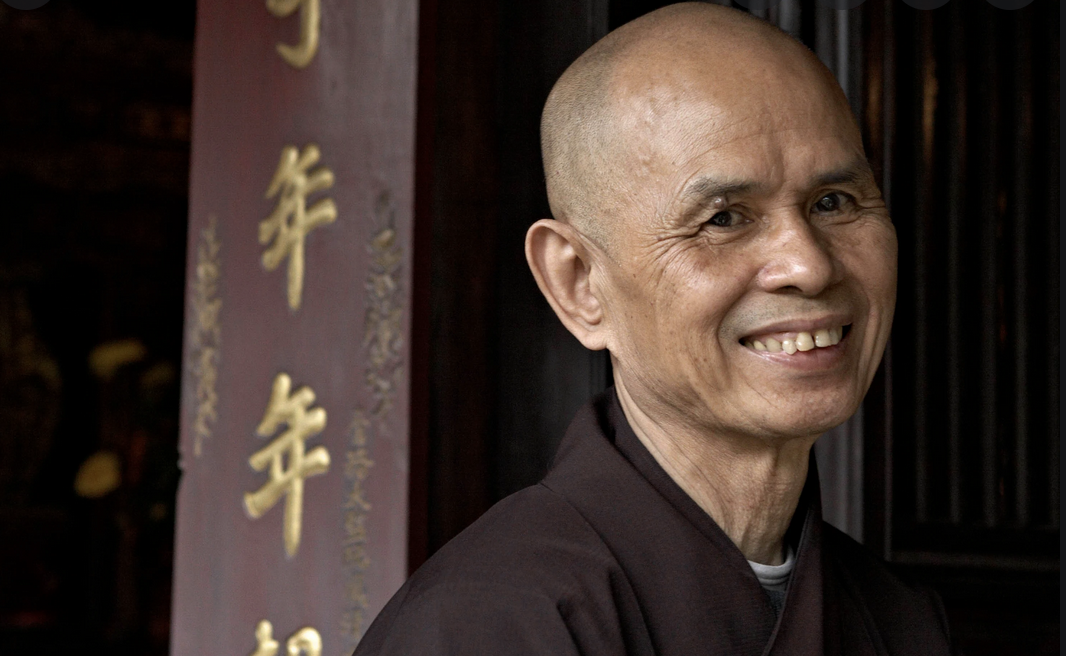
Thich Nhat Hanh, probably the second most well known person in Buddhism in the West, has died at the age of 95. His importance, life and teaching are well summarised in this Washington Post article. May he rest in peace.
“Hanh’s greatest contribution to Western thinking was to inject the idea of mindfulness: to be fully conscious in the current moment.” – Washington Post.
Why do we exercise? It may be that we have been told we must by a doctor because we are facing some sort of health crisis, for which the most obvious solution is to take up more regular exercise. Usually these problems are related to being overweight and the multitude of health problem this can exacerbate, or indeed cause. But sometimes it can be something more subtle, like just not feeling comfortable in our body. We know when our body feels weak, soft, stiff or unused and needs exercise. The sense that we need to move, to stretch or to run is always there within us, if we choose to listen to that inner voice.
The Stoics were very big on the idea of accepting “voluntary hardships” as a kind of “shortcut to virtue”. Like the Cynics before them, or the holy men of India at the time of the Buddha, they would often become beggars, or live like poor people for extended periods of time to refocus on what was important in life, or to simply stop themselves from getting too soft. In life we generally try and avoid pain and discomfort in all areas, and this can lead us into tremendous difficulties in the long run. By seeking to avoid pain we let small problems fester until they become big problems.
“although most people don’t like pain and discomfort, we generally accept that learning to endure it within reason can potentially toughen us up. That’s what most physical exercise is about, to some extent. It improves our fitness but also teaches us to endure pain and fatigue.”
Donald Robertston
Which brings me on to Tai Chi. Generally motivating yourself to get out of bed, or off the couch, to practice Tai Chi involves the same mental toughening up process that is involved in motivating yourself to do any other form of exercise. There’s no difference there, but the difference is in the type of exercise.
Tai Chi is a slow burn. It requires a different type of resilience. You need to develop the resilience to work slowly and patiently at something when your mind is telling you that you’re bored now and you should really be doing something much more exciting or intense.
To some extent you can turn your mind off during sets of star jumps, squats and push ups and just blast through them, maybe while listening to pumping music to help keep you going. In contrast, the first thing you are asked to do in Tai Chi is to stand still and connect with your breath before you even lift a finger. Then you are expected to keep your mind on the job throughout.
But if you try it, you’ll find that this “getting in touch with yourself” first before exercising can lead to a different kind of experience. It’s the gateway to marvels. Maybe you won’t burn as many calories as you do down the gym with your mind on autopilot, but your body will feel better for it, reconnecting with the living spirit of nature that flows through you, and (if Obi-Wan Kenobi is to be believed) all things.
It starts with the breath. Become aware of the breath. Don’t interfere with it, just watch it rise and fall. Once you do that you’ll find that facing minor adversity doesn’t feel like such a big problem anymore, and you can just do it.
I made a special guest star appearence on the Woven Energy podcast last week to join Damon Smith for a chat about Reiki and suicide monks.
Continuing our examination of the spiritual traditions that gave rise to modern Reiki, this episode looks at the Buddhist tradition of Mount Kurama. The tradition of Mount Kurama is one with strong shamanic undertones, and is one of the two primary lines of Buddhism that influenced Usui. We also talk about the related suicide cult of Kiyomizu-dera in Kyoto.
Woven Energy
A bit of an odd subject, and not something I know a lot about, but I the episode was really about how organised religions can convince people to do some very wacky stuff, which is more my bag.
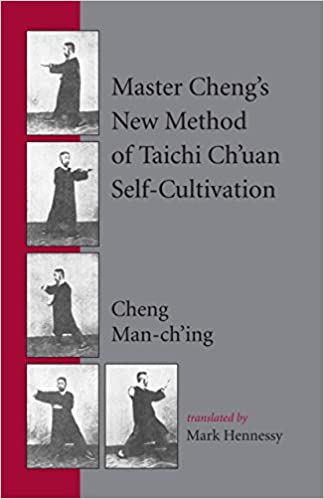
Before the Internet, back in the early 90s, there were only a few books on the subject of Tai Chi in the West, so the authors of these books achieved a kind of fame and notoriety that wasn’t really proportional to their actual importance, or impact on the Tai Chi world. Or maybe their fame became proportional because of the books themselves, in a kind of self fulfilling prophecy. It’s hard to say.
Either way, one book title that always stuck in my mind was “Master Cheng’s New Method of Taichi Ch’uan Self-cultivation”.
This idea of “self cultivation” is kind of the main reason that people practice Tai Chi in the modern world. It’s kind of like exercise, but a little deeper, involving something a little more like meditation. This idea of using eastern spirituality to go on a personal odyssey, or journey into your self is sold to us all the time in the world of Tai Chi, Yoga and health or spiritual practices.
The fact is, it’s nonsense. I hate to break to to you, but individually, we are really not that deep. Scratch our surface and there’s really not that much to us. The idea of cultivating yourself is really a huge waste of time. Our depth lies in our relationships to other people, places and non-human animals. And to find our connection to the world, to the land, the first thing you need to do is get rid of this little self that you’ve been busy cultivating with your various yoga, tai chi and martial arts practices.
Just look at what the Zen or Tao masters of old wrote. They were telling us this constantly in their writings.
When you do something, you should burn yourself up completely, like a good bonfire, leaving no trace of yourself.
– Shunryu Suzuki
One must be deeply aware of the impermanence of the world.
– Dogen
The practice of Zen is forgetting the self in the act of uniting with something.
– Koun Yamada
Those were literally the first three quite in an article I just searched up called “25 Zen Quotes“.
I feel like I could quote any chapter of the Tao Te Ching too, but let’s go with chapter 3:
The Master leads by emptying people’s minds and filling their cores, by weakening their ambition and toughening their resolve. He helps people lose everything they know, everything they desire, and creates confusion in those who think that they know.
Practice not-doing, and everything will fall into place.
Bowman notes that instead of helping people, the myth busting of martial arts which is going on all the time in academic circles is probably destroying the careers of some martial arts teachers. So it’s “doing a service to the world which is actually also a kind of violence”. It’s an interesting point. He notes that people often fall in love with the martial arts for silly orientalist reasons – they fall for the myth of studying an ancient and mystical martial art, then read a well-researched book about it, by somebody like Ben Judkins or Peter Lorge, which shatters their beliefs and makes then doubt the validity of the art they are doing.
My own Heretics podcast does its fair share of myth busting too – our Aikido episode, Kempo & Jiujitsu history series and Tai Chi history series spring to mind as good examples. I’ve had first had experience of those episodes visibly upsetting teachers I know. Whether they know it or not, these teachers are heavily emotionally invested in the myths of their own arts superiority – they believe all the stories of old practitioners and the amazing feats they can do, and know exactly why their martial art is superior to others. If you start to chip away at those beliefs then the whole facade is at risk of crumbling, and they don’t like it! Unfortunately reality is usually disappointing when compared to the myths.
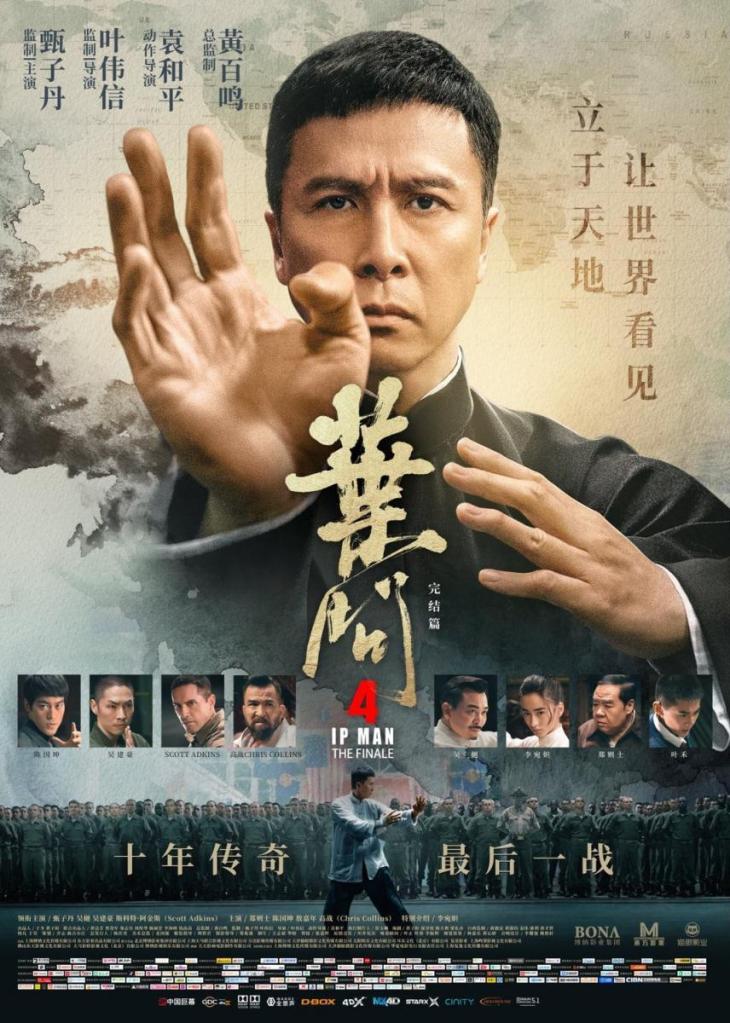
When the Chinese martial arts first started making an impact on the West in the 1970s they were full of obvious untruths. Tall tales of Buddhist and Taoist origins abounded. For example, that Tai Chi was apparently created by a Taoist immortal who had a dream about a crane fighting a snake, and Wing Chun was named after the girl who was taught it by a female Buddhist monk, when it turns out that there’s no evidence that she even existed. Over time these myths then get added to by other myths – like the one that Yang LuChan was “invincible”, for example. Even in the modern age the myth of Ip Man has been enhanced to bursting point by a series of pseudo-historical films in which he combats the Japanese, western wrestlers, boxers and even Mike Tyson at one point!
Ip Man 4
These more marketing-orientated myths about the prowess of practitioners – how deadly they were, how unbeatable their martial arts was, how the power of Qi was greater than physical strength all fed directly into all that nonsense about no touch knockouts and “empty force” that has marred the image of Chinese martial arts in the modern age.
And politics also gets involved. When obvious myths about the origins of martial arts are dispelled they often get replaced by more politically motivated stories about the arts origins that are equally as unprovable and unreliable yet fit a natioanlist agenda. It seems like the Chinese martial arts are forever being used to support some sort of Chinese government propaganda.
In short, the Chinese martial arts world was in need of, and remains in need of, a lot of myth busting, because much of what we are being told and sold is basically not true. But Bowman’s fears, that we are in danger of spoiling the fun for everybody with this relentless search for the truth, holds true, I think. I was certainly attracted to Chinese martial arts by a steady diet of orientalist propaganda from the likes of David Carradine’s Kung Fu TV series and Marvel comics with heroes like Iron Fist. This is often what draws us to the martial arts in the first place and there has to be some way of searching for truth in the martial arts, but keeping the magic that drew us there in the first place.
If you’re interested in the history of Japanese martial arts then I would also recommend this talk by Dr Oleg Benesch on the Martial Studies podcast, which talks about a lot of the same stuff, particularly the interplay of Western and Eastern ideas after 1852, the invention of the ideal of the honorable Samurai warrior and, most importantly, castles!





 The Tai Chi Notebook