Thanks to Ken Gullette at Internal Fighting Arts I just caught wind of this new book that’s just come out called Chen Taijiquan Illustrated. I had a quick look on Amazon using the “Look Inside” feature and the illustrations look fantastic. It looks like it’s designed to be halfway between an instruction manual and a comic. It’s a very cool style that’s quite unlike any Tai Chi book I’ve seen before.
Chen Taijiquan Illustrated – available now!
I think that often Tai Chi books, with pages after pages of printed text, can be a bit off putting for people who are learning an art that is all about feel, movement and “doing it”, not “reading about it”. And when they do have photographs in them they are often black and white and a bit dull and lifeless. So, for the visual learners out there, I think the colourful and imaginative approach found in Chen Taijiquan Illustrated will work very well.
Here’s an example:
An extract from Chen Taijiquan Illustrated by David Gaffney and Davidine Siaw-Voon Sim
Here’s another thing: Looking at the contents page, this is the first Tai Chi book I’ve seen that mentions the concept of Man, which translates as Slowness, apart from the book written by my Tai Chi teacher. Man is a concept my teacher talks about a lot, and it’s nice to see it mentioned in another Tai Chi book – I was starting to think that it was a concept that was unknown to the rest of the Tai Chi world!
Tai Chi Chuan a comprehensive training manual by Raymond Rand
Obviously everybody and their dog knows that Tai Chi is done slowly, but Man is more of a mental quality than a reference to the speed of the form. It can be thought of as “not rushing”. The speed you are moving at is irrelevant to the concept of Man, but if you want to acquire the ability of Man then the best way is by slowing the form down and focusing on keeping your mind on what you are doing. Whenever you find your mind wandering off you just stop the form (no matter how far through it you are) and start again. After a few weeks or months you’ll find you are much better at staying focused on your form than you were before. By adopting the qualities of “not rushing” you open up the headspace required to be aware of other things going on, things that you would simply miss otherwise. I’ve written about not rushing before.
At £16 Chen Taijiquan Illustrated is not particularly expensive for a colour book either. And I’d love it if there was a book on Brazilian Jiutjisu that was written and illustrated in the same manner because I think it would also benefit from this approach. Incidentally, there was a good book written about Brazilian Jiujitsu recently, that has colour photos (and very nice ones too) that I still dip into now and again called Nonstop Jiujitsu, by Stephan Kesting and Brandon Mullins. I reviewed it on my blog recently, so check out my review.
Nonstop Jiujitsu by Brandon Mullins and Stephan Kesting
I’ve ordered my copy of Chen Taijiquan Illustrated so will review it at some point in the future.
I got asked once by a CMA practitioner what the “Shen fa” (body methods) of Brazilian Jiujitsu were and I drew a blank. The only answer I could come up with was “we don’t have any”. What I think we have instead though are foundational movements. Let me explain.
While Chinese martial arts like Tai Chi, Xing Yi and Bagua all have “Shen Fa”, which are “body methods” that need to be internalised before the practitioner can be considered sufficiently proficient in the art, Brazilian Jiujitsu doesn’t have them in the same way. Instead, it has a series of foundational movements that crop up so often in techniques that they are considered the foundations of the art, and are usually done in class as warmups.
I taught an interesting Jiujitsu class this week. (Well, I thought it was interesting – I think you’d have to ask the students themselves what they thought!) I started with the group practicing the basic Technical Stand Up both forward and reversed (which is doing it backwards, so you go fro standing to sitting down), then with variations like a knee or an elbow on the ground instead of a foot or hand.
Sweaty work – a fun class!
A Technical Stand Up is a way of going from sitting on the ground to standing up that exposes you to the least risk if you’ve got an aggressive person attacking you. It minimises your chances of getting kicked in the head and also affords you the ability to kick back at the attacker’s knee, possibly hyper extending their leg painfully.
How to do a Technical Stand Up
Once everybody in the class could do a Technical Standup well enough we went on to practice applications that utilised it as part of the technique. A good example is a basic X Guard sweep, or a way of returning to base after completing a tripod sweep. (I’ll not explain what those are here, because I don’t want to get lost in the details of these techniques in this post, because that’s not what this is about.)
Foundational movements in Jiujitsu include the aforementioned Technical Stand Up, but also things like a bridging movement, a hip escape (shrimp), a triangle, a forward (and backwards) roll and an inversion. If you can’t perform these basic movements correctly then your chances of doing any technique correctly are going to be severely limited.
In contrast, Chinese martial arts “body methods” include things like dantien rotation, opening and closing the chest and rounding the kua. These body methods are postural observances and ways of moving that need to be kept in place during all movements.
Why one art should have developed body methods, and the other not even have that concept, is worth thinking about, and I think it relates to the role of form in Chinese martial arts. Practicing solo movement in the shape of a form done in isolation from other people allows the possibility of subtle things like body methods to be developed.
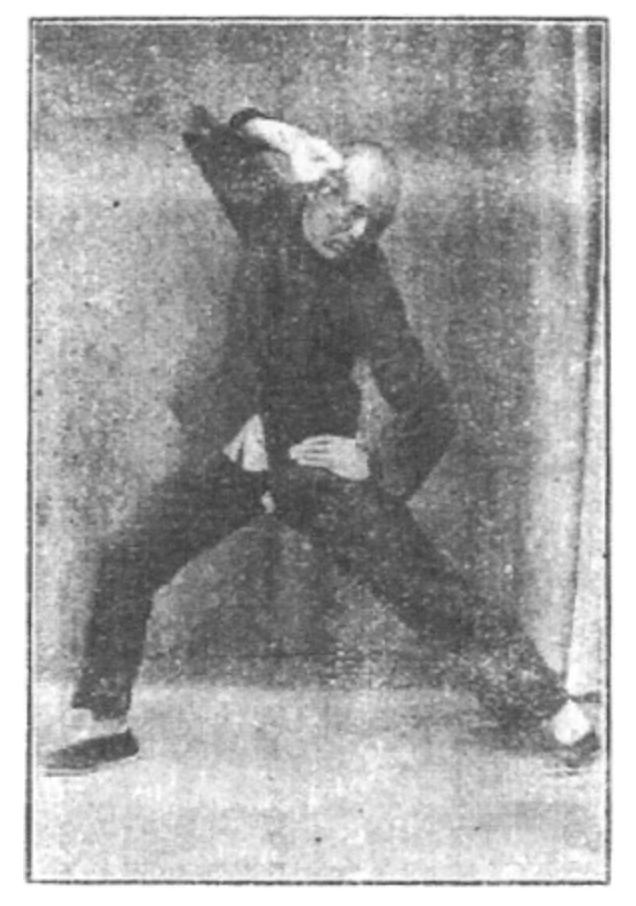
Torso Flung Punch by Chen Zhaopi, 1930,
There are no forms in BJJ. Sure there are solo exercises you can practice to warm up or condition the body, but they don’t have the same function as form (tao lu) does in CMA. BJJ is heavily partner orientated. All the drills and sparring need another person physically there to do it with. To practice BJJ we literally have to get together with other people in nice matted areas and throw down. There is no other way.
These body methods in CMA have resulted from forms, but my suspicion is that this was never planned, rather they have grown out of a situation that happens when you are required to practice forms. Why CMA started practicing forms in the first place is a different question – there are some clues as to why that might be in the video I shared the other day by Simon Cox on the Taoist concept of the Subtle Body.
It’s analogous to the situation in China between Shuai Jiao and Kung Fu (Wu Shu). Shuai Jiao has no extended tao lu (forms), like Kung Fu does, but it has an awful lot of solo conditioning exercises with and without weights and belts. I’m not a Shuai Jiao practitioner, but I think you’d be hard pressed to say that Shuai Jiao has Shen Fa in the same way that the various Kung Fu (Wu Shu) styles do.
Is one approach better than the other? I don’t know. They’re just different and personally I enjoy practicing both.
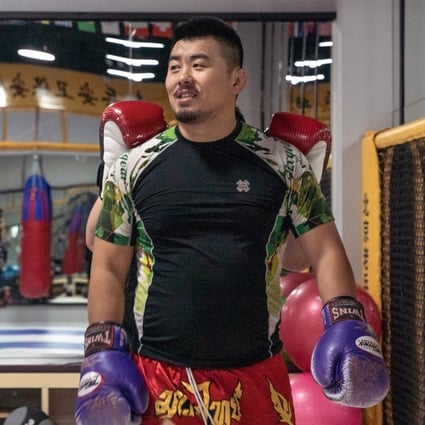
Now we’re a few months/years away from the high point of the Xu Xiaodong controversy it’s good to get a reasonable perspective on the matter from somebody who actually knows him and moves in the same martial arts circles in China.
It’s quite a long talk, but you can think of it like a podcast and listen to it while you’re doing your conditioning exercises. Wait, you are still doing those, right? 🙂
In this episode my guest is Seymour Yang, a long time acquaintance of mine who is also something of a legend in the BJJ world, where he goes by the name Meerkatsu and is famous for his BJJ artworks, which get turned into beautiful t-shirts, rash guards and gis.
Seymour is also a black belt in Brazilian jiujitsu and teaches at the Roger Gracie academy in South Hertfordshire. So, it’s no surprise that this episode is highly focused on the art of Brazilian jiujitsu.
We’re talking right after we both attended the same jiujitsu seminar up in Stafford with Priit Mihkelson (my guest in episode 5 of this podcast) so that’s where we start our conversation. I hope you enjoy it!
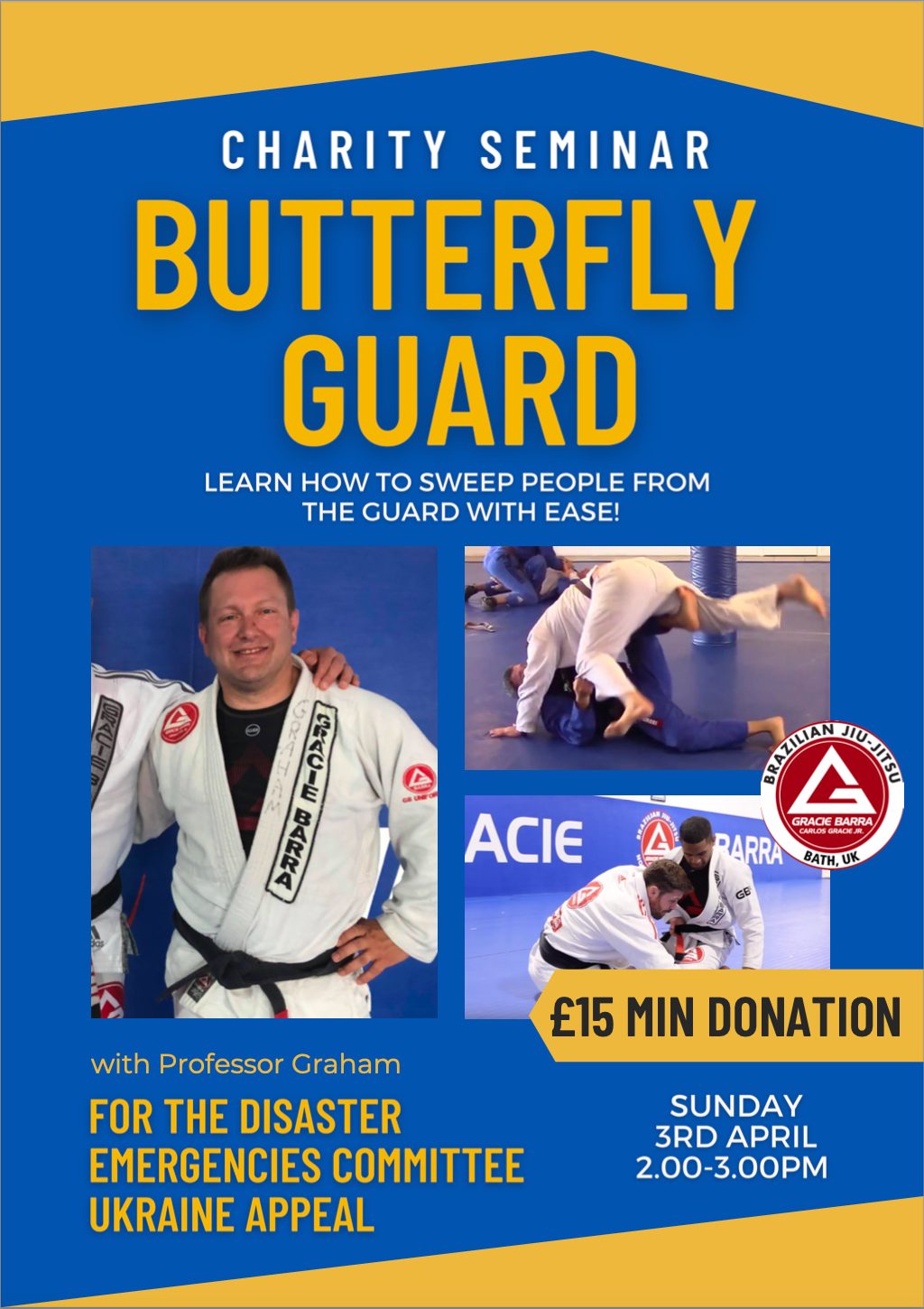
Just a heads up, I’m doing a BJJ seminar on Sunday at Gracie Barra Bath in aid of the Disasters Emergency Committee, Ukraine appeal. It’s open to all and £15 minimum donation. The Justgiving page is here. Thanks.
Let’s take a little diversion into the world of Brazilian Jiujitsu. Here is a video I shot this morning that shows some of my favourite options for getting submissions from side control. For some reason the sound didn’t work, but hey ho, let’s roll.
I’m demonstrating how I like to keep my knees off the mat, so that my body weight is going straight into my opponent, which I use to pin him, freeing up my hands. The hands are then free to see submissions. I show some chokes and armbars. The very last choke, where they get choked by their own arm across their body is my most common submission. It’s quite opportunistic, but the opportunity is there quite a lot if you know to look for it.
If you enjoyed this sort of content then you’ll probably enjoy my chat with BJJ black belt Stephan Kesting of GrappleArts.com. We talk about a lot of BJJ issues and also how BJJ has changed over the years.
One of my poetic/literary heroes, Charles Bukowski had “Don’t try” written as an epitaph on his tombstone. To many people he was simply an alcoholic, womanising, bum who pissed way his talent, but I bet Charles Bukowski did more honest days work in his life than a lot go his critics ever did. Writing was his way out of a life of oppressive blue collar jobs that had ground him down, and he only succeeded as a writer late in life, and that gave him a unique perspective.
There’s a video that explains his seemingly paradoxical philosophy of “Don’t try”.
But if you don’t have time to watch it then Bukowski explained it himself in one of his letters:
“Somebody asked me: “What do you do? How do you write, create?” You don’t, I told them. You don’t try. That’s very important: not to try, either for Cadillacs, creation or immortality. You wait, and if nothing happens, you wait some more. It’s like a bug high on the wall. You wait for it to come to you. When it gets close enough you reach out, slap out and kill it. Or if you like its looks, you make a pet out of it.”
– Charles Bukowski
I think anybody versed in the philosophy of Tai Chi can see an instant parallel here to the Taoist ideal of Wu Wei – “not doing”. Quite often if you can wait for the mud the settle the water becomes clear all by itself, and the right action becomes obvious.
There are a number of quotes you can find in the Tao Te Ching that elucidate on this idea, right from the start of the book, where in chapter 2 Lao Tzu states: “The sage acts by doing noting”, then later in chapter 22 he says “Because he (the Sage) opposes no one, no one in the world can oppose him.” And in Chapter 48, “When nothing is done, nothing is left undone.”
Now I wouldn’t say that Lao Tzu and Bukowski have exactly the same take on this idea, but they’re not a million miles apart.
There are obvious applications of “Don’t try” in all areas of your life – from creativity, as Bukowski found, to business and your home life, but one of the most obvious I find is in martial arts.
If I find I’m engaged in too much of a struggle during sparring, rather than go harder, I have slowly learned to back off. Rather than fight through something it’s much easier to change track and go around it.
In Tai Chi push hands you can encounter this idea whenever you feel resistance from your opponent. How do you react? Do you push harder, knowing if you do, you can impose your will on them? Maybe you can, but you’re just engraining a bad habit that’s not going to lead to success when you try it on somebody bigger than you.
In Jiujitsu I often find guard passing is the best example of this idea of Don’t Try. If you try and force a guard pass, like a knee slide for example, when your partner is defending well then quite often you can make it work, but it’s a lot of effort and ultimately you’ve depleted your energy reserves more than you had to. And again, it won’t work on somebody bigger and stronger. That’s when the words “don’t try” tend to appear in my mind. If the knee slide pass is defended then change the angle, work something else, see if you can switch to a bull fighter pass instead. Or change to a back step. There are always ways around the problem instead of having to power straight through it.
In the latest episode of the Tai Chi Notebook podcast I’m talking to the man, the legend, that is Stephan Kesting. Stephan has taught thousands of people martial arts through his famous website grapplarts.com which, back in the day, was one of the first sites to put out quality Brazilian jiujitsu instructional material and is still putting out top notch instructional material today.
Stephan is a fireman, he has competed in marital arts, he has trekked across the Canadian wilds with a canoe and recently he’s undergone a full hip replacement and documented his recovery – and he’s about to return to training again, so he’s one tough old dude.
Stephan also hosts his own podcast, the Strenuous Life Podcast, which I’d recommend you listen to – because it’s always super interesting, especially his episodes debunking conspiracy theories.
I used to train jiujitsu with Brad back in the day, before he went on to become a UFC fighter, so I’ve known him for years. Brad is retired from the UFC now, but he recently accepted a fight offer from the famous D.K. Yoo, who teaches martial arts seminars all over the world. The fight is scheduled to happen on December 4th on pay-per-view here:
Brad and Joe are flying off to South Korea in just a few days for a boxing match that looks set to make a huge impression on the martial arts scene.
So, let’s find out how it all happened, how Brad’s training is going and what the boys think is going to happen on December 4th.
Picture Grog, the caveman. He’s sitting around the fire with his tribe, wearing animal skins and singing the songs of his ancestors, while his kids run around the back of the cave and paint bison on the walls. Compared to the sabre tooth tigers with their man-splitting canines and the huge giant sloths with their throat-cutting claws that roam freely the valley below, Grog hiding in this cave, doesn’t look like much. But in a mere 10,000 years Grog is going to become the dominant species on this planet. In fact, he probably already is.
Homo sapiens special power is that we’re a tool-making and tool-using creature. Our opposable thumbs gave us fine motor control to skillfully manipulate objects, and our brains have the super power of being able to picture what an object is going to look like before it exists in reality. These two factors, combined with our other abilities, like language and social bonds, put us on track to dominate the earth thousands of years ago. From humble beginnings, like making spears and flint knives, our tool use has grown exponentially into the today’s miracles of engineering like cars, planes, and penis-shaped space rockets. And don’t forget, in the past we’ve managed to build huge, complex structures with what would be considered only basic tools by today’s standards.
When it comes to combat, it’s no different. Our ancestors didn’t charge into battle barehanded as well as bare-chested. Well, maybe some of them did, but they’re not around anymore. We devised a whole range of deadly tools to effectively chop, sever and dismember our opponents, while wearing skillfully-made armor designed to protect our vital organs as best it could. In today’s more peaceful society our preference is for safe, unarmed martial arts, which we use to de-stress ourselves with after work. But these toothless tigers belie the long and bloody history of deadly weapons use amongst humans. And in terms of effectiveness between armed and unarmed, it’s not even a contest: even a professional boxer has very little chance against an unskilled man wielding a sharp knife.
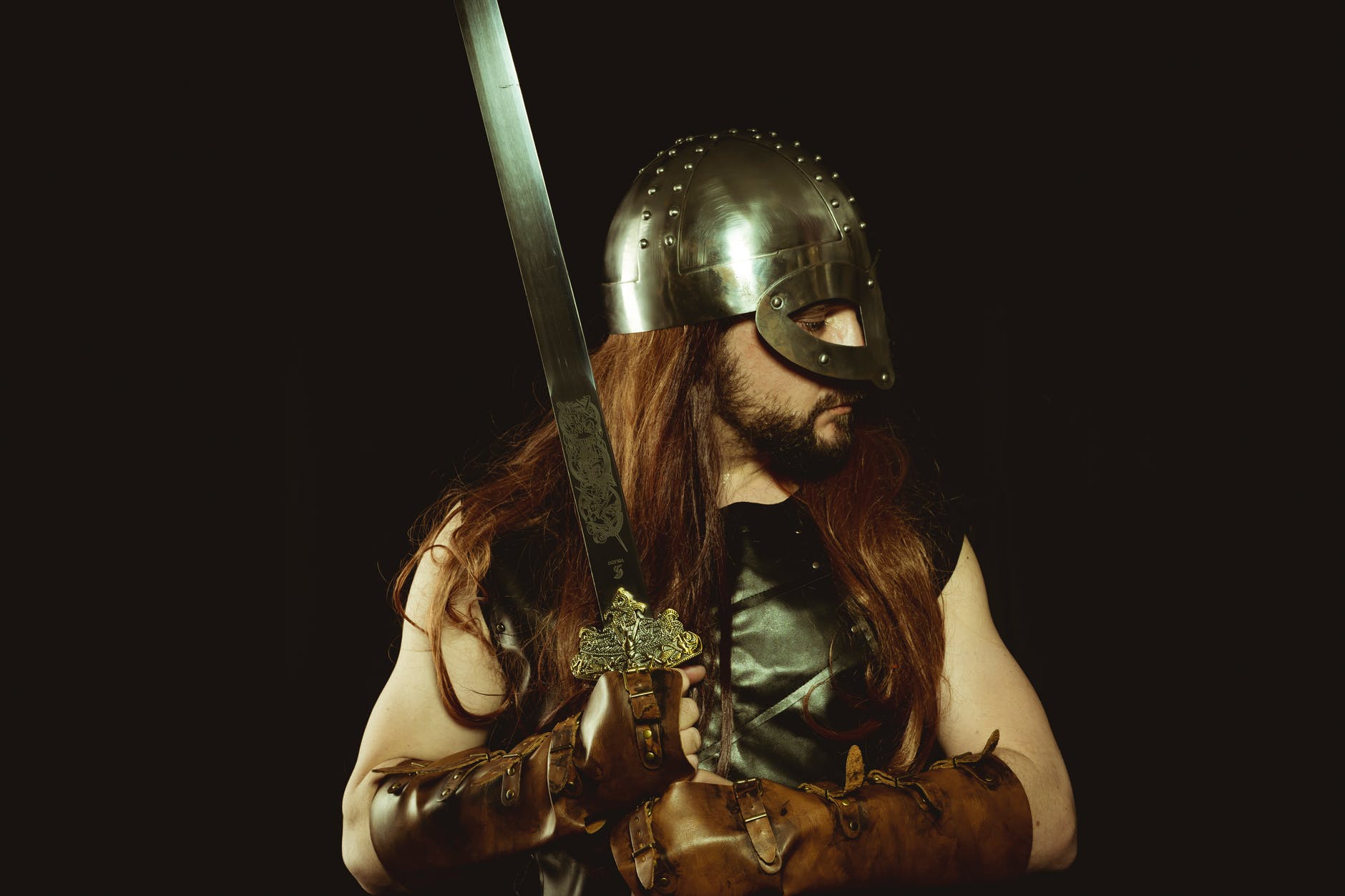
Modern interpretation of a Viking warrior: Photo by Fernando Cortu00e9s on Pexels.com
I remember having an interesting conversation with my martial arts mentor and teacher, Damon Smith, about what kept him interested in a martial arts over such a long period of time. He said that, for him, a marital art needed to contain weapons or he loses interest. While they might not be practical in the modern age, adding weapons to a martial art increases its difficulty level as well as its effectiveness hugely, providing a new physical and cognitive challenge in the process. And by ‘adding weapons’ I mean actually learning to fight with them, not just performing a solo form.
Of course, there is a long history of weapons usage in martial arts. In fact, many modern martial arts started off as weapons systems before transitioning into purely bare-hand arts in modern times. Weapons are found in almost all ‘traditional’ Chinese martial arts and consist of things like spears, nunchucks, swords, throwing darts and wooden staffs. European martial arts use quarterstaff, sword and buckler, amongst other things. The gladiators in the Colosseum in ancient Rome use swords, shields, tridents and nets.
But there’s one marital art that most people would consider a purely bare-hand grappling art, which I think should be more accurately categorised as a weapons system, and that’s Brazilian Jiujitsu, (or BJJ for short).
While most systems of Japanese Jujitsu train with traditional weapons you rarely see them shown in BJJ beyond basic defences to a few random knife or gun attacks, and we certainly don’t train to use things like swords or spears in defence or offense. However there is one weapon that we use all the time – the gi.
Jiujitsu was an import to Brazil from Japan, and adopted and taught by the famous Gracie family in Brazil in the early 20th century. It was originally practiced in the kimono, or “gi” as we call it today , and that is still how the majority of clubs train around the world, although the “no gi” or ‘spats and shorts’ version has been proving more popular in recent years.
The gi is a thick, and durable uniform that can stand up to tugging and wrenching without falling apart. It’s tied at the middle with a belt, which changes colour as you progress through the grades. For adults it goes from white to blue to purple to brown and finally black. There are belts after black, but most normal people don’t reach these.
The gi doesn’t look like it, but it is actually a weapon. Chokes can be performed in BJJ with almost any part of your body. The famous triangle choke, for instance, uses the legs to shut off the bloody supply to the head, causing unconsciousness, unless the person taps first. However, when you’re wearing the gi the number of chokes available increases massively. Chokes using the collar can be performed from almost any angle. You can also wrap the lapels of your gi, or their gi around the neck to create a choke.
Soft weapons, like the rope dart in Chinese martial arts, have long been respected in martial circles for their efficiency and the gi is no different. In the hands of a skilled exponent of the art, the gi becomes simply another weapon with which to attack. While some people might consider that ‘cheating’ and no use for ‘the street’, there are plenty of others who point out that most people wear clothes when they go outside their house (and usually in their houses too), so these skills are transferable to real life situations.
There are plenty of videos online showing how gi chokes can be done even on somebody wearing a t-shirt:
I’ve stuck with Jiuitsu for 11 years now myself. and I think a large part of the attraction is the gi and the huge number of possibilities it offers. And while I favour a basic collar and sleeve grip when playing guard myself, there are whole systems of BJJ guard playing dedicated to intricate lapel grips, popularised by famous practitioners like Keenan Cornelius, the most famous of which is his Worm Guard:
The gi offers the same level of cognitive challenge that using a weapon does in other martial arts. And while Brazilian JiuJitsu takes the use of the gi to new levels, I think the same could be said about other grappling arts that make use of clothing, like judo and Mongolgian wrestling. Modern judo has become all about the grip fighting, for instance, and a good grip on the opponent’s clothing can give you a real advantage in arts like Mongolian wrestling.
There are downsides to fighting with the gi of course. Firstly, the damage to your fingers is real, especially as you get older. Too much gripping of the gi really takes it out of your fingers, especially once your grip gets twisted and your opponent is trying hard to break it.
The gi game tends to be a little bit slower-paced as well, since just having one grip somewhere on somebody can stop an attack completely. But while some people find that frustrating, to me it’s just another problem to solve, and more brain-tingling fun to keep training the mind as hard as the body.







 The Tai Chi Notebook