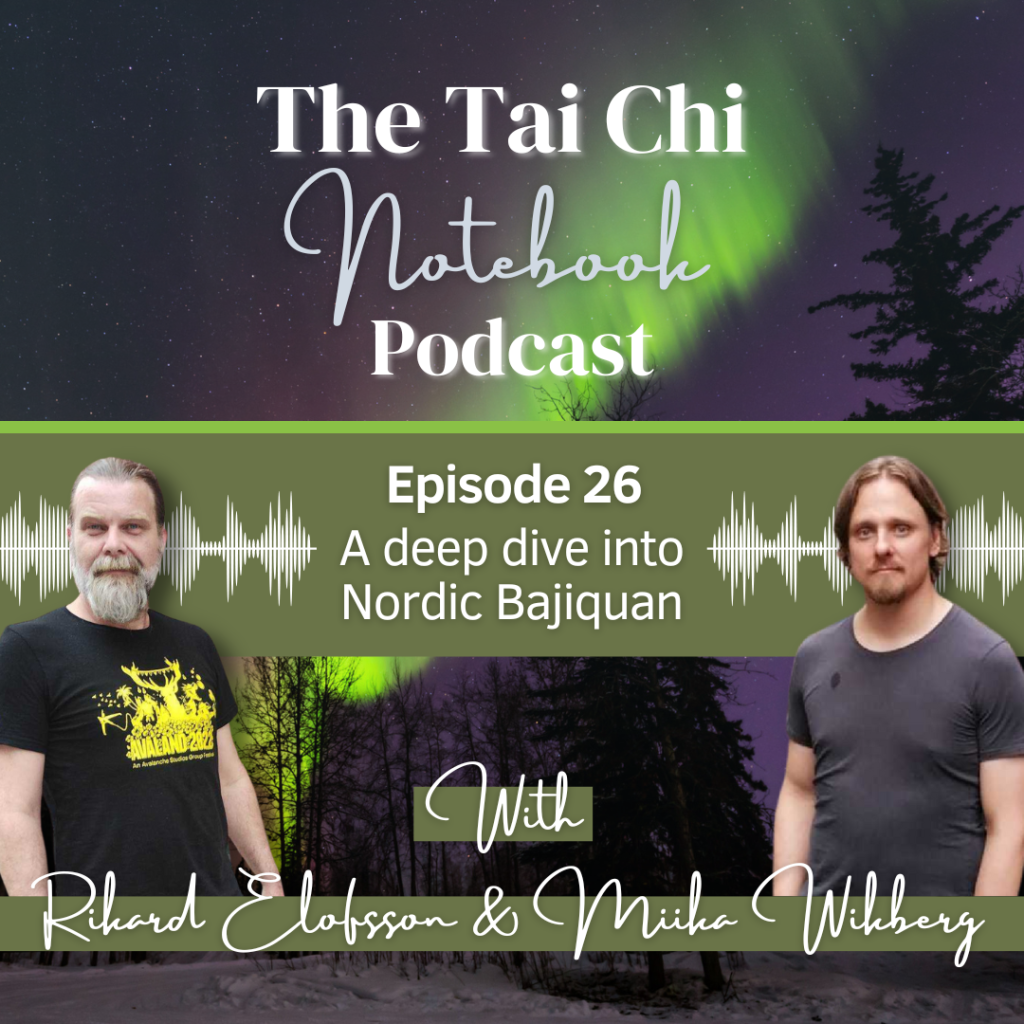
I’ve recorded a follow-up to my recent podcast with Rikard and Miika about Baji, this time with my Heretics podcast co-host Damon Smith, who is also a Baji practitioner. Listen to the new episode here. There’s a lot of talk about technique here, and how it compares to Xing Yi.
Here’s the blurb:
“This episode follows on from Episode 26 of Graham’s Tai Chi Notebook Podcast in which he interviews Woven Energy patrons Rikard Elofsson and Miika Wikberg about the little-known martial art of Baji. We discuss the possibility that the Baji Xiaojia is the most perfectly balanced form from any martial art – “Xiaojia is more Tai Chi than Tai Chi”, and look in a bit more detail at the history, technique, strategy and background to this subtle and robust martial arts style.
Graham, Miika and Rikard’s original episode can be found here: “
So, Mike Sigman raised an interesting point in his comments on my last post on silk reeling – “Silkreeling is about developing the elastic connections of the body.”
I agree with him. That’s probably not all silk reeling is about, but that’s the fundamental idea. But I wonder how many people who teach silk reeling or Tai Chi actually agree? I mean, there are so many style and different ways of doing Tai Chi these days that’s it’s almost like it’s become a terms for a grab bag of different skills all meshed together.
But perhaps we just need to establish a baseline. I’m interested to hear what you would call the point of silk reeling? How does that statement sit with you?
I read something interesting in this interview with Chen Xiaowang, originally published in the October 1996 (vol 20 no. 5) issue of T’ai Chi Magazine.
He’s talking about silk reeling and he says:
Chen commented that many people practice the Chen style in an overly exaggerated fashion making very big movements. He said these kinds of excessively large movements lead to a separation of one part of the body from other parts of the body and is incorrect. A common mistake, he said, especially among those who do the Xin-jia or new frame is to do movements in an exaggerated manner and make a lot of small circles and loops. “That shows that they don’t understand the principles of chan si jing.”
Tai Chi Magazine
I’m not sure what to think about that. It’s pretty well understood in Chinese martial arts that you often practice big and use small. The best way to practice a movement is to start with it in a large, exaggerated way, but then over time you do it in a more refined way and it becomes smaller.
A quote from my teacher I’ve always remembered is:
“In the beginning my circles encompass the whole universe but at the end I roll them up and put them in my sleeves.”
However I think perhaps Chen is not talking about this. I’ve seen a lot of people who do Tai Chi (and particularly Chen style) in a very bendy, rubbery, gyrating way. I think he’s saying that too much of that can often lead people onto the wrong track. And more specifically, he’s saying that if they’re doing this then it’s because they don’t understand the basics of silk reeling.
Now silk reeling is quite a Chen style-specific practice. I don’t think you even need to do it to practice Yang or Wu style, but if you are doing it, I bet it’s very easy to get sidetracked into doing lots of small loops and circles. But really the process should be about being minimalist. Cutting out the inessentials until the movement is pure and simple, while still being effective.
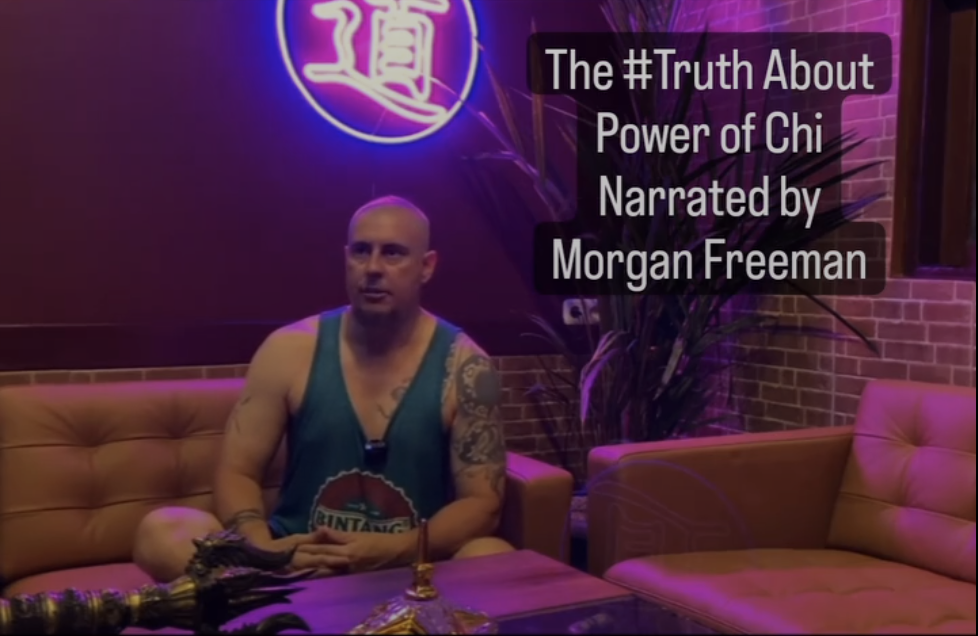
Notable Tai Chi teacher, Damo Mitchell, just released a new video with Adam Mizner where he addresses some of the controversy over The Power of Chi documentary that is worth watching, if you care about these sorts of things.
Damo Mitchell and Adam Mizner are a couple of the most well-known modern Tai Chi teachers on the seminar circuit, both of whom have a lot of followers on social media, and large organisations of students behind them. The Power of Chi was a movie where Adam Mziner demonstrated his chi/qi on a number of athletes from various sports. The movie has since mysteriously disappeared from the Internet, as far as I can tell, but the trailer is still on YouTube:
You can see from the start of the clip where Damo’s thinking is at (around the 4 minute mark) – the reason people criticise the movie, or himself and Adam, is because they are jealousof how well he and Adam are doing and that the people who criticise them have less followers so are below them and it’s therefore wrong to “punch down” by replying to them. These low level people also “are not in a good space mentally”’. His other point is that the movie was not made by Adam, he was just a paid performer in it, therefore everybody’s criticism is misplaced.
Well, talk about missing the point entirely!
At no point does he address the central issue I and many others had with the movie – that all this “chi” stuff is nothing to do with chi/qi!
Now, I’m not egotistical enough to think that Damo is addressing this video specifically to me, but my original post about the documentary is still there for everybody to read. As you can see, I said I thought the whole thing was a bit silly. That’s about the worst of it!
You can decide for yourself if that means I am racked with jealousy about how many students Adam and Damo have, and how great their lives are… I really am not even playing in the same league as Adam and Damo – they are professional Tai Chi teachers making a living off this, I’m not. I have a real job, and just run this blog in my spare time for fun. It’s the same with my podcast. But that doesn’t mean I’m not serious about my practice.
The other thing I did in my original post was link to my friend Rob Poyton’s video response to the trailer showing how all the supposed Chi feats in the trailer were really done – which I thought was quite cool, but seems to have really put the cat amongst the pigeons. I mean part of the attraction of seeing a stage magician is working out how the magic is really done, right?
Rob Poyton explaining how to do the feats seen in The Power of Chi movie.
Now that video by Rob seemed to raise the ire of many of Adam’s followers (who posted in the comments section of my blog, which are still there and you can read) who replied with such gems as this:
“I’m disappointed in your entire take on internal power, as indicated by your dismissive way of talking about those who actually do possess some genuine internal power as using “tricks”. To be blunt, you’re just ignorant–that is, you have no personal experience with real practitioners and assume everyone showing such power must be a charlatan. “
“Why do you have a website about Taiji (that’s the correct pinyin spelling btw) when you’ve never met any of the top taiji practitioners – and refuse to meet them before publishing negative theories about the limits of the art? So the best explanation to you is that the top practitioners in the world who have trained thousands of students are merely liars with fake reviews from professional athletes and professional teachers?”
“So you did not see the move, or met anyone in the movie to experience this skill/ attribute first hand. Kind of strange to have such strong opinions on something you have no experience in….”
You can see from the comments that the followers of Adam and Damo really do believe that the feats presented in the movie, The Power of Chi, are real demonstrations of chi power, (or Qi power.) Again, that’s my issue with all this stuff, not that they’re making a good living off teaching Tai Chi.
As a complete co-incidence Rob just released another clip in the last few days, this time about the subject of Empty Force, that’s also worth a watch, and will undoubtedly upset all these same people all over again, for exactly the same reasons:
There’s a long history of the Tai Chi magician. Empty Force is something that the Tai Chi Magicians of the world engage in regularly, and once again, I think it’s cool that Rob is posting a video showing how it works.
As for Damo and Adam, I hope they keep enjoying their cocktails and cigars – they seem to be having a great time, hidden away in all that smoke, being Tai Chi Gurus. I’m not jealous that we have very different lives at all. I wouldn’t trade mine for anything. Spending a month on a retreat in Thailand training Tai Chi full time, (let alone a year!), sounds like absolute hell to me. I’m sure it would send me potty! I’d rather be with my family, friends and pets, thanks.
It looks like Adam and Damo have some real skills in Tai Chi push hands – I’m not doubting that. After all, they’ve had years training full time to get good at this stuff, so they better have something by now. But as with everything in the internal arts – it pays to keep your feet firmly on the ground.
For me the latest video from Damo and Adam is just another fascinating glimpse into how the mind of a Tai Chi Guru works.
I’ve just finished listening to an interesting podcast where Dr. Rangan Chatterjee talks about about how to form daily habits in a way that actually works. The takeaway is that you need to make the habit as easy as possible and also tack it onto something you already do every day if you want it to stick. Dr Chatterjee makes the good point that we don’t have to force ourselves to brush our teeth in the morning and at night – we just do it. We don’t decide, oh, I’m a bit tired tonight or I’ve got a lot of work on, so I’ll just skip it for a couple of days. No, we just do it, and it’s easy.
Doing Tai Chi could be as easy as brushing your teeth. Photo by Andrea Piacquadio on Pexels.com
Forming a regular practice Tai Chi habit however can be hard. It’s very easy to convince yourself to not practice because you’re tired or just not feeling like it.
Tai Chi, Qigong or stretching is also a bit like brushing your teeth, because you don’t get much benefit from not brushing your teeth for a week, and then doing a massive 1 hour deep clean on a Sunday. No, brushing your teeth needs to be done a little every day if it’s going to work, and so does Tai Chi, Qigong and stretching.
Which brings us to the question of how we actually develop a strong practice habit like this for Tai Chi, and that takes me back to Dr. Rangan Chatterjee. Most of us make a pot of coffee, or cup of tea in the morning. It’s a ritual we’re already doing and nobody needs to force us to start doing. (If you don’t do this, I bet there is something similar you do in the morning?) What we need to do is start hacking that existing habit with the new habit we want to instill, in this case Tai Chi, stretching, standing, meditation, or whatever it is.
It’s all about maximising those moments of dead time. Photo by Rachel Claire on Pexels.com
While your coffee is brewing, stop looking at your phone and spend those minutes doing the thing you want to do. One thing I’ve started to do is pour the water on my tea bag, then do a stretching routine while it is brewing. This way I don’t need to rely on motivation to do the routine each morning, because motivation is great when it’s high, but a rubbish thing to rely on when you are feeling tired, rushed or grumpy.
Even a few minutes of whatever it is will make a difference. I already feel like I’m more flexible in my hips because of these few minutes. And doing those few minutes might make me feel like doing more immediately afterwards. Other ideas for things to do while the coffee is brewing would be some single arm silk reeling circles, some standing Qigong, or repeat small sections of the form, like Grasp Birds Tail. The choice is yours. Try it!
N.B. This does NOT look like a very well applied choke at all, but it’s the only free photo I could find! (Photo by Kampus Production on Pexels.com)
Disclaimer: Please only take medical advice from a qualified doctor. I am not a qualified doctor!
One of the things I find quite astonishing amongst ‘martial artists’ is the generally low level of understanding of the theory of choking people.
Choking is the process of stopping or reducing blood flow to the brain until the person loses consciousness (cerebral hypoxia). It usually requires a bit of squeezing force, but can be effortless and painless if applied with high levels of accuracy, and the person will just go to sleep. It’s one of the most powerful techniques in the self defence arsenal, since chokes generally work on everyone. It doesn’t’ matter if you’re big, small, strong, super strong or even Herculean, everybody goes to sleep. In Judo and BJJ done in a Gi, chokes are often done with a collar and are commonly taught.
Chokes have nothing to do with airflow. Again, I just did a quick google search and the amount of seemingly legitimate websites talking about ‘restricting airflow’ and ‘windpipe’ is insane. There is a lot of bad information out there. Chokes are about restricting the blood flow in the two jugular veins and cartoid arteries on either side of the windpipe. For a detailed analysis of what happens, check here. Being aware of exactly where you should be applying pressure when choking somebody will increase the effectiveness of your chokes massively.
Rendering somebody unconscious by stopping their airflow is also possible, and called smothering in BJJ. Smothering is usually a pretty nasty, violent thing to have done to you. Look up the Mothers Milk submission if you are curious! And a choke that involves crushing/compressing your windpipe to make it happen could also have dire consequences. Similarly, pressure on the chest can also stop you breathing and lead to unconsciousness. That’s particularly unpleasant, too.
But a good old fashioned blood choke is the safest method of rendering somebody who is aggressive instantly harmless. Quite often when they wake up the fight has gone out of them.
Chokes can be trained and practiced safely but become incredibly dangerous in the hands of the inexperienced, as we have tragically seen in many police killings of people already restrained, so only practice them under expert guidance. And if the person has gone unconscious – LET GO! Very often it is hard to tell, so check on them, get verbal feedback, don’t just keep squeezing!
In training, the idea is that before you go unconscious you can feel the effects (a build up of pressure in the head, the world going black around the edges, etc) and tap before it happens, so that the person lets go.
If you are training with somebody that didn’t tap in time and went unconscious then don’t do the commonly seen thing of raising their legs to ‘get the blood flow back to the brain’ – you’re much better off putting them in the recovery position and waiting for them to wake up, which should happen fairly quickly. If they don’t seem ok in anyway, especially if their speech is slurred, call an ambulance.
Nothing in martial arts is ever risk free and there is some evidence of poorly applied chokes, or people struggling too hard to get out of them, causing damage to blood vessels, leading to blood clots, leading to (in rare cases) risk of stroke.
My advice is always tap early and tap often, especially if you feel like you’re going to sleep.
Understanding choke theory is important for all martial artists. If you feel like you need a primer on choke theory, then I’d recommend this new video by Chris Paines. See below.
Martial Art Essays from Beijing, 1760, presents 64 essays written by Yang Mingbin, a painter in the Royal court of the Ching dynasty. Or does it? As well as being a painter, Yang was also a martial artist and the papers are his thoughts on his martial practice, except that Yang Mingbin never actually existed, and the work is entirely a fictional piece of writing by the modern author, Michael A. DeMarco. DeMarco is a Tai Chi practitioner who used to publish the peer-reviewed quarterly Journal of Asian Martial Arts.
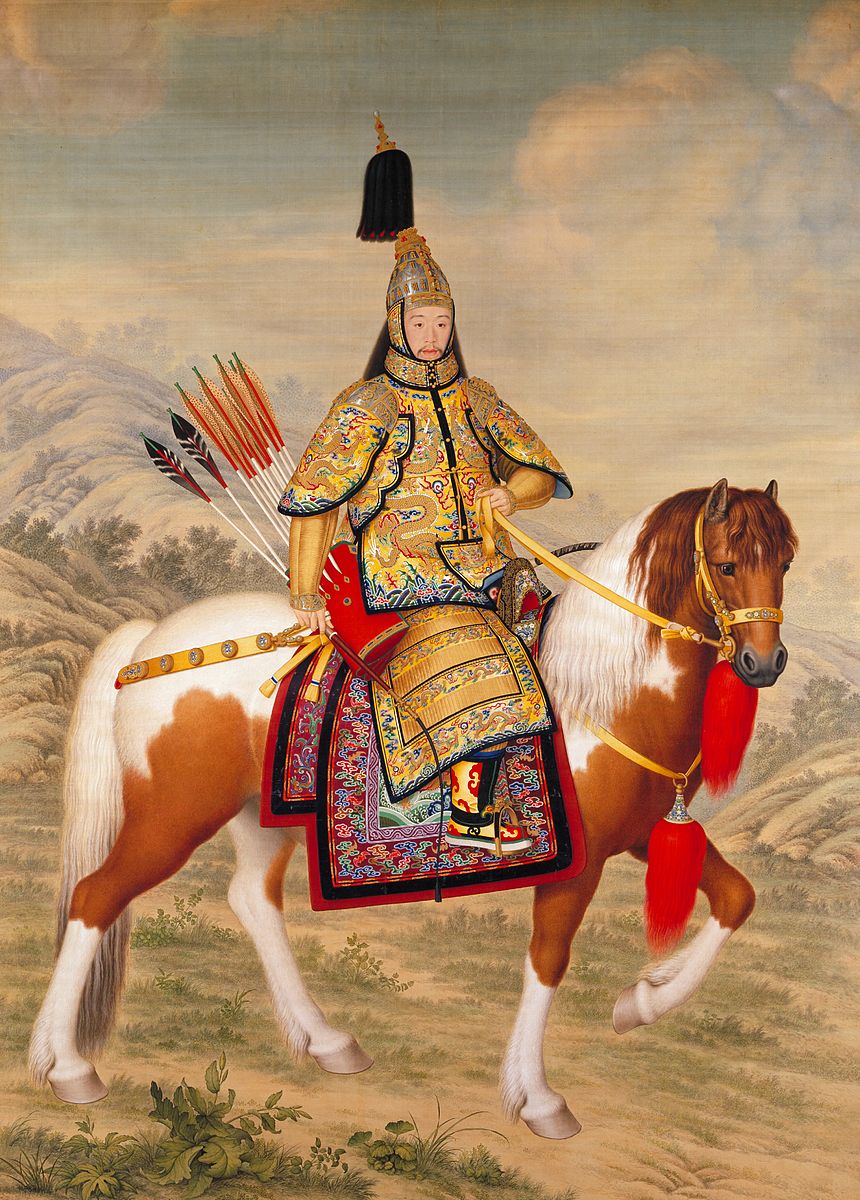
Yang Mingbin’s place in history is well researched, and surrounded by genuine historical figures such as Giuseppe Castiglione (1688-1766), a real Jesuit priest who was a painter in the Royal court in Beijing, and was responsible for influencing the Chinese style of painting of the era with western Renaissance ideas. You’ve likely seen some of his paintings before, such as the famous one of the Emperor Qianlong in ceremonial armour.
The Qianlong Emperor in Ceremonial Armour on HorsebackGiuseppe Castiglione (1688–1766)
So, the conceit here, then, is that you’re being asked to imagine what it would have been like if Giuseppe had had a friend in the court – another painter – who was also a martial artist, and what would happen if we had recently found a copy of his notes on martial arts. It’s a thought experiment, that the author begs your indulgence in as you read along.
Initially it works, because the historical setting feels authentic, but once we get into the actual meat of the book (Minben’s 64 martial arts essays), we find that Yang Minben writes exactly like a 21st century American who practices Tai Chi would write, rather than like somebody actually living in 1760 in China would!
Actual martial arts writings from that period in history tend to be functional, pithy and less verbose. Worse, Mingben’s text often uses modern conventions, for example, (p63),
“Dive into a swift flowing river and swim against the current. Keep swimming, but gradually change the direction – 0 to 45 degrees, to 90 to 135, then to 180 – finally swimming directly with the current.”
Would a Chinese person writing in 1760 have described this using degrees?
And things get very odd when, on p97, Minben writes, “between 1775 and 1779, Qing troops stabalized the northern and western boundary of Xingjang province, harshly squelching the rebellion in the area occupied by the Mongolic Zunghar tribe.”
How is Minben writing about events that happened in 1779 when the current date is supposed to be 1760?
That’s not to say there aren’t interesting things to learn here. I enjoyed the discussion of the Neo-Confucian scholar Zhu Xi and the concept of Li, the calligraphy analogies and the references to Lao Tze and Chuang Tzu. But if the author wants us to enter into his historical conceit, then I think it helps if the writing is consistent with the time period. I would have also liked to have heard more accounts of what Beijing was like in 1760. That would have helped build the illusion – city life, how business was done, what the pervading political climate was like, what the fashions were, what the gossip was – what was happening in Royal Court?
You could argue that since all of this is imaginary anyway, perhaps we do not need to make a big deal out of it? DeMarco’s writings are a collection of modern philosophical musings designed to be easily read and understood by the modern Tai Chi crowd and that draw in frequent references to the Daodejing and analogies with calligraphy and painting. I quite enjoyed them, but if you are looking for something that reads like the real classic writings on martial arts, you’ll be disappointed. However, if you’re after something a little easier to read and that inspires you to practice Tai Chi more, then you’ll find it here.
Bājíquán (八極拳) or shorter just Baji, is commonly known as “the martial art of bodyguards”. It emphasises the use of attacks that close down the distance as well as explosive close combat techniques such as combinations of elbow, knee and takedown techniques.
Both Rikard Elofsson and Miika Wikberg are senior Baji students of Lü Baochun, based in Finland who has over 40 years’ experience in the training and practice of baji. He has trained under many of the famous martial artists who used the style, such as Han Longquan and Zhang Xuchun.
Timestsamps:
0.40: – Rikard – Introduce yourself/how did you meet your teacher Master Lü Baochun?
3.15: – Miika – Introduce yourself/how did you meet your teacher Master Lü Baochun?
7.15: What makes Baji different to other martial arts?
8.30: Old Baji and new Baji
9.20: Trademark techniques of Baji
10.15: How is Baji power different? Training methods and the 3 stepping methods –
The jin should be rooted in the feet, generated from the legs, controlled by the waist, and expressed through the fingers.
This does present something of a dilemma – how can we both be rooted in the feet but also controlled by the waist, let alone also generated by the legs?
In the Treatise on Tai Chi Chuan, the classic says “Sink the chi to the dantien.”
This sinking is related to the pulling in action of the muscle tendon channels that are usually associated with the contraction (closing) phase of opening and closing – usually while breathing in. The breath sinks to the dantien area, and combined with correct mental focus, this should make the dantien area feel full as you breathe in.
This pressurised feeling in the dantien is also the pressurised feeling at soul of the foot. You could think of it as squeezing the pressure from the dantien down to the foot, but you really don’t need to do that, as it should be instantaneous, since they are the same thing.
With the exhale, the pressure pushes up, through the legs, up the back and out to the extremities including the head. It’s a continual cycle of store and release.
You could call this the internal side of Tai Chi, but really, it’s just the way Tai Chi works, rather than a particular side of it.




 The Tai Chi Notebook