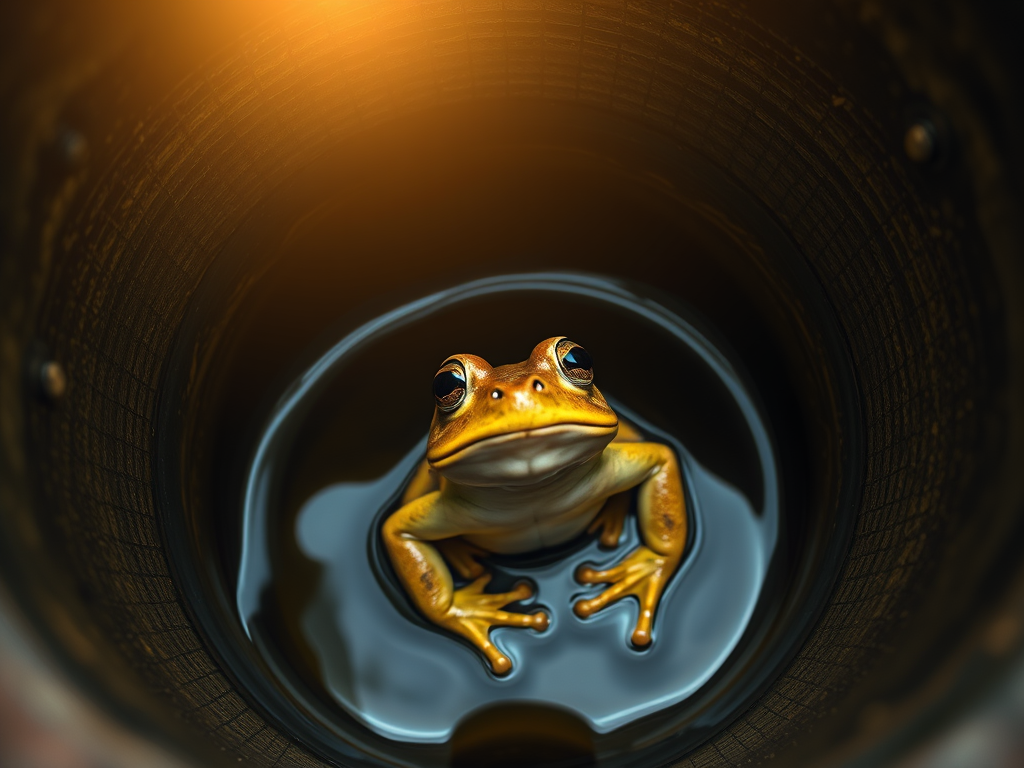
A frog in a well, looking up at the sky
Something I read today was, “training material in my personal practice only includes the methods which have always consistently produced observable benefits and skills. Anything which hasn’t done so in a trial period of regular practice is eliminated and abandoned. I don’t have time for anything which doesn’t give a good return on the investment of time and effort to practice.”
That’s an interesting point of view, and seems logical and rational. It seems very in-line with modern efficiency-based exercise or martial arts thinking. I just don’t think it’s a realistic approach to studying the internal arts or qigong in any depth.
I remember talking to Simon Cox who trained for years at Wudang mountain in one of my podcasts and (I’m going by my failing memory here) he said something like his teacher asking them to do meditation for a few years, with barely minimal instructions, then just leaving them to it. Forget “a good return on investment”, you were just expected to do it, without any hope of a result.
I’ve often heard people say things like, “A year is not a long time in qigong practice”.
And from my own experience, I can say with confidence that you do need to practice without “observable benefits and skills” for a long, long time.
Most people simply stop, and therefore never get anywhere. They stay scratching the surface, thinking that they are deep into their practice.
Once again, I’m reminded about Zhuāng Zǐ’s Frog in a Well story.
But what do you think? Let me know in the comments below.


Though just a reference, I thought the Frog in the Well story was a great example of traditional teaching versus modern methods.
The story, though deeply rooted in Daoism, later became a classic Neo-Confucian test of character. The Great Turtle from the Eastern Sea sees far and knows much, while the frog’s perspective is necessarily limited. A student’s response can reveal hubris, respect for authority, openness to learning, and discernment.
Hubris appears when a student imagines themselves as the Great Turtle, looking down on others as mere frogs with narrow vision. Yet the real danger may lie in mistaking our own well for the whole world—each of us a frog, seeing only a fragment of what exists beyond, yet thinking our perspective encompasses it all.
From a Daoist perspective, there is also a subtler lesson: the frog’s happiness in its own well. The frog is content and harmonious in its environment, and the Great Turtle’s intrusion may be unnecessary—or even disruptive.
From a more modern perspective, the story can serve as a lesson in patience and gradual learning: just as the frog may eventually encounter the sea, students must develop understanding over time.
There is no right or wrong answer. Traditional teachers would often tell this story not simply to convey a moral, but as a means of observing students—assessing their thought processes, humility, and capacity for discernment.
LikeLiked by 1 person
This blog opens a big can of worms. Yes, the internal arts—and traditional teaching in general—often require a kind of unquestioning obedience to the teacher. For modern students, it can be difficult to encounter a system rooted in Confucian education and cultural traditions, where such demands are built in. Over time, that dynamic depends on, and fosters, a bond of trust between both parties.
I don’t blame some students for resorting to the return-on-investment model, but it can easily close off some of the richest opportunities. As the traditional Chinese saying goes, a teacher doesn’t truly know a student’s character for three years. What a teacher does during those three years is often frustrating to students. This illustrates the heart of the conflict: what feels like wasted time to modern students may in fact be an essential part of the traditional process.
At the same time, such a system easily opens the door to abuse, particularly when a teacher doesn’t actually possess the skills they claim. Fear of charlatans has been a major concern for students since teaching became public, and with good reason.
Even with a genuinely skilled teacher, problems can arise. A teacher may decide that a particular student is unworthy. This in itself wouldn’t necessarily be a problem—if it were openly communicated. But with traditional teachers, it rarely is. More often, unwanted students are simply ignored and left without substantive instruction until they give up, though some never catch on.
On the other end of the spectrum, many teachers deliberately string students along, keeping their classes full and their coffers replenished, while reserving real instruction for only a handful of chosen disciples. It’s a classic business model: feed most students empty lessons to support the training of a select few. In these cases, the result is similar: students may devote years of effort without receiving genuine instruction—whether through deception, neglect, or deliberate exploitation.
That leaves those of us seeking legitimate internal arts training with a difficult question: how to balance patience, persistence, and trust in the process with the discernment needed to avoid wasting years on empty promises. In the end, progress in these traditions often comes more slowly, and in more elusive ways, than modern expectations are prepared to accept.
LikeLike