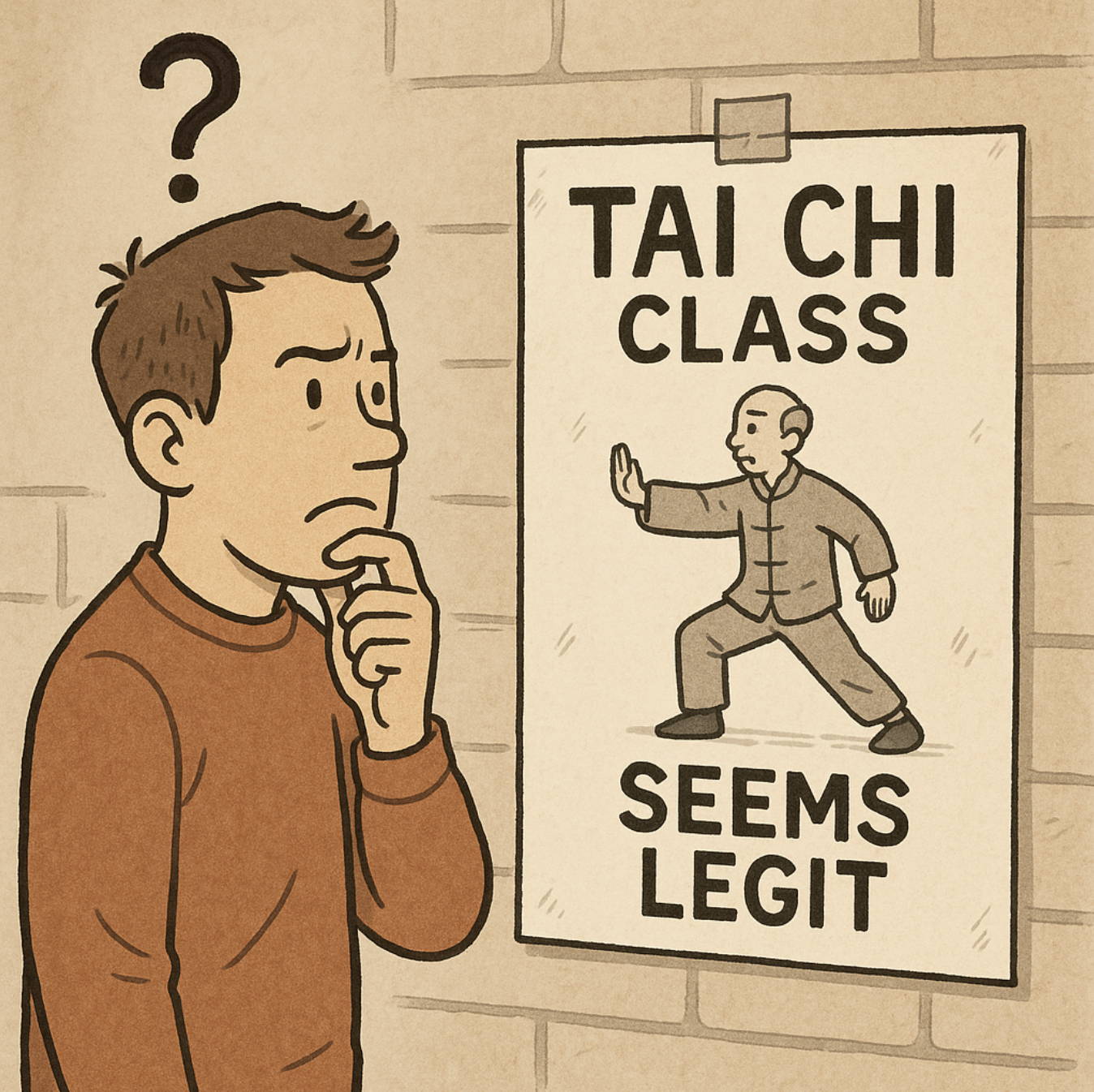
I just saw an advert for a week long “Tai Chi for beginners” intensive with the teacher in question demonstrating a tai chi posture with the head thrust forward, so the chin juts out, the hips and pelvis thrust forward so it looks like he’s doing a bad Elvis impression, the arms awkwardly twisted so the shoulders lock up and the souls of the feet rolling to the sides and coming off the floor, so the ankle joint is not stable.
And yes, he was calling himself “Master”.
I think “buyer beware” is good advice in the tai chi market.
One thing I’ve observed in so many tai chi teachers is this desire to be the teacher way before they are ready. People don’t want to be the student – that’s boring! – they want the glory of leading something, of creating something, of being the person at the front of the class sharing their vast wisdom with their adoring students…
Why is this? I think it’s just ego. I’ve definitely felt it’s twinges in me. It’s a subtle trap that you need to avoid. And one I try actively to avoid all the time when I teach.
It is undoubtedly a nice feeling when people ask you for advice, and look up to you. However, I think it’s nearly always a mistake to want to be that person. People are rarely ever ready to teach tai chi when they start. You could say it’s the curse of tai chi in the western world. That’s why we have people called “master somebody” who can’t do basic tai chi postures or understand tai chi movement leading week-long intensives.
But what do we do about this? After all, somebody has to teach something or there would be no tai chi for anyone!
Perhaps some guidelines if you are teaching:
1. Think of yourself as a coach, or a guide, not ‘a teacher ‘master’. After all, people need to do the work themselves, you can’t do it for them.
2. Don’t let people start to treat you like some guru or master – if they do instantly stop that behaviour developing. You’ll be surprised, a lot of people want a guru to take away all their self responsibility.
3. Self reflect. Are you constantly talking about things you can’t actually do? If so, just stop. There’s never any need for that.
4. The most important thing: Be honest. Tell people what you know, how long you’ve been training, where you got it from. Don’t make yourself into something you’re not in other people’s eyes.
5. Finally, you also need a teacher. Find people you can learn from and don’t stop learning.
 The Tai Chi Notebook
Excellent comment – thanks Richard. There are a number of examples of Greg teaching using his ecological method – e.g. https://www.youtube.com/watch?v=Fa3wJqs4L-I
LikeLike
Caveat emptor! is always great advice.
Your suggestion to “Think of yourself as a coach or guide, not a ‘teacher’ or ‘master’” brings things full circle for me. Your January 25, 2025 blog post on the Ecological Approach, where the environment, not the instructor, becomes the teacher, opened a new direction for me—one grounded in intuitive, experiential learning. It’s reshaped how I think about both teaching and training.
In my experience, taijiquan points toward the body’s biomechanical and postural ideal. If we take that seriously, our role isn’t to impose our version of it—but to create conditions where learners can explore, refine, and discover it within themselves.
That starts with helping people shed patterns that are inefficient, ineffective, or even injury-inducing. Sometimes, just helping someone feel what it’s like to move a joint without tension in the body’s natural way can create a turning point. From there, everything begins to shift. We’re not rewriting their past—we’re supporting what comes next.
And yes—language matters. Calling ourselves guides, coaches, or facilitators isn’t just more accurate; it repositions the learning relationship. It shifts things from authority to discovery, from control to support—and it keeps us honest about our own learning, too.
Looking back, the people who helped me most never needed to be called “master.” They were able to show skill—but more importantly, they helped me recognize it, and cultivate it in myself. That’s what I look for in great guides.
LikeLiked by 1 person