I had an interesting comment on my last post that made me think about the whole idea of making up your own forms (or Tao Lu) – in Tai Chi, Xing Yi, or whatever.
I’ve tried to do this over the course of several years and I’ve come to a few conclusions about it, which I’ll elaborate on here. Firstly, it’s hard. Making up new forms is not as easy as you think. But secondly, it depends what martial art you are making up a form in.
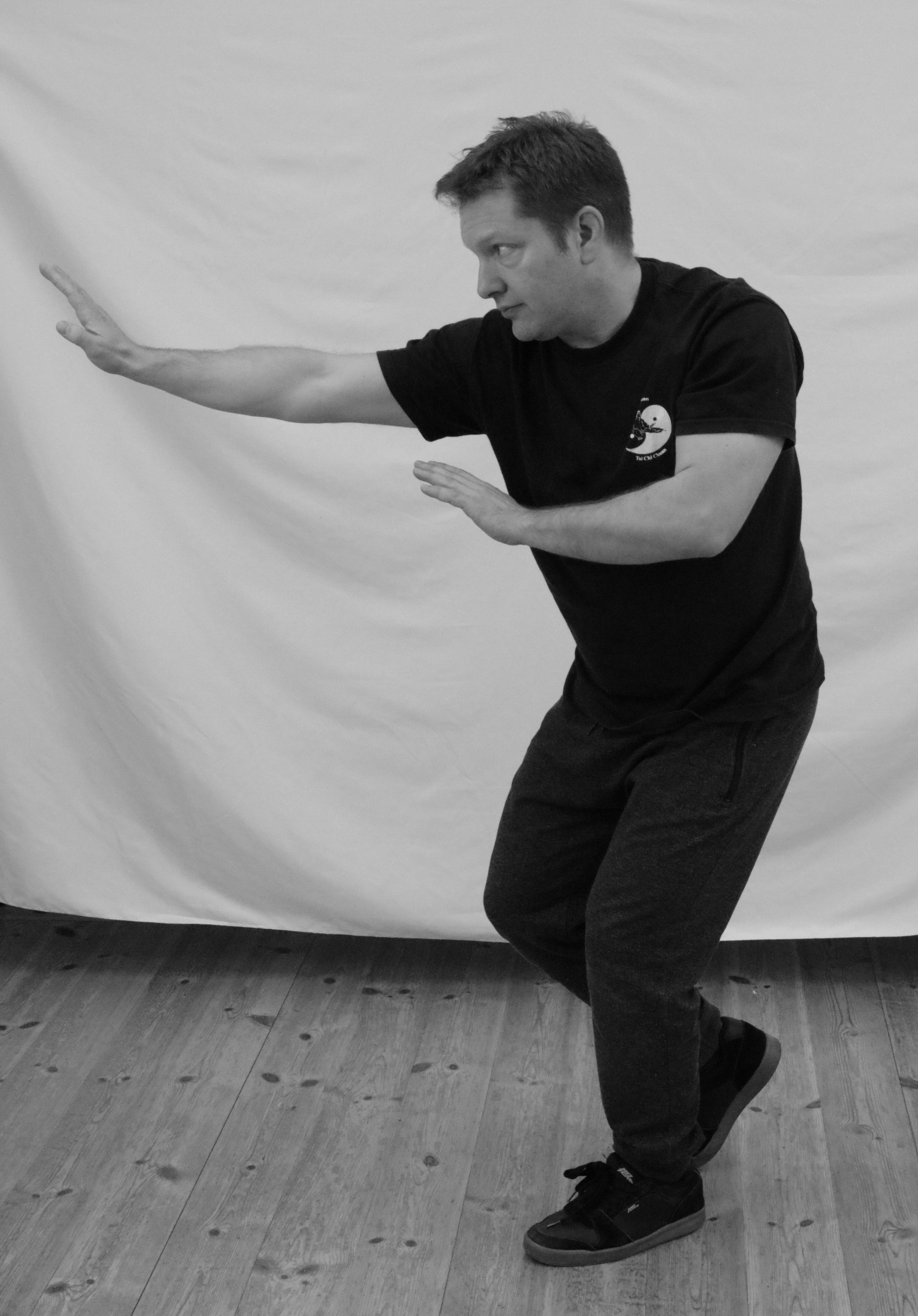
If your martial art has forms that are constructed like lego bricks that can be slotted together in any order and still seem to work then it’s pretty simple to concoct a new form. Xing Yi is a good example of a martial art that has this quality. I was always told never to call Xing Yi tao lu by the English name “forms” because the correct term was lian huan which means “linking sequence” for this very reason.
The idea, (in our Xing Yi at any rate), is that all the links you learn are just examples, and you need to be constantly moving towards being able to spontaneously vary them as required, and then ultimately spontaneously create them. This idea has become heretical in the modern Xing Yi world to a large extent because modern Xing Yi has lost a lot of this spontaneous feel it used to (I admit that’s a subjective point) have, and things have become set in stone – forms that were once supposed to be fluid and flexible have become fixed and rigid. Forms of famous masters from the past now tend to be fixed forever. When words like “orthodox” start appearing to describe something you know it’s already dead, or on the way to dying.
But of course, anybody can make up a form, but is it any good? That’s a different matter. And it usually depends on the person doing it, not the moves themselves. With Xing Yi animals you can also ask the question – can I see the character of the animal being used coming out through the moves?
With Tai Chi I find it a lot harder to make up a form. Tai Chi’s approach to a form is quite different to Xing Yi, or other Kung Fu styles. The Tai Chi form tends to be a highly crafted piece of work that has been honed to perfection over many years. It is fixed because you need to be able to forget about the moves and concentrate more on what’s inside. It helps to do that if you don’t have to worry about what’s coming next because you’ve done it so many times that you can let go of that part of your brain and let it be aware of other things.
Tai Chi forms tend to start and finish in the same place for this reason. Usually, anyway. While long forms don’t tend to be balanced on left and right, a lot of the more modern, shorter forms make more of an effort to balance left and right movements.
If you understand Tai Chi and how to ‘pull’ or direct the limbs from the dantien movement then, sure you can make up your own Tai Chi forms, however, there is almost zero history of doing this in Tai Chi circles and it’s not really encouraged. I think this is because Tai Chi has push hands, which can be used as a kind of free-form expression of Tai Chi, completely away from the form and in contact with a partner to give you something to respond to, which is the whole strategy of Tai Chi Chuan, at least according to the Tai Chi Classics it is. To ‘give up yourself and follow the other’ you have to be spontaneous. There’s no other choice!
So, to conclude. I think that’s it’s in its application where the spirit of improvisation and spontaneity can be found in Tai Chi, not in the forms. I don’t think Tai Chi is particularly concerned with creating endless variations of forms and patterns like Xing Yi is, at all. Xing Yi, having a weapons starting point, doesn’t use this hands-on feeling and sensitivity to get started with spontaneity. Instead, it likes to create patterns, then vary them endlessly. Of course, you work with a partner when required, but it’s a different approach. Which is all quite natural, as these are two different martial arts, created by entirely different groups of people in a different locations and time periods.
You might like our Heretics history of Tai Chi and Xing Yi for more on that.


As usual, you have a valid point. What constitutes traditional versus a modern teaching paradigm? I had specific things in mind, though others might feel they need to modify this list. I’ll describe them, but for brevity, I’ll support with evidence or examples only upon request.
First, modern taiji usually teaches a form(s), often in a group setting. “Applications” and push hands get mixed in variously depending on the teacher. Weapons might include a jian or dao form, maybe some long pole. This is not the traditional method.
Traditionally, students were taught one-on-one. Each element of a movement was taught individually with basic usage to test correctness. Individual movements were then linked into “postures” and those into sequences to teach other principles. Then, sequences formed sections, which were linked together to create what, today, we call a form.
There were animals sequences in taijiquan too. Snake, crane or goose, blue-green dragon, gibbon, tiger, and so on. However, Chen Taijiquan observed and captured the quintessence of each animal, so they are more abstractions than imitations, for example, the coiling-rolling of a snake, claws/paws leading out for a tiger, and so on. These also were taught mostly cumulatively, as appropriate, and became an overall movement method for the entire system.
Only when students could successfully perform all the skills taught in this first phase on a partner was formal push hands started. While pushing hands, the student was expected to use only skills learned from the form(s), although not necessarily longer sequences. Rather than strictly learning spontaneity, I would describe this training as learning to respond appropriately in a taiji manner. This completed the first phase of training.
In the second phase, although first-phase skills were retained, the training method was changed from push hands in preparation for fighting training. There was two-person fight training, but, generally, there was no sport fighting, per se. There was little difference between martial art training and the military training of the day, until about 1900.
Weapons became the apex of training, though empty-hand training was still vital. Weapons training started with practical usage training, which built forms. Weapon movements were familiar from sections in the “quan” forms that applied to spear, staff (long pole), jian, dao, yanyuedao (偃月刀), or others. This system prepared part of the family for the bodyguard/escort business and many others distinguished themselves in battle.
I’m not sure what else to call it other than traditional. Historical? Archaic? So again, while still different, this is more like what you describe in your Xingyi than modern taiji teaching methods. It’s certainly different from the teaching methods of the Tai Chi movement at-large you have described, though it has not been untouched by it, and is now primarily taught like this behind closed doors.
LikeLike
I think Tai Chi is too big a story to decide what’s modern and what’s not. What’s traditional? Depends who you ask. You could decide that Chen style is the original and therefore the only thing that matters, but then you are denying the story of all the ancestors who came before you from the other families. I quite often find that “traditional” is a modern invention and a modern way of looking at things. I like to look back to what came before everybody decided what traditional was. I think my Xing Yi is like that. Out of step with modern times, but happily so.
LikeLike
It seems we have consensus that making up a martial art form with good quality content is not an easy thing, requiring, at least, as Chen Xiaowang implies, proficiency if not mastery in an art. Also, it is not just choreographic; it is pedagogical. It must teach specific manners of movements that can be used by the martial art.
Yet, each teacher-student transfer can cause, usually minor but sometimes significant, variations, which creates “drift,” gradual change, in the form over time. Few have made major revisions to the taijiquan form, Sun Lutang and Fu Zhensong come to mind. And then, there’s the plethora of short forms that appeared in the latter half of the 20th century. Whether any of these had “good quality content” is another question.
Graham, although I agree with most of your points, I think you often compare apples and oranges when you compare your Xingyi and your Taiji training. I get it. You have to speak from your own experience. To an outsider, your Xingyi training seems quite traditional, but your Taiji training seems fairly modern. This seems to apply to Damon Smith’s training as well.
You sometimes identify differences between Taiji and Xingyi that are more due to modern versus traditional. While traditional Taiji training was still different from traditional Xingyi training, it was more like what you describe in Xingyi than to most modern Taiji teaching methods. So, we miss some of the real differences between the traditional systems.
LikeLike
Graham, there are scads of Taiji forms and/or variations of legitimate forms. There are many devolved forms (the other styles still had Chen’s Taiji as their starting point and the only style Yang Lu Chan studied and taught was the Chen style). Making up a form is not so much about making up a sequence of movements: first you have to know how to move and it’s a lot more complex than it appears.
LikeLike