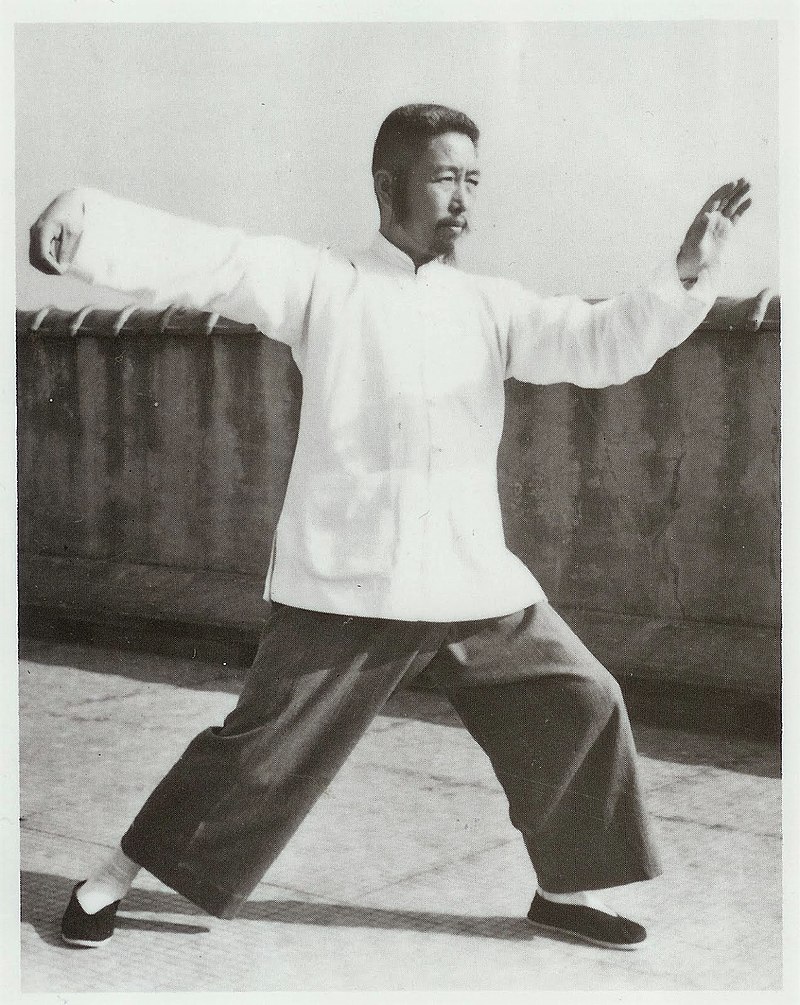
Chen Man Ching once famously said that he only understood Tai Chi after having a dream in which he had no arms.
It’s a good indication of what you’re looking for in Tai Chi – which is to “do” everything with the actions of the legs and waist, not the arms. The idea of moving the arms without moving the arms is, of course, contradictory, but that’s the challenge you undertake when you practice Tai Chi.
I found that I didn’t “get” this concept of “no arms” until I really relaxed my lower back and learned to sit correctly in the form. The lower back is the bridge between the upper body and the lower body. If that bridge is not open then goods and services cannot flow between the two different countries.
So, how do we do this in the correct way? I think the key is to be found in how you get into a riding horse posture properly.

We’re all familiar with the wide-legged riding horse posture. When you start a Tai Chi form you are essentially sitting down into a narrower version of it, but it’s the same kind of stance.
Let’s formalise what I mean by Riding Horse stance a bit more.
1. Toes point forward.
2. Knees bent, but not further forward than the toes.
3. Feet two shoulder widths apart.
As aways we make sure that our upper body is relaxed (not collapsed) and upright. Just take a moment to focus not he AO joint that I mentioned in my last post, to ensure that your head is in the correct position. Your neck should feel long at the back and the chin slightly tucked at the front, crown going in the upward direction.
Now straighten your legs. This brings you out of a riding horse stance and into a leg triangle stance with straight legs.
We’re going to lower back down into a riding horse, but rather than doing what you normally do, I want you to focus on two things.
1. The knees go forward as they bend.
2. The butt does not move backward as it would if you were going to sit in a chair, but instead you open/relax your lower back so that it sinks downward.
There you go. This should feel like a different sort of riding horse stance to what you’ve normally experienced. That elongated and open feeling in the lower back is what you need to maintain during your Tai Chi form. Without that feeling you cannot connect the upper and lower parts of the body.
Play with it, experiment with it a bit, and then when you’re ready, start your Tai Chi form and as the hands come down and you sink, try and achieve the same feeling.
Then try and keep it for the whole form. If you can do that, then you’ll start to notice that Tai Chi is all about the leg movements, not the arm movements. Your arm movements can start to be directed by the leg and waist movements.
As it says in the classics:
It is “rooted in the feet,
generated from the legs,
controlled by the waist, and
expressed through the fingers. “


“We’re going to lower back down into a riding horse, but rather than doing what you normally do, I want you to focus on two things.
“1. The knees go forward as they bend.
“2. The butt does not move backward as it would if you were going to sit in a chair, but instead you open/relax your lower back so that it sinks downward.”
As promised, here’s my comment on this.
I think this is the goal, but there are some steps and caveats along the way.
The knees go forward, but they do not extend beyond the toes and more importantly heels MUST remain on the ground throughout. This protects the Posterior Cruciate Ligament (PCL) from damage.
Before I teach horse stance, I usually teach Tripod Feet. I won’t go into detail here, but each foot is a tripod, and if you lift your toes, your feet should be pressing with three points balanced equally. For some people, the reaction will be, “Duh!” For many others, this will be a revelation. This keeps the knees going the safest direction.
The way I like to teach beginners is,
1. Let your knees go forward without shifting your weight, until it feels like the knees are even with the toes.
2. From there, the knees stay in place and do not move. Drop the tailbone into neutral position, tailbone pointing toward the ground, opening the low back, and allow the hips to move backward as if preparing to sitting. This will move the center of pressure on the feet toward the heel. Stop as it reaches the back of the heel.
3. If you are not able to automatically drop into a squat during #2, and your hips kind of lock up, your knees are not quite even with your toes. Let your knees move forward 1 mm, or a bit more, allowing the center of pressure on your feet to return to center. This should release your hips, so you can drop into a deep squat.
4. To come back up, push the floor away with the soles of your feet. This will engage the muscles in the correct sequence to prevent injury.
5. Now, you can choose the height and width of your horse stance and should not have any unnecessary protective limitations. This process should smooth out with practice, so you can drop from standing to any height of horse stance, as you describe, without having to go through steps 2 and 3.
Additional caveats
Always push the floor away from you with the soles of your feet. Incorrect alternatives are to throw the knees back or push the hips forward.
A common mistake in finding neutral position for the pelvis is to thrust the hips forward locking the hips. The pelvis should rotate as if it were a tipped bowl moving toward level.
There is also a tendency to rotate pushing the tailbone as far under as it will go. This is a correct position for some schools of internal alchemy, however for taijiquan, we use the the lumbo-pelvic-hip complex as an energy gate to store, return, or dissipate the energy of incoming forces. So, we need a neutral sacral position and the ability to move in any needed direction.
Of course, in Chen style, at least in my tradition, while the horse stance is learned and used, its importance is because it prepares the student to learn the Two Half-Horse stance, which is the primary stance used in our taijiquan.
LikeLike
Richard – thanks for that. I really like the idea of putting your finger where you think it is, then moving along to the next finger, which is where it really is 🙂
LikeLike
“to ensure that your head is in the correct position. Your neck should feel long at the back and the chin slightly tucked at the front, crown going in the upward direction.”
Not only is this alignment important, but the kinesthesia of being suspended from above causes specific neuromuscular changes in the torso that are essential for taijiquan.
Here are the directions I usually give to achieve this state.
Place your flat hand on the top of your head to find the highest point on your head. Put your middle finger on that point. This point is only of secondary importance. Put your index finger down next to your middle finger. This is the point we are interested in. The first is the apparent apex, but the second is the true, or functional, top of the head and a focus for body alignment.
Imagine being pulled up by this point. To start with, you can put you index finger on the point and push up if the “pulled up” imagery doesn’t work for you, but eventually you’ll want to grasp the idea of flowing or being pulled upward from that point.
Your head should move up and back so that your ears are over your shoulders. Your nose and chin should “drop slightly.” This is the Top-Back of the Head Up (TBHU) position. This should be relaxing and the rest of your body should “hang down” from this point.
If your nose and chin lift, the point you’ve located on your head is too far forward. If your chin tucks a lot, the point may be too far to the back.
The imagery I like to use for the tailbone is one of a plumbbob hanging from the top of my head being pulled by gravity into the earth and straightening my spine. So, the head is lifted by this point and the tailbone hangs from this point. I label this the neutral sacral position. The lordosis of the lumbar spine in nearly straight, the tailbone is under the spine but neither tucked in all the way nor sticking out. We’ll need the mobility to use the tailbone in taijiquan.
I have a comment on the knees and hips directions you gave, but I’ll make that later separately.
LikeLike