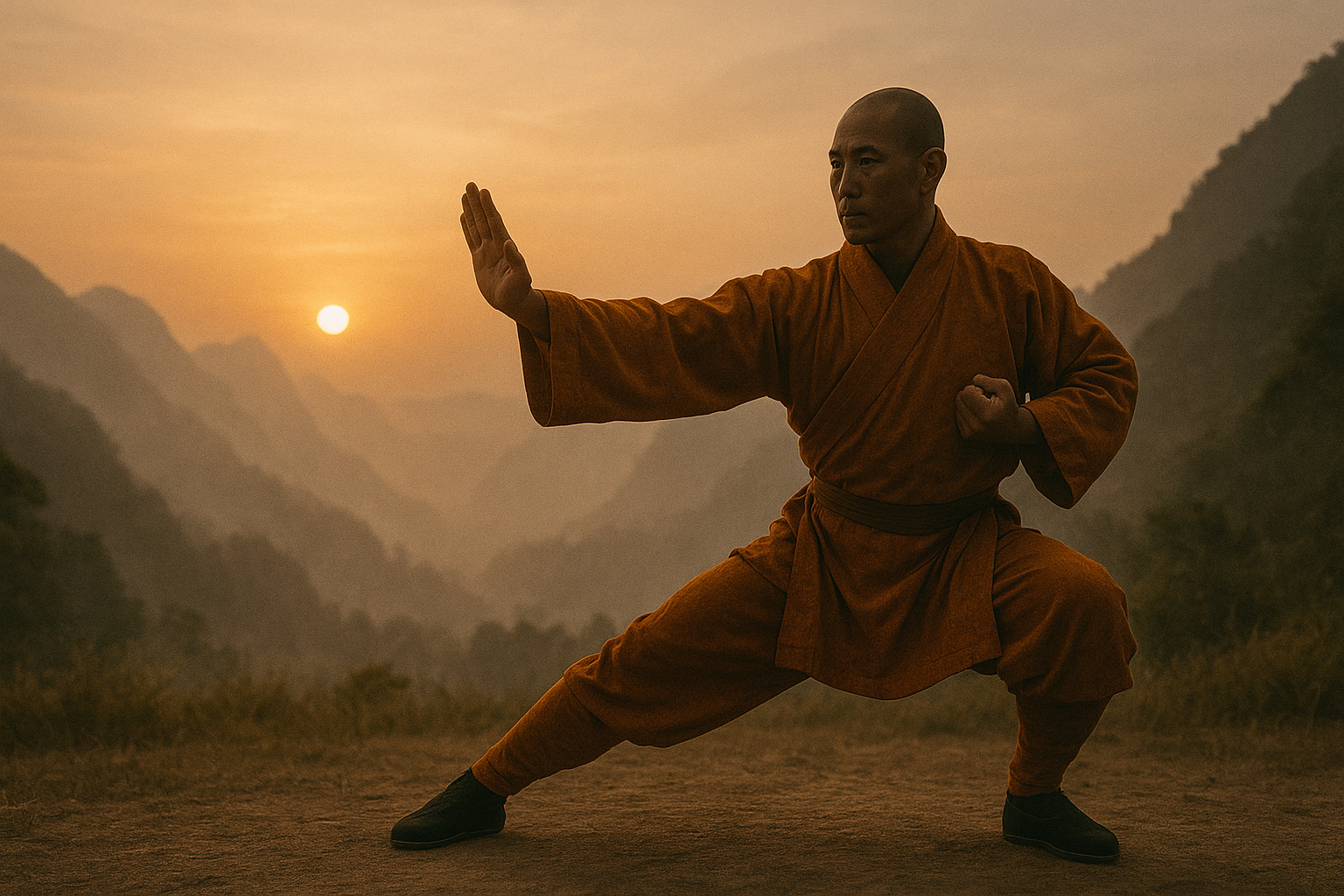
How does rooting work in Tai Chi?
In the Tai Chi Classic it says:
The jin should be
rooted in the feet,
generated from the legs,
controlled by the waist,
and expressed through the fingers.
This does present something of a dilemma – how can we both be rooted in the feet but also controlled by the waist, let alone also generated by the legs?
In the Treatise on Tai Chi Chuan, the classic says “Sink the chi to the dantien.”
This sinking is related to the pulling in action of the muscle tendon channels that are usually associated with the contraction (closing) phase of opening and closing – usually while breathing in. The breath sinks to the dantien area, and combined with correct mental focus, this should make the dantien area feel full as you breathe in.
This pressurised feeling in the dantien is also the pressurised feeling at soul of the foot. You could think of it as squeezing the pressure from the dantien down to the foot, but you really don’t need to do that, as it should be instantaneous, since they are the same thing.
With the exhale, the pressure pushes up, through the legs, up the back and out to the extremities including the head. It’s a continual cycle of store and release.
You could call this the internal side of Tai Chi, but really, it’s just the way Tai Chi works, rather than a particular side of it.


Graham, you may be conflating a couple of different meanings of “rooting”. The original statement simply means that the jin *starts* at the foot/ground at the sole. It is the idea of the “groundpath” where the “solidity of the ground” (discussed in a number of Chinese texts) is transferred through the body, controlled by the turning of the waist, and expressed in the hands. In other words, someone touching your hands should feel the solidity of the ground in your hands.
The act of “rooting”, as in being difficult to move, is a different use of the term “root”. How does rooting work, you asked? It works by the body’s involuntary-muscle system adjusting to compensate for various incoming forces. Much in the same way that a mother holding a baby on her hip moves around the kitched doing chores: the subconscious mind (the “yi” or “intent”) automatically compensates for the off-balancing effect of the baby’s weight/mass. What we do in the Chinese martial arts is learn to consciously obtain some degree of control of normally-involuntary processes. One of those processes is the basic “rooting”: we learn to refocus all incoming forces so that they are immediately at the sole of our foot.
LikeLike
Tai chi is a lifetime practice. There are always clarifications and insights to be discovered. Thanks.
LikeLike
Root is a great topic for hands-on discussion, where it becomes “functional rootedness”. You are right. This is definitely how taijiquan works and one of the reasons people called it internal.
In bullet points, rather than my usual long-winded explanations, here are some additional rooting practices that work for me, YMMV. These are all accomplished with internal methods like or similar to the one you describe. They are taught in foundation training, approximated in the form, and developed through hands-on (push hands) training, which informs foundation and form training to more precisely approximate the practices, and so on, in a cyclical manner.
° Rooting is an aspect of correct taiji structure and is related to substantial and insubstantial, among other important aspects.
° Weighted and unweighted are not the same as substantial and insubstantial, so surprisingly, you can have a leg that is substantial and unweighted or insubstantial and weighted.
° The principal kind of double “weighting”, or double heavy, that causes problems is when your opponent puts her force into your substantial leg causing it to be double heavy, breaking your root, and potentially giving her control of your structure. This can happen in places in the body other than the leg too.
° You want to avoid being substantial where your opponent’s force is going. Fortunately, switching substantial and insubstantial can happen in an eye blink, “Suddenly appearing; suddenly disappearing” as the classic says.
° There’s also a way to make one leg substantial and the other leg “occupied”, so your opponent’s force will not go into it. Her force has to go somewhere, and the taiji adept can learn to direct it back to her, breaking her root, and usually causing loss of balance. This is an important rootedness skill.
° Open and close is a euphemism of sorts. Closed is a fault that potentially makes us more vulnerable. We actually want to “open and release”. This is sort of like a spring-loaded, or even revolving, door. We open, then release, and the door closes itself. This is a much more productive way to think about it.
Your blog and my comment have focused primarily on establishing and protecting one’s own root. There are methods to break the opponent’s root. I think these topics are among the most important lessons of taijiquan.
Excellent choice!
LikeLike
Thank you – this was a helpful explanation – I think I might finally understand.
LikeLike