From http://chentaijiquanworld.blogspot.com/ we find this nice quote about Chen Taijiquan:
“The, at first sight, seemingly humorous Chenjiagou saying to “always keep an egg under your armpit” reflects the importance of not allowing the upper arms to become stuck to the side of the body.
This idea of always keeping a space under the armpit is something I’ve heard said in other styles of Tai Chi as well, and it fits in very well with the idea of “Peng all over the body” that you’re aiming for in Taijiquan, that kind of “inflated like a balloon, but also soft, springy and heavy” feeling.
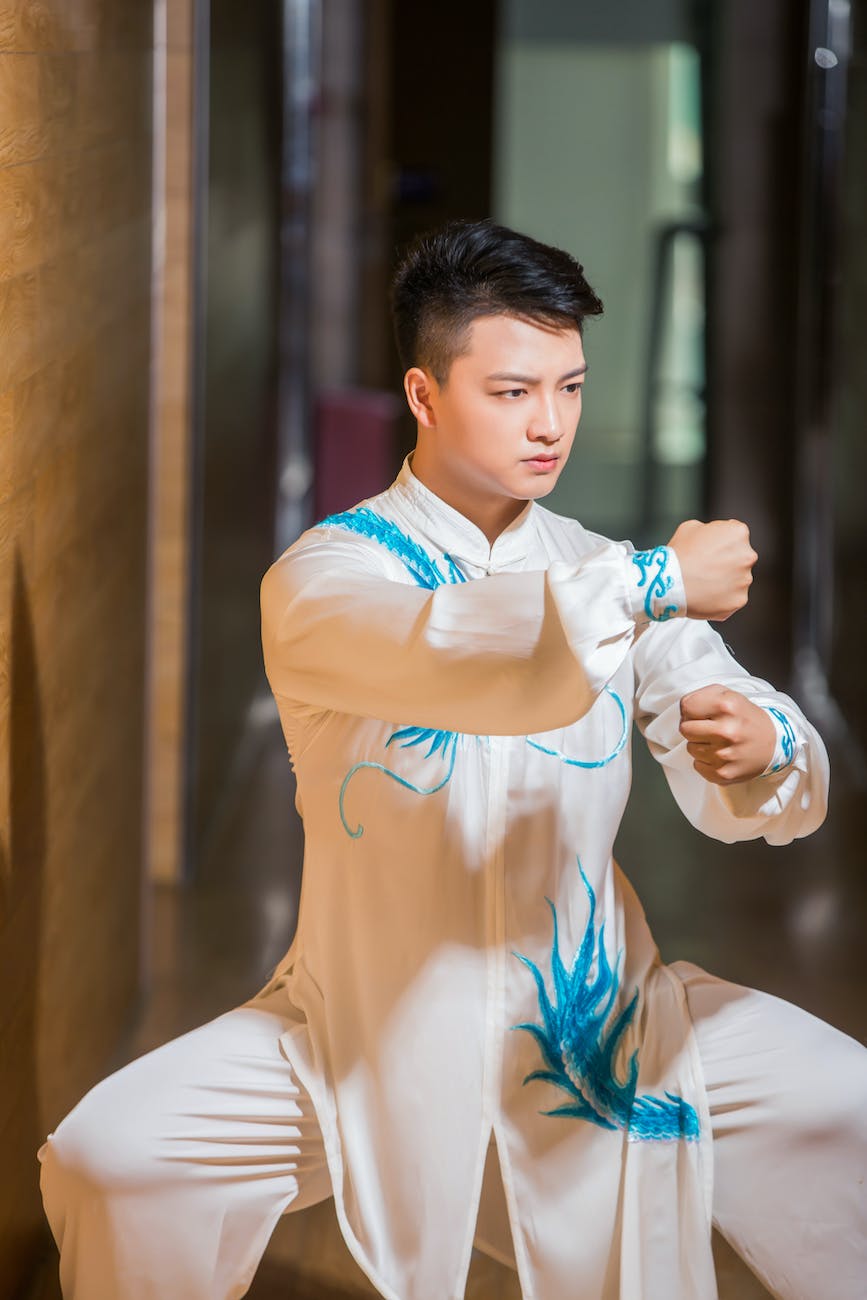
But how does that relate to the question I was looking at recently about the issue of where the elbows should be in Xing Yi? “The elbows never leave the ribs” is a line from the Xing Yi classics* (more of that later) that has caused a lot of arguments between practitioners on its interpretation and meaning.
And when you compare it to the previous saying about the armpit from Chen Village, it’s basically the complete opposite advice! And yet, both Taijiquan and Xingyiquan are said to be internal arts, and part of the same family. So, is the advice about the elbow a crucial element, as fundamental as, say, aligning the Bai Hui point (the crown) with the spine? Or is this more of a piece of strategic advice to do with the fighting style of Xingyiquan, and not anything to do with its fundamental body method?
Let me throw in a curve ball here and switch arts to BJJ. “Glue your elbows to your ribs” is something I say to my students in BJJ all the time when they are on the bottom defending a position like side control, knee on belly or mount.
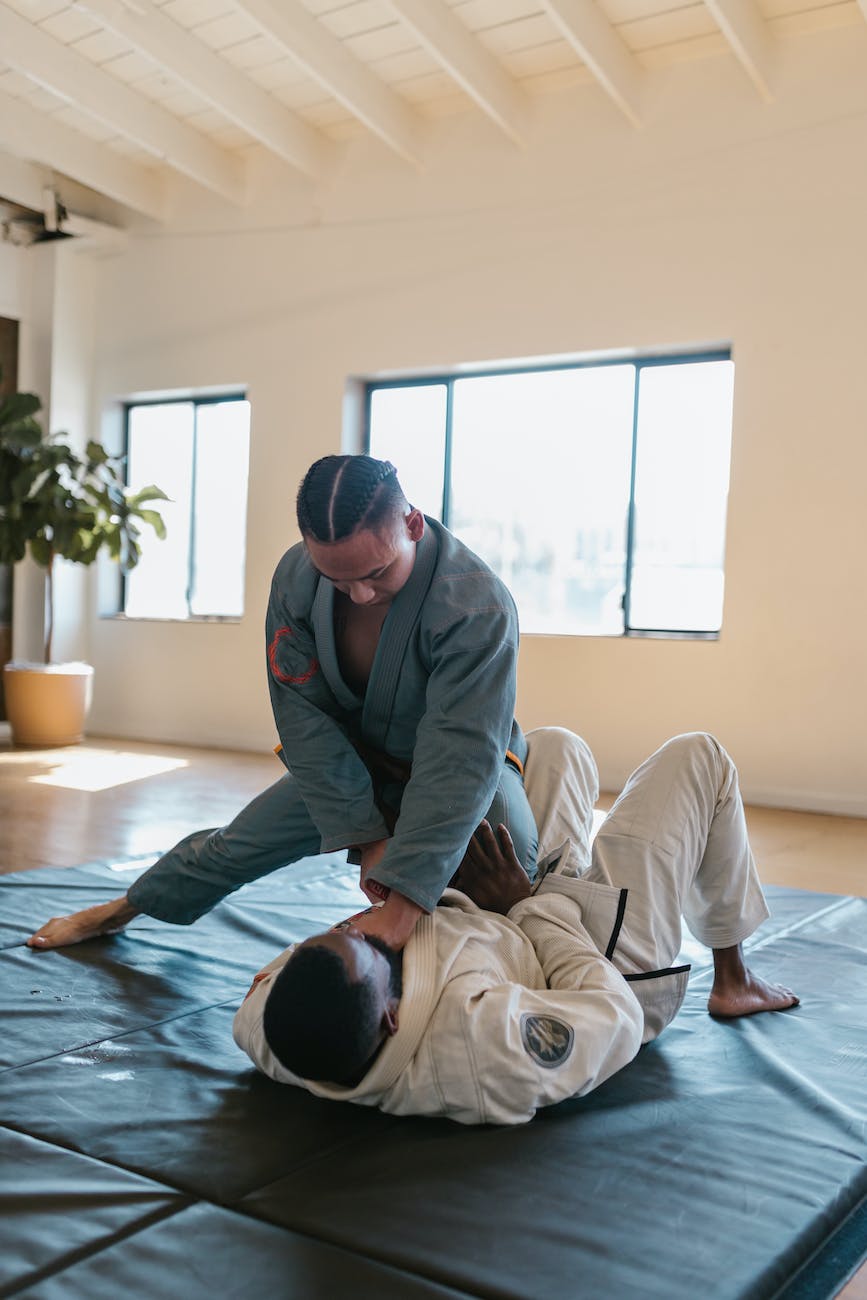
If you let your opponent separate your elbows from your ribs in that position then only bad things can happen, so it’s great advice. Normally after I submit somebody new in BJJ I stop to explain to them how I did it, so we can turn it into a learning moment. 9 times out of 10 my explanation starts with “it started when you let me into the space under your armpit”. However, it would be ludicrous to make it into a hard and fast rule, to suggest that you should never let the ribs leave the armpit at any moment in BJJ. There are plenty of other times in BJJ where you need to pull with your arm, and you can’t do that fully without separating your elbow from your ribs.
* And let’s also decide on what constitutes a “classic” in Xing Yi. My own teacher only considered the 10 Thesis of Yue Fei to be the classic writings in Xing Yi. Most of what people call the Xing Yi classics today are, in fact, writings created in the early 20th century when there was a publishing boom in martial arts manuals (See Chinese Martial Arts Training Manuals: A Historical Survey by Kennedy and Gau), and are based on the original Yue Fei writings anyway. For Xing Yi it started with Sun Lu Tang’s 1915 A Study of Xing Yi Boxing.
In the preface to his manual Sun says (Translation by Brennan), “While once at Bai Xiyuan’s home in Beijing, I got to see one of the Yue Fei manuals, not an original copy of course, but a handwritten copy made by someone in a later generation. It was not very detailed and unfortunately contained no explanations of its terminology, only the barest of text from beginning to end. I was suddenly inspired by this, immediately wishing to provide more complete information, even though I was fully aware that my level of learning and skill was superficial, and without being tempted to make anything up [in order to fill information gaps]. I secretly made my own copy and then deeply studied it, going through it posture by posture until bit by bit I had built up the material to make this book. There is no decorative language in it at all, for in my studies I have not dared to hold on to even the slightest exaggerations. Wherever flaws are found within my work, I hope my comrades will correct me, for which I would be very appreciative.
– sincerely written by Sun Fuquan [Lutang] of Wan County, Baoding, 1915, 1st month, 15th day”
In his manual Sun has a chapter called “The Essentials of Practice” in which we find the advice about elbows and ribs. (Translation by Brennan)
“ESSENTIALS OF PRACTICE
The essentials of practice in Xingyi Boxing: 1. Sink your waist. 2. Shrink your shoulders. 3. Hollow your chest. 4. Press. 5. Lift. 6. Horizontal and vertical should be clearly understood. 7. Lifting, drilling, dropping, and overturning should be clearly distinguished.
…
Your head presses up during drilling, then shrinks back during overturning. Your hands lift during drilling, then drop during overturning. Your foot lifts during drilling, then drops during overturning. Your waist lifts during drilling, then drops during overturning. [from the Xingyi Boxing Classics:] “In lifting there is a horizontal aspect, but it is invisible [because it appears to be only upward]. In dropping there is a vertical aspect, but it is invisible [because it appears to be only forward].”
Lifting is going out and dropping is striking, but when lifting is also striking, dropping is still striking. Strike with lifting and dropping, like the overturning waves of water, which are lifting and dropping. Regardless of lifting and dropping, drilling and overturning, going and coming, it should always be that your elbow does not leave your ribs and your hand does not veer off from your centerline.
These are considered to be the essentials in Xingyi Boxing. Knowing these, the right path in the art will be obtained.“
But you can see that even in this passage, Sun is quoting the older “Xing Yi Boxing Classics”. So, you have to start to wonder, how old is the advice that the elbows do not leave the ribs, really? I know some styles maintain that their “quan pu”, ancient collection of classic handwritten writings their family possesses has this advice in. At least with Sun’s work we have a published date we can be sure of.
But this also brings up the question of how much we dedicate ourselves to following the literal words of “the classics” to the letter. How much freedom are we allowed in our martial art? Were the classics intended to be a kind of set in stone, unwavering, set of rules to be followed on pain of death? The ancient writings of the founders always tend to take on this weight that gets heavier over time. If they’d been written a year ago, would we treat them with the same reverence? There are hard line Christians who treat every word of the Bible as the word of God, never to be questioned, and there are more modern progressive Christians who interpret the words in the Bible into a modern context, or see them as simply stories designed to teach an idea, and not to be taken literally.
So, the question still lingers, like a bad smell.
Where do you put your elbows in Xing Yi?
I think the best answer I’ve found so far is…..
“in between your shoulders and your wrists”.


Graham,
Thanks for posting that really rare video of Chen Yu casually performing the Chen Village Laojia rather than his usual Xinjia-like form. The description links to an interesting article that discusses, among other things, how to develop gongfu. The article also discusses “the variety of expressions Taijiquan practice can have.” Follow the link in the video description. It is worth a read, even if you are not into Chen Taijiquan.
I also like Chen Yu’s usual form. It teaches some important principles really well. If you also watch his application videos, he tightens things up, so the actions are slightly different from the form. This is not unusual for form-to-application conversions.
However, for me, at least, one’s teacher is primarily determined by accessibility. If I had a top level Xingyi teacher at hand, or even something as different as a kenjutsu teacher, for example, I’d likely arrange to study with them. I’ve done similar things in the past. It has broadened my horizons and led me some real gems of knowledge and practice.
Reflecting on this blog and discussion brings to mind Jarek’s “China from Inside” translation of an article on Small Frame Chen Taijiquan. “The Characteristics of Small Frame of Chen Style Taijiquan” section lists “rules” for performing Small Frame Chen Taijiquan, also worth a read. These are virtually identical to those taught by Hong Junsheng who received his rules from Chen Fake. This is evidence that these are just the rules of taijiquan, or at least, Chen Taijiquan.
I have often observed and described Chen Taijiquan as having “perfect biomechanics”, especially for fighting. This view leads me to believe that adapting these biomechanical rules would benefit your Xingyiquan. Besides, as the saying goes, “Northern Chinese martial arts are all sons of the same mother,” while they are not the same, these “brother” arts have a lot in common.
LikeLike
Hi Graham,
Thank you for posting that rare video of Chen Yu casually performing a form that is not the one he usually performs. The description links to an interesting article that says among other things. “In China, it is basically clear to everyone in all Chen lineages I know that if you only do forms casually, you will not develop gongfu.” It is worth a read even if you are not into Chen Taijiquan.
https://www.ctn.academy/blog/gongfu-learning-in-taijiquan
I also like Chen Yu’s usual form. It teaches some basic principles really well. And, if you watch his application videos, he also really tightens things up.
However, in the end, with whom one studies depends on to whom one has access. If there was a top level Xingyi teacher nearby, or even something like kenjutsu, for example, I’d likely arrange to study with them. I’ve done similar things in the past. It has broadened my horizons and led me some real gems.
The article also discusses “the variety of expressions Taijiquan practice can have.” A quirk in my perception causes me to see first primarily similarities between forms and styles. This blog has caused me to reflect Jarek’s “China from Inside” translation of an article on Small Frame Chen Taijiquan.
http://www.chinafrominside.com/ma/taiji/xiaojia.html
“The Characteristics of Small Frame of Chen Style Taijiquan” section lists “rules” for performing Small Frame Chen Taijiquan. These are virtually identical to those taught by Hong Junsheng who received his rules from Chen Fake. This leads me to believe that these are just the rules of taijiquan, or at least, Chen Taijiquan.
My observations have led me to describe Chen Taijiquan as having “perfect biomechanics”, especially for fighting. This view leads me to believe that adapting these biomechanical rules would help your Xingyiquan. Besides, as the saying goes, “Northern Chinese martial arts are all sons of the same mother.”
LikeLike
Hi Richard,
Thanks – if you are following the Zhonghua version of Chen style then that all makes sense. A Chen Zhonghua performance of the Yilu is certainly very different to, say a Chen Yu performance of the YiLu. https://www.youtube.com/watch?v=yPbsGWIjSbU&t=141s
Chen Zhonghua seems much more concerned with keeping things “tight” in terms of elbow and torso gaps. Chen Yu looks more relaxed and open. My personal preference would be for the Chen Yu performance if having to choose between these two. But since I don’t practice Chen style I’m not really invested in either method.
But my quandary is really about Xing Yi, not Tai Chi.
LikeLike
I think I was not as clear as I hoped, and perhaps, you may have misunderstood a bit. The “rules” aren’t carved in stone, but when you violate them, you create space for attack. You want to minimize those opportunities for your opponent. The “rules” delineate risk and sometimes the point beyond which a technique won’t work.
When the hand leads out, the elbow follows. In correct form, the elbow stays at a slightly downward angle that allows the elbow and often the forearm to stay in front of the armpit, so the pathway to the armpit is “blocked”, though the elbow is the length of a humerus bone away. When the arm is overextended the elbow joint straightens too much or the fist may be too high, and the armpit is exposed. This can happen during some fajin, but we try to minimize it to protect the armpit. “You are never more vulnerable than when you attack.”
The internal rotation of the arm that lifts the elbow is never more than 45°, as violated in your first photo. This keeps the humerus bone over the armpit from the side.
And don’t underestimate the power of the mental connection of elbow to ribs to center, as if there were a tight elastic band pulling it. This can really make a difference in how protected the armpit is.
Try these out for yourself. The armpit is not covered every second but it is nearly always protected by blocking the pathway to the armpit.
For a visual reference, and to answer the White Crane Spreads Wings question, attached is a link to Chen Zhonghua performance of the Yilu. At 0:14, even during fajin, the elbow does not raise above the armpit. Also see 0:16, 0:18, 0:22, and so on. In White Crane Spreads Wings at 0:28, we are required that the palm of the hand stay below the eyebrow and again that the elbow stay pointed toward the ground.
The only violation that I know of is during Golden Rooster Stands on One Leg at 3:52 where the application is vertical. There may also be some instances where the rear armpit, the side way from the opponent, may be briefly exposed, 2:59, but technically the torso is protecting the armpit.
I hope that is more clear and still resolves your quandary.
LikeLike
Hi Richard, Nice post! I take your point that in Tai Chi your ‘power delivery hand’ rarely, if ever, has the elbow away from your flanks. But that got me thinking about all the different postures and if it stays true…
I immediately thought that a basic Ward Off from Yang style as being a counter example, but the more I think about it, while the arm is away from the body, the elbow is still ‘in line’ with the flanks.
However, ‘White Stork/crane cools/spreads Wings’, which is a move in both Yang and Chen could be seen as a counter example, could it not?
In Xing Yi when you raise the arms like this, your opponent is normally at your side, and that’s where you’re looking, so the elbow is still in line with the flanks, but here in Tai Chi you are looking forward, in front of you presumably where the opponent is, but your elbows are separated from your sides.
Here’s a video of it done in Chen (just one I found randomly, no comment on his ability, but it breaks the movement down so you can see it done slowly, and I like the Irish accent) https://www.youtube.com/watch?v=sEsxNx0Q_So
LikeLike
You quoted, “The, at first sight, seemingly humorous Chenjiagou saying to “always keep an egg under your armpit” reflects the importance of not allowing the upper arms to become stuck to the side of the body?”
When this topic was only about Xingyi, I had no comment, but since you included Chen Taijiquan, I can only speak to the tradition in which I have been trained. According to Hong Junsheng’s transmission of Chen Fake’s art, “Keeping and egg under your armpit” is not accomplished by lifting the elbows. Instead, it is accomplished by protracting the shoulder girdle to create a hollow in the armpit, which may be accomplished even with the elbows by your side. This allows energy or forces coming from the ground to the shoulder to bridge the gap and connect to arm, hand, and fingers and vice versa. It also helps with some kinds of stepping with the contralateral leg.
Similarly, our instruction is to “loosen the shoulders and sink the elbows.” The elbows point toward the ground and never at an angle less than 45°, so no lifting or reaching so far that the armpit is exposed. Much of the time the elbows rub the ribs, and when they come away from the ribs, they are still connected “energetically” to your center through the ribs, so they snap back to the ribs. This is part of following the instruction to “lead out with the hands, not the elbows, and lead in with the elbows, not the hands.”
So, with this perspective on Chen Taijiquan, it seems your quandary is resolved. This also seems to match the lessons from BJJ and may inform your Xingyiquan practice a bit. Your answer to “Where are the elbows?” is still apt, “in between your shoulders and your wrists”.
LikeLike
I think you have found it, my friend!
Consider yourself illuminated by the light of old Yue Fei. 😀
LikeLike