
Yang Cheng Fu, grandson of the Yang style Tai Chi founder, Yang Lu Chan, is probably the most photographed of all the famous early Yang style practitioners, thanks to the publication of his 1930s books on Tai Chi that showed him performing his Tai Chi form as a series of fixed poses.
Of course, we all know that Tai Chi has no fixed positions, but if you are going to present a series of movements in a book then you either need a series of drawings or a series of photos showing poses. Film was rare and video recorders hadn’t been invented when Yang Cheng Fu published Methods of Applying Boxing (1931) and the Essence and Applications of Tai Chi (1934), which was translated into English in 2005 and published in print.

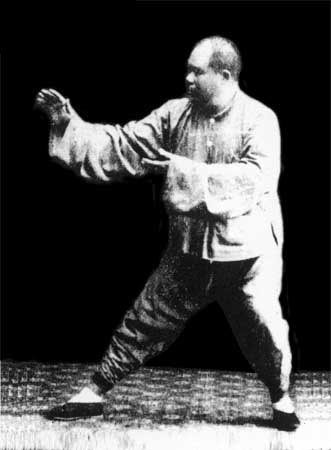
Because of books like these we are used to seeing Yang Cheng-Fu in perfectly poised shots for the camera, which was why it was so surprising to discover this week that somebody had an ‘action shot’ of Yang Cheng-Fu taken while he was doing a form demonstration at a martial arts event.
So, full credit to the person who posted this: The photo was posted to Facebook by Wong Yuen-Ming in the Internal Arts Institute group with the message “Today I am making public one such a photo, possibly the only photo that shows Yang Chengfu demonstrating his Taijiquan in public that was shot by a photographer in action. It was taken on October 15, 1928 when Yang was demonstrating at the Chinese National Guoshu championship.” There is no name of the photographer mentioned.
It’s hard to know whether the photo is genuine, especially in the age of AI where it’s very easy to fake photos in a convincing way, but it does at least look like Yang Cheng-Fu. The posture shown also looks like Yang Cheng-Fu’s frame and style.
As for the location and date, that also checks out: The Central Goushu Institute held two events in 1928, the first in Beijing was a highly competitive lei tai tournament and the second was in Nanjing From Wikipedia: “This event came to be regarded as one of the most significant historic gatherings of Chinese martial arts masters. The tournament was presided by generals Zhang Zhijiang, Li Liejun, and Li Jinglin, who separated the 600 participants into two categories: Shaolin and Wudang.[2] After the first several days of competition, the fighting competitions had to be halted because many participants were severely injured. The final 12 contestants were not permitted to continue, with the public excuse being the fear more injury or a death. The winner was determined by a vote by the participants.”
It’s not clear which of these two events the alleged photo of Yang Cheng-Fu was taken at.
Is it genuine? I don’t know, but it’s very convincing. I initially thought he was performing in front of a mirror but the arms are not a mirror image, so there are two performers on the stage.
 The Tai Chi Notebook