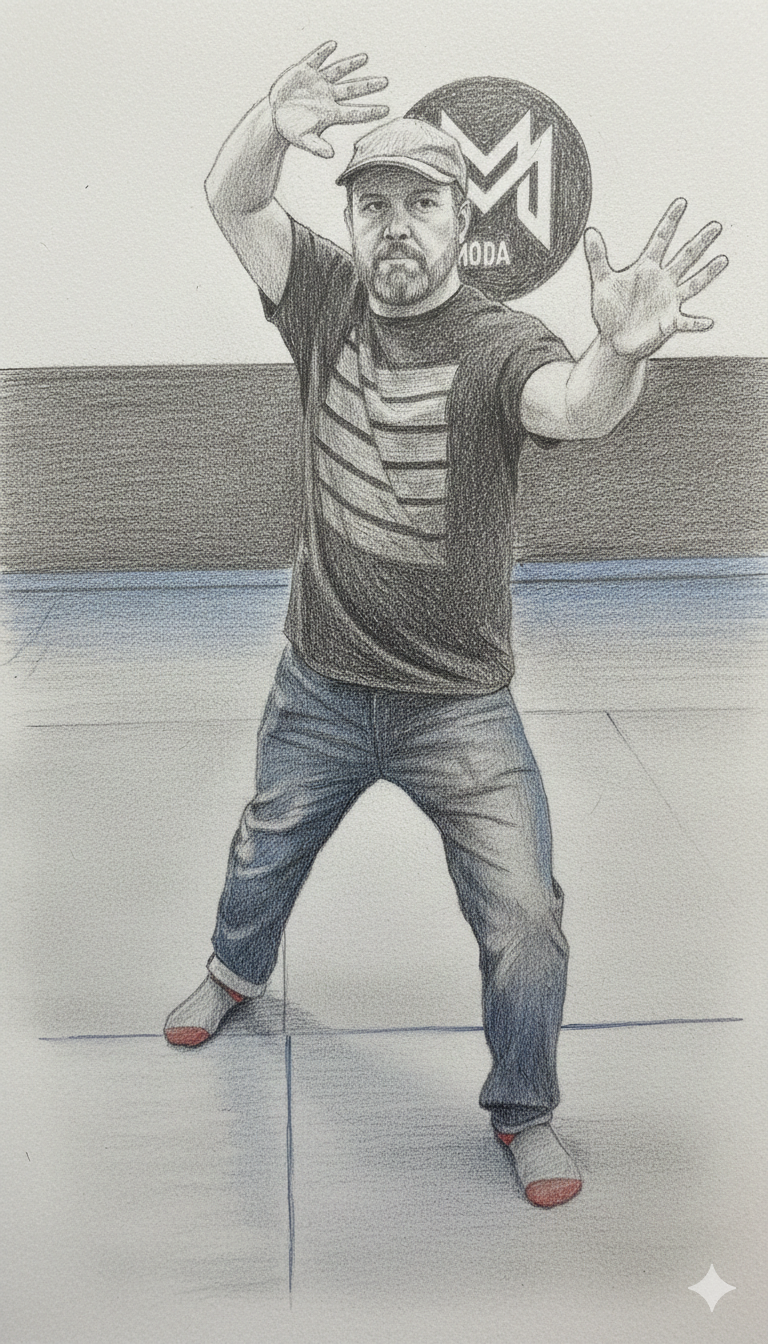
Tai Chi has always felt like it’s very good for me — for the mind, the breath, the joints, for my overall functioning as a human being — but I’ve never really considered it a weight-loss tool. That’s despite the rash of frankly hilarious ads currently clogging up social media, bizarrely presenting Tai Chi as the secret to giving men over 50 a six-pack.
What’s even more galling is that if you actually look at the “Tai Chi” weight-loss exercises these products are trying to sell, they’re not Tai Chi at all. They’re what could most generously be described as basic warm-up movements — and the ripped old men demonstrating them are very obviously AI-generated.
Exercise of any kind is beneficial for health, but Tai Chi has never been particularly associated with weight loss. And now, inconveniently for the entire fitness industry, the idea of exercise as a reliable weight-loss tool has just taken a kick in the teeth courtesy of a recent New Scientist article, which argues that exercise, while very good for you, may not lead to weight loss as much as we’ve been led to believe.
According to the article, the basic problem is compensation. When you exercise more, your body simply burns less energy elsewhere to make up for it — and this effect can be even stronger if you’re also dieting.
As the article puts it:
“Exercise is tremendously beneficial for our health in many ways, but it’s not that effective when it comes to losing weight — and now we have the best evidence yet explaining why this is.
People who start to exercise more burn extra calories. Yet they don’t lose nearly as much weight as would be expected based on the extra calories burned. Now, an analysis of 14 trials in people has revealed that our bodies compensate by burning less energy for other things.” – New Scientist
Seen in that light, it makes far more sense to view Chinese martial arts — Tai Chi included — as tools for improving overall quality of life rather than as weight-loss hacks. That includes balance, coordination, joint health, breathing, mental focus, and, perhaps most importantly, social connection.
Feel the burn
If you’re practicing Tai Chi and want to improve your overall fitness while staying within the Chinese martial arts ecosystem, it’s worth pairing it with something more physically demanding. Styles like Choy Li Fut, Hung Gar, or Praying Mantis, for example, place much greater demands on strength and cardiovascular capacity.
Alternatively, you could lean into the more demanding side of Tai Chi itself — weapons forms, longer routines, or more continuous practice sessions can be surprisingly taxing.
Not all Tai Chi is the same. Most people today practice softer styles, where this advice applies most clearly. Some styles — Chen style in particular — include more vigorous stamping, jumping, and explosive movements, and may not require additional training alongside them.
Either way, common sense still applies. For a well-rounded approach to health, it helps to do something that makes you breathe harder than normal.
Tai Chi doesn’t need to promise abs, calorie burn, or dramatic body transformations to justify its existence. Its value lies elsewhere — in longevity, resilience, awareness, and the quiet accumulation of small benefits over time.
If weight loss happens alongside that, fine. But if it doesn’t, Tai Chi hasn’t failed. It’s simply doing what it has always done best: helping people move better, breathe better, and feel more at home in their bodies — no six-pack required.
“An intangible and lively energy lifts the crown of the head.”
One of the things I often notice about my rolling partners in BJJ is that when they’re passing guard, they’re too easy to pick apart and attack because they let their spine bend by allowing their head to drop. As soon as this happens, I can attack their limbs easily because they’re suddenly not as strong. The spine is an integral part of the structure of our body, and when it’s not properly aligned, we’re weaker.
When we’re rolling in BJJ, and I’m in teacher mode, I’ll stop and point out when their head is down, and it’s often a kind of revelation to them. What I mean by “when their head is down” is that their head (and neck) is not in alignment with the rest of their spine. Once your head is aligned with your spine, you’re much stronger physically, without even trying. You’re also much more resistant to attacks from your partner. The game in BJJ then becomes about how you can break their spinal alignment while they try to keep theirs and break yours.
This takes you beyond the realm of just techniques and into the realm of principles. My BJJ book is certainly full of techniques, but I also tried to include a lot of text, especially in the intro pages for each section, about principles and strategy, too.
Having a background in tai chi, I think I’m more aware of spinal position than people who don’t have some sort of bodywork background before they start BJJ. In the 10 essentials by Yang Cheng-Fu as recorded by Chen Wei-Ming, it says, “An intangible and lively energy lifts the crown of the head. This refers to holding the head in vertical alignment in relationship to the body, with the spirit threaded to the top of the head. One must not use strength: using strength will stiffen the neck and inhibit the flow of qi and blood. One must have the conscious intent (yi) of an intangible, lively, and natural phenomenon. If not, then the vital energy (jingshen) will not be able to rise.”
Now there’s a lot of Chinese jargon in there that we can probably do without, and the way it’s written is not incredibly helpful. In BJJ, I usually just say “keep your head up” because that covers a multitude of sins, but what I’m really talking about is keeping your head in alignment with your spine.
If I’m teaching tai chi and I tell a student to keep their spine “vertical,” or lift “the crown of the head,” as it says in Yang Cheng-Fu’s recorded sayings, they almost immediately stiffen up straight like a soldier, holding their shoulders rigid and looking really uncomfortable. That’s not what you want in tai chi.
I think this stiffness is what Yang Cheng-Fu meant when he said in the next sentence of Chen Wei-Ming’s work: “One must not use strength: using strength will stiffen the neck and inhibit the flow of qi and blood.” A good tai chi spine is not a fixed position; it’s an alignment, and that means it’s an ever-changing position that adapts to your movement.
The general movement of your body in tai chi is always down. You are always relaxing and sinking down. That doesn’t mean you give up and slump on the floor like jelly; it means you just stop trying to hold yourself up all the time. You don’t really ‘do’ anything.
Relax the shoulders and just stand still for a bit in a wu chi posture. If you relax and allow it to happen, your head will naturally find the right spot where it sits in balance on top of your spine. The key is to stop trying to make it happen and let it happen. It wants to be there; you’ve just got to get yourself out of the way and allow it to happen. As it says in chapter 2 of the Tao Te Ching, “The sage acts by doing nothing.”
You’ll know when it feels right, and you can transfer that feeling to other situations: driving, working on a computer, and even, doing Brazilian Jiu-Jitsu.
This video has been doing the rounds online, showing some tai chi (taijiquan) fighting applications.
I don’t think there’s much to say about it, but it does perhaps prove useful for answering that question you get a lot: “can tai chi be used for fighting?”.
Let’s just try to say a few things about it though:
Firstly, he’s clearly just taking a tai chi posture (‘Play Guitar’) that looks very like that an ‘on guard’ position and using it in the same way a boxer does to parry and block punches. The hand he has by his chin he’s using in just the same way a boxer does their back hand to parry a jab. Is there anything wrong with that? Maybe not. You could use the posture like that, but is that its purpose?
Is that what that posture is designed to be used for? At this point, who knows. Usually you see ‘play guitar’ used as an arm locking posture, or combined with a foot sweep into a shuai jiao-style throw.
On the positive side, he’s actually getting the guy to throw the attacks properly, which is nice to see. Maybe they could be a smidgen closer together, so the punch would actually land, but compared to most applications you see from non-committal attacks, it’s not bad.
No, it’s not sparring, but not everything has to be. I don’t think it would look quite as much like ‘tai chi’ if it was sparring.
Finally, is there much ‘tai chi’ going on here? I’d be looking for smoothly flowing into sticking, yielding, and neutralising. He follows up a couple of times, but I don’t see much in the way of controlling the opponent here. The opponent is more often than not just blocked, and not controlled.
The bar for tai chi applications is pretty low. There are too many videos of people bouncing away at the slightest touch to muddy the water, so I think we have to say that this is at least a step in the right direction.
And why you shouldn’t train with weights when developing your qi
Mike Sigman has sent me an article to publish on this blog. I don’t normally publish other people’s work, or agree to their requests, but I’ll make an exception because it will hopefully generate some discussion. Regardless of how you feel about him, there’s is always a real depth to Mike’s writings and ideas that you can get a lot from, that you don’t really find anywhere else.
The article is primarily about one of the trickiest subjects in Chinese martial arts – qi (or chi).
I have a few thoughts about it:
1) The article starts by trying to “separate the skin-related qi, which includes the subconscious mind’s involvement, from the theoretical qi of traditional Chinese medicine”.
To some, particularly those people who relish Chinese history and the evolution of the concept of qi as it appears in Taoist thought, or medicine, that just won’t be acceptable, but I think this works for me. It moves the discussion into the realm of the physical and practical. It becomes a feeling and a doing thing.
2) It appears to be written partly as a reaction to a recent trend of mixing, or doing, Chinese martial arts conditioning through the medium of kettle bell or weights training. The question is, is that a waste of time if you want to get to the root of the subject, which is what the Chinese martial artists call qi?
Look, I don’t think there’s anything wrong with making yourself physically stronger at all. In fact, it’s obviously advantageous if you’re learning martial arts… But the article states that to master the internal movement, “the body must be completely retrained to learn to move with the qi, jin, and dantian”, and using weights will not help you in that respect. If you have retrained the body, then you could probably add them.
3) As I’ve said, nobody else really talks about this stuff, or if they do it’s watered down with a lot of other guff. If the article is correct on qi then what exactly are all the big names in modern tai chi seminar circuit and online courses out there actually teaching? Because they talk about qi a lot… but they don’t approach it in the same way as this article does, at least as far as I can see.
4) The article describes internal movement, quite simply and quite succinctly: “Ultimately, you develop a form of movement that uses the solidity of the ground as the focus of all forces to and from the body, while the qi covering of the body is manipulated by the lower-body and the middle to bring power to the arms and upper body.”
I find it hard to disagree with that definition, probably because it’s pretty broad. Sure, we can argue over what the “middle” is, or what the “lower-body” means,etc.. but as a succinct definition, it’s not half bad.
Now, let’s move on to how you do it…
The article talks about breathing exercises as a starting point: “Breathing techniques that stretch the surface of the skin and the involuntary muscle layers are the usual start of the progression.”
Now, I have personally trained in some of the methods that Mr Sigman uses (there’s a link to a video at the end of the article), and experienced what he’s talking about, and I’d agree that I can feel what he’s talking about. But I wouldn’t count myself as an expert in it, or knowledgeable about anything to do with it beyond the initial foot in the door stages, however, I have found that alone to be incredibly valuable and shone a light on some of the other things I was already doing. Even getting a foot in the door took a lot of work and a lot of time.
Anyway, I’ll leave you to read the article now and feel free to comment with your thoughts below.
Graham
Practical Development of Qi
And why you shouldn’t train with weights when developing your qi
by Mike Sigman, March 2025
Discussing qi is difficult because the definition of qi has become a bird’s nest of related topics. Let’s try to narrow the discussion and then describe an approach to practical development.
Most of the skills related to qi, in the physical body, have to do with an area near the skin of the body that is referred to as the “protective qi” or “wei qi”. While the protective qi is often referred to as an “energy”, it is actually a physical set of tissues that is controlled via the autonomic nervous system … but when you learn to control it via the subconscious mind, it does indeed feel sort of like an “energy” because it is apart from the topical sensations of the somatic nervous system, and the qi indeed feels odd, like an energy.
So, let’s separate the skin-related qi, which includes the subconscious mind’s involvement, from the theoretical qi of traditional Chinese medicine: that’s where most of the confusion lies. The skin-related qi and the subconscious mind are the artifacts which give us heightened toughness of the skin, odd sensations of qi, added strength by supplemental our muscle-bone strength, and dantian control of the body as whole connected by skin-related qi, among other things. Jin forces, the manipulation of the solidity of the ground and/or downward forces of gravity, are also the product of the skin-related qi: jin is defined as “the physical manifestation of qi” in many Chinese sources.
The qi of traditional medicine theory is/was an effort to explain the workings of strength, including the strength of our involuntary systems. We don’t need to know all the theories about meridians, putative different types of qi, etc., in order to develop the qi. Breathing exercises and focused physical and mental exercises are more important than complex qi-paradigm explanations.
The skin-area wei qi is initially controlled by respiration and “breathing exercises” are our initial approach to control and development of the qi tissues. During inspiration, if we are slightly extended or stretched out, we can feel a slight inward pulling of the tissues of the fingers and hand. Other areas of the body, upon being slightly stretched taut, can also be felt during the inhale, but many tissues in other areas of the body can’t be felt. They must be developed over time by breathing exercises before we can feel them respond to our breathing and before we can develop them further.
Some Chinese texts mention the fact that this superficial qi is something that animals still use (think of a horse quivering its flanks, for example), but which has atrophied in humans over the course of evolution. In order to regain our qi, we must use deliberate exercises of breathing, mental imagery, and posture manipulation.
Training the Qi in General Movement
Jin force-manipulation is a product of the qi tissues applying stressors within the body’s frame. That’s why jin is defined as “the physical manifestation of the qi”, among other things. We use jin unconsciously in our everyday movements, so another common definition of jin is as an “intrinsic strength”. The full-blown traditional movement methodology that permeates the Chinese (and related) martial arts involves both qi and qi’s subset, jin. Qi and jin. Jin forces are the mind-directed forces from the ground and gravity; qi can be thought of, in a simplified sense, as a superficial muscular layer that connects the whole body.
The basic idea of movement with qi and jin is that the power from the ground and lower body is used as the power source for the upper body. The qi and the jin work from the lower body (including the middle/dantian), so what we have with “internal” movement is a system where the arms and hands are controlled and powered by the lower body and the middle.
The general admonition is that muscle and power are used in the lower body, as needed, while the upper body is moved without the use of local muscle. I.e., a person has to learn to control his/her upper body via manipulation of the lower body and the middle. The person who thinks the internal arts would be best supplemented with typical weight workouts at the gym has lost the plot and is giving away a total lack of understanding about how the “internal” martial arts work.
Developing the Qi
Jin skills are actually fairly easy to learn, although it generally takes a few knowledgeable pointers and some personal, hands-on demonstrations to get someone started. There are a number of written attempts at jin explanations on the internet, particularly through the 6H forum.
Qi is difficult to develop because it takes time and the feelings we need to focus our attention are tenuous at first. Breathing techniques that stretch the surface of the skin and the involuntary muscle layers are the usual start of the progression. Many traditional Chinese martial arts talk about “100 Days” of breathing exercises to develop the qi to a usable status.
Movement of the involves directing all forces upward from the solidity of the ground (so you must “sink your qi”) or use the weight of the body as a basis for downward movement.
Ultimately, you develop a form of movement that uses the solidity of the ground as the focus of all forces to and from the body, while the qi covering of the body is manipulated by the lower-body and the middle to bring power to the arms and upper body.
All Asian martial arts that are labelled as “internal” martial arts, formal calligraphy, qigongs, traditional dance, etc., use this combination of qi and jin for movements. Learning the external choreography and appearance of a martial art, a qigong, etc., no matter how much it resembles the movements of an expert, will not be correct until the system of movement is changed over to the qi, jin, and dantian type of movement.
Almost all of the movements we so often see in western semblances of “Tai Chi”, Aikido, Xingyiquan, Baguazhang, etc., are based from normal movement parameters, rather than qi and jin mechanics and it will take effort to re-learn these arts with the correct movement basis. There is an old saying to that effect: “Taijiquan is easy to learn, but difficult to correct”. So, if your goal is to learn Taijiquan, Aikido, or related arts, remember that all the talk about “relaxation”, “don’t use weights”, etc., is because the body must be completely retrained to learn to move with the qi, jin, and dantian.
Here’s a video of Chen Zhaosen, with translation by John Prince, teaching basic movement drills for the Chen-style Taijiquan. Notice his comment about no strength in the upper body, but whatever strength you need in the lower body. https://vimeo.com/141009942


 The Tai Chi Notebook