Making an easier Tai Chi form

I’ve returned to teaching beginners recently and that’s left me with a problem: I need a simpler Tai Chi form to teach.

The main problem with beginners learning Tai Chi is remembering the movements. While this is all a distant memory for me, lost behind 30 years of practice, I can see that the struggle is real for them – where does this arm go? Where are my feet? What move is next?

Also, the complexity of movements is an issue. Moves involving kicks where you have to stand are a lot harder for people without any background in a sport or a martial art to do.

I also need a Tai Chi form that’s short enough that the end of it isn’t so far away as to be unattainable to beginners, but has enough content in it that there’s something of a work out going on.

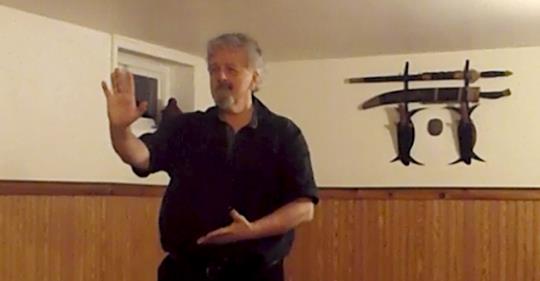
So I came up with doing some modifications to the first section of our long form and running with that. Here it is:

I think this form has a good balance of everything – it’s long enough that there’s enough to learn and practice, plus the movements are relatively simple for beginners, with no complicated kicking or turning manoevers. But it’s not so long that it’s going to take months to get to the end of.

Once the form has been learned and the first 6 posture principles of Tai Chi adhered to:

  1. Suspend the head
  2. Centre the coccyx
  3. Round the shoulders
  4. Bend the elbows
  5. Hollow the chest/raise the back
  6. Bend the knees

…and a reasonable level of relaxation achieved, then they can work on principles, like arms following the body, not moving independently. A good way to work on this is through silk reeling exercise.

Of course, after beginners have reached a reasonable standard in this form, they can move on to the full Lam short form, which is more of a challenge. But I suspect that for a lot of people, this little form will be enough.

I also updated my Tai Chi teaching website with a new name Slouching Tiger. Check it out.

Image credit: eberhard grossgasteiger

Why you can’t learn Tai Chi from a book

woman holding newspaper while burning

Photo by Bruno Moretti on Pexels.com

I’ve been talking a lot about how to move from the dantien recently, and you might be wondering how easy this is to teach or do.

As it happens, I was trying to get a friend to understand how to do it today. I’ve been trying to get him to do this for a while actually (more than 2 years), but despite practicing diligently, he’s never really got it before. He’s got better at parts of it, but never the most important bit – moving from the dantien. It’s a very difficult thing to teach. You can describe it in words, but they’re open to misinterpretation. You can show them what you mean by doing it yourself, but its very hard to see unless you know what you’re looking for. You can even try and move their body for them in the right sort of way, but again, it’s not really the same thing as them doing it for themselves.

For some reason, today the penny dropped and he got it! You could almost see a light bulb appear above his head. The key seemed to be a combination of using the phrase “the arms trail behind the dantien” and trying a double-handed silk reeling exercise for the first time and watching me do it. For some reason, this time, it worked. It was a real Eureka! moment.

Of course, he can’t do it perfectly yet, but at least now I know he’s on the right track. He’s letting the pull of his dantien guide his arms. It sounds so simple, but it’s very hard to actually do. You can lead somebody to the gate as best you can, but they need to go through it themselves.

What was interesting was that with this new way of moving, he instantly felt muscles in his abdomen and lower back moving in ways they hadn’t done before. They were being worked. Instead of this area being ‘dead’ it was now full of movement. So much so that doing a Tai Chi form in this way was suddenly physically demanding. What had once been empty, floating movement was now full, rich and damned hard work. It was also mentally demanding. If he stopped paying attention, he stopped doing it.

His immediate observation was, “You can’t learn this from a book”.

Yes, he’s right. You can’t.

To learn Tai Chi you need to practice, under the guidance of somebody who has gone through that ‘move from the dantien’ gate. Once you’ve got through the gate it’s much easier to practice on your own, as that is the basis of everything that follows.

What you can find in books, like the Tai Chi Classic, which I recently produced a commentary on, only really makes sense once you’ve gone through the gate.

A lot of the requirements of Taijiquan that you find in writings are really external rules to encourage you to go through that gate. For instance, the rules about feet matching the hands, and knees the elbows, etc. These are all external requirements for dantien-driven movement. If you truly are moving from the dantien then your feet and hands will already be co-ordinated. Your knees and elbows will already be in harmony. All these rules will make sense. Before then there are still too many possibilities of going down blind alleys or faulty understanding.

In that sense, books and rules are useful in that they can help you stay on course, but they’re also a trap that you can get stuck in.

Tai Chi is also not an intellectual process. It’s a feeling. As human beings we tend to want to define everything and label it so we can think we understand it that way. Tai Chi isn’t like that. You need to do it, not think it.

I heard about a teacher once that used to confiscate any Tai Chi book that he saw on sight for the benefit of the student attempting to read it. He was probably right.

Q&A with Michael Babin

michael

I’ve known Michael Babin (online) for a number of years, and always enjoyed his insights into online discussion forum arguments and martial arts in general. Michael lives in Canada and may, or may not, be a retired Tai Chi teacher. Do we ever retire? Now David Roth-Lindberg, another online friend, has done a Q&A with him and published it on his blog, Thoughts on Tai Chi.

It’s worth a read as Michael has quite a few insights into the world of being a Tai Chi teacher and his dry sense of humour always amuses me.

Q&A with Michael Babin

Michael’s blog

Thoughts on Tai Chi