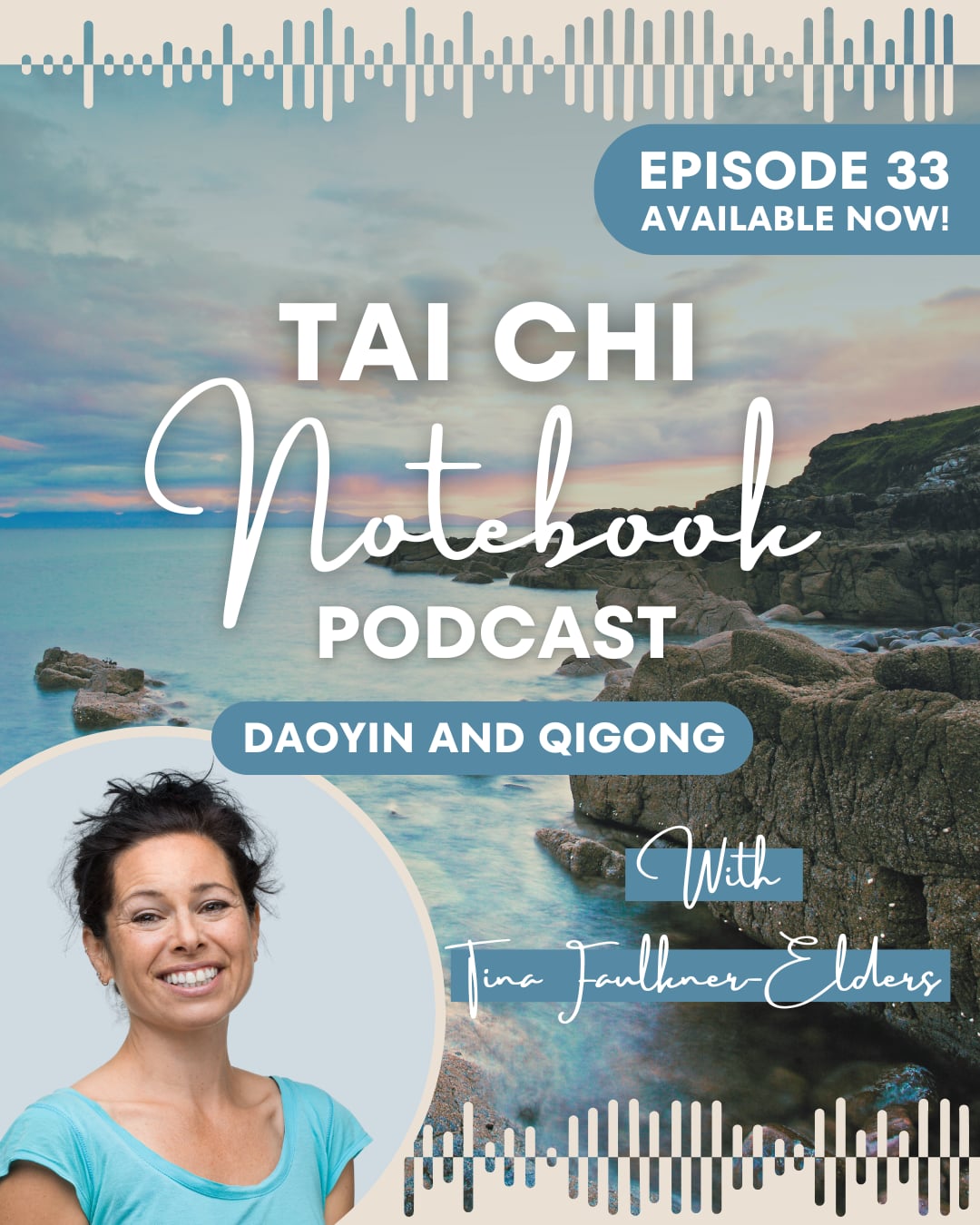
My guest for the latest episode of The Tai Chi Notebook Podcast is Tina Faulkner Elders, chief instructor of the RuYi School of Taijiquan and Qigong in Aberdeenshire. We talk about Tina’s training in qigong, first with her father, then in Beijing, China, and then on Wudang mountain itself, the legendary home of Taoism.
“According to Chinese medicine, all diseases are caused by blocked meridians (energy channels in the body). Hence, disease prevention and healing can be as simple as clearing meridians and expelling toxins and waste in the body.”
The above quote is from the Amazon description of the book PaidaLajin Self-Healing by Hongchi Xiao. If you’re a Tai Chi practitioner, have had acupuncture or are “into” Chinese medicine then you’re probably thinking, hmm that sounds quite reasonable, right? Wrong…
Well, the reason I’m not linking to that book on Amazon (which you can still buy for £5.20, btw) is that Hongchi Xiao, 61, of Cloudbreak, California, is currently on trial for manslaughter by gross negligence at Winchester Crown Court, in the UK.
“Danielle Carr-Gomm, 71, died in October 2016 while taking part in a workshop in Wiltshire which promoted Paida Lajin therapy, which sees patients being slapped or slapping themselves repeatedly.
Prosecutor Duncan Atkinson told Winchester Crown Court Mrs Carr-Gomm had been seen to be “vomiting, tired and weak” and had been “howling in pain”.
Mrs Carr-Gomm had Type 1 diabetes, meaning she had to take insulin every day to keep her blood glucose levels under control.
But Mr Atkinson told the court that she announced on the first day of the workshop that she had stopped taking her insulin, which Mr Xiao “congratulated” her on.
“He did nothing to alert others to the risk. He simply congratulated her and allowed a Type 1 diabetic to commence fasting without insulin,” he added.
There’s a strong crossover between Chinese martial arts and Chinese healing systems. In fact, it’s the link between the two that is often quoted as one of the strengths of the Chinese systems – that the practitioner learns how to heal the body as well as destroy it. And yet, these things keep happening.
One of Cheng Man Ching’s close western students died of a burst appendix that was left untreated because of a distrust of western medicine. I can think of at least one Qigong master who died from a hernia caused by their practice, or the Qigong student who died after not eating for 54 days. I was shocked to learn recently that the Wim Hof Method has a surprisingly high body count.
Let’s see this as a teaching moment. Qigong, massage, Tai Chi, breathing therapy, etc, can all be useful complementary practices to help the healing process, but no matter how wise, guru-like or charismatic your Qigong teacher, Kung Fu master, or alternative-healing therapist appears, you should not hand over your brains at the studio door along with the class fee. Remain skeptical, and trust only qualified medical practitioners if you have serious issues with your health.
Things have not worked out well for the author of the book that got me started with Tai Chi…
The reason I got interested in Tai Chi in the first place was a combination of watching Kung Fu, the classic TV series starting David Carradine, in my early childhood, which primed to be receptive towards “Kung Fu” (whatever I thought that was at the time), and Star Wars with its emphasis on Eastern-influenced spiritual warriors with special powers that could be trained with a rigorous martial arts-like training programme, and then reading The Tao of Pooh by Benjamin Hoff when I was about 20.
This was the version of the book I had, The Tao of Pooh, by Benjamin Hoff.
This simple book combined a nostalgic look back at the Winnie the Pooh books by A.A.Milne from my childhood, which I loved, together with the basics of Eastern philosophy. And somewhere in the pages there was a single mention of a martial art that embodied the best of both, called “T’ai chi ch’uan” (as it was always written back then). That lead me to my first Tai Chi class, and I was hooked from the first minute I tried it. There was no Internet back then – you had to discover martial arts classes by looking at notice boards, that were usually found in health food shops. I remember I got a wobbly 2nd-hand VHS copy of the teachers in my first class doing their form, and I must have worn it out playing it over and over to copy the moves. What we would have given to have had YouTube back then!
The nature of politics and human affairs
Today I wondered what had happened to Benjamin Hoff, and if he was still alive, so I went off to have a look. It turns out he is still alive, but a visit to his website doesn’t reveal the comfortable life of a well respected author, sitting back on his laurels and reaping the benefits that writing one of the most popular books on Pooh and Tao should surely bring you. Instead there’s mention of vicious legal battles with publishers that has lead to a deep depression and a lack of funds. It all sounds rather sad. It’s an unfortunate and desperate station for somebody who has brought so much pleasure to people in the world, not to mention uncharacteristic for somebody who also authored a book about, “how to stay happy and calm under all circumstances”.
In addition to The Tao of Pooh, Hoff also wrote The Té of Piglet, which is also very good, and (I’ve just discovered) he wrote his own Tao Te Ching translation:
“Hoff was awarded the American Book Award in 1988 for The Singing Creek Where the Willows Grow. The Tao of Pooh was an international bestseller and spent 49 weeks on The New York Times’ bestseller list. The Te of Piglet also became an international bestseller and spent 59 weeks on The New York Times’ bestseller list.
In 2006, Hoff published an essay on his website titled “Farewell to Authorship”, in which he denounced the publishing industry and announced his resignation from book-writing.”
If you want a summation of Benjam’s problems with the publishing industry then I’d recommend reading this essay “Farewell to Authorship” – it is very well written. It seems to have been removed from his website, but you can find it on an Internet archive page.
They say that every great career ends in failure but it’s sad to see that the author who inspired me (and presumably many others) all those years ago to start Tai Chi has ended up in this situation, but perhaps all human lives end in some kind of failure. It’s inevitable, it’s just the nature of the Tao. His books, however, remain great.
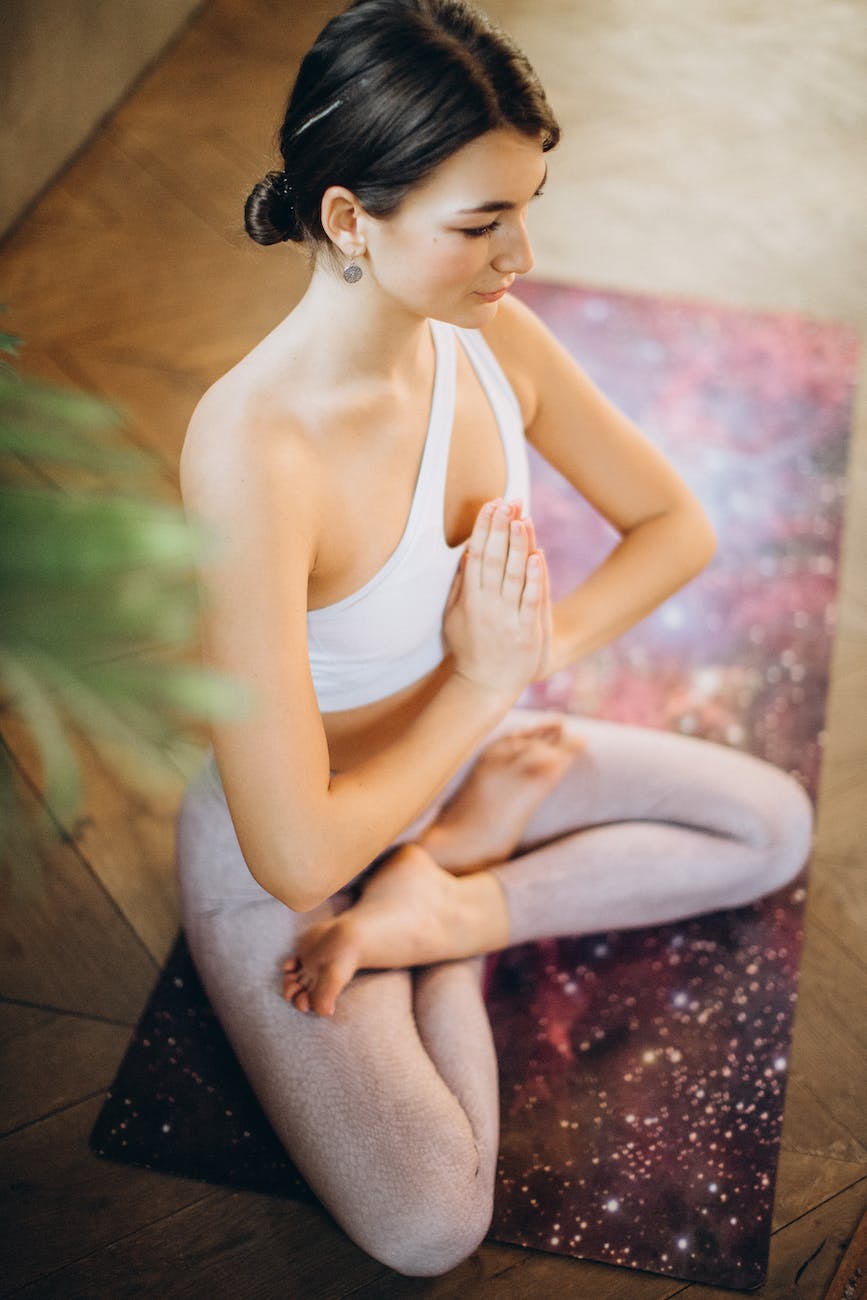
If you’ve been doing Tai Chi, meditation or yoga for any length of time you’ll have heard the old adage to ‘put your tongue behind the two front teeth‘. The explanation given for this is usually that it “connects the two meridians that go up the back and down the front of the body called the Ren and Du meridians, creating the micro-cosmic orbit”.
Micro cosmic orbit connected… man. Photo by Elina Fairytale on Pexels.com
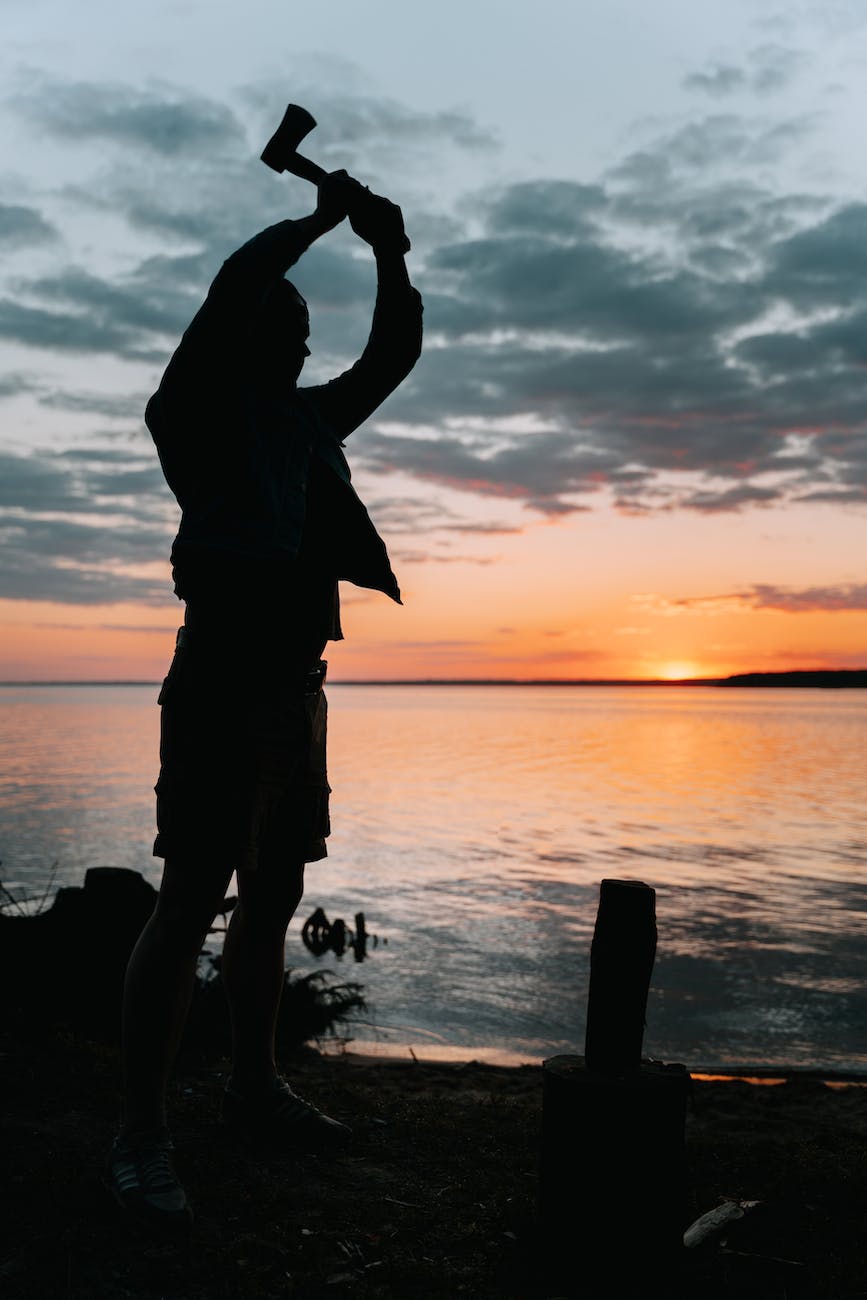
Personally, I have my doubts about the whole idea of ‘energy’ or Qi ‘flowing’ around the body. I often think it’s really an ancient aberration of the simple idea of forces moving inside the body. In Chinese martial arts there’s a phrase you often hear – rise, drill, overturn, fall, which matches this circuit in the body with a martial technique. The best example of which is Pi Quan from Xing Yi, during which forces in the body (jin) rise up and then come crashing down into a strike.
Strength and balance
However, it’s not just Chinese medicine that recommends this tongue position. I’ve recently discovered that there are a lot of Western sources advocating the same tongue position. For example, Colgate toothpaste has an article about correct tongue position on its website that recommends the exact same thing – the tongue resting on the upper palette behind the two front teeth. The article links to a study in Radiology and Oncology called “Three-dimensional Ultrasound Evaluation of Tongue Posture and Its Impact on Articulation Disorders in Preschool Children with Anterior Open Bite“, which notes that “children with poor tongue posture were reported to have a higher incidence of anterior open bite, a type of malocclusion where the front teeth don’t touch when the mouth is shut. This may be because the tongue puts pressure on the teeth which can shift their position over time.” (Colgate).
In this article from Healthline, Dr. Ron Baise, dentist of 92 Dental in London explains “Your tongue should be touching the roof of your mouth when resting… It should not be touching the bottom of your mouth. The front tip of your tongue should be about half an inch higher than your front teeth.“
While dentists may be aware of the benefits of good tongue position for your teeth and preventing problems with your speech, or mouth breathing from occurring, some exercise enthusiasts are going further and claiming that proper tongue position actually increases your strength and balance, something that is undoubtedly important for martial arts, like Xing Yi.
Pi Quan is said to be like the swinging of an axe. (Photo by Ivan Samkov on Pexels.com)
Now, I’m as aware as the next Tai Chi blogger that cherry picking studies that confirm your beliefs (and presumably ignoring everything that doesn’t) is a bit of a red flag. However, the idea that your tongue position effects strength and balance makes more sense to me than imaginary energy channels (Du/Ren) that may, or may not, exist in real life.
Apparently, good tongue placement can give you superpowers!
I remain slightly skeptical about the whole issue, however, my tongue does naturally rest behind my two front teeth on the upper pallet of my mouth… I can feel it there now as I write this. Was it always there? Or have I turned this into my natural position thanks to starting Tai Chi in my 20s?… I don’t know. All I can say is that it feels comfortable, and if my Ren and Du channels are connecting because of it, and my strength and vision is better because of it then…. so much the better.
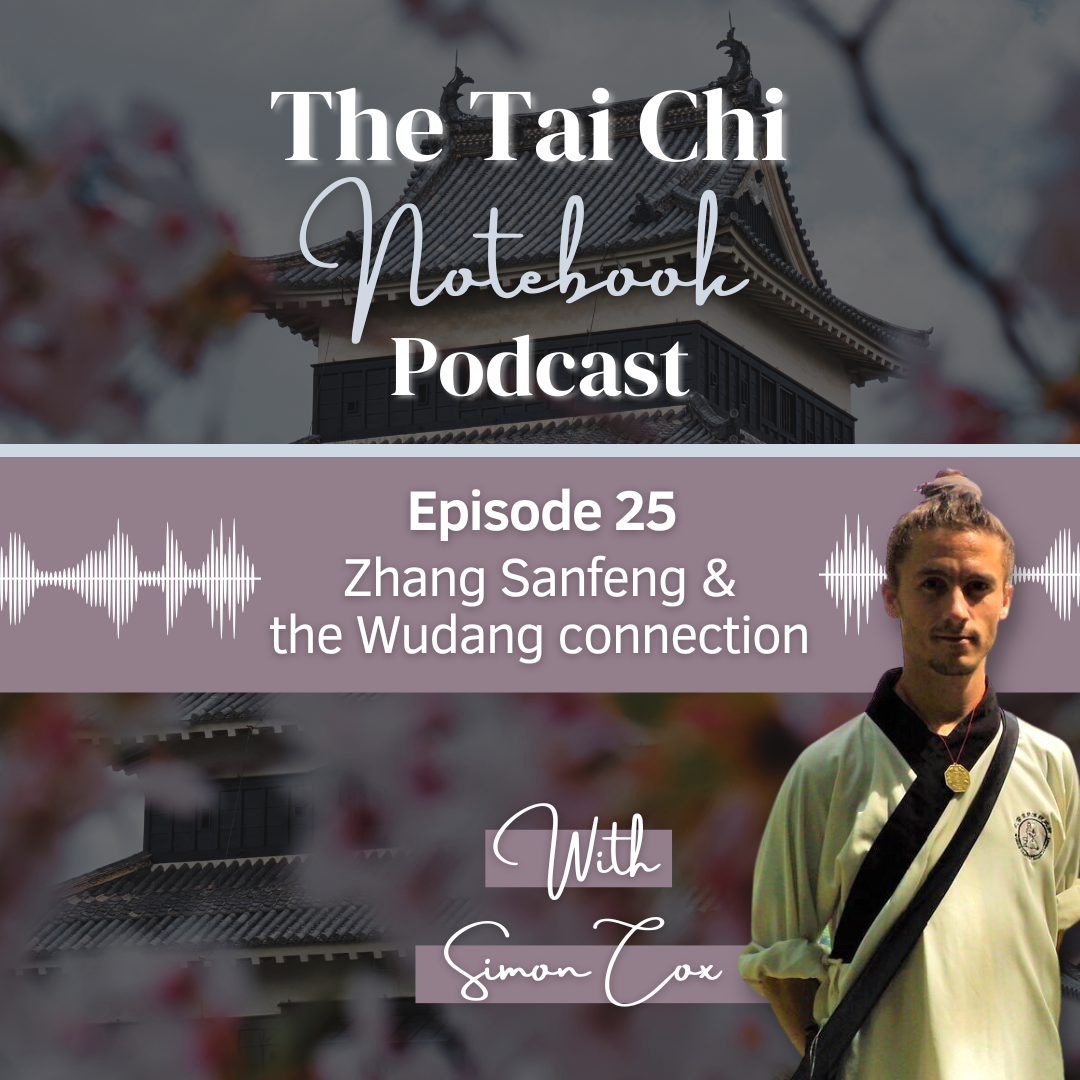
Simon and Brandi spent six years living and training in China under master Yuan Xiu Gang at the Wudang Daoist Traditional Kung Fu Academy. While there they studied Kung Fu, Tai Chi, Qi Gong, meditation, herbal medicine, Daoist music, and ancient and modern Chinese language.
After returning to the West, they started a Kung Fu school and community group in Houston Texas, where Simon was working on his PhD in Chinese and Tibetan mysticism at Rice University. At the end of 2019, they moved up to the Okanagan Valley and began sharing Wudang teachings with the local community.
What I really wanted to get at with Simon was an elucidation on his article about Zhang Sanfeng – exactly who was this mysterious Taoist immortal who is often credited as the founder of Tai Chi Chuan? I also wanted to find out more about Wudang mountain, and where its martial arts really come from. I hope you enjoy are conversation!
The article On the Historical Mystery of Zhang Sanfeng by Simon Cox, on the history of Tai Chi Chuan and its connection to Zhang Sanfeng is great. I’ll just quote a couple of paragraphs from near the end, but recommend you read the whole thing for context:
It seems like Tai Chi was really a Republican era (1912-1949) category that became a sort of umbrella term for various Chinese martial arts that are practiced slowly, containing such multitudes as the ancient martial arts of Chen village, the later arts of the Yang family, and the weird things people were doing at Wudang, in Zhaobao village, and even the government-created variations on these styles. From this view, asking which style started it all is rather meaningless. The historical connections simply aren’t there. From the densest of historical positions, there is no evidence anyone practiced anything called Tai Chi Fist before the 20th century. It arises as a high prestige category in the context of post-Qing Chinese nationalism. Every slow-ish martial art in China seems to have been automatically re-branded as a form of Tai Chi.
According to the Yang Family oral tradition, Yang Luchan 杨露禅 (1799-1872), the founder of the style, called his art variously Cotton Fist 綿拳 or Transforming Fist 化拳, and it was only during his time in Beijing that a Confucian scholar Weng Tonghe 翁同龢 (1830-1904) witnessed him demonstrating his style and wrote a poem about how it embodied the principles of Tai Chi. According to this oral tradition it was after this event that the art came to be known as Tai Chi Fist. This story was first published in the 1930’s and is almost certainly apocryphal. But even if we take it at face value, we arrive at the inevitable conclusion that Tai Chi Fist was an appellation applied first to Yang family martial arts and then later, during the first decades of the 20th century, expanded to include Wudang and Chen styles.
Simon Cox – On the Historical Mystery of Zhang Sanfeng
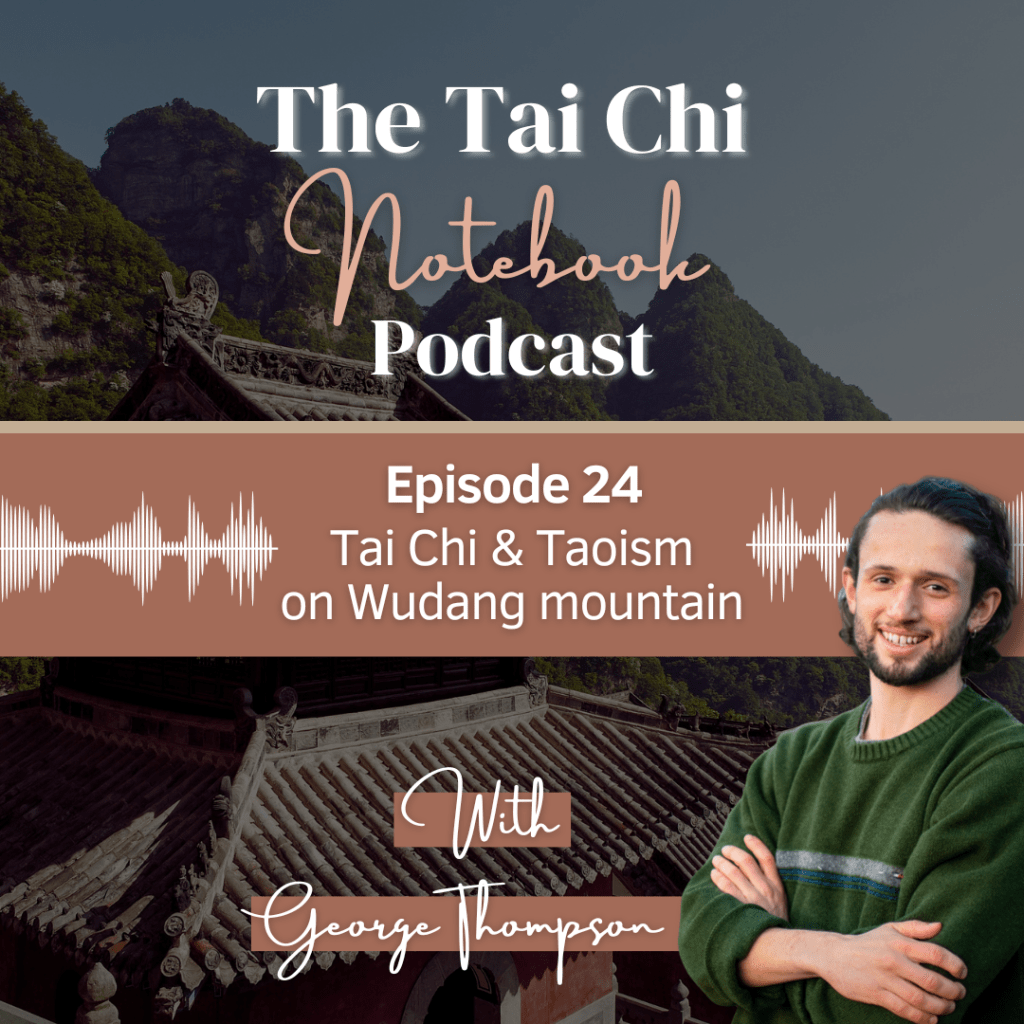
In this episode I ask George what it is like to live and train Tai Chi on Wudang Mountain, what Wudang Tai Chi is like and what lessons he’s learned from Taoism.
You too can learn from George’s teacher, Master Gu, 15th generation of Wudang Sanfeng Pai of Wudang mountain via his online learning site at https://www.taoistwellness.online/
Click on the 7 day trial option, then use the coupon code TAICHINOTEBOOK when you sign up and you’ll get a lifetime 8% discount. That’s equivalent to one free month a year!
You can get a similar discount from George’s website https://www.wayfinder.academy/ using the same discount code TAICHINOTEBOOK when you sign up.
I don’t normally do a preview of my podcasts guests before the podcast comes out, but in the case of George Thompson I think it’s worth doing one because not only is he a fellow Bristolian, but he has so much great media out there for you to view that it’s worth watching some of it before the next podcast drops (which will be episode 24, due in a few weeks).
George has a great YouTube channel that has lots of Tai Chi and Taoism videos. He spent time in the Wudang mountains learning in a small Tai Chi school and there are lots of great videos shot in China that just look amazing.
He also makes hour-long films and I’d recommend giving Journey to the East a go, it’s a documentary of his last trip to Wudang and his adventures getting there because he was attempting to travel by train across Europe to China just at the same time as the pandemic was breaking in 2020. Check it out!
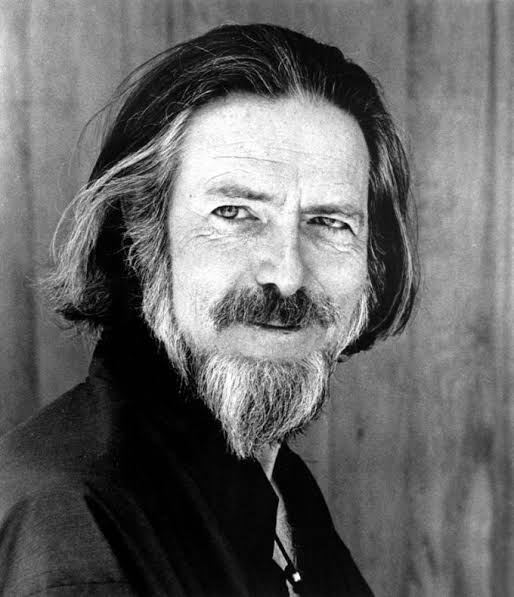
Alan Watts – what a guy! As the public philosopher entertainer de jour he spearheaded the Eastern spirituality movement of the 60s that took America by storm and forever gave Tai Ch its hippy associations. The lectures on Eastern religions, particularly Zen, he did for a local radio station in California have provided endless motivational video fodder for advertising-packed YouTube videos, and they’re all very good. For example:
He had such a good speaking voice, and could articulate mystical ideas, particularly the idea that existence was simply consciousness playing an eternal game of hide and seek with itself, in ways that Westerners could understand. Of course, the downside of that after you die your words get used to advertise all sorts of things you may or may not have been in favour of. For example, he’s currently doing a voice over for a company selling cruises on UK TV at the moment. I’m not sure what the old guy would have thought of that, but there you go. That’s life! It’s never what you expect it to be.
I’ve heard people say that Alan Watts was a good communicator, but a poor example of the Taoist ideas he espoused. This is mainly because he was an alcoholic who died at the relatively young age of 58 due to related health complications. However, if I look at the 60’s popular philosopher entertainers like Alan Watts and Joseph Campbell, they’re so much more interesting and interested in their ideas than today’s sorry crop of pitiful, grifting, sophists like Joe Rogan, Scott Adams and Jordan Peterson. All of them are usually trying to convince you of some terrible conspiracy theory with one hand while selling you something with the other. At least Alan Watts had enough self respect to be dead before he started trying to sell me cruises!
I saw one of Alan Watts’ videos on YouTube recently, that sparked a few ideas in me. It was to do with the Taoist idea of Wu Wei. It’s called “Alan Watts – The Principle of Not Forcing”
“Not forcing” is Alan’s translation of the Taoist idea of Wu Wei, which is usually translated as “not doing”, or “doing nothing”, however Alan’s translation is much better for martial application. In martial arts, like Tai Chi, it is forcing things that is bad. Alan even mentions Judo in his explanation above.
In English, the idea of doing nothing sounds too passive. Tai Chi isn’t passive. You can’t do a marital art by doing nothing, so I much prefer the translation of “not forcing”. It’s what we aspire to in Jiujitsu as well as Tai Chi. If you feel like you have to force techniques to work in Jiujitsu then it’s not the right way. It might be required in a time-limited competition, but the Gracie family were always famous for not wanting time limits on their matches, mainly because, with their hyper-efficient style of Jiujitsu, they knew they could survive longer than their opponent, exhausting them in the process. When you are forcing things to work you are burning energy, and wearing yourself out.
I think different styles of Tai Chi might look at this situation differently though. Yang style, and its derivatives tend to effortlessly breeze through the form. The emphasis is on efficient, continuous movement and relaxation. And while it may look effortless, you feel it in the legs, even if you are not visibly out of breath. Chen style seems to want to work a little harder. The stances are lower, there are occasional expressions of speed, power and jumping kicks. But there is still that emphasis on being like a swan moving through the water – graceful up top, but the legs doing all the hard work below the surface.
But regardless of style, all Tai Chi forms follow the same principle: Wu Wei.
So often we have to practice Tai Chi in our front rooms, back gardens or patios because of time pressures. Or maybe we only get to practice at a class in a village hall, gym or community centre. Either way, our surroundings are often far from natural.
Being able to practice Tai Chi in an environment where there were no other people, no human sounds and no interruptions was a blessing. It was possible to really sink into the environment for once, and not just my legs!
It’s a process one of my teachers calls “being a teabag in the ocean”. If you want to take in the good stuff from the natural world around you then you need to adopt the attitude of being like a teabag in the ocean – i.e. let nature move through you as well as around you, so that you don’t feel like something separate to it. Absorb it, soak it in. I’d say most people practice Tai Chi as if they are a teabag that’s sealed inside a plastic bag then dropped in the ocean. They can be doing great Tai Chi, but they are perfectly contained within themselves and not interacting with the environment. Often there’s not much environment to interact with, as mentioned previously, but if you get the chance to practice Tai Chi out in the woods, you should take it and take the opportunity to get out of that plastic bag.
Before you practice the form, stand for a few moments and try to let the barriers between you and your surroundings break down. Your mind should be focused on the moment and on your breathing, after all, that is as much a part of nature as anything else. Stand like that for a while before doing the form and just experience it, don’t think about experiencing it.
Then as you go through the movements of the form, you’ll start to feel like you are moving with the natural patterns around you. Don’t worry if your form takes on a subtly different quality than normal. It’s all part of the process.
I find that I don’t have as much free time for this in my normal life as I do when I’m on holiday, but I’m going to try and make an effort to get out to a secluded place now and again and practice my Tai Chi out there because the effort is well worth it.


 The Tai Chi Notebook