Thoughts on Tai Chi Push Hands

Photo by mana5280 on Unsplash

Range

People tend to do push hands at the wrong range. I think the combat benefits of training push hands disappear almost entirely when you are too far out.

I notice when I train it with people they keep wanting to edge back. You need to be a range that feels uncomfortably close, until it feels comfortable.

If you look at MMA (sorry to use that as an example, if it rubs you the wrong way, but it provides brilliant examples and feedback of the dynamics of two people in a violent encounter) one of the big, high-percentage, often fight-ending, techniques is the counter left (or right) hook; the check hook. This happens after the fighter throws a jab – you move back (or slip) and throw your hook over the top – that’s the range push hands is working in, and a good practical example of what skill at that range can do.

If you watch this video of Cheng Man Ching pushing hands you can see he tries to stay in close all the time – in fact, when he’s launching people he kind of ‘cheats’ and takes an extra half step in so he’s right inside their base, which enables him to show off a bit more on the distance he can push them – this is only possible because they are keeping their ‘front door’ open with a wide stance. The way I was taught is that your toes match the opponent’s heels, fist width apart to allow for ‘shin biting’. (Lots of people do this distance correctly, but go shoulder width apart – leaving the groin too open and letting people step in to launch them. It’s just a bad habit to get into).

Don’t mistake push hands for sparring

Chinese martial art people in general I think spend too long in these double or single ‘arm contacted’ type positions – in more martial sparring sessions these moments happen in split seconds. People don’t stay here. If you end up putting your arms out looking for that position you get punched on the nose. I think doing too much of it breeds bad habits. You’re doing that ‘safe’ training to learn skills that are hard to acquire, which then get used in freer environments, rather than try to mimic the ‘safe’ environment in freer training.

Staying in this range all the time with another person doing ‘soft’ stuff like push hands seems to lead to teachers who start showing off and generating cult-like guru behaviour. It’s a trap you can fall into if you’re not careful. If your students start treating you like a holy saint, then that’s a red flag!

I’m really not a fan of the kind of following that builds around some of the big names in Tai Chi, like this guy, Adam Mizner. He plays the guru card well, and I’ve seen lots of videos where his students really overreact to him in a way that makes me think they all fell down a rabbit hole years ago. However, the guy clearly has some good skills at push hands, as you can see in this video. This video I think is one of the least worst of his I’ve seen (in terms of over reaction from his students) – yet the group still all stop what they are doing to ‘watch the master’ and play his guru game:

Fighting

It’s always worth repeating, even though its kind of obvious, – you don’t need push hands to fight. Combat sports turn out accomplished fighters quickly without these methods.

You can practice all the applications in a Tai Chi form in push hands – it’s one step up from doing them as stand alone techniques because it requires more timing, flow and ‘listening’, but this is still not ‘fighting’.

Jin

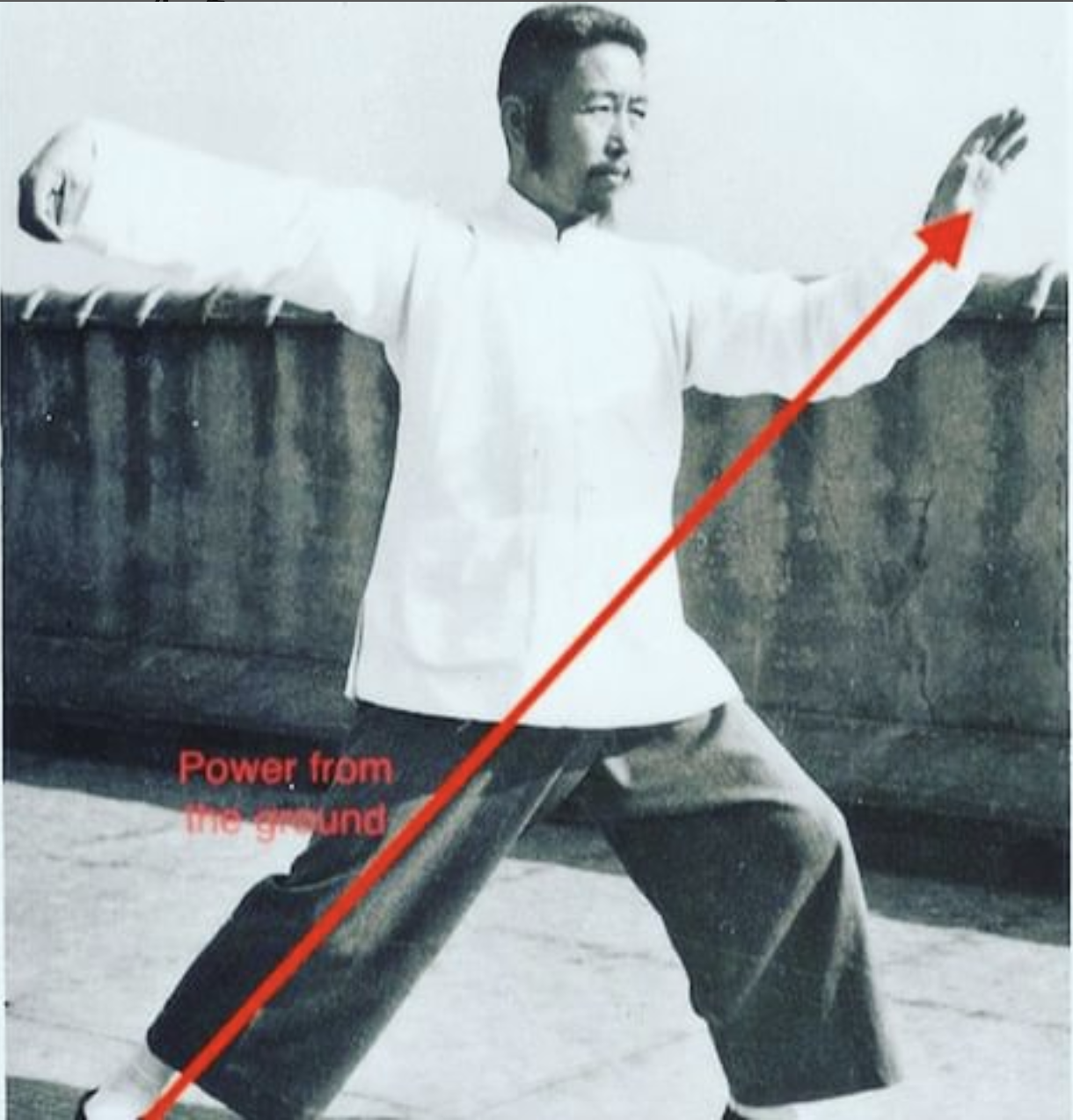
One of the reasons for push hands is to learn to use Jin not Li. For a short answer of what that means, I mean using the ground strength in your movement (jin), not local strength (li). It’s easy to fool yourself that you’re ‘doing it’ when you perform a Tai Chi form, because there’s nobody else there. Can you ‘do it’ when somebody is providing some light resistance? Or trying to ‘do it’ back to you? Push hands enables you to find out. I wish people would view push hands more as a tool for learning that, not as a competitive sport of limited wrestling. It’s like people have been given a knife, but they insist on using it like a spoon.

And the use of Jin in directions also requires a strategy to use them, which can also be practiced in the laboratory of push hands. Listen, stick, yield, neautralise and attack.

In push hands you ‘listen’ to the push from the opponent (with your body), you stick to their limbs (so you can feel and listen) then you yield to their pressure, which leads to neutralising their attack, so that you can attack yourself.

In sparring you use the same idea, but you cannot rely on being stuck to their arm. However, you need to keep the same process going that you’ve learned in push hands, just sometimes there will be no contact – you can still neautralise, and yield, through subtle changes in body posture and position, thanks to your use of sensitivity. Once you take ‘push hands’ into a more real sparring environment, I think you’re in the same territory where Xing Yi spends most of its time training. In Xing Yi it’s just the same idea, even if it looks different – you do not attack blindly at the opponent – that won’t lead to success against somebody good, bigger or stronger. In Xing Yi we have this phrase “don’t attack when you see an opening, attack when you see the heng” – I would interpret that as you only attack once the opponent’s attack has been neautralised (heng being the point of neautralisation); depending on your level of timing, this can be before the attack has even been launched. Good opponents will leave fake ‘openings’ for you to attack. Therefore you don’t attack based on what your eyes alone see – you attack based on feeling for that moment of neautralisation. Different training methods – same results.


Was Stanley Henning wrong about Taijiquan?

Zhan Sangfeng

I’d just like to draw your attention to this excellent article by SSD about Stanley Henning’s often-quoted article Ignorance, Legend and Taijiquan’ on the origins of the term Taijiquan. Henning’s article is often used to discredit the idea of Taoist origins of Taijiquan. However, it’s not without its problems, as Adrian Chan-Wyles (ShiDaDao) writes:

The tone and design of this work is generally dismissive and denigrating toward the subject of Chinese traditional culture, and represents, in my opinion, a continuation of the imperialist Eurocentric attitude that is essentially ‘materialistic’ in nature, and implicitly ‘intolerant’ to any other world-view. Astonishingly, this attitude that misrepresents Chinese culture is prevalent (even dominant) amongst Western martial arts media, and is found within martial arts online discussion forums, etc. One or two Taijiquan magazines in the West even partake in this attitude that demeans the Chinese cultural basis of the martial art they practice and support. Working from Chinese language source texts – which I do – I can say without a doubt that Henning’s viewpoints are not acknowledged as legitimate, and are ignored in China. The idea that certain lineal descendants of the Wu family of Taijiquan claim to have written the Yang family Taijiquan Classic texts appears to be only a Western trend – as this idea is not accepted within China. Indeed, such a claim is viewed as the Wu family trying to raise their lineage of Taijiquan above that of the Yang, but again, such a phenomenon could only happen in the West, outside of the cultural controls of Chinese culture. What is important is that the traditional Chinese cultural heritage is acknowledged and treated with respect. SDD)

By Adrian Chan-Wyles (ShiDaDao) from https://thesanghakommune.org/2012/07/13/how-old-is-the-term-taijiquan/

From Tai Chi to Systema with Rob Poyton

My guest this episode is Rob Poyton a veteran of the UK Tai Chi and martial arts scene. These days Rob is a teacher of the Russian martial art of Systema, which he has been teaching in the UK since the early 2000s and has run workshops and seminars all over Europe. Rob is also a prolific author of Systema books and videos which you can get via his website Cutting Edge Systema which is found at systemauk.com

In this wide-ranging discussion we talk about what the UK Tai Chi scene was like back in the 80s and 90s, and the similarities and differences between Tai Chi and Systema. We even get into a bit of politics, and talk about Rob’s experiences as a professional musician and his sideline as a horror fiction writer. So, sit back and enjoy as we get under the skin of Tai Chi and Systema.

Autumn Tai Chi movements

Photo by Pixabay on Pexels.com

As we’re moving into Autumn, there’s bright sun and a bit of a cold bite in the morning air during Tai Chi practice. I find a change in the weather is a good time to reflect on the things I’ve learned so far and to change the focus of my practice back towards the fundamentals.

I feel like summer was a time to be more active and energetic in my practice and Autumn is a time to be more reflective, so I’m picking up the practice of fundamental single-arm silk reeling again. Refocusing my Tai Chi on the idea of 1) sinking my weight down into the lower body and 2) generating movement from the legs, hips and feet while trying to stay as relaxed in the upper body as I can. I prefer to focus on these two tangible things rather than to talk too much about dantien and qi.

So, let yourself do the movements of a Tai Chi form, but remember, you’re not allowed to move your arms at all! And by that I mean, you cannot move from your arms all. Your arms move, of course, but they move because of the lower body. And don’t just pay lip service to this idea. Really do it. Ban yourself from arm movements and see where it takes you. Movements that could be seen as superficial take on whole new layers of meaning when practiced this way.

Podcast Episode 2: Byron Jacobs on Beijing martial arts

Episode 2 of the Tai Chi Notebook podcast is out!

Byron Jacobs is a teacher of Xing Yi and Bagua based in Beijing, China. He’s a student of the famous Shifu Di Guoyong and is heavily involved in the martial arts scene in Beijing. As well as training traditional martial arts he’s also a BJJ practitioner and competitor.

If you’d like to be taught by Byron in the arts of Xing Yi and Bagua, then he has an online learning platform available .

In this wide ranging discussion we talk about training Xing Yi, Bagua and Tai Chi and whether Wu Shu will ever get into the Olympics. We also find out what it was like to train martial arts in Beijing during the Corona virus pandemic, and what the Chinese BJJ and MMA scene is like.

Show notes
—————

(9.45)
Byron’s Hua Jin Online learning platform
https://www.patreon.com/mushinmartialculture

(15.22)
Byron’s Mu Shin Martial Culture YouTube channel
https://www.youtube.com/channel/UCg_V6eznSvYOFz2naGlgRpg

(47.05)
DQ’d for Kicking TOO HARD? – Doctor Reacts to Olympic Karate Controversy and Knockout Science
https://www.youtube.com/watch?v=6QFxxM3QOws

(1.05.30)
Speed passing by Rafa Mendes
https://www.youtube.com/watch?v=Qu_9Lcdrh_w

(1.18.11)
Ku Yu Chang (Guruzhang’s) Yang style Taijiquan:
A STUDY OF TAIJI BOXING by Long Zixiang
https://brennantranslation.wordpress.com/2018/03/30/the-taiji-manual-of-long-zixiang/

(1.23.00)
Stand Still Be Fit by Master Lam Kam Chuen
https://www.youtube.com/user/StandStillBeFit

You can find it on all the usual places you find podcasts – search for The Tai Chi Notebook on Apple podcasts, Spotify, etc.. or here’s a link:

Spotify
Apple
Web

Lineage Queens

If I had a pound for every time I’ve heard a Chinese martial artist start to explain the history of their style in a way that means, by sheer coincidence, that their particular lineage is the most special and authentic example of all the different branches of their style, then I’d be as rich as a relative of a Conservative MP in 2020 with no previous experience of procuring PPE equipment.

So, what’s going on here? Obviously not every single Chinese martial artist you talk to can have the ultimate lineage of a style, so one of two things is happening here. Either, you’ve just happened to bump into that one guy on the planet who has the best version of this style known to mankind… Or, like most human beings, the person talking lacks the self awareness to see that they are parroting a line they’ve been sold, and that they’re now selling to you. Everybody likes to think that they are doing the real thing, and that means, that all the other people who do their martial art a bit differently to them therefore can’t also be doing the real thing. As a side note, I think the elaborate and fanciful origin stories of most Chinese martial arts serve a similar purpose – to make the students confident that their style is somehow better than the others.

The most recent example of this phenomina I’ve listened to was in an episode of a podcast featuring a Chen style lineage holder talking about why his style is the best. The whole episode is essentially about who has the real Chen style lineage – the Beijing Chen group or the Village Chen group. I don’t do Chen style myself, and don’t really have any desire to either, so I don’t have a dog in the fight, but listening to the long, convoluted reasoning he used to explain exactly why his lineage is better than the others, I do wonder if he’s ever stopped to listen to himself?

Martial arts styles are essentially brands, and everybody involved is selling you their particular brand in one way or another, whether they realise it or not. This is a cynical view to take on martial arts, I agree, but I think it’s also historically accurate. Martial arts styles only appeared in China the age of commercialism when people realised that it was possible to make money teaching them. Before that different styles didn’t necessarily have different names, or names at all. Once you could make money teaching it was necessary to differentiate your particular style from others, otherwise, how would you attract students?

I don’t mean to single out the Chen style guy – he’s not alone by a long stretch – but it seems to me that all Chinese martial artists have some version of the same story they tell themselves about why their lineage is the most special, unique or authentic. Heck, I used to be one of those guys myself!

This is usually the point where my very wise Polish BJJ friend taps me on the shoulder and reminds me with his usual Spartan brevity that the only reason lineage becomes important is because the art has died and nobody is using it to fight with any more.

Again, that sounds a bit harsh, but he could well be right. BJJ is a brand like any other martial arts, and very marketing heavy, but in BJJ circles people don’t tend to care about lineage in the way they do in Chinese martial arts because the art has a healthy competiton culture. Nobody would say things like, “This is not the real Rio De Janeiro style of jiujitsu”. They’d just get laughed out of town for saying that. In BJJ, if you can make a technique work in training, or even better, in competition, then it’s valid. There is no need for any other type of validation. If it works, it works. You are expected to add to it and innovate. I really like that. Sure, there are a few branches of the BJJ tree that venerate the original self-defence orientated teachings of Helio Gracie as if they were written in stone, and refuse to modernise for fear of losing their street effectiveness, but they’re not that big a deal in the great scheme of things. The rest of the BJJ world carefully steps around them so they can carry on living in the 1930s without affecting anybody else. It’s not a big problem.

Lineage is real. It exists. But surely, what matters more is what we can actually do with the art?

My question is always, “does it work?” If it does, I’m interested.

Never let your knees go over your toes… or should you?

I remember when I started Tai Chi in the 90s, one of the things that was talked about a lot was that you should never let your knees go beyond the line of your toes in a forward stance.

YCF: Knees not extending past the line of the toes.

Letting this happen was always seen as unequivocally bad. Not only was knees beyond toes seen as structurally unsound (your weight is too far forward making you easy to pull off balance), but this was seen as the primary cause of the epidemic of so many Tai Chi people having bad knees.

The Snake Creeps Down posture in particular was quite often used as an example of a badly done posture by Western dilettantes.

But it always struck me as a bit odd that it was seen as being such a dangerous thing to do. If you were training the martial side of Tai Chi then you were being punched, thrown and armlocked on the regular. Worrying about your knees going over the line of your toes seemed a minor danger in comparrison.

Fast forward to 2021 and today I found out that a lot of BJJ people (an art that specialises in slowly destroying your body over time) were raving about the benefits of the method espoused by the Knees Over Toes Guy on YouTube, who had achieved great results reparing people’s knees using a traning methods that empahsises, yes, you guessed it, putting your knees beyond the line of your toes as much as possible.

Interesting. Here’s what he says:

A year went by with no results. In fact, I was certain I needed another surgery when a spark of truth finally presented itself…

“The athlete whose knees can go farthest and strongest over his or her toes is the most protected.”

Everything I had been taught up to this point by dozens of trainers and physical therapists was very clear: NO KNEES OVER TOES — but when I read this statement, I immediately knew it was true.

Knees Over Toes Guy

The write up of his method is here. And here’s a video of his basic method is here:

The logic seems sound to me, so if you’ve got knee trouble, you might want to give it a try.

It makes me think – is the epidemic of Tai Chi people with bad knees (if it really exists) caused by the knees going over the toes? Or is it more likely because that group self-selects for other unhealthy behviours?

The future of push hands

I think push hands is completely flawed as a competitive sport, which is why it ends up as a shoving match, but somebody (Jet Li?) is trying to change the rules to make it work better as an Olympic sport…. So here it is! It’s essentially more like wrestling, which is probably a good thing as it means you can move your foot.

And it’s got takedowns, but I think the question is then always … why not just compete at Shuai Jiao?

What is an authentic understanding of Chinese martial arts?

Qing Dynasty martial artists performing in a procession (between 1901-1904)

I’m still fascinated by that film I posted a little while ago of China from 1901-1904. It’s as close as we’ll get to seeing the people who were around at the time that the popular martial arts of Northern China – Taijiquan, Baguazhang and Xingyiquan were being formalised into the structures and routines we still know and recognise today.

It gives a small insight into what the martial arts of the time were like, we have an idea of what they practiced, but we don’t always know where they practiced them, and to some extent really why they practiced them. There’s a particular sequence starting at 17.10 in the film where we see a procession of sorts going along a riverbank and then entering a village or town. There are martial arts performers doing twirls and spins of their weapons as they go. The setting is informal, music is being played (we see the musicians) and it has something of an air of the Saint’s Day religious processions you still see going on between villages in rural European nations, or the May Day “Hobby Hoss” procession that can still found in Cornwall in the United Kingdom.

But back to China. The martial artists involved seem embedded into the culture of the place and time as much as the musicians or flag holders.

“There was a well established pattern of village festival culture in Northern China. The ritual was called a sai and it was based on a three-part structure: inviting, welcoming and seeing off the gods. Ritual could last anywhere from three days to a month. Wherever you happened to be, these rituals were happening nearby every two weeks. A smaller sai might have only 50 people officiating and a thousand participants, while a large one might involve hundreds of ritual experts and 100,000 participants. A large ritual could invoke as many as 500 gods, their statues escorted out of temples in massive processions with armed escorts of martial performers that snaked between villages for miles.”

“According to David Johnson, ritual festivals were so common and so old and so large that they were overwhelmingly the most important influence shaping the symbolic universe of the common people. Regionally they happen about every two weeks and could involve over a hundred villages, with processions that strung out for miles attracting thousands of spectators. “It is quite impossible to understand what villagers… in North China thought and felt about the world of politics, about Chinese history and traditions, about the world of gods and demons, or about any of the grand matters of life and death, without a close familiarity with sai [and similar rituals]. Ref: David Johnson 1997, “Temple Festivals in Southeastern Shanxi”, Overmyer 2009,8.”

From Tai Chi, Baguazhang and the Golden Elixir: Internal martial arts before the Boxer Rebellion by Scott Phillips, p173.
Qing Dynasty martial artists performing in a procession (between 1901-1904)

I don’t think we can assume, from one film. that all Chinese martial art of the period was like this, but it’s fascinating to see a glimpse of how well it was integrated with everything else.

As Charles Holcombe wrote at the start of his seminal 1990 essay on the subject, Theater of combat: A critical look at the Chinese martial arts

Everywhere in China the martial arts either present themselves in the guise of simple exercises or are shrouded in arcane religious mysteries. Western enthusiasts often feel impelled to strip away these religious trappings and construct a version of the martial arts that is neither simple gymnastics nor religion, but emphasizes true hand-to-hand combat skills. The question remains, is this an authentic understanding of the martial arts?

Charles Holcombe, Theater of combat: A critical look at the Chinese martial arts