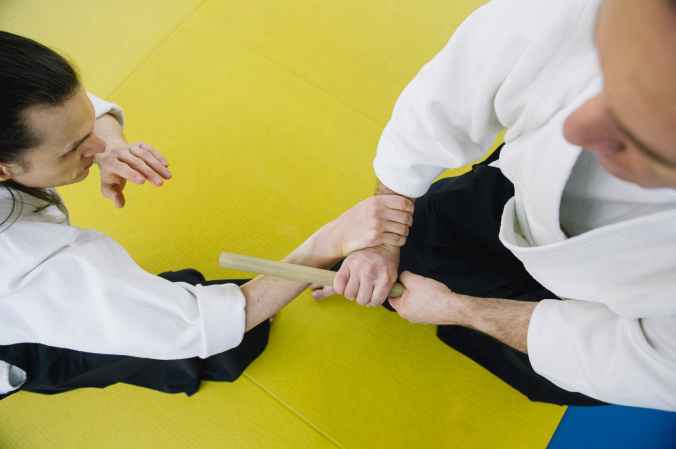
My first time sparring in BJJ

meBJJ

I was reminded recently of a blog post I wrote for Cook Ding’s Kitchen a few years ago about starting BJJ after years of doing Tai Chi. I just re-read it and decided it was ‘not too bad’, so I’m sharing it again here.

Here’s a quote about my first time sparring in BJJ.

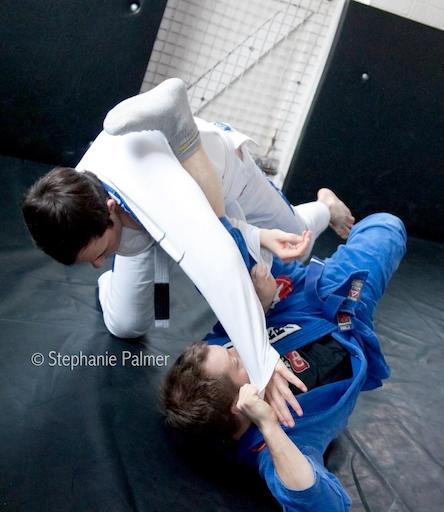
We fist-bumped again and went for round 2. He then proceeded to act out a BJJ clinic on me. He was tapping me out using every sort of conceivable lock or choke hold I could think of at a rate of one tap every 2 minutes. And worse, he wasn’t even trying. I quickly realised he’d let me tap him the first time just to see what I could do. This went on for the full 30 minutes. It wasn’t a matter of being out-muscled – it was clear that he possessed a knowledge that I didn’t. I wanted to lie down, curl up and die after about 10 minutes, but something in me refused to give up and I lasted until the end of the class. The black belt running the class was keeping an eye on me, and expressed some concern about the curious wheezing noises my breathing was making and asked if I’d like to sit out, but my pride wouldn’t let me. I kept going until the end. It took me about 2 days to recover fully. My next class was the same, but this time the blue belt I fought was a smaller female, who repeatedly jumped on my back and tapped me out with chokes until time was up.

That was it, I was hooked.

There was a type of knowledge here I could learn, and it worked in a fight, and it didn’t matter if the other person was stronger than you. There were no forms, deadly techniques or imagining ‘what if’ scenarios. You were hit by reality from the first fist bump.


Take a long hard look at yourself, Chinese martial artist

mirror fragments on gray surface with the reflection of a person s arm

Photo by Thiago Matos on Pexels.com

A new video in the long line running ‘Tai Chi master vs MMA guy’ series got posted the other day. Rather than talk about it here straight away I wanted to see what the reaction was from the martial arts community, and boy, it didn’t disappoint!

This whole MMA vs Tai Chi genre was started by the now-infamous Xu Xiaodong who posted the first video showing what happens when a delusional Tai Chi “master” gets in a fight with an MMA guy.

The qualifications for being a “Tai Chi master” these days seem to be that you have:

1) The backing of Chinese state TV, who will post lots of faked videos of you performing magical martial skills.

2) You have a sufficient number of minions and followers to do you bidding.

3) You look the part (silk pyjamas) and have can talk a good talk about your abilities.

Of course, none of these martial abilities are grounded in reality, so when you get in a challenge match with an MMA guy it usually ends quickly and badly for you. Chinese martial arts, particularly Tai Chi, is the focus of the soft power emanated by Beijing and the hyper-nationalistic Chinese government on the global stage. Therefore, publicly humiliating a Tai Chi “master” doesn’t make the MMA guy very popular in China, and Xu Xiaodong has been badly persecuted – his social credit score is now so low that he can’t even travel on trains and his social media accounts keep being deleted.

After the initial video of Xu Xiaodong surfaced he didn’t let the persecution put him off and he kept calling out the masters boasting of their skills on state TV. Challenge after challenge followed. One involved self-proclaimed Tai Chi/Xing Yi Master Ma Bao Guo who had previously paid a retired cage fighter Peter Irving in the UK to perform in a demo video that made him look good, and was boasting that this video was proof he was the real thing.

In this excellent article, Peter recounts the story behind the video.

Here’s the video:

To anybody that knows anything about fighting it’s obvious that Peter is just feeding attacks to Ma who reacts with some twitching responses. The fact that some people thought this was real says a lot about the mentality of minions and followers.

Xu and Ma’s challenge match was all set to go ahead (and would have ended the same way as all the others) but Ma actually called the police on his own challenge match and it was called off!

But Ma Bao Guo wasn’t giving up. At 69 he recently got in a challenge match with a San Da (Chinese kickboxing) guy who was 20 years younger than him. Here’s the video of Ma Bao Guo vs the San Da guy

As expected, it was a shocking display of ineptitude, and as I said, the reactions of the martial arts community have been interesting. Here are a few of the common responses I noticed:

  1. The rebranding of this as MMA vs Tai Chi to fit the narrative.
    The fight is actually between two practitioners of Chinese styles – one is Tai Chi/Xing Yi and the other is San Da, which is a homegrown Chinese kickboxing style. But it instantly becomes “MMA” because it fits the story created so far.
  2. “The Chinese have absolutely ruined kungfu.”
    Hard to argue with this really.
  3. Concern for Ma’s safety.
    This was my first thought – getting knocked out like that at 69 could have been fatal, and will likely have long-term effects.
  4. He needs to be sued for fraud.
    I wonder how many minions and followers he convinced of his nonsense over the years? I wonder what they think of his teachings now? If they gained health benefits are they now invalid?
  5. Why don’t those Kungfu guys that angrily complain about the fraudulent masters’ performance themselves step up to make Kungfu great again?
    It seems like a bit of false reasoning to me. I think the point is that if you are going to claim abilities then you need somebody to test them. Perhaps you need to be more realistic about what you claim? The reason Xu is not challenging 20-year-old kickboxers, is that they’re not claiming magical abilities on state-run TV. And also, it’s usually the old masters doing the challenging!
  6. “I look at someone getting beaten and it has little to do with me or my training.”
    True – exposing the delusional Tai Chi masters doesn’t mean that Tai Chi itself is delusional. If you are honest about what you can and can’t do, then that’s a good thing.

But then we get to number 7, and this is the one that really gets my goat…..

        7. “It says a lot about those that post these clips.”

What???

Aiming your ire at the guy lifting the curtain to show a little old man, not a wizard, behind it is something you’d attribute more to the mad emperor Nero, (who had a habit of shooting dead the bearers of bad news) than the sane and balanced mind of Marcus Aurelius, one of the last ‘good’ emperors of Rome.

The event was done publicly. There were press there with cameras. Ma had clearly arranged for this to be broadcast. And I can bet if (by some miracle) Ma had actually defeated the San Da guy, then heralds of his victory would be celebrated far and wide by everybody who purports to be a Chinese martial artist.

Stop trying to shame people for exposing the bullshit.

You can’t have it both ways. If you do something sportive and public then it remains pubic, regardless of whether you like the outcome. The point of challenge matches is to see what works. Part of the appeal of MMA for me is that it’s on one hand sport, but on the other a long-running public education project about what works in fighting.

I can already feel the voices of those “MMA is not for the street!” guys building as I write this, but you know – screw them. A good answer to that is that if you can’t make your art work with a limited rule set that simulates a real fight as closely as we can make it, how are you supposed to make it work when the other guy isn’t even restricted by those few rules?

San Da, boxing or MMA is a young man’s game. Old masters of whatever martial art it is should really stop trying to engage in it altogether. Putting yourself in a position where you can get knocked out cold at 69 years old is just a terribly bad idea. The implications for what remains of your life are serious. There’s a reason that Muay Thai fighters’ careers usually end in the 20s.

The whole thing was folly.

Ma was delusional for

  1. Thinking that whatever martial skills he had gained from a lifetime of pushing minions, followers, and paid performers, around while wearing silk pyjamas could actually translate into real fighting skills.
  2. Thinking that you could do this at 69 years old.

But human beings are delusional. And in normal life, we can get away with it up to a point because there are no serious consequences. I talked about this in my recent interview on the Martial Arts Studies podcast. My point was that nature is not delusional, which is why the Song Dynasty had such success economically and military thanks to the Li Movement, which aimed to get back to looking at nature for what it is, not what we think it is. That was the point I was making about studying animal methods (that I don’t think my interviewer quite picked up on) that a snake does what a snake does regardless of what human beings think about it, or even better, with no human beings around at all.

Similarly, MMA or San Da or challenge matches bring martial artists into direct contact with nature, or reality, if you like. And sometimes that can be a painful act of recognition.

It should be celebrated, not turned away from. Look it full in the face and learn. As the old martial arts saying goes:

“In martial arts you either win or you learn.”

It’s probably not a good idea to wait until you’re 69 to start learning.

Tai Chi throws

A new comment on one of my older YouTube videos called simply “Tai Chi Throws”, made me realise that it’s now got 13,000+ views on YouTube. It was nice to watch it back and remember those times 🙂

There are applications for many popular Tai Chi moves here: Single Whip, Diagonal Flying, Needle at Sea Bottom, etc.

Here it is:


Make Xing Yi wild again

animal animal photography avian beak

Photo by Pixabay on Pexels.com

Rewilding is an environmental process that brings nature back to life and restores living systems. Apex predators and keystone species are reintroduced and we let nature reclaim parts of the landscape, without human intervention.

The coronavirus pandemic has lead to a kind of enforced rewinding of the urban world. As the human race retreats indoors for the next few months it’s a chance for nature to reclaim parts of cities. As tourists left corona-stricken Venice, swans, fish and even dolphins returned to the canals. In England, the constant background hum of traffic is dimmed as people stay at home. As I stand in my back garden and look up at the last of the blossom on my cherry tree I can see more birds flitting about in its branches than normal. I can hear more bird song than usual.

One of my favourite martial arts, Xing Yi, was once a wild and untamed martial art, but over time it has become a rather domesticated and pale version of its former self. Human ideas have come to dominate in Xing Yi, where once nature was its real inspiration. But now Xing Yi can no longer be practiced freely with other people maybe we should take this time to do the same thing with it and other martial arts — rewild them and return them to the source.

animal close up country countryside

Photo by Pixabay on Pexels.com

Our hook into the natural world

After trees and fields, our next point of entry into the natural world is usually from seeing wild animals. Even in cities, animals are all around us, but we rarely pay much attention to them. Foxes roam our streets at night, magpies land on our rooftops and birds of prey can even hunt in our gardens. In the past animals provided inspiration for many martial arts. Xing Yi, with its various animal ‘shapes’, in particular, was one of them. Unlike humans, wild animals aren’t separated from nature by civilisation. Even our pets can unexpectdly reveal their wild side on occasion.

Unusually, I was first introduced to Xing Yi Animals as part of my Tai Chi training. My teacher’s teacher had learned Xing Yi, along with various other martial arts in Hong Kong, before moving to the UK in the 1970s, but rather than teach the whole art to his UK students he used the 12 Animals as coat hangers for techniques which suited their individual body types and attributes. The main arts he taught my teacher were Tai Chi Chuan, Northern Shaolin and Buk Sing Choy Lee Fut, but to help his students become more effective in sparring he saw a lot of value in using the Xing Yi animal strategies. So, for example, one student who was good at straight punches would be given Horse to work with in sparring, and another, who was more stocky and good at rounded punches and kicks would be given Bear.  Learning in this way was very individual. You were given some sample movements, and it was then up to you to build from there by adding in other techniques that you found worked well in combination.

My own teacher also used the Xing Yi animals in the same way and from this little dip into the art my curiosity for Xing Yi was piqued and I became hungry to learn more. My search for Xing Yi-proper lead me to eventually meet an actual teacher of the full art, who was kind enough to take me on as a student. And while his techniques had more variety and specialisation, and the body methods looked more distinctively “Xing Yi”, (they required a good grounding in the 5 Element fists first, and were quite different to Tai Chi Chuan) I was pleased to see that his overall approach to the animals was roughly the same. After first learning a set sequence, he would then introducing variations to help you get the flavour of the animal through free experimentation. He encouraged you to actually observe the animal in question. Rather than being prescribed an animal to work with, his students tended to naturally gravitate towards one animal or two; the ones that suited their personalities and abilities.

Xing Yi Snake

The author practicing Xing Yi Snake with Glen Board, author of Xing Yi – A study of Tai and Tuo Xing . Photo by Emma Heeney (c) 2020 Somerset Valley Publishing

A proficient Xing Yi practitioner however, he taught me, should always be able to switch between animals freely, as required by the situation. Tiger, for instance, is good at entering from a distance while striking heavily on the opponent. Bear, for example, is good at close infighting and Snake is good at close quarter grappling. Moving between all three in an encounter may take only a few seconds.

Ultimately, the goal for a Xing Yi student is to get good at all 12, rather than just one or two, then leave them behind entirely and just practice “Xing Yi” itself. Of course, this training progression assumes you have hours of free time to practice, since this was the traditional way. The reality of adapting Xing Yi to our busy, modern lives is somewhat at odds with this expectation, so I found that focussing on an animal or two that suited me personally was perhaps a better use of my limited time. Bear-Eagle, Chicken and Monkey were my favourites.

Rewilding Xing Yi

In modern times, Xing Yi animals have taken something of a back seat to the 5 element fists, or set linking forms. Rather than expansive fighting strategies derived from nature they have become somewhat domesticated, reduced and institutionalised. Really, each animal should be practiced like a mini martial art in itself, yet it is often shrunk down to a single move repeated over and over.

Rewinding Xing Yi would involve putting the focus back on the 12 animals and expanding them. And that’s starts with research.

We live in a time when it’s possible to view Xing Yi from all over the world on your laptop at home. Between all the different lineages of Xing Yi there is enough animal content preserved to fully flesh out the characters of each animal. If we start to look at as many variations of them as we can possibly find between both Xin Yi and Xing Yi, we can build up a bigger picture of what a Xing Yi animal represents.

Even better, find another Xing Yi practitioner and share your animal methods.

Xing Yi Chicken

The author practicing Xing Yi Chicken. Photo by Emma Heeney (c) 2020 Somerset Valley Publishing

And let’s not forget that we can still do with a lot of the Xing Yi animals what the founders of the Li tradition of the Song Dynasty tried to do, which is to get back to nature through direct observation. Amongst the 12 animals, there are several which it’s possible to observe directly yourself in the countryside and woodlands of the United Kingdom. For instance, chickens can be found in farmyards. Horses can be found in fields, and swallows still perform their aerial acrobatics in our skys. While there are a goshawks living in Wales and Scotland, Sparrow hawks are common throughout Brtain, and you can at least find birds of prey on display at many centres throughout the UK.

The other way we can rewild our practice is to change where we practice. My teacher always taught outside, in nature, because that was the way he learned in China. It didn’t matter what the weather was like, if he said he was going to be there, he was there. In fact, if you turned up to practice in a snow or rainstorm he’d be happier and teach you something especially good! Experiencing the weather directly is one way to get closer to nature. You can only learn to take the environment into account in your practice if you have to deal with it on a regular basis. Practicing at night under the night sky where you can see the stars is another great way of turning your head back to nature. Stop practicing indoors. Training in village halls is fine, but that perfectly flat wooden floor is making life too easy for you. Get outside and feel the wind on your face, it will do you good.

brown and white eagle

Photo by Magda Ehlers on Pexels.com

I’m not suggesting that we abandon the fundamental principles of Xing Yi and adopt a delusional approach to practice, where our only judge of what’s correct is our own opinion. Animals living wild in nature don’t have the luxury of opinions. Their methods of hunting for prey or defending against predators either work, or they starve or get eaten.

The principles of Xing Yi are not derived from old sayings or old books. They’re derived directly from nature.

We’ve been ignoring nature for a long time now. As the coronavirus sweeps the world an old, uninvited guest has returned to the table. To quote the excellent poem, Sometimes a Wild God, by Tom Hirons,

Sometimes a wild god comes to the table.
He is awkward and does not know the ways
Of porcelain, of fork and mustard and silver.
His voice makes vinegar from wine.

When the wild god arrives at the door,
You will probably fear him.
He reminds you of something dark
That you might have dreamt,
Or the secret you do not wish to be shared.

We can fear this guest, or we can embrace him.

Let’s let nature be our teacher once more.

Let’s make Xing Yi wild again.
woman walking on a log in the forest

Photo by Brady Knoll on Pexels.com

How to motivate yourself to do Tai Chi every day

man sitting on edge facing sunset

Photo by Abhiram Prakash on Pexels.com

If you’ve been in the Tai Chi game for long enough it’s impossible to not recognise the hard truth that you can’t progress very far without daily practice. You have to practice this stuff every single day or you won’t see any real progress. That requires time, and unless you’re independently wealthy, you’ll find that there are already a lot of competing demands on your time, even your ‘free’ time. Add kids into the mix and your me-time shrinks to absolute zero faster than Jorge Masvidal running across the ring to flying knee poor Ben Askren in the face.

Quite often though, we could make time to practice, but we just don’t have the motivation. We get distracted by all sorts of other fun pursuits, like social media, TV, Netflix, Box Sets or listening to music, things that simply occupy us rather than fulfill us. In the old days, these used to be considered treats, but now they seem to be the main course.

If we cut all that out then I’m willing to bet that we’d have more than enough time to practice Tai Chi in our day. We just lack the proper motivation.

I’m no expert on motivation. In fact, I should be writing a piece of very dull freelance work right now, but instead, I’m here procrastinating on this blog by writing this article for you all about motivation. Ironic, huh?

So, I thought I’d ask somebody who is an expert what they thought would be the solution to getting our butts outside to practice Fair Lady Weave the Shuttles (even when it’s cold) should be. Mark Manson writes lots of books and blog posts about getting yourself together, getting motivated and getting stuff done. You can read his whole article on motivation, but the top line is that his advice is alarmingly simple – instead of waiting for inspiration to strike, just do something.

It doesn’t matter what it is, just do something, and build from there. Hopefully, that something will then inspire you to do something else, and so on.

So rather than starting your morning by looking at your phone, just pick one warm-up exercise and do it. After that, you might find you want to try another, and another and so on, until you’ve built a practice out of positive curiosity rather than enforced discipline and willpower, which never lasts.

Try it, and let me know how you get on. Go do something now.


Let the Qi sink to the Dantien

split level photography of man underwater

That sinking feeling. Photo by Jeremy Bishop on Pexels.com

I’ve been doing some work with the Tai Chi Classics lately, which has thrown up an interesting point. There’s only one time the Tai Chi Classics mention the “dantien” by name, which is the admonition to  “Let the qi sink to the dantien”.

Instead, it uses the term “waist”, a lot.

I’ve been wondering why this is.

It’s not like the Tai Chi Classics don’t utilise archaic Chinese language – they do. They mention Chi, Jin, Xin, Shen and Yi all the time. But only that one line about the Dantien.

One of the most quotable lines in the classics is:

“The jin should be
rooted in the feet,
generated from the legs,
controlled by the waist, and
expressed through the fingers.”

Again, it says waist here, not dantien.

I wonder if it’s because “waist” gets across the idea that it’s the whole area of the abdomen that you need to utilise, including the front, sides and back.

The idea of sinking the qi to the dantien is another of those lines from the classics that is often stated and little understood. You’ll find a hundred different interpretations from a hundred different practitioners. So, I might as well add my own.

To me it’s not a particularly esoteric subject. It’s a practical consideration.

It simply means relaxing the upper body enough that your weight seems to settle in your lower body. Your breathing also lowers, as it relaxes, and becomes diaphragmatic breathing, so the abdomen expands and contracts as you breathe. There should be almost no expansion of the chest when you breathe like this.

With your breathing and weight settled around the dantien area you can sense a kind of fullness, or heaviness. Thus your “qi” is sunk to the your “dantien”. It should also help you feel calm. If you notice when you get stressed or anxious, your breathing quickens and raises up in the body. Sinking your qi to the dantien is the opposite of this.

In terms of martial technique, it helps you stay rooted. You’re using your mind to overcome a ‘fight or flight’ reaction. Of course, as soon as you engage with an opponent, the temptation is to react too physically with your arms and shoulders – this would be ‘letting the qi rise’ and the wrong thing to do from a Tai Chi perspective. Instead, you should maintain the sinking feeling in the lower body and try and stay calm and move from the dantien.

Sinking the qi to the dantien will always improve your technique, regardless of what it is, when dealing with an opponent.

two men practicing aikido

Sink your qi to enhance your technique. Photo by Anton Belitskiy on Pexels.com


Why you can’t learn Tai Chi from a book

woman holding newspaper while burning

Photo by Bruno Moretti on Pexels.com

I’ve been talking a lot about how to move from the dantien recently, and you might be wondering how easy this is to teach or do.

As it happens, I was trying to get a friend to understand how to do it today. I’ve been trying to get him to do this for a while actually (more than 2 years), but despite practicing diligently, he’s never really got it before. He’s got better at parts of it, but never the most important bit – moving from the dantien. It’s a very difficult thing to teach. You can describe it in words, but they’re open to misinterpretation. You can show them what you mean by doing it yourself, but its very hard to see unless you know what you’re looking for. You can even try and move their body for them in the right sort of way, but again, it’s not really the same thing as them doing it for themselves.

For some reason, today the penny dropped and he got it! You could almost see a light bulb appear above his head. The key seemed to be a combination of using the phrase “the arms trail behind the dantien” and trying a double-handed silk reeling exercise for the first time and watching me do it. For some reason, this time, it worked. It was a real Eureka! moment.

Of course, he can’t do it perfectly yet, but at least now I know he’s on the right track. He’s letting the pull of his dantien guide his arms. It sounds so simple, but it’s very hard to actually do. You can lead somebody to the gate as best you can, but they need to go through it themselves.

What was interesting was that with this new way of moving, he instantly felt muscles in his abdomen and lower back moving in ways they hadn’t done before. They were being worked. Instead of this area being ‘dead’ it was now full of movement. So much so that doing a Tai Chi form in this way was suddenly physically demanding. What had once been empty, floating movement was now full, rich and damned hard work. It was also mentally demanding. If he stopped paying attention, he stopped doing it.

His immediate observation was, “You can’t learn this from a book”.

Yes, he’s right. You can’t.

To learn Tai Chi you need to practice, under the guidance of somebody who has gone through that ‘move from the dantien’ gate. Once you’ve got through the gate it’s much easier to practice on your own, as that is the basis of everything that follows.

What you can find in books, like the Tai Chi Classic, which I recently produced a commentary on, only really makes sense once you’ve gone through the gate.

A lot of the requirements of Taijiquan that you find in writings are really external rules to encourage you to go through that gate. For instance, the rules about feet matching the hands, and knees the elbows, etc. These are all external requirements for dantien-driven movement. If you truly are moving from the dantien then your feet and hands will already be co-ordinated. Your knees and elbows will already be in harmony. All these rules will make sense. Before then there are still too many possibilities of going down blind alleys or faulty understanding.

In that sense, books and rules are useful in that they can help you stay on course, but they’re also a trap that you can get stuck in.

Tai Chi is also not an intellectual process. It’s a feeling. As human beings we tend to want to define everything and label it so we can think we understand it that way. Tai Chi isn’t like that. You need to do it, not think it.

I heard about a teacher once that used to confiscate any Tai Chi book that he saw on sight for the benefit of the student attempting to read it. He was probably right.

The Tai Chi Classic [Part 2] – a new interpretation

The Tai Chi Classic [Part 2]

Attributed to Chang Sanfeng (est. 1279 -1386),
interpretation and commentary by Graham Barlow.
girl thumbs through the old book

Photo by Kaboompics .com on Pexels.com

6.

“All movements are motivated by Yi,
not external form.”

[Yi is usually translated as “intent” and refers to the mind. It doesn’t mean ‘your intent to do something’ – a closer English translation of that would be “will”, and it definitely doesn’t mean what a lot of people end up thinking it means, which is your intent to be violent. People talk about having this kind of killer, or predator, mindset. Maybe that’s useful for self defence, but no, that’s not what Yi means.

What these lines are saying is that the guiding action for a movement comes from your mind leading the body. It’s your internal self leading your external self. In Taijiquan your dantien leads the physical movement, with your body kind of trailing behind, but here we are told that before that happens, the intuitive part of your mind starts the movement.

It’s important to note that we’re not talking about the thinking, intellectual, part of your mind here. I quite often liken Yi to thinking in directions. You want to raise your arm up, you think in that direction and let the body follow. What this does is dispense with the intellectual, thinking, part of the brain, and just gets you in touch with the physical body directly, with no barrier in between.]

7.

“If there is up, there is down;
when advancing, have regard for withdrawing;
when striking left, pay attention to the right.

If the yi wants to move upward,
it must simultaneously have intent downward.”

[I think there are two, related, ideas going on here. The first is that (paradoxically) if you want to push somebody up and away, you first let your dantien area sink downwards and connect to the ground, then the power comes up from the feet.

Previously we talked about power coming up from the ground. Now we get into the nitty-gritty of how we make that actually work without just using brute strength from the legs. If you sink the dantien area – think “drop” – then there is an instant ground force reaction that comes back in the opposite direction. Provided the body is ‘threaded together’ and relaxed enough, where this force goes is guided by the part of your brain the Chinese called Yi. Here are two photos attempting to illustrate this, but remember, it’s all happening simultaneously, rather than in two separate steps.

drop 1

Sink down from the dantien.

drop 2

Issuing force with jin.

The other idea presented here is that of being aware of the left and right, and when advancing, being aware of withdrawing. On a simple level, it’s saying don’t over commit, but I connect this idea to a phrase in one of the other classics which says “if you empty the left, you must fill the right”. Just like the Taiji symbol, everything in Tai Chi is circular and in harmony. So, if you move something left, then another part of you must move to the right simultaneously, as you rotate around a central point, otherwise, you will be out of balance. You want to create the effect of a sphere, perfectly balanced on all sides.

The Taiji symbol is perfectly balanced, and you need to achieve the same state in your body.]

yin-yang-2024615_640

8.

“Alternating the force of pulling and pushing
severs an opponent’s root
so that he can be defeated
quickly and certainly.

Full and empty
should be clearly differentiated.
At any place where there is emptiness,
there must be fullness;
Every place has both emptiness and fullness.”

[Here we are getting towards the fault of double-weighting, in Taijiquan. You need to have your weight more on one leg than the other at all times. If your weight settles in an equal position then your Taiji symbol has stopped ‘moving’ and is now inert – it has become two separate halves, not a spiraling mix of energy. There’s more to double-weighting than that, but see the link above for that.

As your weight shifts from one leg to the other in push hands, for example, you are ‘alternating the forces of pushing and pulling’. If you can do this while staying in balance then your opponent will become disrupted. But again, you must stay in balance. So, if you advance something – here represented by fullness – then you must withdraw something else – here represented by emptiness – at the same time.]

9.

“The whole body should be threaded together through every joint
without the slightest break.”

[This is a return to the theme at the start of the classic of threading the body together, making it connected and keeping everything balanced. After reading the words between the start and these lines you should have a better idea of what that means. The emphasis on keeping the joints open and relaxed in particular is that these are usually the problem points where we lose connection.]

10. 

“Long Boxing is like a great river
rolling on unceasingly.”

[It’s interesting that the classic calls the art “Long boxing”. These days there are different martial arts in China called Long Boxing (Chang Quan) that aren’t Taijiquan.  I think in older times any long form routine was called long boxing, and I think that’s what is being referred to here.]

11.

“Peng, Lu, Ji, An,
Tsai, Lieh, Zhou, and Kao
are equated to the Eight Trigrams.
The first four are the cardinal directions;
Ch’ien [South; Heaven],
K’un [North; Earth],
K’an [West; Water], and
Li [East; Fire].
The second four are the four corners:
Sun [Southwest; Wind],
Chen [Northeast; Thunder],
Tui [Southeast; Lake], and
Ken [Northwest; Mountain].
Advance (Chin), Withdraw (T’ui),
Look Left (Tso Ku), Look Right (Yu Pan), and
Central Equilibrium (Chung Ting)
are equated to the five elements:
Metal,
Wood,
Water,
Fire, and
Earth
Taken together, these are termed the Thirteen Postures”

[This last section is almost a bit of admin. It lays out the fundamentals that define Taijiquan – the 8 energies and the 5 directions].

The Tai Chi Classic [Part 1] – a new interpretation

The Tai Chi Classic [Part 1]

Attributed to Chang Sanfeng (est. 1279 -1386),
 interpretation and commentary by Graham Barlow.
brown book page

Photo by Wendy van Zyl on Pexels.com

1. “In motion, the whole body should be light and agile,
with all parts linked as if threaded together.”

[Here the Classic is connecting together the ideas of being ‘light and agile’ with ‘threading the body together’. It is referring to being relaxed and without stiffness or excess local muscle tension in your movement. If you can be relaxed then your movement can flow and be connected together via the muscle-tendon channels. Any stiffness you possess will prevent you from moving in this unique way, which is key to Taijiquan. Particular problem areas to look out for that can prevent your body being ‘threaded together’ are the shoulders and lower back where we tend to store tension. If we are tense in our shoulders then the movements of the body cannot reach the hands, and if we are tense in our lower back then we cannot connect the upper and lower parts of the body. Everything in Taijiquan needs to be driven by the legs, waist and dantien area.]

2. “The chi should be activated,
The mind should be internally gathered.”

[In the first line I’ve chosen the word ‘activated’ when referring to the chi, rather than the usual ‘aroused’ or ‘excited’. This is to give more of a sense that you are switching to dantien-driven movement, using the muscle-tendon channels, rather than using normal movement, which is unconnected to the waist.

The second line originally says Shen, which refers to the spirit, rather than mind, but I think that this line is really referring to ‘paying attention to what you’re doing’ in a calm yet focused way, rather than letting the mind wander or become distracted.

Taken together these two lines are a way of saying, ‘in Taijiquan we move the body in an internal way, and to do that we need to use the mind and keep it on what we are doing, rather than letting it wander’.]

3. “The postures should be rounded and without defect,
without deviations from the proper alignment;
in motion, your form should be continuous, without stops and starts.”

[These lines start by addressing the physical posture considerations of Taijiquan. I’ve added ‘rounded’ here, because you need to physically round your posture to make it properly relaxed. That means no awkwardness or straight lines in the physical posture, just nice smooth curves.

The second part talks about the movement itself. Developing the skill of being able to move without ‘stops and starts’ takes a while and is one of the fundamental reasons for practicing the Tai Chi form every day. Of course, we are talking about moving from the dantien without stops and starts here, not just normal movement.

The phrase ‘drawing silk’ is often used to describe this quality of continuous movement you find in Taijiquan. If you were drawing silk from a cocoon then you need to do it at a constant rate – if you speed up and you risk the thread breaking. If you slow down you risk it collapsing. Just keep it at a constant rate and it should go well.

By linking these two ideas in the same section the author is drawing a parallel here between having no breaks in the physical posture (keeping it rounded) and having no breaks in the actual movement either (keeping it continuous).]

4. “The jin should be
rooted in the feet,
generated from the legs,
controlled by the waist, and
expressed through the fingers.”

[These are the lines most often used to describe how power should be expressed in Taijiquan. So, when issuing a punch, or a push, you should be going through this sequence, which starts at the ground and goes up to the fingertips. Taijiquan uses the ground force (jin), so the first part of the body mentioned is that which is closest to the ground – the feet. Next it links together the legs and waist as the parts of the body most associated with delivering that force to the hands – or fingers as it says here.

Obviously, this part is not talking about kicking. Notice that the palms are not mentioned, either. In Tai Chi your hand technique is usually a punch or a push. Occasionally a back fist or hammer fist is used, but it’s mainly pushing or punching to the torso or head, both of which use the fingers to make contact with the opponent.

When you push (to the chest) in Tai Chi you shouldn’t use your palm. Instead, you push with your fingertips. If you try pushing hard on a heavy bag with your palm you’ll soon discover why – pushing hard with your palm risks serious injury to your wrist. Of course, pushing on an arm, as we do in push hands is different, and you can use your palm without risk.

Taijiquan goes beyond simply using the raw power of your legs to augment the power of punches and kicks – it’s not talking about just doing this physically and externally. Instead, it’s talking about making use of the power of the ground through a relaxed body that is used as a coordinated whole. This passage also makes it clear that the ground force and the force of the legs are the only power inputs required to create jin, so, don’t try and punch or push from the shoulder.]

5. “The feet, legs, and waist should act together
as an integrated whole,
so that while advancing or withdrawing
one can take the opportunity for favorable timing
and good position.

If correct timing and position are not achieved,
the body will become disordered
and will not move as an integrated whole;
the correction for this defect
must be sought in the legs and waist.

The principle of adjusting the legs and waist
applies for moving in all directions;
upward or downward,
advancing or withdrawing,
left or right.”

[I’ve grouped these lines together as I think they are all talking about the same subject. Following on from the previous point about the role of the feet, legs and waist in producing power from the ground, the Classic now makes it explicitly clear that these three need to act together even when moving. This emphasises the supreme importance of the trinity of the feet, legs and waist (dantien area) in powering movement. If you can power your movement like this then you can produce Jin (power from the ground). Once you break this trinity, say by using local muscle in your shoulder, then your power has become disordered, and lacks the connection to the ground which is required by Taijiquan.]

Part 2 is now available.