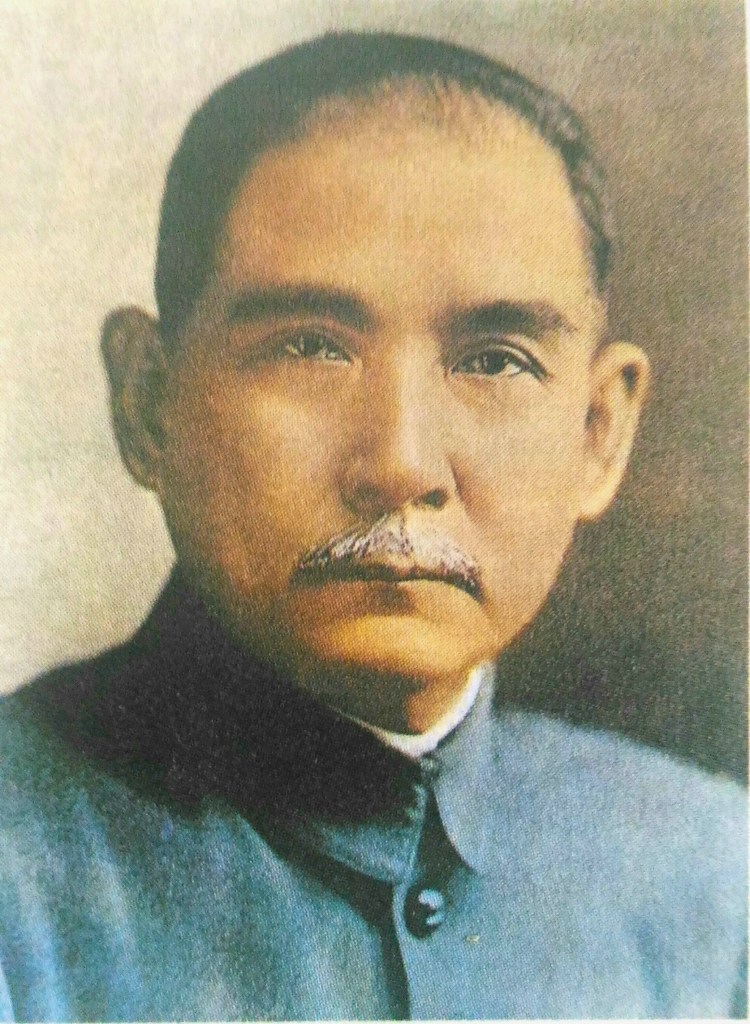
Sun YatSen, the provisional first president of the Republic of China and the first leader of the Kuomintang the Nationalist Party of China.
In our last look at Tai Chi for a while, we examine the context of the times in which Chen Zhaopei and Chen Fake became prominent for their martial arts in Beijing, and then at a national level, joining the wave of commerciality that had been originally instigated by the legacy of Yang Luchan and the Wu brothers. In addition we explain why the forms are similar in general order between the Yang/Wu and Chen lineages.
Here’s some Chen Canon Fist (mentioned in the podcast episode, posted here as a visual reference) – – under the Heretical Hypothesis this would be representative of the “original stuff” of the Chen village. Everybody is free to make their own mind up 🙂
Interesting comment from Mike Sigman on my blog. No, that’s not him in the picture, I just though it was a funny picture 🙂
….The real problem with a lot of these theories that basically denigrate the Chen-style Taijiquan as being “only an offshoot of something else” or “it’s really a Shaolin art” is that none of the westerners engaged in those musings have any minor skills in how to move the body in the way that the Chen-style Taijiquan does. It really doesn’t matter that “Chen-style has umpteen of the same techniques/moves shown in the XYZ style of martial-art” … the essence of the Chen-style Taijiquan is in how the body moves, using jin, qi, dantian, and silk-reeling.
So, if you listen to our Heretical Hypothesis, I think you’ll find that although we’re challenging the usual narrative of the origins of Taijiquan, we’re not really denigrating Chen martial arts, calling it an offshoot of something else, or “Shaolin” (as if that’s so bad). In contrast I think it’s actually quite positive about what it really is. It’s the brand name “Taijiquan” that is looking less authentic, not Chen village martial arts.
Chen village has a long history of marital prowess. If we’re talking around the time period we’ve got up to in the podcasts (- around 1900) – then at this point I’d say Chen village style is a genuine badass martial art – it’s practitioners are bodyguards, militia fighters and people with the name Chen are tracking down and fighting “bandits” (Or “freedom fighters” – as usual, it often depends which side of history you are looking at them from) for the Ching as ‘guns for hire’. In contrast, the “Taijiquan” passed down from Yang in Beijing is a kind of court-sanctioned entertainment. Sure, Yang had genuine skills but it’s much of a domesticated experience compared to the “in the wild and doing it” Chens.
From my point of view that’s not denigrating it at all, it’s lifting it up. Around 1900 you’ve got people like Chen Yanxi being employed full time as a martial arts teacher in Shandong by General Yuan Shikai because of his reputation as a badass fighter.
On the second point – I agree – the Chen style moves differently, especially the silk reeling, and it that very well might be because Yang LuChan never even went to Chen village. That explains so much.
Here’s an interesting criticism of the Heretics Hypothesis from blog reader Tom:
“I’ve enjoyed Damon’s monologues in this series on taiji. I think people understand the history given is just Damon’s interpretation, unsourced. The unfortunate part of the narrative is that some key assertions are made that are not true. Wu Yuxiang met Yang Luchan in Yongnian County before Yang went to Beijing. We actually don’t know whether WYX ever went to Beijing. WYX’s older brother did have a position of some importance in the Qing imperial administration, but it was at the county level as a magistrate. There is no extant written record, in a bureaucracy of exhaustive written records, of any of the Wu brothers in Beijing during this time. By contrast, we do have references for YLC appearing in Beijing and being called in to demonstrate at a banquet being held at the mansion of the wealthy Zhang family, purveyors of pickles to the Imperial court (and connected to the Wu brothers …. Damon should look at the sources available for this connection, because it helps support his thesis more clearly than what he’s established only by inference so far).”
There’s a lot to unpack there. So let’s start at the top:
“Wu Yuxiang met Yang Luchan in Yongnian County before Yang went to Beijing.”
This could very well be true. It’s a reasonable point – Wu Yuxiang and Yang could have met in Yongnian, and the Heretical Hypothesis plan (of using Tai Chi to bind together the fractured Imperial Court over something essentially ancient, Chinese and unifying in the face of the world-shaking contact with foreign aggression, which the Ching seem utterly unprepared for) could have been hatched earlier, with Wu Yuxiang and his brothers, who then, using the Ching patronage system, fund the introduction of Yang LuChan to Beijing elites.
Wu’s brothers both wrote texts on Tai Chi Chuan that only surfaced in the 1930s – see Lost Classics from the Late Ching Dynasty’s by Douglas Wile – so they are both implicated in the invention of Tai Chi Chuan myth, as well as their more famous brother Wu Yuxiang.
It’s ironic that Wu YuXiang is the famous brother by today’s standards, but at the time it was Wu ChengChing who was the famous one, having passed the very highest Civil Examinations. This is why there is no official record of Wu Yuxiang anywhere (as Wile notes on page 16) – he was simply not important enough. And if even he is not important enough, then there is zero chance of Yang LuChan – a low-class person ever being mentioned in an official record. Which brings us to Tom’s line:
“There is no extant written record, in a bureaucracy of exhaustive written records, of any of the Wu brothers in Beijing during this time.”
So, that’s not surprising for Wu YuXiang, since there are no written records of him anywhere – “to official historians he does not exist” – as Wile says.
However, that doesn’t mean he wasn’t in Beijing at some points. Here’s something to consider. A lot of people attribute the “small frame” of Wu (Hao) style Tai Chi to the limited movement available in Court Dress.
A quote from that article: “The Yang Small Frame which comes down to us from Wu Chien Quan has little resemblance to Wu Yu Xiang’s small frame and the primary reason for the origin of that form was the Imperial Court Dress which hampered movement.”
Royal Court Dress, Ching Dynasty.
If Wu Yu Xiang wasn’t in Beijing he wouldn’t have been wearing Court Dress.
Regarding his brothers we can be more sure:
The Jinshi (highest Confucian) exam that Wu Chengching passed could only be taken in Beijing if you were from Hebei Province – it wasn’t held in any other location, and final preparation for it wasn’t done in any other location. Wu Chengching records in his chronological autobiography that he passed that exam in 1852, after Yang LuChan moved to Beijing. He was then assigned to be a district magistrate. (Wile, Tai Chi Touchstones, page 180).
Wu Chengching wasn’t just any old magistrate – he was one of a small handful of elite magistrates ruling the counties of China’s heartland, and based in an area of huge strategic importance militarily speaking. I can’t see any way he would get into that position without strong/long-standing links to the Imperial Court in Beijing.
I think we can say that the Wu brothers had strong connections in Beijing, and Wu Chengqing couldn’t have got into his elevated position anywhere other than Beijing. When he moved to Wuyang in 1854 (four years after YLC settled in Beijing), there was no one local who outranked him – his immediate superiors were based in Beijing all the time, and he would have been expected to report to them frequently. To pass Jinshi he would have needed the support of his extended family, including Wu Yuxiang – it was a decision you had to make – to become a magistrate you had to go “itinerant” – you go wherever the government sends you.
But even so, I don’t think the physical location of Wu Yuxiang, or his brothers affects the overall Heretics Hypothesis very much – the Confucian officials were moved around a lot.
Key to the argument is the idea that “anything at all like Tai Chi” could not have existed in that region until after 1850 – and it doesn’t matter who was/wasn’t involved, because the kind of thing that Tai Chi is, is a modern idea that arose through China’s contact with the West.
Nothing comes from nothing, so for the Yangs and Wu brothers to have concocted Taijiquan (according to the Heretics Hypothesis) it must still have been made from Yang LuChan’s genuine martial skill. The postures of Yang style share a lot in common with various Northern Chinese martial arts. Changquan (long boxing) is often quoted as something Yang LuChan practiced in childhood, but again, this seems to be purely anecdotal. That doesn’t mean it’s not true of course.
A martial art popular in the region Yang came from was Hong Quan. A video surfaced recently that showed some traditional Hong Quan. It’s interesting to watch because I think it’s a good example of the type of martial art that would have been around at the time of Yang LuChan.
The description offered with the video says: “Here is the Xiao Hong Quan of Mogou Village. Mogou is to the east of Dengfeng and has practiced Hong Quan for hundreds of years.”
Hong Quan was very popular during the reign of Emperor Daoguang, which would be the Emperor immediately before Xiangfeng, who was emperor when YLC went to Beijing in the 1850s.
Out of interest, at a cursory glance I can see at least four Tai Chi Chuan techniques I recognise in that Hong Quan form presented – wave hands like clouds, snake creeps down (low single whip), bend bow to shoot tiger, and lotus kick. It’s hard to spot because it’s quite fast. But I’d hazard a guess that you’d probably find those same general techniques in lots of northern martial arts, like Chang Quan, as well.
I think I’m going to start referring to the theme of our recent Heretics podcasts (that Taijiquan was started by the Wu’s and Yang LuChan in 1851, then continued to evolve over the following decades, getting more commercial as it went, and was finally ‘completed’ as a coherent philosophy, martial art and national art in the 20th century), the Heretical Hypothesis.
It stands in contrast to the conventional lineages for the art. Which were first:
i) Zhang SanFeng was the originator. Then it goes into Chen village via Wang ZongYue, and then to Yang LuChan.
Then when this fell out of favour you get either:
i) Various ancient lineages of Taijiquan from Wudang some of which end up in Chen village, others continue to the present day and miss out Yang LuChan.
ii) Obviously Zhang is a fiction, so we start in Chen village (via Wang ZongYue) to Chen Wanting (16th century) and onwards to Yang LuChan.
What’s in a name?
There is an absolute dearth of writing about Taijiquan until after the Ching Dynasty ends. Why there are no published works during this period is an interesting question, but we’ll leave that for another time. All we have in that period is really the group of writings know as the Tai Chi classics, also called the Salt Shop Classics, that Wu YuXiang alleges he found in a Salt Shop, but most people think he actually authored.
In the Salt Shop Classics we see two names pop up – Zhan SanFeng and Wong ZongYue representing a historical lineage. Zhan SanFeng’s name is dropped in the Li copy of the original by 1881, but that’s a good 20 years after Tai Chi entered its commercial period (1861), so a lot has happened and the fortunes of the Ching Dynasty has changed.
Douglas Wile (‘Lost Classics…’ page 111) expresses that view that Zhang SanFeng was already associated with pro-Chinese and anti-foreigner sentiment, and that was the reason for his inclusion in the original version of the Salt Shop Classics. And by the time the manuals were copied by Li (1880s) it is removed because politically it looks more likely the Ching dynasty is going to survive at that point.
It’s an interesting idea, that makes sense. But what of the name Wang ZongYue? There’s no historical evidence that Wang ZongYue existed. Again, Wile points out that using the name “Wang ZhongYue” could have a more political than factual origin. Wang ZhongYue is a euphemism for Marshal Yue Fei of the Song Dynasty, who again stood for anti-foreign sentiments and pro-Chinese nationalism.
Wang = King, Zhong = Revering. Yue = Yue Fei, either himself or his lineages (his army).
That would make sense if (following the Heretics Hypothesis) the original purpose of the Wu’s was to create an essentially Chinese martial art practice to bind the Confucian Elite together against all the threats they were facing – Taiping rebellion, Nian rebellion, Foreign powers, etc.
Confucian Scholar Zhu Xi -(1130-1200AD. This man has a lot to answer for 🙂
Our recent Heretics Podcast series on the history of Tai Chi Chuan keeps generating interesting feedback. Here’s a particularly good one I got today:
My compliments to Damon and Graham on their podcast about the origins of Tai Chi Chuan. I particularly liked mapping martial art history to the general history of the period. From a strict reading of the available evidence the podcast cannot be faulted. Where there maybe problems is in the interpretation provided, which it could be argued commits the error of anachronism. Here is a good quote from a Wikipedia article: “In historical writing, the most common type of anachronism is the adoption of the political, social or cultural concerns and assumptions of one era to interpret or evaluate the events and actions of another”. The interpretation basically argues that Tai Chi Chuan was a bonding exercise in the Imperial Court because of the political decline in the Qing state. A lot more evidence is needed to support the claim that Yang Lu Chan, probably an illiterate low-class bonded servant, was used like an external consultant to go into a large organization and help reassert tradition Confucian values. That looks like an interpretation of Chinese History filtered through the prism of 21th century corporate culture.
Well, that’s an interesting idea. I really like well thought out criticism, especially when it’s delivered so succinctly.
Let’s explore a few of these ideas, and see where it takes us.
I see our podcast on the Myth of Tai Chi as “what Damon thinks really happened based on the available evidence”.
So, there will always be a lot of interpretation involved. History is essentially how you join the dots together. I think what Damon is doing is joining the dots together in a new way that makes a lot more sense than the stories we have been given by our teachers (in some senses the last people you should be asking about real history are martial artists), which all have parts that don’t make sense:
1. The original story we were given was about Tai Ch Chuan (Taijiquan) being created by a Taoist immortal called Chan San Feng. He’s a semi-fictional character who appears at various times throughout Chinese history. Most people who don’t believe in spirits of the ancestors walking amongst us (a common belief in China then) now dismiss this story. Li Yiyu even removed it from his hand written copy of the Tai Chi classics as early as the 1880s. I think this is one for the flat-earthers out there 🙂
2. The next story is that he learned in Chen village where Tai Chi was created by Chen Wanting in the 16th Century. This story was officially adopted by the General Administration of Sport of China who awarded Chen Village, Henan, a commemorative plaque acknowledging its status as ‘the birthplace of taijiquan’, in 2007 (See Fighting Words, Wile, 2017, Martial Arts Studies (4).) however this plaque had to be removed after just two months after a “firestorm” of new claims to the Tai Chi $ appeared, including the newly ‘discovered’ Li family documents.
But apart from that the story is full of holes. i) For a start nobody in Chen village used the name “Taijiquan” until long Yang used it. ii) There is also no actual evidence he was in Chen village at all. iii) Wu Yuxiang and Yang Luchan meet in Beijing for the first time, yet both have separate connections to an obscure village in China? iv) Then there’s the issue of why they taught an outsider like Yang, but only him – they didn’t teach anybody else, ever! v) Then there’s all the extra content (lots of other forms, weapons, etc) not found in Yang style, but found in Chen style, vi) Chen village records crediting their martial art to the earlier Chen Bu, not Chen Wanting, vii) the emphasis on silk reeling found in Chen style… the list goes on and on. It just doesn’t add up. However, it still needs explaining why the Chen old form and the Yang long form follow the same pattern (see the upcoming part 6 of Heretics podcast series for Damon’s explanation).
3. There are other theories of Tai Chi Chuan being ancient – really ancient, sometimes a thousand, or two thousand years old (that’s the White Cloud Temple claim) – and coming from Wudang mountain, via various unverifiable people, and ending up in the hands of Yang LuChan somehow – but nobody takes these claims seriously.
Of course, Damon isn’t saying that Tai Chi Chuan was created out of thin air, but rather it is the content of Northern Shaolin arts that Yang LuChan (a good martial artist) knew, adapted to fit certain traditional Confucian Court values thanks to Wu Yuxiang, and with a backstory added by Wu to make it appear ancient.
A class-based society
Chinese society was class-based, and teaching martial arts would make Yang LuChan the same class as theatre performers, i.e. the lowest of all classes.
From the Wikipedia article above: “There were many social groups that were excluded from the four broad categories in the social hierarchy. These included soldiers and guards, religious clergy and diviners, eunuchs and concubines, entertainers and courtiers, domestic servants and slaves, prostitutes, and low class laborers other than farmers and artisans. People who performed such tasks that were considered either worthless or “filthy” were placed in the category of mean people (賤人), not being registered as commoners and having some legal disabilities.[1]”
So, Yang LuChan was a Jianren, yet, there he was inside the Forbidden City, teaching (and mixing with) the most high-level people in the system.
Wu Yuxiang and Yang Luchan
I think this can be verified: The only students we know he had were all in senior positions, like Wu Yuxiang, and Wu Quan Yu, for example. Those are the facts of the matter, and viewed through our eyes that does make him something like an external consultant, but only superficially. Compared to a consultant of today the power dynamic would be very different. I imagine Yang would be doing a lot of bowing and kowtowing to these senior people he’s teaching.
But is that anachronism or just a reading of the facts? The teaching of martial arts as a hobby or binding action for the court, was indeed a unique innovation, but I don’t think somebody of the lowest class being used to entertain the court is that unusual at all – there is plenty of historical precedent: Theatre entertainers, for example, were regularly brought to the Forbidden City to entertain the Confucian court, throughout Chinese history:
“The Ming imperial court also enjoyed opera. However, most Ming emperors liked to keep their music entertainments inside the palace.[24] They performed for the court. ”
Jingxi (Peking Opera) was certainly popular in the Ching court too:
“In music, the most notable development of the dynasty probably was the development of jingxi, or Peking opera, over several decades at the end of the 18th century. The style was an amalgam of several regional music-theatre traditions that employed significantly increased instrumental accompaniment, adding to flute, plucked lute, and clappers, several drums, a double-reed wind instrument, cymbals, and gongs, one of which is designed so as to rise quickly in pitch when struck, giving a “sliding” tonal effect that became a familiar characteristic of the genre. Jingxi—whose roots are actually in many regions but not in Beijing—uses fewer melodies than do other forms but repeats them with different lyrics. It is thought to have gained stature because of patronage by the empress dowager Cixi of the late Qing, but it had long been enormously popular with commoners.” – from https://www.britannica.com/topic/Qing-dynasty
So, I think we can establish Yang in the position we say he is in (the Royal Court). But let’s get to the meat of the matter!
“A lot more evidence is needed to support the claim that Yang Lu Chan, probably an illiterate low-class bonded servant, was used like an external consultant to go into a large organization and help reassert tradition Confucian values.”
I agree, but it’s hard to know what form that evidence could take? The Smith hypothesis is that it was Wu Wuxiang who was performing some sort of re-instigation of Confucian values, and Yang LuChan was just being used as a gun for hire. We know he was there, in the royal court, but the question of what he was doing there is the key issue.
Tai Chi Chuan as Neo-Confucianist martial art
Everybody knows Tai Chi is based on Taoist principles, starting with Yin and Yang. But wouldn’t you expect the martial art Yang and Wu came up with to be more Confucian in flavour than Taoist? Why then was Yang teaching a martial art that people instinctively know is Taoist in philosophy? Tai Chi Chuan (a soft, internal martial art) is, after all, based on those great symbols of Taoism – the Yin Yang symbol, the 5 elements, the 8 Bagua, etc..
So, how do you explain that contradiction? Well, I can add one more piece of evidence. I wouldn’t call it a smoking gun, but it does add to the overall narrative:
If we look at the content of what he was teaching (Tai Chi Chuan) – then you’ll find it kind of is based on traditional Confucian values, rather than anything Taoist. I’ll explain…..
People talk about Tai Chi as being Taoist a lot, but Taoism is this shaggy, messy, nature-loving, outdoorsy, shamanic, magic, smokey, rich, spiritual, earthy thing involving things like spirit possession and exorcism – it’s not very Confucian at all. Or indeed, very like Tai Chi Chuan.
The best description of Taoism I’ve heard was by Bill Porter (Red Pine), who likened Taoism to “house-broken shamanism”.
The philosophy we find in Tai Chi Chuan – yin and yang, 5 elements, 8 powers, etc. uses the symbols of Taoism, but is all very heavy on categorisation – it’s very clean, neat and orderly. In fact, very… Confucian!
Or, rather, it’s what scholars call “Neo Confucian”. At the time that Buddhism was gaining popularity in China, as a threat to Confucianism, the Confucians needed something to combat it, because they had nothing very “spiritual” in their religion, whilst Buddhism and Taoism were both full of spiritual stuff.
The Confucians plugged the gap with what became known as Neo-Confucianism. Neo-Confucianism adopted the signs and symbols and ideas of these more spiritual religions (yin and yang, Taiji symbols, 5 elements, etc), but it was really just repackaged Confucianism 101. The scholar responsible for all this was Zhu Xi, who lived during the Song Dynasty, from 1130-1200AD. He effectively sanitised all these Taoist ideas and related it all back to the 4 classic texts of Confucianism. His impact in his lifetime was not so great, but to later periods it was absolutely huge – his ideas formed the basis of the Civil and Martial exams that people had to pass to enter government/senior positions, for example.
Zhu Xi
Damon did an excellent episode about Zhu Xi’s impact on Chinese society and martial arts as part of the Heretics Xing Yi series (the same Neo-Confucian philosophy ends up being dumped on Xing Yi during a later period).
Give that episode 5 of Xing Yi a listen. To me it makes sense.
I should add some rumour control, since I think that Tai Chi people will generally not like this Neo-Confucian angle:
1. I don’t think saying that the philosophy of Tai Chi is actually Neo-Confucian, rather than Taoist is a diss to the art – an actual Taoist martial art I imagine would not be as practical! It would be messy, unfocussed and a bit wild. A martial arts form repeated over and over in the same sequence each time would probably be a strange concept to a Taoist!
2. I also don’t want to diss the Chen family – their reputation during the Ching Dynasty was of them being practical and expert martial artists who actually used their martial skills to fight bandits and escort caravans. They were the real deal! Their family martial art is older than the appearance of Taijiquan in the 1850s by far – and as any good Confucian knows, older is always better! 🙂
What matters to me about Taijiquan is that it works, not what you call the philosophy behind it.
In this episode we examine the Chen family’s relationship with General Yuan Shikai, the friction between modernising and conservative factions within China and the events of the Boxer Rebellion.
My recent Heretics Podcasts episodes on the history of Tai Chi Chuan seem to have provoked a lot of debate. People I’ve talked to seem to have this unshakeable belief that Tai Chi is ancient, and it must be ancient to be authentic. It’s simply unacceptable to them that Tai Chi is not as old as they think it is. This myth that old = authentic is pervasive.
I’ve become quite fascinated with the reasons why people think like this. A lot of it goes back to why we, people living in the West, started Asian martial arts in the first place. Quite often we reject our own history and culture, and adopt a fantasy of a Chinese Kung Fu culture that maybe never existed. Were we all just looking for our own Yoda?
In this new interview for the Martial Arts Studies podcast, historian Prof. Peter Lorge talks about this exact issue, and tackles the subject of orientalism, which often provides our first impulse to try a Chinese martial art, head on. It’s well worth a listen.
Stand in a place high up. Looking out over a valley, or the sea, or if you’re in a tower block then look out over the city. Don’t try to think and analyse what you’re looking at, just be open to it. See the place where the sky and land meet.
Open your body posture, holding the arms as if about to embrace an old friend. Let the breath enter the body and leave without any interference. Let the body breathe itself. Start to notice the breath as it goes deep inside you. Feel for the sound of your heartbeat. Get in touch with the rhythms of your breathing, of your heart beat and keep your internal focus there, while maintaining your external focus wide, on everything around you.
If you notice your mind has become caught in thought, simply return it to the body. Stand for as long as you want. Feel what happens to you as you enter a more natural state. You may start to feel a kind of inner strength.
This is the feeling you want to have in the Wu Chi position before you start the Tai Chi form.
How quickly you can enter that state depends very much on how much you’ve practiced it, what’s going on in your life and the state of your health. It’s much easier to achieve this state of Wu Chi in nature, without man-made things in your field of vision or man-made sounds polluting your ears. But if you’ve got a feel for it, then you can do it anywhere. Your body is after all a part of nature.
Tao Te Ching, chapter 49, translation by Stephen Mitchell
49 The Master has no mind of her own. She works with the mind of the people. She is good to people who are good. She is also good to people who aren’t good. This is true goodness. She trusts people who are trustworthy. She also trusts people who aren’t trustworthy. This is true trust. The Master’s mind is like space. People don’t understand her. They look to her and wait. She treats them like her own children.
In part 4, the latest episode of our look at the creation of Tai Chi Chuan, we can see how the actions of the British and French acting aggressively in China forced the hand of the powerful new dowager empress, Cixi to make some changes in the Royal Court.
Empress Dowager Cixi, portrait 1905.
People like the Wu brothers and Yang LuChan were suddenly out on their ear and had to make a living in a strange new world that suddenly valued entrepreneurship over nepotism. When your family business is teaching martial arts and you’ve got a family to feed, then it’s time to open your own public martial arts school.
Wu Yuxiang
Here, in the 1860s, we start to see the birth of martial art styles in Beijing that can compete against each other for paying students. At this time Yang LuChan’s two sons were finally old enough to teach martial arts full time.





 The Tai Chi Notebook