I think push hands is completely flawed as a competitive sport, which is why it ends up as a shoving match, but somebody (Jet Li?) is trying to change the rules to make it work better as an Olympic sport…. So here it is! It’s essentially more like wrestling, which is probably a good thing as it means you can move your foot.
And it’s got takedowns, but I think the question is then always … why not just compete at Shuai Jiao?
What are the internal martial arts? Does the term “Internal Martial Arts” have any legitimacy? What is a “fake” martial art? All this and more is explored in our new episode.
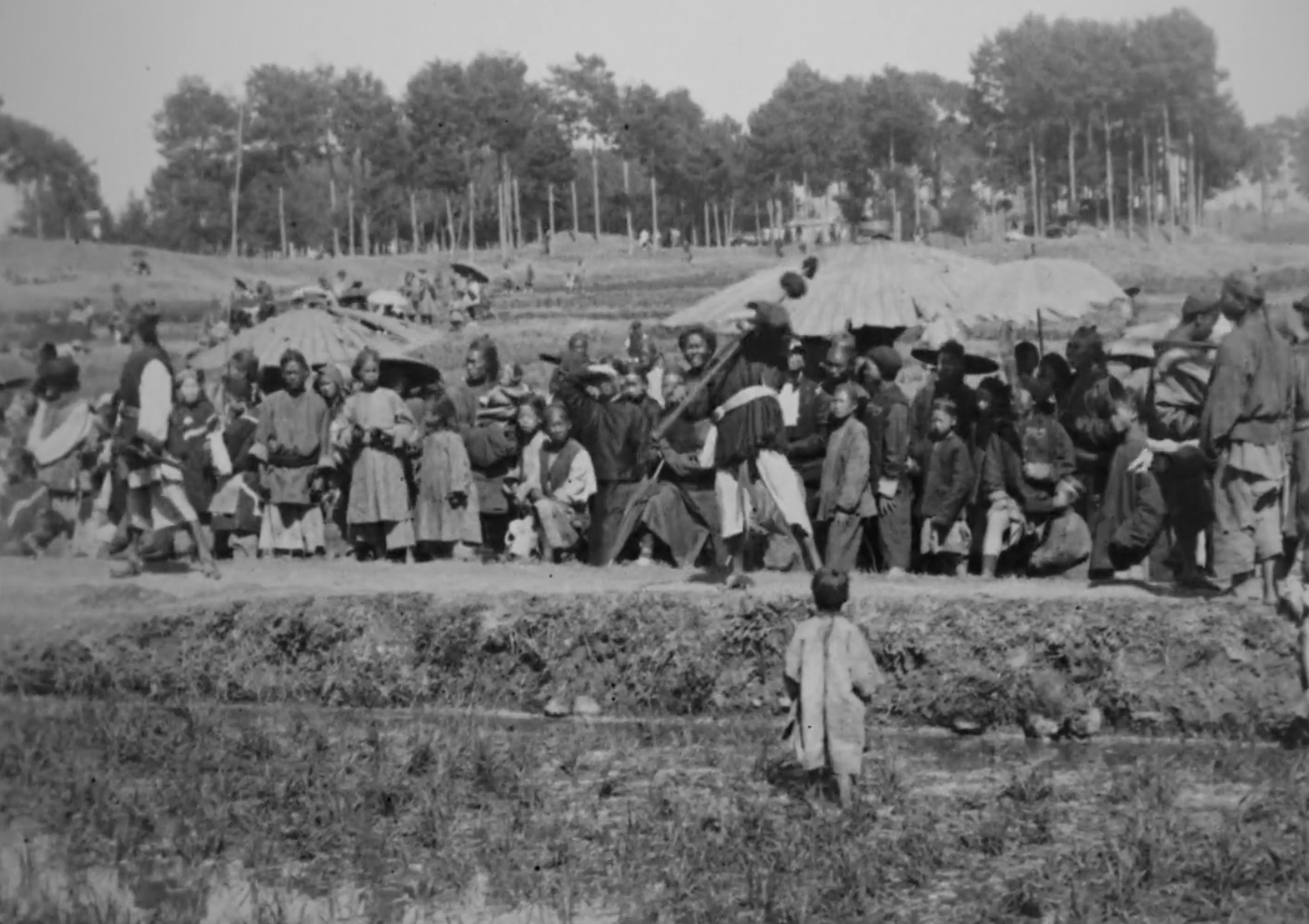
Qing Dynasty martial artists performing in a procession (between 1901-1904)
I’m still fascinated by that film I posted a little while ago of China from 1901-1904. It’s as close as we’ll get to seeing the people who were around at the time that the popular martial arts of Northern China – Taijiquan, Baguazhang and Xingyiquan were being formalised into the structures and routines we still know and recognise today.
It gives a small insight into what the martial arts of the time were like, we have an idea of what they practiced, but we don’t always know where they practiced them, and to some extent really why they practiced them. There’s a particular sequence starting at 17.10 in the film where we see a procession of sorts going along a riverbank and then entering a village or town. There are martial arts performers doing twirls and spins of their weapons as they go. The setting is informal, music is being played (we see the musicians) and it has something of an air of the Saint’s Day religious processions you still see going on between villages in rural European nations, or the May Day “Hobby Hoss” procession that can still found in Cornwall in the United Kingdom.
But back to China. The martial artists involved seem embedded into the culture of the place and time as much as the musicians or flag holders.
“There was a well established pattern of village festival culture in Northern China. The ritual was called a sai and it was based on a three-part structure: inviting, welcoming and seeing off the gods. Ritual could last anywhere from three days to a month. Wherever you happened to be, these rituals were happening nearby every two weeks. A smaller sai might have only 50 people officiating and a thousand participants, while a large one might involve hundreds of ritual experts and 100,000 participants. A large ritual could invoke as many as 500 gods, their statues escorted out of temples in massive processions with armed escorts of martial performers that snaked between villages for miles.”
“According to David Johnson, ritual festivals were so common and so old and so large that they were overwhelmingly the most important influence shaping the symbolic universe of the common people. Regionally they happen about every two weeks and could involve over a hundred villages, with processions that strung out for miles attracting thousands of spectators. “It is quite impossible to understand what villagers… in North China thought and felt about the world of politics, about Chinese history and traditions, about the world of gods and demons, or about any of the grand matters of life and death, without a close familiarity with sai [and similar rituals]. Ref: David Johnson 1997, “Temple Festivals in Southeastern Shanxi”, Overmyer 2009,8.”
From Tai Chi, Baguazhang and the Golden Elixir: Internal martial arts before the Boxer Rebellion by Scott Phillips, p173.
Qing Dynasty martial artists performing in a procession (between 1901-1904)
I don’t think we can assume, from one film. that all Chinese martial art of the period was like this, but it’s fascinating to see a glimpse of how well it was integrated with everything else.
Everywhere in China the martial arts either present themselves in the guise of simple exercises or are shrouded in arcane religious mysteries. Western enthusiasts often feel impelled to strip away these religious trappings and construct a version of the martial arts that is neither simple gymnastics nor religion, but emphasizes true hand-to-hand combat skills. The question remains, is this an authentic understanding of the martial arts?
Charles Holcombe, Theater of combat: A critical look at the Chinese martial arts
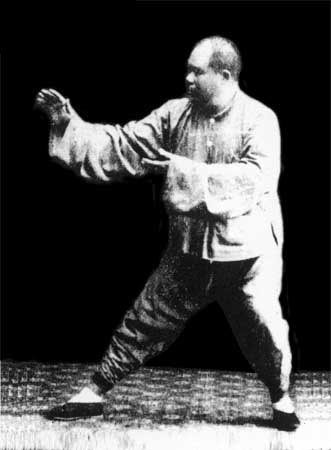
I thought I’d start a series of posts commenting on what I like about photos of famous masters of the past. I thought I’d start with this photo of Yang Cheng-Fu doing rollback from the Yang long form.
Yang Chengfu, Rollback.
Yang Cheng-Fu comes in for a lot of criticism, mainly I think because of his weight. He was a big man, but I’ve always been impressed with how precise and delicate his postures seem to be. What I like most about this picture is that you can almost feel the heaviness and sinking in what he’s doing, yet at the same time there is the precise placing of his hands and feet.
Tai Chi is a paradox in that you are supposed to feel light yet also heavy. According to the Tai Chi Classics your head needs to feel like it is being pulled up “as if suspended from above”, and yet your body needs to also have the feeling of sinking, “Make the chi sink calmly” and “The abdomen relaxes, then the chi sinks into the bones.”
You can see both these qualities in Yang Cheng-Fu performing Rollback, head upright, light and nimble, yet also firm and heavy. With the placement of his hands you also get a sense of the yin and yang being distributed throughout his body. The back hand has the intent of pulling and the front hand has the intent of pushing. He is not “double weighted” – each hand is expressing a different energy. The weight on his feet is on the back leg – again, not in no man’s land in the middle, but clearly distinguished.
You also get a sense of calm. This is not a frantic and hurried performance. It’s slow and deliberate, like a great river rolling.
Jack Slack was the first person to draw my attention to the parallel between rioters storming government buildings that happened in China’s Boxer Rebellion around 1900, and the storming of the Capitol Building by Trump Supporters in 2021. Both involve a kind of “spirit possession”.
Of course, America, along with many European nations, was involved in the Boxer Rebellion:
“In 1898 the Yellow River burst its banks and destroyed the harvest in much of Northern China, but this misfortune was followed by an agonizing drought which dried out the land and hardened the dirt. As young men went hungry and without work, some Chinese noted the connection between the anger of nature and the construction of train tracks, telegraph lines and churches since the arrival of foreigners in the Qing Empire. Anti-foreign sentiment brought together groups of peasants practicing martial artists and calling themselves the Righteous Society of the Harmonious Fists—though the West came to know them as “The Boxers”. The Boxers attacked and murdered missionaries across the Empire and in the summer of 1900, Tianjin and Beijing were plunged into chaos as the Boxers received the blessing of Empress Dowager Cixi and the Imperial army. 400 foreigners and 3000 Chinese Christians endured a two month siege in Beijing’s legation quarter—a stone’s throw from the Imperial Palace but completely helpless. The Boxer Rebellion is a story about agriculture and diplomacy, magic and court intrigue, and it stands as both the last great event of the Victorian Era and the beginning of the end for the Qing Dynasty. ” – Jack Slack
Of course, I’d contest that the events that lead to the end of the Qing Dynasty had started much earlier, back in 1860s. It was these conflicts with foreign powers and internal rebellions which lead directly to the creation of Tai Chi Chuan, as we discussed on our History of Tai Chi podcast series. Yes, I’m sorry, the myth of a Taoist inventing Taijiquan after a dream about a snake and a crane, is just a fairytale. The real reason is much more pragmatic.
Jack has done an excellent podcast episode on the Boxer Rebellion, which he’s just released to the public, instead of being behind his Patreon paywall. If you want to find out more, have a listen:
“When the opponent expands, I contract. When he contracts, I expand. And, when there is an opportunity, I do not hit – it hits all by itself.” ― Bruce Lee
Practicing both Xing Yi and Tai Chi together helps you gain insights into both arts. Here’s what occured to me this morning: If you were to strip down Tai Chi and Xing Yi forms to their essentials then Tai Chi is a series of deflecting moves interspersed with occasional punches or kicks, and Xing Yi is a series of punches or kicks interspersed with occasional deflecting moves.
That’s a gross simplification, but I think it’s true to some extent. It’s what makes the two arts good companions for each other.
I’ve written before about not putting power in the form, but in a related note I think the idea of not using your arm to punch is another way of looking at it from a more Xing Yi perspective. It’s the same nut, just another way to crack it.
The famous Tai Chi practitioner, Cheng Man Ching, is said to have had a dream in which he had no arms, and it was only after that that he grasped the secret of pushing hands. The secret was that pushing hands had nothing to do with hands at all, and he credited this dream with in his ability to push people.
But I find it a lot easier to understand the ‘not using your hands’ thing when you are constantly pushing and deflecting. It’s a lot harder to do it when you are striking.
Xing Yi is obsessed with striking. Most of the forms are a series of strikes linked together (called “links” – Lian Huan). I’ve come to appreciate however that the key to it is to not use your arm to strike. I mean, yes, your arm is doing the striking, of course, but it’s like it’s not involved in the process. I’m thinking about what Bruce Lee said when he said “it hits all by itself”. But while I believe Lee was talking about a more spiritual process (the top line of the hexagram), I’m thinking about a more mid-line process that’s rooted in the body. The hand moves into the position you want, but what moves it there has nothing to do with the arm at all, it’s all from the body. I find that when Xing Yi becomes “too much in the arm” it ceases to be the art it’s supposed to be.
Paradoxically by trying to hit hard, you ruin it. You’ve got to ease back a little bit – take your foot slightly off he gas and let the body do the work, almost as if you are a craftsman using a tool skillfully (your body) rather than making a great effort to get things done and just making a mess in the process.
In the video above amateur Chinese MMA fighter Xu Xiaodong is fighting Chen Yong, the self-proclaimed sixth-generation Tai Chi Master of the Wu lineage. It’s the latest in a long line of fights between Xu and people who claim to be martial arts ‘masters’.
If we analyse the 10 seconds of action we can see Chen takes a forward weighted stance with his hands up in a high guard. It leaves him completely imobile and open for a kick. Xu kicks him low, Chen drops his guard and that was all she wrote.
Presumably Chen thought that whatever he had been doing for the past few decades was good enough training to actually fight with. But whatever Chen has been practicing… it wasn’t fighting.
Some of my Chinese Martial Arts colleagues get really upset with these fights. They think the whole thing is set up to make Chinese marital arts look bad and promote the UFC, and I’m somehow complicit in a plot designed to bring the whole Chinese martial arts down. Or that Xu won’t fight anybody young and fit and only challenges old men. It’s classic conspiracy theory nonsense.
I find this attitude odd because, frankly the UFC doesn’t give a crap about any of this. And nobody is making these delusional ‘masters’ fight anybody – they’re doing it of their own free will and more often than not, they are the challengers in the fights, and put up all the money required to make them happen. They clearly think they are going to win with their martial skill despite a huge age gap or a gap in fighting experience.
There is a strong tradition of Chinese Kung Fu masters appearing in faked fights on Chinese TV and seeming to be all-powerful. It’s that delusion that Xu fighting against. Watch this:
serpentza and Byron Jacob explain what’s happening in China.
A common thing I’ve hear is that nobody has heard of these ‘masters’ before. Again, that’s true, but there are a lot of delusional people in martial arts, so I don’t think that’s surprising. China is a big place. Perhaps it’s the use of the term “master” that gets bandied about so freely? In light of all these fights there has been a government move in China to ban the use of the word. Xu Xiaodong has been heavily persecuted – being forced to hide his face in clown makeup and have an insulting nickname in one fight. It didn’t stop him beating these ‘masters’.
But it’s not just Xu doing it. Here’s another video from a couple of years ago. In white pyjamas we have “The 47-year-old expert Zhu Chunping, who has been practising tai chi for decades” vs Yao Hantian “The 22-year-old Yao has been training kick-boxing for just six months”. Read the report in the South China Morning Post. From the 5 seconds of action in the video we can see Zhu takes up what looks like a version of the San Ti Shi stance from Xing Yi while Yao immediately starts moving, establishing range and holding his hands in a modern guard position. One right hand from Yao, which goes right down the middle of Zhu’s guard and he doesn’t react at all to, and it’s all over.
As for the attitude of trying to pretend these fights aren’t happening… I believe it’s some misguided implementation of Wu De – martial virtue. Why shouldn’t people watch these fights? If you engage in a bout with a ring, a judge, and cameras involved, that’s designed to be streamed or televised then clearly you are now in the entertainment industry. That’s what prize fighting is. If this was some sort of battle for honour or revenge it would all be played out in a dark alley somewhere and nobody would ever know about it.
I think the lessons these videos teach is so valuable that they’re worth posting. You need to keep it real (to some extent at least) if you want to teach “martial arts”. Even if that “real” is realising your limitations, and that you shouldn’t be fighting a 22 year old in a ring when you’re 47 and don’t have any fight experience.
Chinese martial arts are full of fantastic skills and valuable content, but if you spend all your time doing your “body method” training and no time doing fighting training, then don’t expect to be able to fight with it.
And let’s not keep hiding this stuff away – you don’t fix your problems by pretending they don’t exist.
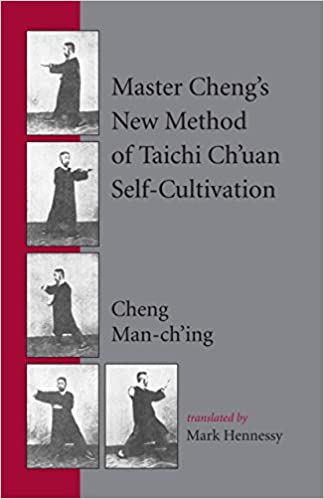
Before the Internet, back in the early 90s, there were only a few books on the subject of Tai Chi in the West, so the authors of these books achieved a kind of fame and notoriety that wasn’t really proportional to their actual importance, or impact on the Tai Chi world. Or maybe their fame became proportional because of the books themselves, in a kind of self fulfilling prophecy. It’s hard to say.
Either way, one book title that always stuck in my mind was “Master Cheng’s New Method of Taichi Ch’uan Self-cultivation”.
This idea of “self cultivation” is kind of the main reason that people practice Tai Chi in the modern world. It’s kind of like exercise, but a little deeper, involving something a little more like meditation. This idea of using eastern spirituality to go on a personal odyssey, or journey into your self is sold to us all the time in the world of Tai Chi, Yoga and health or spiritual practices.
The fact is, it’s nonsense. I hate to break to to you, but individually, we are really not that deep. Scratch our surface and there’s really not that much to us. The idea of cultivating yourself is really a huge waste of time. Our depth lies in our relationships to other people, places and non-human animals. And to find our connection to the world, to the land, the first thing you need to do is get rid of this little self that you’ve been busy cultivating with your various yoga, tai chi and martial arts practices.
Just look at what the Zen or Tao masters of old wrote. They were telling us this constantly in their writings.
When you do something, you should burn yourself up completely, like a good bonfire, leaving no trace of yourself.
– Shunryu Suzuki
One must be deeply aware of the impermanence of the world.
– Dogen
The practice of Zen is forgetting the self in the act of uniting with something.
– Koun Yamada
Those were literally the first three quite in an article I just searched up called “25 Zen Quotes“.
I feel like I could quote any chapter of the Tao Te Ching too, but let’s go with chapter 3:
The Master leads by emptying people’s minds and filling their cores, by weakening their ambition and toughening their resolve. He helps people lose everything they know, everything they desire, and creates confusion in those who think that they know.
Practice not-doing, and everything will fall into place.
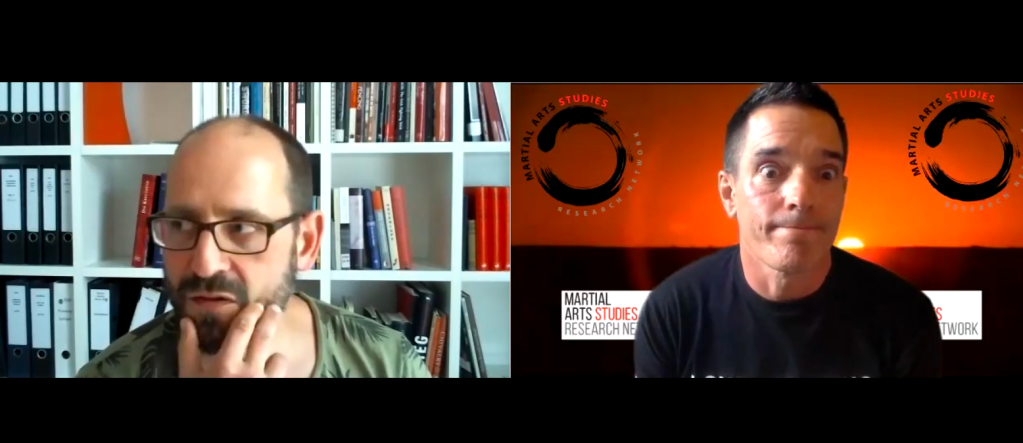
Bowman notes that instead of helping people, the myth busting of martial arts which is going on all the time in academic circles is probably destroying the careers of some martial arts teachers. So it’s “doing a service to the world which is actually also a kind of violence”. It’s an interesting point. He notes that people often fall in love with the martial arts for silly orientalist reasons – they fall for the myth of studying an ancient and mystical martial art, then read a well-researched book about it, by somebody like Ben Judkins or Peter Lorge, which shatters their beliefs and makes then doubt the validity of the art they are doing.
My own Heretics podcast does its fair share of myth busting too – our Aikido episode, Kempo & Jiujitsu history series and Tai Chi history series spring to mind as good examples. I’ve had first had experience of those episodes visibly upsetting teachers I know. Whether they know it or not, these teachers are heavily emotionally invested in the myths of their own arts superiority – they believe all the stories of old practitioners and the amazing feats they can do, and know exactly why their martial art is superior to others. If you start to chip away at those beliefs then the whole facade is at risk of crumbling, and they don’t like it! Unfortunately reality is usually disappointing when compared to the myths.
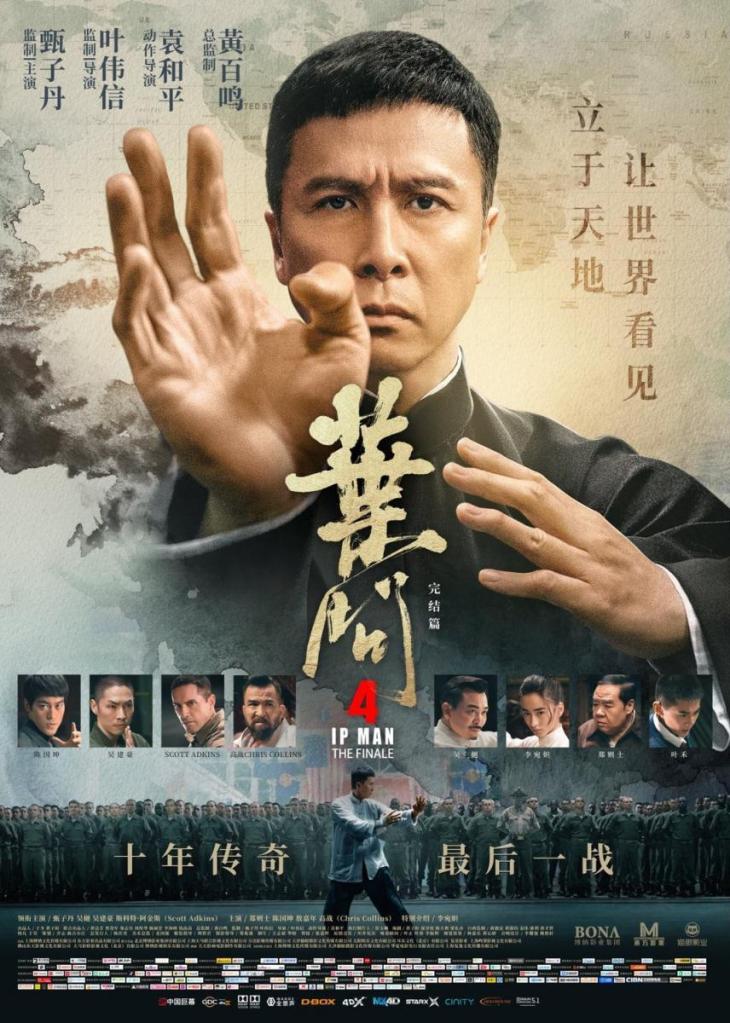
When the Chinese martial arts first started making an impact on the West in the 1970s they were full of obvious untruths. Tall tales of Buddhist and Taoist origins abounded. For example, that Tai Chi was apparently created by a Taoist immortal who had a dream about a crane fighting a snake, and Wing Chun was named after the girl who was taught it by a female Buddhist monk, when it turns out that there’s no evidence that she even existed. Over time these myths then get added to by other myths – like the one that Yang LuChan was “invincible”, for example. Even in the modern age the myth of Ip Man has been enhanced to bursting point by a series of pseudo-historical films in which he combats the Japanese, western wrestlers, boxers and even Mike Tyson at one point!
Ip Man 4
These more marketing-orientated myths about the prowess of practitioners – how deadly they were, how unbeatable their martial arts was, how the power of Qi was greater than physical strength all fed directly into all that nonsense about no touch knockouts and “empty force” that has marred the image of Chinese martial arts in the modern age.
And politics also gets involved. When obvious myths about the origins of martial arts are dispelled they often get replaced by more politically motivated stories about the arts origins that are equally as unprovable and unreliable yet fit a natioanlist agenda. It seems like the Chinese martial arts are forever being used to support some sort of Chinese government propaganda.
In short, the Chinese martial arts world was in need of, and remains in need of, a lot of myth busting, because much of what we are being told and sold is basically not true. But Bowman’s fears, that we are in danger of spoiling the fun for everybody with this relentless search for the truth, holds true, I think. I was certainly attracted to Chinese martial arts by a steady diet of orientalist propaganda from the likes of David Carradine’s Kung Fu TV series and Marvel comics with heroes like Iron Fist. This is often what draws us to the martial arts in the first place and there has to be some way of searching for truth in the martial arts, but keeping the magic that drew us there in the first place.
I had an interesting conversation with a reader recently about Tai Chi and butts, which I thought I’d share as it’s a good topic. A lot of Tai Chi people, me included, tend to stick out their bottom slightly during form and push hands. Maybe more so in push hands… either way, it’s a fault that inhibits relaxation.
I think in push hands it happens because people try to “brace” against the incoming force to stop themselves being pushed backwards, but by going for a short term solution they are inhibiting their progress in the long term.
Q: Do you have any experience of Chen style TCC? I’ve been to a few lessons. Seems like, in order to soften the kua sufficiently, you need to stick your backside out more than in Yang….?! Having spent a whole lifetime trying not to do this, it feels weird…..!
A: I’ve never really done Chen style, but I’ve looked into their silk reeling exercises quite a bit – just the simple one hand “wave” – I really like that and do it quite often.
I’ve seen some Chen stylists that stick their butt out a lot, but to be fair I’ve also seen a lot of Yang styists do the same. I think as part of an opening and closing movement it’s ok (like in Yoga, for example), but leaving it “stuck out” all the time can’t be right. Tai Chi requires you to move from the waist (or the dantien, if you like) and that encompasses both the front (belly), sides and back of the body around the waist line – the lower back is part of that. If you put your hands on your lower back then stick your butt out you can feel your muscles contract and tighten – having a tight lower back as your default means you can’t effectively “move from the dantien” so everything else you do, no matter how clever or artful looking, has to be wrong because the foundation is wrong.
When doing silk reeling exercises I try to keep my lower back relaxed and “hanging down” – that’s the right feel – so the movement can originate there. The form should be no different. I feel like the people who stick out their butt have simply missed an obvious problem with their Tai Chi.




 The Tai Chi Notebook