It occurred to me the other day that I’ve been running a tai chi class for a couple of years now but never taken a single group picture. In jiu-jitsu you’re lucky you get out of the door without somebody taking your picture at least once — it’s a totally different culture and it’s interesting to reflect on the reason why.
In a martial arts class you expect your picture to be taken and shared on social media, or maybe you’ll even be captured briefly in a video of the class. I suppose it’s because you’re doing something exciting and worth bragging about. As an activity it’s ‘loud’ – there’s loud music playing a lot of the time.
The instagram for my jiu-jitsu academy is full of pictures of students, for example.
Tai chi is a different sort of activity — it’s quieter, softer and less about showing off. Taking a picture in that sort of environment feels a bit like going against the grain. It’s a shame because pictures can act as markers for when you started tai chi and how long you’ve been doing it, and a reminder of who was in the class then.
But anyway, I did take a group picture of the Tai Chi class last Friday, and I’m glad we’ve got at least one. I won’t post it here because it was just for the group’s Whatsapp. I’ll probably wait a year before I take another one.
Behind the gesture is a code about power, respect, and control
I always finish my Tai Chi class, which takes place in the UK and is taught by me, a British person with no connection to Chinese culture outside of martial arts, with a small Chinese-style salute.
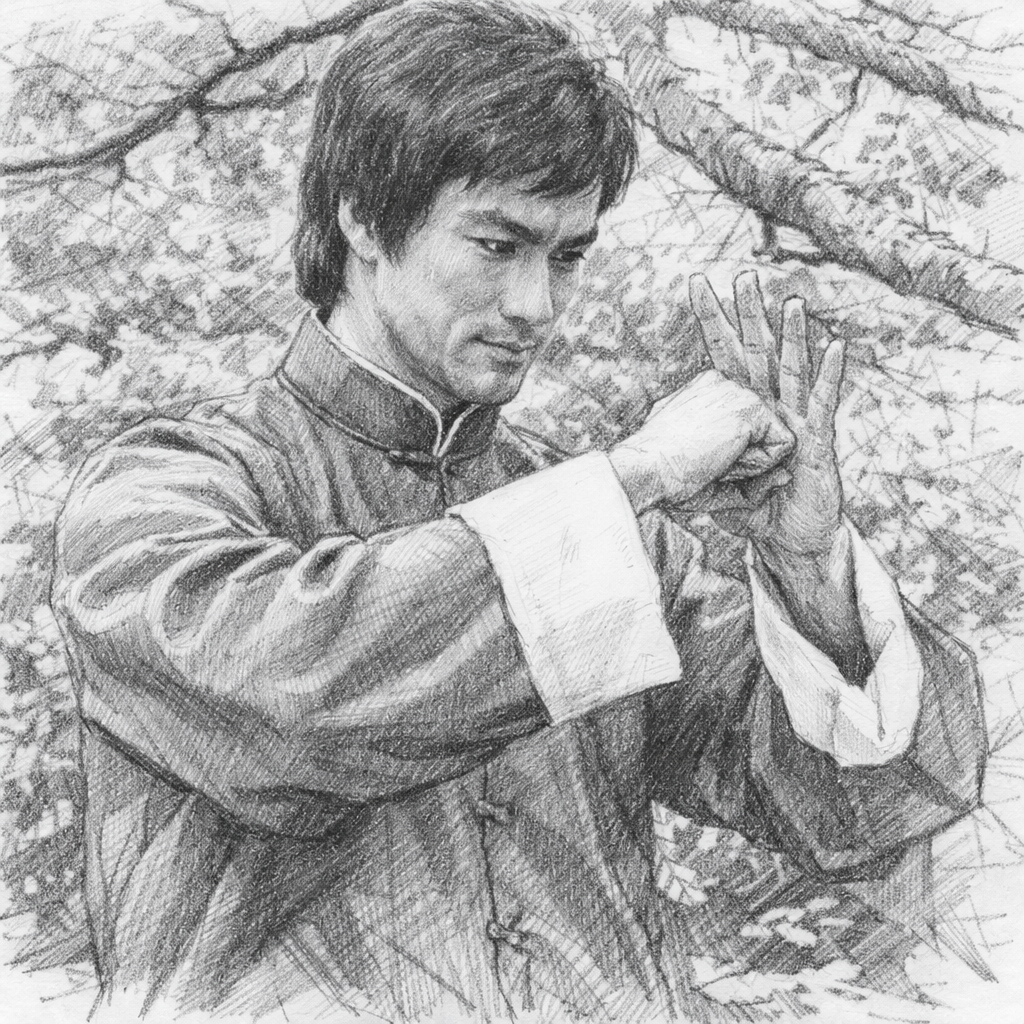
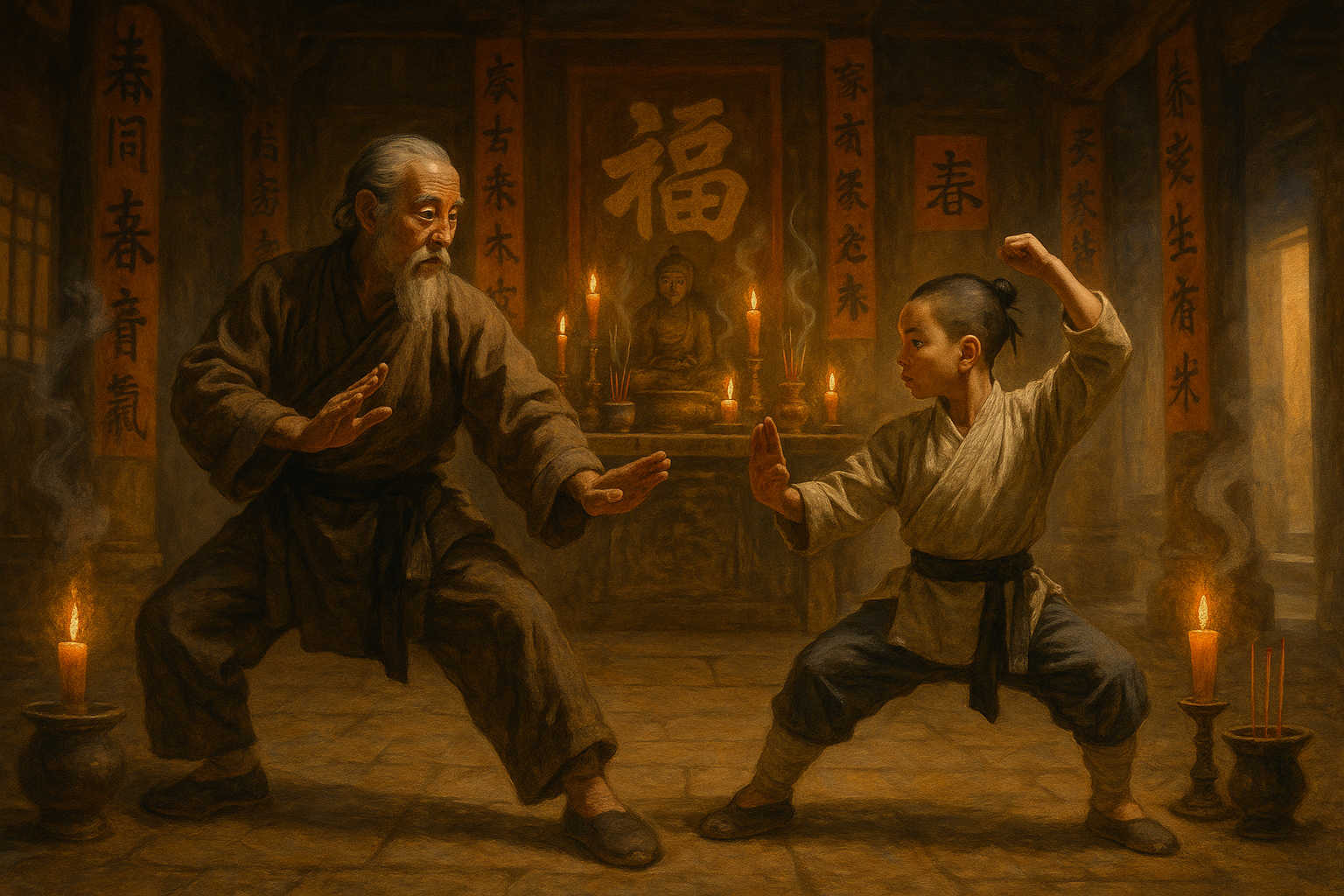
Often called the “sun and moon” salute, it’s a traditional greeting in Chinese martial arts circles. It’s the same one you see Bruce Lee do to his student at the start of Enter the Dragon. But like most things in Chinese martial arts, it has both an obvious meaning and a hidden one. Of course, you don’t need to know the hidden meaning to use it.
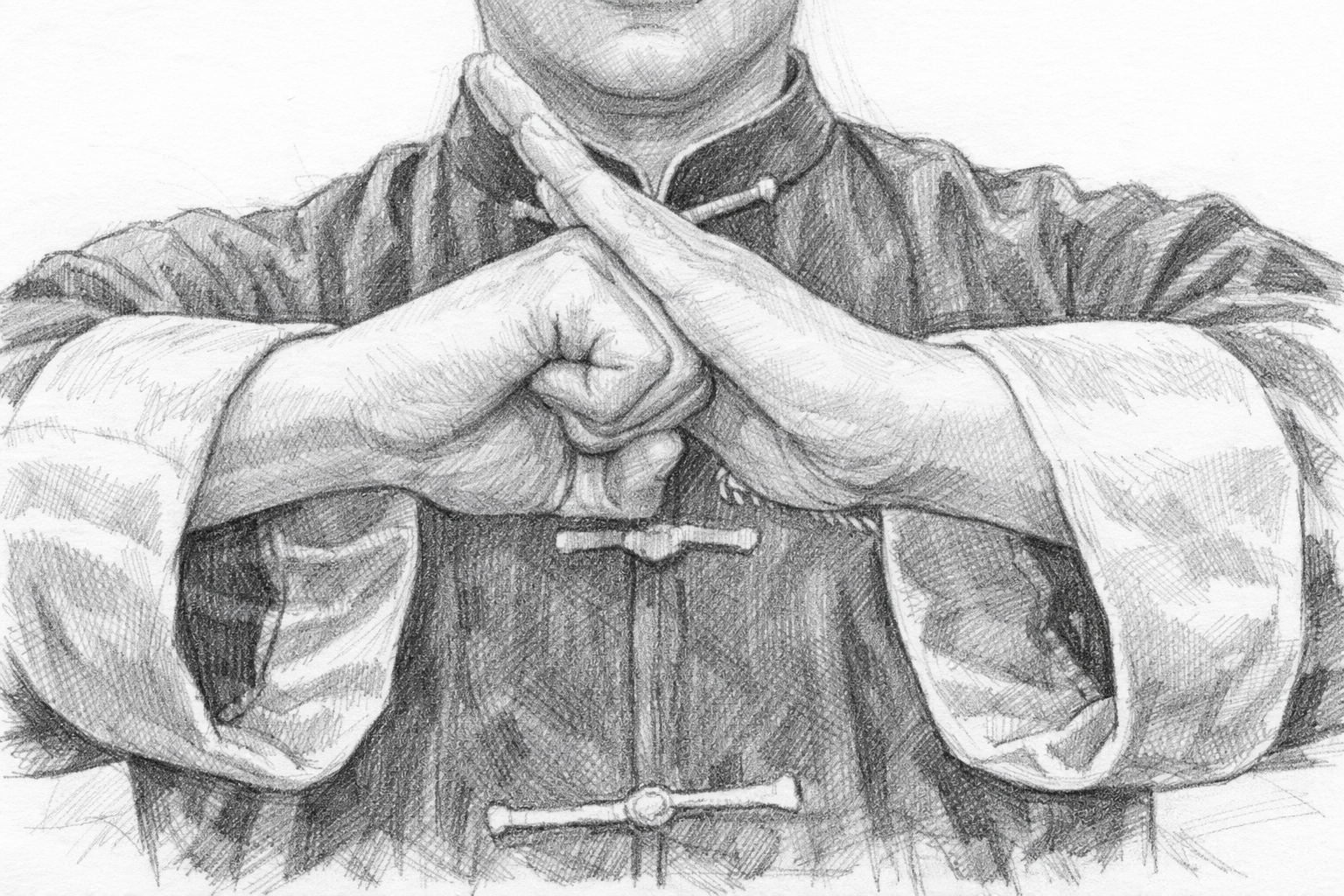
In Chinese, the salute is called bàoquán lǐ, which roughly translates as “fist-wrapping rite.” Your right hand forms a fist — the “sun” — and your left hand presses flat against it — the “moon.” You stand straight, feet together. It’s accompanied by a short, respectful nod of the head rather than a deep formal bow, while maintaining eye contact.
Sometimes the fingers are folded instead. This seems to be a softer, less formal greeting (and it’s the one I usually use). This variation is often called gōngshǒu lǐ (“cupped hands greeting”) and is traditionally gendered — the closed fist is the right fist for men and the left fist for women.
It’s worth noting that this is far from the only hand position used for greeting across China’s long history, particularly within religious traditions.
Why do it?
The bàoquán lǐ isn’t a tradition added to Chinese martial arts — it’s a remnant of a moral code that existed before they were formally named.
At a basic level, the fist represents martial skill or strength, while the palm represents civility, restraint, and wisdom. The palm covering the fist symbolizes martial power governed by virtue or, put simply: I can fight, but I choose respect and control.
When I do it at the end of class, it’s quick and almost reflexive, sometimes even a little embarrassed. I don’t expect my students to do it back. It’s a brief gesture with a clear purpose: it marks the end of the session and acts as a quiet “thank you” for the work they’ve just done.
When I do it to my kung fu teacher, it carries a different weight. My teacher (who is not Chinese) still greets his own teacher (who was Chinese) with this salute every time they meet, and that tradition was passed on to me. I still greet my teacher this way whenever I see him. Even though it isn’t part of my culture, the meaning is clear when I do it.
In that sense, I suppose I’ve passed on a “light” version of the tradition to my own students by using the salute at the end of class. Even if they don’t return it, it’s something they now recognize. The tradition has softened over time, we don’t use it to greet each other, and honestly, I think it would feel strange if we did.
I’d describe my teacher’s period of training with his teacher as serious, and my own training as semi-serious by comparison. People in modern Tai Chi classes aren’t devoting their lives to this with the all-or-nothing commitment that might have been expected in 1860s China. For most people, it’s a hobby. A social activity. Ideally, people leave class feeling better than when they arrived, or at least like they’ve worked hard and learned something.
Hidden meanings
As with most things in a culture that has existed continuously for thousands of years, meanings tend to come in layers.
The sun and moon are obvious representations of yin and yang, shown here as equal forces held in harmony, suggesting balance rather than dominance.
There’s also a practical dimension. A level of formality in martial arts is useful. What we’re engaging in is potentially dangerous, and maintaining respectful ritual helps reinforce that fact.
(Incidentally, that’s one reason I don’t mind bowing in Brazilian Jiu-Jitsu training too. We routinely put our training partners in potentially life-changing situations, and a moment of ritual respect is a good reminder that what we’re doing carries real consequences.)
One of my favorite hidden interpretations, though, comes from Chinese history, specifically the Ming–Qing dynasty transition.
The Ming were the last ethnically Han Chinese ruling dynasty. The Qing were Manchu invaders from the north, and they were deeply unpopular with large parts of the population. Resistance movements emerged almost immediately.
The slogan “Overthrow the Qing, restore the Ming” (反清復明, Fǎn Qīng fù Míng) became a rallying cry for secret societies and rebel groups from the fall of the Ming in 1644 well into the early 20th century.
The bàoquán lǐ salute was reportedly adopted by some of these movements as a covert signal of allegiance. The closed fist was said to represent the character for sun (日), while the open palm represented moon (月). Together, these two characters form 明 (Míng), meaning “bright” or “to illuminate,” and also the name of the fallen dynasty.
Which means that, technically speaking, every time I’ve used this greeting, I’ve been quietly expressing support for the overthrow of the Qing dynasty.
But no, my Tai Chi class isn’t secretly plotting the restoration of a long-collapsed Chinese dynasty. But I do like the idea that a small, slightly awkward gesture at the end of a community hall class carries echoes of philosophy, rebellion, and restraint. Even if most of the time, it’s really just a polite way of saying: thanks for showing up — see you next week.
When I’m teaching my Friday class one of the things I quite often say is “don’t look down” – however, like most of the short, pithy statements you hear delivered by Tai Chi teachers… it’s not really true. Rather, it depends on the context of what you’re doing. Let me explain.
Yes, generally speaking, you want to be looking at the horizon when doing Tai Chi because you want to keep your head and neck aligned with your spine. Specifically with the head and neck we are talking about the posture principle of ‘suspending the head’. However, there are times in Tai Chi, where it is perfectly acceptable to look down – particularly on moves where the direction of the application is down towards to the ground.
The reason I say “don’t look down” a lot when teaching is that people learning a Tai Chi form have a general tendency to look down (me included!). Generally as we age our posture seems to become more slumped forward, perhaps because we sit down a lot in modern life, but also because scanning the horizon for signs of danger has long since stopped being an evolutionary priority. We also use computers, phones and devices all the time, and they lead to a general posture of our heads being tilted forward slightly. This can result in people doing the whole Tai Chi form while never looking up from the ground.
Extending the qi
In Tai Chi you want to have a feeling of a slight stretch all over the exterior of the body at all times – that’s really what following the posture principles of Tai Chi gives you – things like flattening the lower back, rounding the shoulders and suspending the head. This is known as ‘extending the qi’ all over the body. When you stand in a Zhan Zhuang posture you can feel this slight stretch all over the surface of the body that the posture generates – it’s subtle, but that’s what you’re looking for.
Suspending the head is part of that extension of the qi over the head, and you can keep that extended feeling even when you glance down. What you definitely don’t want to do is break the alignment of the spine and neck, which is what typically people do when looking at their phone, or their feet:
If you want a good fix for this then I find regular Zhang Zhuang (“post standing” or “standing like a tree”) practice is a good way to remedy this and retrain your head position on a subconscious level. Master Lam has a 10-day course on the subject.
The problem with looking down is that our head is rather heavy (between 2.3 and 5kg), and when you take your neck out of alignment with your spine your body automatically compensates for the extra weight that is pulling it forward (or you’d fall) and it does that by tensing some of its posture control muscles, particularly in the middle of the body, and that can interfere with the relaxation and freedom of movement we are looking for in Tai Chi. You also aren’t creating an optimal path for sending incoming forces to the ground or for sending jin up to the head. You are also not ‘extending qi’ to the head.
If you’re going to look down then you need to do it while keeping that slight stretch up the back of the neck and over the head.
Ward-off and martial applications
‘Ward off’ is another example of a posture where I do look down, although it’s only briefly. I look down because of the martial application I’m thinking of. My active hand in that posture is first the back hand, which I’m using to send my imaginary opponent to the floor. The front hand can then be used as a deflector, so after I’ve dispatched the first opponent to the floor, I then look up and deflect the second attack, which leads into the ‘roll back’ posture.
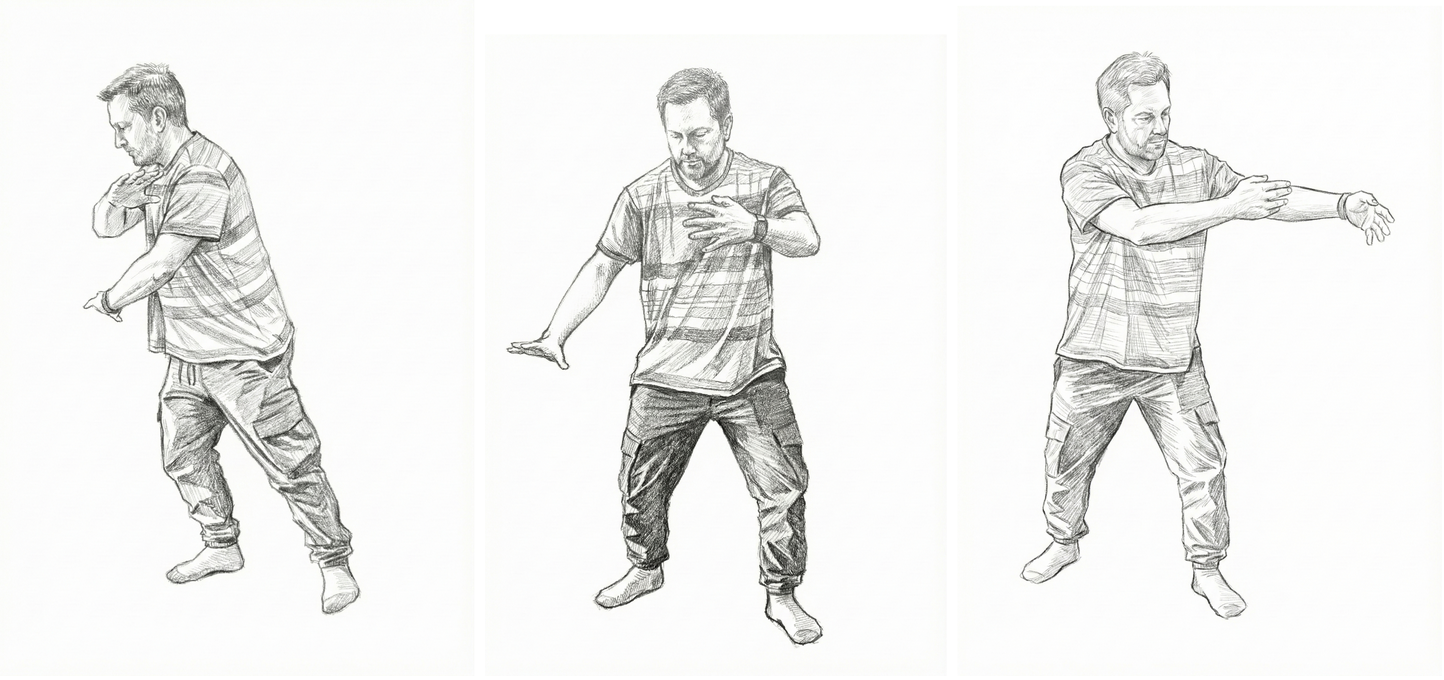
Here is the sequence:
In this sequence, the ‘ward off’ is the middle picture, and my focus is on my right hand pushing down from where it was in the previous picture, then in the next picture I refocus on the left hand deflecting, and getting ready to perform a ‘roll back’.
Here’s a much younger and hoplessly naive version of myself showing the marital application at around 19 seconds in this video:
As you can see, where you are looking in the Tai Chi form is dependent on what application you have in mind when doing the movement. So, while there are some useful maxims to remember in Tai Chi, such as ‘don’t look down’, it’s important that you know when it’s acceptable to bend the rules so that your Tai Chi becomes a living practice, with things done for a reason, not just blindly following the rules.
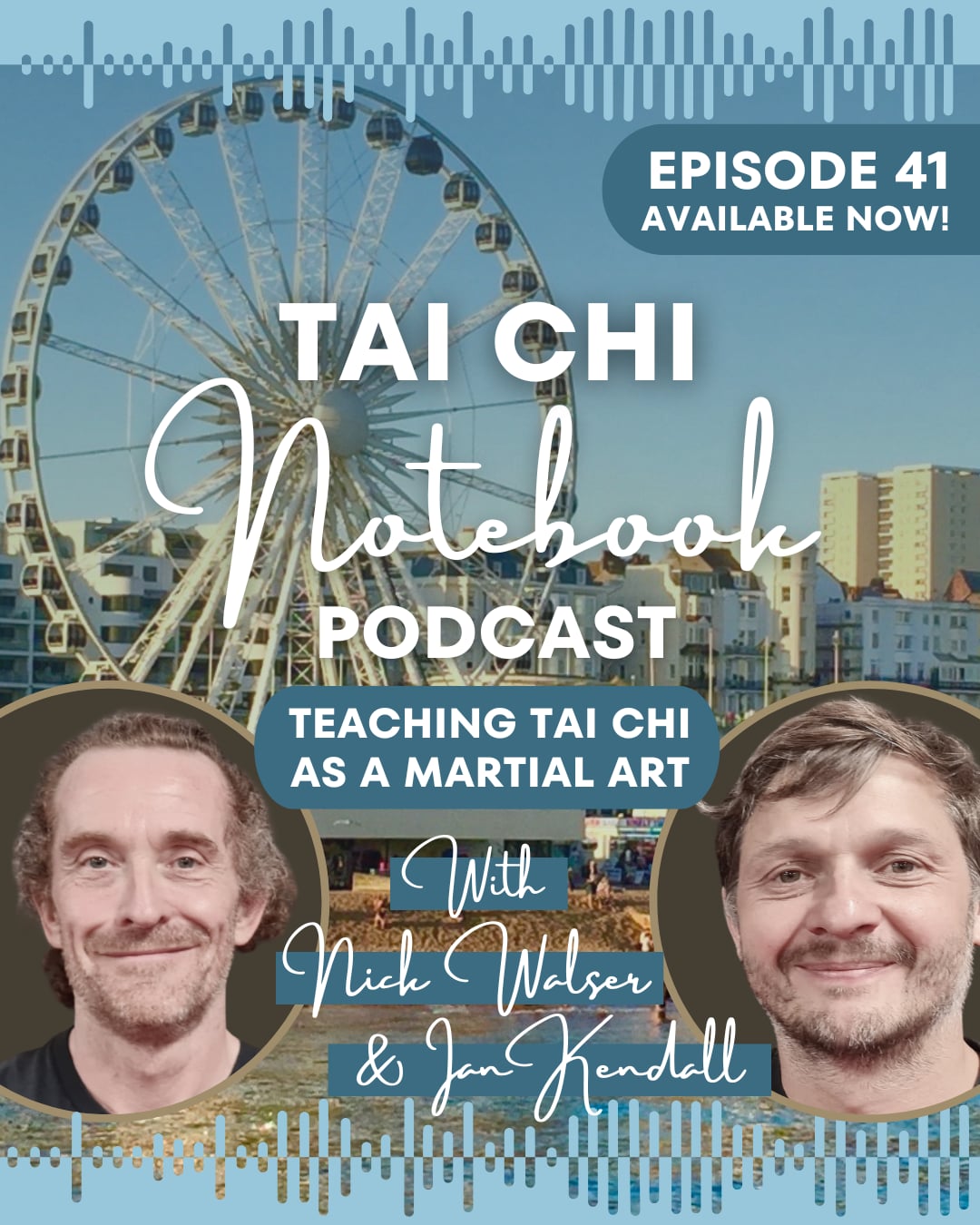
In this episode I talk to two Wudang Tai Chi teachers from Brighton, UK: Nick Walser and Ian Kendall. Both students of the late Dan Docherty, they have continued to practice the tai chi that Dan taught them and developed a new training system called 5 Snake.
5 Snake is a unique and powerful method for finding flow, resilience, and calm through partnered close- quarter practice, and they’re here to tell you all about it.
Just watched a great clip of 1980s Wushu in China – featuring Sun Jianyun, Sun Lu Tang’s daughter performing Bagua. But there’s also some clips of Tai Chi and some kids doing Northern Shaolin (at least I think it’s Northern Shaolin). Well worth a watch. The martial arts are on their way to being the heavily performance-based WuShu we have today, but are not quite there yet, with martial technique still a priority.
Something I read today was, “training material in my personal practice only includes the methods which have always consistently produced observable benefits and skills. Anything which hasn’t done so in a trial period of regular practice is eliminated and abandoned. I don’t have time for anything which doesn’t give a good return on the investment of time and effort to practice.”
That’s an interesting point of view, and seems logical and rational. It seems very in-line with modern efficiency-based exercise or martial arts thinking. I just don’t think it’s a realistic approach to studying the internal arts or qigong in any depth.
I remember talking to Simon Cox who trained for years at Wudang mountain in one of my podcasts and (I’m going by my failing memory here) he said something like his teacher asking them to do meditation for a few years, with barely minimal instructions, then just leaving them to it. Forget “a good return on investment”, you were just expected to do it, without any hope of a result.
I’ve often heard people say things like, “A year is not a long time in qigong practice”.
And from my own experience, I can say with confidence that you do need to practice without “observable benefits and skills” for a long, long time.
Most people simply stop, and therefore never get anywhere. They stay scratching the surface, thinking that they are deep into their practice.
I just saw an advert for a week long “Tai Chi for beginners” intensive with the teacher in question demonstrating a tai chi posture with the head thrust forward, so the chin juts out, the hips and pelvis thrust forward so it looks like he’s doing a bad Elvis impression, the arms awkwardly twisted so the shoulders lock up and the souls of the feet rolling to the sides and coming off the floor, so the ankle joint is not stable.
And yes, he was calling himself “Master”.
I think “buyer beware” is good advice in the tai chi market.
One thing I’ve observed in so many tai chi teachers is this desire to be the teacher way before they are ready. People don’t want to be the student – that’s boring! – they want the glory of leading something, of creating something, of being the person at the front of the class sharing their vast wisdom with their adoring students…
Why is this? I think it’s just ego. I’ve definitely felt it’s twinges in me. It’s a subtle trap that you need to avoid. And one I try actively to avoid all the time when I teach.
It is undoubtedly a nice feeling when people ask you for advice, and look up to you. However, I think it’s nearly always a mistake to want to be that person. People are rarely ever ready to teach tai chi when they start. You could say it’s the curse of tai chi in the western world. That’s why we have people called “master somebody” who can’t do basic tai chi postures or understand tai chi movement leading week-long intensives.
But what do we do about this? After all, somebody has to teach something or there would be no tai chi for anyone!
Perhaps some guidelines if you are teaching:
1. Think of yourself as a coach, or a guide, not ‘a teacher ‘master’. After all, people need to do the work themselves, you can’t do it for them.
2. Don’t let people start to treat you like some guru or master – if they do instantly stop that behaviour developing. You’ll be surprised, a lot of people want a guru to take away all their self responsibility.
3. Self reflect. Are you constantly talking about things you can’t actually do? If so, just stop. There’s never any need for that.
4. The most important thing: Be honest. Tell people what you know, how long you’ve been training, where you got it from. Don’t make yourself into something you’re not in other people’s eyes.
5. Finally, you also need a teacher. Find people you can learn from and don’t stop learning.
This video has been doing the rounds online, showing some tai chi (taijiquan) fighting applications.
I don’t think there’s much to say about it, but it does perhaps prove useful for answering that question you get a lot: “can tai chi be used for fighting?”.
Let’s just try to say a few things about it though:
Firstly, he’s clearly just taking a tai chi posture (‘Play Guitar’) that looks very like that an ‘on guard’ position and using it in the same way a boxer does to parry and block punches. The hand he has by his chin he’s using in just the same way a boxer does their back hand to parry a jab. Is there anything wrong with that? Maybe not. You could use the posture like that, but is that its purpose?
Is that what that posture is designed to be used for? At this point, who knows. Usually you see ‘play guitar’ used as an arm locking posture, or combined with a foot sweep into a shuai jiao-style throw.
On the positive side, he’s actually getting the guy to throw the attacks properly, which is nice to see. Maybe they could be a smidgen closer together, so the punch would actually land, but compared to most applications you see from non-committal attacks, it’s not bad.
No, it’s not sparring, but not everything has to be. I don’t think it would look quite as much like ‘tai chi’ if it was sparring.
Finally, is there much ‘tai chi’ going on here? I’d be looking for smoothly flowing into sticking, yielding, and neutralising. He follows up a couple of times, but I don’t see much in the way of controlling the opponent here. The opponent is more often than not just blocked, and not controlled.
The bar for tai chi applications is pretty low. There are too many videos of people bouncing away at the slightest touch to muddy the water, so I think we have to say that this is at least a step in the right direction.
Let’s see if we can explain this without getting lost in too much theory…
(N.B. I’m writing this, to help my own thought process, rather than producing a tidy finished article, so let’s see where we go.)
Yi is one of those confusing terms in taijiquan. I don’t think you can talk about it without reference to jin and fangsong (probably qi too, but let’s try to leave that for now).
Amongst the taijiquan community there are a lot of varied ideas about jin, the “refined strength” or “trained strength” that you find mentioned in the Chinese marital arts, particularly taijiquan.
Many people seem to think that jin is about generating force maximally for whatever movement you’re doing, so a swimmer has ’swimmer jin’ or a weightlifter has ‘weightlifting jin‘.
It’s a tempting idea – after all who wouldn’t want to move with the grace, power and agility of an athlete, but I don’t think that practicing taijiquan should be looked at as some sort of shortcut to those abilities.
Athletic abilities are hard won, don’t last forever and require an awful lot of maintenance to keep a hold of. You can’t just short-cut them.
In taijiquan that is not what’s really meant by the word jin anyway, or there wouldn’t be anything different, at a fundamental level, between the training a boxer does and the training a taijiquan player does (and at this point you may actually be standing on the sidelines shouting, “No, there isn’t and difference!”, however, that’s your choice, but let me try and change your mind…)
In taijiquan we are specifically talking about ground force when we talk about jin. By ground force I mean the solidity of the ground manifested to our fingers. As the saying in the taiji classic says
The jin should be rooted in the feet, generated from the legs, controlled by the waist, and expressed through the fingers.
This is achieved by letting whatever forces we’re working with find their way to your foot to rest on the ground. This ground force can be bounced back from where it comes, turning it into something that can be used actively as well as passively.
When people talk about jin the next word out of their mouth is usual fangsong, to relax. There’s a reason for this.
The only way to let the forces you’re working with rest on the ground as directly as possible is by relaxing your upper body. (Relaxing your legs doesn’t really help much, since the weight of the body is sinking down into them). It’s getting the tension out of your upper body, by letting it dissolve down, that works the magic.
So what does it mean to ‘let forces rest on the ground’, and how do you do it?
Let’s make this a practical example.
If you’re sitting at a desk right now reading this on a laptop, I want you to pick up your laptop with your hands.
Got it? Good. (If you haven’t got a laptop, grab something of equal weight)
Now, you might think you’re fairly relaxed as you sit there holding your laptop off the desk, but what happens if you say to yourself “let the weight of this laptop go to the ground, through my chair”.
Now, if you’re anything like me you’ll notice that something invisible subtly changes inside yourself when you do this. There’s a noticeable switch of the internal musculature of your body (the qi) that is rearranging things for the weight you are holding to be supported by the ground.
I don’t know what exactly changes, because subconsciously your body just does it, and that subconscious switching is a function of your yi, which is usually translated as “intent”.
You can put your laptop back down now.
What I notice when I do this is that when direct forces to the ground my neck feels freer, my shoulders looser and space seems to open up. Mentally I also feel clearer. These are a lot of the benefits that you get from practicing taijiquan.
Your yi is activated when you imagine a direction that you want to send a force into. It does all the hard work of plotting the path through your body on a subconscious level that you aren’t usually aware of. In fact, trying to work out how it’s doing it is a sure way to mess up actually doing it.
If you see people practicing taijiquan, or other internal arts, with that kind of faraway focus that’s about halfway between open awareness and fixed attention, that’s what they’re doing. They’re not communing with the angles, they’re imagining directions for the jin to ‘flow’ in. They are using their yi while doing the form.
Now that was quite a lot of concepts to throw at you in a short while, and probably enough for now, so let’s stop there.



 The Tai Chi Notebook