Nabil Ranné is a Chen style teacher living in Berlin who offers classes and online training at CTN Academy Nabil is a student of Chen Yu, who is the only son of Chen ZhaoKui and grandson of the famous Chen Fake. Listen here.
Here’s what we talk about:
Timestamps:
1.00: Nabil’s background in martial arts and what attracted him to Chen style Tai Chi
3.40: What is Jin in Tai Chi?
7.30: What makes Tai Chi different to other marital arts?
11.15: What is the strategy for Tai Chi?
16.00: What is the function of Tai Chi push hands?
17.55: Competition push hands vs Tai Chi push hands
22.20: The Xin Yi podcast and how do you train applications in Tai Chi
As well as a Tai Chi practitioner and teacher, Richard is a full time movement coach working with athletes, so he brings an appreciation of athletic movement to his views on Tai Chi.
In our discussion Richard delves deeply into the internal workings of the Chen Style Practical Method and we talk a lot some interesting movement principles based around rotation. We also talk about how the Practical Method is different to the Chen Village style of Tai Chi.
There’s a lot of talk in the internal arts about the “kua”, and how using the kua (as opposed to the hip joints) is central to getting the idea of internal movement in Tai Chi.
“Kua refers to the area that extends from the inguinal folds (front of the hip where the leg and body meet) to the crest of the pelvis. It includes the hip joints, the iliopsoas, and adductor muscles as well as the sacrum and the perineum.”
I’ve written about the kua several times myself, but I think Ken Gullette’s book (my review is here) does a great job of describing it. To me, moving the kua is about opening and closing the body in the space inside the hip joints. Integrating the opening and closing of the kua into your movement facilitates power moving smoothly from the legs and feet up through the body, or receiving force in the opposite direction and directing it down towards the ground.
Moving “inside” the hip joints allows for very detailed movement and enables you to create and remove space when interacting with an opponent, which has martial application.
However, I think that the focus on the kua in internal arts often risks people ignoring the pivotal (ha!) role of the hip joints. I think the hip joints are actually more important to get right – if you focus on the kua but never think about your hip joints it’s a bit like building the walls of your house without a firm foundation.
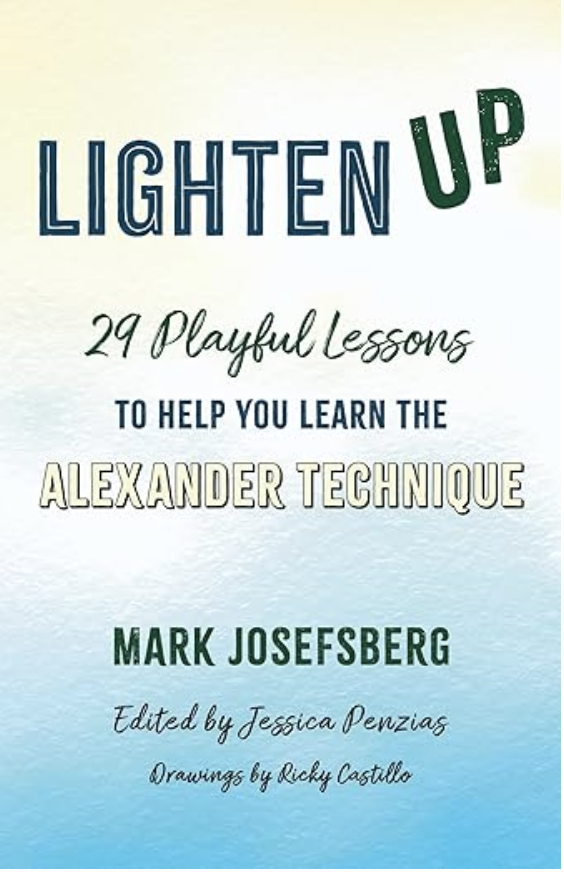
I’ve been reading a great little book called Lighten Up by Mark Josefsberg, which is a humorous description of the Alexander Technique, and only costs £2.50 for the Kindle edition.
It starts off making the great point about the pivotal (ha!) role the hip joint play in actions like sitting, standing, running, walking, bending, etc.. A good point it makes about your hip joints is that they probably aren’t where you think they are. People tend to think that you put your ‘hands on your hips’ that’s where you bend from, when in fact, your hips attach to your legs via a ball and socket joint that is much lower down.
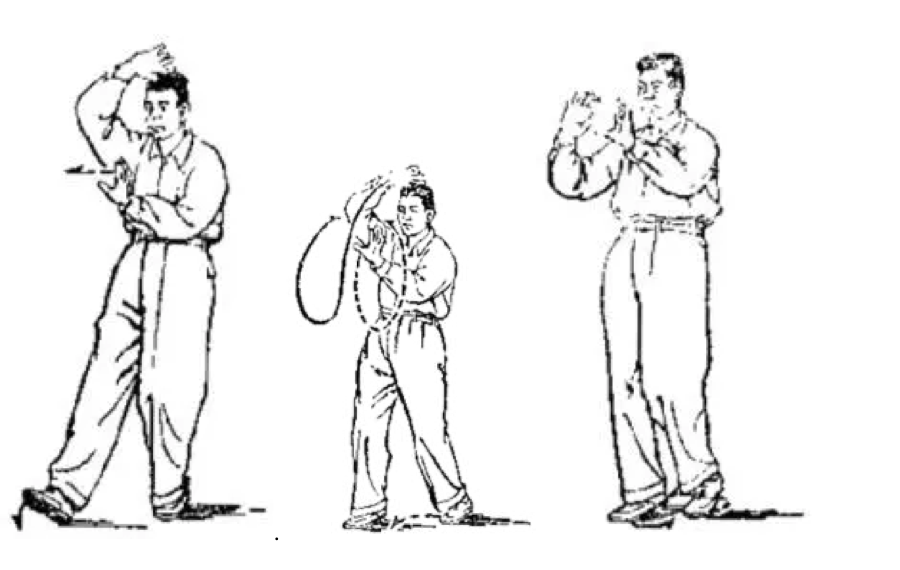
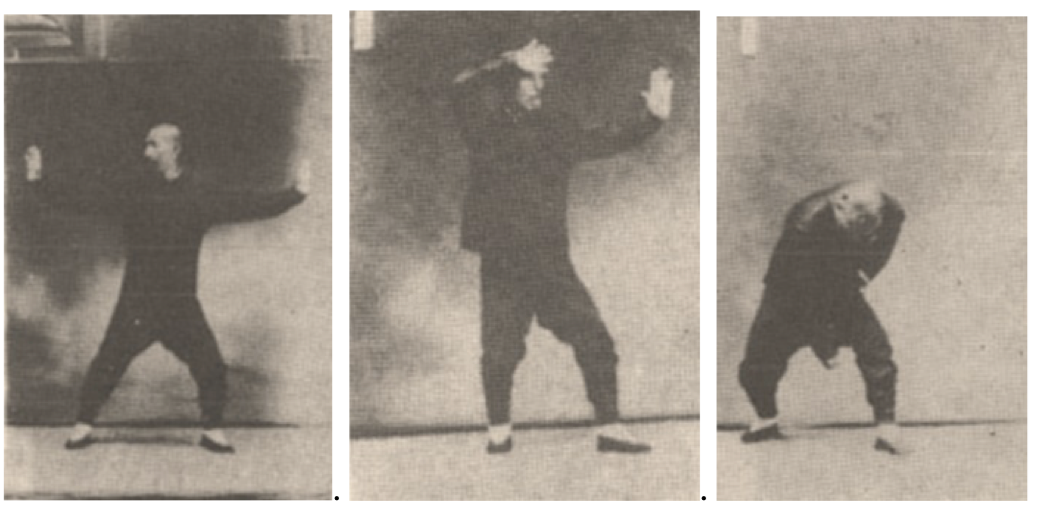
This has real consequences for Tai Chi postures such as “Needle at Sea Bottom”, where you bend forward. If you bend from too high up then you are compromising your spine, and bending from your hip joints is always a bit lower down than you think it is.
Wu Jianquan, Needle at sea bottom
The way I do Need at Sea Bottom is to try and keep my head going “up” away from the spine and bend from the hip joints (where the legs attach to the body) keeping my spine in a straight line. In theory, at least.
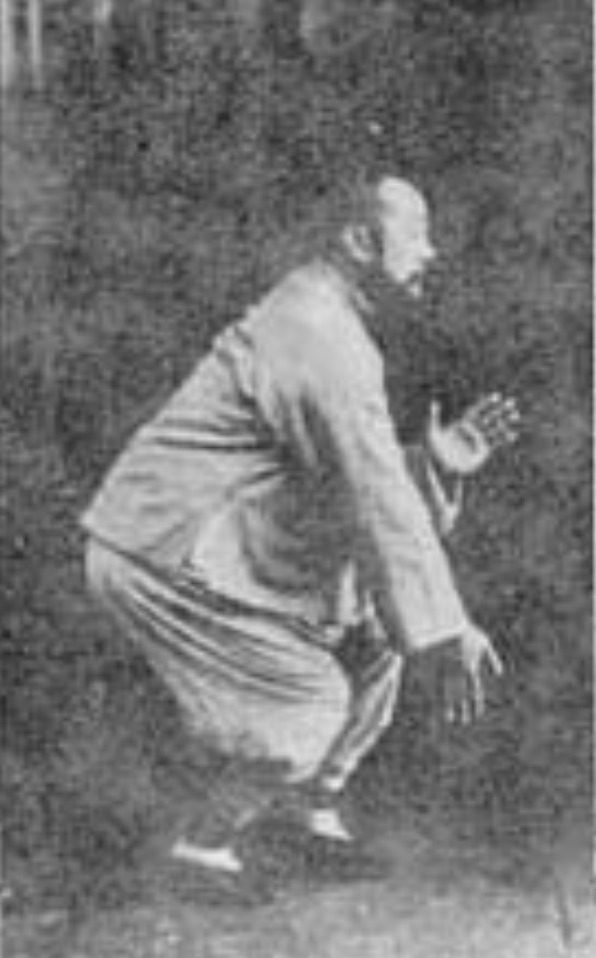
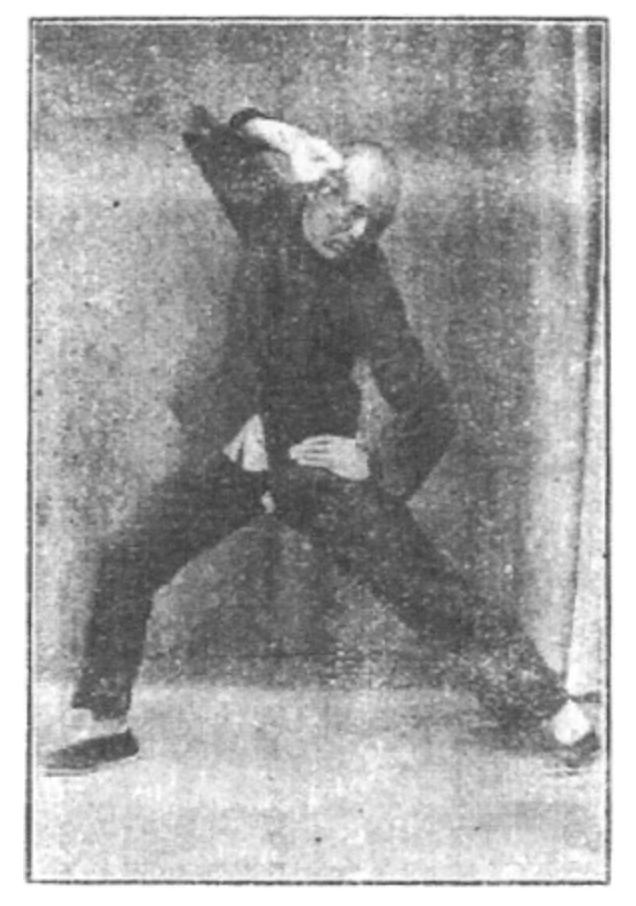
I don’t know who this is, but look at this guy doing it:
To me there are all sorts of problems here – he’s rounding his spine, and the head is kinked at an unnatural angle that isn’t an extension of the spine, in an effort to go too low. I’d rather not go as low as he is, and not compromise my spine like that.
The other point that Mark continually makes in the Lighten Up book I mentioned is to be aware of the AO joint – the atlanto-occipital joint. This is where the head meets the neck, and again, it’s not exactly where you think it will be. Put your fingers in your ears and imagine they are touching. Rotate the head up and down from something on a level with that point – that’s roughly where it is. What you’ll find is that you can look up and down without your fingers moving up or down because you are rotating the head around this point. Now apply that principle to Needle at Sea Bottom and you can see how your head position is meant to be.
Here’s a video of my Sifu Raymond Rand doing the movement correctly, with martial application:
You can see the little wobble of the knee he does before he does a fajin in the form. This knee wobble has been the source of seemingly endless debate. Some lineages of Chen style do it, some don’t. Some do it but it’s very minimal, some do it and it’s quite exaggerated. It doesn’t even seem to be a village vs Beijing style thing either.
So, why do it? It’s a way to involve the knee in the generation of power. The best analogy I can think of is that it’s like retracting your fist before you punch, but instead of having to move your fist back (which has certain obvious martial disadvantages), you store power by moving the knee back instead. This obviously requires a conditioned body, where the hand to foot is all connected, so that when one part moves, all parts move. If you just took your average Joe off the street and they did a knee wobble, I don’t think it would do anything for their punching power. In fact, it would probably decrease it. But for somebody who has built that connection over time throughout the body, it has advantages.
Lots of people are convinced that the knee wobble is the route to ruin for your body, that it’s bio-mechanically inefficient and potentially injurious over time with hard training. I can see where they are coming from since you are using the knee as part of a whip-like kinetic chain for which the hinge joint is not well evolved.
But personally I’m not so convinced that, done properly as part of an overall training system, it is bad for the knee, necessarily. I think if you were holding your weight for a long time on a misaligned knee joint then that would be a bigger problem. But the quick flick of a fajin isn’t like that. There are also plenty of things athletes do all the time that I’d say are potentially much more dangerous. It also depends on the person. The knee is a particular weak point in the evolution of the human beings into an upright posture, and being severely overweight is very dangerous to your knee joints. And if I was severely overweight there is no way I’d be flicking my knee joints about like this, so it very much depends on the overall health of the person doing it.
Disclaimer! I’m not an orthopedic surgeon, or a physiotherapist, so I’d suggest getting your medical advice from somebody who is actually medically qualified.
It’s no secret that Tai Chi is a series of circles. The body opening and closing using circulation motions, like a yin/yang symbol in action. But when you look at a Tai Chi form, you’ve got to wonder, what came first, the techniques or the philosophy? Was Tai Chi created in a moment of philosophical purity and clarity, or was the philosophy simply bolted on to existing military or self-defence techniques (or popular movements from theatrical or religious rituals) that were already as old as the hills?
What I’m wondering is, was there at some point a founder of the art who decided, as a starting point, that he was going to purposely create a martial art based entirely on a philosophy based on the Tai Chi symbol, which would be both the overarching principle and the raw material, out of which martial applications would be fashioned?
Or did the idea of doing things in circles come later, and get added to existing martial techniques, and in so doing, alter them forever?
Well, let’s look at what we know as fact.
Fact 1: Tai Chi does indeed contain nothing but circular movements. I’m sure somebody somewhere can point out a movement in a form that looks linear, but it’s quite possible that the movement is actually being created in a circular way, or it has degraded over time into something else. All we can do here is talk in broad brush strokes. If you look at a Karate form, or a Tae Kwan Do form you see lots of examples of linear movements, that are usually lacking from Tai Chi forms. From this we can conclude that some sort of philosophical idea must have been involved in its creation.
Fact 2: The techniques in Tai Chi forms look a lot like other techniques in other Chinese martial arts forms, so are not in any way unique. If you look at a lot of forms from the Shaolin Temple, or village styles from all over China, you see postures and movements that are very similar to the techniques found in Tai Chi. In a way, there is nothing new under the sun.
When solving a murder, detectives look for two things first – opportunity and motive.
When Tai Chi first appeared in Beijing in the late 19th century it was promoted along with the idea that it had a founder, an immortal Taoist called Chan Sang Feng who had created the art based on his observation (or a dream) of a fight between a crane (or possibly stork) and a snake. And while certain groups (see my last interview with George Thompson) on Wudang mountain still take this story very seriously, and possibly literally, modern scholarship has tended towards the idea that it was a fighting art from the rural countryside (Chen village being the most popular choice for origin) that found its way to Beijing via a young Yang LuChan, who taught it to those at the highest level of influence inside the Forbidden City.
Of course, the shadowy figure of Yang LuChan is never adequately explained, and since he was an uneducated nobody – a rural rube – nobody really made a record of his existence. The story everybody, including all the heads of the various Tai Chi families, follows, (because it’s the story the Chinese government approves of), is that he learned the art in Chen village. But I always wonder about that time in the 1860s when Yang and the very well educated and important Wu brothers were in Beijing, as being a time when Tai Chi could have been invented. The Wu brothers would have known the philosophy on which to hang it, and Yang would have had the martial skills to make it work and turn it into something that could bring the fractured court of the late Ching Dynasty together, bonding over something that was essentially Chinese in the face of constant threat from foreign powers. Yang and the Wu brothers together had both opportunity and motive, and regardless of whether you accept that interpretation of history or not, Tai Chi has been used as a political football ever since, especially by the current government to whom Tai Chi (the world’s most practiced marital art!) represents the ultimate form of soft power, spreading Chinese culture and influence the world over.
In the latest episode of the Tai Chi Notebook podcast host Graham is left all on his own without a guest, so he’s decided to pick up a book and read it to you! He’s gone for The Tai Chi Classic, one of the core works which make up a collection known as The Tai Chi Classics. Graham goes through the text a paragraph at a time and gives his interpretation of what the classic is saying. We hope you enjoy!
The Tai Chi Classic
In motion, the whole body should be light and agile,
with all parts linked as if threaded together.
The chi should be activated,
The mind should be internally gathered.
The postures should be rounded and without defect,
without deviations from the proper alignment;
in motion, your form should be continuous, without stops and starts.
The jin should be
rooted in the feet,
generated from the legs,
controlled by the waist, and
expressed through the fingers.
The feet, legs, and waist should act together
as an integrated whole,
so that while advancing or withdrawing
one can take the opportunity for favorable timing
and good position.
If correct timing and position are not achieved,
the body will become disordered
and will not move as an integrated whole;
the correction for this defect
must be sought in the legs and waist.
The principle of adjusting the legs and waist
applies for moving in all directions;
upward or downward,
advancing or withdrawing,
left or right.
All movements are motivated by Yi,
not external form.
If there is up, there is down;
when advancing, have regard for withdrawing;
when striking left, pay attention to the right.
If the yi wants to move upward,
it must simultaneously have intent downward.
Alternating the force of pulling and pushing
severs an opponent’s root
so that he can be defeated
quickly and certainly.
Full and empty
should be clearly differentiated.
At any place where there is emptiness,
there must be fullness;
Every place has both emptiness and fullness.
The whole body should be threaded together through every joint
without the slightest break.
Long Boxing is like a great river
rolling on unceasingly.
Peng, Lu, Ji, An,
Tsai, Lieh, Zhou, and Kao
are equated to the Eight Trigrams.
The first four are the cardinal directions;
South; Heaven, North; Earth, West; Water, and East; Fire.
The second four are the four corners:
Southwest; Wind, Northeast; Thunder,
Southeast; Lake, and Northwest; Mountain.
Advance, Withdraw,
Look Left, Look Right, and
Central Equilibrium
are equated to the five elements:
Metal,
Wood,
Water,
Fire, and
Earth
Taken together, these are termed the Thirteen Postures
For clarity, his assertion is that the “dantien” is something that doesn’t exist by default, the way, say, your shoulder exists, but that it is formed by the simultaneous actions of other parts of the body. In this case, the hips, back, spine, breathing and more.
I’ve written here before that this is somewhat similar to the idea of the lap in English. The lap is formed by taking a seated position, and when you stand up it disappears.
So, when you form Tai Chi postures, you are also forming a dantien. Or at least you should be.
You can think of this as being an incredibly complicated prospect, but I don’t think you need to. There is also an implied simplicity to the idea. The problem is that when you start out the feeling of ‘strength’ in that area of the body is inherently weak, but correct practice of Tai Chi should be the training you require to start to build that dantien so that it’s a much stronger feeling.
Correct practice on a daily basis is what you need.
Of course, if you talk to Chinese medical practitioners, to them the dantien is as real as any other part of the Chinese medical system, and doesn’t require ‘work’ to exist. But I think that when talking about Tai Chi things, it’s safer to assume that this is not the dantien being talked about.
I’ve always been curious about the postures in martial arts forms where both feet are together, because these postures don’t look very martial at all. In fact, it’s hard to imagine why you would want to use a stance like that in a fight, and yet we find them in a lot of Tai Chi forms:
Here’s an example of the posture in application in Taiji performed by my teacher Sifu Raymond Rand:
Sifu Rang, Brush Knee, Twist Step.
It seems to be mainly Taiji lineages that have some influence from Sun Lu Tang that do this the most. A lot of people attribute the distinctive ‘feet together’ postures he used to his prior training in Xing Yi, and there could be some truth to this. Xing Yi does have ‘feet together’ postures quite a lot.
Of course, the root of Xing Yi is spear fighting, but the modern interpretation of the art is heavily biased towards bare hand training, and this creates a misleading impression. Think about it – if you were at at least one spear length away from your opponent the risk of being tackled to the ground because your feet are together would be greatly reduced. You’re now free to use the power generation advantages that can be gained by letting both feet come together, which is handy when you are holding a heavy object, like a spear.
If you watch this excellent video of Xing Yi spear technique by Byron Jacobs you’ll see that he doesn’t hang out with his feet together all the time, but occasionally he uses the feet together moments for power generation (and of course, also standing on one leg for range advantage and manoeuvrability in a way that makes sense with weapons).
In Xing Yi the most famous example of the ‘feet together’ posture is the Half-Step Beng Quan. Here the back foot stepping up to meet the front foot in place creates a powerful closing action of the body, kind of like a door slamming.
So, is this the origin of ‘feet together’ postures in Taiji forms? Quite possibly. However, there is one more thing to consider. After first learning Xing Yi, Sun Lu Tang learned his Taiji from Hao Weizhen 1849–1920, who learned from Li Yiyu 1832–1892, who learned from one of the Wu brothers, Wu Yuxiang 1812–1880 who had learned directly from Yang Luchan 1799–1872 and also sought out Chen Qingping 1795–1868 who he learned from in Zhaoboa village.
It’s often thought that the distinctive stepping seen in Sun style Taiji, where the back foot is often lifted and brought up close to the front foot, is a consequence of Sun’s prior Xing Yi training. This makes sense as part of the narrative created as part of the Sun Style Taiji brand, which is that he incorporated his earlier Xing Yi and Bagua training into his Taiji style. However, if you look at the Wu (Hou) style he learned, it already had this distinctive stepping in it.
While the feet don’t go completely together as much, if at all, in Wu(Hao) style, they are very close together for a lot of the time. Watch this video for an example of the form in action:
I think you can see that influence extending into Sun Lu Tang’s Taiji, which makes sense since he learned from this lineage.
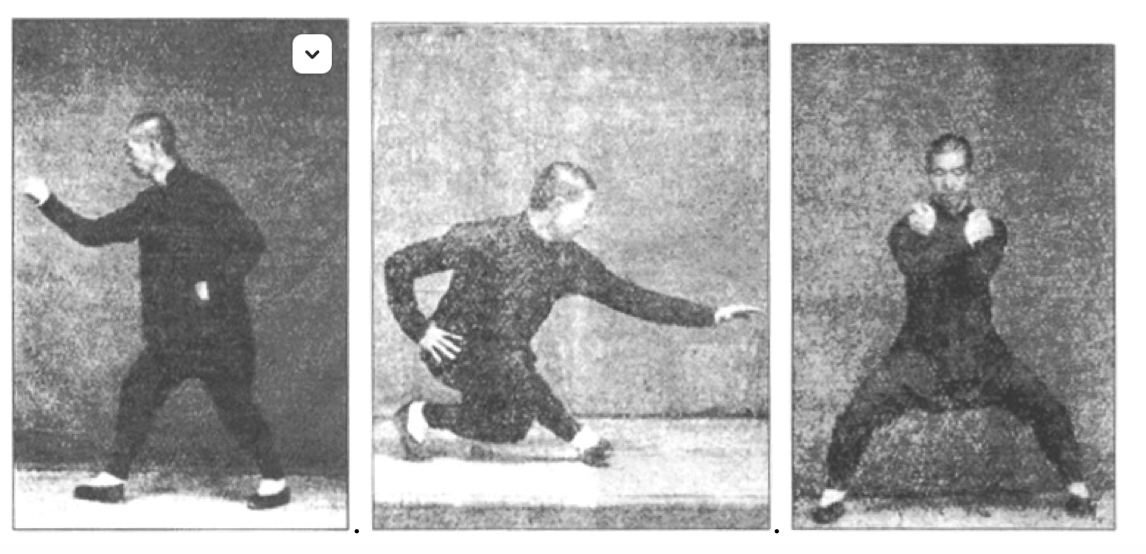
Finally, I should note that thought this post I don’t want to create the impression that all the steps in either Xing Yi or Taiji performed by Sun Lu Tang are small or restricted. He also had plenty of wider postures in his arts too, for example.
Xing Yi:
Taiji:
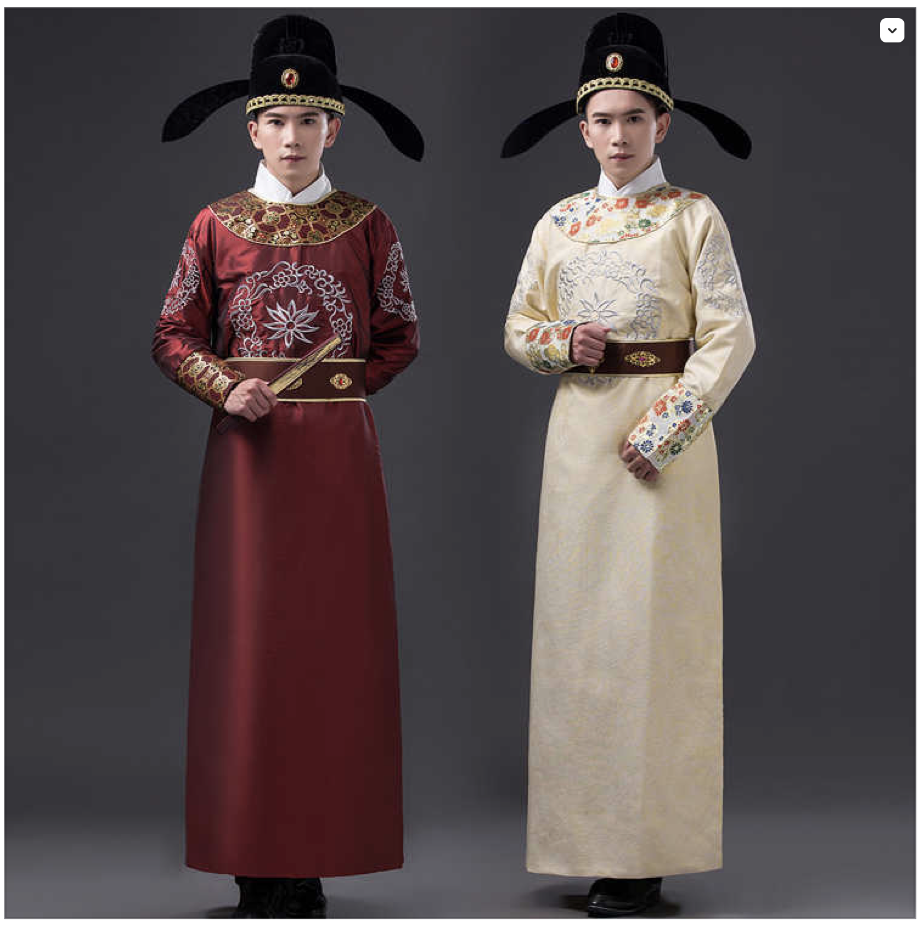
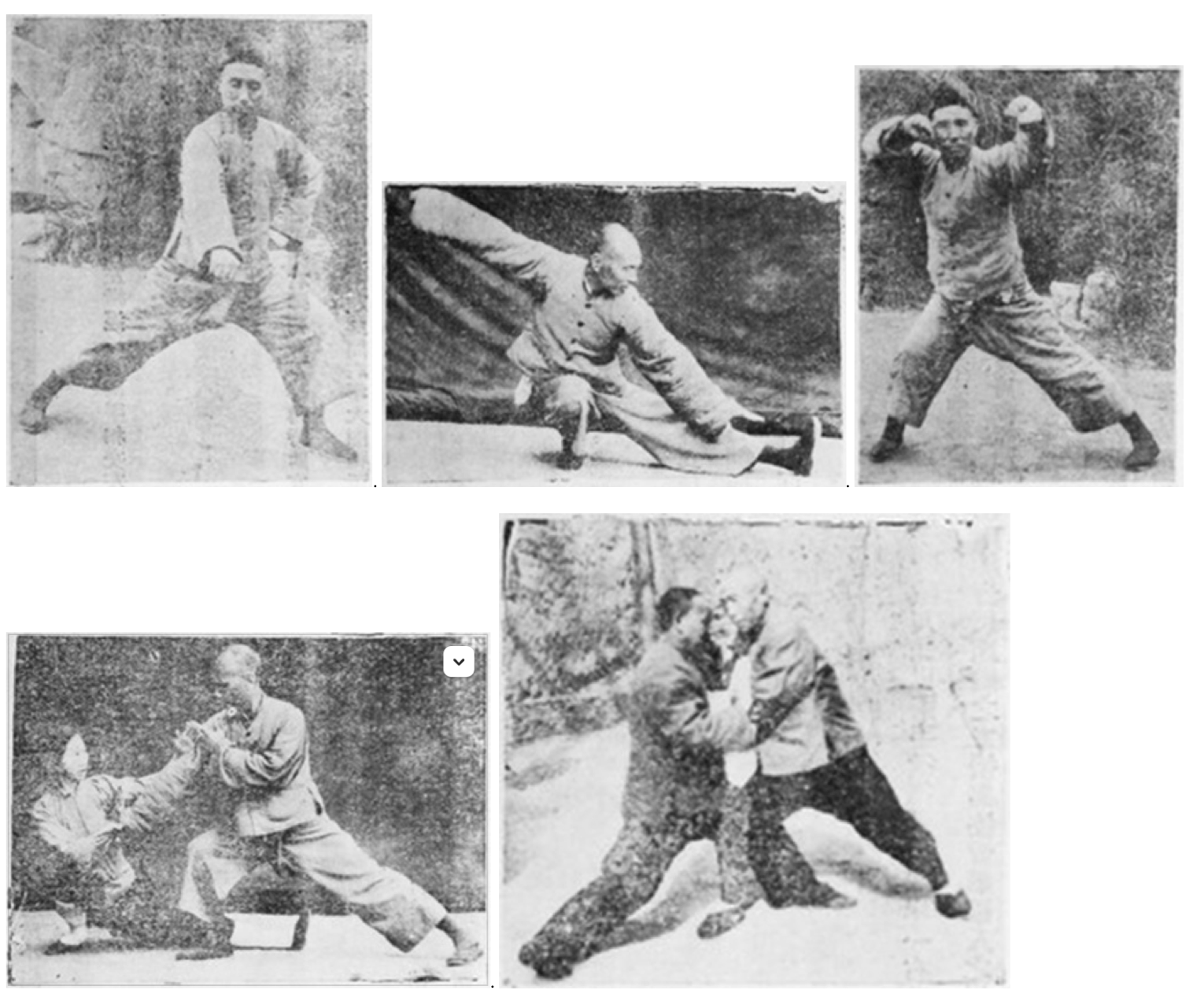
However, compare it to postures found in other styles of Taiji whose practitioners didn’t have to wear court dress:
In this episode of the Tai Chi Notebook podcast I’m teaming up with Ken Gullette, to answer the kind of questions that Tai Chi teachers get asked all the time.
YouTube version for people who, er, like YouTube?
Ken is an all-round good guy and owner of the Internal Fighting Arts website where he teaches the arts of Xing Yi, Bagua and Tai Chi at a very reasonable monthly cost. Check him out at www.internalfightingarts.com
Ken is a Chen style guy, and I’m a Yang style guy so it’s no surprise we have slightly different views on a lot of different topics, but that’s part of the fun of it all.
And if you’d like to help out my podcast then you can now become a friend of the Tai Chi Notebook on Patreon. Head over to Patreon.com/taichinotebook and you’ll be able to get a downloadable version of the podcast as well as support my work and get exclusive articles.
I was observing the usual argument/discussion between two people about ancient Chinese words like Yi and Qi that frequently happen in Tai Chi circles, and it was going down a familiar route..
“Don’t lecture me! I read classic Chinese and Yi means ‘idea’ and Qi means ‘movement’.”
“Really? Wang Yongquan wrote ‘To mobilize Qi, you create an empty space, by Soong and a light Yi to empty the area. The differentiation of yin and yang is what makes Qi flow.”
“Seems quiet different then…”
Confused! Photo by Oladimeji Ajegbile on Pexels.com
And on and on and on…
Recently I had a conversation with a very experienced Chinese martial artist (it will be released as a podcast soon, don’t worry) about how these things are trained in Asia vs how we do it in the West.
He made the point that in the West we have to understand something intellectually before we will do it. i.e. we have to know we’re not wasting our time, that we will get something out of this. It has to ‘make sense’. And we usually ask loads of questions before even trying it. In contrast, in Asia, there is a lot less questioning and a lot more doing. You just do it. If you’re doing it wrong you hope your teacher will notice and put you on the right track. But generally you just keep doing it secure in the knowledge that eventually you will get it. It’s all in the feel. If you have the feel right, then you are doing it. End of story.
Nowhere is this distinction between the Eastern and Western approach more clearly represented that on discussion forums about Tai Chi that are full of Westerners. We love to argue about what these ancient concept and words like Qi, Yi and Xin really mean. As if one day we will arrive at the ultimate answer. It seems we can’t get enough of it.
But here’s the secret: it doesn’t matter how you define these words, what concept or theory you use for their implementation, or how well you read Classical Chinese from the Ming Dynasty. What matters is – can you do it?Can you show it to me?
If I said, “Show me your Yi. Let me feel your Jin” Could you do it?
If you can then it doesn’t matter wether you define Yi as “idea”, “mind” or “intent”. I’m sure we’re all familiar with the famous phrase coined by Polish-American scientist and philosopher Alfred Korzybski, who gave a paper in 1931 about physics and mathematics in which he wrote that “the map is not the territory” and that “the word is not the thing”, encapsulating his view that an abstraction derived from something, or a reaction to it, is not the thing itself.
So, all these online arguments about Qi and Yi, are effectively pointless. They are map, not territory. However, I do think that a little intellectual understanding can be useful. Especially if it stops you asking questions long enough to just practice. Also, there’s always this temptation to think that if I can just understand something perfectly, or write it down in the perfect, most simple way, then eventually everyone will go “Yes! That’s it!”
Anyway, as I was practicing this morning a thought popped into my head which I thought felt right, so I thought I’d write down and share it:
“Yi is the direction you’re sending your mind in, and the Jin follows.”
To me, Yi is always about a direction. And it is directed. It’s the opposite of a vague, warm, fuzzy haze. It has a steadfastness and a focus. There. Did that help? Or did it just make you more confused. Answers in the comments section please. If you have your own pithy phrase to summarise a concept as subtle as Yi that works for you, then feel free to add it below.
I’ve written before about Yi in Tai Chi Chuan. So, you can have a read of that too.






 The Tai Chi Notebook