Key details for a good riding horse stance by connecting the upper and lower

Chen Man Ching once famously said that he only understood Tai Chi after having a dream in which he had no arms.

It’s a good indication of what you’re looking for in Tai Chi  – which is to “do” everything with the actions of the legs and waist, not the arms. The idea of moving the arms without moving the arms is, of course, contradictory, but that’s the challenge you undertake when you practice Tai Chi.

I found that I didn’t “get” this concept of “no arms” until I really relaxed my lower back and learned to sit correctly in the form. The lower back is the bridge between the upper body and the lower body. If that bridge is not open then goods and services cannot flow between the two different countries.

So, how do we do this in the correct way? I think the key is to be found in how you get into a riding horse posture properly. 

We’re all familiar with the wide-legged riding horse posture. When you start a Tai Chi form you are essentially sitting down into a narrower version of it, but it’s the same kind of stance. 

Let’s formalise what I mean by Riding Horse stance a bit more.

1. Toes point forward. 

2. Knees bent, but not further forward than the toes. 

3. Feet two shoulder widths apart. 

As aways we make sure that our upper body is relaxed (not collapsed) and upright. Just take a moment to focus not he AO joint that I mentioned in my last post, to ensure that your head is in the correct position. Your neck should feel long at the back and the chin slightly tucked at the front, crown going in the upward direction.

Now straighten your legs. This brings you out of a riding horse stance and into a leg triangle stance with straight legs.

We’re going to lower back down into a riding horse, but rather than doing what you normally do, I want you to focus on two things.

1. The knees go forward as they bend.

2. The butt does not move backward as it would if you were going to sit in a chair, but instead you open/relax your lower back so that it sinks downward.

There you go. This should feel like a different sort of riding horse stance to what you’ve normally experienced. That elongated and open feeling in the lower back is what you need to maintain during your Tai Chi form. Without that feeling you cannot connect the upper and lower parts of the body.

Play with it, experiment with it a bit, and then when you’re ready, start your Tai Chi form and as the hands come down and you sink, try and achieve the same feeling.

Then try and keep it for the whole form. If you can do that, then you’ll start to notice that Tai Chi is all about the leg movements, not the arm movements. Your arm movements can start to be directed by the leg and waist movements. 

As it says in the classics:

It is “rooted in the feet,

generated from the legs,

controlled by the waist, and

expressed through the fingers. “

The crucial detail of using the kua and hips in Needle at Sea Bottom

There’s a lot of talk in the internal arts about the “kua”, and how using the kua (as opposed to the hip joints) is central to getting the idea of internal movement in Tai Chi.

So, what is the kua?

A definition from Crane Tiger Tai Chi reads:

Kua refers to the area that extends from the inguinal folds (front of the hip where the leg and body meet) to the crest of the pelvis. It includes the hip joints, the iliopsoas, and adductor muscles as well as the sacrum and the perineum.

I’ve written about the kua several times myself, but I think Ken Gullette’s book (my review is here) does a great job of describing it. To me, moving the kua is about opening and closing the body in the space inside the hip joints. Integrating the opening and closing of the kua into your movement facilitates power moving smoothly from the legs and feet up through the body, or receiving force in the opposite direction and directing it down towards the ground.

Moving “inside” the hip joints allows for very detailed movement and enables you to create and remove space when interacting with an opponent, which has martial application.

However, I think that the focus on the kua in internal arts often risks people ignoring the pivotal (ha!) role of the hip joints. I think the hip joints are actually more important to get right – if you focus on the kua but never think about your hip joints it’s a bit like building the walls of your house without a firm foundation.

I’ve been reading a great little book called Lighten Up by Mark Josefsberg, which is a humorous description of the Alexander Technique, and only costs £2.50 for the Kindle edition.

It starts off making the great point about the pivotal (ha!) role the hip joint play in actions like sitting, standing, running, walking, bending, etc.. A good point it makes about your hip joints is that they probably aren’t where you think they are. People tend to think that you put your ‘hands on your hips’ that’s where you bend from, when in fact, your hips attach to your legs via a ball and socket joint that is much lower down.

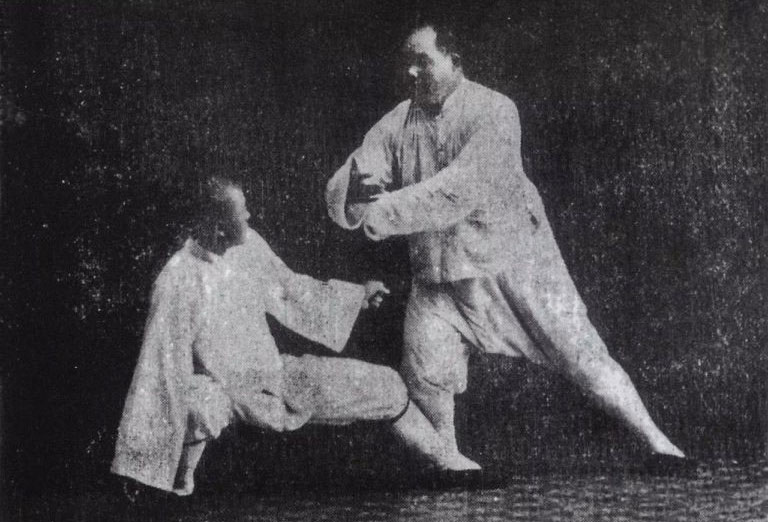
This has real consequences for Tai Chi postures such as “Needle at Sea Bottom”, where you bend forward. If you bend from too high up then you are compromising your spine, and bending from your hip joints is always a bit lower down than you think it is.

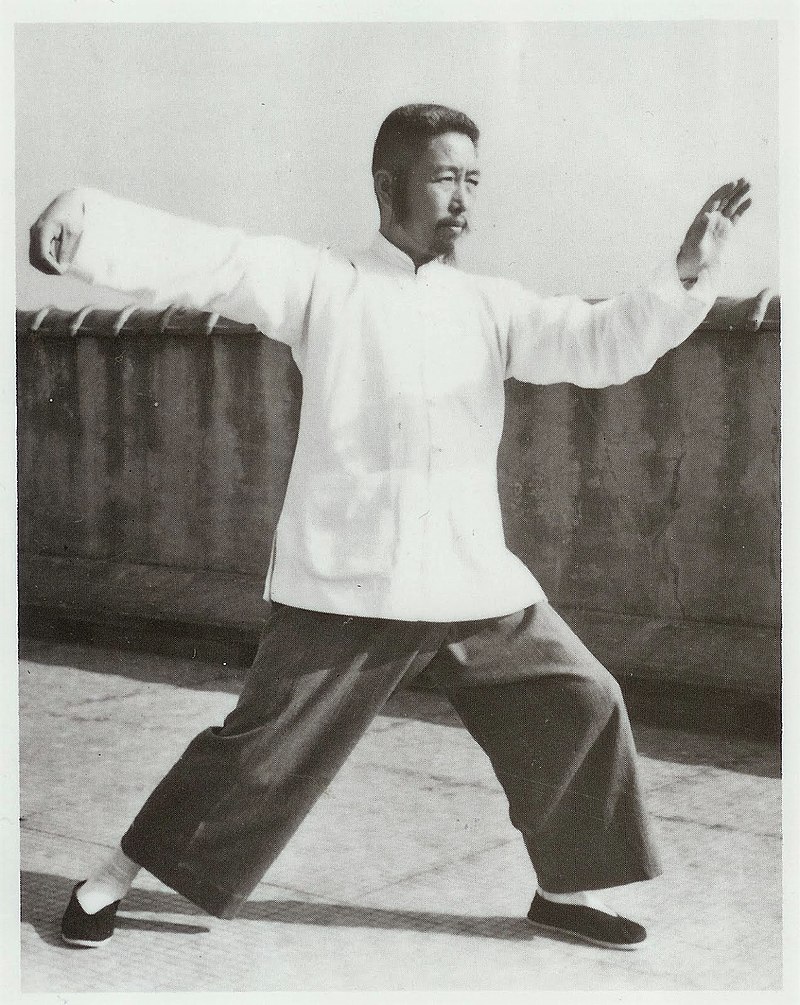
Wu Jianquan, Needle at sea bottom

The way I do Need at Sea Bottom is to try and keep my head going “up” away from the spine and bend from the hip joints (where the legs attach to the body) keeping my spine in a straight line. In theory, at least.

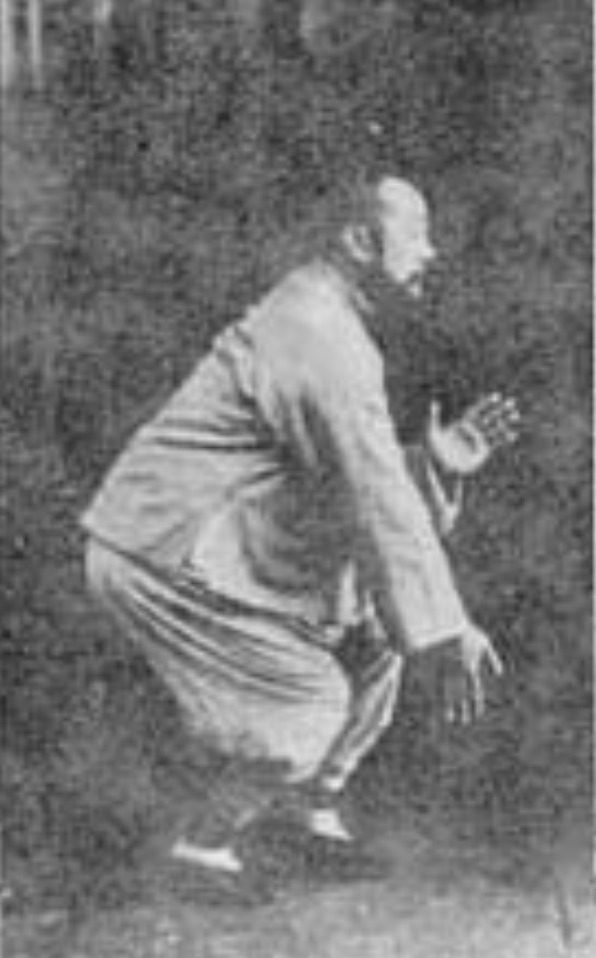
I don’t know who this is, but look at this guy doing it:

To me there are all sorts of problems here – he’s rounding his spine, and the head is kinked at an unnatural angle that isn’t an extension of the spine, in an effort to go too low. I’d rather not go as low as he is, and not compromise my spine like that.

The other point that Mark continually makes in the Lighten Up book I mentioned is to be aware of the AO joint – the atlanto-occipital joint. This is where the head meets the neck, and again, it’s not exactly where you think it will be. Put your fingers in your ears and imagine they are touching. Rotate the head up and down from something on a level with that point – that’s roughly where it is. What you’ll find is that you can look up and down without your fingers moving up or down because you are rotating the head around this point. Now apply that principle to Needle at Sea Bottom and you can see how your head position is meant to be.

Here’s a video of my Sifu Raymond Rand doing the movement correctly, with martial application:

Why I’m a martial arts snob

So, apparently I’m a snob when it comes to martial arts! I must be because on two separate occasions now women have accused me of being one (interesting that it’s women both times!)

A recent exchange went something like this…

Me: Are you going to the seminar with master x this week?
Her: Yes, you?
Me: Yes, but if he teaches a basic hip throw I’m walking out. 🙂
Her: You’re such a marital arts snob! 🙂

As you can see, there were smilies involved, so I don’t think it was meant seriously, but there’s always a grain of truth at the bottom of most jokes.

Photo by Anete Lusina

This got me thinking. I think I am a bit of a snob when it comes to technique in jiujitsu. The popular wisdom goes that after black belt you start to really appreciate the basic techniques and find hidden value in them. Sure, I can see that. It’s true, you do revisit seemingly basic techniques and find things you’ve missed or deeper levels to the technique. But sometimes basic techniques are just… basic. And a bit boring. Show me something new and cutting edge, especially if I’m paying for a seminar!

When it comes to Chinese martial arts (CMA), I’m a snob in a different sort of way. Watching other people do CMA I don’t always express an opinion, but internally I’m very judgy. I find it hard to praise people for a mediocre performance, or even ignore all the bad bits like some people seem to be able to. But equally, when I do see something I like, I’m pretty free with my praise about it.

When watching forms done on video I always try to factor in that “everything looks 20% worse on video compared to real life”, and judge accordingly. But even so, what some people in marital arts deem worthy of sharing with the pubic makes me question their sanity. A lot of it is just embarrassing, but there is something else to look out for…

As I discuss with Jess O’Brien in an upcoming podcast, it can be hard to know what is correct in Chinese marital arts. Quite often, even within the same style, two teachers will have radically different interpretation of the same principles, and they can often both be right at the same time – i.e. they can both make it work. It’s not until you get hands on with a person that you can tell if what they’re doing works, or not. So, it’s usually a good idea to gets hands on with somebody before you criticise them too much.

With that said, I think you do need to be pretty discerning with what you’re accepting as “good” in Chinese martial arts. CMA has always been infiltrated by people who were, shall we say, not very good, but pretended to be so, especially to naive Westerners who can’t tell the difference. Then there are the teachers who hold things back and don’t teach all their skills. There are plenty of ways to waste years in CMA not really learning anything of value.

But what is being a snob? Isn’t it just having high standards? The Cambridge dictionary defines a snob as: “a person who respects and likes only people who are of a high social class, and/or a person who has extremely high standards who is not satisfied by the things that ordinary people like”

OK, ignore the first bit about social class, since that’s got nothing to do with it, but look at the second part. “Not satisfied by the things that ordinary people like”. Hell yeah! I can identify with that.

When it comes to martial arts I think that a snob is a pretty good thing to be. When there are 7 year old kids going around with black belts in Karate or Taekwondo, I’m quite happy to hold myself to higher standards. Most ‘self defence’ videos you find on YouTube are laughably bad. And a lot of Tai Chi videos appear to be cult-like and weird.

If this is what ordinary people think martial arts are, then yes, I’m a snob.

Imposter syndrome and martial arts

I’ve been delving into the depths of imposter syndrome and how it relates to martial arts recently. It started when we had Dr Marc Reid of the Reid Indeed podcast and author of “You are not a fraud” on our Heretics podcast last week.

It was a great interview – one of the best episodes we’ve done, I thought. I’d never really thought much about Imposter Syndrome before, but once we had Marc booked as a guest I realised it was a great opportunity to discuss how it relates to martial arts, and that it was actually something that has been on my mind for quite a while.

I think every martial artist must deal with imposter syndrome to some extent. But, as I learned in the podcast, having a little bit of imposter syndrome can actually be a good thing for your development, as it allows you room to grow and stops you thinking you know everything.

The question, “am I really good at this?” Is one that I think plagues all long-term martial artists… after they get good enough at their art that it becomes a question worth asking, of course.

One thing that’s quite common to see, especially in Chinese marital arts, (where entering competition or testing against resistance is often frowned upon, as it prevents “lethal” techniques being used) is the ‘master’ demonstrating only on his own students who are literally throwing themselves on to the ground for him, at the lightest of touches. I mean, we’ve all seen Aikido demonstrations, right? I often wonder what’s going through the mind of the ‘master’ in those situations, because they must know they’re a fraud, yet they carry on as if they are unbeatable. But I guess that so long as they never out themselves in a situation where they will encounter any real resistance they will be! In a way, it’s almost like the performance of a magic show, and the students are subtly required to play along by the group dynamic by the magician performing his tricks.

Sadly, we’ve all seen the videos of what happens when these ‘masters’ try their tricks on tough people from outside their group who are not going to play along. Of course, not all Chinese marital artists (or Aikido schools) are like this. I need to say that now because otherwise you just get tarred with the “hater” brush.

One of the things that attracted me to BJJ initially was the live sparring. You get to ‘test’ your ability every class, since half the class is usually live sparring. You can see exactly how good you are compared to other people. I love that real, live, feedback – I guess you could call it direct contact with nature because you are experiencing what happens against a live person who is not just going to play along in the same way that somebody who thought they were good at running could try a long distance, or a weight lifter can try lifting a heavy weight.

BJJ sparring has a limited rule set, yes, there’s no punching or kicking, for example, but within the confines of that ruleset you can really go 100% and see what happens. As a tool to keep your ego in check, I think it’s invaluable. (Not that you want to be going 100% every roll, of course).

But even within BJJ there are opportunities for the imposter syndrome to sneak in in other, more subtle, ways. There are belts that get awarded as you progress, and to this day it’s rare for me to find somebody who has just been promoted who thinks they are worthy of the belt they’ve just been given – everybody feels a little bit like a fraud, even with all the live sparring going on, or even entering competitions and testing yourself against people of the same belt rank and age from other schools. Competing is time consuming and expensive and not everybody competes and you can start to worry that you are only good within the confines of your own school.

Bruce Lee had a lot to say about belts “Belts are only good for holding up your pants” was, I think, one of his. I remember that and “boards don’t hit back” being another classic Lee quote from Enter the Dragon. But it’s an interesting perspective – all this worrying about belts and being an imposter is completely in your own head – in realty, belts don’t matter, all that matters is what you can do.

That’s one of the reasons I make an effort to get out and train with other BJJ people whenever the opportunity arises, like at the recent 40+ Grappling event I went to. I get to mix with a range of belt levels, all from different schools.

Getting out there and mixing it up can certainly do wonders for quashing any imposter syndrome that might be building up in your head. Even if you don’t necessarily ‘win’ all the time, I find it really rare that any BJJ practitioner isn’t up to the level their belt suggests. BJJ belts tend to only get awarded when an instructor thinks you’re ready for it. Trust your instructor. They’re usually right.

There are also plenty of complete frauds in martial arts who are clearly running some sort of con. Fake black belts in BJJ tend to get found out pretty quickly, but the marital arts is a very unregulated profession and anybody can set up shop at any time, claiming whatever qualifications they like. If any serious martial arts practitioner compares themselves to these genuine imposters it’s pretty easy to realise that you’re not the imposter you might think you are.

The opposite of the impostor syndrome of course is the over confidence of the person who is slightly, or perhaps very, deluded about their own abilities. I’m sure we all know people who talk a good game (especially on the Internet), but if you ever see them move or demonstrate something they can’t hide their actual true ability, or lack of it.

So, maybe feeling like a bit of an imposter sometimes is actually good for you, and stops your ego taking control and turning you into one of these untouchable master types. I notice all the time when I’m teaching that people will try very hard to put you on a pedestal. To be honest it happened much more often when I was teaching Tai Chi compared to teaching BJJ, but it still happens. I’m very aware of people’s attempts to turn me, the teacher, or me the higher belt into some sort of idol and I try and stop it happening before it starts. A good start is to reject people calling you special Chinese titles like Sifu or Laoshi, (I’m not Chinese) in Tai Chi and in BJJ it’s a custom to call your teacher a Professor (Portuguese for “coach”), but I try and discourage that where I can. I’m happy with just my name. That’s my personal choice, and not a judgement on other people who may have very good reasons for using those titles. They can do what they want.
Small circles and loops

I read something interesting in this interview with Chen Xiaowang, originally published in the October 1996 (vol 20 no. 5) issue of T’ai Chi Magazine.

He’s talking about silk reeling and he says:

Chen commented that many people practice the Chen style in an overly exaggerated fashion making very big movements. He said these kinds of excessively large movements lead to a separation of one part of the body from other parts of the body and is incorrect. A common mistake, he said, especially among those who do the Xin-jia or new frame is to do movements in an exaggerated manner and make a lot of small circles and loops. “That shows that they don’t understand the principles of chan si jing.”

Tai Chi Magazine


I’m not sure what to think about that. It’s pretty well understood in Chinese martial arts that you often practice big and use small. The best way to practice a movement is to start with it in a large, exaggerated way, but then over time you do it in a more refined way and it becomes smaller.

A quote from my teacher I’ve always remembered is:

“In the beginning my circles encompass the whole universe but at the end I roll them up and put them in my sleeves.”

However I think perhaps Chen is not talking about this. I’ve seen a lot of people who do Tai Chi (and particularly Chen style) in a very bendy, rubbery, gyrating way. I think he’s saying that too much of that can often lead people onto the wrong track. And more specifically, he’s saying that if they’re doing this then it’s because they don’t understand the basics of silk reeling.

Now silk reeling is quite a Chen style-specific practice. I don’t think you even need to do it to practice Yang or Wu style, but if you are doing it, I bet it’s very easy to get sidetracked into doing lots of small loops and circles. But really the process should be about being minimalist. Cutting out the inessentials until the movement is pure and simple, while still being effective.

Tai Chi in 5 minutes a day

I’ve just finished listening to an interesting podcast where Dr. Rangan Chatterjee talks about about how to form daily habits in a way that actually works. The takeaway is that you need to make the habit as easy as possible and also tack it onto something you already do every day if you want it to stick. Dr Chatterjee makes the good point that we don’t have to force ourselves to brush our teeth in the morning and at night – we just do it. We don’t decide, oh, I’m a bit tired tonight or I’ve got a lot of work on, so I’ll just skip it for a couple of days. No, we just do it, and it’s easy.

Doing Tai Chi could be as easy as brushing your teeth. Photo by Andrea Piacquadio on Pexels.com

Forming a regular practice Tai Chi habit however can be hard. It’s very easy to convince yourself to not practice because you’re tired or just not feeling like it.

Tai Chi, Qigong or stretching is also a bit like brushing your teeth, because you don’t get much benefit from not brushing your teeth for a week, and then doing a massive 1 hour deep clean on a Sunday. No, brushing your teeth needs to be done a little every day if it’s going to work, and so does Tai Chi, Qigong and stretching.

Which brings us to the question of how we actually develop a strong practice habit like this for Tai Chi, and that takes me back to Dr. Rangan Chatterjee. Most of us make a pot of coffee, or cup of tea in the morning. It’s a ritual we’re already doing and nobody needs to force us to start doing. (If you don’t do this, I bet there is something similar you do in the morning?) What we need to do is start hacking that existing habit with the new habit we want to instill, in this case Tai Chi, stretching, standing, meditation, or whatever it is.

It’s all about maximising those moments of dead time. Photo by Rachel Claire on Pexels.com

While your coffee is brewing, stop looking at your phone and spend those minutes doing the thing you want to do. One thing I’ve started to do is pour the water on my tea bag, then do a stretching routine while it is brewing. This way I don’t need to rely on motivation to do the routine each morning, because motivation is great when it’s high, but a rubbish thing to rely on when you are feeling tired, rushed or grumpy.

Even a few minutes of whatever it is will make a difference. I already feel like I’m more flexible in my hips because of these few minutes. And doing those few minutes might make me feel like doing more immediately afterwards. Other ideas for things to do while the coffee is brewing would be some single arm silk reeling circles, some standing Qigong, or repeat small sections of the form, like Grasp Birds Tail. The choice is yours. Try it!

If you like this life hack then I’ve talked about a similar idea before to do with brushing your teeth in a horse stance. Check it out!

REVIEW Martial Art Essays from Beijing, 1760

By Michael A. DeMarco, MA

Amazon link (UK)
Amazon link (US)

Martial Art Essays from Beijing, 1760, presents 64 essays written by Yang Mingbin, a painter in the Royal court of the Ching dynasty. Or does it? As well as being a painter, Yang was also a martial artist and the papers are his thoughts on his martial practice, except that Yang Mingbin never actually existed, and the work is entirely a fictional piece of writing by the modern author, Michael A. DeMarco. DeMarco is a Tai Chi practitioner who used to publish the peer-reviewed quarterly Journal of Asian Martial Arts

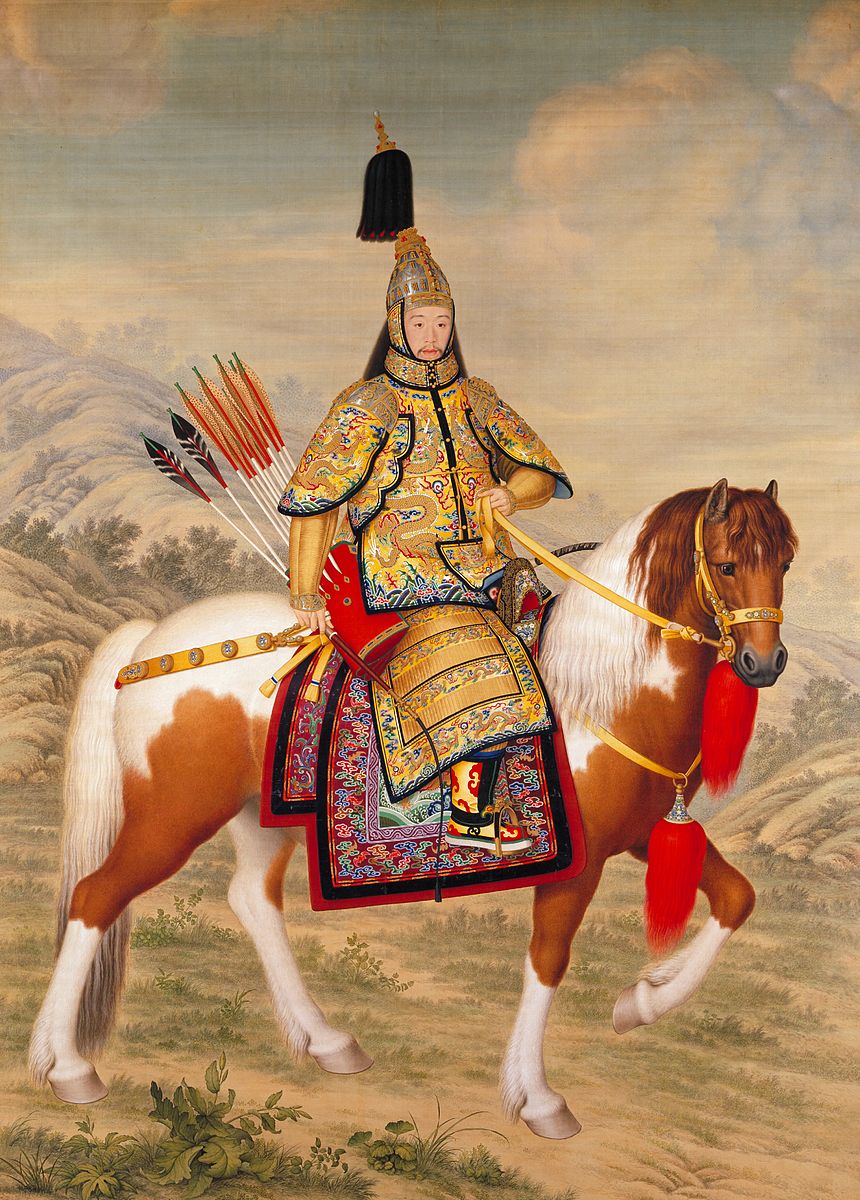
Yang Mingbin’s place in history is well researched, and surrounded by genuine historical figures such as Giuseppe Castiglione (1688-1766), a real Jesuit priest who was a painter in the Royal court in Beijing, and was responsible for influencing the Chinese style of painting of the era with western Renaissance ideas. You’ve likely seen some of his paintings before, such as the famous one of the Emperor Qianlong in ceremonial armour.

The Qianlong Emperor in Ceremonial Armour on Horseback Giuseppe Castiglione  (1688–1766)

So, the conceit here, then, is that you’re being asked to imagine what it would have been like if Giuseppe had had a friend in the court – another painter – who was also a martial artist, and what would happen if we had recently found a copy of his notes on martial arts. It’s a thought experiment, that the author begs your indulgence in as you read along.

Initially it works, because the historical setting feels authentic, but once we get into the actual meat of the book (Minben’s 64 martial arts essays), we find that Yang Minben writes exactly like a 21st century American who practices Tai Chi would write, rather than like somebody actually living in 1760 in China would! 

Actual martial arts writings from that period in history tend to be functional, pithy and less verbose. Worse, Mingben’s text often uses modern conventions, for example, (p63), 

Dive into a swift flowing river and swim against the current. Keep swimming, but gradually change the direction – 0 to 45 degrees, to 90 to 135, then to 180 – finally swimming directly with the current.

Would a Chinese person writing in 1760 have described this using degrees?

And things get very odd when, on p97, Minben writes, “between 1775 and 1779, Qing troops stabalized the northern and western boundary of Xingjang province, harshly squelching the rebellion in the area occupied by the Mongolic Zunghar tribe.” 

How is Minben writing about events that happened in 1779 when the current date is supposed to be 1760? 

That’s not to say there aren’t interesting things to learn here. I enjoyed the discussion of the Neo-Confucian scholar Zhu Xi and the concept of Li, the calligraphy analogies and the references to Lao Tze and Chuang Tzu. But if the author wants us to enter into his historical conceit, then I think it helps if the writing is consistent with the time period. I would have also liked to have heard more accounts of what Beijing was like in 1760. That would have helped build the illusion – city life, how business was done, what the pervading political climate was like, what the fashions were, what the gossip was – what was happening in Royal Court?

You could argue that since all of this is imaginary anyway, perhaps we do not need to make a big deal out of it? DeMarco’s writings are a collection of modern philosophical musings designed to be easily read and understood by the modern Tai Chi crowd and that draw in frequent references to the Daodejing and analogies with calligraphy and painting. I quite enjoyed them, but if you are looking for something that reads like the real classic writings on martial arts, you’ll be disappointed. However, if you’re after something a little easier to read and that inspires you to practice Tai Chi more, then you’ll find it here. 

Sinking the Qi and rooting in the foot

How does rooting work in Tai Chi?

In the Tai Chi Classic it says:

The jin should be
rooted in the feet,
generated from the legs,
controlled by the waist,
and expressed through the fingers. 


This does present something of a dilemma – how can we both be rooted in the feet but also controlled by the waist, let alone also generated by the legs?

In the Treatise on Tai Chi Chuan, the classic says “Sink the chi to the dantien.”

This sinking is related to the pulling in action of the muscle tendon channels that are usually associated with the contraction (closing) phase of opening and closing – usually while breathing in. The breath sinks to the dantien area, and combined with correct mental focus, this should make the dantien area feel full as you breathe in.

This pressurised feeling in the dantien is also the pressurised feeling at soul of the foot. You could think of it as squeezing the pressure from the dantien down to the foot, but you really don’t need to do that, as it should be instantaneous, since they are the same thing.

With the exhale, the pressure pushes up, through the legs, up the back and out to the extremities including the head. It’s a continual cycle of store and release.

You could call this the internal side of Tai Chi, but really, it’s just the way Tai Chi works, rather than a particular side of it.

NEW PODCAST Simon Cox on Zhang Sanfeng and the Wudang connection to Tai Chi

New podcast! My guest today is Simon Cox, who co runs the Okanagan Valley Wudang with his wife Brandi in Penticton, British Columbia.

Simon and Brandi spent six years living and training in China under master Yuan Xiu Gang at the Wudang Daoist Traditional Kung Fu Academy. While there they studied Kung Fu, Tai Chi, Qi Gong, meditation, herbal medicine, Daoist music, and ancient and modern Chinese language.

After returning to the West, they started a Kung Fu school and community group in Houston Texas, where Simon was working on his PhD in Chinese and Tibetan mysticism at Rice University. At the end of 2019, they moved up to the Okanagan Valley and began sharing Wudang teachings with the local community.

What I really wanted to get at with Simon was an elucidation on his article about Zhang Sanfeng – exactly who was this mysterious Taoist immortal who is often credited as the founder of Tai Chi Chuan? I also wanted to find out more about Wudang mountain, and where its martial arts really come from. I hope you enjoy are conversation!

Is Tai Chi really about relaxation (fangsong)?

I noticed a person on Facebook recently who was trying to make the point that the term Fangsong (放松 relax, unwind, loosen, ease, release, slacken) doesn’t appear in writings about Tai Chi until about 1930, and is therefore a modern idea that we are retrofitting to suit our modern ideas of Tai Chi being all about relaxing. That’s not his argument word for word, but that was the gist of it, anyway.

I’ve heard similar things from other people about how ‘back in the day’ Tai Chi was practiced hard, like a real marital art, until you were exhausted, and that modern training has gone soft in comparison. To those people I would point out that intensity and duration of practice have nothing to do with how you practice. Ask anybody who has practiced ‘standing still and relaxing’ for half a hour in a Zhan Zhuang posture and you’ll find out that practicing relaxing for half an hour in a stressful position is an exhausting, sweaty, business.

But to return to the original point, I would point out that even if you look at one of the oldest writings we have on Tai Chi – the handwritten manuscript of Li Yiyu from 1881 (which is available to read on Brennan Translation) you’ll find the word “relax” appears in the English translation 9 times. That’s not an insignificant amount. (I’ll leave it to the Chinese language experts to search the original Chinese).

You find it in phrases like:

I relax my power, but I do not allow it to collapse. (This has to do with “calm”.)

and

Every movement is a technique of first putting forth strength and then immediately relaxing, yet always there must be continuity from one to other, and there is never to be a departure from the four stages of “begin, develop, transmit, and finish”.

However, if you check out the even earlier 1875 text Explaining Tai Chi Principles, written by Yang BanHou, son of the famous Yang LuChan, you’ll find that he’s right – the phrase “relax” doesn’t appear, even once!

However, just look at one of the things written in the text:

“Power comes from the sinews. Strength comes from the bones. Looking at it purely physically, one who has great strength is able to carry many hundreds of pounds, but this is an externally showy action of bones and joints, a stiff strength. If on the other hand the power of your whole body is used, it may appear you are unable to lift hardly any weight at all, yet there is an internal robustness of essence and energy, and once you have achieved skill, you will seem to have something more wonderful than one who has the stiff sort of strength. Thus runs the method of physical training for self-cultivation.”

It seems pretty clear that he’s talking about relaxation being required for whole body strength.

But getting away from the nitpicking about facts (sorry!) I do think he has a point – there has been a modern re-framing of everything to do with Taoist arts as a kind of therapy for stress and dealing with the pressures of modern living that wasn’t necessarily there in the original arts – especially with Tai Chi.

Tai Chi was created in pretty stressful times, when wars were being fought, the concepts of law and order and justice were malleable depending on how important you were and life could be brutal and short. Taoism emerged at a time that was probably even more dangerous to be alive in! Frankly, I don’t think you expected to live long enough to have to worry about getting stressed! You were probably too busy trying to stay alive and earn a living. Being stressed is something of a modern disease because we live lives of relative comfort and we’ve got nothing truly life threatening to worry about on a daily basis.

The same thing has already happened to yoga.

But, I think we’ll have to live with it, because the hippies who have taken over Tai Chi Chuan do have a very good point – the first step in Tai Chi is to relax, whether you like it or not! You cannot move your body as a unit if parts of it are tense.

In Tai Chi Chuan the body is required to move as a whole unit, connected by fascia, tendons, muscles, etc, with all the joints allowed to move freely during exercise. All the joints are involved to some degree in all movement, so need to be relaxed. The ball-and-socket joints of the shoulders and hips are allowed to move freely. The gliding joints of the ankles and wrists move freely, and the hinge joints at elbows and knees are all allowed to move freely. Finally, the dantian moves freely and controls everything. Tensing the muscles around a joint separates it off from the rest of the organism, meaning that whole body movement is not possible.

And being mentally ‘tense’ is just as much of a problem as being physically tense, since the mind and the body are intimately connected.

Perhaps the emphasis in the original writings on Tai Chi was focused on more lofty philosophical principles, yes, but you will find plenty of admonitions to relax in there, and for good reason. That’s just how Tai Chi works.