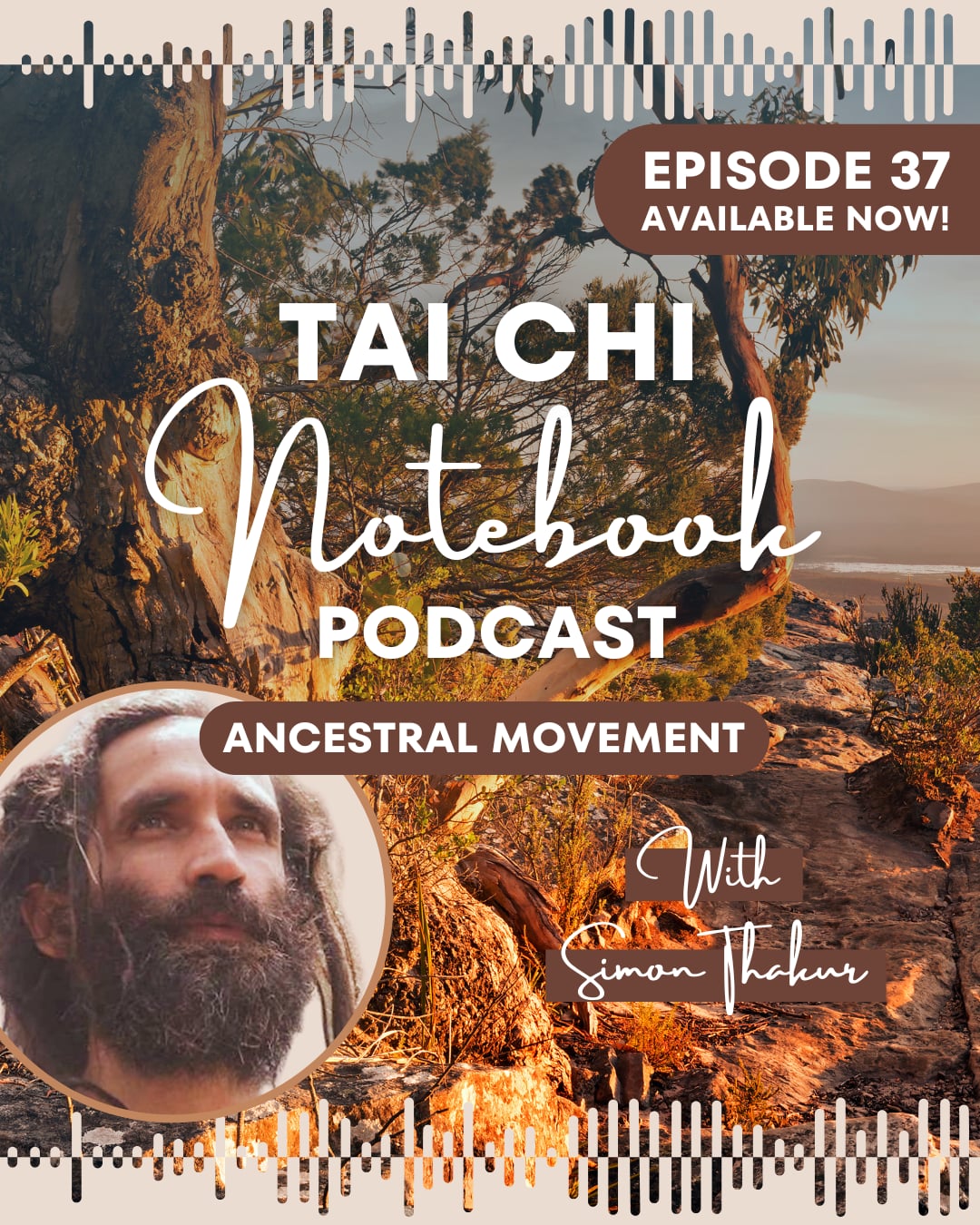
Simon Thakur is the founder of Ancestral Movement, “An ecological approach to movement and mind-body practice, exploring ancient ancestral patterns of movement and awareness built into our bodies, rediscovering the power, grace and ease of natural movement and our bodies’ innate connection to the rest of the living world.”
In this episode we talk about many subjects including Yoga, Chinese Martial Arts, Brazilian Jiu-Jitsu, Tai Chi, Shamanism and more!
Hello! Happy Year of the Snake, dear reader. On an occasion such as this is would normally be customary for a tai chi blog like mine to do a little post about the influence of the snake on tai chi, kung fu and Chinese culture in general.
Snake is, after all, one of the five main Shaolin kung fu animals, one of the 12 main xing yi animals and frequently appears as a menu item in Chinese restaurants, er no, sorry, I mean, appeared in Kung Fu Panda!
But, no! I’m not going to do that; partly because it’s such an obvious thing to do that I’ve done it before, and I hate being predictable, or at least repeating being predictable, but also because I’ve just recorded an excellent conversation for my next podcast with Australian national treasure and sometimes-Chinese-martial-arts-practitioner, Simon Thakur of Ancestral movement about finding your inner, ancestral animal, including, of course, the snake, and I just need to find the time to get on with editing it so I can get it out to you lovely people.
I think that what Simon says about our human connection to snake-style movement is probably more valuable than whatever I’ve got to say on the subject of our slithering cousin. So, I’ll leave the snake talk until the podcast comes out!
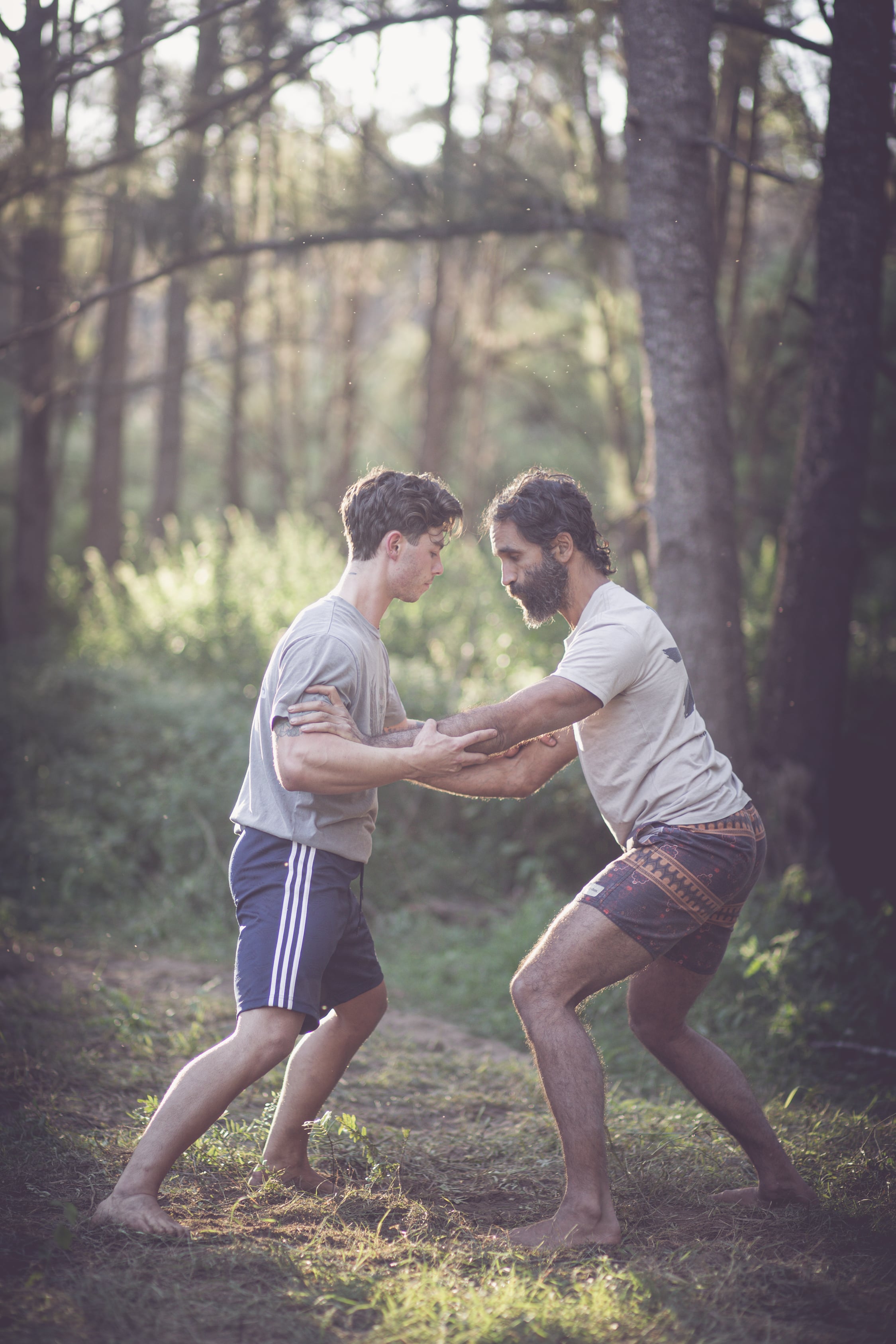
Simon Thakur, trying to locate his inner snake while doing an impromptu bit of Fox Trot in The Bush.
In the meantime, while you wait for that podcast to properly percolate (all the best things take time) I’ll leave you with a thought. “Tai Chi is more than the techniques, it’s the jins that make it interesting”.
If you listened to my last podcast with the esteemed Alan Wycherley of ‘In Defence of the Traditional Arts’, you might be forgiven for thinking that I’m all about training tai chi techniques. Now, while I’ve no objection to practicing a Repulse Monkey or a Part Wild Horse’s Mane (or two), or even a Snake Creeps Down, I definitely agree with the statement that tai chi is more than the moves. In fact, I think we can probably agree that tai chi applications aren’t that great as martial techniques. There are (shock!) other martial arts that have more effective techniques. Hello, Brazilian Jiu-Jitsu, I’m looking at you. Hello, Choy Li Fut. Hello, Western Boxing. Hello, Muay Thai, stop hiding at the back! Yes, all these martial arts have techniques that I would probably put ahead of anything found in a tai chi form, regardless of style. They’re practical and effective. And yet, I practice tai chi. So, why is that?
What tai chi has, and emphasises over techniques, are the eight energies – the jins: Peng, lu, ji, an, etc.. What you are doing when you practice a tai chi form is emphasising energy changes using these eight over technique. Flowing from one to the other a bit like a river flowing along smoothly. Sometimes there are fast bits, sometimes there are slow bits, sometime the river turns one way or another, but its energy flow keeps going.
When I practice other martial arts, my emphasis is more on technique. When I practice tai chi I can relax and get more inside the movement and concentrate on the energy flow.
And of course, in tai chi push hands you get to interact your energy flow with the energy flow of another person in a live situation, and that’s extremely valuable for developing martial ability. Techniques are another thing.
Now, if the analogy of a river doesn’t work for you then think of something else… perhaps, a snake? Snakes can flow along smoothly, they can change direction sharply and they can be incredibly powerful or incredibly quick, as well as slow and suffocating. They’re a great example of energy changes.
Homework
In preparation for my next podcast allow me to recommend a documentary by professional paleontologist and evolutionary biologist Neil Shubin called Your Inner Fish. (He’s written a book of the same name, if you prefer to read about him). Snakes come out to play in episode two. Here you go:
My latest podcast with Alan Wychereley, who was as student of the late UK tai chi legend Dan Docherty inspired my listener/reader Steffan Stringer to track down Dan’s autobiography “Wild Colonial Boy” (I have to admit, I’d heard of this book before, but never read it, and in my mind it was always called “Wild Caledonia Boy”, which, I think, given the Scottish-centric design of the cover would have been a far better title!)
“In 1975, Dan Docherty, a young Scots law graduate and karate black belt, left Glasgow to spend nine years as a Hong Kong police inspector.
As well as serving as a detective and vice squad commander, he also took up Tai Chi and won the 5th Southeast Asian Chinese Full Contact Championships in Malaysia in 1980.
In 1985, he was awarded a postgraduate diploma in Chinese from Ealing College.
He travels extensively teaching Tai Chi and has written four books on the subject.”
When I started Tai Chi in the early 90s everybody had heard of Dan Docherty, and he was something of a big name, not only because of his competition success, but also because of his reputation for unmasking frauds. I remember him gaining a lot of notoriety for pouring a bottle of water over the head of an ethnically Chinese Qigong teacher who was doing seminars on Ling Kong Jin or “Empty force”. Dan’s reasoning was that if he could move people without touching them then he should be able to deflect the bottle without the need for physical contact. It didn’t work. He was also famous for “getting into it” with one of the Yang family representatives in the UK, who ended up leaving the UK after their encounter.
Sadly Dan Docherty died of complications from Parkinson’s disease in 2021. I never met Dan in real life, but his impact on the UK tai chi community continues to be felt long after his death. That’s probably the best legacy a tai chi teacher could hope for.
Greg Souders on the Grappler’s Perspective podcast.
In the last episode of my podcast episode with Alan Wycherley about fantasy vs reality in tai chi we mentioned a subject that might have been unfamiliar to some of you – the ecological approach. This is a training method that is finding a lot of familiarity with BJJ right now, but I believe it has always been a part of tai chi training too, since tai chi contains push hands as a training method, which has the potential to be a free and playful exploration of movement.
Rather than try and explain the ecological approach myself, I thought it would be better to hear directly from the guy who made it famous in BJJ, Greg Souders. As you’ll discover, he’s not afraid to say controversial things about the learning method adopted by most BJJ academies!
So, here he is on a no punches pulled episode of the Grappler’s Perspective podcast. Have a listen and see what you think:
I had a chat with Alan Wycherley from the In Defence of the Traditional Martial Arts YouTube channel for my podcast and the episode is now live. We talk about how Tai Chi can be used as a realistic self-defence system and Alan’s encounters with traditional martial artists from different kung fu systems.
I often wonder what most people’s biggest fear is in Tai Chi. Or what it is that stops them trying it out? Is it looking silly? Is it the fear of other people in the class looking at you as you struggle to get the movements? That you won’t fit into the group?
Believe me, everybody feels the same. You do need some willingness to be open to new experiences if you’re going to try a Tai Chi class for the first time, but just say to yourself, what’s the worse that could happen?
You can learn Tai Chi online these days, but nobody I’ve met in real life who learned online had much of a real practice, as far as I could see anyway.
To learn Tai Chi you need somebody to point out everything you’re doing wrong, because on your own, you won’t see it. Even if you know that your knees aren’t supposed to bend inwards, and are supposed to be in line with your toes, you’ll let your knees collapse in without realising your doing it.
Often those ‘light bulb’ moments in Tai Chi occur when somebody points out what you’re doing wrong without even realising you’re doing it, and for that you need a teacher.
If you’re thinking about starting Tai Chi classes in the new year then dig deep and give it a go. You won’t be the only one who is a bit nervous, and once you realise that everybody else is just as worried as you are you can relax a bit and enjoy it. Believe me, your teacher will simply be pleased to see you. What have you got to lose?
Doing both BJJ and Tai Chi I love seeing moves from one art crop up in the other. Imagine my surprise when I happened across this BJJ seminar clip where the coach seems to be cycling unawares through a variety of Tai Chi moves.
At one point he says that one of the moves looks like “some karate bullshit that looks silly but works”, which is funny because you could describe Tai Chi like that as well 🙂
If you do Tai Chi or Bagua or pretty much any long fist style Chinese martial art, or probably Aikido, you’ll recognise these moves. I’ll give them Tai Chi names:
Breakdown
It starts with a grip break, that is similar to Hidden Hand Punch from Chen style (0.00- 4.00) The first technique from here is like Needle at Sea Bottom (4.17- 6.15) The second is like Diagonal Flying (6.15 – 9.20)
After that it becomes more traditional wrestling/judo takedowns, but it was nice to see some Tai Chi appearing fora minute there.
While the rest of the video is much more of the usual jiu-jitsu fair, the initial positions have a strong similarity to Tai Chi moves, and could definitely help Tai Chi practitioners become more aware to the martial potential of Needle at Sea Bottom and Diagonal Flying.
One of the first things I talk about when it comes to alignment is:
Head over shoulders Shoulders over hips Hips over ankles
These three are the basic alignments for standing upright at the beginning of almost all Tai Chi forms and looks something like this (ignore the arm positions):
If one of these things is out of alignment then you are leaning forward or backwards, or your posture is out of whack.
It’s easy enough to keep these three alignments in a standing stance, but things can get more complicated in movement, and when you introduce forward and back-weighted stances. At that point I try and keep the following two alignments:
Head over shoulders Shoulders over hips
The ankles can now be in different places, as reacquired by the stance.
It depends on the style of Tai Chi you do, but if you do a style that advocates a forward lean then you need to make sure that there’s a straight-ish line between your back foot and your head. If you do a style that doesn’t advocate a lean, then your back knee must be bent and you want to keep your body upright with your shoulders vertically over the top of your hips.
But the real answer is that no one style of Tai Chi only does things one way. Most styles contain some moves that lean and some that don’t. Wu style, for example:
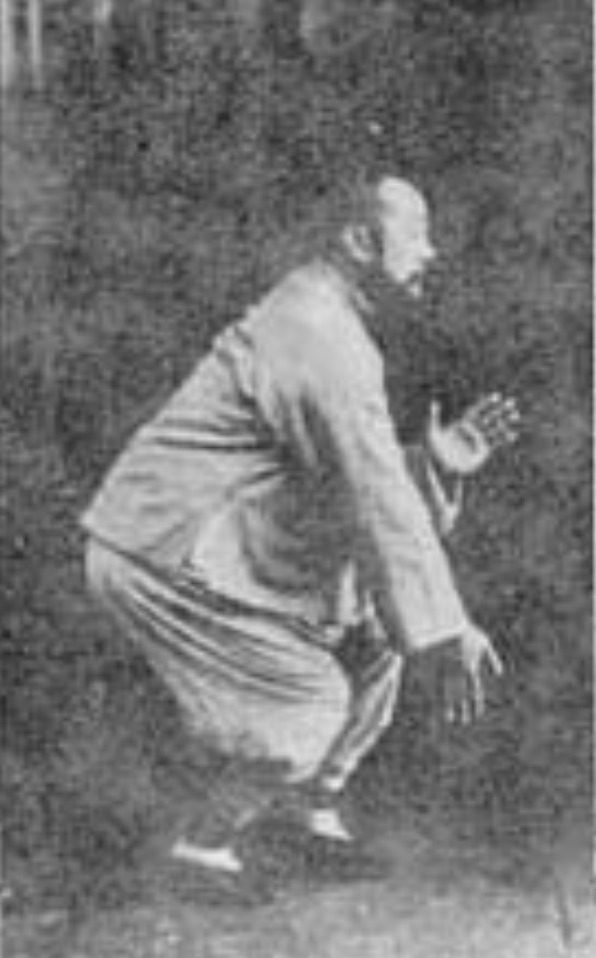
If you compare late Yang Cheng Fu to early Chen Man Ching postures, you can see that they are very similar, and are both trying to keep the head over the shoulders, over the hips:
While doing the tai chi form, take a moment to think: ‘where is my head in relation to my hips?’ You don’t want to be sticking your bottom out and destroying your alignment, which often happens in transition movements between postures:
A picture paints a thousand words, especially in Tai Chi. I recently found an incredible source of Tai Chi images drawn (I think) by Anthony of Brisbane Tai Chi.
Just scroll down the main page and look at the images – they’re great! Full of tips on alignment and posture for Tai Chi and Zhan Zhuang (standing practice).
One of Anthony’s best images for thinking about how alignment relates to the tai chi form is this one:
Anthony/Brisbane Tai Chi
I think that image very clearly shows head over shoulder over hip over ankle, and how easy it is to mess that alignment up once you start moving in Tai Chi. You basically want to keep the blocks aligned over each other.
Why?
As it says in the picture, if you align yourself correctly with gravity then your legs become the primary weight holders in the body. That means you can be more relaxed (Sung) in the upper body, so that you can use it to transfer force, instead of tensing up to hold weight that is misaligned. Plus, it just feels better.
The UK is having a bit of a women’s safety moment right now, and since I’m in the UK and it’s a topic that crosses over into subjects I discuss on my blog, I think I should address it. As well as being about self-defence it’s also about how women and female perspectives are often ignored by a male-focused society. It all relates back to comments made by actress Saoirse Ronan on the Graham Norton Show, a clip of which has gone viral.
You can view the clip here:
She’s sitting on the sofa with fellow actors Denzel Washington, Eddie Redmayne and Paul Mescal. They’re having a lighthearted discussion about training martial arts/self defence for movie roles. While the men laugh and joke about something as ludicrous as thinking about a phone as a weapon of self defence, (can you imagine, lol!?) Ronan points out (she has to try twice to be heard) that this is something women have to think about all the time. The resulting awkward silence speaks louder than anything else.
That this one moment seems to have captured something very familiar to a lot of women – it’s captured men’s ignorance of women’s lived experience in terms of feeling unsafe when moving about in the world and having to think about using things like keys or mobile phones as weapons. Things that men generally don’t have to worry about.
I don’t want to jump on any kind of bandwagon and write an article about how to use a mobile phone as a weapon, because a) you can’t learn self defence from articles! And b) that seems like very opportunistic behaviour.
But what I would say to any women reading this, Brazilian Jiu-Jitsu (BJJ) is a great martial art that will benefit you more in the long run way more than a one-off 2-hour seminar on “self defence for women”. If you really want to feel more confident and less unsafe (of course, there is no guaranteed panacea for this, unfortunately) then I’d recommend starting regular BJJ classes at a BJJ Academy you feel comfortable with, and with an instructor you feel comfortable with (please shop around!), rather than going to a one-off seminar that aims to provide you with a quick fix.
And to the men who might need to become more of women’s lived experience (yes, you at the back!) You might like to read this article from the Guardian, detailing six women’s reactions to the clip, that’s worth a read.
And in the words of the sergeant from Hill Street Blues, “let’s be careful out there”.
You can think of the Tai Chi form as an exercise in claiming your space. We rarely think of the space we occupy or move around in as part of ourselves, but it is. We often let others take our space, or give it away needlessly. We move out of the way when people walk towards us in the street. Rarely do we stand our ground and own the part of the earth that is directly underneath us.
In tai chi push hands we learn to claim our space, to gently redirect people that want to come into it and also to take away other people’s space if we need to, and not let them get it back. In the tai chi form we learn to round out our movements, so that (as the classics say) there are “no hollows or projections” in tai chi. Your goal is to create a kind of sphere with your body, as if you were inside a giant beach ball. Your hands extend to the limits of the ball, and no further.
Finding your centre
In tai chi there is ‘finding your centre’ within yourself, but there is also ‘finding your centre’ when in contact with another person. When two people are in contact, especially if engaged in some form of conflict, they are rarely both in balance, usually the advantage lies with one person or the other. The one in control is usually the person who has made both people part of their ‘centre’. Viewed from above, they become the centre of the circle, around which the other person is orbiting.
In class today I was working on the ward-off posture. I think by far the best way to think about ward off, as a martial posture, is to think about having just slipped a straight punch over your right shoulder by moving your head and turning your body to your left, you then step diagonally into the space occupied by the other person, right under their armpit using the familiar ‘ward off’ posture to keep them off balance. You need to keep that full, rounded, ‘peng’ aspect to your arms here, and once you have them off balance, you never retreat or give up the ground you’ve taken. If you do then you’re simply giving them their balance back. You need to keep them off balance continually, so that they can’t recover and they end up open to strikes or to being knocked over.
That ability is one reason why, while strikes exist in Tai Chi, they’re not really emphasised in the form. Instead, in the form you’re continually learning how to take ground from the opponent and occupying it while remaining in balance. As a means of self defence, it is highly effective, but not easy to understand without feeling it, which is another reason why so many people are confused about how Tai Chi works as a martial art.
Thank you for supporting The Tai Chi Notebook. If you are reading this on a website that isn’t thetaichinotebook.com, then it’s highly likely it’s been stolen. Please let me know so I can issue their webhost a DMCA takedown notice for copyright breach. Thanks.And if you have the great idea of starting a tai chi website by stealing other people’s work to fill it with content for clicks then take a good hard look at yourself, and do better.