So, Mike Sigman raised an interesting point in his comments on my last post on silk reeling – “Silkreeling is about developing the elastic connections of the body.”
I agree with him. That’s probably not all silk reeling is about, but that’s the fundamental idea. But I wonder how many people who teach silk reeling or Tai Chi actually agree? I mean, there are so many style and different ways of doing Tai Chi these days that’s it’s almost like it’s become a terms for a grab bag of different skills all meshed together.
But perhaps we just need to establish a baseline. I’m interested to hear what you would call the point of silk reeling? How does that statement sit with you?
I read something interesting in this interview with Chen Xiaowang, originally published in the October 1996 (vol 20 no. 5) issue of T’ai Chi Magazine.
He’s talking about silk reeling and he says:
Chen commented that many people practice the Chen style in an overly exaggerated fashion making very big movements. He said these kinds of excessively large movements lead to a separation of one part of the body from other parts of the body and is incorrect. A common mistake, he said, especially among those who do the Xin-jia or new frame is to do movements in an exaggerated manner and make a lot of small circles and loops. “That shows that they don’t understand the principles of chan si jing.”
Tai Chi Magazine
I’m not sure what to think about that. It’s pretty well understood in Chinese martial arts that you often practice big and use small. The best way to practice a movement is to start with it in a large, exaggerated way, but then over time you do it in a more refined way and it becomes smaller.
A quote from my teacher I’ve always remembered is:
“In the beginning my circles encompass the whole universe but at the end I roll them up and put them in my sleeves.”
However I think perhaps Chen is not talking about this. I’ve seen a lot of people who do Tai Chi (and particularly Chen style) in a very bendy, rubbery, gyrating way. I think he’s saying that too much of that can often lead people onto the wrong track. And more specifically, he’s saying that if they’re doing this then it’s because they don’t understand the basics of silk reeling.
Now silk reeling is quite a Chen style-specific practice. I don’t think you even need to do it to practice Yang or Wu style, but if you are doing it, I bet it’s very easy to get sidetracked into doing lots of small loops and circles. But really the process should be about being minimalist. Cutting out the inessentials until the movement is pure and simple, while still being effective.
In this episode Tai Chi Notebook podcast my guest is Ken Gullette, a native of Illinois, USA, where he trains in all three of the main internal arts – Tai Chi, Bagua and Xing Yi. Ken also runs a website called internalfightingarts.com where he trains students from around the world in the three internal arts using a combination of recorded and live classes.
Ken is quite famous for his focus on body mechanics, internal power and getting to the root of these arts in a non-mystical and no-nonsense way. In fact, he’s written an excellent book that’s available on Amazon – it’s called ‘Internal body mechanics for Tai Chi, Bagua and Xing Yi’, and I’d recommend you get a copy.
In this episode we discuss the internal body mechanics of Tai Chi, training with disciples in the Chen family linage and there’s also a few stories of the times Ken has had to use his arts in real situations.
Interesting comment from Mike Sigman on my blog. No, that’s not him in the picture, I just though it was a funny picture 🙂
….The real problem with a lot of these theories that basically denigrate the Chen-style Taijiquan as being “only an offshoot of something else” or “it’s really a Shaolin art” is that none of the westerners engaged in those musings have any minor skills in how to move the body in the way that the Chen-style Taijiquan does. It really doesn’t matter that “Chen-style has umpteen of the same techniques/moves shown in the XYZ style of martial-art” … the essence of the Chen-style Taijiquan is in how the body moves, using jin, qi, dantian, and silk-reeling.
So, if you listen to our Heretical Hypothesis, I think you’ll find that although we’re challenging the usual narrative of the origins of Taijiquan, we’re not really denigrating Chen martial arts, calling it an offshoot of something else, or “Shaolin” (as if that’s so bad). In contrast I think it’s actually quite positive about what it really is. It’s the brand name “Taijiquan” that is looking less authentic, not Chen village martial arts.
Chen village has a long history of marital prowess. If we’re talking around the time period we’ve got up to in the podcasts (- around 1900) – then at this point I’d say Chen village style is a genuine badass martial art – it’s practitioners are bodyguards, militia fighters and people with the name Chen are tracking down and fighting “bandits” (Or “freedom fighters” – as usual, it often depends which side of history you are looking at them from) for the Ching as ‘guns for hire’. In contrast, the “Taijiquan” passed down from Yang in Beijing is a kind of court-sanctioned entertainment. Sure, Yang had genuine skills but it’s much of a domesticated experience compared to the “in the wild and doing it” Chens.
From my point of view that’s not denigrating it at all, it’s lifting it up. Around 1900 you’ve got people like Chen Yanxi being employed full time as a martial arts teacher in Shandong by General Yuan Shikai because of his reputation as a badass fighter.
On the second point – I agree – the Chen style moves differently, especially the silk reeling, and it that very well might be because Yang LuChan never even went to Chen village. That explains so much.
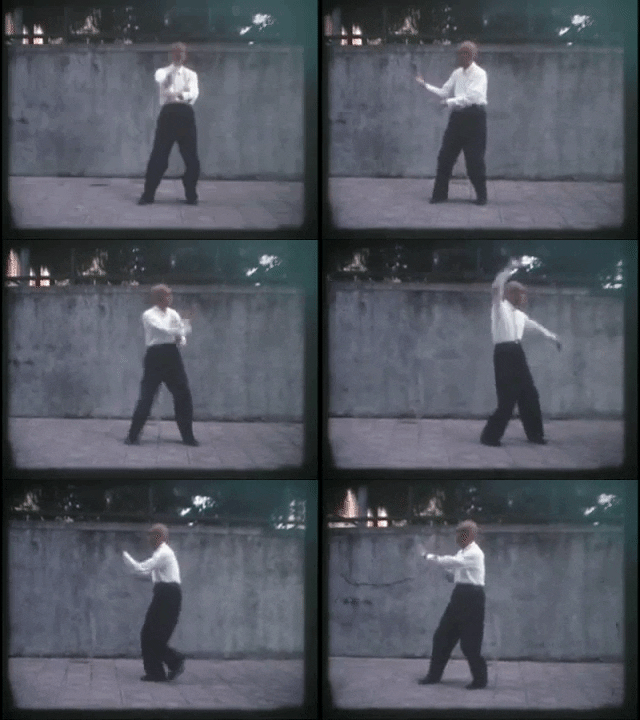
Below is a video, shot in 1977, of the Tai Chi form of Xiong Yangho who was a student of Yang Shau-Hou, the (much) older brother of Yang Cheng Fu. Born in 1862 he was effectively of a different generation than his brother Yang Cheng-Fu who was born in 1883, which is 21 years later.
You can see that the form follows the same pattern as the Yang Cheng-Fu version but has a few unique characteristics. Again, this hints that there were different ways of doing the form before Yang Cheng-Fu standardised it into “Yang style”.
These different interpretations are a bit like the Gnostic Christian gospels – they’ve been rejected from the main orthodox canon, but they have just as much validity as any ‘official’ version of the form.
The description reads:
“Taiji Grand Master Xiong Yang He (1889-1981) The Interpretation of Taiji Quan The Teaching Frame of Hundred & Eleven Styles in Taiji Quan Video & voice edited by Li Ri Xing 28th September 1977”
What’s particularly interesting is the second video, at 7.51 onwards, after the form has finished, he does what looks like a couple of silk reeling exercises in which he traces a Yin Yang symbol in a manner described in Shen Jiazhen’s book.
In the video Xiong Yangho then does some fast moves that look a lot like Southern Kung Fu – Pake Mei or Wing Chun, that sort of thing:
Edit: A comment on this post from Bai Yiming reveals that these are from another martial art called “Xiyangzhang”
“What Xiong Yanghe shows in the later vids has nothing to do with TJQ; those “5 little hands”, as they are called, originate form Xiyangzhang, another style. Xiong has cross-trained a lot and taught a huge curriculum. There is no Taiji symbol traced, it is purely an application. I know as I’m training in the Xiongmen, the Xiong system, do the Xiyangzhang and also those hand moves!”
Here’s a video of Xinog Yanghe doing some more Xiyangzhang:
Here’s another video of Xiong Yangho doing Tai Chi:
Originally from the mainland, Xiong Yangho was a military man who escaped to Taiwan with the nationalists once the Communists took over in China. There’s a short biography of him here.
“I remember one time when a student was showing a qigong posture she was taught from another teacher and spoke about how qi circulated through it. He adjusted her posture slightly and said “now you have qi circulation”. “
When you read something like this I think it reinforces the incorrect idea that Qi is some type of etheric, mystical energy that rises in our bodies like steam and can be directed by the mind… (in fact, that’s what the article goes on to talk about)
Well, frankly, it isn’t. At least in the context of martial arts, it isn’t. Acupuncturists probably have a different opinion on that, but I’m not talking about acupuncture.
But at the same time, if you know what is meant by “Qi” (through your practical understanding) then that original sentence I quoted above does make sense. Let me explain.
You’ve got to remember that when a Chinese teacher talks about Qi in terms of martial arts, what they are talking about is related to your physical structure. The stuff that makes you up. Skin, bones, tissue, muscles, etc…
If you have “strong Qi” then it means you are physically strong. So, for example, a strong athletic young guy or gal would be described as somebody with “strong chi”. Usually, the posture is good, the eyes bright, the hair shiny, etc… These are all aspects of “strong Qi”.
A weak slumped, tired, or sick-looking person would be described as having “weak Qi”.
You, my friend, have “weak Qi”.
So, an old person could have either “strong chi” or “weak chi” depending on how they presented themselves. If you’re bright-eyed and bushy-tailed, you’re doing well. Your Qi is strong.
Strong Qi, or BDE as the Yooth say today…
In Tai Chi your Qi refers to your physical structure in a movement, as well as a special type of conditioning of the body’s structures that takes place through exercises like Standing Post and Silk Reeling. Through these exercises, you can strengthen the felt connection from your fingers to your toes – a kind of all-over body suit. It’s the strengthening of this ‘body suit’ that explains the circus-style feats of strength you see martial arts groups demonstrating. Things like throwing a needle through glass, bending a spear on your neck, being resistant to blades and breaking rocks with your hands.
I would not suggest trying these things at home! Sure, there are often ways to fake feats like the ones above, but there are also ways to do it correctly, utilising the conditioning of the body’s Qi.
Martial arts techniques in Tai Chi require two things – Qi and Jin. Here we’re only talking about Qi. I’ve talked about Jin before.
Qi (Chi) relates to structure. So, if you adopt a Tai Chi posture that’s relaxed, sunk, stable and strong (i.e. your structure is good), then you are “using your Qi well”. And it could be said the “Qi is circulating well”. (Actually, nothing is circulating in the sense of water in a pipe). If your structure is off in someway then it could be said that your “chi is not circulating well”.
So, if we read that quote again, with the new knowledge that it is to do with posture and structure:
“He adjusted her posture slightly and said, “now you have qi circulation”.
Could equally be written:
“He adjusted her posture slightly and said, “now you have better structure”.
So, to me that means, he corrected some defect in her posture (say an overly tense lower back, or tense shoulders, for example), so that her “Qi” started to circulate – i.e. the posture regained its natural strength.
Sorry guys, but none of this has anything to do with steam or heat or a mystical energy in the body. But it’s so easy to assume that this is what is meant when you read quotes like the one above.
Especially once you add to that the fact that people can feel pretty much anything they can imagine.
The Daoyintu “Drawings of guiding and pulling” were uncovered in the Mawangdui site in Changsha, Hunan, in 1973. The texts were written on silk. From Wikipedia:
“They include some of the earliest attested manuscripts of existing texts (such as the I Ching), two copies of the Tao Te Ching, a copy of Zhan Guo Ce, works by Gan De and Shi Shen and previously-unknown medical texts, such as Wushi’er Bingfang (Prescriptions for Fifty-Two Ailments).[1] Scholars arranged them into 28 types of silk books. Their approximately 120,000 words cover military strategy, mathematics, cartography and the six classical arts: ritual, music, archery, horsemanship, writing and arithmetic.[2]“
The tombs date from 206 BC – 9 AD, which puts them in the Western Han Dynasty (this was mentioned in a previous post of mine on Buddhism), and contained the burial tombs of Marquis Li Cang, his wife, and a male believed to have been their son. The site was excavated from 1972 to 1974.
The scroll above was found in 1973 and dates to 168BC. Again, from Wikipedia:
A painted scroll on display at the Hunan Provincial Museum and known as the Daoyintu found in tomb three at Mawangdui in 1973 and dated to 168 BC shows coloured drawings of 44 figures in standing and sitting postures doing Tao yin exercises. It is the earliest physical exercise chart in the world so far and illustrates a medical system which does not rely on external factors such as medication, surgery or treatments but internal factors to prevent disease.
What they are doing in the scroll is clearly related to what we call Qigong today – an exercise system that has come out of China. These exercises are still found all over China, and in many cases, the theory behind them has merged with martial arts, and they tend to be practiced together.
The question still remains – what are they actually doing? How is this good for health?
I believe you need to understand “suit” theory to get a handle on what they’re doing. I first heard the “suit” theory from the writings of Mike Sigman. He just posted about it again recently:
Mike: The “suit” idea is that the connective tissues throughout the body and muscles can be developed and conditioned to the point that they wrap the body like a snug spandex/lycra “suit”. The “suit”, however, is not just a passive connection: it can be controlled, conditioned, etc., as an aid and support to strength and movement. The “suit” is just a model that can be used to illustrate the functional qi of the body. As “qi”, the suit responds to controls and actions from the subconscious mind.
First of all, if you’re looking for an explanation of what “qi” is, when it comes to martial arts, or its functional usage, then I think this is where you should be looking. Qi is not some mysterious energy that flows through the universe and through invisible channels in the body – it’s the physical connections you can create through conditioning exercises where you stretch this “suit” and gradually learn to manipulate the body using it. This naturally leads to the idea of the body being moved by “qi” not muscle, which is a phrase we hear given lip service to in Tai Chi, but rarely explained. It sounds initially like magical qi thinking, but if you can understand the “suit” theory you’ll see that it’s actually grounded in a solid practice that builds up over time. Another of the meanings of the word “Qi” is simply breath. However, if you realise that using the breath is one of the key methods you can use to stretch the suit, that also makes sense.
Mike also has videos where he explains the suit ideas further:
Mike: Think of the “suit”, for a moment, as the plastic coating/skin on a child’s soft, plastic-coated doll. Imagine that you can take a doll’s legs in each hand and twist and manipulate the whole doll, including the arms, by the way that you twist the legs of the doll. The connection of the arms to the legs via the plastic “skin” of the doll allows for the conveyance of the twist to the arms. That’s not a great example, but it gives you an idea about how the twisting and control of your own lower body (from waist downward) can be conveyed through the “suit”/functional-qi to effect movement in your arms and upper body.
Looking back at that picture on the silk painting from the “Drawings of Guiding and Pulling” in the Mawangdui Silk Texts, you can see that these are clearly stretching-based exercises – the arms are lifted to either shoulder height or above the heads and stances are being deliberately taken. So what are they doing? My answer would be that they are conditioning this suit.
Suit theory
A good way to think about the suit is by splitting it into yin and yang – the yin parts cover the soft, ventral,areas of the body – the front, the insides and backs of the legs, inside of arms, and the Yang parts are the harder, dorsal, parts – the back, outside and front of legs and arms. “Breathing in the Qi” is usually done by “pulling” in on this connection on the yin parts of the suit, and expansion is usually done by releasing the pressure and stretch that this has built up using the Yang parts of the suit – “guiding” – as you breathe out and open the body. Remember, Tao Yin was called “pulling and guiding”.
John Appleton’s Posture Release Imagery web page is a good source for seeing how this ventral/dorsal split works in both humans and other animals.
The point of qigongs is to develop the connections in the body to the point where you can feel them and move the body with them through natural cycles of open and close.
Mike: It’s a little bit difficult to feel the connections of the “suit” at first, so the first thing you have to do with qigongs is begin to develop the connections of your body by using breathing techniques to strengthen the connective tissues. Gradually, you develop your qi/”suit” all over the body and you learn to control it as an aid and support to your musculo-skeletal strength. There is an interesting thought mentioned in some Chinese thought that wild animals still have this rapport of qi and musculoskeletal strength; humans (it is opined) have evolved out of this rapport and have to be taught to control and develop their qi in this manner.
So, there’s the hint for what you’re looking for in your qigong exercises: “using breathing techniques to strengthen the connective tissues.”
At all times the body length connection – the slight stretch on the suit – must be maintained – “don’t break the qi”.
(Credit to Mike Sigman for the quotes, and the suit concept).
Here’s the last episode of my 8-week course in mindful Tai Chi movements. This week we bring things full circle back to the first exercise we did in week 1 and take a closer look at the back bow.
Here’s part 7 of my 8-week Tai Chi course. This week we look at the negative circle and experimenting with making our circles smaller while trying to keep the connection we’ve built up already.
To celebrate Father’s Day I’ve got my oldest son in this episode, providing a bit of feedback for me to work with. This week we look at the role of the mind in directing forces to your feet (the ground) and sending them back out





 )
) The Tai Chi Notebook