
I noticed a person on Facebook recently who was trying to make the point that the term Fangsong (放松 relax, unwind, loosen, ease, release, slacken) doesn’t appear in writings about Tai Chi until about 1930, and is therefore a modern idea that we are retrofitting to suit our modern ideas of Tai Chi being all about relaxing. That’s not his argument word for word, but that was the gist of it, anyway.
I’ve heard similar things from other people about how ‘back in the day’ Tai Chi was practiced hard, like a real marital art, until you were exhausted, and that modern training has gone soft in comparison. To those people I would point out that intensity and duration of practice have nothing to do with how you practice. Ask anybody who has practiced ‘standing still and relaxing’ for half a hour in a Zhan Zhuang posture and you’ll find out that practicing relaxing for half an hour in a stressful position is an exhausting, sweaty, business.
But to return to the original point, I would point out that even if you look at one of the oldest writings we have on Tai Chi – the handwritten manuscript of Li Yiyu from 1881 (which is available to read on Brennan Translation) you’ll find the word “relax” appears in the English translation 9 times. That’s not an insignificant amount. (I’ll leave it to the Chinese language experts to search the original Chinese).
You find it in phrases like:
I relax my power, but I do not allow it to collapse. (This has to do with “calm”.)
and
Every movement is a technique of first putting forth strength and then immediately relaxing, yet always there must be continuity from one to other, and there is never to be a departure from the four stages of “begin, develop, transmit, and finish”.
However, if you check out the even earlier 1875 text Explaining Tai Chi Principles, written by Yang BanHou, son of the famous Yang LuChan, you’ll find that he’s right – the phrase “relax” doesn’t appear, even once!
However, just look at one of the things written in the text:
“Power comes from the sinews. Strength comes from the bones. Looking at it purely physically, one who has great strength is able to carry many hundreds of pounds, but this is an externally showy action of bones and joints, a stiff strength. If on the other hand the power of your whole body is used, it may appear you are unable to lift hardly any weight at all, yet there is an internal robustness of essence and energy, and once you have achieved skill, you will seem to have something more wonderful than one who has the stiff sort of strength. Thus runs the method of physical training for self-cultivation.”
It seems pretty clear that he’s talking about relaxation being required for whole body strength.
But getting away from the nitpicking about facts (sorry!) I do think he has a point – there has been a modern re-framing of everything to do with Taoist arts as a kind of therapy for stress and dealing with the pressures of modern living that wasn’t necessarily there in the original arts – especially with Tai Chi.

Tai Chi was created in pretty stressful times, when wars were being fought, the concepts of law and order and justice were malleable depending on how important you were and life could be brutal and short. Taoism emerged at a time that was probably even more dangerous to be alive in! Frankly, I don’t think you expected to live long enough to have to worry about getting stressed! You were probably too busy trying to stay alive and earn a living. Being stressed is something of a modern disease because we live lives of relative comfort and we’ve got nothing truly life threatening to worry about on a daily basis.
The same thing has already happened to yoga.
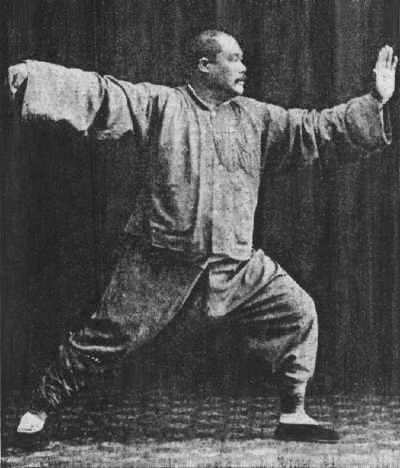
But, I think we’ll have to live with it, because the hippies who have taken over Tai Chi Chuan do have a very good point – the first step in Tai Chi is to relax, whether you like it or not! You cannot move your body as a unit if parts of it are tense.
In Tai Chi Chuan the body is required to move as a whole unit, connected by fascia, tendons, muscles, etc, with all the joints allowed to move freely during exercise. All the joints are involved to some degree in all movement, so need to be relaxed. The ball-and-socket joints of the shoulders and hips are allowed to move freely. The gliding joints of the ankles and wrists move freely, and the hinge joints at elbows and knees are all allowed to move freely. Finally, the dantian moves freely and controls everything. Tensing the muscles around a joint separates it off from the rest of the organism, meaning that whole body movement is not possible.
And being mentally ‘tense’ is just as much of a problem as being physically tense, since the mind and the body are intimately connected.
Perhaps the emphasis in the original writings on Tai Chi was focused on more lofty philosophical principles, yes, but you will find plenty of admonitions to relax in there, and for good reason. That’s just how Tai Chi works.

 The Tai Chi Notebook