A rare and welcome return to dead tree media for Brazilian Jiu-Jitsu fans everywhere.
Since the advent of DVD, and easily downloadable video tutorials from the likes of Kesting’s own Grapple Arts website and sites like BJJ Fanatics, new books that teach you BJJ techniques in a step-by-step manner have dwindled to the point of non-existence. Back in the day we had masterworks in print, like Jiu-Jitsu University by Saulo Ribeiro and Kevin Howell, and Advanced Brazilian Jiujitsu Techniques by Marcelo Garcia and Marshal D Carper* to guide us. But VHS and then DVD took over, which is why I’m so pleased to see this new release from Brandon Mullins and Stephan Kesting. Nonstop Jiu-Jitsu is the first new book about Brazilian Jiu-Jitsu to buck the trend and feature photos and step-by-step techniques, released in years.

You might be wondering what the point of a printed book teaching you BJJ is in the modern age of YouTube and steaming video, so let me offer you some reasons for its existence:
1) You don’t need a phone, app, computer or VR headset to enjoy a book. You can take it wherever you go and dive into any page anytime, anywhere. Talk about “instant access”!
2) Some people learn better from printed material – reading puts you in a different headspace. There’s also just something nice about a real, physical book that you can hold in your hands.
3) A DVD of this material (“Nonstop Jiu-Jitsu”) already exists from Grapple Arts, so this book acts as an additional resource.
4) Goddamn it, I’m just tired of all BJJ instructionals being in video format these days! It’s so nice to go back to something more old school.
So, as you can probably tell, I really wanted to like this book. I work in print magazines as my day job, so I love print with the sort of passion that Gordan Ryan normally reserves for protein shakes. I want to see the printed medium continue for as long as possible. So, as a fan of the original Nonstop Jiu-jitsu video instructional from Grapple Arts, I was beyond excited to hear that a print version was now available. And at 260 pages, with literally hundreds of full colour photos it is clearly a labour of love for the authors Kesting and Mullins. Yet alas, (alas!), it is not without its problems, of which there are many, but more of that later.
First though, who are Kesting and Mullins, and why should you care what they have to say about BJJ? As mentioned, Kesting runs the Grapple Arts business of BJJ instructional videos. I’ve been a fan of his work for a long time, and purchased many of his products. They’re all good, high-quality productions and usually done in conjunction with another teacher, who has a unique or valuable insight into the world of BJJ. Kesting usually takes the role of uke in the videos, while the featured instructor takes you through his techniques, or concepts. The featured instructor here is Brandon “Wolverine” Mullins, a BJJ world champion who is known for his clear instructional style and showing you complete gameplans, rather than isolated techniques, so he will show you a guard sweep, followed by a guard pass and then a submission, rather than techniques that leave you hanging and not knowing quite what comes next. Mullins isn’t one of the really famous BJJ guys out there, but he’s no stranger to competition and is a very competent teacher.
So what’s my beef? Well, the problem is that the book smacks of self publishing. A quick scan of the credits page reveals they didn’t employ an editor or a sub editor, and it really shows. Not only could almost all the text in the book do with a good edit to make it punchier, tighter and more interesting to read, there are a lot of unforgivable grammatical errors that have crept in, mainly in the introduction text admittedly, but that’s the thing you read first, so it creates a very bad first impression. But while things improve in later sections, typos are prevalent throughout the work, and if like me you can’t stand seeing obvious mistakes in a finished book, you’ll be tearing your hair out. I have a lot of sympathy for the authors here – working in print I know how hard it is to spot your own mistakes. You go “word blind” to your own writing. There are probably typos in this review that I’ve missed, but I can easily go back and fix them because it’s a blog post. In contrast, once something has been published in print it can’t be changed without issuing an expensive reprint – it’s really a very unforgiving medium, and not getting another pair of eyes to look at every single page before you send it to the printers is always fatal. Heck, I’d have done it for free myself if only they’d asked me!**
Some examples of typos from the introduction:
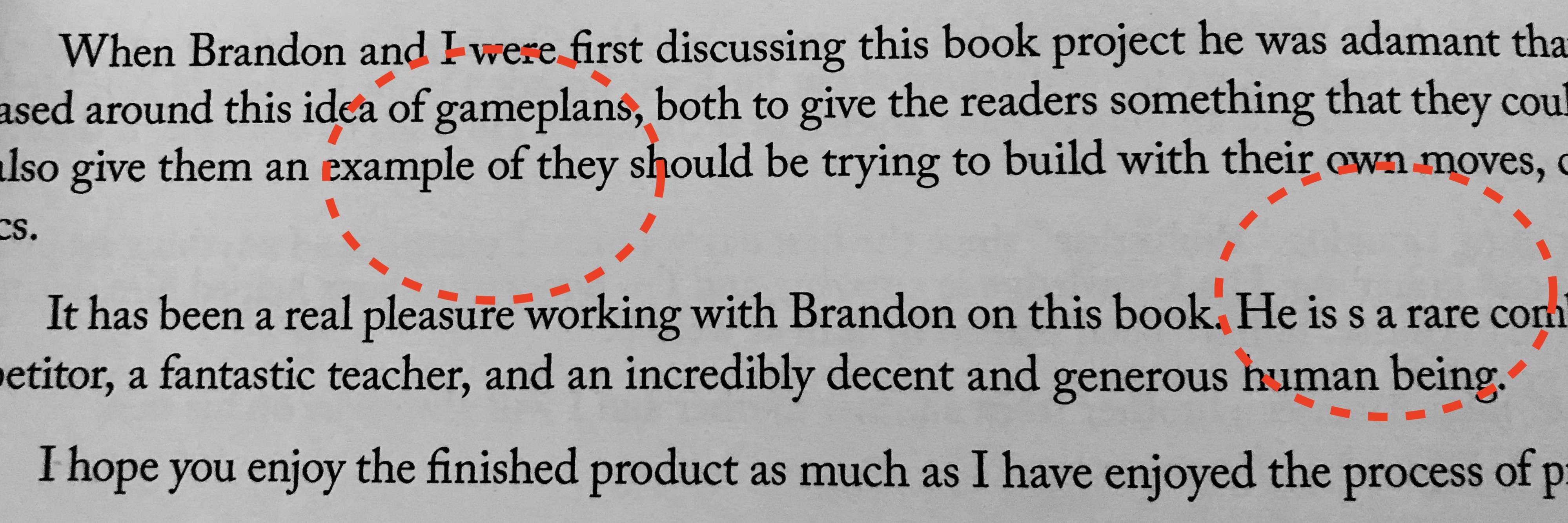
Maybe you’re not be the sort of person who cares about dotting the i’s and crossing the t’s. You just want to get to the great content, right? Well, I have some issues there as well.
I can’t fault the quality of the instruction presented. Like I said before, I was a fan of the original video series. But the way it’s presented here could be improved. For a start, the book is an odd shape (21.5cm across and 21.5cm high). There’s a reason why most books generally aren’t square – they’re really awkward to design for and you can see how this has created problems. When they have a full page of text, they’ve used only 1-column, so a line is uncomfortably long. The margin on the outside edge of the page is very tight too, and it all makes reading difficult, as you have to track your eye back a long way to the left to find the start of the next line. A 2-column grid would have made scanning text much easier.

The pages of photos have a different problem. Following from one step to the next is difficult, as they often have alternative shots of the same technique on the page. They’ve put numbers on photos so you can see where to move your eye to next, but knowing where to go next is not intuitive. They also expect you to read the explanation in the text box at the top of the page, then move your eye back to the correct picture to see what is meant, then move your eye back to the text box at the top to read the next step, and so on. It’s all a bit awkward.

All credit to Kesting and Mullins for spending the time to re-shoot every single technique in detail and presenting colour photos of each step (that’s not cheap to do in print). The photos are clear and accurately show the techniques. They avoid the classic mistake of both weaing the same colour gi, but the printing is a bit too dark, meaning there are some shadows and dark patches on Kesting’s blue gi that are hard to make out, as you can see in my photos. (This probably looked fine on screen when they were creating the book, but the printed version can differ).

The design has competing systems of classification too, which makes it even more confusing. Sometimes a “what not to do” type photo has a red thumbs down icon on it, at other times it is crossed out with a big red “x”. Why not just pick one system and stick with it?
In their enthusiasm the authors have tried to squeeze too much into this book, both in terms of the number of photos on each page, and the amount of material covered. There are 3 big sections – 1. Fundamental movements, 2. Butterfly guard, 3. De La Riva guard – and to fit it all in, something important has been lost, which is context. In the video version of Nonstop Jiu-Jitsu, Mullins explains why he’s doing each technique, usually in response to the opponent defending his previous effort. Here you don’t know when or why you would use the techniques shown. For instance, when you have butterfly guard, what makes you choose either the hook flip to x guard or the hook flip to phantom choke? It’s not entirely clear. A short piece of text explaining the context before diving into the steps would have made all the difference.
To give you an idea of how much content there is here, the table of contents alone runs to 6 pages! Complaining there’s too much value in a book sounds like an odd gripe, but this book could easily have been split into 3 different books, with more room to really let each subject breathe, and it would have been all the better for it.
The first section (which seems unsure if it’s called Fundamental Movements, or Advanced Fundamentals) is based around the fundamental movements of Jiu-Jitsu, like the technical stand up, sit through, hip escape, butt double and rolling forward and backwards, and then shows you how these movements can be applied in techniques. In a section aimed at beginners the applications are actually quite involved and ramp the difficulty level up very quickly – for example, a rolling omoplata from the armbar position in side control, anybody? As a more experienced Jiu-jitsu player I personally loved the high-level technical content here, but a real beginner might be a bit out of their comfort zone. My only criticism is that they show plenty of applications for all the movements except the hip escape (or shrimp) and bridge, which only get one application each – regaining closed guard from half guard for the shrimp and bridging from mount. I would have liked to have seen a shrimping escape from side control here, and another mount escape added for completeness sake.
The second section goes on to cover butterfly guard. Butterfly is a really good guard to use against an opponent who is trying to pass your guard from his knees. The standard butterfly sweep is shown, plus a plethora of options for when they post a hand or leg. Quite naturally this leads into all sorts of x guard material, back takes and shin sweeps. The section starts with Mullins’ trademark aggressive butt double attack from butterfly, which is a very proactive way to get the action going against a stalling opponent, and as such is nicely suited to competition. Because Mullins teaches in a game plan-based system, a lot of this chapter is devoted to guard passing after you’ve swept them from butterfly guard.
The final section covers the De La Riva guard, which shows you what to do against a standing opponent. The majority of the section is on how to attack with the ball and chain sweep, and follow ups depending on how the opponent defends. Again, the jiu-jitsu shown is attacking and aggressively non-stop, in the sense that he links together guard sweeps, passes and submissions.
Throughout all of the book’s sections, Mullins drops in some tips on motivation, competition strategy and his general thoughts on BJJ. It’s welcome advice, but I think it could have done with an editor to make it more concise.
After all this moaning you probably think I’m going to recommend staying well clear of Nonstop Jiu-Jitsu (or is it “Non-stop Jiu-Jitsu“? Even the name of the book is editorially styled in two different ways, one on the cover without a hyphen and another on the footers of each page with a hyphen – argh! Just choose one way and stick with it), because of all the editorial problems, but I’m not. I’m recommending it because this book is actually glorious!
I love seeing BJJ back in print, and despite the issues I’ve mentioned**, it didn’t stop me from loving this book. If you’re looking for some new ideas for a game to play from butterfly or de la Riva, then you’ll find inspiration here that will last a lifetime, and you can easily add to your game. And, godamn it, it’s a real book about BJJ and we should celebrate that fact.
Link to Nonstop Jiujitsu on Amazon
(* If you’re interested, I consider Marcelo Garcia’s book to be the gold standard in terms of these types of instructional BJJ manuals. Its production standards are first rate, from the quality text and explanations to the brilliant photos. Sadly it went out of print a long time ago.)
(** Lads, if you are reading this and want to do an updated version 2 of this book without all the typos, then please do, but please, please hire an editor this time!)