Is Chinese wrestling the root of all Chinese martial arts?

An interesting video has surfaced that links the guard postures used in Shuai Jiao (Chinese Wrestling) with postures in various Chinese martial arts. The premise of the video is that Shuai Jiao is the root of all the Chinese martial styles. The text accompanying the video says:

“Guards in traditional Chinese wrestling are meant to favor certain fighting techniques and strategies. Since Shuai Jiao is very ancient and there are precise references in these guards to the styles that exist today, traditional wrestling is at the roots of Chinese styles. My Master Yuan Zumou has clearly stated this for over thirty years. In Shuai Jiao these attitudes are not aesthetic, but are used in real combat. I have put the captions of the styles I know or of those that maestro Li Baoru (Beijing, late 80s) mentions in the video.”

It’s an interesting theory, but unfortunately I can’t agree with such a blanket statement as “traditional wrestling is at the roots of Chinese styles“. Was it a strong influence on all Chinese styles? Yes, of course. But calling it the root of all styles is a bit strong for me. Some styles developed entirely from military practices, and a lot of styles have no wrestling component at all, or have their roots in weapons usage.

I can certainly see postures in the video that resemble Tai Chi – particularly the “White Stork Cools Wings” posture and another guard that looks a little like the “Wave Hands Like Clouds”. But we only have two arms and two legs – inevitably there are going to be similarities between postures found in different martial arts. That alone doesn’t confirm a genuine historial link. Influences betweewn marital arts can flow in both directions, too. So it’s quite possible that wrestling has been influenced by local village styles. And even things that are not necessarily combat arts, like xìqǔ, can have an influence on them.

I’d also have to take issue with the statement that “In Shuai Jiao these attitudes are not aesthetic, but are used in real combat.” Let’s not even get into the idea of what “real combat” is (Shuai Jiao matches have rules, after all) but it’s a simple fact that Shuai Jiao was enjoyed in the royal court in the Ching Dynasty (and probably all the dynasties before it) as a kind of entertainment for the nobles. The same thing happened in the Japanese royal court with Sumo, just as medieval kings in Europe enjoyed watching martial games like jousting and fencing. And obviously wrestling is still enjoyed as a kind of popular entertainment in America and Mexico today.

But let’s turn our attention to the contend of the video. A lot of the guards being demonstrated look quite showy to me – as if they were designed to impress an audience, particularly the Wave Hands Like Clouds style guard, where the practitioner seems to deliberately trip over his own legs.

But I don’t think that’s a bad thing. Ever since modern Wu Shu put the emphasis on gymnastic ability over practicality, people have been searching for this false dichotomy between performance and practicality in historical martial arts, too. It’s almost like a real martial art isn’t allowed to have any ‘fun’ aspects to it. In reality, and with several historical examples, a martial art can be both a serious, practical tool for combat, and something that can be performed for social, entertainment and cultural reasons all at the same time.

Choy Li Fut schools often perform lion dance, and that doesn’t mean their kung fu won’t work in a fight. Similarly, I would contend that Shuai Jiao can be used as a form of entertainment and a practical method of self defence. Just like almost all Chinese martial arts can.

Pressure point striking is back!

Dim mak, pressure points, high kicks and nerve strikes! Along with permed hair, styled into a mullet, and blue jeans, these were part of the staple diet of kung fu magazines in the 1980s and 1990s. But pressure point striking quickly became something of a running joke once people found out that it couldn’t be applied in a real fight, you know, when somebody was actually trying to punch your face in, not just when they were standing in front of you passively in the dojo, happily waiting for you to strike their Gallbladder 15 or Lung 4 points.

The reputation of pressure point striking wasn’t helped by the many obvious charlatans peddling their fake pressure point striking systems on DVD and on seminar circuits. These ‘masters’ tended to only demonstrate their skills on their own gullible students, and they rarely seem to work on other people, who hadn’t been brainwashed to think they were the second coming. 

But while falling foul of reality, pressure point striking carried on a healthy second life in the fantasy-based genre of martial arts movies. For example, Crouching Tiger, Hidden Dragon had a great scene where one of the fighters is almost instantly paralysed by some quick pressure point tomfoolery until he can be released by yet more pressure point touching.

And in Kill Bill: Volume 2, the late David Carridine famously succumbed to Bak Mei’s legendary 5 point palm exploding heart technique, delivered deliciously by Uma Thurman. 

Even as recently as 2021, in the Marvel TV series, Falcon and the Winter Soldier, homage was paid to the pressure point movie trope with a body-popping sequence that made the Winter Soldier’s metal arm suddenly detach from his shoulder and fall to the floor with a clank, turning him from super soldier into one-armed bandit with one simple cheat code.

However, if you ignore the mystical nonsense surrounding pressure point striking you’ll find that it is actually based on some pretty sound scientific principles. In a recent UFC 252 match Anthony Smith seemed to paralyse Jimmy Crute’s leg with a well-delivered calf kick. 

After the kick, Crute’s leg seemed to be unable to function in a way that was almost comical. Crute bravely tried to fight on, but his leg was so unusable after the strike that the ring doctor waved the fight off when he was unable to walk in a straight line properly between rounds. I’m sure I heard Pak Mei chuckle quietly to himself in his grave when it happened.

So how was this possible? The answer lies in nerves. 

As orthopedic surgeon Dr Lucius Pomerantz explains, on his YouTube channel, the phenomenon is called Drop Foot, and it’s what happens when the peroneal nerve sustains an injury. “When a nerve does not work the muscles that it innervates do not receive messages from the brain. When the peroneal nerve is injured the muscles that raise the foot at the ankle do not work – the foot drops down. Simply walking can be extremely difficult without the ability to raise the foot.”

So, there you have it. A pressure point strike achieved via a calf kick in MMA! I’m glad pressure points are making a comeback, and I hope we’ll see more of them in the future.

I just hope the permed mullet doesn’t make a comeback as well. 

Kung Fu 2021

The classic TV series is back! This time the lead is female and the cast is almost all Asian. I’m looking forward to seeing what they’ve done with it. I thought the trailer was pretty good. Not sure how I watch this in the UK though…?

Suspended from above. Bringing a sense of lightness to your Tai Chi.

One admonition from Yang Cheng Fu’s 10 important points, that has become something of a law in Tai Chi Chuan, is to ‘keep the head suspended, as if from above’. In the Tai Chi Classics it also states “Stand like a perfectly balanced scale and move like a turning wheel”, whilst also saying, “Don’t lean in any direction; suddenly appear, suddenly disappear.

These quotes have produced all sorts of controversies in the Yang style side of the Tai Chi universe. If you look at ChengFu’s student Cheng ManChing, who did so much to popularise Tai Chi in the West, you can see that he changed his form to truly embody this principle of suspending the head and standing like a perfectly balanced scale. In a forward posture, Cheng ManChing kept his head, neck and back vertical in relation to the ground at all times. He allowed no forward incline at all. To stay vertical he softened his back knee a bit, which removed the straight line from the heel to the head, producing a much softer posture than his teacher, Yang Cheng-Fu, exhibited.

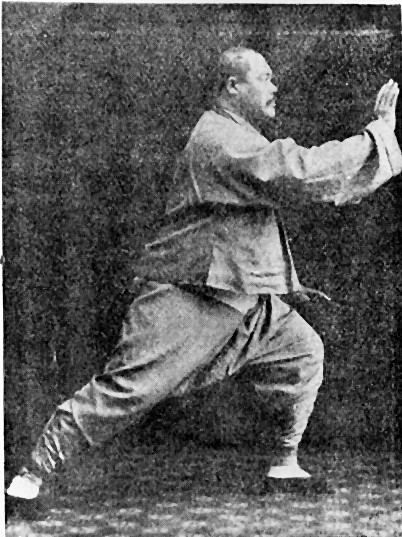
Whereas, if you look at pictures of Yang Cheng-Fu in a similar forward posture you can clearly see that he holds his head in the same vertical alignment, but holds his back with a slight forward incline. He keeps his back leg straighter, forming a straight line from his back heel to his head, meaning that his posture is slightly harder than Cheng ManChings, and he exerts more of a forward pressure.

Both of these approaches can be seen as interpreting the advice to not “lean in any direction” differently. The situation becomes even more confusing when you look at the Wu style of Tai Chi Chuan, derived from the version of the form practiced by ChengFu’s peer Wu Jianquan. Wu holds an even more inclined position, which keeps the head vertical, but often seems to break the line at the hip, so that the back heel is no longer in a straight line all the way to the head. Being of Manchu heritage, Wu Jianquan had a shuai-jiao background. He was taught martial arts by his father who was a student of Yang LuChan and also a cavalry officer and imperial palace guard, as he was, so a change in his preference for grappling techniques could very well account for the changes in his version of the form.

I used to ponder these discrepancies a lot, but these days I have become more interested in the relation of the back (including the neck) to the hands and arms, regardless of its orientation in the vertical plane. When we lift and use our arms our tendency is to bend the top of our spine and drop the head forwards, a fact that can be proved each and every time you type on a laptop. The next time you’re sitting at a laptop observe what happens when you start to type. Notice that your head wants to move towards your focus of attention, the object you are interacting with.

Recently I was watching an excellent performance by a child doing Bak Sing Choy Li Fut, filmed in the 1960s. Young children doing martial arts can be great teachers because they effortlessly keep their posture as they move. It is only as we become adults that we seem to lose this ability.

Search for the video “Old Kung Fu Footage in Hong Kong in the 1960’s” on YouTube and you’ll see what I mean. Watch the good posture he keeps throughout – his back remains still in relation to the movement of his arms allowing his neck to stay extended and space and awareness to be present.

This is what I think is being asked for in Yang Cheng-Fu’s writings and the Tai Chi Classics, not mere fussing about how vertical a posture is. What is required is the freedom to move our arms, but to keep our back still, and maintain our head and neck relationship without falling into the trap of bending towards the object of our attention.

But how do we train this? Here’s something simple you can try. Get a 4-pint carton of milk out of the fridge and swing it in a figure of 8 in front of you. Now do it again and notice how you head wants to be pulled forward. Resist the pull and feel the work done by the neck and back muscles to prevent it from happening. It shouldn’t feel like they’re straining, but they should feel active.

You can do the same thing with a heavy sword, of course, if you want to look more like a traditional martial artist, and less like a deranged milk man. And once you get a feeling for it you can try it without a heavy object, in which case it becomes more like a silk reeling exercise, or you can try and keep the same feeling when you do the Tai Chi form. In which case it doesn’t look like anything.

Obviously, when you are standing still, or sitting, in meditation you can achieve the same relationship of the torso, neck, head and arms but with even less use of muscle to maintain the position. Initially at least. If you try standing in a Zhan Zhuang posture with your arms extended for a few minutes you’ll start to feel your neck and shoulder muscles tighten. This is where you need to work on relaxing them, yet maintaining your posture. You need to let the weight of the upper body rest on the lower body, and flow down into the ground through the centre of the foot, or through the sitting bones if you are seated.

A human head is quite heavy, at around 5KG, which is a lot more than a typical bowling ball weighs. If the head moves forward of the hips too far then we have to start using a lot of muscle to hold it up. In a way, the neck being tense, or feeling tired, after we’ve been doing an activity is a warning sign that we’re not using our body to the best of our ability. If we can maintain the relaxed, neutral, position of the neck through movement, then the weight of the head is transfered down to the ground through our frame instead. Our breathing will be better, and we won’t lose that sense of lightness and ease that the kid in the Choy Li Fut video from the 1960s so effortlessly demonstrates.

Finally, his idea of keeping an open relationship between the head, neck, back and arms raises a few good questions when applied to martial arts. What springs first to my mind is, should you have your head in that position to fight? I’d say probably not – you want to tuck your chin in a bit more when you fight, for obvious reasons, but the real question is how you tuck your chin. The idea of the extended neck that you’re training by working on your posture can be transferred into the way you tuck your chin. Dropping the head towards the opponent has all the same disadvantages we’ve outlined above when applied to martial arts, and will inhibit the free movement of your arms, so critical to fluid punching, not to mention making you more hittable.

So, keep your head up, as people say to you when you’re looking down. Walk lightly, smile brightly!

Kung Fu and firearms

“Western enthusiasts often feel impelled to strip away these religious trappings and construct a version of the martial arts that is neither simple gymnastics nor religion, but emphasizes true hand-to-hand combat skills. The question remains, is this an authentic understanding of the martial arts?”

Charles Holcombe, Theater of Combat (1990)

I think it’s important to bear in mind Charles Holcombe’s classic article, Theater of Combat, when thinking of Chinese martial arts.

One recurring trope that I encounter from, as Holcombe puts it, “Western enthusiasts”, (a label I would apply to myself) is the idea that the Chinese martial arts styles evolved as effective fighting systems in a purer time, before the use of firearms became widespread, and that they gradually went out of favour as practical self defence arts in the face of modern weapons, and turned their attention instead to the more lofty goals of attaining physical fitness, health and spiritual enlightenment.

The idea gives credence to the original version of these arts being purely pugilistic. It follows that once the evil West showed up with their firearms the martial arts needed to find some other way to survive, so it tended towards gymnastic displays or spiritual attainment. It’s a neat idea, but it doesn’t really hold sway with reality.

People forget that China is credited with inventing gunpowder and that the ‘older’ version of its martial arts was intricately embedded within a culture whose religious expression was revealed through performance at festivals and ceremonies, often officiated by a priest performing a ritual with a sword or a troupe of performing martial artists acting out conversations with the gods. 

Also, I think the “whiff of ancient mysticism” (as Judkins calls it) around the martial arts makes people think of them as being  incompatible with modern methods of warfare, like the gun. A popular theme within marital arts films, for example, is that of the introduction of guns destroying the old order, usually involving the death of an old master at the hands of a less skilled and resentful disciple who only had to pull the trigger. 

But, as Judkins explains, these media perceptions have twisted the truth:

“Historically speaking, this is totally backwards.  First the guns came, and then the modern martial arts developed.  What we see in China is quite similar to the puzzle that made life difficult for Perrin when he discussed Japan.

Firearms have been a fact of life in China since the 1300s.  At first they were difficult and expensive to manufacture, but the government employed large numbers of hand cannons, field artillery pieces and even massive rocket launchers from an early period.  If you are curious about what early military gunnery looked like you should check out the Fire Dragon Manual.  At the start of the Ming dynasty Chinese firearms were probably the most advanced in the world.  So what happened?”

Clearly there is more to this story of Kung Fu and firearms than we are aware. I’d recommend reading Ben’s full article: Forgetting about the Gun: Firearms and the Development of the Southern Chinese Martial Arts. and also his other article: Tools of the Trade: The Use of Firearms and Traditional Weapons among the Tongs of San Francisco, 1877-1878.

Enjoy!

Weapons of Chinese highbinders. 1900

Why you should train your martial art like a sport

“Sport” is kind of a trigger word for a lot of martial art practitioners, at least some of the ones I’ve met! So telling them they should train their martial art more like a sport usually goes down like a cold bucket of sick, but really I think they should listen.

“There are no rules on the street!”

“I train for the street, dude!”

“You mean a sport like netball, right?”

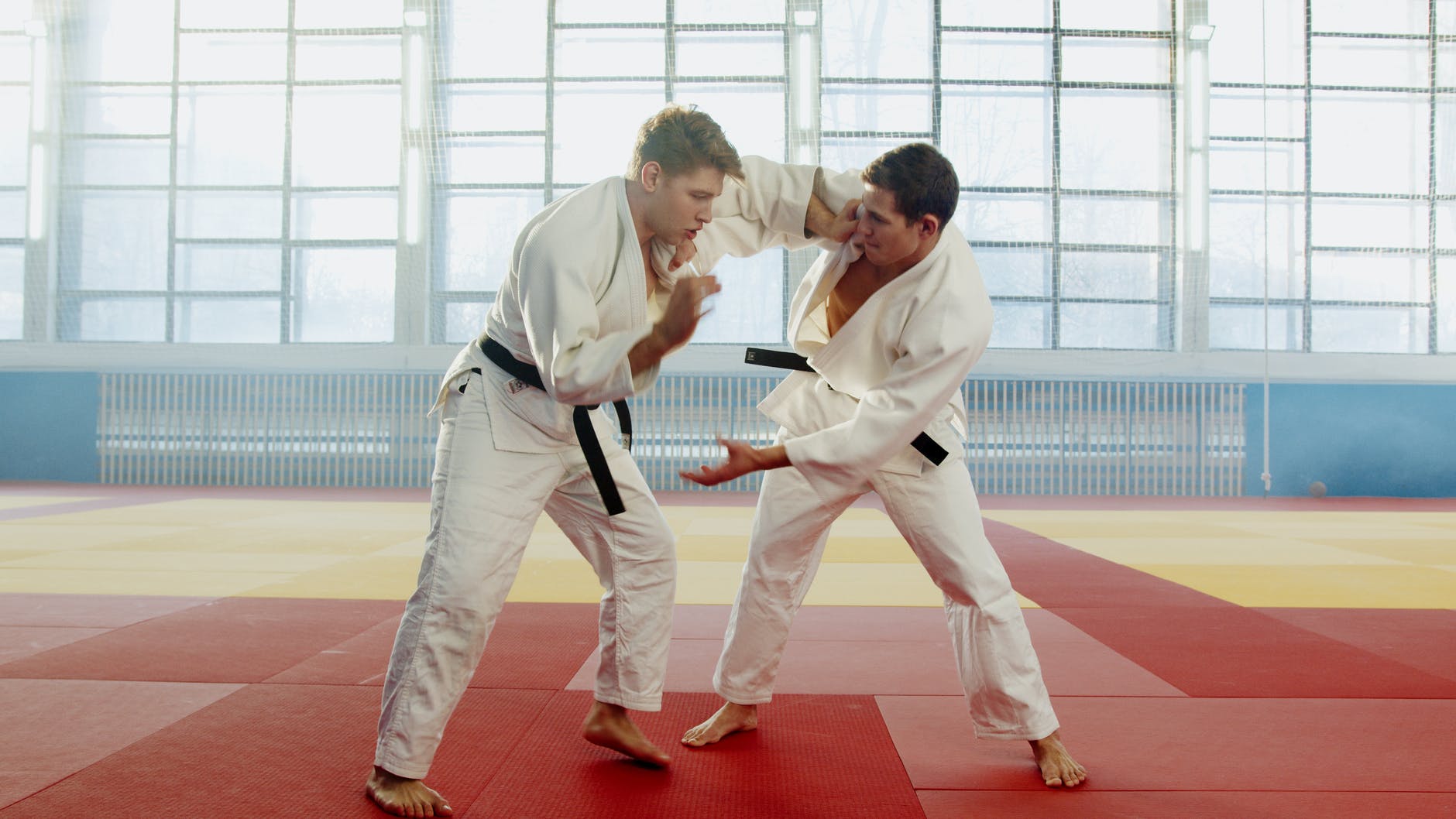
Photo by Artem Podrez on Pexels.com

When here’s the thing: Training your martial art like a ‘martial art’ is often an excuse for not working very hard and not really pressure testing anything you do.

Sport is a sweaty, dificult, thing to do that usually involves doing something pretty athletic (unless you count darts). Sport is also structured. Quite often in a martial art there is no real training methodology. People just turn up, do a few forms, practice a few safe applications against little or no resistance then go home again. The learning process can be a bit random.

I should stress, I don’t really think that there’s anything wrong with that, depending on your motivations for training, which often change as you age. Just feeling good about doing something is certainly reason enough to do it, but I think you should ask yourself, what progress are you really making? And, worse, are you becoming delusional?

Sports, in contrast, tend to be very structured. You train attributes specifically, and you engage in a focussed practice where you can drill to increase your ability in tightly defined things. Sometime those things are measured. You sit down and discuss progress with your coach. You troubleshoot and then you give it a go against somebody who is going to be uncooperative and gives you feedback. That’s real testing against nature – the sort of thing a human shaman would engage in 10,000 years ago.

Martial arts also have strange rules that sports don’t have – we have to call people odd titles like Sifu or Professor. There’s bowing and etiquette that looks strange to people outside the system. I can understand the cultural reasons for a lot of these things, but I often wonder that when these arts are put into a different culture, whether some of these things should be left behind because they’re not helpful and, in fact, can stand in the way of progress. For example, the little quirks like bowing to photos of dead guys or using a 1-2-3 clap system can gradually breed a cult-like quality of obedience that makes us stop questioning things.

I saw a brilliant video of a Muay Thai coach recently. I love the tiny details he’s giving. Muay Thai is an interesting martial art because it’s probably the most traditional martial art remaining on the planet, but it’s also a sport. It is undoubtedly effective and trained at the highest level in popular combat sports. I think there’s something to learn from that.

As I said earlier, I don’t think we need to make all martial arts into competative sports, but I think we can take elements of the sporting approach and apply it to what we’re doing, regardless of the martial art we’re doing.

Finally, the inspiration for this post is the latest brilliant episode of the BJJ Mental Models podcast to featuring Priit Mihkelson, about how to train your martial art like a sport. Give it a listen.

It’s also on YouTube:

The great mystery of Kung Fu forms

One of the frequent criticisms I hear of the idea that there is a connection between Chinese martial arts and Chinese theatre and religion is that no respectable Chinese martial arts teacher has ever implied their work comes from dance or spiritual ritual, so the idea is laughable. I have experienced a pretty negative reaction from some of my Chinese martial arts friends to these ideas. The thought that the rough and tough martial art they genuinely suffered to learn and dedicated their lives to had religious or (worse) theatrical origins is anathema to their world view, akin to an insult.

But the question really is, how can they not be theatrical? Just look at Chinese martial arts – of course they’re theatrical!

Here are some questions to ask yourself: Why do we do long complex, showy forms at all? Why is Chinese martial arts still so strongly associated with Lion Dance? Why do its modern day performers so often put on demonstrations for the local community, on stages? Why do performances sometimes have chaotic drumming soundtracks?

I’m sure any competent Chinese martial arts practitioner can produce answers to all these questions based entirely in the physical realm of pugilism – it’s all physical training at the end of the day –  but when you put all these questions together an obvious picture begins to form.

Nobody looks at Capoeira and says, “this has nothing to do with dance”. So, why do most Chinese martial arts practitioners look at their long theatrical forms and say, “this has nothing to do with theatre or religious practice”?

There’s an inherent mystery to Tao Lu, or “forms” found in Chinese martial arts. This great video by The Scholar-General hopes to provide some answers:

The Invention of Martial Arts, Popular Culture Between Asia and America by Paul Bowman

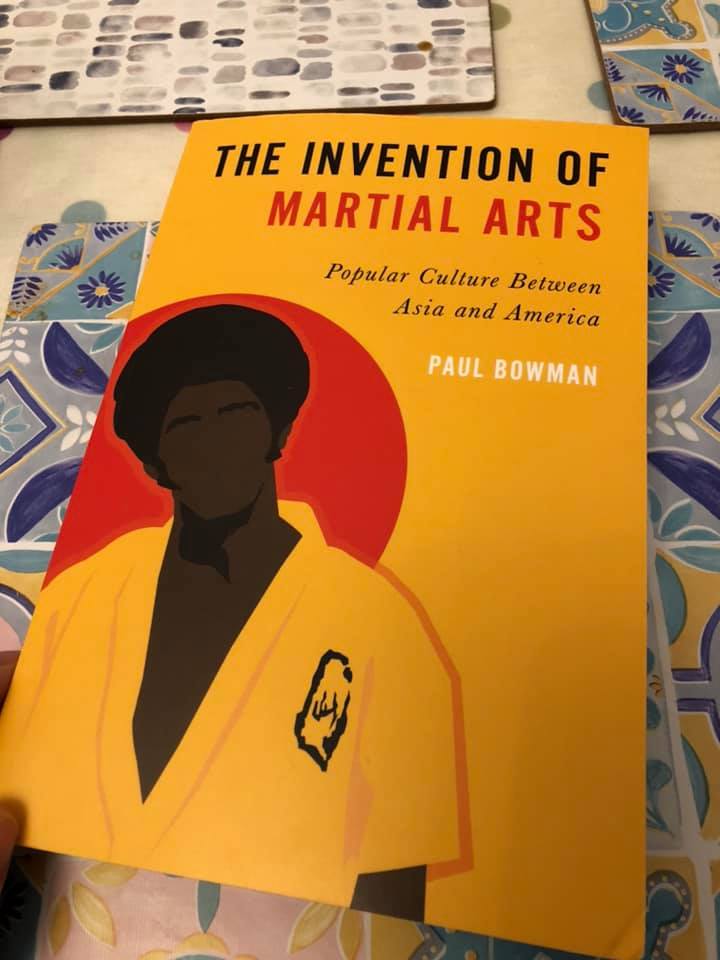
I’ve just got a copy of The Invention of Martial Arts, Popular Culture Between Asia and America, by Paul Bowman. (Amazon link. Non-Amazon link). Firstly, yes, that excellent cover illustration is a picture of Jim Kelly playing the iconic character Williams in Enter the Dragon, a character who speaks volumes about the international and multi-ethnic appeal of East Asian martial arts in the early 1970s. It was created by the incredible Jon Daniel, who passed away in 2017.

Some of Bowman’s work is very academic, but this one is for “normal people”, like me. I’m still on the Introduction, but feel compelled to write something about it because this book is dripping with ideas to do with the conversations we all have around martial arts.

That to me is what much of Martial Arts Studies is – it’s not about the martial arts themselves, it’s about “what we talk about, when we talk about martial arts”, which would otherwise be left unexamined.

Take his writing on theory in the introduction:

“At first glance martial arts may seem simple. But any discussion of them will involve an implicit or explicit theory about them.”

So true. If you’ve ever been involved in any sort of online discussion about martial arts you’ll find the participant are talking past each other because of an assumption of (often contradictory) theory that underlines everything they say to each other about any subject to do with marital arts. One person thinks the martial art is really all about this, and the other person thinks the martial art is really all about that, and they go on busily talking about different things.

He raises the brilliant point that no theory of martial arts (or culture) can contain all the answers and that “different theories offer variations and varieties of perspective. Looking at things from the perspective of one paradigm, or orientation, followed by another, and then another is stimulating and illuminating in many ways. The shifts in perspective caused by this can produce more well-rounded or enriched understandings of phenomena, and can also instil a prudent awareness of the limits of our own understanding. However, by the same token, such shifts can also produce contradictory, conflicting incompatible pictures of ‘the same thing’.”

It should come as no surprise that the title of the book can then be viewed in multiple ways. He’s not talking about the literal invention of the term “martial arts”, or the actual martial arts themselves, but the invention of the ideas about martial arts, ways of thinking about them, depicting them and valuing them.

I could go on, but really, I’d recommend grabbing a copy yourself.

Where Karate got its kicks from (it was the French!)

This is a very nicely made video from the Karate Nerd that shows the influence of Western military methods (created by the French from Savate) on the formation of Japanese Karate. This influence of the West on Japan was something we talked about a lot in our podcast on The origins of Kempo and Jiujitsu, but it’s nice to see a video that uses old footage so well to demonstrate the point.

Here’s some of that lovely Savate from 1924, in normal and slow motion: