Stephan Kesting on the martial arts life

In the latest episode of the Tai Chi Notebook podcast I’m talking to the man, the legend, that is Stephan Kesting. Stephan has taught thousands of people martial arts through his famous website grapplarts.com which, back in the day, was one of the first sites to put out quality Brazilian jiujitsu instructional material and is still putting out top notch instructional material today.


Stephan is a fireman, he has competed in marital arts, he has trekked across the Canadian wilds with a canoe and recently he’s undergone a full hip replacement and documented his recovery – and he’s about to return to training again, so he’s one tough old dude.


Stephan also hosts his own podcast, the Strenuous Life Podcast, which I’d recommend you listen to – because it’s always super interesting, especially his episodes debunking conspiracy theories.

Chinese martial arts: The place where theatre, religion and fighting meet

One of the ways you can tell genuine history from a ‘made up’ history (in Chinese martial arts, or in anything really), is that the real history is always pretty messy, convoluted and complicated, and a conveniently invented origin myth or history of a style is usually pretty simplistic. Tai Chi Chuan is a good example, I think. Attributing the origin of Tai Chi to one particular Taoist immortal, or one particular remote rural village, is a very neat and simple solution – and probably not the whole truth.

And I think the same thing applies to Chinese martial arts as a whole. The Chinese martial arts, (as we know them today) were not just invented fully formed, hundreds of years ago and have remained unchanged ever since. On this blog I’ve often quoted those who have proposed that kung-fu has a more convoluted pedigree than one might otherwise have expected. Historian Charles Holcombe’s excellent “Theatre of combat” on the subject of kung fu history from 1990 is a good starting point for this line of enquiry. Also check out my first podcast episode with Daniel Mroz.

To quote from Holcombe:

“In China the martial arts are far more than just techniques of hand-to-hand combat, although actual fighting skills are indeed traceable far back into antiquity. In China the martial arts are an aspect of religion, with all of the attendant mystery and miracles. At the same time, the public face of the martial arts has often been that of the entertainer, and the self-image of the martial artist has been thoroughly imbued with motifs drawn from fiction and the theater. The martial arts of today must be understood as a confluence of China’s unique approach to physical combat, Buddho-Taoist religion, and theater.”

Theater of Combat – Charles Holcombe

It’s worth reading that quote a couple of times.

One curious thing I’ve noticed from other martial artists is that they often can’t comprehend this argument at all. They don’t seem able, or unwilling, to hear it properly. Some internal bias seems to prevent it. I’ve had people come back to me a year later saying, “I thought you were saying that all Chinese martial arts comes from dance”. Or theatre. No, that’s really not what I’m saying. I’m saying, it’s complicated. I’ve even gone back to these people and shown them the exact thing I wrote, a year ago, saying exactly the opposite of what they think I said. But for some reason, it doesn’t go in. They hear what they think I’m saying rather than what I’m actually saying.

Real history is always complicated. “Kung Fu came from dance” is just too simplistic to be true.

Incidentally, the excellent Kung Fu Tea blog has written a long, and detailed post addressing Holcombe’s article: “Reevaluating the “Theater of Combat”: A Critical Look at Charles Holcombe, Popular Religion and the Traditional Chinese Martial Arts.”

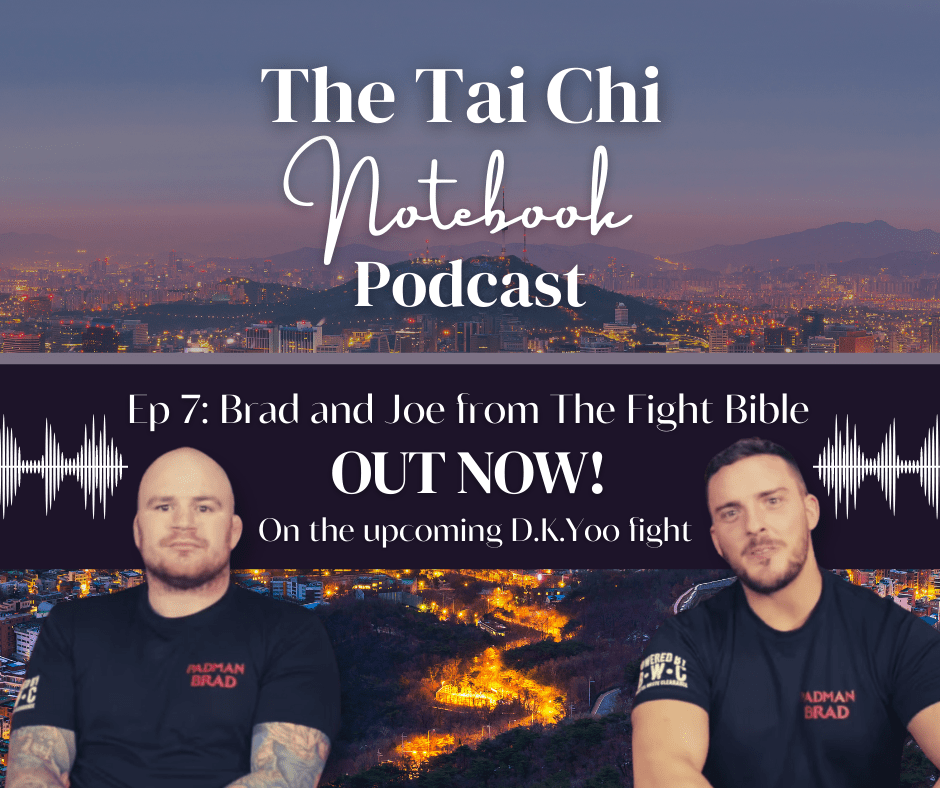
Special podcast edition: Brad and Joe from The Fight Bible on Brad’s upcoming fight with D.K.Yoo

Hello and welcome to a special bonus edition of the Tai Chi Notebook. This time I’m interviewing Joe and Brad from The Fight Bible, a popular YouTube martial arts channel.

I used to train jiujitsu with Brad back in the day, before he went on to become a UFC fighter, so I’ve known him for years. Brad is retired from the UFC now, but he recently accepted a fight offer from the famous D.K. Yoo, who teaches martial arts seminars all over the world. The fight is scheduled to happen on December 4th on pay-per-view here:

Brad and Joe are flying off to South Korea in just a few days for a boxing match that looks set to make a huge impression on the martial arts scene. 

So, let’s find out how it all happened, how Brad’s training is going and what the boys think is going to happen on December 4th.

7th International Martial Arts Studies Conference

June 29 – July 2, 2022, Lausanne University, Switzerland

Martial Arts, Tradition and Globalisation

This conference was originally planned for summer 2021, but was postponed until 2022 because of the Covid-19 pandemic.

This landmark international conference will be hosted and co-organised by the University of Lausanne, and will see for the first time the joining together of the annual conferences of the Martial Arts Studies Research Network and the martial arts and combat sports commission of the German Society of Sport Science (DVS-Kommission ‘Kampfkunst & Kampfsport’).

The deadline for the call for papers is 30th November. Find out more here!

Criticising solo forms – again

In this post I want to ask a question. I’m going to give an answer too, so the question is slightly rhetorical, but I think it needs to be asked.

“Why do internal martial artists spend so much of their time criticising each other’s solo forms?”

Let’s break this down – firstly, is this statement true?

I’ll give you one recent example to act as a poof of the statement:

As somebody who has been involved in discussing internal martial arts on the Internet since around the year 2000 I can attest that this happens all the time. In fact, I would say that it’s the majority of the discussion is of this nature.

You don’t need to watch the whole video. It’s long, boring, petty and doesn’t display a particularly high level of etiquette or skill.

It’s essentially one Chinese martial artist ciricising another Chinese martial artists for the same thing over and over, which is sticking his elbow out a bit too much. I know! The horror!

Ok, he probably has a point, but you could easily turn this around and criticise all the mistakes that the tall skinny guy is making too.

The question I have is why did he make this? Why must internal arts people spend all their time criticising each other’s solo forms?

Look at other martial arts – especially the ones that have a sporting side. They don’t tend to do this. MMA people do not do this,

With internal arts it’s an endless debate on degree of uprightness, too much or not enough opening of the kua, level of relaxation, sinking enough or not enough, degree of the knee flextion, etc. The list goes on…

But ok, here’s my caveat. Internal arts are obsessed over these details because they matter. The amount of opening and closing of your kua dictates the amount of power you can produce, and the quality of your movements. The position of your elbow has a direct connection to whether you can produce whole body power or not.

But nobody has the same set of rules that these things are being judged by. In theory, there should be a standard set of rules, but in reality, different styles do things in different ways, and always will. I’m more inclined to think that obsessing over details of solo forms is a bit of a trait of internal arts and less valuable than seeing what a practitioner can do in application/sparring.

The language of internal arts is also based on the same ideas. People go to their Tai Chi teacher to get corrected. The language itself is kind of negative. Nobody talks like this is in sports. You spend time with a good boxing coach and get improved.

But, what do you think?

Down, but not out? Kung Fu in Hong Kong

There’s a fascinating new interview with Daniel Amos about training Kung Fu in Hong Kong over at the excellent Kung Fu Tea blog. Daniel has been training in the same style of Kung Fu and living in Hong Kong since 1976.

The majority of the interview is about his academic research methods, but the last two questions are of most interest to Kung Fu practitioners and discuss the effects of globalisation that he’s observed on Kung Fu training over the last 45 years. The result seems to be a less “fighty” version of the arts being taught, and the breakup of the complex, interlocking social, cultural and religious weave of forces that made up martial arts in favour of a more easily packaged version that can be taught piecemeal.

The lack of sparring in modern Kung Fu houses is of course a cause for concern, however he says he believes that the knowledge is still there in young practitioners, particularly the children of Kung Fu masters, and could easily be revived in the future.

Have a good read of the answers to questions 6 and 7. Here’s a quote:

“Little sparing was occurring at Hong Kong martial houses in 2019, not only among those who practiced kungfu, but also in martial houses which taught martial arts styles developed in non-Chinese cultures. Students of western Muay Thai, for example, now probably the most popular martial arts practiced in Hong Kong, estimate that only ten percent of fellow learners do contact sparring.  The motivation of most is to get exercise, lose fat and stay in shape. 

During fieldwork between 2017-2019 among martial houses where kungfu was practiced, I witnessed only light, geriatric sparring, that performed by my kungfu brothers and me, all of us in our sixties and seventies, the eldest members of our brotherhood then still practicing.  Members of one of our brother martial houses were reported to be doing some limited sparring, but I did not witness it. In interviews with a variety of kungfu learners many complained that they’d like to do sparring, but it rarely or never happened in their martial house.       

Forty-five years earlier, if someone in Hong Kong wanted to learn one of the various kungfu fighting systems one usually needed to become a devout follower of a master, join his martial house, and enter into a complex socio-cultural system of loyalties and obligations. If one was loyal to the master, respected and followed the commands of more senior kungfu brothers and studied hard, one gained the opportunity to acquire knowledge and skills associated with the specific variety of Chinese martial arts taught by the master. To belong meant not only showing up at the martial house five or six times a week for intense practice, but also participating in the brotherhood’s ritual practices and religious observations.  

By 2021, economic globalization and cultural homogenization in Hong Kong has a meant that the corpus of complex Chinese kungfu knowledge and practices of many styles of kungfu have frequently been fractured into separate parts, turned into individual commodities, and sold on the open marketplace.  This has placed the consumer, the potential learner of kungfu skills, in the driver’s seat.  “

Daniel Amos

Read the full interview.

Facing adversity

Why do we exercise? It may be that we have been told we must by a doctor because we are facing some sort of health crisis, for which the most obvious solution is to take up more regular exercise. Usually these problems are related to being overweight and the multitude of health problem this can exacerbate, or indeed cause. But sometimes it can be something more subtle, like just not feeling comfortable in our body. We know when our body feels weak, soft, stiff or unused and needs exercise. The sense that we need to move, to stretch or to run is always there within us, if we choose to listen to that inner voice.

The Stoics were very big on the idea of accepting “voluntary hardships” as a kind of “shortcut to virtue”. Like the Cynics before them, or the holy men of India at the time of the Buddha, they would often become beggars, or live like poor people for extended periods of time to refocus on what was important in life, or to simply stop themselves from getting too soft. In life we generally try and avoid pain and discomfort in all areas, and this can lead us into tremendous difficulties in the long run. By seeking to avoid pain we let small problems fester until they become big problems.

Photo by Kelvin Valerio on Pexels.com

“although most people don’t like pain and discomfort, we generally accept that learning to endure it within reason can potentially toughen us up.  That’s what most physical exercise is about, to some extent.  It improves our fitness but also teaches us to endure pain and fatigue.”

Donald Robertston

Which brings me on to Tai Chi. Generally motivating yourself to get out of bed, or off the couch, to practice Tai Chi involves the same mental toughening up process that is involved in motivating yourself to do any other form of exercise. There’s no difference there, but the difference is in the type of exercise.

Tai Chi is a slow burn. It requires a different type of resilience. You need to develop the resilience to work slowly and patiently at something when your mind is telling you that you’re bored now and you should really be doing something much more exciting or intense.

To some extent you can turn your mind off during sets of star jumps, squats and push ups and just blast through them, maybe while listening to pumping music to help keep you going. In contrast, the first thing you are asked to do in Tai Chi is to stand still and connect with your breath before you even lift a finger. Then you are expected to keep your mind on the job throughout.

But if you try it, you’ll find that this “getting in touch with yourself” first before exercising can lead to a different kind of experience. It’s the gateway to marvels. Maybe you won’t burn as many calories as you do down the gym with your mind on autopilot, but your body will feel better for it, reconnecting with the living spirit of nature that flows through you, and (if Obi-Wan Kenobi is to be believed) all things.

It starts with the breath. Become aware of the breath. Don’t interfere with it, just watch it rise and fall. Once you do that you’ll find that facing minor adversity doesn’t feel like such a big problem anymore, and you can just do it.

Ep 5: Priit Mihkelson – Meet the BJJ Turtle Master

My guest in this episode is my first from the world of Brazilian Jiujitsu. He’s Estonian Jiujitsu coach Priit Mihkelson.

For over 15 years now Priit has been pioneering an innovative, logical and defensive style of jiujitsu that has been taking the BJJ world by storm.

He’s just back from running a training camp held in a castle in Italy and his seminars are sold out until mid June next year, so it was great to grab some of his precious time and catch up with him before he jetted off for his next training camp.

In this podcast we talk about defensive BJJ, training methods and technical innovations.

Show Notes:

Priit’s talk at BJJ Globetrotters Iceland Camp in 2020
“Want to get better at Jiu Jitsu?”

Priit’s online coaching website:
www.DefensiveBJJ.com

Challenging assumptions: Were martial arts really created to teach us how to fight?

What has this got to do with fighting? Photo by Vladislav Vasnetsov on Pexels.com

Thinking about my last post with the discussion from Tim Cartmell. Everything Tim says is great advice for people interested in learning to fight and applies to what we know as “martial arts” today, but I do wonder about the very starting point of their discussion, which is the assumption that underlies it all – “martial arts were created to teach people how to fight”.

It sounds so obvious that it’s not even worth mentioning. I mean, it’s almost farcical to think otherwise… but is it true? Were they all “created” for that purpose? How can we be sure?

Martial arts as practiced in Western countries today are obviously about teaching people to fight, but it seems to me that once you trace “martial arts” back further and further it becomes harder to separate them out from cultural practices that included “fighting”, but also encompassed a whole lot more – a whole world view that is no longer with us.

It seems to me that most people today see “martial arts” as the original, stripped-down, very concentrated pure combat practice, that over time has become waylaid with cultural and religious baggage that has been added after the fact.

I think they’ve got it backwards. I think it “martial arts” starts off as part of a really rich and deep, varied practice incorporating all sorts of aspects of the complex array of cultural activities… and in modern times we have stripped out the combat elements and separated them off from the other elements – to pursue in our leisure time, or by governments for political means. That was certainly what happened in China in the early 20th century, for example, with the Kuo Shu movement.

Does this matter? Does it make any difference to what we practice today. Probably not, but I think it’s a more honest view of the subject, and explains why we still have a lot of these cultural practices associated with marital arts, like the picture of Lion Dance above.

This period of Yang LuChan in Beijing (around 1860) is really the time we see the arrival of “martial arts” as a separate subject in Beijing, taught in its own right and not as part of something else, like a village ritual or festival rite, or as an entertainment performance, and different to what soldiers learned. Yang was teaching soldiers, yes, but he wasn’t teaching them how to fight on a battlefield. He was also teaching rich people. This was the newly created niche that “martial arts” fitted into – the serious leisure practice. After the Empress Dowager takes control and the Wu brothers are “out”, Yang loses his patronage and has to open a commercial school in Beijing, and it becomes a family business with his sons teaching too.

The “martial arts” as we know them, and as they were created, are a civilian occupation – the serious leisure practice of already tough men (think Yang LuChan’s banner men that he taught in Beijing), or the rich middle/upper class idlers with too much time on their hands (hello the Wu brothers).

The martial arts, as we know them, have very minimal connection to actual military arts. Those were for killing people, and required weapons. As General Qi Jiguang wrote in his 1560 Boxing Classic,

“(Boxing arts do not seem to be useful skills for the battlefield, but they exercise the hands and feet, and accustom the limbs and body to hard work. Thus they serve as basic training. Therefore I have included this discussion of them as the final chapter, in order to complete this study [of military theory].”

As you can see – boxing arts were being practiced in Ming Dynasty China, but they were not considered part of regular military training. They were part of something else.

Autumn Tai Chi movements

Photo by Pixabay on Pexels.com

As we’re moving into Autumn, there’s bright sun and a bit of a cold bite in the morning air during Tai Chi practice. I find a change in the weather is a good time to reflect on the things I’ve learned so far and to change the focus of my practice back towards the fundamentals.

I feel like summer was a time to be more active and energetic in my practice and Autumn is a time to be more reflective, so I’m picking up the practice of fundamental single-arm silk reeling again. Refocusing my Tai Chi on the idea of 1) sinking my weight down into the lower body and 2) generating movement from the legs, hips and feet while trying to stay as relaxed in the upper body as I can. I prefer to focus on these two tangible things rather than to talk too much about dantien and qi.

So, let yourself do the movements of a Tai Chi form, but remember, you’re not allowed to move your arms at all! And by that I mean, you cannot move from your arms all. Your arms move, of course, but they move because of the lower body. And don’t just pay lip service to this idea. Really do it. Ban yourself from arm movements and see where it takes you. Movements that could be seen as superficial take on whole new layers of meaning when practiced this way.