In this episode of the Tai Chi Notebook Podcast I’m joined by Chris Paines, a BJJ black belt from Staffordshire in the UK.
Chris gained a level of fame in the BJJ world for a seminar he taught at a BJJ Globetrotters camp called “How to Defend Everything”, which was wildly successful, especially when that seminar went on YouTube. It got over 100,000 views.
Chris has gone on to develop a system for teaching Jiu-Jitsu that he calls Elements and which can be found on the BJJ Fanatics website under the name ‘Strategic Guard Passing and Pinning’.
You can also subscribe to Chris’ Patreon which is called In Theory BJJ. I’ve known Chris for a few years now and rolled with him and attended his seminars a number of times and I’ve always found his ideas original, innovative and inspiring.
When I was asked to name my favourite Check Norris film I could only think of the Bruce Lee classic Way of the Dragon, which features the legendary fight between Bruce and Chuck in the Colosseum.
Filmed 54 years ago, and it’s still one of the best fight scenes ever choreographed:
The fact that I couldn’t name another film he’d been in makes me think I knew Chuck as less as a film star and more as an Internet meme, related to his legendary toughness.
I guess he can now get that rematch with Bruce he’s been waiting for. Rest easy.
Every year, a BJJ celeb sounds off about how the gi* is dying and no-gi is the future. And yet, the death of the gi never actually happens — and I don’t think it ever will.
While the pro scene screams “no-gi future,” the average BJJ practitioner is still tying their belt every night. Here’s why.
If you only watch professional BJJ, you’d be forgiven for thinking the gi is already dead. But it’s a mistake to confuse what we watch with what we actually do.
Take my own academy as an example: we run roughly twice as many gi classes as no-gi. That’s driven by demand, not coach preference. Not every gym is the same, but I don’t think this is unusual — at least not in the UK.
Last year I went to Camp Eryri, a BJJ training weekend in North Wales. There were workshops in both gi and no-gi, but when it came to open rolling, most people chose to train in the gi. The majority of workshops leaned that way too.
Sure, no-gi dominates pro events, streaming, and social media clips. But the gi still dominates hobbyist practice, traditional gyms, and the belt progression culture that keeps people coming back. So why is that?
Why no-gi looks like the future
You often hear that the gi is boring to watch, but I don’t think that holds up. When a gi match appears on a Polaris card, it’s often one of the most engaging fights of the night.
And no-gi isn’t immune to the same problems. Matches can devolve into long stretches of unproductive stand-up, followed by a last-minute scramble or leg lock exchange that feels more like a coin flip than a conclusion.
Let’s be honest: no-gi dominates the pro scene partly because it looks better—more athletic, more modern, more like MMA. Tight rashguards, visible physiques, more tattoos, faster scrambles—it’s easier to sell and easier to package.
With fewer grips, it’s also theoretically easier for casual viewers to understand. There are also supposed to be fewer opportunities to stall—again, in theory. In practice, anyone who’s watched recent ADCC trials knows that stalling is alive and well in no-gi too.
No-gi also benefits from crossover appeal. Wrestlers and MMA fighters can step in more easily, and if BJJ ever pushes for Olympic recognition, the argument tends to favor no-gi.
But the gi isn’t going anywhere.
Belts still matter in BJJ, and people value the sense of progression that comes with them. It’s addictive. It gives structure. It connects you to the history of the art.
Then there’s the technical depth. The gi adds layers—grips, controls, positions—that appeal to the more analytical side of training.
And perhaps most importantly, the gi is still the default language of BJJ worldwide.
I understand why some people prefer no-gi. The gi can be tough on your fingers. It can be frustrating when someone neutralizes your athleticism using your own clothing. And yes, there’s a lot of laundry.
But I don’t mind the laundry. I like having a few clean layers between me and my opponent. It feels more hygienic, and less like I’m stepping into a low-level germ warfare experiment every time I train.
In competition, both styles can be boring. The real issue isn’t the uniform — it’s the rule set.
No-gi will probably continue to dominate the professional scene. The gi will continue to dominate everyday training. And that’s fine.
We haven’t stopped training in the gi—we’ve just stopped paying attention to it.
(* If you’re new to BJJ: the gi is the traditional uniform, similar to judo, while no-gi typically involves a rash guard and shorts.)
It’s a bit annoying that there is clearly something wrong with my microphone, but it is what it is. (At least the video version below has subtitles!)
I manged to talk about my BJJ book, what tai chi and Chinese martial arts can bring to Brazilian Jiu-Jitsu training and some thoughts on different ways of learning and training.
Behind the gesture is a code about power, respect, and control
I always finish my Tai Chi class, which takes place in the UK and is taught by me, a British person with no connection to Chinese culture outside of martial arts, with a small Chinese-style salute.
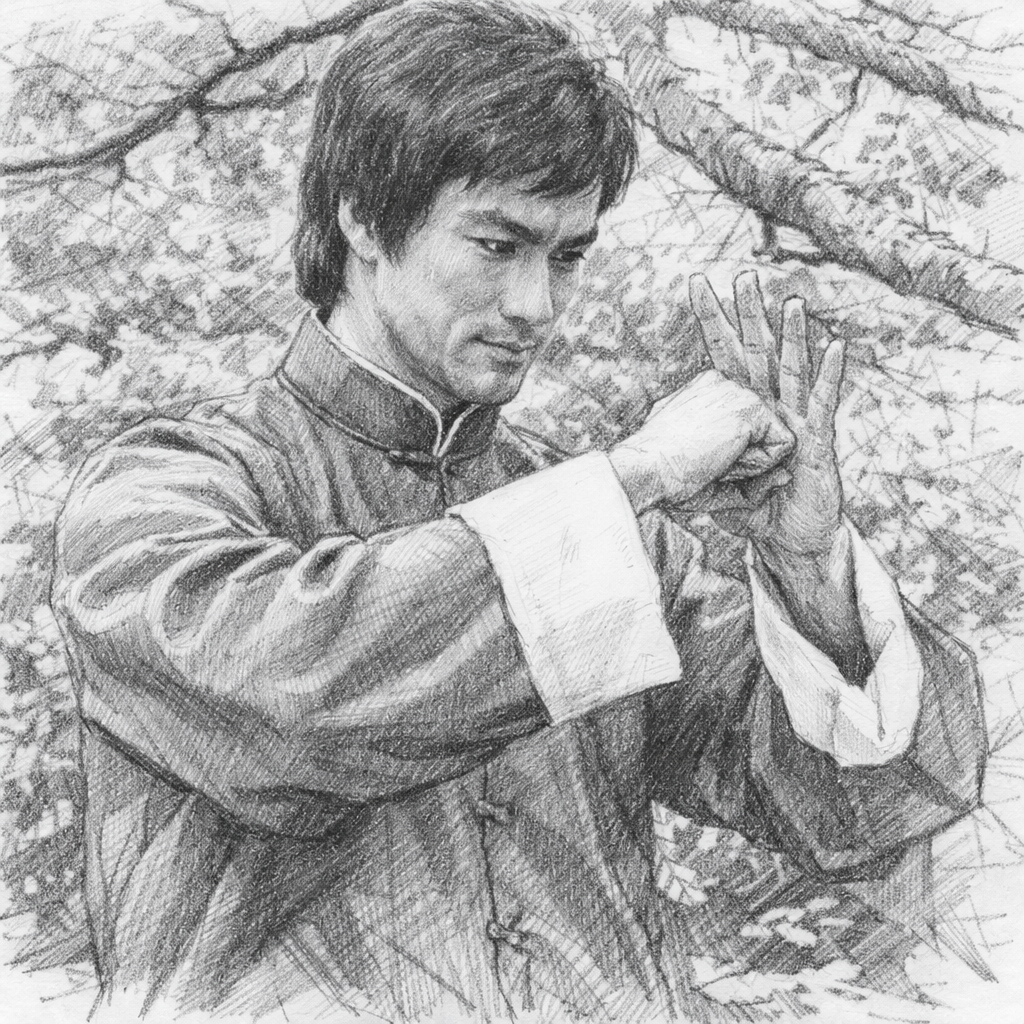
Often called the “sun and moon” salute, it’s a traditional greeting in Chinese martial arts circles. It’s the same one you see Bruce Lee do to his student at the start of Enter the Dragon. But like most things in Chinese martial arts, it has both an obvious meaning and a hidden one. Of course, you don’t need to know the hidden meaning to use it.
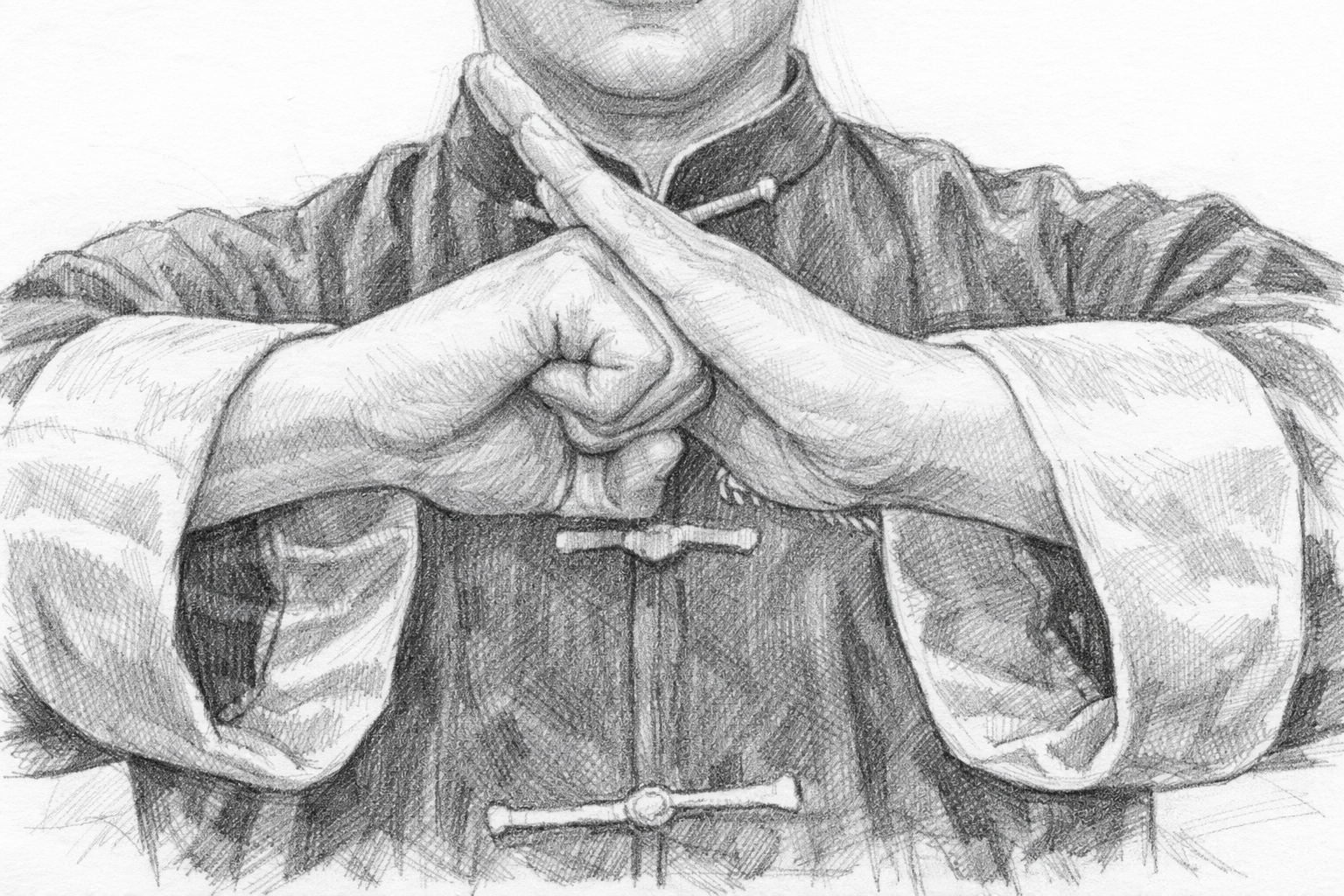
In Chinese, the salute is called bàoquán lǐ, which roughly translates as “fist-wrapping rite.” Your right hand forms a fist — the “sun” — and your left hand presses flat against it — the “moon.” You stand straight, feet together. It’s accompanied by a short, respectful nod of the head rather than a deep formal bow, while maintaining eye contact.
Sometimes the fingers are folded instead. This seems to be a softer, less formal greeting (and it’s the one I usually use). This variation is often called gōngshǒu lǐ (“cupped hands greeting”) and is traditionally gendered — the closed fist is the right fist for men and the left fist for women.
It’s worth noting that this is far from the only hand position used for greeting across China’s long history, particularly within religious traditions.
Why do it?
The bàoquán lǐ isn’t a tradition added to Chinese martial arts — it’s a remnant of a moral code that existed before they were formally named.
At a basic level, the fist represents martial skill or strength, while the palm represents civility, restraint, and wisdom. The palm covering the fist symbolizes martial power governed by virtue or, put simply: I can fight, but I choose respect and control.
When I do it at the end of class, it’s quick and almost reflexive, sometimes even a little embarrassed. I don’t expect my students to do it back. It’s a brief gesture with a clear purpose: it marks the end of the session and acts as a quiet “thank you” for the work they’ve just done.
When I do it to my kung fu teacher, it carries a different weight. My teacher (who is not Chinese) still greets his own teacher (who was Chinese) with this salute every time they meet, and that tradition was passed on to me. I still greet my teacher this way whenever I see him. Even though it isn’t part of my culture, the meaning is clear when I do it.
In that sense, I suppose I’ve passed on a “light” version of the tradition to my own students by using the salute at the end of class. Even if they don’t return it, it’s something they now recognize. The tradition has softened over time, we don’t use it to greet each other, and honestly, I think it would feel strange if we did.
I’d describe my teacher’s period of training with his teacher as serious, and my own training as semi-serious by comparison. People in modern Tai Chi classes aren’t devoting their lives to this with the all-or-nothing commitment that might have been expected in 1860s China. For most people, it’s a hobby. A social activity. Ideally, people leave class feeling better than when they arrived, or at least like they’ve worked hard and learned something.
Hidden meanings
As with most things in a culture that has existed continuously for thousands of years, meanings tend to come in layers.
The sun and moon are obvious representations of yin and yang, shown here as equal forces held in harmony, suggesting balance rather than dominance.
There’s also a practical dimension. A level of formality in martial arts is useful. What we’re engaging in is potentially dangerous, and maintaining respectful ritual helps reinforce that fact.
(Incidentally, that’s one reason I don’t mind bowing in Brazilian Jiu-Jitsu training too. We routinely put our training partners in potentially life-changing situations, and a moment of ritual respect is a good reminder that what we’re doing carries real consequences.)
One of my favorite hidden interpretations, though, comes from Chinese history, specifically the Ming–Qing dynasty transition.
The Ming were the last ethnically Han Chinese ruling dynasty. The Qing were Manchu invaders from the north, and they were deeply unpopular with large parts of the population. Resistance movements emerged almost immediately.
The slogan “Overthrow the Qing, restore the Ming” (反清復明, Fǎn Qīng fù Míng) became a rallying cry for secret societies and rebel groups from the fall of the Ming in 1644 well into the early 20th century.
The bàoquán lǐ salute was reportedly adopted by some of these movements as a covert signal of allegiance. The closed fist was said to represent the character for sun (日), while the open palm represented moon (月). Together, these two characters form 明 (Míng), meaning “bright” or “to illuminate,” and also the name of the fallen dynasty.
Which means that, technically speaking, every time I’ve used this greeting, I’ve been quietly expressing support for the overthrow of the Qing dynasty.
But no, my Tai Chi class isn’t secretly plotting the restoration of a long-collapsed Chinese dynasty. But I do like the idea that a small, slightly awkward gesture at the end of a community hall class carries echoes of philosophy, rebellion, and restraint. Even if most of the time, it’s really just a polite way of saying: thanks for showing up — see you next week.
When I’m teaching my Friday class one of the things I quite often say is “don’t look down” – however, like most of the short, pithy statements you hear delivered by Tai Chi teachers… it’s not really true. Rather, it depends on the context of what you’re doing. Let me explain.
Yes, generally speaking, you want to be looking at the horizon when doing Tai Chi because you want to keep your head and neck aligned with your spine. Specifically with the head and neck we are talking about the posture principle of ‘suspending the head’. However, there are times in Tai Chi, where it is perfectly acceptable to look down – particularly on moves where the direction of the application is down towards to the ground.
The reason I say “don’t look down” a lot when teaching is that people learning a Tai Chi form have a general tendency to look down (me included!). Generally as we age our posture seems to become more slumped forward, perhaps because we sit down a lot in modern life, but also because scanning the horizon for signs of danger has long since stopped being an evolutionary priority. We also use computers, phones and devices all the time, and they lead to a general posture of our heads being tilted forward slightly. This can result in people doing the whole Tai Chi form while never looking up from the ground.
Extending the qi
In Tai Chi you want to have a feeling of a slight stretch all over the exterior of the body at all times – that’s really what following the posture principles of Tai Chi gives you – things like flattening the lower back, rounding the shoulders and suspending the head. This is known as ‘extending the qi’ all over the body. When you stand in a Zhan Zhuang posture you can feel this slight stretch all over the surface of the body that the posture generates – it’s subtle, but that’s what you’re looking for.
Suspending the head is part of that extension of the qi over the head, and you can keep that extended feeling even when you glance down. What you definitely don’t want to do is break the alignment of the spine and neck, which is what typically people do when looking at their phone, or their feet:
If you want a good fix for this then I find regular Zhang Zhuang (“post standing” or “standing like a tree”) practice is a good way to remedy this and retrain your head position on a subconscious level. Master Lam has a 10-day course on the subject.
The problem with looking down is that our head is rather heavy (between 2.3 and 5kg), and when you take your neck out of alignment with your spine your body automatically compensates for the extra weight that is pulling it forward (or you’d fall) and it does that by tensing some of its posture control muscles, particularly in the middle of the body, and that can interfere with the relaxation and freedom of movement we are looking for in Tai Chi. You also aren’t creating an optimal path for sending incoming forces to the ground or for sending jin up to the head. You are also not ‘extending qi’ to the head.
If you’re going to look down then you need to do it while keeping that slight stretch up the back of the neck and over the head.
Ward-off and martial applications
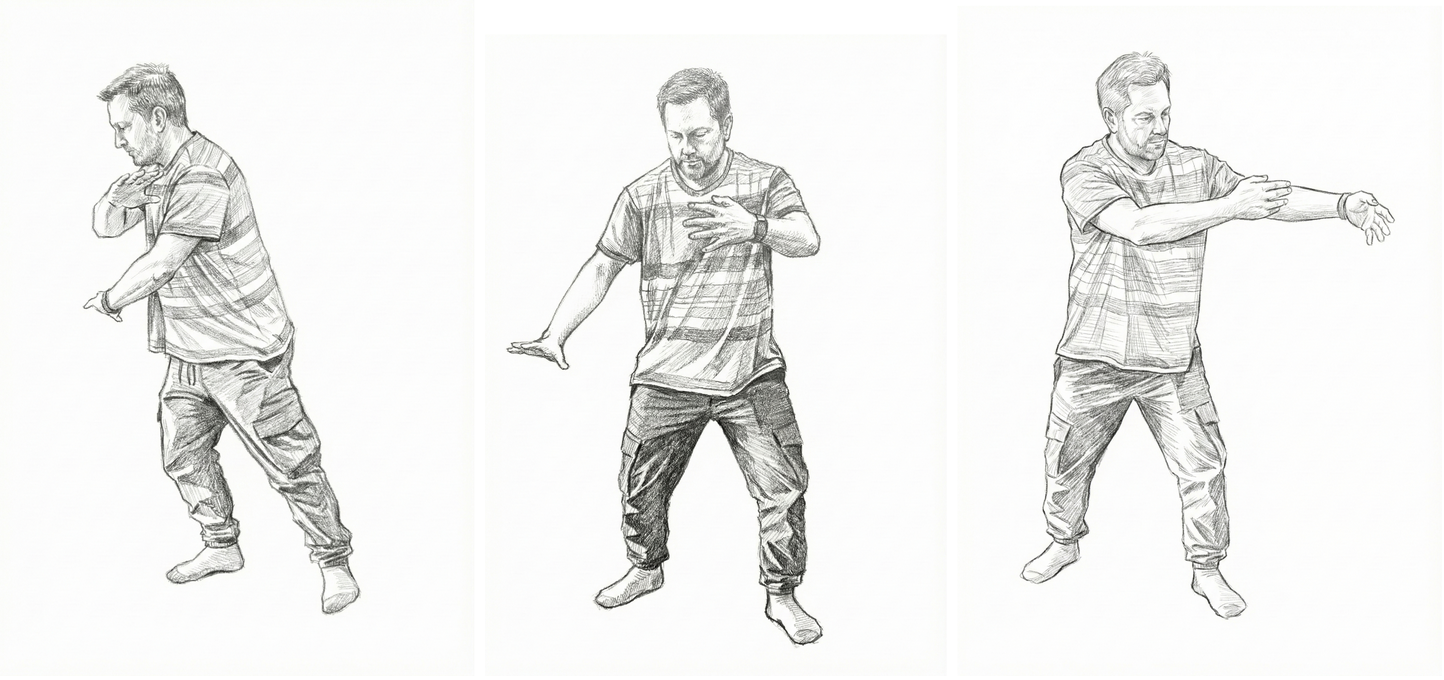
‘Ward off’ is another example of a posture where I do look down, although it’s only briefly. I look down because of the martial application I’m thinking of. My active hand in that posture is first the back hand, which I’m using to send my imaginary opponent to the floor. The front hand can then be used as a deflector, so after I’ve dispatched the first opponent to the floor, I then look up and deflect the second attack, which leads into the ‘roll back’ posture.
Here is the sequence:
In this sequence, the ‘ward off’ is the middle picture, and my focus is on my right hand pushing down from where it was in the previous picture, then in the next picture I refocus on the left hand deflecting, and getting ready to perform a ‘roll back’.
Here’s a much younger and hoplessly naive version of myself showing the marital application at around 19 seconds in this video:
As you can see, where you are looking in the Tai Chi form is dependent on what application you have in mind when doing the movement. So, while there are some useful maxims to remember in Tai Chi, such as ‘don’t look down’, it’s important that you know when it’s acceptable to bend the rules so that your Tai Chi becomes a living practice, with things done for a reason, not just blindly following the rules.
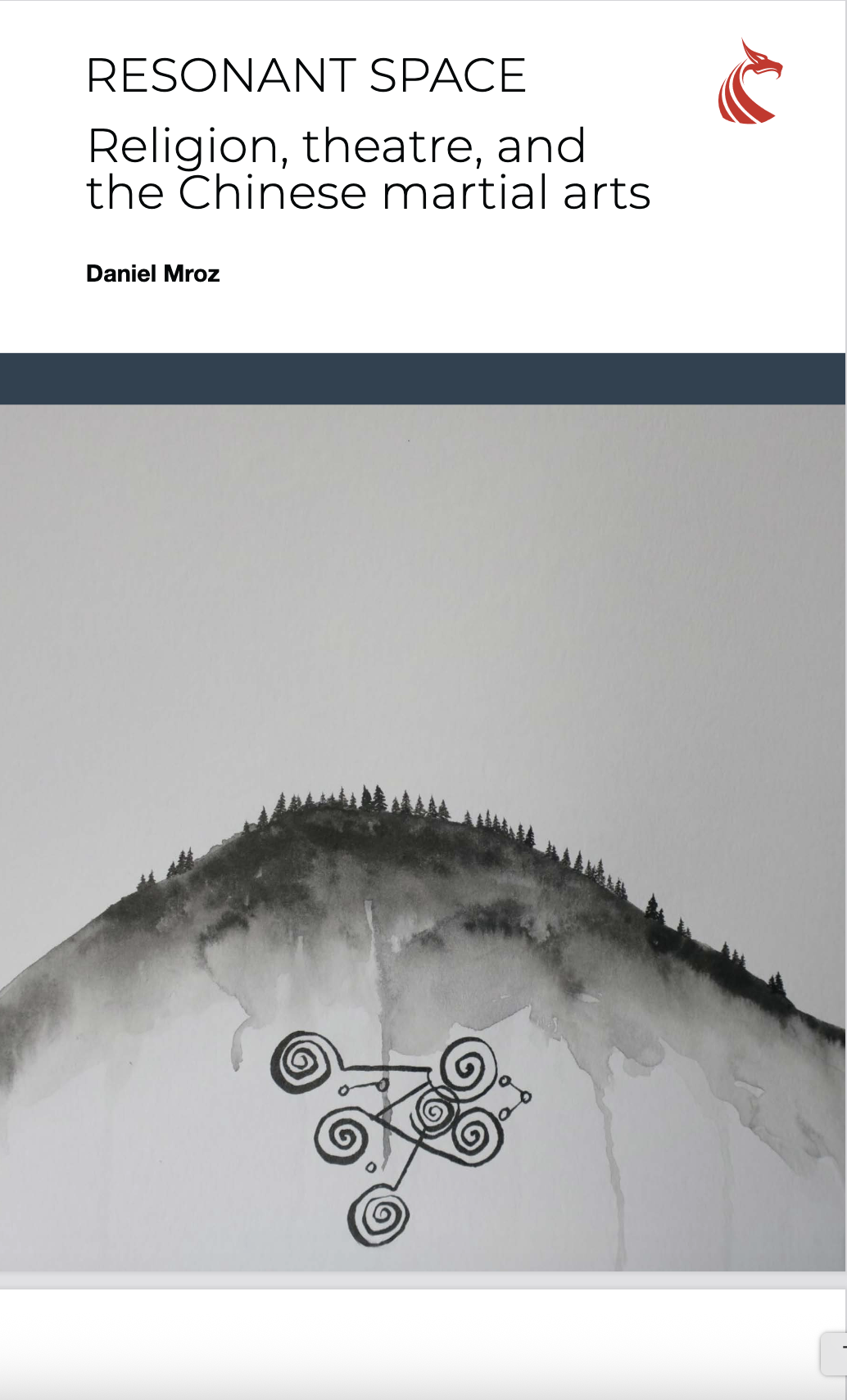
Religion, Theatre, and the Chinese Martial Arts, by Daniel Mroz
My good friend Daniel Mroz’s new book Resonant Space is out now! Daniel was the first guest on my podcast — back when I had no idea what I was doing with recording and editing audio, so it sounds pretty bad compared to my more recent efforts. However, what he talked about remains as insightful and up to date now as it did then. This book takes his ideas even further.
Here’s the blurb:
“Resonant Space constellates the martial, ritual, and theatrical elements of the Chinese martial arts with the practice of contemporary theatre and dance. This interdisciplinary approach blends the embodied experiences of the author, a lifelong student of the Chinese martial arts and a theatre director and dance dramaturg, with the study of Chinese cultural history. This is a work for scholars and practitioners of the Chinese martial arts, of contemporary dance and theatre, and for scholars of Chinese religion and cultural history.”
If you are at all interested in the intersection of Chinese martial arts, magic, theatre, military methods, violence, dance, self defence and religion, then you can’t miss this. I have read bits of this book already (it’s excellent), but I haven’t read it all yet, so I’m yet to appreciate it as a whole, and to see how he makes all the pieces fit together. I’m very excited to finally get to read the complete thing.
If you’re a practitioner of Chinese marital arts, then I can guarantee that this book will make you think. In good ways. There’s almost an embarrassment of riches packed into every page. So, rather than attempt to describe it, I thought I’d just throw three random quotes at you from the first chapter of the book, without context. Hopefully they’ll make you want to find out more.
“In the Chinese martial arts and in military strategy more generally, excellence in fighting is secondary to trickery and wisdom.”
“Perhaps the most famous failure of war magic was experienced by the Yìhéquán 義和拳 fighters of the Boxer Rebellion of 1899, who discovered they were not impervious to the bullets of Western colonial powers.”
“Given its spectacular nature and emphasis on dramatic fights, it comes as no surprise that Chinese theatre, or xìqǔ 戲曲, employs many training methods that are virtually identical to those used in martial arts.”
Again, you can read the whole book for FREE from Cardiff University Press as a PDF, or you can buy a printed copy for a reasonable price. Don’t miss this!
“An intangible and lively energy lifts the crown of the head.”
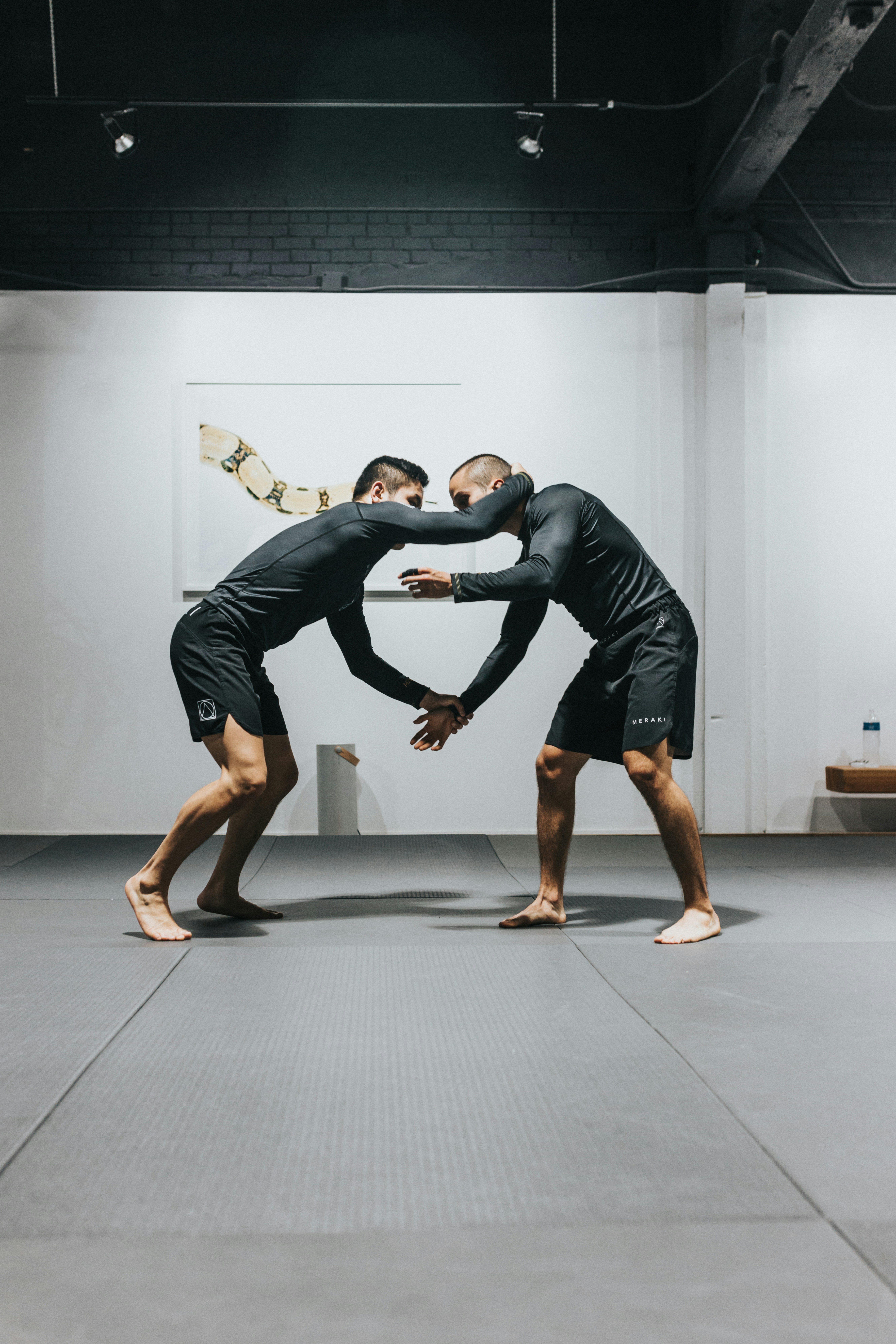
One of the things I often notice about my rolling partners in BJJ is that when they’re passing guard, they’re too easy to pick apart and attack because they let their spine bend by allowing their head to drop. As soon as this happens, I can attack their limbs easily because they’re suddenly not as strong. The spine is an integral part of the structure of our body, and when it’s not properly aligned, we’re weaker.
When we’re rolling in BJJ, and I’m in teacher mode, I’ll stop and point out when their head is down, and it’s often a kind of revelation to them. What I mean by “when their head is down” is that their head (and neck) is not in alignment with the rest of their spine. Once your head is aligned with your spine, you’re much stronger physically, without even trying. You’re also much more resistant to attacks from your partner. The game in BJJ then becomes about how you can break their spinal alignment while they try to keep theirs and break yours.
This takes you beyond the realm of just techniques and into the realm of principles. My BJJ book is certainly full of techniques, but I also tried to include a lot of text, especially in the intro pages for each section, about principles and strategy, too.
Having a background in tai chi, I think I’m more aware of spinal position than people who don’t have some sort of bodywork background before they start BJJ. In the 10 essentials by Yang Cheng-Fu as recorded by Chen Wei-Ming, it says, “An intangible and lively energy lifts the crown of the head. This refers to holding the head in vertical alignment in relationship to the body, with the spirit threaded to the top of the head. One must not use strength: using strength will stiffen the neck and inhibit the flow of qi and blood. One must have the conscious intent (yi) of an intangible, lively, and natural phenomenon. If not, then the vital energy (jingshen) will not be able to rise.”
Now there’s a lot of Chinese jargon in there that we can probably do without, and the way it’s written is not incredibly helpful. In BJJ, I usually just say “keep your head up” because that covers a multitude of sins, but what I’m really talking about is keeping your head in alignment with your spine.
If I’m teaching tai chi and I tell a student to keep their spine “vertical,” or lift “the crown of the head,” as it says in Yang Cheng-Fu’s recorded sayings, they almost immediately stiffen up straight like a soldier, holding their shoulders rigid and looking really uncomfortable. That’s not what you want in tai chi.
I think this stiffness is what Yang Cheng-Fu meant when he said in the next sentence of Chen Wei-Ming’s work: “One must not use strength: using strength will stiffen the neck and inhibit the flow of qi and blood.” A good tai chi spine is not a fixed position; it’s an alignment, and that means it’s an ever-changing position that adapts to your movement.
The general movement of your body in tai chi is always down. You are always relaxing and sinking down. That doesn’t mean you give up and slump on the floor like jelly; it means you just stop trying to hold yourself up all the time. You don’t really ‘do’ anything.
Relax the shoulders and just stand still for a bit in a wu chi posture. If you relax and allow it to happen, your head will naturally find the right spot where it sits in balance on top of your spine. The key is to stop trying to make it happen and let it happen. It wants to be there; you’ve just got to get yourself out of the way and allow it to happen. As it says in chapter 2 of the Tao Te Ching, “The sage acts by doing nothing.”
You’ll know when it feels right, and you can transfer that feeling to other situations: driving, working on a computer, and even, doing Brazilian Jiu-Jitsu.
Good news, the softback edition of my co-authored book with Seymour Yang, Brazilian Jiu-Jitsu: The Ultimate Illustrated Guidebook will be available to buy from Meerkatsu.com in a couple of weeks!
With over 260 pages and 970 hand-draw illustrations this is the perfect book for somebody wanting to start BJJ, or just for the martial artists who wants to enjoy a beautifully illustrated book that focuses heavily on technique, but also provides you with concepts, history, strategy advice and more!
The softback will be £10 cheaper than the previous hardback edition, but still feels luxurious thanks to its high-quality printing.
Something I read today was, “training material in my personal practice only includes the methods which have always consistently produced observable benefits and skills. Anything which hasn’t done so in a trial period of regular practice is eliminated and abandoned. I don’t have time for anything which doesn’t give a good return on the investment of time and effort to practice.”
That’s an interesting point of view, and seems logical and rational. It seems very in-line with modern efficiency-based exercise or martial arts thinking. I just don’t think it’s a realistic approach to studying the internal arts or qigong in any depth.
I remember talking to Simon Cox who trained for years at Wudang mountain in one of my podcasts and (I’m going by my failing memory here) he said something like his teacher asking them to do meditation for a few years, with barely minimal instructions, then just leaving them to it. Forget “a good return on investment”, you were just expected to do it, without any hope of a result.
I’ve often heard people say things like, “A year is not a long time in qigong practice”.
And from my own experience, I can say with confidence that you do need to practice without “observable benefits and skills” for a long, long time.
Most people simply stop, and therefore never get anywhere. They stay scratching the surface, thinking that they are deep into their practice.



 The Tai Chi Notebook