I often wonder what most people’s biggest fear is in Tai Chi. Or what it is that stops them trying it out? Is it looking silly? Is it the fear of other people in the class looking at you as you struggle to get the movements? That you won’t fit into the group?
Believe me, everybody feels the same. You do need some willingness to be open to new experiences if you’re going to try a Tai Chi class for the first time, but just say to yourself, what’s the worse that could happen?
You can learn Tai Chi online these days, but nobody I’ve met in real life who learned online had much of a real practice, as far as I could see anyway.
To learn Tai Chi you need somebody to point out everything you’re doing wrong, because on your own, you won’t see it. Even if you know that your knees aren’t supposed to bend inwards, and are supposed to be in line with your toes, you’ll let your knees collapse in without realising your doing it.
Often those ‘light bulb’ moments in Tai Chi occur when somebody points out what you’re doing wrong without even realising you’re doing it, and for that you need a teacher.
If you’re thinking about starting Tai Chi classes in the new year then dig deep and give it a go. You won’t be the only one who is a bit nervous, and once you realise that everybody else is just as worried as you are you can relax a bit and enjoy it. Believe me, your teacher will simply be pleased to see you. What have you got to lose?
Doing both BJJ and Tai Chi I love seeing moves from one art crop up in the other. Imagine my surprise when I happened across this BJJ seminar clip where the coach seems to be cycling unawares through a variety of Tai Chi moves.
At one point he says that one of the moves looks like “some karate bullshit that looks silly but works”, which is funny because you could describe Tai Chi like that as well 🙂
If you do Tai Chi or Bagua or pretty much any long fist style Chinese martial art, or probably Aikido, you’ll recognise these moves. I’ll give them Tai Chi names:
Breakdown
It starts with a grip break, that is similar to Hidden Hand Punch from Chen style (0.00- 4.00) The first technique from here is like Needle at Sea Bottom (4.17- 6.15) The second is like Diagonal Flying (6.15 – 9.20)
After that it becomes more traditional wrestling/judo takedowns, but it was nice to see some Tai Chi appearing fora minute there.
While the rest of the video is much more of the usual jiu-jitsu fair, the initial positions have a strong similarity to Tai Chi moves, and could definitely help Tai Chi practitioners become more aware to the martial potential of Needle at Sea Bottom and Diagonal Flying.
One of the first things I talk about when it comes to alignment is:
Head over shoulders Shoulders over hips Hips over ankles
These three are the basic alignments for standing upright at the beginning of almost all Tai Chi forms and looks something like this (ignore the arm positions):
If one of these things is out of alignment then you are leaning forward or backwards, or your posture is out of whack.
It’s easy enough to keep these three alignments in a standing stance, but things can get more complicated in movement, and when you introduce forward and back-weighted stances. At that point I try and keep the following two alignments:
Head over shoulders Shoulders over hips
The ankles can now be in different places, as reacquired by the stance.
It depends on the style of Tai Chi you do, but if you do a style that advocates a forward lean then you need to make sure that there’s a straight-ish line between your back foot and your head. If you do a style that doesn’t advocate a lean, then your back knee must be bent and you want to keep your body upright with your shoulders vertically over the top of your hips.
But the real answer is that no one style of Tai Chi only does things one way. Most styles contain some moves that lean and some that don’t. Wu style, for example:
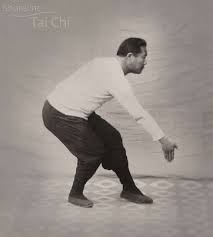
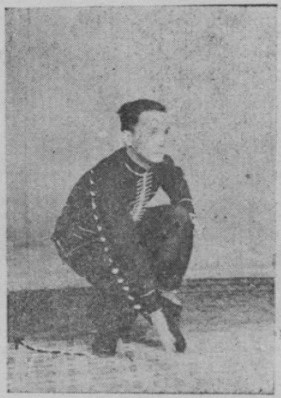
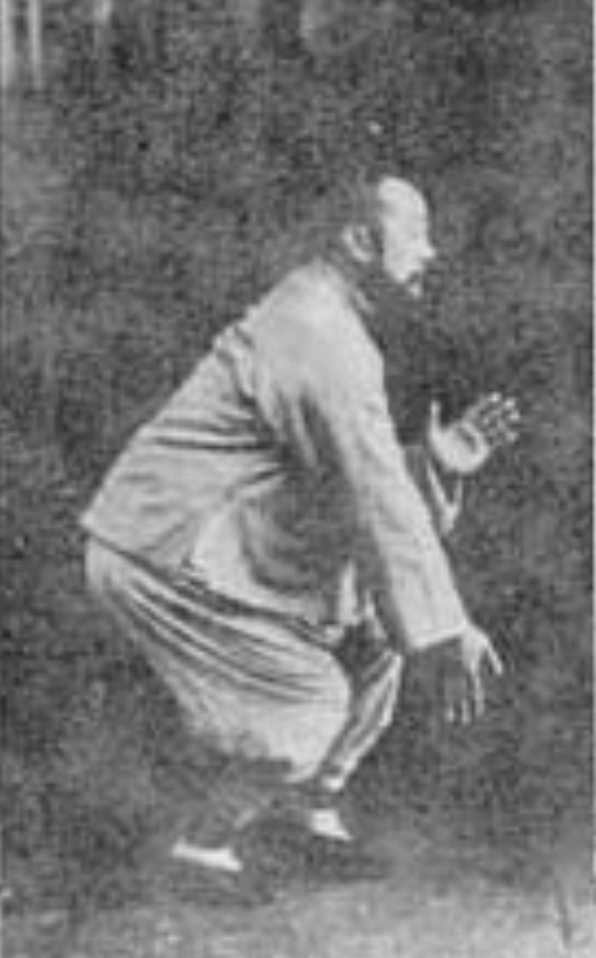
If you compare late Yang Cheng Fu to early Chen Man Ching postures, you can see that they are very similar, and are both trying to keep the head over the shoulders, over the hips:
While doing the tai chi form, take a moment to think: ‘where is my head in relation to my hips?’ You don’t want to be sticking your bottom out and destroying your alignment, which often happens in transition movements between postures:
A picture paints a thousand words, especially in Tai Chi. I recently found an incredible source of Tai Chi images drawn (I think) by Anthony of Brisbane Tai Chi.
Just scroll down the main page and look at the images – they’re great! Full of tips on alignment and posture for Tai Chi and Zhan Zhuang (standing practice).
One of Anthony’s best images for thinking about how alignment relates to the tai chi form is this one:
Anthony/Brisbane Tai Chi
I think that image very clearly shows head over shoulder over hip over ankle, and how easy it is to mess that alignment up once you start moving in Tai Chi. You basically want to keep the blocks aligned over each other.
Why?
As it says in the picture, if you align yourself correctly with gravity then your legs become the primary weight holders in the body. That means you can be more relaxed (Sung) in the upper body, so that you can use it to transfer force, instead of tensing up to hold weight that is misaligned. Plus, it just feels better.
You can think of the Tai Chi form as an exercise in claiming your space. We rarely think of the space we occupy or move around in as part of ourselves, but it is. We often let others take our space, or give it away needlessly. We move out of the way when people walk towards us in the street. Rarely do we stand our ground and own the part of the earth that is directly underneath us.
In tai chi push hands we learn to claim our space, to gently redirect people that want to come into it and also to take away other people’s space if we need to, and not let them get it back. In the tai chi form we learn to round out our movements, so that (as the classics say) there are “no hollows or projections” in tai chi. Your goal is to create a kind of sphere with your body, as if you were inside a giant beach ball. Your hands extend to the limits of the ball, and no further.
Finding your centre
In tai chi there is ‘finding your centre’ within yourself, but there is also ‘finding your centre’ when in contact with another person. When two people are in contact, especially if engaged in some form of conflict, they are rarely both in balance, usually the advantage lies with one person or the other. The one in control is usually the person who has made both people part of their ‘centre’. Viewed from above, they become the centre of the circle, around which the other person is orbiting.
In class today I was working on the ward-off posture. I think by far the best way to think about ward off, as a martial posture, is to think about having just slipped a straight punch over your right shoulder by moving your head and turning your body to your left, you then step diagonally into the space occupied by the other person, right under their armpit using the familiar ‘ward off’ posture to keep them off balance. You need to keep that full, rounded, ‘peng’ aspect to your arms here, and once you have them off balance, you never retreat or give up the ground you’ve taken. If you do then you’re simply giving them their balance back. You need to keep them off balance continually, so that they can’t recover and they end up open to strikes or to being knocked over.
That ability is one reason why, while strikes exist in Tai Chi, they’re not really emphasised in the form. Instead, in the form you’re continually learning how to take ground from the opponent and occupying it while remaining in balance. As a means of self defence, it is highly effective, but not easy to understand without feeling it, which is another reason why so many people are confused about how Tai Chi works as a martial art.
Thank you for supporting The Tai Chi Notebook. If you are reading this on a website that isn’t thetaichinotebook.com, then it’s highly likely it’s been stolen. Please let me know so I can issue their webhost a DMCA takedown notice for copyright breach. Thanks.And if you have the great idea of starting a tai chi website by stealing other people’s work to fill it with content for clicks then take a good hard look at yourself, and do better.
Tai Chi could be the secret to improving your balance and living longer.
Standing on one leg is one of those things that’s supposed to be very good for you, especially as you get older. It’s the sort of thing that you keep hearing studies about. It’s supposed to reduce falls and make you more coordinated. It’s even an indicator of when you will die. People who cannot stand on one leg for 10 seconds are found to be almost twice as likely to die within 10 years.
“When you attempt the one leg balance, your brain is performing a remarkable amount of coordination. It integrates signals coming from the fluid in your inner ears, visual cues from eyes, and even feedback from your joints and muscles. Signals from your eyes play a big role in maintaining your balance, which helps explain why standing on one leg is significantly harder when you close your eyes. If you can reach 10 seconds with your eyes closed, you’re doing well.”– Michael Mosley.
As you can see, the process of balancing is a lot more complicated than most of us realise. Of course, standing on one leg is also something that we do in Tai Chi a lot, we just don’t make a big deal about it.
Therefore, to hear that a one legged stand has all these extra health benefits is great news, since we’re doing it anyway in our Tai Chi kicks, which are often done slowly, so can take 2-3 seconds to accomplish, all of which is time spent with one leg off the ground.
(That photo, by the way, is a free image from the Unsplash website – and it’s actually very nicely done. A lot of the images on Unsplash that appear for a search on “tai chi” are so bad I can’t use them here, but that one is pretty good. Look at that nice vertical alignment from head to foot down the spine and leg. Perfect!)
I find that balancing on one leg is something that beginner students in Tai Chi really struggle with. They wobble, a lot, but I think it’s just from lack of practice, and as the article says, you can get better at it very quickly. You build new nerve connections and recalibrate your brain, simply by practicing.
As this article by fellow Bath resident and journalist, Joel Snape, explains, having good balance becomes increasingly important as you get older. He also makes the argument for Tai Chi as a great way to improve your balance, and makes the important point that the standing leg needs to be bent:
“Standing on one straight leg isn’t the same as standing on one bent leg,” says Locker, who began practising tai chi with a master who “could throw guys half his age and twice his size around the room”. “When the leg is straight, the skeleton supports the body, not the postural muscles. Older people are commonly advised to practice brushing their teeth standing on one leg to build their balance, but in order to train the postural muscles to support the lower body, you should use one bent leg.” This way, over time, you’ll build not just balance but work capacity.– Joel Snape.
So, it’s important to bend your knee (even if it’s just slightly) when standing on one leg. This is something I notice about beginners in Tai Chi. Whenever the feet come together it’s natural to want to straighten your legs, as if you were doing a Waltz. Learning to keep your feet together and your knees bent is a skill that has to be learned over time, and is much harder to do than you think. As soon as your mind wanders off, your legs will straighten. If you can get good at this, then when it comes to standing on one leg, it will be much easier to keep the standing leg slightly bent at the knee.
Thank you for supporting The Tai Chi Notebook. If you are reading this on a website that isn’t thetaichinotebook.com, then it’s highly likely it’s been stolen. Please let me know so I can issue their webhost a DMCA takedown notice for copyright breach. Thanks.
I’ve returned to teaching beginners recently and that’s left me with a problem: I need a simpler Tai Chi form to teach.
The main problem with beginners learning Tai Chi is remembering the movements. While this is all a distant memory for me, lost behind 30 years of practice, I can see that the struggle is real for them – where does this arm go? Where are my feet? What move is next?
Also, the complexity of movements is an issue. Moves involving kicks where you have to stand are a lot harder for people without any background in a sport or a martial art to do.
I also need a Tai Chi form that’s short enough that the end of it isn’t so far away as to be unattainable to beginners, but has enough content in it that there’s something of a work out going on.
So I came up with doing some modifications to the first section of our long form and running with that. Here it is:
I think this form has a good balance of everything – it’s long enough that there’s enough to learn and practice, plus the movements are relatively simple for beginners, with no complicated kicking or turning manoevers. But it’s not so long that it’s going to take months to get to the end of.
Once the form has been learned and the first 6 posture principles of Tai Chi adhered to:
…and a reasonable level of relaxation achieved, then they can work on principles, like arms following the body, not moving independently. A good way to work on this is through silk reeling exercise.
Of course, after beginners have reached a reasonable standard in this form, they can move on to the full Lam short form, which is more of a challenge. But I suspect that for a lot of people, this little form will be enough.
I also updated my Tai Chi teaching website with a new name Slouching Tiger. Check it out.
Yang Cheng Fu, grandson of the Yang style Tai Chi founder, Yang Lu Chan, is probably the most photographed of all the famous early Yang style practitioners, thanks to the publication of his 1930s books on Tai Chi that showed him performing his Tai Chi form as a series of fixed poses.
Of course, we all know that Tai Chi has no fixed positions, but if you are going to present a series of movements in a book then you either need a series of drawings or a series of photos showing poses. Film was rare and video recorders hadn’t been invented when Yang Cheng Fu published Methods of Applying Boxing (1931) and the Essence and Applications of Tai Chi (1934), which was translated into English in 2005 and published in print.
Yang Cheng Fu posing in Single Whip, from his Methods of Applying Boxing, 1931
Because of books like these we are used to seeing Yang Cheng-Fu in perfectly poised shots for the camera, which was why it was so surprising to discover this week that somebody had an ‘action shot’ of Yang Cheng-Fu taken while he was doing a form demonstration at a martial arts event.
So, full credit to the person who posted this: The photo was posted to Facebook by Wong Yuen-Ming in the Internal Arts Institute group with the message “Today I am making public one such a photo, possibly the only photo that shows Yang Chengfu demonstrating his Taijiquan in public that was shot by a photographer in action. It was taken on October 15, 1928 when Yang was demonstrating at the Chinese National Guoshu championship.” There is no name of the photographer mentioned.
It’s hard to know whether the photo is genuine, especially in the age of AI where it’s very easy to fake photos in a convincing way, but it does at least look like Yang Cheng-Fu. The posture shown also looks like Yang Cheng-Fu’s frame and style.
As for the location and date, that also checks out: The Central Goushu Institute held two events in 1928, the first in Beijing was a highly competitive lei tai tournament and the second was in Nanjing From Wikipedia: “This event came to be regarded as one of the most significant historic gatherings of Chinese martial arts masters. The tournament was presided by generals Zhang Zhijiang, Li Liejun, and Li Jinglin, who separated the 600 participants into two categories: Shaolin and Wudang.[2] After the first several days of competition, the fighting competitions had to be halted because many participants were severely injured. The final 12 contestants were not permitted to continue, with the public excuse being the fear more injury or a death. The winner was determined by a vote by the participants.”
It’s not clear which of these two events the alleged photo of Yang Cheng-Fu was taken at.
Is it genuine? I don’t know, but it’s very convincing. I initially thought he was performing in front of a mirror but the arms are not a mirror image, so there are two performers on the stage.
This is a nicely made video about Tai Chi Push Hands:
Some quick observations:
1) I quite like the emphasis on feeling where the opponent is during push hands instruction – I think this is bang on.
2) “Sensei Seth” correctly identifies very quickly that push hands competitions are very, very, similar to Sumo. And if you’re good at Sumo then you should be good at this, and indeed, he is.
3) There are some fascinating insight into the teaching process here. Seth seems to do a few things that are “wrong” according to the laws of Tai Chi, but are working (i.e. sticking his butt out and leaning forward), however, he gets corrected by the instructor to stop doing it. I just find that interesting. The “Stop cheating, it makes you win!” mentality is rife all over the Tai Chi world. It’s one of the reasons I avoid push hands with people unless the conditions are right (i.e they are the right sort of person). I much prefer the “Hey, if it works, then it works! It’s up to you to figure out what I’m doing and stop me” mentality of BJJ.
4) In the end, with competitive push hands, the better wrestler always wins the exchange (for example, when they are doing the ‘foot outside the square’ push hands). So, if you want to be good at competitive push hands then why not just learn some wrestling? You can even keep things Chinese by learning Shuai Jiao.
5) I like this coach – he’s clearly skilled, but competitive push hands is the problem here. Even this coach gets super tense when under pressure because of the need to win. I just think that Push Hands is better used as a training exercise for learning TCC skills – when it gets competitive, all the principles go out the window (unless you are very, very, very very good).
There is a phrase in Tai Chi that the whole body is a fist. I think it actually comes from Chen style, but applies to all styles of Tai Chi. Now, you can interpret that in different ways, but I think all of them are valid.
Firstly, it’s saying that it doesn’t matter what part of the body you hit with, so if you’re using Jin channeled from the ground into the target, the path it takes could go through the shoulder, or elbow, or head, for example, just as easily as it can to the fist. Tai Chi in application tends to be at close range, sometimes body to body, so limiting yourself to boxing range doesn’t make much sense.
Another way to look at it (and I think this is potentially more useful) is to think of the action of opening and closing the body as being similar to opening and closing a fist. While the concept of opening and closing the body is hard to grok, everybody is familiar with the idea of opening and closing the fist. In Tai Chi (and other ‘internal’ arts) that opening and closing is done with the whole body. While some internal arts (particularly Xin Yi) go for a open/close/ followed by a hard stop then repeat type of action, Tai Chi is particular amongst the internals in that is opens and closes in a smooth, continuous motion in a fluid series of motions. There’s never a hard stop in the form. You could say that this is defining feature of Tai Chi.
Practical training
So, let’s get to practical training. The ins and outs of how you open and close the body are to do with the 6 harmonies and silk reeling. I created a short video series years ago now, that looked at this. Watching the video is a lot easier than me trying to explain it all in text.
But here’s a training idea: do your Tai Chi form, and try and feel where the open and close movements are in the form. Even just doing the form with the mental attitude of ‘listening’ for where the body naturally opens and where is naturally closes is a practice in and of itself, that can reap rewards.
Derek frequently refers to this idea of ‘the whole body is a fist’ in the podcast and how that applies to Xin Yi. I think that it’s a good listen for Tai Chi practitioners because the idea of opening and closing the body and the 6 harmonies all come from Xin Yi – one of the oldest documented Chinese martial arts. That’s where Tai Chi gets them from.
Derek also talks a few times about another interesting idea, which is that Chinese martial arts aren’t there to teach you to fight, they’re training systems. He suggests going to learn boxing, MMA, or whatever it is that appeals to you first, to get it out of your system before you approach Chinese martial arts. Now, that’s going to be a controversial idea for a lot of my readers, but it’s also a very interesting idea that I don’t think is without merit. Have a listen and see what you think.
I’m always on the look out for interesting bio mechanical things and that search recently lead me to a character called David Weck, who is known as the ‘Head over Foot Guy’. Of course, that’s not his only idea about biomechanics- he’s got loads of them – but this video is a good introduction to his Head over Foot idea:
(It’s unfortunate that there’s a picture of the controversial social media influencer Andrew Tate in the header image for that video, because he doesn’t feature in the video. I guess they’re just using him as an example of a good walker, but while he may be a good walker, I don’t like him or his opinions, nor do I think he’s a good example for kids to follow).
The ‘head over foot’ idea can be explained very easily – if you’re going to stand on one leg, then your head has to be directly over your foot if you want your balance to be good. You can try this now, by standing on one leg and playing with where your head balances over your foot. I think he’s right – if you move your head anywhere else but over your foot then your balance starts to go.
Weck then takes this into the idea of walking, so instead of the usual description of walking that you read, which is that it’s a series of controlled falls, if you alternately put your head over your foot as you walk then you end up with a more athletic, balanced and confident walking style with a bit of swagger. You can start off over exaggerating the swagger, then work on reigning it in and making it smaller until it’s hardly noticeable.
I like it – it takes a bit of getting used to, but the alternative of trying to keep your spine neutral and upright (as we are encouraged to do in Tai Chi) ends up with a very forced, stiff, walking pattern. The alternative walking pattern of placing your foot over your head creates a kind of infinity symbol movement around the solar plexus with an alternating pattern of one side of the body shortening and the other side extending.
The idea of being upright is talked about a lot in the Tai Chi classics. For example, the Tai Chi classics say “Stand like a perfectly balanced scale” (from the Treatise) and
“The upright body must be stable and comfortable to be able to sustain an attack from any of the eight directions.” (from the ‘mental elucidation of the 13 postures’.)
But that doesn’t mean that you should look like a robot when you do it. Your body is a fluid collection of hard unbending bones connected by soft joints that allow for movement. It is designed to move in spirals, and the ‘head over foot’ idea promotes this spiral movement.
A lot, in fact, almost all, of the time in Tai Chi your weight is either on one foot or the other, or you are actually standing on one leg with the other leg kicking. So, I find that thinking about whether your head is over your foot as you do the Tai Chi form is actually a good idea. If it is then your balance will be better.
Think about the classic Tai Chi walk. We do this exercise called the Hero Stroll, which looks like this:
It’s worth doing this and thinking about the concept of keeping your head over your foot as you do it, then applying that to your Tai Chi form. Hopefully you’ll find your Tai Chi becomes more balanced, especially in the kicking movements. I find that this is where a lot of beginners have problems – they can’t balance on one leg. Well, here’s the solution!







 The Tai Chi Notebook