REVIEW: Dragon Body, Tiger Spirit: A translation and explanation of the classic texts of Xingyi Quan, by Byron Jacobs

Xing Yi is one of the oldest Chinese martial arts that is still practised today, and so naturally it has attracted a large variety of writings over the hundreds of years of its existence. These various writings can be found scattered about in different lineages and books, but now Byron Jacobs has collected them together in one weighty tome – Dragon Body, Tiger Spirit – and included not only the original Chinese texts, but also his own English translation and commentary on them.

Originally from South Africa, Byron is a student of Di Guoyong of the Hebei lineage of Xing Yi, and lives and trains in Beijing.  At one time he was a member of the technical committee of the International WuShu Federation, so he has been able to meet and talk to practitioners of other martial arts and Xing Yi lineages. He runs the Mushin Martial Culture website that offers online tuition, as well as provides excellent YouTube videos on all aspects of Chinese martial culture, history and practice.

(Full disclaimer for this review: I’ve known Byron for years, and while we’ve never met in person I’d consider him a friend. He’s been a guest on my podcast and I’ve been on his.)

The cover

Being interested in design, I always like to spend a bit of time talking about the cover of a book in my reviews, but in this case it’s not really an indulgence because discussion of the cover is properly warranted. Not only is it well designed but it contains a fully colourised reproduction of the famous black and white photo of Xing Yi masters Guo Yunshen and Che Yizhai, taken when Guo visited Che’s martial arts school. Now, since this is the only picture that can reliably be said to exist of Guo Yunshen, it has always been treasured by practitioners in the Hebei lineage of Xing Yi, of which I would count myself as one. Colourising the famous photo is an audacious and brilliant idea. The colours and shading on the faces in particular all look natural and really bring Xing Yi to life as a living breathing art practised by real people, rather than an ancient art lost to history. Did Guo Yunshen actually wear blue robes? I don’t know, but he looks great in them.

Incidentally, the photo is misleading, because the martial arts display Che and Guo are watching is definitely not Xing Yi. Che and Guo are the seated older gentlemen in the centre, watching two performers of what looks like a more Shaolin-derived art, or even a theatrical performance. The stage they are sitting on, complete with performers doing martial arts, and a painted city background behind them makes the whole thing look very much like a Chinese theatre.

What’s inside

The meat of Dragon Body, Tiger Spirit is the collection of all the classic writings on Xing Yi, including a lot of the stuff that came out during the Republican-era martial arts manual-writing craze, as well as older material. Everything is provided in original Chinese characters first, then as a translation into English and finally there is a commentary by Byron which explains what the classic is about. For me the most important classics in the Xing Yi corpus are Yue Fei’s 10 Thesis, since these are amongst the earliest writings on Xing Yi, and a lot of the other writings are based on these, but rest assured they’re included here. In fact, there’s everything you could want, including the Five Elements Poems, Cao Jiwu’s Key extracts of the 10 methods, the 12 animals poems and more. There’s also a section called “Nei Gong Four Classics”, which is a supplementary text included from the Song style lineage of Xing Yi. The classics are bookended with two different sections – the book starts with a short article about the history of Xing Yiquan, written by Jarek Szymanski, which aims to dispel some of the myths that have built up around the art, and ends with some well-researched biographies of famous Xing Yi masters written by Byron. As a practitioner of Xing Yi you’ll find these biographies useful because the names of old masters often crop up in Xing Yi discussion.

I can’t speak for the quality or accuracy of the translations themselves since I’m not a Chinese writer or speaker, however my impression through comparing Byron’s translation here to others is that Byron has used his martial arts knowledge, and specific Xing Yi knowledge to present what he thinks the real message that the classics are trying to be convey is, rather than go for a literal translation each time. This is the best way to approach martial arts texts, as often a literal translation will sound nonsensical, and  just make an English speaker scratch his or her head.

Having the actual text of the classics all gathered together in one place is an invaluable resource for any Xingyi Quan practitioner. That alone makes the book worth getting, but what really tips the balance is Byron’s commentary. He’s always clear, down-to-earth and practical. He does his best to interpret old texts that can often be esoteric and difficult to understand into something that makes sense to practitioners living in this day and age. Apparently, this book took him 10 years to complete, and you can see why. He must have spent a long time agonising over his translations and commentary before committing to a final version – nothing here seems rushed, hurried or half-baked. Everything has been carefully considered.

The casual reader, or beginner in Xing Yiquan, needs to be aware that this is not a “how to” manual – a lot of the Xing Yi classic are about things like endlessly dividing the body into sections and saying how one part works with another, which is not much use to you if you just want to learn how to do a Bengquan. They are full of things like “the eyes connect to the liver, the nose connects to the lungs” – i.e. things that aren’t that much use for practical application. There is a lot of this stuff to wade through if you are going to read the book from start to finish in full. However, having said that, Byron’s commentary on the 5 Element poems (the section of the book that deals with the Xing Yi 5 Element Fists – Pi, Beng, Zuan, Pao and Heng) is so detailed and practical that it does almost function as a bit of a How To. If you are in the process of learning Xing Yi you’ll find this section invaluable. You’ll learn where to put your elbow, fist, feet and how to move your body. And there’s a picture of Byron performing each fist, too. 

I did find myself having small differences of opinion with Byron’s commentary on occasion, but it’s always over very small details or emphasis, and it feels like nit-picking to list them all, but I think it highlights an important point, which is that translation relies on interpretation and because we come from different lineages of Xing Yi I think it’s only to be expected that we’d have slightly different ways of looking at the odd thing. And you too, dear reader, will probably have small differences too, if you are already a Xing Yi practitioner. If there weren’t small differences between lineages, then there wouldn’t be different styles of Xing Yi in the first place. 

My favourite part

For me the best part of this book is the 12 animals section. I’ve always found the 12 animals to be the most fun part of Xing Yi, and if you’re a fellow 12 animals fanatic like me then you’ll love this section. It’s also the largest section of the book, and is illustrated with pictures of the animals being described. For each animal there is a poem written by Byron’s own teacher Di Guoyong, followed by a discourse on the animal written by Xue Dian, taken from his 1929 Republican-era manual “Discourse on Xing Yi Quan” (which was written at a time when it had become popular to include aspects of Chinese philosophy and medicine in martial arts writings). Byron translates both and provides his own commentary. There’s such limited writing about Xing Yi animals available that it’s fantastic to hit such a rich vein of Xing Yi animal discussion. My experience has been that every lineage of Xing Yi has slightly different ideas about what a few of the 12 animals are, particularly “Tai” (which gets called everything from hawk to ostrich and phoenix) and “Water lizard” which gets called a turtle, an insect or a crocodile by some. The view presented here is Di Guoyong and Xue Dian’s (amongst many others), that Tai is a small hawk and Water lizard is a mythical creature being one of the 9 sons of the dragon that had a turtle’s shell.

It’s the spirits of these animals that infuse all Xing Yi practice – even if you’re doing the 5 elements or SanTi, you are still admonished to observe ‘bear shoulders’, ‘tiger head embrace’, ‘dragon body’, ‘eagle claw’, and ‘chicken leg.’ So, it’s great to see such a large section of the book, which gets its name from the dragon and the tiger, devoted to them. Di Guoyong’s poems and Byron’s commentary here are especially valuable, particularly in regard to the intent and particular features of each animal.

Should you buy?

As always with Chinese martial arts classics, these are not writings you read through once and put on the shelf, having absorbed all their insights. Instead, you need to return to them again and again over the course of your life and dip in and out. You’ll find this reinvigorates your Xing Yi practice and each time you re-read the same section you’ll discover new insights. Picking the book up and turning to any page, it’s not hard to find something to be inspired by and to get you motivated to go outside and practice.

If you are a Xing Yi practitioner then having everything here in a single book will prove invaluable to you and Byron Jacobs has done every practitioner a great service by completing his magnum opus. Even if you are a Tai Chi practitioner, I’d still say you should get this book, as many of the ideas contained in all internal arts found their first flourshings of life in Xing Yi and the Xing Yi classics. Highly recommended.

Rating: 5/5

Where to buy::

Amazon UK

Amazon US

Direct from Mushin Martial Culture

If you want to find out more about the book then I’d recommend listening to Byron’s interview about this book on Ken Gullette’s podcast

You can also buy a reproduction of the cover photograph from Byron’s Mushin Martial Culture website.

The crucial detail of using the kua and hips in Needle at Sea Bottom

There’s a lot of talk in the internal arts about the “kua”, and how using the kua (as opposed to the hip joints) is central to getting the idea of internal movement in Tai Chi.

So, what is the kua?

A definition from Crane Tiger Tai Chi reads:

Kua refers to the area that extends from the inguinal folds (front of the hip where the leg and body meet) to the crest of the pelvis. It includes the hip joints, the iliopsoas, and adductor muscles as well as the sacrum and the perineum.

I’ve written about the kua several times myself, but I think Ken Gullette’s book (my review is here) does a great job of describing it. To me, moving the kua is about opening and closing the body in the space inside the hip joints. Integrating the opening and closing of the kua into your movement facilitates power moving smoothly from the legs and feet up through the body, or receiving force in the opposite direction and directing it down towards the ground.

Moving “inside” the hip joints allows for very detailed movement and enables you to create and remove space when interacting with an opponent, which has martial application.

However, I think that the focus on the kua in internal arts often risks people ignoring the pivotal (ha!) role of the hip joints. I think the hip joints are actually more important to get right – if you focus on the kua but never think about your hip joints it’s a bit like building the walls of your house without a firm foundation.

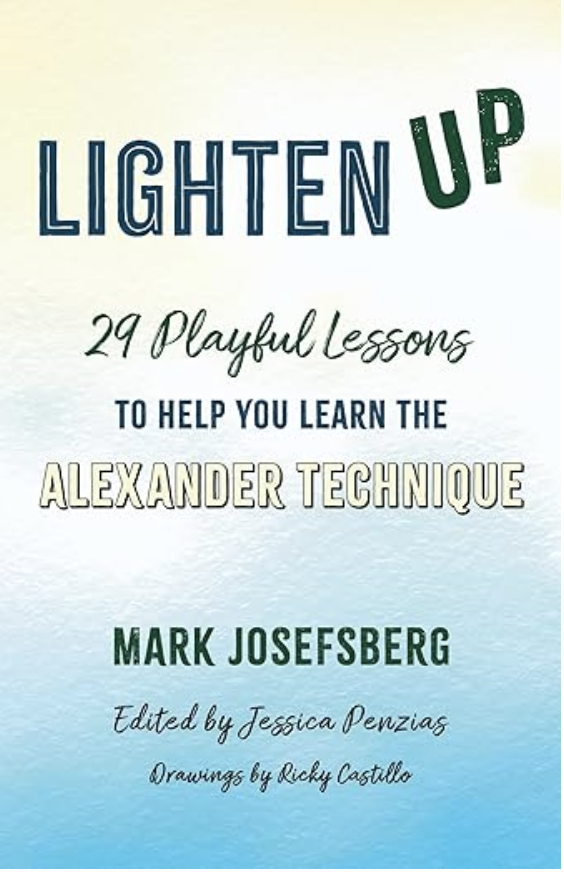
I’ve been reading a great little book called Lighten Up by Mark Josefsberg, which is a humorous description of the Alexander Technique, and only costs £2.50 for the Kindle edition.

It starts off making the great point about the pivotal (ha!) role the hip joint play in actions like sitting, standing, running, walking, bending, etc.. A good point it makes about your hip joints is that they probably aren’t where you think they are. People tend to think that you put your ‘hands on your hips’ that’s where you bend from, when in fact, your hips attach to your legs via a ball and socket joint that is much lower down.

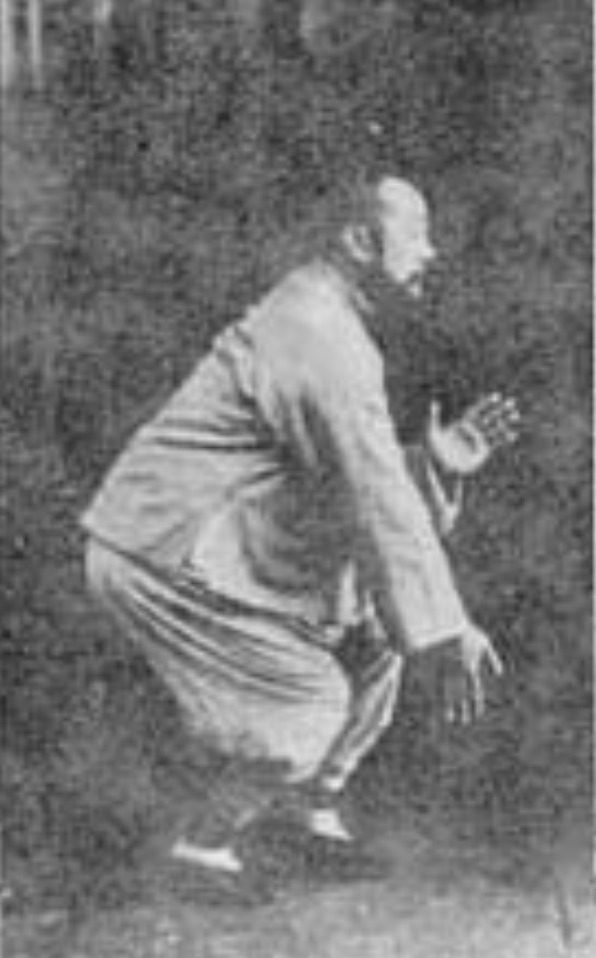
This has real consequences for Tai Chi postures such as “Needle at Sea Bottom”, where you bend forward. If you bend from too high up then you are compromising your spine, and bending from your hip joints is always a bit lower down than you think it is.

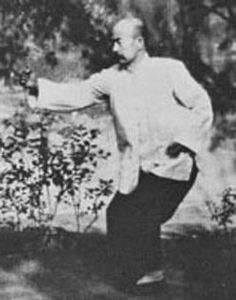
Wu Jianquan, Needle at sea bottom

The way I do Need at Sea Bottom is to try and keep my head going “up” away from the spine and bend from the hip joints (where the legs attach to the body) keeping my spine in a straight line. In theory, at least.

I don’t know who this is, but look at this guy doing it:

To me there are all sorts of problems here – he’s rounding his spine, and the head is kinked at an unnatural angle that isn’t an extension of the spine, in an effort to go too low. I’d rather not go as low as he is, and not compromise my spine like that.

The other point that Mark continually makes in the Lighten Up book I mentioned is to be aware of the AO joint – the atlanto-occipital joint. This is where the head meets the neck, and again, it’s not exactly where you think it will be. Put your fingers in your ears and imagine they are touching. Rotate the head up and down from something on a level with that point – that’s roughly where it is. What you’ll find is that you can look up and down without your fingers moving up or down because you are rotating the head around this point. Now apply that principle to Needle at Sea Bottom and you can see how your head position is meant to be.

Here’s a video of my Sifu Raymond Rand doing the movement correctly, with martial application:

Is Tai Chi really about relaxation (fangsong)?

I noticed a person on Facebook recently who was trying to make the point that the term Fangsong (放松 relax, unwind, loosen, ease, release, slacken) doesn’t appear in writings about Tai Chi until about 1930, and is therefore a modern idea that we are retrofitting to suit our modern ideas of Tai Chi being all about relaxing. That’s not his argument word for word, but that was the gist of it, anyway.

I’ve heard similar things from other people about how ‘back in the day’ Tai Chi was practiced hard, like a real marital art, until you were exhausted, and that modern training has gone soft in comparison. To those people I would point out that intensity and duration of practice have nothing to do with how you practice. Ask anybody who has practiced ‘standing still and relaxing’ for half a hour in a Zhan Zhuang posture and you’ll find out that practicing relaxing for half an hour in a stressful position is an exhausting, sweaty, business.

But to return to the original point, I would point out that even if you look at one of the oldest writings we have on Tai Chi – the handwritten manuscript of Li Yiyu from 1881 (which is available to read on Brennan Translation) you’ll find the word “relax” appears in the English translation 9 times. That’s not an insignificant amount. (I’ll leave it to the Chinese language experts to search the original Chinese).

You find it in phrases like:

I relax my power, but I do not allow it to collapse. (This has to do with “calm”.)

and

Every movement is a technique of first putting forth strength and then immediately relaxing, yet always there must be continuity from one to other, and there is never to be a departure from the four stages of “begin, develop, transmit, and finish”.

However, if you check out the even earlier 1875 text Explaining Tai Chi Principles, written by Yang BanHou, son of the famous Yang LuChan, you’ll find that he’s right – the phrase “relax” doesn’t appear, even once!

However, just look at one of the things written in the text:

“Power comes from the sinews. Strength comes from the bones. Looking at it purely physically, one who has great strength is able to carry many hundreds of pounds, but this is an externally showy action of bones and joints, a stiff strength. If on the other hand the power of your whole body is used, it may appear you are unable to lift hardly any weight at all, yet there is an internal robustness of essence and energy, and once you have achieved skill, you will seem to have something more wonderful than one who has the stiff sort of strength. Thus runs the method of physical training for self-cultivation.”

It seems pretty clear that he’s talking about relaxation being required for whole body strength.

But getting away from the nitpicking about facts (sorry!) I do think he has a point – there has been a modern re-framing of everything to do with Taoist arts as a kind of therapy for stress and dealing with the pressures of modern living that wasn’t necessarily there in the original arts – especially with Tai Chi.

Tai Chi was created in pretty stressful times, when wars were being fought, the concepts of law and order and justice were malleable depending on how important you were and life could be brutal and short. Taoism emerged at a time that was probably even more dangerous to be alive in! Frankly, I don’t think you expected to live long enough to have to worry about getting stressed! You were probably too busy trying to stay alive and earn a living. Being stressed is something of a modern disease because we live lives of relative comfort and we’ve got nothing truly life threatening to worry about on a daily basis.

The same thing has already happened to yoga.

But, I think we’ll have to live with it, because the hippies who have taken over Tai Chi Chuan do have a very good point – the first step in Tai Chi is to relax, whether you like it or not! You cannot move your body as a unit if parts of it are tense.

In Tai Chi Chuan the body is required to move as a whole unit, connected by fascia, tendons, muscles, etc, with all the joints allowed to move freely during exercise. All the joints are involved to some degree in all movement, so need to be relaxed. The ball-and-socket joints of the shoulders and hips are allowed to move freely. The gliding joints of the ankles and wrists move freely, and the hinge joints at elbows and knees are all allowed to move freely. Finally, the dantian moves freely and controls everything. Tensing the muscles around a joint separates it off from the rest of the organism, meaning that whole body movement is not possible.

And being mentally ‘tense’ is just as much of a problem as being physically tense, since the mind and the body are intimately connected.

Perhaps the emphasis in the original writings on Tai Chi was focused on more lofty philosophical principles, yes, but you will find plenty of admonitions to relax in there, and for good reason. That’s just how Tai Chi works.

The Heretical Baguazhang and Xing Yi Monkey connection

Bagua and Xing Yi are two styles that have historically been trained together. The story you usually read is that martial artists living in Beijing in the 1900s rooming together found the two styles to be complimentary and therefore a long history of cross training naturally arose between them. I think this description of history is true, however, I often wonder if the real story is that earlier in time the two styles sprang from the same source, so this period was more of a reuniting of styles than two separate styles meeting?

Xing Yi Beng Quan

We speculated about the origins of Baguazhang before in the Heretics episode I did with my teacher. That one seemed to upset a lot of people, especially those were emotionally invested in Baguazhang, but hey it’s not called the Heretics Podcast for no reason! You’re going to get an heretical view of things there, and that will always upset people. Perhaps we should have put a big disclaimer on the front! If you’re going to listen to it, we’d suggest emptying your cup first. But anyway…

If we forget historical lineage questions for a moment and just look at the arts as presented today, it’s not hard to see a connection between the two. The stepping is very similar. Xing Yi normally steps in a straight line, but once you look at the turns at the end of each line you start to see what is clearly the same sort of stepping that is used in Baguazhang’s circle walking.

I think this is a very good video by a martial artist called Paul Rogers explaining how Bagua circle walking is basically two steps – an inward turning out step bai bu (inward placing step) and kou bu (hooking step).

Notice that his student is asking him questions about why they circle walk in Baguazhang and he keeps returning to the same answer, which is “you could do it in a straight line”. The problem with doing things on a straight line is that you need a lot of space, doing it in a circle helps you make more efficient use of whatever space you have. So, it’s the steps that are important, not the circle.

Here’s a short article about the two steps and their usage in Baguazhang. Plenty of styles of Baguazhang do have straight line drills too. And when you take the circle walking away, I think the connection between Xing Yi and Baguazhang starts to become clearer, at least to me.

In the Xing Yi lineage I’ve been taught the animal that most looks like Baguazhang is the monkey. These days Xing Yi is know for short little forms (or Lian Huan: “linking sequences” -as we prefer to call them) however I believe this is a result of years and years of politically-directed reformations being applied to the rich and varied martial systems that existed before the Boxer Rebellion. After the Boxer Rebellion and the religious secret societies that fueled it, there was an effort to strip martial arts away from any religious connections. Then came the Kuo Shu movement (we’re simplifying history here, but several authors have written about this – have a look on Amazon, and this video from Will at Monkey Steals Peach will help) and then the Communists arrived with the WuShu movement. The result was that the rich and varied lineages of Xing Yi became standardised, often into short sequences that could be easily taught to large groups. In any case, the idea of set sequences doesn’t have to be the be all and end all of martial arts. Some teacher encourage students to create their own, once they have a good enough understanding off the principles.

We have an extended linking sequence for Monkey, taught to me by my teacher. Here’s a video of me doing a fragment of it, being a Xing Yi Monkey in a forest grove. My natural home :). I’ll put the full video in my Patron’s area if you want to see more of it.

But look at the steps I’m doing – can you see the bai bu and the kou bu? I think that if I added circle walking into that it would be almost indistinguishable from Baguazhang.

This begs the question, which came first? Xing Yi is historically older than Baguazhang, but I think because of the mixing of the arts, they both influenced each other at this point, and possibly are the same art to begin with!

I like to think of the best answer to the terrible question that plagues martial arts lineages of “which is oldest?” is “right now, we are all historically equidistant to the founder”.

Why you should know (at least) two different styles of Tai Chi Chuan

Back when I interviewed Michael Babin on my podcast he mentioned that in addition to Yang style he also practiced Sun style on the side. He felt he got quite a lot out of it because Sun style emphasised different things when compared to his main style.

Single whip posture by Sun Jianyun, 1957

I didn’t mention it at the time, but I also have a Tai Chi-style (1) that I do on the side, and I practice it for exactly the same reasons as Michael: I get things out of it that aren’t emphasised to the same extent in my main style.

While my Yang style uses deep, wide stances with obvious circular movement coming from the dantien, my side style has slightly higher, narrower stances and is less obviously centred around the dantien area. Both styles use whole body movement, but with the different physical emphasis there’s more headspace available to focus on other ways of achieving whole body movement – effectively making more use of opening and closing the body. I think that is also exactly how Sun style compliments Yang style, too. By practicing my side style I get to focus more exclusively on the opening and closing of the body, and I can then bring that back into my Yang style practice.

Of course, style purists will find fault with this approach. I’ve nothing against people who only practice one Tai Chi style all their life, or even practice only one martial art all their life. There’s definitely something to be said for ‘don’t fear the man who has practiced 10,000 techniques, but fear the man who has practiced one technique 10,000 times’. And, of course, any Tai Chi style should be enough, on its own, to take you to the highest levels of the art. But I think that if you only practice one style then it’s at least worth dabbling in another, just to get that new perspective on what you already do. In my experience this will make you a better Tai Chi practitioner and a more well-rounded martial artist, if for no other reason than you’ll gain experience of defending attacks from more than just one style.

When we look at well known martial arts masters of the past there’s a pervading view that they only practiced one style, or were only permitted to practice one style by their teachers, but history is full of examples of famous masters who were well known for cross training – Ku Yu Chang, Sun Lu Tang and Wang Xiangzhai, to name but 3.

In terms of biology, nature prefers diversity, if the gene pool of a species starts to become too small you get inbreeding leading to genetic defects. You can see this happen in marital arts styles that become too insular as well. They maintain their purity, but at what cost? They becoming dysfunctional.

I’m all for diversity in my martial arts training and in life.

  1. The side style of Tai Chi I practice is a UK-centric style called Li style. I’ve been doing it since the 90s and while my interest in it can wax and wane it’s been a constant for over 30 years now. The Li style form is a nice, relaxing form to do. It’s slightly controversial because you can’t find the style in China, which is an obvious red flag, but I stopped caring about that a long time ago. I do it because I enjoy it. If I didn’t enjoy it I wouldn’t do it. It doesn’t matter to me if it was “made up” in the 1950s, or not. I mean, at some point everything was “made up” anyway, right? So what matters is if you get something out of it and if you can do it following the Tai Chi principles, which in the case of Li style, you can.

    Li style essentially looks a bit like Wu (Jianquan) stye. The form starts off following (very) roughly the same pattern as Wu Jianqan style, but after White Crane Spreads Wings it splits off into its own sequence, which is nothing like any other Tai Chi style I’ve seen before. It’s a very long form, with no repeated sections, and I’ve never quite been able to get to the end of it and remember all of it satisfactorily, but I can get quite a long way through it. Here’s a video of the Li form being done.

Getting lost in words like Qi and Yi

Photo by Happy Pixels on Pexels.com

I was observing the usual argument/discussion between two people about ancient Chinese words like Yi and Qi that frequently happen in Tai Chi circles, and it was going down a familiar route..

“Don’t lecture me! I read classic Chinese and Yi means ‘idea’ and Qi means ‘movement’.”

“Really? Wang Yongquan wrote ‘To mobilize Qi, you create an empty space, by Soong and a light Yi to empty the area. The differentiation of yin and yang is what makes Qi flow.”

“Seems quiet different then…”

Confused! Photo by Oladimeji Ajegbile on Pexels.com

And on and on and on…

Recently I had a conversation with a very experienced Chinese martial artist (it will be released as a podcast soon, don’t worry) about how these things are trained in Asia vs how we do it in the West. 

He made the point that in the West we have to understand something intellectually before we will do it. i.e. we have to know we’re not wasting our time, that we will get something out of this. It has to ‘make sense’. And we usually ask loads of questions before even trying it. In contrast, in Asia, there is a lot less questioning and a lot more doing. You just do it. If you’re doing it wrong you hope your teacher will notice and put you on the right track. But generally you just keep doing it secure in the knowledge that eventually you will get it. It’s all in the feel. If you have the feel right, then you are doing it. End of story.

Nowhere is this distinction between the Eastern and Western approach more clearly represented that on discussion forums about Tai Chi that are full of Westerners. We love to argue about what these ancient concept and words like Qi, Yi and Xin really mean. As if one day we will arrive at the ultimate answer. It seems we can’t get enough of it. 

But here’s the secret: it doesn’t matter how you define these words, what concept or theory you use for their implementation, or how well you read Classical Chinese from the Ming Dynasty. What matters is – can you do it? Can you show it to me?

If I said, “Show me your Yi. Let me feel your Jin” Could you do it?

If you can then it doesn’t matter wether you define Yi as “idea”, “mind” or “intent”. I’m sure we’re all familiar with the famous phrase coined by Polish-American scientist and philosopher Alfred Korzybski, who gave a paper in 1931 about physics and mathematics in which he wrote that “the map is not the territory” and that “the word is not the thing”, encapsulating his view that an abstraction derived from something, or a reaction to it, is not the thing itself.

So, all these online arguments about Qi and Yi, are effectively pointless. They are map, not territory. However, I do think that a little intellectual understanding can be useful. Especially if it stops you asking questions long enough to just practice. Also, there’s always this temptation to think that if I can just understand something perfectly, or write it down in the perfect, most simple way, then eventually everyone will go “Yes! That’s it!”

Anyway, as I was practicing this morning a thought popped into my head which I thought felt right, so I thought I’d write down and share it:

“Yi is the direction you’re sending your mind in, and the Jin follows.”

To me, Yi is always about a direction. And it is directed. It’s the opposite of a vague, warm, fuzzy haze. It has a steadfastness and a focus. There. Did that help? Or did it just make you more confused. Answers in the comments section please. If you have your own pithy phrase to summarise a concept as subtle as Yi that works for you, then feel free to add it below.

I’ve written before about Yi in Tai Chi Chuan. So, you can have a read of that too.

Can traditional masters beat MMA?

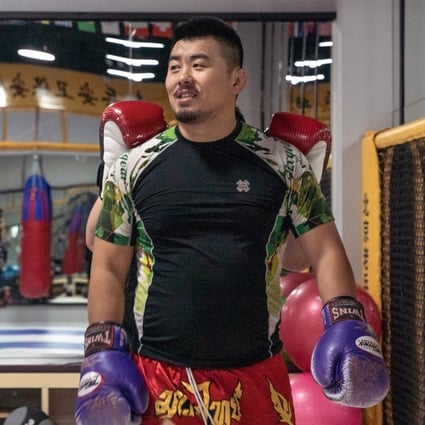
Friend of the Notebook, Byron Jacobs, who runs the Mu Shin Martial Culture Youtube channel and the Hua Jin Online Learning Program for Xing Yi and Baguazhang, just posted this monologue about Xu Xiaodong and the challenge matches that happened between him and various (self proclaimed) Chinese martial arts masters.

Now we’re a few months/years away from the high point of the Xu Xiaodong controversy it’s good to get a reasonable perspective on the matter from somebody who actually knows him and moves in the same martial arts circles in China.

It’s quite a long talk, but you can think of it like a podcast and listen to it while you’re doing your conditioning exercises. Wait, you are still doing those, right? 🙂

The middle of the Yuan Dynasty

We’ve recorded a new episode on our long running ‘history of Xing Yi’ series. There’s no actual Xing Yi in this episode – it’s more about a period of Chinese history that little is written about – the middle to end of the Yuan dynasty.

Horse and Groom, handscroll after Li Gonglin by Zhao Yong, China, Yuan dynasty, 1347, Freer Gallery

In the middle to late part of the Yuan Dynasty the former Confucian ruling class came back with a vengeance and started a downward spiral that would ultimately lead to the fall of the dynasty. In this episode we examine how and why this happened, which will set the context for the important events at the end of the dynasty in the next episode.

If you like Chinese history, then you’ll enjoy it.

#71 Xing Yi (part 13) The Water Chestnut Mirror

This episode explores the connection between the martial arts of the great Song generals’ tradition and Chinese theatre, which emerged during the height of the Yuan Dynasty.

Xing Yi Part 13, The Water Chestnut Mirror

I would also recommend this short, funny and smart crash course on Chinese Theatre as background ‘reading’:

A lot of the “x number of shoes, y number of hairdos” regulatory stuff was added later by the Confucians from the Ming onwards. In the Yuan it was much more Vale Tudo in spirit 🙂

To see some Yuan Dynasty plays we talk about in action I’d recommend this page, which also gives some more background on Yuan Zaju plays.

A mural from a temple in the Shanxi province, dated 1324. It shows zaju actors and musicians. Image source: The Archives of Finland–China Society.

Is Xing Yi a nature-based martial art any longer?

I quite often see this written in Xing Yi discussions:

“The animals are just variations of the five elements”.

I should probably just let it go, but I can’t. This idea that Xing Yi’s 12 animals are just variations of the 5 element fists has become so ubiquitous now that it’s almost impossible to counteract. And, of course, it’s true in a very basic sense, but it’s far from the whole story of Xing Yi, and it creates a misleading impression of what the art really is. It’s also buying into the whole reductionist movement in Chinese martial arts that happened in the 20th century, performed by both the Republic of 1912 and the Communist state of 1949, when these rich, smokey, traditions turned into somewhat culturally bland, ideologically driven, if athletically more challenging, versions of themselves.

[Photo by Amiya Nanda on Pexels.com]

If you look at a sample movement from the Xing Yi animals, like say Tiger, (firstly there’s the problem that this animal has been reduced to but a single movement in most lineages of Xing Yi, but let’s ignore that for now), you’ll see that it consists of a kind of aggressive double-palm push, or strike, to the chest, repeated over and over. The way the push is done is clearly related to Pi Quan (Splitting) from the 5 element fists, which also uses a palm to strike, so I can see why this generative view of the relation between elements and animals is so popular.

Take the wood element – Beng (often called crushing fist). It’s a straight strike, like a spear thrust, usually to the body using a strong opening and closing action. Again, it pops up all over the animals: For example, you could look at the double fist strike seen in Tai Xing – another of the 12 animals, and say that it’s a variation of Beng using both fists with a particular fist shape. (You can extend the knuckle of the middle finger in Tai).

Viewed like this it does start to look like the elements came first, but what I believe really happened in the historical development of Xing Yi was that somebody (one of the Dai family or Li Luoneng, who learned from them, are the most obvious candidates) created the 5 elements out of the pre-existing animal movements as a way to teach beginners.

(Historically we can say animals came first with some certainty, since an older lineage known as Xin Yi Liu He has the animals, but not the 5 elements).

Most of the animals in Xing Yi and Xin Yi have a kind of downward cutting Pi action, just expressed in different ways. By identifying it and using it as one of the 5 elements, and practicing it in isolation away from the complexity of the animals you have a way ‘in’ to Xing Yi, so it’s quite useful. You have something simple that you can practice over and over again.

So, it’s not like the elements aren’t a useful addition – they are. And you might be left wondering if it really matters which way you view the relationship between Xing Yi’s animals and elements?

Our podcast on the history of Xing Yi has been gently making the case that Xing Yi grew out of the ideas contained in the Li movement in the Song Dynasty, which was a turning back to nature and the natural way of things. Xing Yi as I generally see it being practiced today isn’t a nature-focused martial art anymore. That time has gone, and the focus on nature was stripped out a long time ago, from the start of the 20th century onward. It’s an understatement to say that in nationalist and communist ideologies, taking inspiration from nature and the natural world is not a popular idea. The concept of an animal-based martial art didn’t really fit in a China where people could live or die based on their belief in abstract political ideas. These things were understandably more ‘real’ to the average person than the natural world around them. So, the martial arts were changed accordingly.

That leads on to the obvious question – if you aren’t practicing a nature-based martial art anymore then what’s the point of fussing about the place of animals within it?

I think that’s for the individual practitioner to answer for themselves, but I’ll just leave you with this thought – nature-based martial arts are, or should be, reality-based martial arts. They should be grounded in the way the real world actually functions, and not in the world of concepts about the way we think the real world should be. The modern trend in China for (self proclaimed) Chinese martial arts masters to take on challengers trained in fight sports and get a good pasting can be seen as an example of what happens when ideology hits the nature of reality.

Quite often it hits back.