Just watched a great clip of 1980s Wushu in China – featuring Sun Jianyun, Sun Lu Tang’s daughter performing Bagua. But there’s also some clips of Tai Chi and some kids doing Northern Shaolin (at least I think it’s Northern Shaolin). Well worth a watch. The martial arts are on their way to being the heavily performance-based WuShu we have today, but are not quite there yet, with martial technique still a priority.
Baguazhang
New podcast! Ep 35: Baguazhang misconceptions with Edward Hines
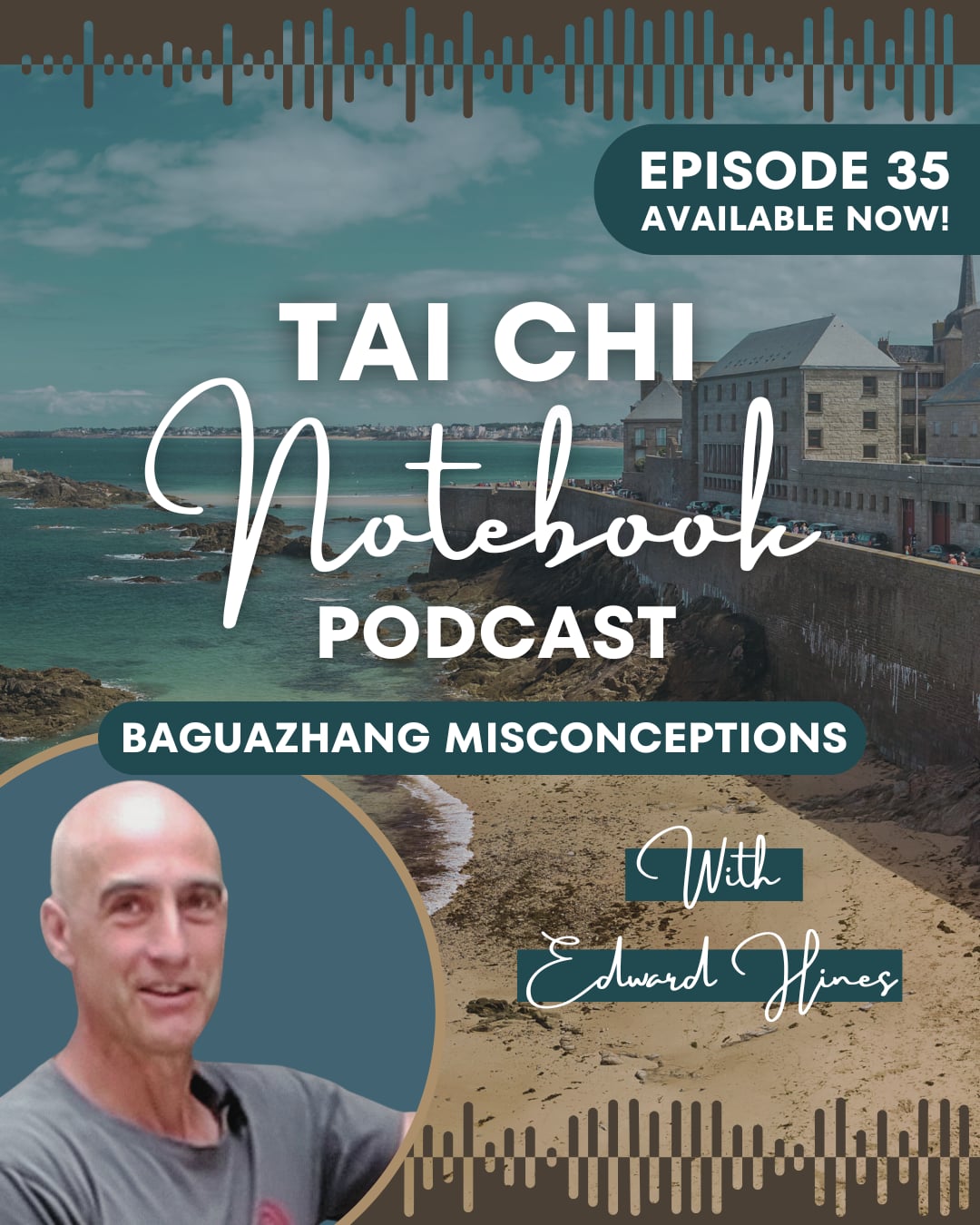
My guest for episode 35 of the Tai Chi Notebook podcast is Edward Hines, a long time Baguazhang student of Lou Dexiu. Ed started training Bagua in Taiwan way back in 1991, and has continued ever since. He now teaches online at I-bagua.com and has books about Baguazhang you can find on Amazon.
To frame our chat we decided to cast around for the most common misconceptions you hear about Baguazhang, and address each of them, one at a time.
Links:
How to do takedowns and throws, in Tai Chi, Xing Yi, Baguazhang or any martial art
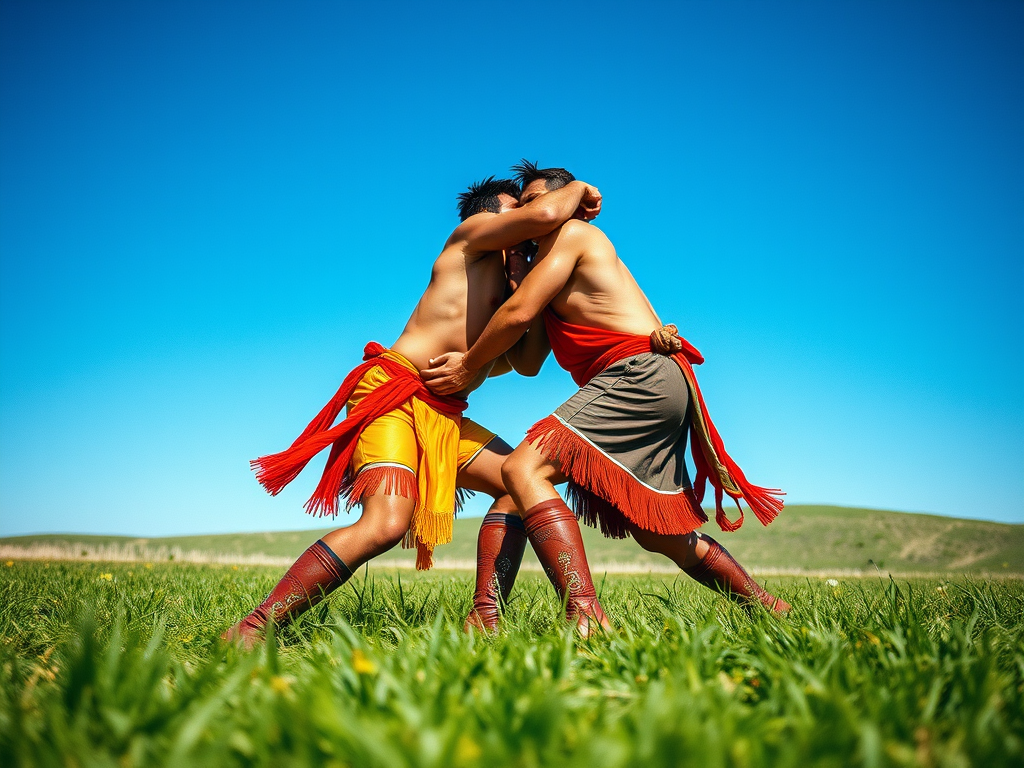
I came across an interesting video by Ed Hines of i-Bagua.com recently that discussed some general principles of throws and takedowns. There is some good information here, especially about dead angles, and base. Have a watch:
Of course, in my ear I can hear my BJJ friend saying it’s all nonsense, “why not just do wrestling?”, or “he’s doing zero hand fighting!”. My friend tends to think that everything you can know, or ever want to know, about throwing and standup grappling is already inside wrestling.
He probably has a point, and a lot of the clever ‘internal’ things that Tai Chi teachers demonstrate are really just found in wrestling basics, or are obvious if you do wrestling. But here’s the thing – not everybody wants to do wrestling or even can do wrestling! It’s time-intensive hard, physical work, from which you will probably get injured, and, frankly, it’s for young people, not anybody over the age of 30. Not to mention that you’ll also need to invest in a good quality BJJ mat for grappling training.
If you’re going to approach takedowns without having the time or energy required to learn wrestling, then you’re going to need a softer approach. Oh, hello internal arts.
How to defend everything
I wonder if you’ve ever seen the video “how to defend everything” by Chris Paines on YouTube? (It won’t embed, so I’ve had to link it). It’s about BJJ, not internal arts, and focused ground work, not standing, but those principles he’s expounding, I feel, are universal to all grappling, and they’ve really changed my approach to takedowns. It’s also very simple. Simple is good – simple is practical.
At 50 minutes it’s quite a long video, and some of the important points don’t happen until near the end, so I’ll give you a quick summary: In a nutshell, there are 5 parts of the human body that you need to access in at least one place to achieve a throw or takedown.
Part 1. Back of the head,
Parts 2-3. Armpits and
Parts 4-5. Back of the knees.
(back of knee area extends down to ankle, armpit area extends down to hip).
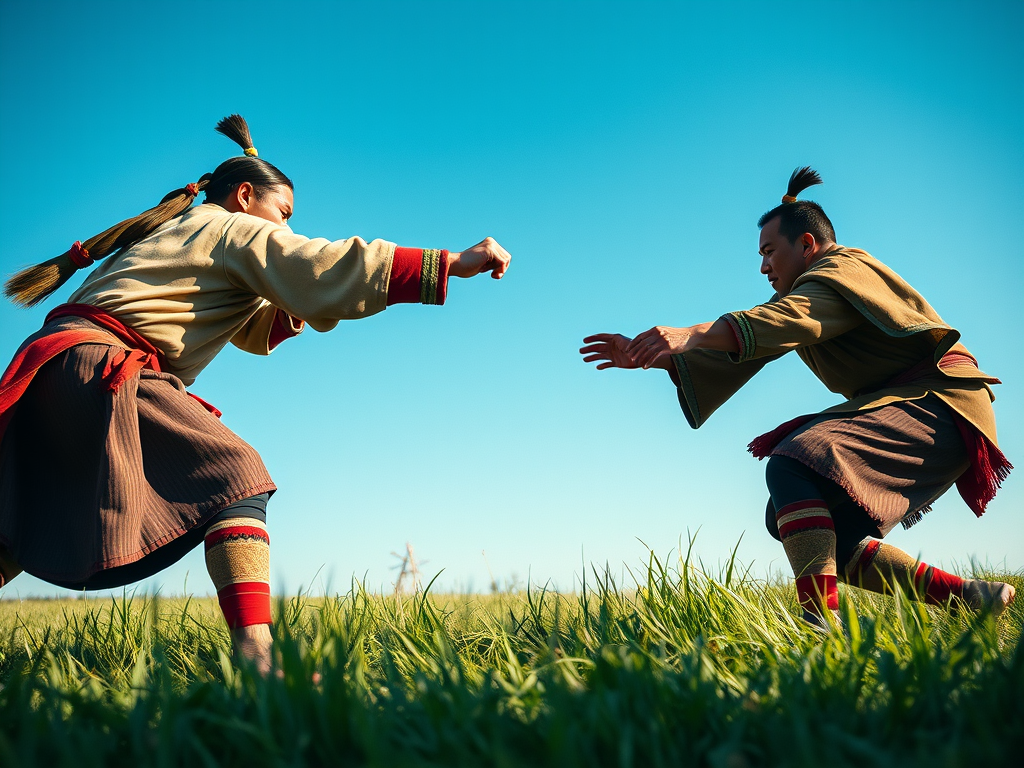
When I do takedowns I just keep looking to insert a part of my body (arm/hand/foot/head/whatever) into one of those places. I just keep spamming it as an attack. If you keep doing that then eventually you manage to ‘own’ one of those places and a takedown will sort of present itself, especially if you get more than one.
You can analyse any throw on YouTube and you’ll find that the person who did the throw got some part of their body into at least one of those places to make it happen. Now, that might mean that the model being used is too general (i.e. it covers a lot of the body!), however, I think it’s still a useful model if you want to work on defence (which people rarely do!)
If you’re doing some grappling and you get taken down, then replay what happened in your mind – you will have let your opponent into one of the 5 spaces for too long. Long enough for them to get a takedown on you. The answer to preventing the takedown then becomes about reclaiming control over those 5 points of your body, rather than trying to do some sort of pre-scripted counter to the throw.
N.B. You can look at standing on the foot as a possible exception to these rules, however… that doesn’t tend to work in a pure grappling environment, unless you also get one of the other 5 as well. Standing on a foot and striking somebody however is a different beast – it’s much more effective. It’s the same with standing wrist locks… they can work, but 9 times out of 10 they won’t – i.e. they are very low percentage, and almost certainly don’t work against experienced people. Your time is better spent trying to get one of the 5 control points. (Apologies to Aikido 🙂 )
N.B. 2 – But what about the gi or wrestling jacket? Well, think of it this way, a collar grip is simply a very effective lever to the under armpit area, so when you grip the collar, you are effectively cheating because it’s giving you easy access to their armpit area. It’s why, when we go for chokes we grip deep on the collar, under the ear, but when we go for throws we tend to grip much lower down, so that the lever to the armpit is stronger.
Anyway, some food for thought.
Open up your hips with these Bagua mobility exercises
As you age your hips definitely get less flexible. If you do BJJ as well, like I do, then the wear and tear seems to add up exponentially, which is why I’m always interested in mobility routines for the lower back and hips, and I think I’ve found one I really like.
This is Carsten Stausberg – Martial Arts, Movement & Nutrition Coaching and this is the mobility routine he recommends for students of his Bagua course.
In Carsten’s own words:
“The main goal here is to get comfortable with “uncomfortable” positions by re-searching them on a daily basis. Ideally first thing in the morning, or as a warm up to your practice. Note: A mobility sequence will not necessarily improve your mobility permanently, but is mostly useful for opening up your normal range of motion by releasing unnecessary tension. For more specific mobility issues, you need more specific and targeted practice”.
A lot of these movements remind me of Yoga for BJJ by Sebastian Brioche, which is no bad thing. I like the way the set it put together, and it makes my hips feel great afterwards. It seems to target all the right areas for me. I could see myself running through this each morning.
Have a go (N.B. consult your doctor first, you do so at your own risk, etc) and let me know how you get on!
Thank you for supporting The Tai Chi Notebook. If you are reading this on a website that isn’t thetaichinotebook.com, then it’s highly likely it’s been stolen. Please let me know so I can issue their webhost a DMCA takedown notice for copyright breach. Thanks.
Bagua Boy Documentary
Alex Kozma of Line of Internet has made his 1+ hour documentary on Paul Rogers and his son available free online. It concentrates on how Paul learned in China in the 1990s then back in the UK has trained his son from the age of 5 in Baguazhang. Definitely worth a watch.
The elbow positioning is interesting in this style of Bagua. Thanks to Mr Kozma for making this free as it’s definitely worth a watch. Check out Line of Intent’s online store for their other releases.
And here’s part 2 looking at spear and more:
NEW PODCAST Simon Cox on Zhang Sanfeng and the Wudang connection to Tai Chi
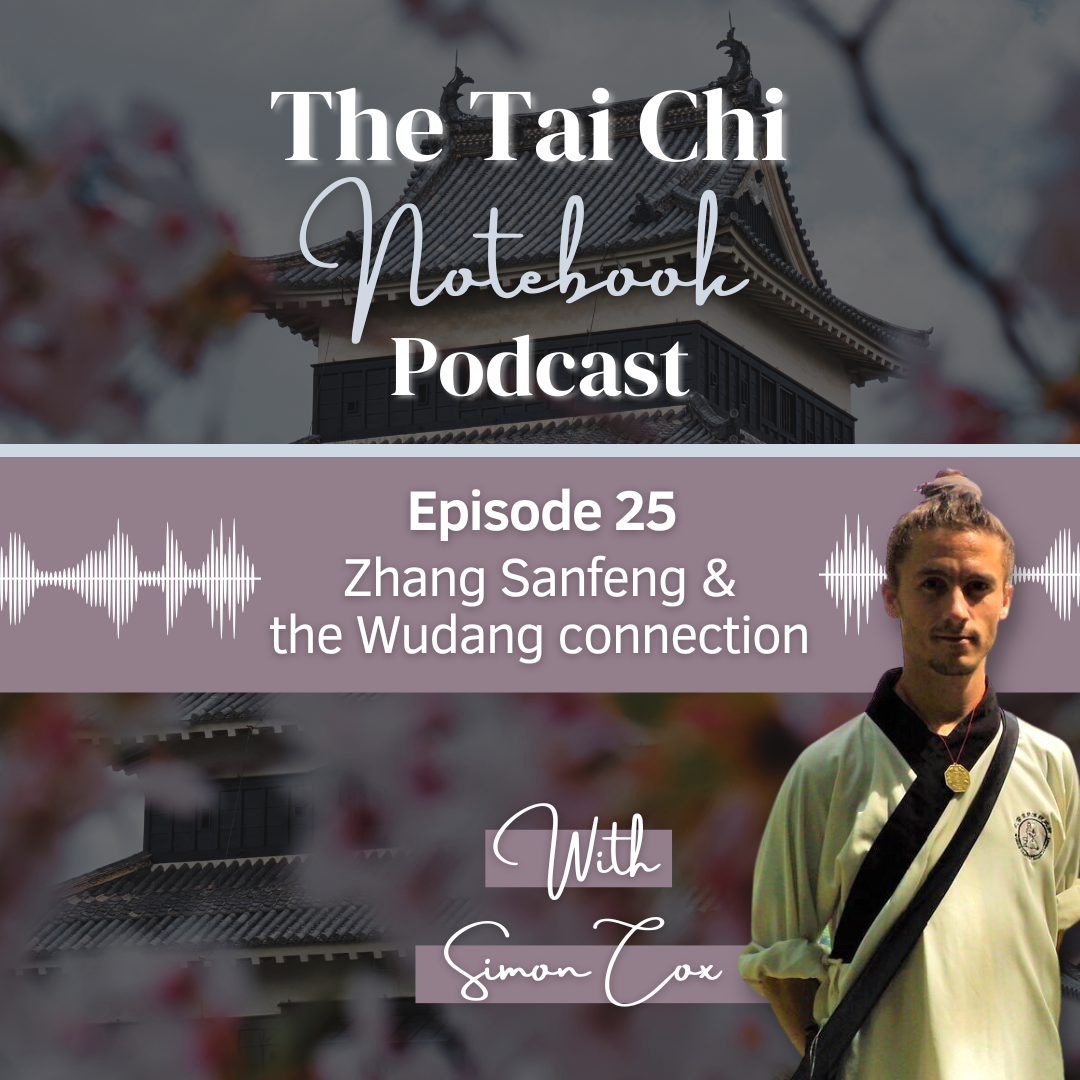
New podcast! My guest today is Simon Cox, who co runs the Okanagan Valley Wudang with his wife Brandi in Penticton, British Columbia.
Simon and Brandi spent six years living and training in China under master Yuan Xiu Gang at the Wudang Daoist Traditional Kung Fu Academy. While there they studied Kung Fu, Tai Chi, Qi Gong, meditation, herbal medicine, Daoist music, and ancient and modern Chinese language.
After returning to the West, they started a Kung Fu school and community group in Houston Texas, where Simon was working on his PhD in Chinese and Tibetan mysticism at Rice University. At the end of 2019, they moved up to the Okanagan Valley and began sharing Wudang teachings with the local community.
What I really wanted to get at with Simon was an elucidation on his article about Zhang Sanfeng – exactly who was this mysterious Taoist immortal who is often credited as the founder of Tai Chi Chuan? I also wanted to find out more about Wudang mountain, and where its martial arts really come from. I hope you enjoy are conversation!
Episode 16: Tim Cartmell on keeping it real in martial arts
My guest in this episode will need no introduction to anybody who trains in the Chinese styles of Xing Yi and Baguazhang, especially in the United States. Tim Cartmell is a lifelong martial artist who spent many years living in Asia learning the internal arts, before heading back to the US where he took up BJJ, becoming a black belt. Tim is now the head jiujitsu coach at Ace Jiujitsu Academy in Fountain Valley, California where he teaches classes and trains professional MMA fighters. https://www.acejiujitsu.com/
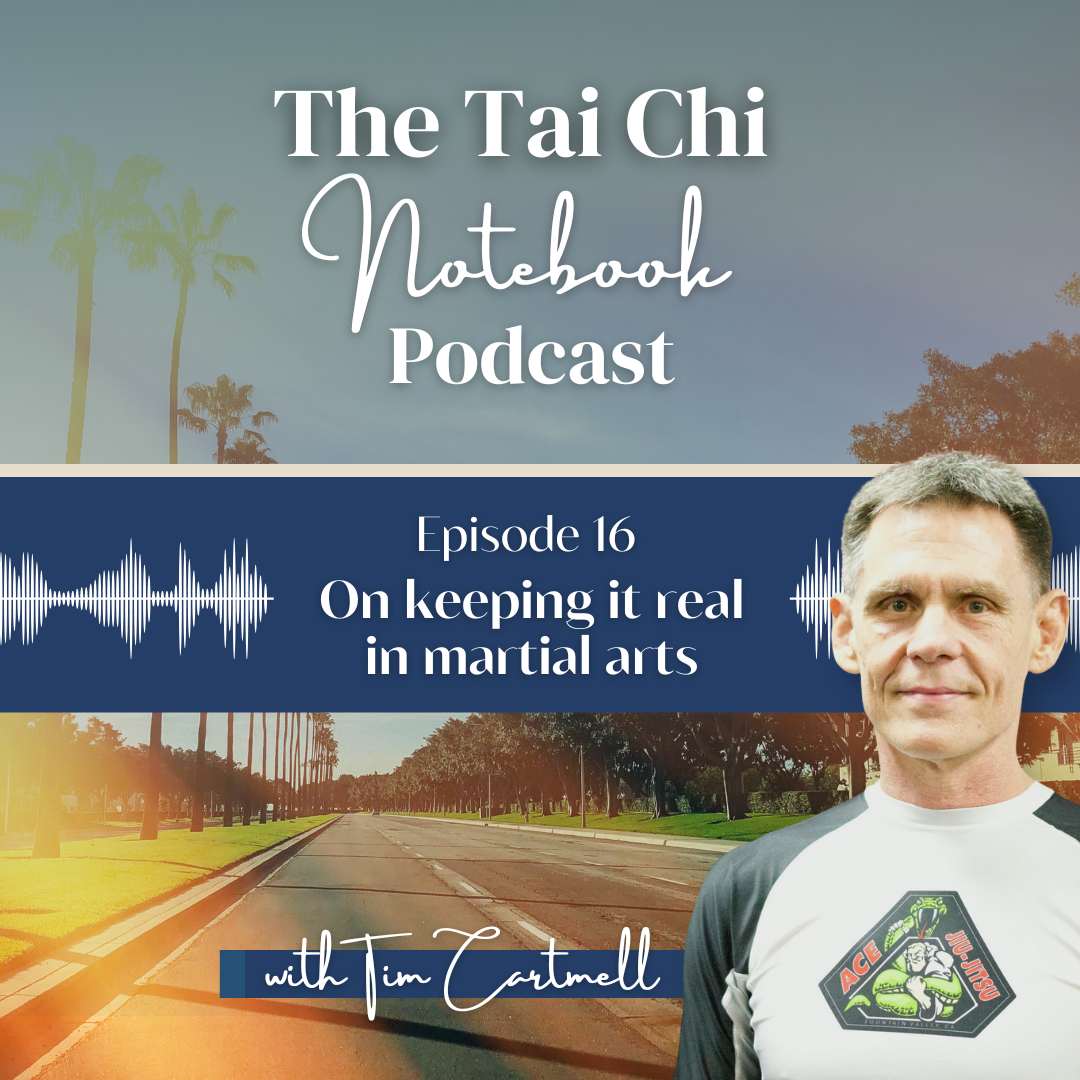
In this podcast I ask Tim about his training tips, especially for older martial artists, where he thinks martial arts is going in the future and his approach to combining all the arts he knows into a single principle-based, reality-driven approach.
You can find out more about Tim at his website www.shenwu.com and don’t forget to check out the Shen Wu Martial Arts group on Facebook.
I hadn’t talked to Tim before this interview, but many of the people I’ve had as guests on my podcast have rated him highly, and now I know why – for somebody with so much experience of martial arts Tim is a very humble and genuine guy, as I hope you’ll discover over the next hour or so.
You can support The Tai Chi Notebook Podcast by becoming a patron. Head over to www.patreon.com/taichinotebook and become a patron today! You’ll get a version of the podcast you can download, exclusive video clips and articles.
The Heretical Baguazhang and Xing Yi Monkey connection
Bagua and Xing Yi are two styles that have historically been trained together. The story you usually read is that martial artists living in Beijing in the 1900s rooming together found the two styles to be complimentary and therefore a long history of cross training naturally arose between them. I think this description of history is true, however, I often wonder if the real story is that earlier in time the two styles sprang from the same source, so this period was more of a reuniting of styles than two separate styles meeting?
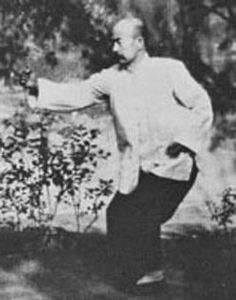
We speculated about the origins of Baguazhang before in the Heretics episode I did with my teacher. That one seemed to upset a lot of people, especially those were emotionally invested in Baguazhang, but hey it’s not called the Heretics Podcast for no reason! You’re going to get an heretical view of things there, and that will always upset people. Perhaps we should have put a big disclaimer on the front! If you’re going to listen to it, we’d suggest emptying your cup first. But anyway…
If we forget historical lineage questions for a moment and just look at the arts as presented today, it’s not hard to see a connection between the two. The stepping is very similar. Xing Yi normally steps in a straight line, but once you look at the turns at the end of each line you start to see what is clearly the same sort of stepping that is used in Baguazhang’s circle walking.
I think this is a very good video by a martial artist called Paul Rogers explaining how Bagua circle walking is basically two steps – an inward turning out step bai bu (inward placing step) and kou bu (hooking step).
Notice that his student is asking him questions about why they circle walk in Baguazhang and he keeps returning to the same answer, which is “you could do it in a straight line”. The problem with doing things on a straight line is that you need a lot of space, doing it in a circle helps you make more efficient use of whatever space you have. So, it’s the steps that are important, not the circle.
Here’s a short article about the two steps and their usage in Baguazhang. Plenty of styles of Baguazhang do have straight line drills too. And when you take the circle walking away, I think the connection between Xing Yi and Baguazhang starts to become clearer, at least to me.
In the Xing Yi lineage I’ve been taught the animal that most looks like Baguazhang is the monkey. These days Xing Yi is know for short little forms (or Lian Huan: “linking sequences” -as we prefer to call them) however I believe this is a result of years and years of politically-directed reformations being applied to the rich and varied martial systems that existed before the Boxer Rebellion. After the Boxer Rebellion and the religious secret societies that fueled it, there was an effort to strip martial arts away from any religious connections. Then came the Kuo Shu movement (we’re simplifying history here, but several authors have written about this – have a look on Amazon, and this video from Will at Monkey Steals Peach will help) and then the Communists arrived with the WuShu movement. The result was that the rich and varied lineages of Xing Yi became standardised, often into short sequences that could be easily taught to large groups. In any case, the idea of set sequences doesn’t have to be the be all and end all of martial arts. Some teacher encourage students to create their own, once they have a good enough understanding off the principles.
We have an extended linking sequence for Monkey, taught to me by my teacher. Here’s a video of me doing a fragment of it, being a Xing Yi Monkey in a forest grove. My natural home :). I’ll put the full video in my Patron’s area if you want to see more of it.
But look at the steps I’m doing – can you see the bai bu and the kou bu? I think that if I added circle walking into that it would be almost indistinguishable from Baguazhang.
This begs the question, which came first? Xing Yi is historically older than Baguazhang, but I think because of the mixing of the arts, they both influenced each other at this point, and possibly are the same art to begin with!
I like to think of the best answer to the terrible question that plagues martial arts lineages of “which is oldest?” is “right now, we are all historically equidistant to the founder”.
Podcast Episode 2: Byron Jacobs on Beijing martial arts
Episode 2 of the Tai Chi Notebook podcast is out!
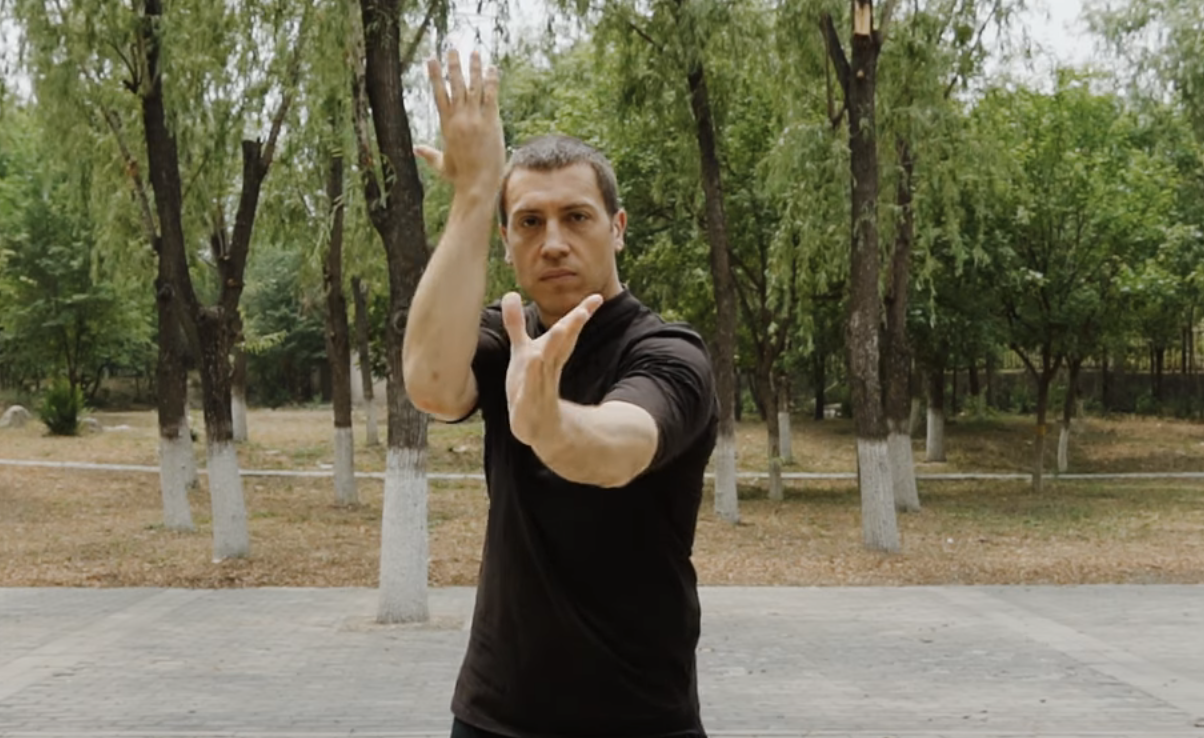
Byron Jacobs is a teacher of Xing Yi and Bagua based in Beijing, China. He’s a student of the famous Shifu Di Guoyong and is heavily involved in the martial arts scene in Beijing. As well as training traditional martial arts he’s also a BJJ practitioner and competitor.
If you’d like to be taught by Byron in the arts of Xing Yi and Bagua, then he has an online learning platform available .
In this wide ranging discussion we talk about training Xing Yi, Bagua and Tai Chi and whether Wu Shu will ever get into the Olympics. We also find out what it was like to train martial arts in Beijing during the Corona virus pandemic, and what the Chinese BJJ and MMA scene is like.
Show notes
—————
(9.45)
Byron’s Hua Jin Online learning platform
https://www.patreon.com/mushinmartialculture
(15.22)
Byron’s Mu Shin Martial Culture YouTube channel
https://www.youtube.com/channel/UCg_V6eznSvYOFz2naGlgRpg
(47.05)
DQ’d for Kicking TOO HARD? – Doctor Reacts to Olympic Karate Controversy and Knockout Science
https://www.youtube.com/watch?v=6QFxxM3QOws
(1.05.30)
Speed passing by Rafa Mendes
https://www.youtube.com/watch?v=Qu_9Lcdrh_w
(1.18.11)
Ku Yu Chang (Guruzhang’s) Yang style Taijiquan:
A STUDY OF TAIJI BOXING by Long Zixiang
https://brennantranslation.wordpress.com/2018/03/30/the-taiji-manual-of-long-zixiang/
(1.23.00)
Stand Still Be Fit by Master Lam Kam Chuen
https://www.youtube.com/user/StandStillBeFit
You can find it on all the usual places you find podcasts – search for The Tai Chi Notebook on Apple podcasts, Spotify, etc.. or here’s a link:
The Tai Chi Notebook Podcast

Thanks to the wonders of modern technology your favourite Tai Chi blog is now available in podcast form. No, not that one, I mean, my blog, The Tai Chi Notebook.
A glorious computer voice called Cassidy now reads my blog posts and publishes them as an audio podcast, so I don’t have to. I’m still playing around with the system, so I imagine it will start badly and get better 🙂
Anyway, my first episode, my review of Kent Howard’s Introduction to Baguazhang is now live as a podcast episode. Enjoy!
RSS feed if you want to subscribe.
Spotify page (available in a few days)
 The Tai Chi Notebook