We had BJJ world champion Victor Estima at our BJJ school recently for a seminar. There was a guy there who I think is trying to make a life for himself as a YouTube Vlogger (although he only appears to have 1 video on YouTube!)
Anyway, he made this video about the event and it’s very funny because he challenges Victor to a match. He’s just a white belt. Hilarity ensues…
My Facebook friend Byron Jacobs is the Technical & Events Manager and Technical Committee Member at International Wushu Federation in China. That’s a pretty high up in Chinese Martial Arts for a guy from South Africa 🙂
This is a YouTube video about him:
As you can see from the video, he’s fluent in Chinese and lives in China. He trains Xingyiquan under his Sifu, Di Guoyong.
Recently Byron appeared in an episode of the Chinese TV documentary “Da Dao Taiji” in which he was interviewed about traditional Chinese martial arts, its utility in the modern age and the problems it is facing both in the mentality of practitioners and their methods today. I don’t think they were quite expecting such a frank interview!
Unsurprisingly, it was edited quite heavily, and they only kept some of these “inconvenient truths” in the documentary.
The good news is that here on Tai Chi Notebook you can view his whole interview, complete with subtitles. It may have been too hot for Chinese TV, but nothing is too hot for you, my dear readers!
(As an interesting sidenote, the new laws in China were passed last year prohibiting people with tattoos from being shown on TV, so they had to smudge out his tattoo for the aired version of this!)
Enjoy the inconvenient truths video:
And here is the entire episode 2, as it appeared on Chinese TV:
The connections between Tai Chi and Taoism are at once obvious (the Tai Chi symbol is used extensively in Taoism) and also sketchy at best (there is no historical lineage connection).
You see a lot of Taoist priests (or at least Chinese people wearing Taoist priest robes) on Wudang mountain, which has traditionally been associated with Taoism, teaching people Tai Chi, Xing Yi and Bagua (the internal arts) in the lineage of Chang San Feng, the mythical Taoist who is traditionally associated with the origins of Tai Chi Chuan, but whose historical existence seems difficult to prove.
However, how long these modern days Taoists have been there teaching people martial arts I’m not sure. The fact that their ‘ancient’ martial arts look remarkably similar to the modern “wu shu” versions created in Beijing makes them seem highly suspect to me…
But while a direct connection between Taoism and Tai Chi may be difficult to prove, they clearly employ the similar ideas. Take for instance the idea of Wu Wei – the ever elusive “doing without doing” of Taoism.
If you take a look at the Tai Chi Classics you see that while they don’t mention the phrase “Wu Wei” itself the strategy of the art described fits it like a glove. Take the following quotes from the Treatise on Tai Chi Chuan:
It is not excessive or deficient;
it follows a bending, adheres to an extension.
When the opponent is hard and I am soft,
it is called tsou [yielding].
When I follow the opponent and he becomes backed up,
it is called nian [sticking].
If the opponent’s movement is quick,
then quickly respond;
if his movement is slow,
then follow slowly.
It seems Taoism is having something of a resurgence, as this article reveals, as a philosophy for dealing with the anxiety-inducing modern world. Even the rock star intellectual de jour, Jordan Peterson, is getting in on the act.
From Alan Watts back in the ’60s to Jordan Peterson in the modern age, the Western intellectual has had a recurring fascination with Taoist thought. Particularly with the concepts of Wu Wei and the Tao Te Ching. In fact, the book that first got me interested in Tai Chi years ago was The Tao of Pooh by Benjamin Hoff.
I think all this interest in Taoism again is generally a good thing. Let’s see where it leads.
There are things you can only work on in your Tai Chi training if you already have a certain amount of practice under your belt. Take for example the concept of continuous movement.
The original Classics say Tai Chi Chuan is “like a great river rolling on unceasingly.”
Sure, that’s easy to say, but is it easy to do?
The way Tai Chi Chuan is taught you inevitably learn the form as a series of individual movements linked together, with inevitable stops and starts. Then, after you get better at them, you can start to practice the form as one continuous flowing motion, the same way a piece of Chinese calligraphy is meant to be one continuous brush stroke (disclaimer: I known nothing about calligraphy, I’m just assuming this to be true).
In Tai Chi, the practice of learning to move so that everything is connected together smoothly at a constant rate, without speeding up or slowing down, is a skill in itself. If you can do it you still aren’t “doing Tai Chi” yet, not by a long shot, but you are learning one of the important pieces to the puzzle. Without having done enough form practice to not have to worry about what comes next, or about forgetting where you are, this skill simply cannot be developed.
Tai Chi forms are usually pretty long, so memorising an entire form, and then being able to perform it at a constant rate, without breaks or imperfections to that movement, is a significant undertaking. Add to that the fact that a lot of the body skills you need for Tai Chi are better worked on as repeated individual exercises (silk reeling exercises for example), and you find the idea of practicing a long, often difficult, form is slowly falling out of favour.
I see this a lot. The modern idea (which I think has a lot to do with influence from the ever-growing field of sports science) is that you really don’t need to practice a form at all. In fact, your time would be better spent on individual conditioning exercises.
So why do we have a Tai Chi form in the first place? That’s a good question to ask.
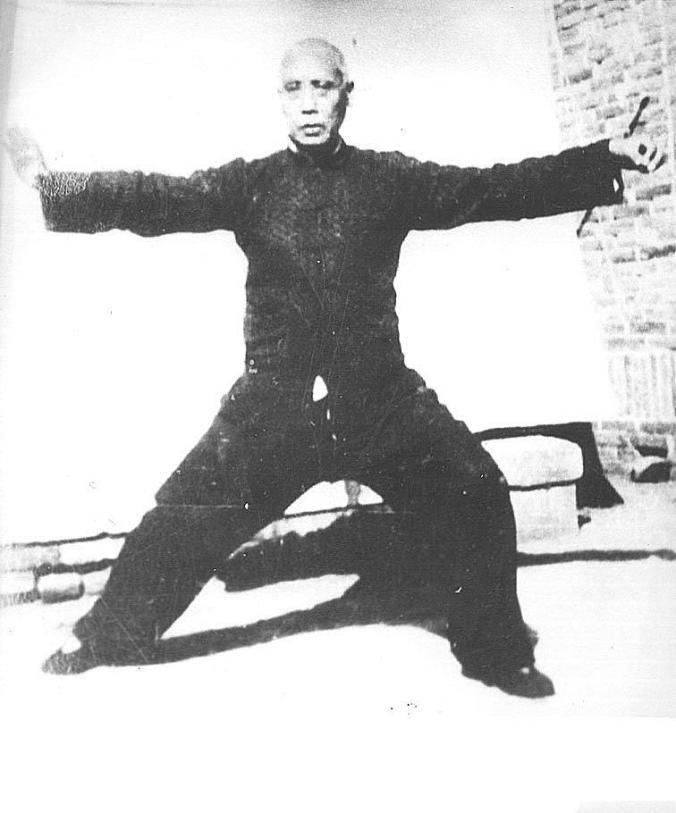
Chen Fa-Ke performing his Tai Chi form.
Why do we have a form?
The first thing to notice about the Tai Chi form is that it is designed to be performed. It has a start, a middle, and an end. This has led some people to think that its origins might lie in other performance arts, like ancient Chinese religious rituals, which were used for all sorts of reasons (banishing spirits, pacifying the ancestors, blessing the crops, etc) since these were often done as a type of performance at annual festivals, and also contained movements that were martial in nature, often done by priests carrying swords. In ancient times when war was fought using steel weapons these rituals would be performed before battles, to summon the spirits of ancient warriors to help assure a victory.
One of the leaders in this particular field of inquiry is Scott Phillips, who has written extensively about these performance aspects of Tai Chi and speculated about its origins in his book Possible Origins. Of course, others reject his theories entirely, I think mainly because none of the famous Tai Chi families, like the Chens or Yangs, share the same ideas on the origins of Tai Chi, and also because I just don’t think that people who are practicing Tai Chi as a martial art like the idea that its origins might lie in something that doesn’t feel very pugilistic in nature. Or maybe they just have an irrational fear of dance 🙂
Perhaps, the reason why we had a form in the first place, doesn’t really matter. The thing is, it’s here now, and it is still thought of as the defining thing that makes Tai Chi, Tai Chi. Just ask the average person “what is Tai Chi?” and they instantly think of “that thing that Chinese people do in the parks” while moving their hands in a mystical way.
As anyone who has learned a Tai Chi form knows, it’s as much a test of memory and determination as anything physical. So why is the form so long? I can only assume that the effort you have to expel to learn the form is part of the training. Also, as we’ve mentioned already, once the movements are under your belt you get the chance to practice something else with them and develop skills that can’t be practiced without them.
The reason why the art has the name “Tai Chi Chuan” is because it is a physical embodiment of the Yin/Yang symbol – as you go through the form your body goes from open to close to open to close and so on – from yang to yin, to yang to yin, and on and on. Rather than just going through the same movement sequence to practice this, knowing a form gives you the chance of practicing all sorts of variations on this open and close sequence. Perhaps, before you can really understand something, you have to know it inside and out and with all sorts of variations.
One thing I notice is that the majority of “martial artists” seem to have an irrational fear of the dance or entertainment roots of their arts. While we all like to believe that Kung fu originated in the Shaolin temple under the austere eye and strict tutelage of a high-ranking Zen monk, I think we all know that most of these stories are bunk now.
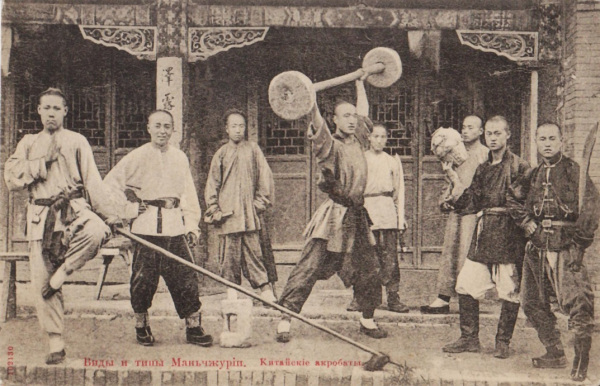
In fact, it seems that most Kung Fu masters were earning a living as street performers. It’s not as glamourous, is it? If you search back in the lineage of Wing Chun, for example, you soon end up at an Opera company – these were traveling entertainers. In Europe we’d call them a circus. A lot of other Kung Fu styles can trace their origins back to particular rituals and festivals where a martial group put on a demonstration. You still see these sorts of things today with Lion dances at festivals. They are always run by a Kung Fu school.
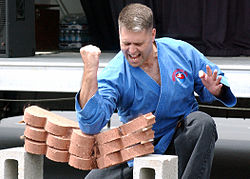
And even today, what do most martial arts groups do to attract new students? They put on a stunning demonstration, usually involving breaking something, again another form of entertainment. The martial arts lend themselves to ‘putting on a show’ so very, very easily.
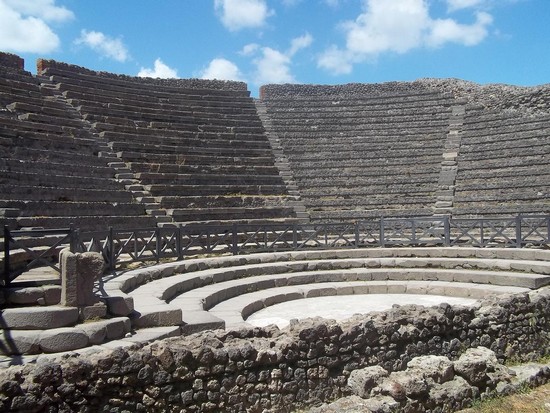
And don’t forget, these days the most popular martial arts is MMA, which is, after all, a sport done for entertaining large crowds in an arena, in a way that’s very similar to the Roman Gladiator experience.
How different is this really to the Roman amphitheater?
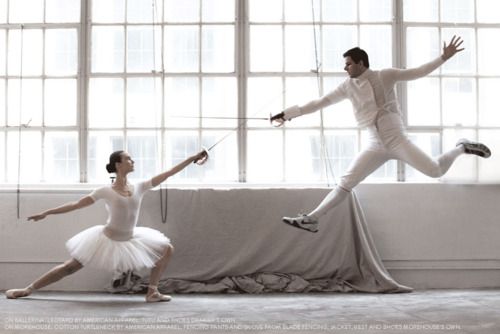
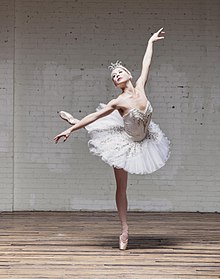
But let’s turn it around and look at Europe’s past, not its present. I’m thinking about that killer martial art known as Ballet 🙂
Our aristocracy’s preferred movement art form came out of its martial art of choice – fencing. The aristocracy was obsessed with fencing, especially to settle disputes. (Is it any wonder our leaders lead us into World War I when this was their preferred method of conflict resolution for centuries?)
But anyway, Ballet, with it’s turned out legs, has clear origins in fencing. As this video shows you:
The connection between movement arts like dance and martial arts is deep, and shouldn’t be dismissed because dance is seen as a more feminine expression these days. In 14th century France, Ballet was a very manly occupation.
Remember, Bruce Lee was a dance champion in Hong Kong 🙂 And don’t forget David Branch, a middleweight and light heavyweight champion of the world, swore by ballet classes.
“The first day I went, it was harder than any workout I’ve ever done,” Branch told wsof.com. “I feel it in my balance. I feel it in my overall physical strength. I feel it everywhere. Just in my posture and I feel like when I get into scrambles in a fight or anything fighting wise that involves entanglement and striking, I feel so strong. It’s natural strength, you know?”
At 6.28 in this BJJ promotion video from the early 1950s by Helio and Carlos Gracie, a “skinny guy” gets his girl stolen by bigger, stronger bully. But don’t worry – he signs up for jiujitsu lessons and wins her back!
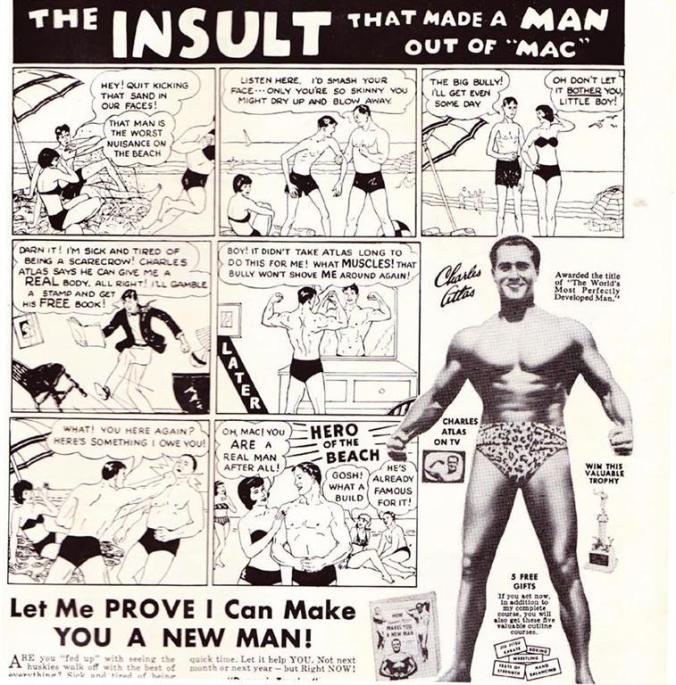
Let’s ignore the 1950’s idea of women as property and prize, which jars with modern sensibilities, and look at the marketing message. This narrative around the marketing of jiujitsu is clearly based on this classic advert for the Charles Atlas body building system “The insult that made a man out of Mac”:
Again, a skinny scrawny guy, discovers the secret information that will turn him into a strong young bull and he has the powers to repel the sand kickers (with unlawful assault this time, but let’s forget about that at for a moment – it was a different age). He goes from being called a “little boy” by his girlfriend to being a “real man”.
In both cases we can see they’ve identified the target audience as the geeks. The skinny, scrawny men who need to gain knowledge and skills to compete with their more athletic contemporaries to win the approval of women.
So many times we hear the narrative that the founder of system x,y,z of martial arts was a sickly child or young man who overcame this using the power of his martial system to defeat not only his opponents but also his own weaknesses.
Notice that in the older, more conservative, Chinese narratives, there’s very rarely a women involved, unless it is the person’s mother. Sun Lu-tang was “a small and frail seeming child… When Sun’s mother heard that he was studying Kung Fu, She at first objected, afraid that he would hurt himself. Then she saw how much healthier her formerly-sickly child looked and give her blessing to him to continue his studies. ”
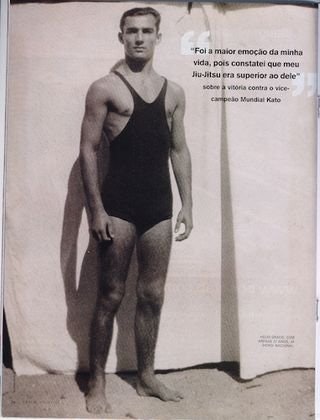
Do these stories bear much relation to reality? Sometimes, but often not. Here, for example, is a picture of the weak and sickly Helio Gracie who created Brazilian Jiujitsu by modifying the techniques of Jiujitsu to make them less physical, because he couldn’t use any strength in his techniques due to his frail condition.
There probably is a lot of truth to sickly or weak people practicing martial arts diligently to improve their health, but the narrative is so often used and so often repeated that I can’t help but think a bit of marketing has slipped in at the same time.
And what’s the modern day equivalent? I suppose that it’s become about marketing martial arts directly to women. Women today don’t need a man to protect them – they can do it themselves!
Where will it go in the next 10-20 years, I wonder? Classes for men to learn to protect themselves from women? It’s possible….
I don’t think there’s anything wrong with any of these marketing trends, but I think it’s important to see them as trends. As always with martial arts – Caveat emptor “Let the buyer beware!”.
Great video by Chen Zhaosen on putting the internal into your Taijiquan practice so that it becomes Taijiquan not Taiji Gymnastics. Of course, it should already have been there, but we all know that already, right? 🙂 The secrets are all here, hidden in plain sight. Chen Zhaosen on breathing:
I really need (do I really?) to write something about this new Cobra Kai film coming out on YouTube Red (whatever that is – I think it’s just another way of saying, er, “YouTube you have to pay for”).
Here’s the trailer:
I’m picking up unusual levels of intelligence and self-awareness here. There has been a long-running fan theory that everybody got Karate Kid wrong – that Ralph Macchio’s character, Danny, the Karate Kid himself, wasn’t the hero of the film at all – he was the villain!
Check out the fan theory here:
It’s a good example of how you can view the same events from a different perspective and come up with a different version of “the truth”.
From watching the trailer, Cobra Kai seems well aware of this fan theory and is playing on it nicely. It seems that Daniel has grown up to be a bit of an asshole, his ego has become uncontrollable from his victory, while Johnny has kept it real, but fallen on hard times, his ego deflated by the ass-kicking he received in that infamous competition.
It looks like the two are heading for an inevitable rematch, but whose side do you feel like you belong on? There are 10 episodes planned, and I really hope there’s a schmaltzy ending where a digitally reconstructed hologram of Pat Morita comes back as some sort of Jedi force-ghost and whispers “Trust your feelings! Do the Crane kick!” in Danny’s ear.
I was giving the Tao Te Ching the cursory glance I occasionally give it recently. I’ve got the copy shown above. I usually flick to a random chapter, read it three times and ponder it deeply. Well, as deeply as I am able to. I landed on chapter 61, and the next day I landed on chapter 8. These two seemed to be linked in theme, so I thought I’d say something about them.
Incidentally, I really like the Stephen Mitchell translation. I’ve no idea how accurate it is compared to the Chinese, but all translation seems to involve some interpretation, and I like the way he’s done it.
Here’s chapter 61:
61
When a country obtains great power, it becomes like the sea: all streams run downward into it. The more powerful it grows, the greater the need for humility. Humility means trusting the Tao, thus never needing to be defensive.
A great nation is like a great man: When he makes a mistake, he realizes it. Having realized it, he admits it. Having admitted it, he corrects it. He considers those who point out his faults as his most benevolent teachers. He thinks of his enemy as the shadow that he himself casts.
If a nation is centered in the Tao, if it nourishes its own people and doesn’t meddle in the affairs of others, it will be a light to all nations in the world.
and chapter 8:
8
The supreme good is like water, which nourishes all things without trying to. It is content with the low places that people disdain. Thus it is like the Tao.
In dwelling, live close to the ground. In thinking, keep to the simple. In conflict, be fair and generous. In governing, don’t try to control. In work, do what you enjoy. In family life, be completely present.
When you are content to be simply yourself and don’t compare or compete, everybody will respect you.
So, firstly let’s look at the imagery of water, one of the classic symbols of the Yin side of the Taiji diagram. Both chapters use water as a metaphor for the correct way of acting or being in the world. It’s a theme that repeats through the Tao Te Ching, and also throughout the history of Asian martial arts, even in modern times. I’m thinking of Bruce Lee in the infamous interview where he says “Be water, my friend!”
I was reading another article about Wing Chun today by Ben Judkins, which also expanded upon this idea of softness overcoming strength, and how this idea has permeated Asian martial arts:
Early reformers in martial arts like Taijiquan (Wile 1996) and Jujitsu sought to shore up their own national identities by asserting that they brought a unique form of power to the table. Rather than relying on strength, they would find victory through flexibility, technique, and cunning (all yin traits), just as the Chinese and Japanese nations would ultimately prevail through these same characteristics. It is no accident that so much of the early Asian martial arts material featured images of women, or small Asian men, overcoming much larger Western opponents with the aid of mysterious “oriental” arts. These gendered characterizations of hand combat systems were fundamentally tied to larger narratives of national competition and resistance (see Wendy Rouse’s 2015 article “Jiu-Jitsuing Uncle Sam” Pacific Historical Review, Vol. 84 No. 4, November, pp. 448-477).
but as the author notes, the situation is often muddied
Shidachi appears to have had little actual familiarity with Western wrestling. It is clear that his discussion was driven by nationalist considerations rather than detailed ethnographic observation. And there is something else that is a bit odd about all of this. While technical skill is certainly an aspect of Western wrestling, gaining physical strength and endurance is also a critical component of Judo training. Shidachi attempted to define all of this as notbeing a part of Judo. Yet a visit to the local university Judo team will reveal a group of very strong, well developed, athletes. Nor is that a recent development. I was recently looking at some photos of Judo players in the Japanese Navy at the start of WWII and any one those guys could have passed as a modern weight lifter. One suspects that the Japanese Navy noticed this as well.
But while the idea of the soft overcoming the hard has already fallen to the level of a cliché, especially when it comes to martial arts, and mixed with political ideas, should we ignore it as a way of being in the world? I’d say not. It does point to a truth.
Anyone with any familiarity in martial arts is aware of the feeling of having to ‘muscle’ a technique to make it work, as opposed to executing a clean technique based on good leverage. This points towards what I think these chapters of the Tao Te Ching are talking about.
When it comes to Tai Chi one of the hardest things to grasp about the techniques exemplified in the forms is that they shouldn’t necessarily feel powerful to you as you do them. My teacher often uses this phrase: “…if you feel it then they don’t – you want them to feel it, not you“.
If you can give up the need to control and struggle with a situation, then you can relax and access your own inner power. See what acliché that statement sounds like already? It sounds like one to me as I wrote it, but I guess all cliches were probably based on something real, otherwise, they wouldn’t be acliché.
In Chinese martial arts that sweet spot between doing and not doing (to bastardize some more Taoist terminology) is called Jin. I’ve written a bit about that before: