Although I never met him, as a fellow practitioner of “old man Jiujitsu” the loss of Anthony Bourdain hit me hard. It felt like we lost a warrior, an inspiration and friend all at the same time.
Rest in Power Anthony Bourdain (1956-2018), Renzo Gracie Blue Belt.
Xin Yi (also called Xin Yi Quan) is the oldest of the ‘internal’ martial arts, and possibly something of a precursor to Taijiquan. It was certainly the precursor to XingYi Quan.
There are numerous different regional and family styles of Xin Yi. The basic exercise used to develop the body in the Dai family version of Xin Yi is known as Squatting Monkey. Here Xin Yi practitioner Steve Chan goes through the basics of the exercise. It’s a fascinating look into the fundamentals of ‘internal’ movement.
Mike Sigman posted a video on how to use the power of the ground in your movements recently and it’s one of the best explanations I’ve seen. I’ve shared it below. It’s a simple concept to understand (but hard to do under pressure) so I think this can be applied to any martial art.
I like videos like this because they take a lot of the mystery out of Asian martial arts. Quite often you’d need to be training in a system for a number of years before you were taught these concepts, mainly due to a traditional culture of secrecy. In contrast, Mike’s approach is to start with these concepts right at the beginning of your training, so you don’t go off on the wrong track. Take a look:
In this exclusive clip of outtakes from my Tai Chi course I show how to use Peng Jin against a kick to the groin and a variety of other attacks including bribery, throwing shade and street dance. Enjoy!
To celebrate Father’s Day I’ve got my oldest son in this episode, providing a bit of feedback for me to work with. This week we look at the role of the mind in directing forces to your feet (the ground) and sending them back out
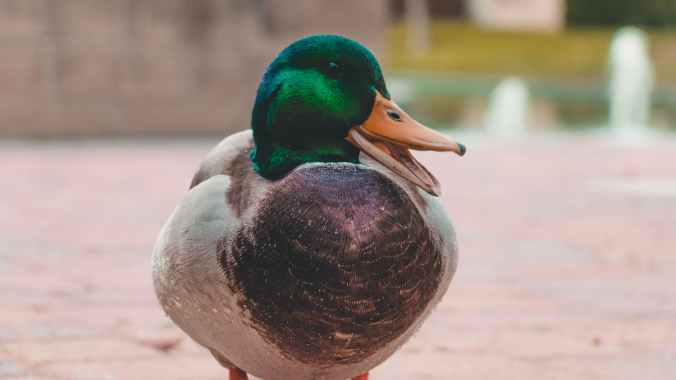
The duck test is a form of abductive reasoning, usually expressed as:
“If it looks like a duck, swims like a duck, and quacks like a duck, then it probably is a duck.”
The test implies that a person can identify an unknown subject by observing that subject’s habitual characteristics.
Ninja warrior
I was browsing through my Facebook feed recently and a friend had posted a funny martial arts video from a page called McDoLife. It came with the description:
“The most savage and terrifying form known to man!!”
In the video a western male, who doesn’t look particularly young, strong, or athletic, and is dressed up in Asian atire, introduces a martial form he’s about to perform with the immortal words (delivered in a Southern drawl, and without a hint of irony), “it’s composed of 27 of the deadliest poison hand techniques ever devised. Each one of which is guaranteed to kill, cripple, or main any attacker. It is not for the squeamish nor the weak at heart.”
Guaranteed!
Then, after a formal bow, he and a doomed student run through a frankly baffling performance of screaming, flailing arm attacks and kicks, to which his student makes no attempt to resist.
I found a copy of the same clip on YouTube here. Watch for yourself:
The man in the video is known as Ashida Kim (real name Radford Davies), who wrote several books on Ninjutsu, including Secrets of the Ninja, first published in 1981, which contains such gems as how to use a “cloak of invisibility”. It looks like the video was shot on VHS which would make it 1980s (?), probably. The YouTube title is “Kinji-Te, the Forbidden Fist of the Ninja.”
Despite there being no record of him ever have being trained by anyone (according to this Wikipedia page) Kim/Davies because famous in martial arts circles for teaching ninja skills during the ninja craze of the 1980s.
To modern eyes his videos look ridiculous. Back in the 1980s when access to quality martial arts instruction from the East was rare, and the Internet hadn’t been invented, these sort of things were common. It’s just a man flailing his way through a series of “deadly” martial arts techniques on an unresisting opponent – pretending to rake his face, rip out his throat, gouge his eyes, etc.
In the modern age of social media, we’re all used to funny videos like this popping up, and I was laughing along with the rest of the Internet, until I suddenly stopped and thought, hang on, “poison hand”… that rings a bell…
Then I watched the clip again and thought, “Hey, I know some of these moves!”. Before the video descends into a 100 move Monty Python-esque kata against a guy lying on the ground not fighting back, he was definitely doing the start of a form known as “Duck Sau” from a martial art I used to practice in my youth called “Feng Sau Kung Fu”. We pronounced it “Duck Sau”, but in written form it was presented as “Tu Shou”, which translated as “Poison hand”!
Here’s a video of the Tu Shou form being performed:
Note the similarities – after the initial bow to his student, Kim settles himself back into a riding horse stance, just like the Tu Shou performer does. His student attacks with a blow with his right hand and Kim steps back with his right leg into a back stance (known as “Duck stance” in the Li family system), raising his left hand as a deflection, and then proceeds to perform a sequence of arm attacks.
Feng Shou (“Hand of the wind”) is the kung fu section of the Li Family System of Taoist Arts taught by a figure famous in the British martial arts scene, Chee Soo (who died 1994). Since he was in Britain, and one of the few Chinese teachers openly teaching kung fu to the public during the kung fu boom of the 1970s, Chee Soo’s martial arts society became really popular in Britain in the 1970s and 1980s, before another styles of Chinese martial art could really get a foothold in the country. Of course, it’s popularity dwindled as the kung fu boom died out, and after Chee’s death his society fractured into different, smaller, groups, but they are all still teaching his system today.
Having practiced the Tu Shou form myself, I think that it’s essentially what Ashida Kim is using as the inspiration for his Kinji-Te form in the video.
Of course, it’s entirely possible that both forms are identical to an old karate, or Aikido form I don’t know, and if they are, then please tell me. The origins of Chee Soo’s martial arts are hard to prove themselves, the story being that he was taught everything by an old Chinese gentleman he met in London, who later adopted him as his nephew. However, it is documented that Chee Soo studied Judo, Aikido and Kendo and mixed with many other martial artists of the era.
But Occam’s Razor (and the use of the phrase “poison hand”) would suggest that one of these individuals probably copied the form from the other. (Another thing about the video that struck me was that the salute he does right at the start is exactly the same salute that I learned in a Feng Sau class).
The question then becomes…. who stole what from who?
Tu Shou in print.
You can read Chee Soo’s biography on the Amazon page of “Taoist Art of Feng Shou”. I think it’s pretty accurate and gives dates for various things. Of particular interest here:
“In 1973 Chee Soo and his daughter Lavinia made an appearance on BBC One’s Nationwide where they demonstrated Feng Shou Kung Fu to presenter Bob Wellings in the studio giving practical demonstrations of the power of internal energy or Chi. He also talked about the history of Chinese Martial Arts. The hallmark of his style was the relaxed technique and the emphasis on non-competition.”
You can view this video here:
So we know that he was teaching this form in the early 70s. In 1974 Chee Soo published “Teach yourself Kung Fu”, which contained the Tu Shou form. So, the Tu Shou form would have been available in print for people to view in the ‘70s, and also was being taught in public classes.
This would lead me to conclude that Kim obtained this form, if only by reading a book, from Soo, and used it as a basis for his “Kinji-Te” form. After all, the book was called “Teach yourself Kung Fu“…
If it quacks…
This whole investigation has made me really consider the role of lineage in martial arts. What exactly constitutes a lineage? Can martial arts really be created out of nothing? If not, then can they legitimately be considered as part of the lineage of a previous art, even if there has been no direct human connection between them – no teacher and student relationship – and it all came out of watching a video or reading a book?
But what if it was only an idea that formed the link? Ideas about martial arts can inspire. Tai Chi is a perfect example of an art that appears to be inspired by Taoist ideas, yet there’s not actual, provable, Taoist connection beyond the realm of myth. And what if modern day Tai Chi is being practiced by somebody who identifies as a Taoist, or even has lineage in a sect of Taoism. Is it then a Taoist art?
Was Ashida Kim’s Kinji-Te form an original, old, Ninja form, or was it in fact, his creation based on Chee Soo’s book?
Perhaps the safest model to use is, in fact, the Duck (Sau) Test. If it looks like a duck sau, swims like a duck sau, and quacks like a duck sau, then it probably is a duck sau (Tu shou)!
Here’s week 5 of my course Pulling Earth Pushing Heaven, on mindful Tai Chi movement.
OK, so to recap, we’ve started off looking at building the elastic connection along the channels. We’ve looked at relaxing the lower back and getting the power to come from the lower body. We’ve talked about not compromising the movement in the arms. We’ve added in reverse breathing. Now we’re going to try to keep all that and get the movement to be directed from the middle of the body – the dantien.
Born in 1990, Wang Yan became head coach of Cheng village training centre in 2013 and is as a Taiji fighter as well as a coach, not to mention an expert in forms. He was one of the “nine tigers” – the best nine students of Chen ZiQiang. There’s an interview with him in English on Chen Taijiquan blog, with some great pictures from his private collection. The interview is pretty long, but there are lots of really interesting insights into his daily training, San Da competitions training and how exhausting it all was!
“Our daily routine started in the morning with running and warming-up excercises. In the first morning class we studied forms, in the second class we did strength excercices, in the third class we did push hands exercises, kicks, punches and other self defense techniques, and during the last evening class we were again doing push hands exercises, and sometimes weight lifting.”
“When a student grows a little older, reaching his late teens and early twenties, then the school starts putting much more attention to learning taolu (forms).”
“When I was a young student, the training was more strenous then now. The approach has changed nowadays towards a somewhat softer way. Students now come from more comfortable backgrounds and are, generally speaking, often more interested in computer games than in serious training.”
“Some of us developed more in the direction of Taiji fighting, while the others became the very best in various Taiji forms.”
Competition training:
“To develop stamina we would practice frog jumps, running in a crouched position, running while carrying someone on our shoulders etc., until the point where I would be absolutely exhausted.
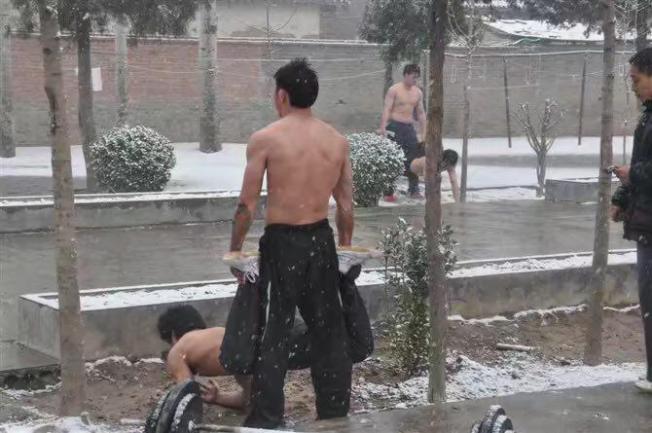
One method of practicing tuishou was, for example, being in a circle of about twenty students, who would challenge you one after another. When I knock the first one down, the next one would attack, and so on till the last one, after which the circle repeats itself. I also practiced the same circle exercise blindfolded in order to sharpen body sensations. Sometimes during wintertime, shifu would take us outside, dressed just in trousers, to train in the snow. One of exercises was to hold each other by the legs while ‘hand walking’ on the cold or frozen ground.
Before tuishou competitions I always have to control my weight, so during preparation time I would eat less and avoid spicy and very greasy food. Finally, after hard training, it is also important to have a proper rest.”
Training:
“There is a saying: “By missing one day of practice, your skill regresses for three days”. So, I make sure that I practice every day.That means that I go at least through forms. And when I have some more time, I do also some fitness exercises like running and weight lifting.”
It really does sounds beyond what most people could have physically and mentally endured at a young age, and more extreme than the training is in Chen Village these days.
There’s a lot of controversy in Tai Chi circles about the role of weight training in internal arts. It’s often dismissed as either unnecessary or worse, damaging to progress. It sounds like the antithesis of the frequently heard advice to relax more. Yang Cheng Fu’s “10 important points” essay is often read as a warning of the dangers of following an “external” path. (I think people often miss the meaning of that text though, so I’ll return to it at a later date.)
When the Chen Tai Chi masters teach seminars to Westerners they keep the focus on traditional conditioning exercises, like silk reeling, or zhan zhuang and forms, which do not involve weights, and emphasize things like relaxation and internal conditioning. Traditionally of course, training with heavy weapons would have been a form of weight training, and village farmers would have naturally been very strong people from all the physical labour, but there still seems to be a contradiction between the methods espoused to Western students in seminars and the content of the syllabus for training young fighters in Chen village itself.
There are also the ‘internet famous’ pictures of Chen ZiQiang doing weight training, and looking very ‘cut’ that spark off these debates, for example:
So, it’s interesting to read the above interview, where Wang Yan makes clear the role that weight training played in training his generation of Chen village teachers, especially when preparing for San Da competition. It’s also interesting to note that they may be the last generation to be trained like that, as “Students now come from more comfortable backgrounds and are, generally speaking, often more interested in computer games than in serious training.”
That’s an interesting point in itself, that makes me wonder if that generation was a kind of high point for martially trained Tai Chi fighters from Chen village. “May the children of your enemies live in luxury!”, as the famous Cynic philosopher Antisthenes said; a quote that echoes the famous poem/meme:
Of course, it’s all a matter of perspective. The people Wang Yan is training now are probably working a lot harder than most people could tolerate, even if they’re not doing wheelbarrows in the snow in winter wearing only their trousers 🙂
Full-time training
If I was training full time to be a fighter and I had a fight coming up in which somebody was going to try their best (under the rules) to hurt/beat me, then you can bet I’d be weight training too! You can’t fake fitness. And no matter how good your Tai Chi skills, if you get out of breath in a fight and your conditioning fails then you can’t fight back. Also, extra muscle mass doesn’t stop you from doing internal movement, although speaking realistically I don’t think that would have been the focus of training going into a fight.
Wang Yan was training as a full-time athlete. As well as doing all the hard physical training he would have been training in traditional Chen family methods at the same time. One does not preclude the other. While some might look down on all that physical training, it appears that the Chen village plan is to develop physical attributes first in its young people, including fighting skills, and later the more subtle Tai Chi skill is focussed on.
Here’s a video of Wang Yan doing some traditional Chen forms:
And here he is looking pretty good in a San Da match from 2013:
He’s a great inspiration for all Tai Chi practioners everywhere.
No, not my life. This guy’s life. He made a video about it:
Yes, I know the connection between Tai Chi and Wudang mountain is tenuous at best, and he repeats some old made-up stories about the origins of Tai Chi, but it’s a fun video to watch.
Here’s part 4 of the course. This week we focus on breathing. I cover the topics of normal and reverse breathing, then show a couple of different exercises that will get you on the right track for applying the breathing methods to the movement we are working on. Finally, we integrate the breathing into the movement, preserving all the progress we have made so far. Once you get the hang of it those breathing exercises I show are not required anymore, as you should be integrating it into your main exercise.
This week is more subtle than work showed previously. An inner focus will be required. Good luck! I’m happy to answer any questions you have.

 )
)