BJJ as therapy: Martial Arts Studies journal, issue 10 out now

Issue 10 of the (free) Martial Arts Studies journal is out now. This issue marks a 5 year anniverary for the journal. You should read it and support it, because it’s the most important journal we have for martial arts, and if, like me, you’re back in some sort of lockdown, what else are you going to do with your time? 🙂
Find out what’s in issue 10 at the Kung Fu Tea blog.

Amongst the delights contained within is a great article by my friend/teacher/student/Professor/Sifu/Guru Paul Bowman about finding Brazilian Jiujitsu (BJJ), falling in love with it and then having to give it up because of the COVID 19 Pandemic. It contains some great insights into why we practice martial arts there.

Here’s a quote that caught my interest:

“Since every challenging BJJ roll produces the feeling of a fight for life, the end of a session is like the aftermath of a near-death experience, with all of the attendant exhaustion, elation, and camaraderie that goes along with surviving such encounters. A BJJ saying goes, ‘if you don’t roll, you don’t know’. This has a range of possible meanings, but prime among them is that those who have never trained BJJ cannot begin to grasp its appeal, its feel, and its profound psychological and emotional effects. In a very real sense, BJJ can easily be regarded as a kind of therapy. The question is one of who it is that needs BJJ as therapy, and why.”

The contemporary condition (whether figured as modern or postmodern) has often been characterised as one permeated by sedentary media consumption, work-stress, insecurity, work/life imbalance, information overload, consumerism and indoor living. The so-called ‘developed’, ‘Western’ world of consumer societies, neoliberal policies and deregulated economies, are acknowledged to be the cradle of ‘diseases of affluence’. Part of the background noise of this environment is generalised anxiety.
One biological feature of chronic anxiety has been said to involve the constant low-level ‘running’ or ‘leaking’ of aspects of the sympathetic nervous system – manifesting in the anxiety-sufferer’s inability to ‘switch off’ feelings of stress and anxiety [Nestor 2020]. Activities that directly stress the mind and body – such as intense exercise and extreme experiences – have been connected with ‘correcting’ this constant ‘leak’. The argument is that they may do so by, in a sense, giving the body a dose of ‘real’ (physical and/or psychological) stress, which thereby ‘reminds’ the body what stress actually looks and feels like. This thereby allows the organism to ‘recalibrate’ and switch off anxiety-producing chemicals in the absence of ‘real’ physical stressors [McKeown 2015; Nestor 2020]. Short-term, low-level doses of the kinds of stimulation that would cause lasting damage or even death in prolonged exposure is called hormesis, or hormetic stress [Hof 2020].”

Great stuff.
Threading into one – Shen Fa and weapons

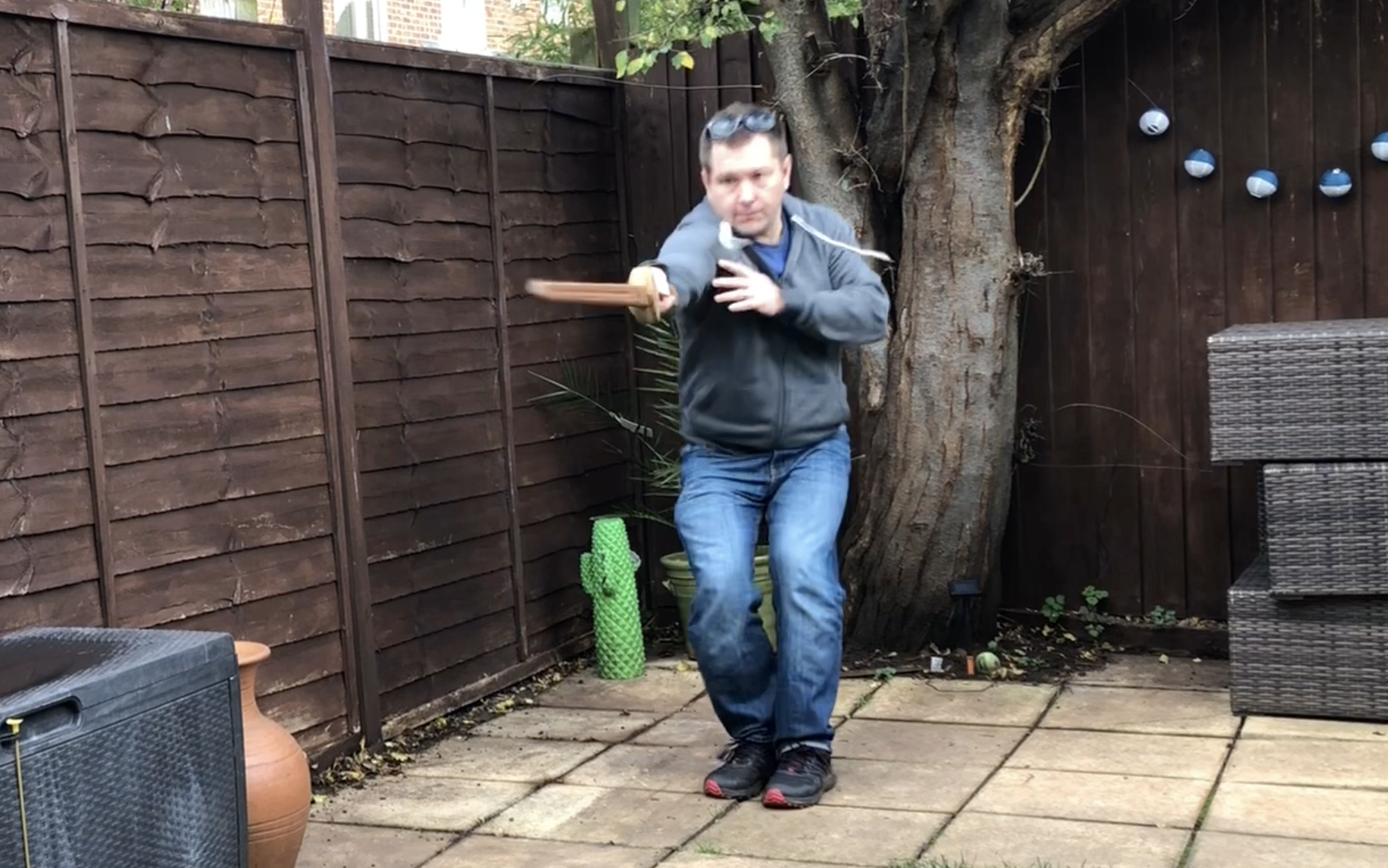
Day 3 of my experiment with switching my training around so that weapons (specifically sword) are the mainstay of my practice, and changes are already happening.

Today I want to talk about Shen Fa, which translates as “body method”. You could call it whatever you want really, but it just means “the way you move”. Xing Yi has a very detailed Shen Fa and in bare hand practice you have to make your body do it. In contrast, using a sword almost teases it out of the body. The key to Xing Yi Shen Fa is learning to use your body as a coordinated whole. If you start “using your arm” and muscling it, then nothing seems to work as it should.

As it says in the Xing Yi Classics:

“(When) the top wishes to move, the bottom automatically follows. The bottom wishes to move, the top will automatically lead. (When) the top and the bottom move, the center section will attack. (When) the center section moves, the top and the bottom will coordinate. Internal and external are combined, the front and the rear mutually required. This is what is called “threading into one.”

You could say that the sword forces you to do this threading, by using your whole body to do each move. I mentioned before that my teacher emphasised using a heavy sword, and that is part of the reason why. (The other is that this style of sword is for going through armour, but that’s another topic).

I’m focussing on just one Xing Yi animal for my practice at the moment – Bear Eagle. It’s quite a lengthy ‘form’ by Xing Yi standards (although much shorter than a typical Chinese sword forms”), so there are lots of variation in the moves involved. In Xing Yi you’re free to do the forms fast – in fact, sometimes, the faster the better. That means you need to “flick”, “jab” and “swoosh” (I’ll spare you the technical terms!) a pretty heavy sword through lots of very quick techniques. If you are using your body in an uncoordinated way then it’s simply not possible to control a heavy sword at speed with momentum and with the accuracy required.

I noticed that an older post of mine on the Principles of XinYi seems to have generated a lot of interest lately. While Xin Yi and Xing Yi have evolved to have a different look, they are both rooted in the same idea of threading into one, which originated from spear use.

Incidentally, I’ve decided to focus on sword not spear for my weapons practice – I’ll go over why another time, but one reason is that I don’t own a long enough spear. Needs must when the Devil drives hard!

Sword as your main practice

Sorry there haven’t been many blog posts lately. I just didn’t feel inspired to write anything, and when I don’t feel inspired, following the Tai Chi principle, I don’t like to force it.

Something has got me back into writing recently though. I was having a conversation with a friend about Chinese marital arts and specifically weapons, and I thought – ‘well, instead of trying to describe things in words, I can just show you this on Zoom’, and I ended up teaching part of a sword form. What a time to be alive! It’s great that we can do this. When I started martial arts there was no such thing as the Internet, and if you couldn’t make it to see your teacher all you got was the occasional crappy VHS tape to learn from. Now we can Zoom between continents in seconds. I love the spontaneity of it.

As usual, the process of having to teach something means you get as much out of it as the person learning – you have to riffle out your old memory box, and then practice it hard enough so that it’s polished back up to a decent level before you teach it. I’d definitely put my Xing Yi sword on the back burner to focus on other things since lockdown began back in March, so getting back into it was an absolute pleasure. I miss the physicality of it, and the subtlety.

What occurred to me is that we (the general corpus of Chinese martial arts practitioners) tend to practice bare hand as our main art, then tack on weapons as an afterthought. Historically (and I’m generalising here, but stick with me), it was always the other way around. Our precious bare hand forms are actually more recent things, tacked on the end of weapons systems. Wing Chun practitioners, for example, spend most of their form training time practicing Siu Lim Tao, not butterfly knives. This got me thinking… what happens if we swap it back to the way it used to be? 

What if, instead of heading outdoors to do Chi Kung, Tai Chi practice and Kung Fu each morning,  I instead picked up my sword and did sword routines, then tacked on a few barehand bits on at the end if I’ve got time?

I’m going to experiment with this idea for a couple of weeks and see how it feels. 

What I usually find is that practicing barehand does nothing for your sword practice, but practicing with a sword doesn’t seem to knock back your bare hand practice as much as you think it would: It’s much easier to transition from weapon to bare hand, than it is to transition from bare hand to weapon.

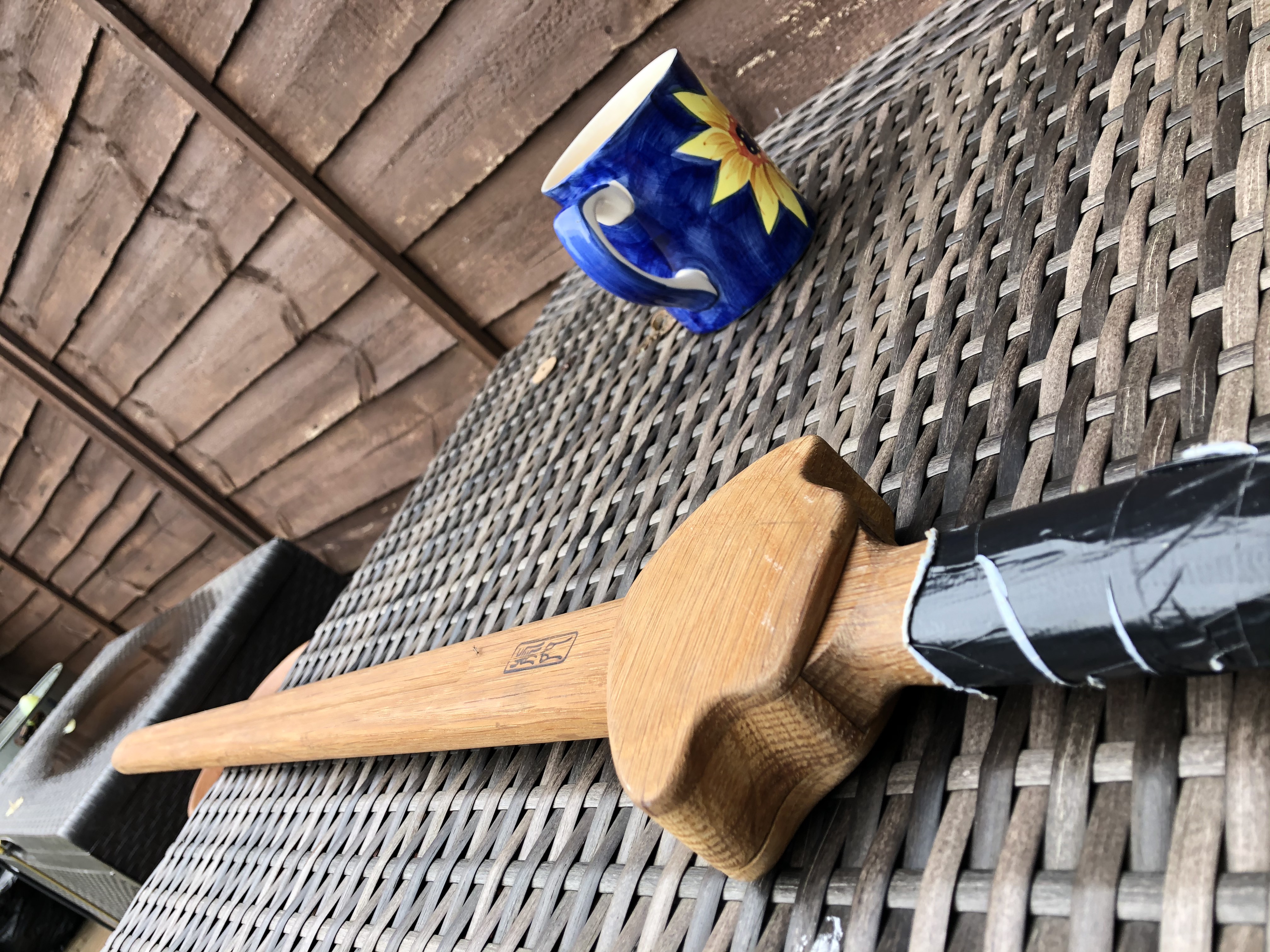
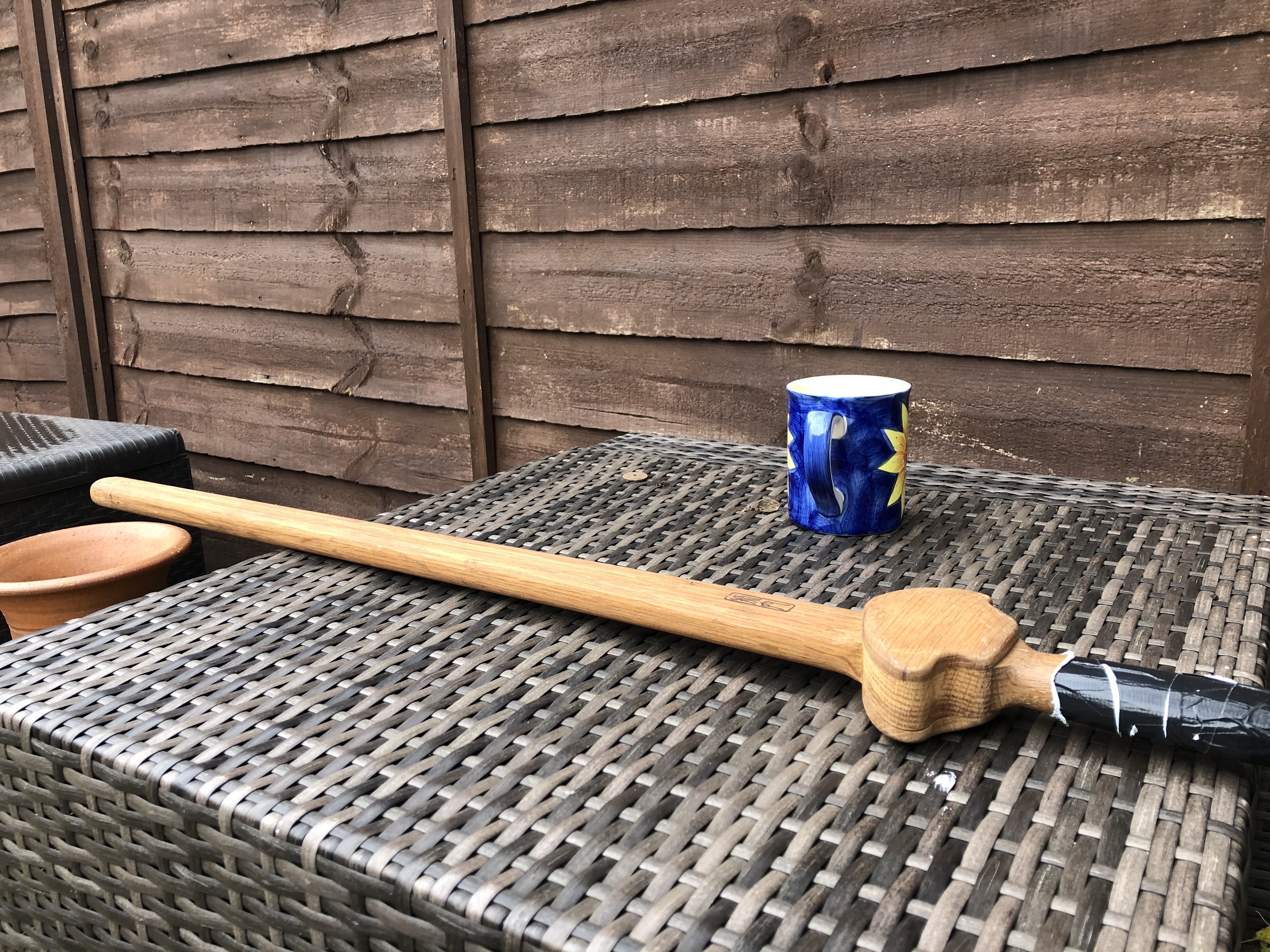
Even after a couple of days I can feel the physical difference. My forearms and wrists ache a bit from lack of conditioning. The sword I use is quite heavy – 800 grams, I think – and it’s a replica of a Ming Dynasty sword, hand made by Tigers Den in the UK. It’s great. I’ve put some tape over the handle, because it was slipping in the cold weather. That might ruin the esthetic, but at least it makes it look like a “used” weapon, rather than something that you hang on the wall.

Anyway, back to Zoom. Of course, as soon as I stepped outside to wave my sword around it started raining. This is Britain, after all. However I managed to get my laptop somewhere dry enough that it was only me getting wet, not the machine, and taught a few moves. It all went rather well I think. We’re going to do it again this week.

The whole thing brought back a lot of memories about practicing Xing Yi sword in the rain somewhere in a field back in the “naughties”, as the 2000s was called. My teacher used to be very into practicing outdoors in nature, and his mood positively lifted the worse the weather got and the further away from other people we got! There’s something to be said for not giving in to nature and working with it, no matter what it throws at you.

But, anyway, I think having the sword as your main “thing”, rather than it existing on the periphery of your practice, could lead to some interesting results. I’ll experiement and see. Let me know what you think, or if you’re doing something similar.

Edward Hines and Scott Park Phillips Discussing Tai Chi, Baguazhang and The Golden Elixir

Scott P Phillips is one of the few authors discussing the link between Chinese martial arts and Chinese Opera (also called Chinese Theatre).

I find his ideas intellectually fascinating. But, for many martial arts people he goes too far in the sense of seeing this one idea in almost everything to do with Chinese martial arts. You could say that in terms of taking the ball and running with it, he does tend to kick it out of the park (sorry) completely 🙂

Is that a fair summation of Scott’s work? Probably not. Part of the problem I think is that the world where theatre was the big entertainment of the day in China, and was simultaneously connected to religion and martial arts, has long since disappeared. From today’s standpoint it’s hard to imagine it even existed. Also, words like “theatre” and “opera” in the West have distinctly different cultural baggage attached to them already, so it’s almost impossible for us to see them as they actually were, free of our cultural biases.

So, that’s why I was pleased to see this interview with him and Ed Hines where Ed gets to ask Scott some basic questions about his theories. Ed is a Baguazhang practitioner based in Paris and he asks some of the more “down to earth” questions that need to be addressed by Scott before he can take us on his magical mystery tour. Have a listen:

Why so many grappling styles stop when things go to the ground

If you throw your opponent to the ground in almost all of the old, traditional folk wrestling styles then you win. That’s it. Game over. To modern day martial artists that seems very odd, as we’re now all used to seeing MMA and BJJ fights on the ground, sometimes lasting minutes. But in olden times, if your shoulders touched the ground or you were pinned (or some version thereof), it was all over.

Why is that?*

Photo by Alan Stoddard on Pexels.com

You’ll find the answer in the latest episode of the Sonny Brown Breakdown in which he interviews RuadhĂĄn MacFadden of the Hero with a Thousand Holds podcast.

“I talk to RuadhĂĄn MacFadden. He runs a project titled The Hero with a Thousand Holds which looks at the culture and practice of folk wrestling styles around the world. In particular the people and places that the styles have emerged from and not just the techniques which they used. We discuss some of the mythology and culture behind these styles and what the future holds for them. And we get into some of the particulars of Icelandic Glima and Irish Collar and Elbow Wrestling and Scuffling.”

* Ok,I’ll tell you the answer, (or one of the possible answers anyway). Wrestling between males (and sometimes females) was often used as a form of socialisation, and entertainment in tightly knight communities, or as a way of settling disputes without recourse to serious violence. Killing valuable members harmed the community’s chances of long term survival. In any case, there was nothing to be gained for the community from people getting seriously hurt either, so there had to be a simple way of declaring a winner without things escalating to the point that somebody was bludgeoned to death with a rock. Hence, once you landed on the ground, it was over.

Movie Kung Fu vs real Kung Fu

I was alerted to a great post by Reddit User drkaczuz about the role of stunt men and women compared to the same scenes done by “real” martial artists who are not trained in movie-fu.

I’ll quote it here (I hope he doesn’t mind because it’s really interesting, and he makes some great points):

“Yeah, people very often misunderstand the role of stunt doubles, especially in fight scenes. It’s often not as much about skill, or risk as about production logistics. Even if you have a physically capable actor, with MA experience, you still want to use the stunt doubles, simply to squeeze the most out of pre-production time. You can’t lock the star of the show in a room with the stunt crew for a few weeks to rehearse the scene to perfection, they need to well, act. Learn their lines, prepare for their non-action scens, do marketing stuff, photoshoots, etc. What you CAN do is have the stunt double rehearse the entire choreography for months untill it’s buttery smooth and them tag them in on a moment’s notice.

Another thing with actors that have MA background is how different movie fighting is from real fighting – a lot of time real fighting skills and reflexes actually make on-screen fighting look worse.

I think Donnie Yen vs Mike Tyson is a good example showcasing a lot of issues when working with real athletes – we all know Mike is insanely fast, but in this clip he appears slow and sluggish, and you can’t really see the power behind the blows – further below I’ll try to explain why.

 BJ Penn and Rampage in this clusterfuck of a movie – in this case choreography, montage, lighting are absolute garbage, but you can still see that they seem weirdly uncoordinated and slow.

 Anderson Silva from the same flick, notice the kicks especially, also look at all Randy Couture scenes from Expendables – they’re a dark, shakycam mess, but a lot of shakycam and bad lighting is damage control to hide hits that didn’t sell well.

I am not saying that having actual martial artists on set is bad – but you have to manage them really well, have an action director that will guide them and communicate their vision clearly. In a lot of cases a director will oh so wrongly assume that if they have the star martial artist on set they can just tell them to do their thing and it’ll come together somehow. Also it’s not that being good at actual fighting is somehow a hinderance – all good stuntpeople will be at least competent in one or more actual combat sport or martial art. It’s just they have a LOT of additional knowledge on top, as well as the ability to turn some instincts on and off.

There’s more to this post, including links to good examples of well done fight choreography.

A better way to do martial arts

I’m thinking again about my theme for the last couple of posts, the subject of myth busting and how it can lead to disillusionment in martial arts.

Essentially the question I grapple with is: How do we make martial arts better without all the bullshit?

One guy who is doing a lot to change things in martial arts – specifically in his area, which is BJJ, but I don’t think it takes much to apply it to a wider context – is Priit Mihkelson. In this lecture he gives one possible version of what this “how to make martial arts better without the bullshit” might look like.

Perhaps the specific things he’s talking about don’t relate to your particular martial art, but it’s the thinking behind it I like. It feels progressive, scientific, hopeful and perhaps a glimpse of a better future for martial arts: training methods based on progressive resistance, feedback and success, rather than failure.

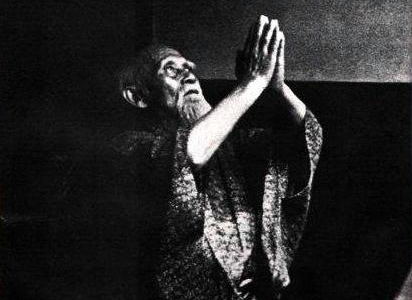
Ueshiba was not the Messiah. He was a very naughty boy.

Not Jesus.

With our Heretics podcast existing as a kind of permanent record online people can discover it at any time. Recently the Aikido Heresies episode we did has kicked off a couple of conversations. 

I think they relate directly to the Myth Busting post I did yesterday. That was all about Chinese martial arts, but the same thing applies to Aikido, perhaps on an even bigger scale.

One post from a listener goes as follows:

“So recently I came across some apparently very grim details of Morihei Ueshiba’s life history. Apparently he was in good terms with far-right activists and known war criminals (including the head of Unit 731; if you don’t know what it is, do yourself a favour and DON’T google it), and was a staunch nationalist supporter of the Emperor and the Imperial regime. 

   I have for long held to the opinion that Ueshiba was perhaps the most complex and misunderstood figures of 20th century martial arts, but now I’ve been really left to grapple with how his legacy and ideology should be correctly dealt with during our era.

   Is this more “ugly” side of Ueshiba well understood and interacted with among many Aikidoka, and what has been your solution to it?”

I see a lot of parallels between the myth-busting of martial arts and the things that are happening in modern times now in the US and UK as we unpick the uncomfortable truths of our relationships to slavery.

For example, almost all the big Downton Abby-style manor houses in the UK that have become the property of the National Trust (usually after the 2nd World War) and we all enjoy spending our Sundays visiting and enjoying the splendid gardens and architecture, were all built by fortunes made off the backs of the slave trade. And none of this is taught in our schools.

Statues like the one of the famous slave trader Edward Coulston in Bristol have been pulled down by angry crowds in the wake of the Black Lives Matter protests in the US, which have spread to the UK. 

The question is how do we deal with this. Should we stop people bowing to photos of Ueshiba in Aikido dojos, for example?

I don’t know what the answer is. Walking the fine line between personal freedom and making right the sins of the past is a difficult job.

Personally, with Aikido I would look to the Aikido community to address this issue and come to terms with it.

As our friend Tammo notes:

“As a long standing practitioner of Aikido who also runs his own dojo, it was a shocked to hear these things and in the course of a year it completely changed my perspective of Aikido. Meanwhile I have come to terms with that and think I can see and value Aikido for what it is and what it isn’t.

The success of Aikido from roughly the 60s to the early 2000s (I would guess) seems to have been due to the huge efforts of myth-making around Ueshiba, modelling him into a saint-like figure… with a god-like martial ability and some strange esoteric practices which seem all very impressive. It seemed to work. Now I find it more interesting to get my head around general developments in eastern martial arts as a way to understand how different styles and branches are able to develop and become successful and why others don’t.”

In the Aikido episode of our podcast we established Ueshiba’s colonial activities in Manchuria, close ties to the leadership of, for instance 731, and (not war) but colonial crimes against the Ainu. As a member of the Kwantung army he is also associated with all of their atrocities on the continent. On that basis, I think it’s fair to say that Ueshiba was not a nice person.

Myth busting in Chinese martial arts

Look at those lovely brain boxes.

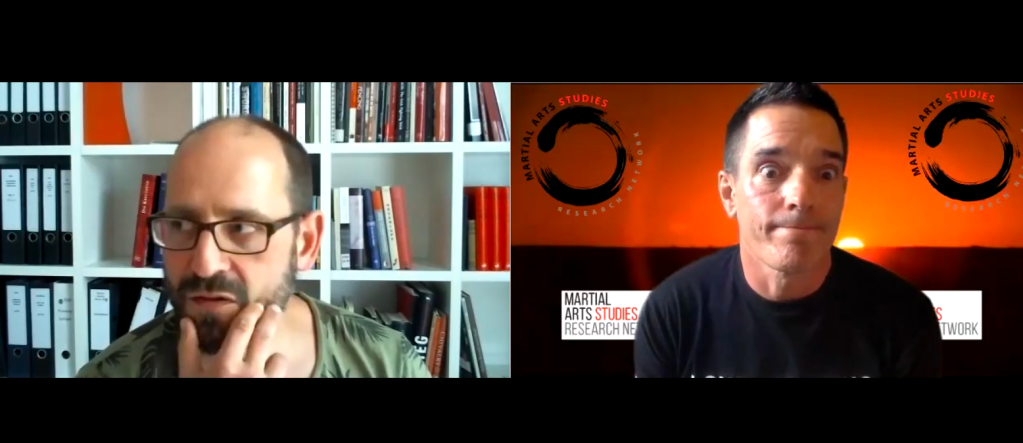
I’ve been re-watching the excellent conversation between Dr Paul Bowman and Dr Sixt Wetzler on Martial Arts, Religion and Spirituality and it’s sparked a few thoughts in my mind. At 34.39 in the podcast they get on to the subject of myth busting.

Bowman notes that instead of helping people, the myth busting of martial arts which is going on all the time in academic circles is probably destroying the careers of some martial arts teachers. So it’s “doing a service to the world which is actually also a kind of violence”. It’s an interesting point. He notes that people often fall in love with the martial arts for silly orientalist reasons – they fall for the myth of studying an ancient and mystical martial art, then read a well-researched book about it, by somebody like Ben Judkins or Peter Lorge, which shatters their beliefs and makes then doubt the validity of the art they are doing. 

My own Heretics podcast does its fair share of myth busting too – our Aikido episode, Kempo & Jiujitsu history series and Tai Chi history series spring to mind as good examples. I’ve had first had experience of those episodes visibly upsetting teachers I know. Whether they know it or not, these teachers are heavily emotionally invested in the myths of their own arts superiority – they believe all the stories of old practitioners and the amazing feats they can do, and know exactly why their martial art is superior to others. If you start to chip away at those beliefs then the whole facade is at risk of crumbling, and they don’t like it! Unfortunately reality is usually disappointing when compared to the myths. 

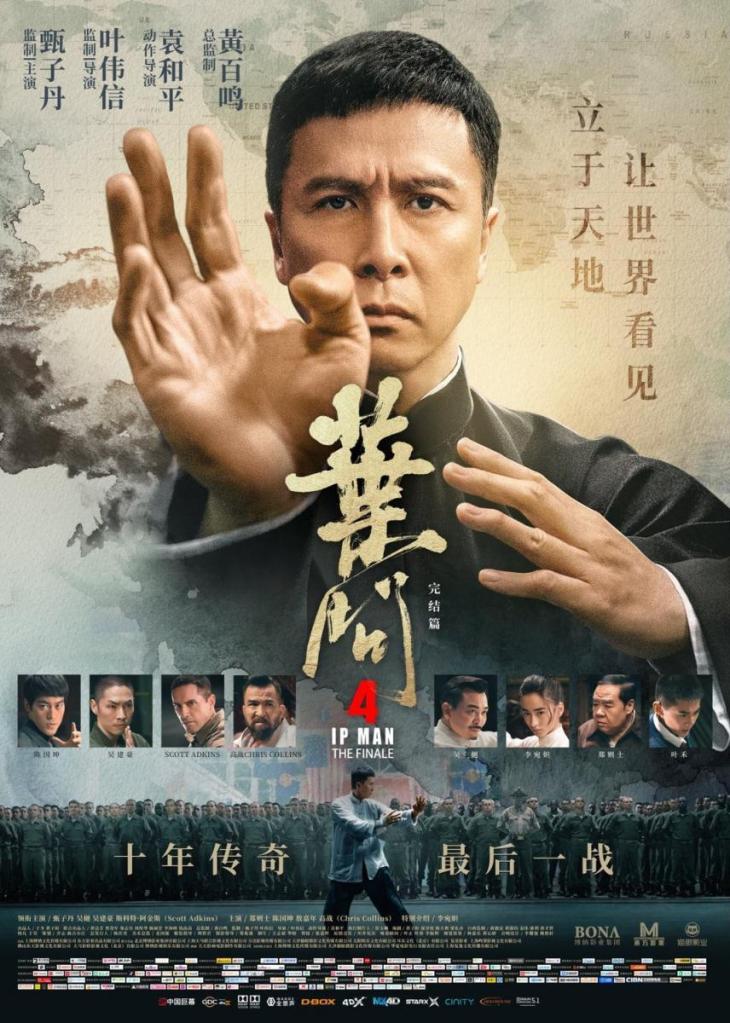
When the Chinese martial arts first started making an impact on the West in the 1970s they were full of obvious untruths. Tall tales of Buddhist and Taoist origins abounded. For example, that Tai Chi was apparently created by a Taoist immortal who had a dream about a crane fighting a snake, and Wing Chun was named after the girl who was taught it by a female Buddhist monk, when it turns out that there’s no evidence that she even existed. Over time these myths then get added to by other myths – like the one that Yang LuChan was “invincible”, for example. Even in the modern age the myth of Ip Man has been enhanced to bursting point by a series of pseudo-historical films in which he combats the Japanese, western wrestlers, boxers and even Mike Tyson at one point! 

Ip Man 4

These more marketing-orientated myths about the prowess of practitioners – how deadly they were, how unbeatable their martial arts was, how the power of Qi was greater than physical strength all fed directly into all that nonsense about no touch knockouts and “empty force” that has marred the image of Chinese martial arts in the modern age.

And politics also gets involved. When obvious myths about the origins of martial arts are dispelled they often get replaced by more politically motivated stories about the arts origins that are equally as unprovable and unreliable yet fit a natioanlist agenda. It seems like the Chinese martial arts are forever being used to support some sort of Chinese government propaganda.

In short, the Chinese martial arts world was in need of, and remains in need of, a lot of myth busting, because much of what we are being told and sold is basically not true. But Bowman’s fears, that we are in danger of spoiling the fun for everybody with this relentless search for the truth, holds true, I think. I was certainly attracted to Chinese martial arts by a steady diet of orientalist propaganda from the likes of David Carradine’s Kung Fu TV series and Marvel comics with heroes like Iron Fist. This is often what draws us to the martial arts in the first place and there has to be some way of searching for truth in the martial arts, but keeping the magic that drew us there in the first place. 

Don’t stick out your bottom!

I had an interesting conversation with a reader recently about Tai Chi and butts, which I thought I’d share as it’s a good topic. A lot of Tai Chi people, me included, tend to stick out their bottom slightly during form and push hands. Maybe more so in push hands
 either way, it’s a fault that inhibits relaxation.

Photo by Jamie Haughton on Unsplash

I think in push hands it happens because people try to “brace” against the incoming force to stop themselves being pushed backwards, but by going for a short term solution they are inhibiting their progress in the long term.

Q: Do you have any experience of Chen style TCC? I’ve been to a few lessons. Seems like, in order to soften the kua sufficiently, you need to stick your backside out more than in Yang….?! Having spent a whole lifetime trying not to do this, it feels weird…..!

A: I’ve never really done Chen style, but I’ve looked into their silk reeling exercises quite a bit – just the simple one hand “wave” – I really like that and do it quite often.

I’ve seen some Chen stylists that stick their butt out a lot, but to be fair I’ve also seen a lot of Yang styists do the same. I think as part of an opening and closing movement it’s ok (like in Yoga, for example), but leaving it “stuck out” all the time can’t be right. Tai Chi requires you to move from the waist (or the dantien, if you like) and that encompasses both the front (belly), sides and back of the body around the waist line – the lower back is part of that. If you put your hands on your lower back then stick your butt out you can feel your muscles contract and tighten – having a tight lower back as your default means you can’t effectively “move from the dantien” so everything else you do, no matter how clever or artful looking, has to be wrong because the foundation is wrong.

When doing silk reeling exercises I try to keep my lower back relaxed and “hanging down” – that’s the right feel – so the movement can originate there. The form should be no different. I feel like the people who stick out their butt have simply missed an obvious problem with their Tai Chi.