Arlene Faulk is the author of Walking on Pins and Needles, her memoir of living with multiple sclerosis without a diagnosis for many years, spending two years not getting up from the couch and how she eventually found Tai Chi and how it helped her combat the disease and regain her health, eventually becoming a Tai Chi teacher herself. Make sure you listen right to the end as we have some tips from Arlene on how you can use Tai Chi principles discussed in the Tai Chi Classics to feel better right now as you listen to the podcast.
This Xingyiquan video caught my eye recently. It’s a good performance and demonstrates a nice range of material drawn from Xing Yi’s animals and elements. The performer is doing it well, and using some untypical examples of the animals in some cases, which adds a nice bit of variety.
Check it out:
Xing Yi is typically split mainly into two big demographic styles known as Shanxi and Hebei. The video shown here is a good example of Hebei style. It’s practiced by Sun Liyong, a famous Xingyiquan master from Beijing Simin Wushu Club.
If you’d like to know more about the different styles of Xing Yi and how they evolved then check out my history of Xing Yi podcast series.
A sphere is one of the strongest shapes regardless of the direction of force. Photo by Laura Tancredi on Pexels.com
I wanted to talk today about the concept of the Tai Chi ball, or more accurately, Tai Chi sphere. While it might sound simple, I think it’s really an advanced concept because it’s taking the Tai Chi teachings out of the realm of specifics, of things like ‘relax that shoulder’, ‘move that foot’, ‘drop that elbow’, ‘align that hip’, etc…, and into the realm of concepts, which are much harder to pin down into physical details.
The Tai Chi Classics talk about Tai Chi being circular a lot. For example, it says:
“The postures should be rounded and without defect, without deviations from the proper alignment; in motion, your form should be continuous, without stops and starts.”
At a certain point the position of the hands and feet and other body parts in Tai Chi gets subsumed by the general sense of keeping your body and all your movement rounded, like a ball. (Newsflash: despite a thousand form corrections from seminar masters, the exact position off your hands isn’t what’s important.)
What’s important in Tai Chi is that your body is creating a ball-like structure, with ‘you’ at the centre. That’s what determines if you hands and arms are in the correct position, not angles and degrees. If you are making a sphere with your movement and body, then everything will be in the right place, and if you aren’t, it’s not.
The advantage of creating a sphere is that force can comes in and be rolled off without too much interference and muscular tension. A sphere is a Tai Chi symbol write large, in 3 dimensions.
The Tai Chi Classics talk about Tai Chi Chuan being circular. Photo by Sindre Stru00f8m on Pexels.com
The idea of separating empty and solid in the body goes hand in hand with creating a Tai Chi sphere. In fact, I don’t think you can do it successfully without a separation of empty and solid – or yin and yang – in the body.
But here’s the kicker. You can’t just decide one day to do this practice. You can’t go outside right now and do you form and decide to make your Tai Chi like a sphere because it will be meaningless. Instead, it’s a situation where you gradually discover, after many years of practice, that Tai Chi is like a sphere. One day you’re practicing and you suddenly notice it, and bang! Your Tai Chi will never be the same again. It’s like that famous picture that looks a bit like an old man but isn’t:
You either know or you don’t! Can you see what this is a picture of?
Most people are unable to see what that is actually a picture of at first glance, but once you get it, no amount of me trying to persuading you otherwise will prevent you from knowing exactly what it is.
It’s the same with the Tai Chi sphere. Your Tai Chi has always been a sphere, you just didn’t know it, until one day you did, and then it was suddenly obvious to you.
Referring to the Tai Chi Classics can help your practice. Photo by RODNAE Productions on Pexels.com
I’m writing this as a kind of follow up to my previous article on 3 views of qi in Tai Chi. That article contained the 3 different things I think people really meant when they talk about qi in Tai Chi. This article aims to do the same thing with yi. I don’t consider myself an authority on either matter, but I have had some skin in the Tai Chi game for a while now, and I’ve read enough of other people’s writings to come to some conclusions about what I think they’re talking about. Hopefully you’ll find these definitions helpful, and I’d be interested to hear your thoughts in the comments section.
Yi gets a few mentions in the Tai Chi Classics, and is usually translated into English as “intent”, or “mind-intent”, a translation which I think can be problematic because there are at least 3 different things that people mean when they say “intent” in Tai Chi, and while the three are obviously related, they’re also quite distinct from each other.
Before we get into the definitions, let’s have a look at what the Tai Chi Classics have to say about yi:
The most quoted line regarding Yi is in the Tai Chi Classic: “All movements are motivated by yi, not external form”, which can also be translated as “use the mind, not force”. In no.6 of Yang Cheng-Fu’s 10 important points he says:
“6.) Use the mind instead of force. The T’ai Chi Ch’uan Classics say, “all of this means use I [mind-intent] and not li.” In practicing T’ai Chi Ch’uan the whole body relaxes. Don’t let one ounce of force remain in the blood vessels, bones, and ligaments to tie yourself up. Then you can be agile and able to change. You will be able to turn freely and easily. Doubting this, how can you increase your power?”
So, here the emphasis is on relaxing and not using “force”, but why? And What does that mean? I will explain later.
Interestingly, right after that line, the Tai Chi Classic then goes on to say:
“If there is up, there is down; when advancing, have regard for withdrawing; when striking left, pay attention to the right.
If the yi wants to move upward, it must simultaneously have intent downward. “
Definition 1: Martial intent
Given the lines quoted in the Tai Chi classics above I find it strange that the most common interpretation of yi in Tai Chi is as a kind of martial intent. Here intent is “your intent to do something”, and in Tai Chi people generally mean a martial intention that needs to be contained within every particular posture or movement. So, for example, when you do the ward off movement, you need to have the intention of deflecting a blow away. If you movement lacks that intention, it is said to be empty.
Now this may all be true, and not knowing the martial applications of a movement inevitably leads to it becoming too abstract and unfocused, but this understanding of ‘intent’ is clearly not what is being talked about in the Tai Chi Classics when it admonishes us to “use the mind, not force”. If all it meant was to have a martial intention behind the movements, then it’s impossible to see how that can match up with lines from the classics like:
“If the yi wants to move upward, it must simultaneously have intent downward.”
What has that got to do with martial intent?
Clearly this is talking about something else. Yes, a martial spirit is obviously important for Tai Chi, and some Chinese teachers refer to an “eye spirit” which his making sure you are focused and looking in the right place in form performance, and you look like your actions are martially proficient, but I don’t really think this is what is specifically meant by yi in the Tai Chi classics.
Definition 2: A line of intent from the ground up
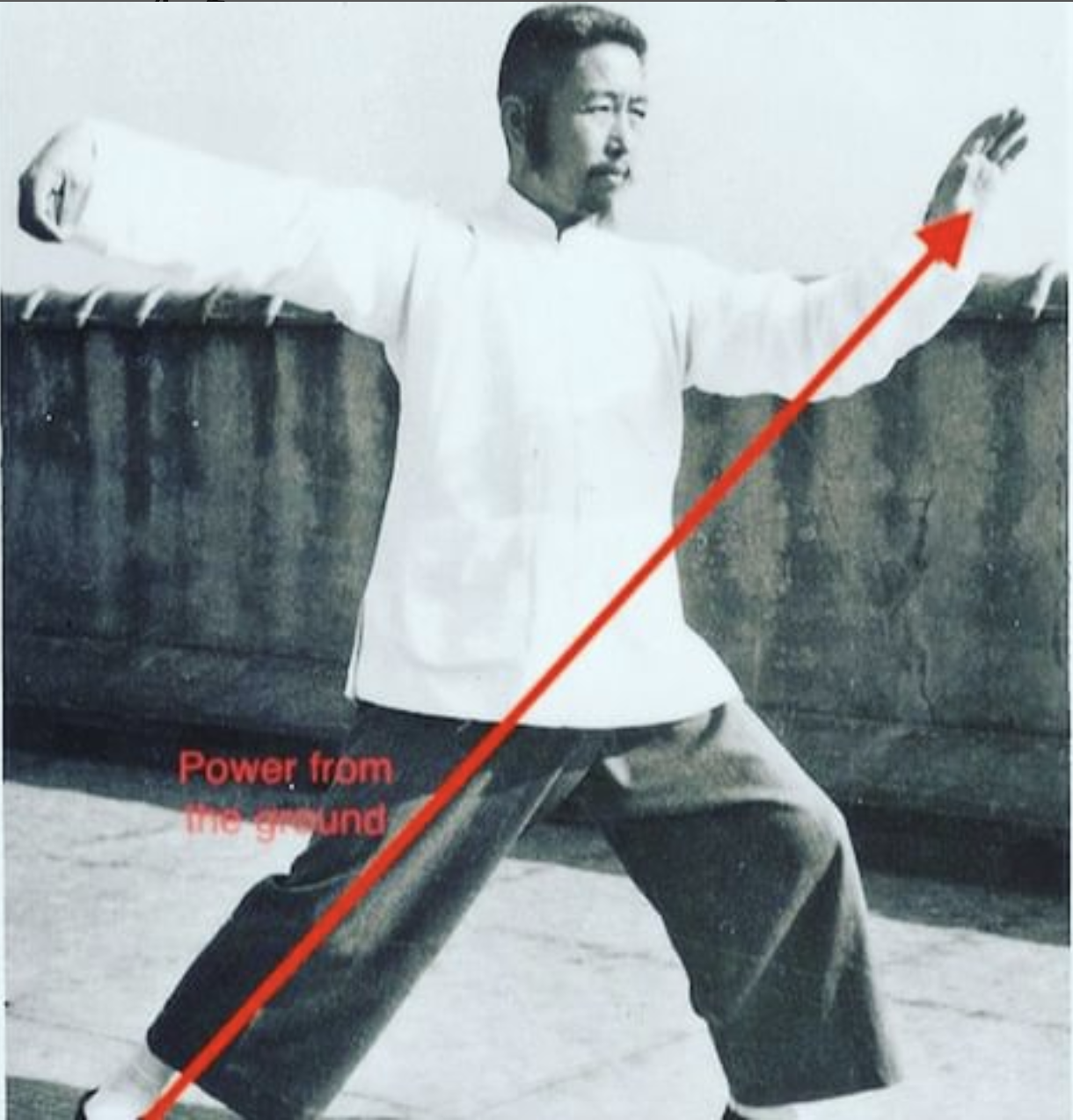
The second way that people refer to intent in Tai Chi is as a line of force, usually from the ground to the point of contact with the opponent. The idea in Tai Chi is to bring the solidity of the ground to your point of contact with the opponent. How do you do this? Well, firstly by relaxing, so that your body can function as a whole, connected, unit, and then by feeling a line of connection from the point where you contact your opponent (in push hands that would be your palm or wrist) directly to your foot (the part of you that is closest to the ground). By imagining the force of your opponent going straight down to the ground in a straight line from your palm to your foot then you can make use of jin – which is a force obtained from bringing the solidity of the ground to the point of contact with your opponent. This jin force stands in contrast to the normal force of the body produced by exerting your muscles, which the Chinese call li. Of course, muscles are involved in generating jin (otherwise you’d collapse not he ground), but they kept as neutral and relaxed as possible, so that excess force is avoided.
If you send force from the ground to your point of contact with your opponent, using jin, you can bounce them back off you.
Of course, you cannot be thinking of the ground if you want to project somebody away from you. Your work in creating the path to the ground is already done – in the bow analogy this is the drawing of the bow. All that remains now is to fix a direction and release the arrow:
As it says in the classics:
“Release the chin like releasing the arrow.
To fajin [discharge energy], sink, relax completely, and aim in one direction!”
This use of Jin fits in better with the lines in the classic that say
“If the yi wants to move upward (i.e. bounce your opponent back) it must simultaneously have intent downward. (i.e. you imagine a line of force to the ground).
(N.B. this straight line of force obviously goes through empty space, so it’s not the actual line any force from the ground will take, but it’s a case of your mind having the overall goal in mind, and your body filling in the details on a kind of subconscious level.)
Definition 3: A part of the mind
This definition is about yi being a part of your mind and the hardest to put into words. Obviously, definitions 1 and 2 also involve using the mind, so you can see how all 3 definitions are kind of wrapped up in each other.
In everyday life when you want to do something, like say pick up a pen or bring a cup of tea to your lips, the idea to do it appears in your head before the physical action takes place.
In internal arts the 6 harmonies get a lot of press. Of these 3 relate to the physical body, and 3 relate to the internal make up of the person. In the West we tend to have one word “mind” to relate to all the different and distinct parts that the Chinese have words for, like xin, shen and yi, but the three internal harmonies (san nei he) are:
1) The heart (Xin) harmonises with the intention (yi).
2) The intention (yi) harmonises with the chi.
3) The chi harmonises with the movement (li).
The heart mind (Xin) is related to our desire to do something, the yi (intent-mind) is the part of our mind that makes things happen on a subconscious level. When you pick up the cup to bring it to your lips you don’t think “hand move to cup, fingers wrap around handle”, etc.. It just happens because your intent-mind is taking over, based on what you desired to happen. The intent-mind is therefore a kind of subconscious process.
Now, going along with the idea that there are these different parts of our mind that exist as separate entities comes the idea that we can train these separate entities in isolation to gain a deeper ability with them. So, for example, by repeated practice of a Tai Chi form (or Zhan Zhuang standing practice), in which we are trying to access the subconscious intent-mind, rather than brute force, to perform action we might, in fact, get better at it and develop some ability that ‘normal’ people who lack this cultivation don’t have. It’s an interesting idea!
A good starting point for developing this intent-mind is Zhan Zhuang standing practice. One common practice is to stand in the ‘hugging a tree’ posture and try and get the mental sense that your hands are expanding outwards, yet without physically moving them. You are cultivating your intent-mind when you do this. This is starting with just one direction, but in standing practice people often talk about training 6 directions at once.
When performing a Tai Chi form it’s obvious that you are dealing with moving energy (in a physical sense) in different directions. If you can utilise your mind to “think” in these directions then you can start to train your yi, and it can start to feel like your movements are generated by yi and not by physical force.
Conclusions
It’s not easy to talk about what is meant by yi in Tai Chi, but hopefully I’ve provided you with some good starting points and ideas. I’ll repeat again my assertion that the three definitions I’ve given are all important parts of the practice that makes up Tai Chi Chuan and all inter-related. And while yi may be tricky to describe, it is of utmost importance to all the internal arts. There is a line from the Xing Yi classics that goes:
“There is nothing but structures and nothing by qi”
On hearing this line I remember my Tai Chi teacher saying “Oh, that’s good, I like that, but I’d change it to:
There is nothing but structures and nothing by yi”.
Structure and intent. When it comes right down to it, that’s all the internal arts are made up of. That’s how important yi is.
People often claim that it was Bruce Lee who was the father of the Kung Fu boom of the 1970s, but was he really? Sure, Bruce brought a sense of realism to the genre, but it was Kwai Chang Caine who set the ball rolling. The other popular TV series Monkey and The Water Margin were also influential, but felt like they were aimed at a younger audience. And for kids like me it wasn’t possible to watch a Bruce Lee movie – they all tended to be rated 18.
I’d go as far as to say that Lee wouldn’t have had the movie success he had, particularly in the west, if it weren’t for the Kung Fu series.
Here’s a good documentary on the making of Kung Fu – I still remember some of these action sequences, particularly the one where he kicks the knife out of the guy’s hand and it sticks in the roof, which is shown in this video. That moment was the start of my lifelong interest in Chinese martial arts.
We’ve recorded a new episode on our long running ‘history of Xing Yi’ series. There’s no actual Xing Yi in this episode – it’s more about a period of Chinese history that little is written about – the middle to end of the Yuan dynasty.
Horse and Groom, handscroll after Li Gonglin by Zhao Yong, China, Yuan dynasty, 1347, Freer Gallery
In the middle to late part of the Yuan Dynasty the former Confucian ruling class came back with a vengeance and started a downward spiral that would ultimately lead to the fall of the dynasty. In this episode we examine how and why this happened, which will set the context for the important events at the end of the dynasty in the next episode.
If you like Chinese history, then you’ll enjoy it.
One of my poetic/literary heroes, Charles Bukowski had “Don’t try” written as an epitaph on his tombstone. To many people he was simply an alcoholic, womanising, bum who pissed way his talent, but I bet Charles Bukowski did more honest days work in his life than a lot go his critics ever did. Writing was his way out of a life of oppressive blue collar jobs that had ground him down, and he only succeeded as a writer late in life, and that gave him a unique perspective.
There’s a video that explains his seemingly paradoxical philosophy of “Don’t try”.
But if you don’t have time to watch it then Bukowski explained it himself in one of his letters:
“Somebody asked me: “What do you do? How do you write, create?” You don’t, I told them. You don’t try. That’s very important: not to try, either for Cadillacs, creation or immortality. You wait, and if nothing happens, you wait some more. It’s like a bug high on the wall. You wait for it to come to you. When it gets close enough you reach out, slap out and kill it. Or if you like its looks, you make a pet out of it.”
– Charles Bukowski
I think anybody versed in the philosophy of Tai Chi can see an instant parallel here to the Taoist ideal of Wu Wei – “not doing”. Quite often if you can wait for the mud the settle the water becomes clear all by itself, and the right action becomes obvious.
There are a number of quotes you can find in the Tao Te Ching that elucidate on this idea, right from the start of the book, where in chapter 2 Lao Tzu states: “The sage acts by doing noting”, then later in chapter 22 he says “Because he (the Sage) opposes no one, no one in the world can oppose him.” And in Chapter 48, “When nothing is done, nothing is left undone.”
Now I wouldn’t say that Lao Tzu and Bukowski have exactly the same take on this idea, but they’re not a million miles apart.
There are obvious applications of “Don’t try” in all areas of your life – from creativity, as Bukowski found, to business and your home life, but one of the most obvious I find is in martial arts.
If I find I’m engaged in too much of a struggle during sparring, rather than go harder, I have slowly learned to back off. Rather than fight through something it’s much easier to change track and go around it.
In Tai Chi push hands you can encounter this idea whenever you feel resistance from your opponent. How do you react? Do you push harder, knowing if you do, you can impose your will on them? Maybe you can, but you’re just engraining a bad habit that’s not going to lead to success when you try it on somebody bigger than you.
In Jiujitsu I often find guard passing is the best example of this idea of Don’t Try. If you try and force a guard pass, like a knee slide for example, when your partner is defending well then quite often you can make it work, but it’s a lot of effort and ultimately you’ve depleted your energy reserves more than you had to. And again, it won’t work on somebody bigger and stronger. That’s when the words “don’t try” tend to appear in my mind. If the knee slide pass is defended then change the angle, work something else, see if you can switch to a bull fighter pass instead. Or change to a back step. There are always ways around the problem instead of having to power straight through it.
Tai Chi is just one of a number of Chinese martial arts that have extended forms practice as a key component of their training methods. An incredible amount of time in Tai Chi is dedicated to performing the form in just the right way. Of course, there are lots of martial arts that don’t have forms, but they tend to be more sportive and wrestling based, although striking arts like boxing don’t have set forms either. Exactly why so many Chinese martial arts have forms at all is another question – one that relates back to their cultural origin and use in entertainment and religious festivals, and has relatively little to do with martial efficiency. It’s a contentious point, so for now let’s just accept that most Chinese martial arts today do have forms, and if you’re going to practice a Chinese martial art in 2022, then you’ll be practicing forms too.
In my training I’ve been exposed to various Chinese martial arts, and they all had a number of “set in stone” forms to train, until that is, I was introduced to Xing Yi. Or rather, I should say, to my Xing Yi teacher. His method of teaching Xing Yi was entirely different to most modern teachers – he really didn’t like the idea of set forms. Beyond the 5 Element form (the basics of Xing Yi) he didn’t really believe that any form should be ‘set in stone’. In fact, he wouldn’t even let you call them “forms”. You had to metaphorically put a pound in the swear jar every time you said the word “form”. He preferred the term “linking sequence” (lian huan, in Chinese) because it implied that the postures were linked together and could just as easily be linked together in an entirely different way. This is not entirely true, either. Sometimes he would teach you a particular sequence that was the way one of his teachers did it, and we’d call it the “master xyz linking sequence”, on the basis that you had to start somewhere, but if you ever quizzed him too deeply about a particular movement sequence then the answers would soon start to turn into the “well you could do it this way, or you could do it this way…” territory. He really didn’t want to be pinned down into a specific way of doing anything.
Xing Yi Bear link
I think the reason he was like this is that he didn’t want to kill the natural creativity in his students, and he wanted to keep the practice vital and alive. It should be obvious that your goal in martial arts is to be a formless fighter – even a small amount of light sparring will reveal the universal truth to you that if you try and adopt fixed methods to a live situation, the results are never good. To deal with any kind of live situation you need to be able to respond and adapt freely to whatever is happening. I think he saw the popular “fixed forms” training method as being part of the reason that some Chinese martial arts were less than successful when applied for real. It was also the way he’d been taught Xing Yi, and he wanted to teach in the manner in which he’d been taught. Of course, this makes it a lot harder to teach – having a few set forms makes teaching much easier, and also transfers to large groups well. Being spontaneous requires much closer attention from a teacher and is almost impossible to expand to teaching larger groups of people. The best class size is always 1-1, and commercially that’s a hard thing to pull off. Luckily money was never part of the equation when we trained! I can’t say his method was universally successful in creating good students either – it’s definitely not. I’ve seen students of his who ended up being pretty delusional about their own abilities from following this method. It requires time (years) of prolonged contact so that you can absorb a martial art this way. If you get separated from the teacher too much then you can easily go off on the wrong track. It’s a bit like throwing mud at a wall – sometimes it sticks, sometimes it doesn’t. And sometimes the mud decides it’s somebody who has nothing left to learn from other people, and develops delusions of grandeur while trying to maintain the illusion of being humble. But, c’est la vie.
Anyway, I’ve peppered some video of me throughout this post so you can see some examples of what I mean by linking sequences – these are little Xing Yi linking sequences I’ve create to fit the space I’m working in. I like this sort of practice where you create new links each time you practice. You can combine different animals and elements in an almost endless number of variations. You can even do the movements from one animal but in the style – the xing – of another. Each day you train is different and depends on how you feel and the environment you’re training in. In fact, letting your environment (preferably, nature) into your practice is part of the training.
Xing Yi Tiger link
Now contrast that to typical Tai Chi training – you practice the same form in the same way, every day, for the rest of your life. Sounds a bit dull, doesn’t it?
Well, perhaps not. While the sequence in a Tai Chi form never varies, you can introduce a tremendous amount of variation within that fixed frame. This was how my Tai Chi teacher taught me, years before I started Xing Yi. After you’d learned the form you’d do the form in different ways, depending on what you were working on. The size of the postures could vary, the height of the postures could vary, the speed could vary from very fast to very slow, or you could focus on the breathing, on separating empty and solid. Again, the list was almost endless. It worked better if you stuck to one particular ‘thing’ for a good few months though, before you moved on to the next. Again, close contact with a teacher is required, over years.
Once the Communist ideology took over in China it infiltrated everything, including martial arts, and it’s influence is still there today. The Communist ideal is that everything looks the same, and is done in the same way. The individual identity is subsumed by the group identity. You can see this influence in the martial arts of the period and its effects echoing into modern times. Row upon row of silk pyjama-wearing Tai Chi people practicing exactly the same form in perfect unison. If you want to get good at martial arts, that’s the thing you want to avoid. And if you’re thinking right now that your practice doesn’t involve enough spontaneity or creativity, then perhaps some of the ideas contained in this post can help.
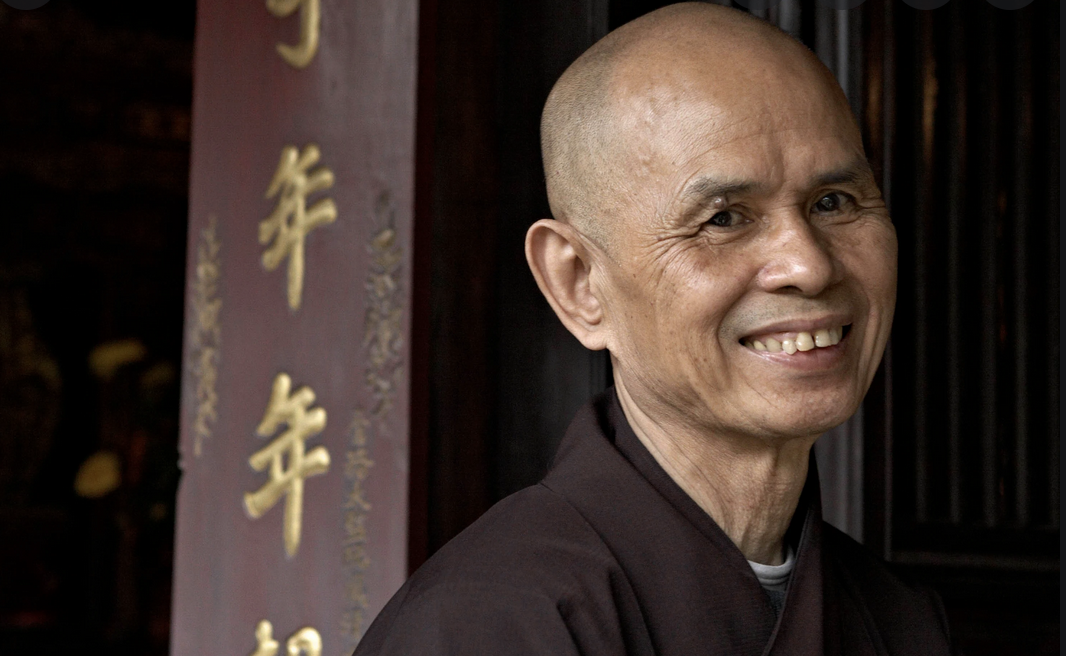
Thich Nhat Hanh, probably the second most well known person in Buddhism in the West, has died at the age of 95. His importance, life and teaching are well summarised in this Washington Post article. May he rest in peace.
“Hanh’s greatest contribution to Western thinking was to inject the idea of mindfulness: to be fully conscious in the current moment.” – Washington Post.





 The Tai Chi Notebook