The Tai Chi Notebook Facebook page has finally got far enough over the 1,000 followers milestone that I feel confident in shouting about it a little bit! So, here we go – 1,000 followers!
Thanks to everybody who has liked, subscribed and commented on The Tai Chi Notebook over the years – it’s all very much appreciated!
Also, I’ve changed the sidebar on the blog over to the right —-> It now shows the most popular posts on the page by views and likes, so if you’re looking for something interesting to read about martial arts and Tai Chi, then look here to find something.
The classic BBC TV series, Way of the Warrior’s episode on Shorinji Kempo just appeared online, and it still holds up today.
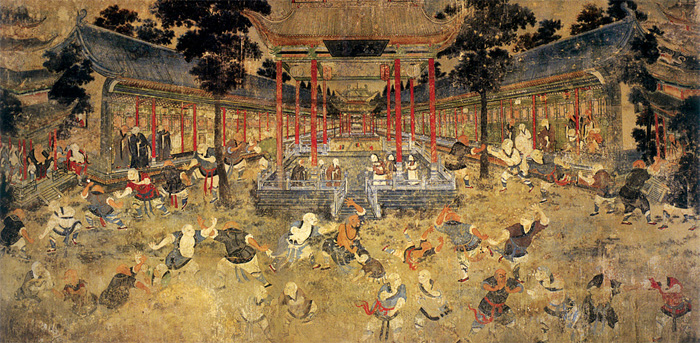
The BBC seem to have complete access to the style to film this, which at the time they say had a million followers and was floating on that ‘cult’ borderline, and it’s a fascinating glimpse into the past. Shōrin-ji kempō means something like Shaolin Temple Fist Way, and was established in 1947 by Doshin So after his time as a spy in China, where he supposedly trained at the Shaolin Temple. I think, as the documentary makes out, that his main form of training at the Shaolin Temple consisted of looking at the famous painting (which is not that old at all) of Chinese and Indian monks fighting. Like all Kempo styles his art is probably an eclectic mix of all sorts of different martial arts he trained in. However, he appears to have used that painting as the inspiration for his whole martial art! The Shaolin origins made a great backstory, anyway.
The mural painting from the Shaolin Temple.
While this is only one type of Kempo from Japan, you can see a lot of the elements we talked about in our Heretics Podcast, History of Kempo and Jiujitsu episodes, that seem to be recurring themes:
The blending of marital arts and religion (in this case Buddhism)
Far right political views
A sense of freedom in where you get techniques from (absorb what is useful)
Helping fight crime as a kind of unofficial police force
A lot of sparring!
What is also interesting is that the film shows the widespread use of the original Shorinji Kempo logo – the Swastica – that they replaced for all branches in 2005 with the so-en (double circle).
Today’s blog is about a weird quirk of the Xing Yi world. There’s a surprisingly large amount of online debate in Xing Yi circles about where the elbow should be when performing Xing Yi. I mean, a surprisingly large amount of debate. Especially for a matter that might, forgive me for saying this, be seen as trivial by people actively engaged in combat sports that actually spar with resistance.
Obviously, if you have some sort of two person free practice in your Xing Yi system that you actually engage in regularly, I’m not talking to you. I think the real reason why all these debates happen is simple – too much forms and not enough fighting.
But, ok, there are other reasons. For example, details do matter in internal arts. Quite often we’re being asked to look in detail at our movements and micro movements to get the most perfectly coordinated and natural human movement possible. But without keeping one foot on the ground, (and grounded in the reality that sparring provides), the theoretical arguments start taking over and the art disappears up its own bum. A martial art that is predominantly forms-first is always going to be theoretical at best. To take the well worn analogy – you don’t learn to swim by practicing on dry land.
The problem stems from the fact that there’s a line in the Xing Yi classics that translates as:
“The hands do not leave the heart and the elbows do not leave the ribs”.
But it’s how literally you take these words seems to be the crux of the matter. Now, I’ve seen videos of respected Xing Yi masters quoting this passage while demonstrating and their elbows are clearly leaving the ribs, if not in the horizontal axis, at least in the vertical axis.
The reasoning behind keeping the elbows tight is sound – in boxing, kickboxing and MMA it’s generally considered best practice to keep your shoulders high and elbows tucked in close to the body to help protect the ribs. But boxers don’t tend to get hung up on this – as their individual style develops they don’t feel like they have to conform to the same ‘rules’ that the novice has to. They are free to develop their own personal style through experimentation and testing in the ring. I’m sure Prince Naseem was taught the same basics as Mike Tyson, but look how differently their boxing styles turned out in the end.
So, (and I know, dear reader, that you are just dying the hear this), what’s my take on where the elbow should be in Xing Yi?
Well, I’m glad you asked. Rather than getting hung up on words in an old writing (that may or may not be old at all) I prefer to get hung up on history. I mean, you have to get hung up on something, right?
Xing Yi is generally considered to be descended from military spear fighting. If you hold a heavy spear it becomes readily apparent that your best chance of wielding it with power is to keep it in front of the body, not out to the sides. It’s the same when you hold any heavy object – you are stronger when your arms are in front of you holding it than when they are at your side holding it. This is the truth I feel these words are aiming towards, and generally the postures and techniques of Xing Yi all comply with this idea of keeping the elbows in and the arms in front of the body, not to the sides. There are exceptions though. For example, Xing Yi Bear has a much rounder posture, with gaps under the elbows, more like the Yi Quan standing postures.
Some postures in our Xing Yi dragon and chicken links are for hitting with the elbows and we hold them out to the side when doing so, but in these cases you are normally (but not always) standing side-on to the opponent, so the elbow tip is pointing at the opponent, so in that sense it is not ‘out to the side’.
A good example is this famous Liang Yi Zhuang posture from Baji, which is similar to the chicken posture I was talking about. (Baji is another Northern Chinese martial arts, that is a bit similar to Xing Yi).
I mean, we could decide that viewed from the opponent’s position the elbow is in line with the body, therefore it is not leaving the ribs, but the hands are not in front of the heart. No way. Are we therefore going to decide that this posture, taken out of context on its own, is wrong because it doesn’t correspond literally to some ancient writing that may, or may not, have been referring to a specific context?
Here’s another theory: I think what the whole thing is quite possibly about how soldiers work in formation on a battlefield. If Xing Yi does have military roots then a line of soldiers on a battlefield would all be orientated towards the enemy, standing side by side in a line. That’s another good reason to stick the elbows to the ribs. Any bladed weapons going towards your sides would definitely not be welcomed by your brothers in arms.
Ultimately, I don’t expect this post to have really made a difference to the debate. I feel like this one is just going to run and run forever. So long as there are mainly theoretical practitioners of the art there will be always be many theoretical debates about how what somebody is doing is right or wrong in relation to some ancient writing.
I just think people’s efforts would be better put to trying moves out on other people and getting feedback that way. As one of my teachers used to say often:
“There is no such thing as correct technique, there is only appropriate technique.”
I’ve been meaning to read the story of Matthew Polly’s time spent training at the famous Shaolin monastery for years, but I finally got around to it recently thanks to my Audible.co.uk subscription*. And what a great read it is! I’m sure we can all identify with the teenage Polly, unsure of himself and his place in the world, who falls under the spell of Kung Fu and decides to dedicate his life to the pursuit of it as some kind of escapism from the pressures and fakeness of the modern world. To Polly, Kung Fu represented something sublime, pure and otherworldly that actually meant something. But unlike most of us, he did more than just dream about it, he actually went to Shaolin and lived there for almost a year, at a time when there was no Internet, no easy way to get there and China had only recently opened up to foreigners, so most Chinese people had never even seen a Laowai in the flesh before.
Polly’s story could best be summed up as a sequence of misadventures punctuated by moments of sublime martial arts inspiration. He manages to get into all sorts of scrapes involving accidentally offending senior party officials, being entered into a tournament against a San Da champion and hilarious misadventures with the opposite sex. Part Bill Bryson-style travelogue, and part kung fu geek-out, this is a rewarding, even emotional, look into what the Shaolin monks were really like in the 1990s, just as their international fame as stage performers was starting to spread and take over from the mystical image everybody had of them from the Kung Fu TV show. (Interestingly, at one point Polly watches the Kung Fu TV show with the monks who laughed their heads off at the idea of burning a dragon and tiger into your arms by lifting a hot anvil and dropping it into the snow – “why would you do that???”)
What you really get from this book is a sense of what the Shaolin monks are really like back then, and how much more human, relatable and down to earth they are compared to the lofty ideas we all have of them. It answers all the big questions like, how good are they at actually fighting, how seriously they take the “monk” side of their lives and how they train iron first, arm, head and even iron crotch.
The little snatches of Chinese you pick up by reading the book are also a hidden bonus and bring the characters to life marvellously. By the end of the book you feel like they are your friends and you know them just as well as Polly did. Anybody who likes this blog would love this book. Recommended.
N.B. The cover with a monk holding a Burger King bag is representative of the idea of American values seeping into China, but a little misleading as there were no Burger Kings in China then, and certainly nothing like that in the rural backwater of the Shaolin village.
*Like a number of other books, American Shaolin is included in the cost of an Audible subscription, so if you are a subscriber you get it free.
It’s no secret that Tai Chi is a series of circles. The body opening and closing using circulation motions, like a yin/yang symbol in action. But when you look at a Tai Chi form, you’ve got to wonder, what came first, the techniques or the philosophy? Was Tai Chi created in a moment of philosophical purity and clarity, or was the philosophy simply bolted on to existing military or self-defence techniques (or popular movements from theatrical or religious rituals) that were already as old as the hills?
What I’m wondering is, was there at some point a founder of the art who decided, as a starting point, that he was going to purposely create a martial art based entirely on a philosophy based on the Tai Chi symbol, which would be both the overarching principle and the raw material, out of which martial applications would be fashioned?
Or did the idea of doing things in circles come later, and get added to existing martial techniques, and in so doing, alter them forever?
Well, let’s look at what we know as fact.
Fact 1: Tai Chi does indeed contain nothing but circular movements. I’m sure somebody somewhere can point out a movement in a form that looks linear, but it’s quite possible that the movement is actually being created in a circular way, or it has degraded over time into something else. All we can do here is talk in broad brush strokes. If you look at a Karate form, or a Tae Kwan Do form you see lots of examples of linear movements, that are usually lacking from Tai Chi forms. From this we can conclude that some sort of philosophical idea must have been involved in its creation.
Fact 2: The techniques in Tai Chi forms look a lot like other techniques in other Chinese martial arts forms, so are not in any way unique. If you look at a lot of forms from the Shaolin Temple, or village styles from all over China, you see postures and movements that are very similar to the techniques found in Tai Chi. In a way, there is nothing new under the sun.
When solving a murder, detectives look for two things first – opportunity and motive.
When Tai Chi first appeared in Beijing in the late 19th century it was promoted along with the idea that it had a founder, an immortal Taoist called Chan Sang Feng who had created the art based on his observation (or a dream) of a fight between a crane (or possibly stork) and a snake. And while certain groups (see my last interview with George Thompson) on Wudang mountain still take this story very seriously, and possibly literally, modern scholarship has tended towards the idea that it was a fighting art from the rural countryside (Chen village being the most popular choice for origin) that found its way to Beijing via a young Yang LuChan, who taught it to those at the highest level of influence inside the Forbidden City.
Of course, the shadowy figure of Yang LuChan is never adequately explained, and since he was an uneducated nobody – a rural rube – nobody really made a record of his existence. The story everybody, including all the heads of the various Tai Chi families, follows, (because it’s the story the Chinese government approves of), is that he learned the art in Chen village. But I always wonder about that time in the 1860s when Yang and the very well educated and important Wu brothers were in Beijing, as being a time when Tai Chi could have been invented. The Wu brothers would have known the philosophy on which to hang it, and Yang would have had the martial skills to make it work and turn it into something that could bring the fractured court of the late Ching Dynasty together, bonding over something that was essentially Chinese in the face of constant threat from foreign powers. Yang and the Wu brothers together had both opportunity and motive, and regardless of whether you accept that interpretation of history or not, Tai Chi has been used as a political football ever since, especially by the current government to whom Tai Chi (the world’s most practiced marital art!) represents the ultimate form of soft power, spreading Chinese culture and influence the world over.
Sometime back in the early 2000s I had an article published in what was, at the time, the premier Tai Chi magazine, T’ai Chi Magazine. It was American, but you could find it in the UK in newsagents like WHSmiths and in martial arts shops. I was reminded of it recently and dug it out of my archive. Here it is! I looked a lot younger back then…
I remember being really excited that I got this article published. It’s hard to imagine now, but beyond your instructor or random seminar big wig in your town, T’ai Chi Magazine was one of the only ways to get information about Tai Chi before the Internet took over everything. It was run by its Editor, Marvin Smalheiser, who sadly passed away in 2016.
Whenever you dig out something from the past it’s a good opportunity to reflect on how things have changed. T’ai Chi Magazine was run to a pretty high standard, the images it published were always good, and many of them were in colour. The articles were generally of the interview type and provided a little glimpse into the T’ai Chi world for fanatic followers, who would look at the articles for hours, trying to work out what a particular pose could be for, or how the featured practitioner was doing something. Then VHS video came along and made still images irrelevant, since you could actually see the applications being done (a lot of the pages in T’ai Chi Magazine were dedicated to advertising VHS videos of forms and styles, mainly from China). And later online video sites like YouTube came along and made VHS look antiquated.
Considering the latest developments in AI it looks like our future will consist of an AI-generated person teaching us Tai Chi forms with no credit to the sources it stole it from, and probably teaching the moves wrong anyway. I’m not sure that technology is always moving us forward. You can imagine the fear that the first Tai Chi instructors had that if they put images of their form in a book it could be stolen from them. These days, it’s not only going to be stolen by AI, but it’s going to be manipulated into something else entirely!
You can imagine the prompts now:
“Alexa, teach me a Tai Chi form that lasts for 10 minutes and exercises all my major muscle groups”.
“Sure, here you go Graham.”
A video (or hologram?) of Alexa will then start teaching you some ‘follow along’ series of Tai Chi movements it’s magicked up out of thin air, with no credit to where it got them from, and slightly wrong.
And the worst thing will be, it’s probably exactly what people want.
“If correct timing and position are not achieved, the body will become disordered and will not move as an integrated whole; the correction for this defect must be sought in the legs and waist.“
When you’ve been practicing Tai Chi for a while – a few years maybe – you’ll get to the stage where you start to think about making your own form. Something that puts all the bits you really like together, and is either shorter than what you usually do, or longer, or uses less space, or fits into your garden better, or… something.
It’s potentially driven out of a need to make your own mark on the world; perhaps a sense of ego. You want something that is yours! Or maybe it’s just that you are a creative person and you have a need to continually create. Or perhaps it’s just to bring a sense of aliveness and play back into your Tai Chi…
What will then happen is you’ll start making a form, and then you fiddle with it, and fiddle with it and fiddle with it… and years pass and you’re still fiddling with it.
Ultimately, you’ll realise that this process never ends, and that your form will never be “finished”. Just when you think you’ll got it finished, you’ll notice a part of it isn’t quite right.
Whenever I mentioned to my teacher, over the years, that I’d made my own little form he was usually completely nonplussed. I mean, he asked to see it, but I could tell it wasn’t setting his world on fire 🙂
As I was pondering on my millionth version of my form this morning, another thought occurred to me. An obsession with creating your own form is probably an indication that you are getting a little too concerned with the external aspects of Tai Chi.
Switch your focus in Tai Chi back to the ‘internal’ elements – your perception of your body in space. Slow down, put your mind on what you are doing, notice your breathing, feel the (for want of a better word) energy inside the movements, notice where your weight is on your feet, push up from the ground, etc…
Now you’ll find that it doesn’t really matter to you what form you are doing – it’s all the same. If you are focused on the inside, your concern for what order movements come in and how many times you repeat something isn’t what matters anymore.
Suddenly, the idea of creating your own sequence of moves seems a bit, well, meaningless. Instead, you create your own form every time you practice, with every movement you do.
In this episode I ask George what it is like to live and train Tai Chi on Wudang Mountain, what Wudang Tai Chi is like and what lessons he’s learned from Taoism.
You too can learn from George’s teacher, Master Gu, 15th generation of Wudang Sanfeng Pai of Wudang mountain via his online learning site at https://www.taoistwellness.online/
Click on the 7 day trial option, then use the coupon code TAICHINOTEBOOK when you sign up and you’ll get a lifetime 8% discount. That’s equivalent to one free month a year!
You can get a similar discount from George’s website https://www.wayfinder.academy/ using the same discount code TAICHINOTEBOOK when you sign up.
“When you can take the pebble from my hand, it will be time for you to leave.” – Master Kan
Here’s the blurb:
“Did Western movies and TV lead to the creation of the Shaolin Warrior monks? Did the modern Shaolin fake something that had already been reinvented anyway? Did the Qing Dynasty really destroy the Shaolin temple, or did they instead create it? What influence did three subsequent phases of communism have on Shaolin? Was there a Southern Shaolin Temple, and what about the modern stuff at Wudang Mountain? These questions and more answered in our new episode on the infamous temple and its monks.”
Yesterday was World Tai Chi and Qigong day (note the crazy mix of Wade-Giles and Pinying Romanisation going on there!)
So, I hope you celebrated the day by doing some sort of practice somewhere. I saw a couple of posts in my feed showing groups practicing Tai Chi in the park. Here’s one taken by Donald Kerr of Spinning Dragon Tao. Check out his YouTube channel.
Just a group of people getting together and peacefully practicing Tai Chi. Given the state of the world today, that’s no small thing.