The crucial detail of using the kua and hips in Needle at Sea Bottom

There’s a lot of talk in the internal arts about the “kua”, and how using the kua (as opposed to the hip joints) is central to getting the idea of internal movement in Tai Chi.

So, what is the kua?

A definition from Crane Tiger Tai Chi reads:

Kua refers to the area that extends from the inguinal folds (front of the hip where the leg and body meet) to the crest of the pelvis. It includes the hip joints, the iliopsoas, and adductor muscles as well as the sacrum and the perineum.

I’ve written about the kua several times myself, but I think Ken Gullette’s book (my review is here) does a great job of describing it. To me, moving the kua is about opening and closing the body in the space inside the hip joints. Integrating the opening and closing of the kua into your movement facilitates power moving smoothly from the legs and feet up through the body, or receiving force in the opposite direction and directing it down towards the ground.

Moving “inside” the hip joints allows for very detailed movement and enables you to create and remove space when interacting with an opponent, which has martial application.

However, I think that the focus on the kua in internal arts often risks people ignoring the pivotal (ha!) role of the hip joints. I think the hip joints are actually more important to get right – if you focus on the kua but never think about your hip joints it’s a bit like building the walls of your house without a firm foundation.

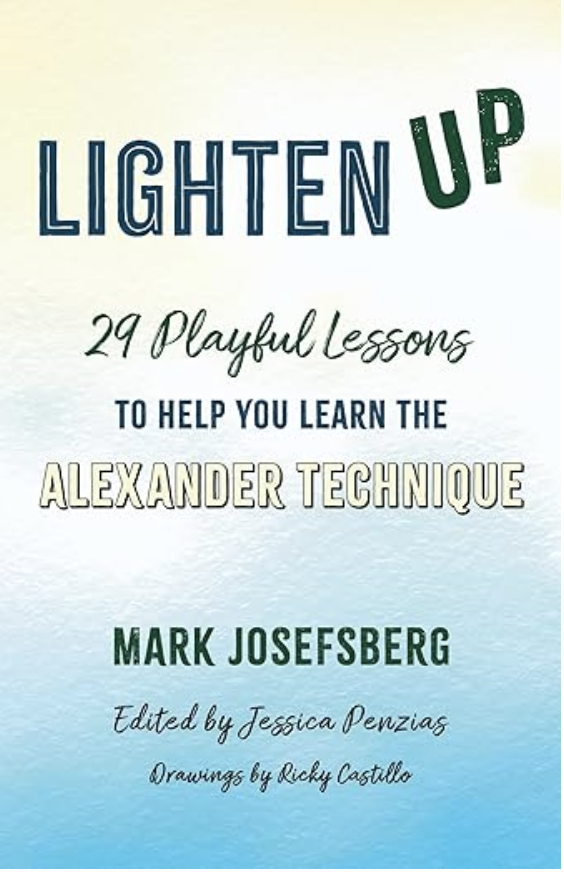
I’ve been reading a great little book called Lighten Up by Mark Josefsberg, which is a humorous description of the Alexander Technique, and only costs £2.50 for the Kindle edition.

It starts off making the great point about the pivotal (ha!) role the hip joint play in actions like sitting, standing, running, walking, bending, etc.. A good point it makes about your hip joints is that they probably aren’t where you think they are. People tend to think that you put your ‘hands on your hips’ that’s where you bend from, when in fact, your hips attach to your legs via a ball and socket joint that is much lower down.

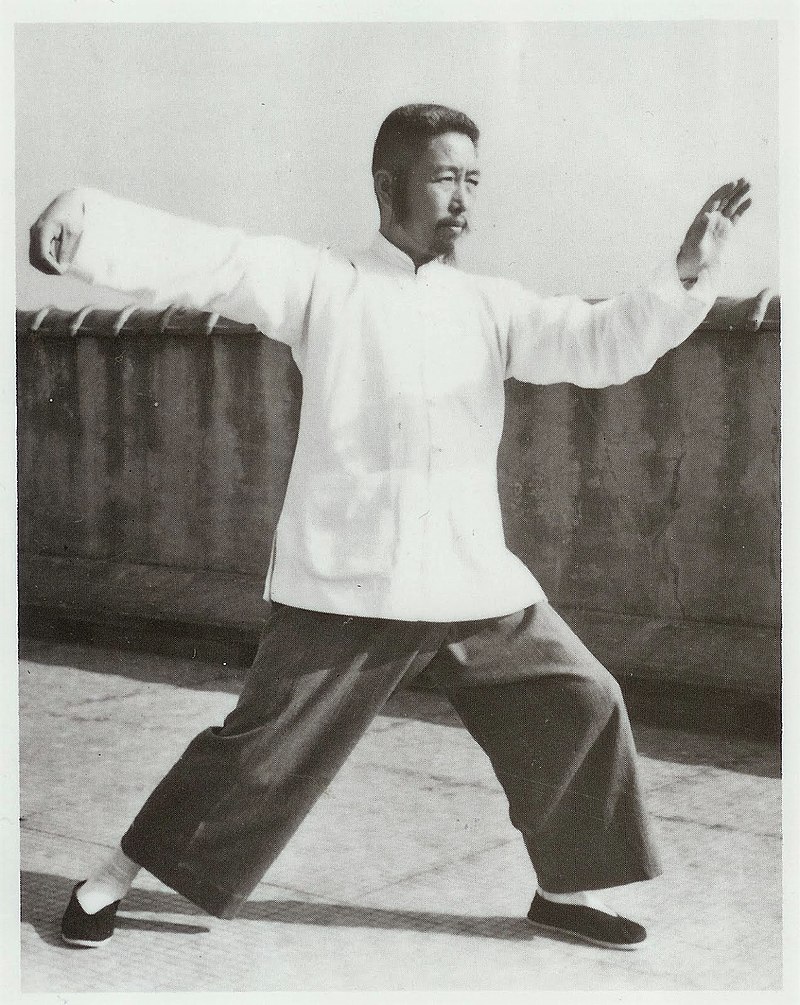
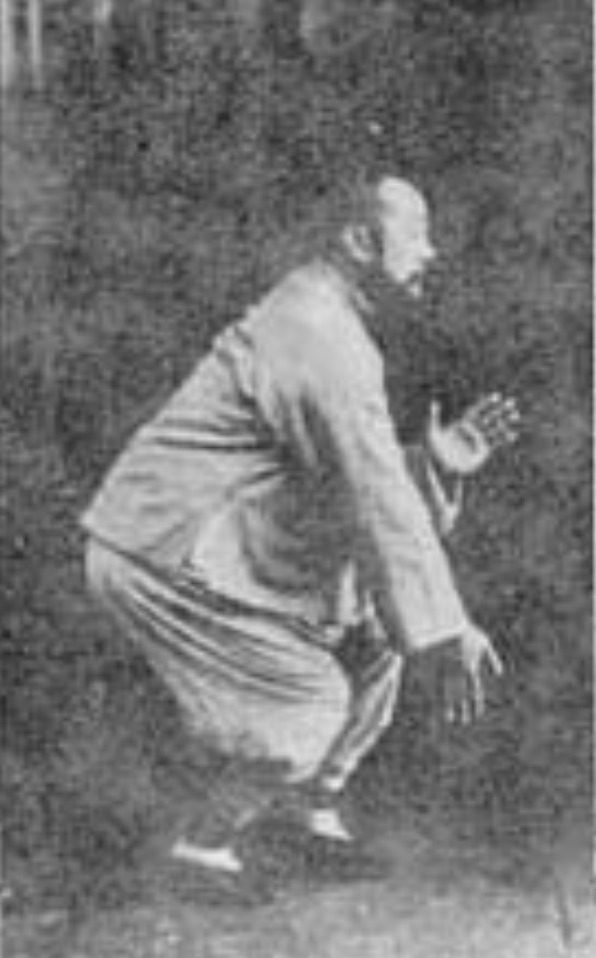
This has real consequences for Tai Chi postures such as “Needle at Sea Bottom”, where you bend forward. If you bend from too high up then you are compromising your spine, and bending from your hip joints is always a bit lower down than you think it is.

Wu Jianquan, Needle at sea bottom

The way I do Need at Sea Bottom is to try and keep my head going “up” away from the spine and bend from the hip joints (where the legs attach to the body) keeping my spine in a straight line. In theory, at least.

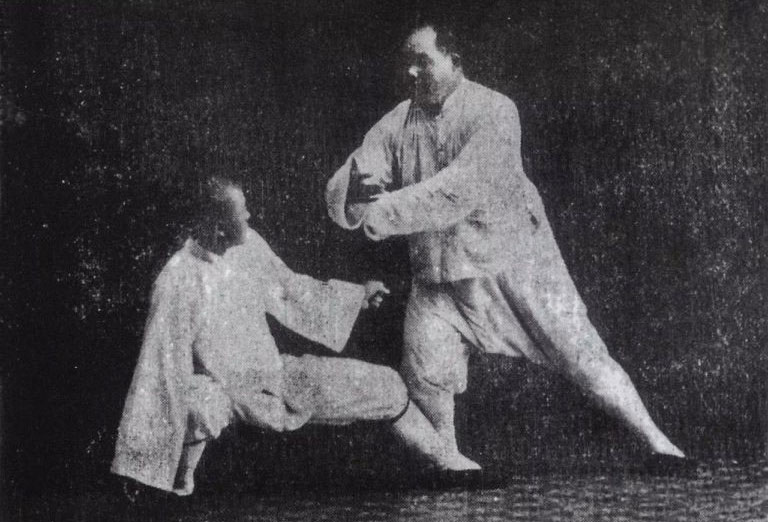
I don’t know who this is, but look at this guy doing it:

To me there are all sorts of problems here – he’s rounding his spine, and the head is kinked at an unnatural angle that isn’t an extension of the spine, in an effort to go too low. I’d rather not go as low as he is, and not compromise my spine like that.

The other point that Mark continually makes in the Lighten Up book I mentioned is to be aware of the AO joint – the atlanto-occipital joint. This is where the head meets the neck, and again, it’s not exactly where you think it will be. Put your fingers in your ears and imagine they are touching. Rotate the head up and down from something on a level with that point – that’s roughly where it is. What you’ll find is that you can look up and down without your fingers moving up or down because you are rotating the head around this point. Now apply that principle to Needle at Sea Bottom and you can see how your head position is meant to be.

Here’s a video of my Sifu Raymond Rand doing the movement correctly, with martial application:

The best swordsman in the world…

Photo by cottonbro studio on Pexels.com

You might have heard this quote before:

“The best swordsman does not fear the second best. He fears the worst since there’s no telling what that idiot is going to do.”

Many attribute the quote to Mark Twain, but it was actually a summation of something Twain wrote in “A Connecticut Yankee in King Arthur’s Court”, 1889, which was:

“But don’t you know, there are some things that can beat smartness and foresight? Awkwardness and stupidity can. The best swordsman in the world doesn’t need to fear the second best swordsman in the world; no, the person for him to be afraid of is some ignorant antagonist who has never had a sword in his hand before; he doesn’t do the thing he ought to do, and so the expert isn’t prepared for him; he does the thing he ought not to do: and often it catches the expert out and ends him on the spot.”

I think about that quote a lot, mainly because I spend a lot of my time sparring with people in jiujitsu who range vastly in skill level. And the reason I think about that quote a lot is because it’s true.

When I’m rolling with a higher belt in jiujitsu, my best jiujitsu comes out – I can pull off things – clever, complicated things – I can’t do with beginners because the more experienced person is reacting correctly for a jiujitsu person. However, when you roll with a beginner even they have no idea what they are going to do next, so you are constantly stuck in this awkward stop/start phrasing of movement where you have to be constantly on guard for the unexpected because the risk of injury is real. But rolling with beginners also reaffirms another maxim for me – often you don’t need complicated jiujitsu, you just need to do the simple thing well.

New podcast: Discovering Neijiaquan, with Jess O’Brien

My guest for this episode is Jess O’Brien, author of the book Neijiaquan and co host of the Neijiaquan podcast, which he runs with Isaac Kamins.

Since 1999, Jess has studied extensively under BK Frantzis. Over the years, he has also trained with other, preeminent internal martial artists like Luo De Xiu. He has been active in martial arts since his teens.

In this episode we discuss what drew Jess to the internal arts and how he trained with various different teachers before becoming a student of Bruce Kumar Frantzis.

Why I’m a martial arts snob

So, apparently I’m a snob when it comes to martial arts! I must be because on two separate occasions now women have accused me of being one (interesting that it’s women both times!)

A recent exchange went something like this…

Me: Are you going to the seminar with master x this week?
Her: Yes, you?
Me: Yes, but if he teaches a basic hip throw I’m walking out. 🙂
Her: You’re such a marital arts snob! 🙂

As you can see, there were smilies involved, so I don’t think it was meant seriously, but there’s always a grain of truth at the bottom of most jokes.

Photo by Anete Lusina

This got me thinking. I think I am a bit of a snob when it comes to technique in jiujitsu. The popular wisdom goes that after black belt you start to really appreciate the basic techniques and find hidden value in them. Sure, I can see that. It’s true, you do revisit seemingly basic techniques and find things you’ve missed or deeper levels to the technique. But sometimes basic techniques are just… basic. And a bit boring. Show me something new and cutting edge, especially if I’m paying for a seminar!

When it comes to Chinese martial arts (CMA), I’m a snob in a different sort of way. Watching other people do CMA I don’t always express an opinion, but internally I’m very judgy. I find it hard to praise people for a mediocre performance, or even ignore all the bad bits like some people seem to be able to. But equally, when I do see something I like, I’m pretty free with my praise about it.

When watching forms done on video I always try to factor in that “everything looks 20% worse on video compared to real life”, and judge accordingly. But even so, what some people in marital arts deem worthy of sharing with the pubic makes me question their sanity. A lot of it is just embarrassing, but there is something else to look out for…

As I discuss with Jess O’Brien in an upcoming podcast, it can be hard to know what is correct in Chinese marital arts. Quite often, even within the same style, two teachers will have radically different interpretation of the same principles, and they can often both be right at the same time – i.e. they can both make it work. It’s not until you get hands on with a person that you can tell if what they’re doing works, or not. So, it’s usually a good idea to gets hands on with somebody before you criticise them too much.

With that said, I think you do need to be pretty discerning with what you’re accepting as “good” in Chinese martial arts. CMA has always been infiltrated by people who were, shall we say, not very good, but pretended to be so, especially to naive Westerners who can’t tell the difference. Then there are the teachers who hold things back and don’t teach all their skills. There are plenty of ways to waste years in CMA not really learning anything of value.

But what is being a snob? Isn’t it just having high standards? The Cambridge dictionary defines a snob as: “a person who respects and likes only people who are of a high social class, and/or a person who has extremely high standards who is not satisfied by the things that ordinary people like”

OK, ignore the first bit about social class, since that’s got nothing to do with it, but look at the second part. “Not satisfied by the things that ordinary people like”. Hell yeah! I can identify with that.

When it comes to martial arts I think that a snob is a pretty good thing to be. When there are 7 year old kids going around with black belts in Karate or Taekwondo, I’m quite happy to hold myself to higher standards. Most ‘self defence’ videos you find on YouTube are laughably bad. And a lot of Tai Chi videos appear to be cult-like and weird.

If this is what ordinary people think martial arts are, then yes, I’m a snob.

Rewire your brain in six weeks – the benefits of meditation

There’s an interesting article on the BBC website about how a six week mediation programme (that you can access free online) can produce measurable changes in the human brain. It’s interesting, but does end with the disclaimer that “A final note of caution – it is important to acknowledge that any brain changes we had seen could also be random“.

Photo by Mike Bird on Pexels.com

Imposter syndrome and martial arts

I’ve been delving into the depths of imposter syndrome and how it relates to martial arts recently. It started when we had Dr Marc Reid of the Reid Indeed podcast and author of “You are not a fraud” on our Heretics podcast last week.

It was a great interview – one of the best episodes we’ve done, I thought. I’d never really thought much about Imposter Syndrome before, but once we had Marc booked as a guest I realised it was a great opportunity to discuss how it relates to martial arts, and that it was actually something that has been on my mind for quite a while.

I think every martial artist must deal with imposter syndrome to some extent. But, as I learned in the podcast, having a little bit of imposter syndrome can actually be a good thing for your development, as it allows you room to grow and stops you thinking you know everything.

The question, “am I really good at this?” Is one that I think plagues all long-term martial artists… after they get good enough at their art that it becomes a question worth asking, of course.

One thing that’s quite common to see, especially in Chinese marital arts, (where entering competition or testing against resistance is often frowned upon, as it prevents “lethal” techniques being used) is the ‘master’ demonstrating only on his own students who are literally throwing themselves on to the ground for him, at the lightest of touches. I mean, we’ve all seen Aikido demonstrations, right? I often wonder what’s going through the mind of the ‘master’ in those situations, because they must know they’re a fraud, yet they carry on as if they are unbeatable. But I guess that so long as they never out themselves in a situation where they will encounter any real resistance they will be! In a way, it’s almost like the performance of a magic show, and the students are subtly required to play along by the group dynamic by the magician performing his tricks.

Sadly, we’ve all seen the videos of what happens when these ‘masters’ try their tricks on tough people from outside their group who are not going to play along. Of course, not all Chinese marital artists (or Aikido schools) are like this. I need to say that now because otherwise you just get tarred with the “hater” brush.

One of the things that attracted me to BJJ initially was the live sparring. You get to ‘test’ your ability every class, since half the class is usually live sparring. You can see exactly how good you are compared to other people. I love that real, live, feedback – I guess you could call it direct contact with nature because you are experiencing what happens against a live person who is not just going to play along in the same way that somebody who thought they were good at running could try a long distance, or a weight lifter can try lifting a heavy weight.

BJJ sparring has a limited rule set, yes, there’s no punching or kicking, for example, but within the confines of that ruleset you can really go 100% and see what happens. As a tool to keep your ego in check, I think it’s invaluable. (Not that you want to be going 100% every roll, of course).

But even within BJJ there are opportunities for the imposter syndrome to sneak in in other, more subtle, ways. There are belts that get awarded as you progress, and to this day it’s rare for me to find somebody who has just been promoted who thinks they are worthy of the belt they’ve just been given – everybody feels a little bit like a fraud, even with all the live sparring going on, or even entering competitions and testing yourself against people of the same belt rank and age from other schools. Competing is time consuming and expensive and not everybody competes and you can start to worry that you are only good within the confines of your own school.

Bruce Lee had a lot to say about belts “Belts are only good for holding up your pants” was, I think, one of his. I remember that and “boards don’t hit back” being another classic Lee quote from Enter the Dragon. But it’s an interesting perspective – all this worrying about belts and being an imposter is completely in your own head – in realty, belts don’t matter, all that matters is what you can do.

That’s one of the reasons I make an effort to get out and train with other BJJ people whenever the opportunity arises, like at the recent 40+ Grappling event I went to. I get to mix with a range of belt levels, all from different schools.

Getting out there and mixing it up can certainly do wonders for quashing any imposter syndrome that might be building up in your head. Even if you don’t necessarily ‘win’ all the time, I find it really rare that any BJJ practitioner isn’t up to the level their belt suggests. BJJ belts tend to only get awarded when an instructor thinks you’re ready for it. Trust your instructor. They’re usually right.

There are also plenty of complete frauds in martial arts who are clearly running some sort of con. Fake black belts in BJJ tend to get found out pretty quickly, but the marital arts is a very unregulated profession and anybody can set up shop at any time, claiming whatever qualifications they like. If any serious martial arts practitioner compares themselves to these genuine imposters it’s pretty easy to realise that you’re not the imposter you might think you are.

The opposite of the impostor syndrome of course is the over confidence of the person who is slightly, or perhaps very, deluded about their own abilities. I’m sure we all know people who talk a good game (especially on the Internet), but if you ever see them move or demonstrate something they can’t hide their actual true ability, or lack of it.

So, maybe feeling like a bit of an imposter sometimes is actually good for you, and stops your ego taking control and turning you into one of these untouchable master types. I notice all the time when I’m teaching that people will try very hard to put you on a pedestal. To be honest it happened much more often when I was teaching Tai Chi compared to teaching BJJ, but it still happens. I’m very aware of people’s attempts to turn me, the teacher, or me the higher belt into some sort of idol and I try and stop it happening before it starts. A good start is to reject people calling you special Chinese titles like Sifu or Laoshi, (I’m not Chinese) in Tai Chi and in BJJ it’s a custom to call your teacher a Professor (Portuguese for “coach”), but I try and discourage that where I can. I’m happy with just my name. That’s my personal choice, and not a judgement on other people who may have very good reasons for using those titles. They can do what they want.

I had a great time teaching at the 40+ BJJ Open Mat, South West and Wales, September 2023

I felt very honoured to be asked to teach the technique section at the 2nd South West and Wales 40+ BJJ Open Mat this weekend at Bristol Dojo. It’s a group set up by a couple of older BJJ players who just want to organise some get-togethers for people to train BJJ in an open mat-type format. So, you can chat, pick each other’s brains, learn some technique or just roll. It’s up to you. There were 4 black belts on the mat and a whole raft of purple and browns, so there was no shortage of experience in the room.

I didn’t start BJJ until later in life and have always felt it’s a great sport/martial arts for older people despite its reputation as being all about younger, stronger, athletic guys who want to smash it in competitions or get into MMA. To me BJJ was just a natural progression from the arts I already practiced, like Tai Chi, into something that was similar, relied on technique not brute strength, and didn’t have the lack of martially-inclined training partners that Tai Chi suffers from.

Tending towards the ‘soft’ style of marital art, BJJ is also something you can do as you get older. Sure, you can’t keep up with the young guys, and your body racks up the damage, but with enough technique under your belt you can stay martially active and still enjoy really competitive rolls as you age.

I taught some back takes from the guard pull. All donations went to the Dementia UK charity. Thanks to Rob, @b_team_bjj for organising everything, it was a great day.

And thanks to Eira Culverwell @beyond_the_mats_ for the amazing Kinetic Massage I received – I felt like a new man again in just 10 minutes! Great for grapplers.

New podcast! The REAL fights of Bruce Lee, with John Little

I have a new podcast out! Bruce Lee will be no stranger to anybody listening to The Tai Chi Notebook Podcast – even 50 years after his death he remains the most famous martial artist in the world.

But could he actually fight?

World Champions in karate competition have gone on record to point out that he never once competed in tournaments. So, were his martial abilities simply a trick of the camera?

My guest for this episode is Bruce Lee authority and bestselling author John Little.

John has a new book out called Wrath of the Dragon: The real fights of Bruce Lee, in which he takes a hard look at Bruce Lee’s real-life fights to definitively answer these questions

To get these first hand accounts John has tracked down over 30 witnesses to the real fights of Bruce Lee as well as those who were present at his many sparring sessions. There are over 30 years of research in this book that took him thousands of miles around the globe.

Find out more about Bruce Lee’s fights in:

WRATH OF THE DRAON: The Real Fights of Bruce Lee

The internal qualities of martial arts

Photo by Thao LEE on Unsplash

One observation I have on ‘internal’ martial arts is that there there is often very little focus on the ‘internal’ qualities to a human being. Or if they do address them then it is, not directly and often in passing.

I’m not talking about things to do with forces, or the body, like Qi, Xin and Jin. Yes, the Yi (intent or mind) is mentioned all the time in the Tai Chi Classics, but it’s always in relation to fighting, or releasing and accepting forces on the body. “Quelle surprise”, you might say, since Tai Chi is a marital art, but if I contrast ‘internal’ martial arts with ‘external’ martial arts for a moment, the discussion there is often on the internal qualities of a human that internal martial arts, ironically, neglect.

I’m talking about things like self-control (temperance), endurance and patience.

The goal of improving these internal qualities has been the goal of practical philosophers since man first decided to ponder his/her existence. I could quote from LaoTzu here, but I find it more explicitly written by the Greek philosophers, particularity the Stoics.

In Chapter 10 of the Greek classic of Stoicism, The Enchiridion, we find:

“On the occasion of every accident (event) that befalls you, remember to turn to yourself and inquire what power you have for turning it to use. If you see a fair man or a fair woman, you will find that the power to resist is temperance (continence). If labour (pain) be presented to you, you will find that it is endurance. If it be abusive words, you will find it to be patience. And if you have been thus formed to the (proper) habit, the appearances will not carry you along with them.”

Epictetus, The Enchiridion

Sure, these internal qualities can certainly be learnt from any martial art, however I find it is the external martial arts that really emphasise them. Many Taekwondo schools use the goal of improving your inner qualities as the main sell in their marketing approach. For example, I just did a Google search for Taekwondo clubs in the local area, clicked on Tiger martial arts, and what do I find written on their website, in all caps, so you can’t miss it?

“WE BELIEVE MARTIAL ARTS IS ABOUT MORE THAN JUST KICKING AND PUNCHING”.

This is followed up with “We give students the focus and confidence to achieve in all areas of their lives.  Yes, you can learn to take care of yourself in dangerous situations, but really it’s about learning to use your mind and body like a martial artist – learn how to control your body and your mind, and you will be set up for life.”

It’s the same with Karate. I did another random search on Karate clubs and found Bristol Karate Academy whose motto is “virtue in industry” from “Virtute et industria” — or by virtue and industry — from the city of Bristol, which dates back to at least 1569. They explain how that relates to the values of their club on their About us page:

“So what does that mean for us?

Virtue (美徳): We have integrity, in our commitment to traditional, effective Karate and integrity in the way that we treat others. We are respectful, fair and aim for high moral standards. We build character, strive for excellence and show courage in the face of challenges.

Industry (勉励): We work hard to reach our goals. We’re diligent and determined to get better at every single training session. We are rigorous in our approach to improvement and dedicated to our own and each other’s development.

Through hard, honest training we become our best possible selves”

Again, while I’m sure they can kick-ass with their karate, the emphasis in their motto is on the internal qualities of a human being. It’s about becoming your best possible self.

I know what you’re thinking – “perhaps it’s about teaching children?” Things like Karate and Taekwondo can be very orientated towards teaching children, and you obviously don’t want to be raising a hoard of little ninjas who have no idea about the moral implications of using their marital arts. However, it’s not just non-Chinese marital arts that have a heavy emphasis on building moral character. Similar ‘external’ Chinese martial arts do too, and those tend to have as much emphasis on adults as children. Also the moral aspects were there right from the beginning in the Southern arts.

Photo by Nikita Belokhonov: https://www.pexels.com/photo/a-boy-participating-in-a-dragon-dance-6673225/

For the history of Southern Chinese martial arts I’d recommend Ben Judkin’s excellent book “The Creation of Wing Chun”. Its tag line is “A social history of the Southern Chinese Martial Arts” because it covers all of them, not just Wing Chun, and particularly Choy Li Fut. When the first professional Choy Li Fut school opened in 1836 a moral education was seen as part of the ethos of the school. The school had 10 rules that had to be followed at all times:

Ten Points
1 Seek the approval of your master in all things relative to the school.
2 Practice hard daily.
3 Fight to win (but do not fight by choice).
4 Be moderate in sexual behavior.
5 Eat healthily.
6 Develop strength through endurance (to build a foundation and the ability to jump).
7 Never back down from an enemy.
8 Practice breathing exercises.
9 Make the sounds (“Yik” for punches, “Wah” for tiger claws, “Tik” for kicks).
10 Through practice you cannot be bullied.

Wing Chun also initially had a similar set of rules. I’ve written before about Choy Li Fut’s 10 rules and Wing Chun’s 9.

While some of the rules are to do with body use, like making sounds on punches, others are more moral, like being moderate in sexual behaviour. And also eating healthy is a rule! Can you imagine going to a Tai Chi class or a Xing Yi class today and being told that healthy eating is now a rule, and if you don’t follow it, you’re out? In fact, I’d go as far to say that many internal martial arts teachers were renowned for hard drinking and over eating!

(It should be noted that Bak Mei tended to not have this moral emphasis. Reasons for this are explored in the book.)

Moving forward in time and changing locations to Brazil… Carlos Gracie also created a set of rules called the 12 Commandments when he started Brazilian Jiujitsu as an offshoot of Judo.

1 Be so strong that nothing can disturb the peace of your mind.
2 Talk to all people about happiness, health, and prosperity.
3 Give to all your friends the feeling of being valued.
4 Look at things by the enlightened point of view and update your optimism on reality.
5 Think only about the best, work only for the best, and always expect the best.
6 Be as just and enthusiastic about others victories as you are with yours.
7 Forget about past mistakes and focus your energy on the victories of tomorrow.
8 Always make those around you happy and keep a smile to all people who talk to you.
9 Apply the largest amount of your time on self-improvement and no time in criticizing others.
10 Be big enough so you can feel unsatisfied, be noble enough so you can feel anger, be strong enough so you can feel fear, and be happy enough so you can feel frustrations.
11 Hold a good opinion about your self and communicate that to the world, but not through dissonant words but through good works.
12 Believe strongly that the world is in your side, as long as you stay loyal to the best of yourself.

Carlos Gracie

These are mainly forgotten about these days and I’ve noted before that a lot of them were borrowed from somewhere else but they are almost exclusively about internal qualities of a human being.

If you contrast these sorts of rules to what you find in “internal” marital arts schools, well first of all, there are usually no set rules like this at all! Secondly, we tend to look to the classics for our ancient sayings, and finding moral instruction in them is like finding a needle in a haystack. Instead you find simile – for example, “be still like a mountain and move like a great river” from the Tai Chi classics, or philosophy from the Xing Yi classics like The 10 Theses of Yue Fei:

“From the beginning, that which is discrete must have its unification.
The divided must be combined. 
Therefore, between heaven and earth, all that is disordered has its abode, all the thousand branches and the confusion of then thousand endings, all have their origin.
This is because one root divides into ten thousand branches, and ten thousand branches all belong to one root.
These events are natural“.

– The Thesis of Integrity

Or you find descriptions of body use and strategy.

The jin should be
rooted in the feet,
generated from the legs,
controlled by the waist, and
expressed through the fingers. 

The Tai Chi Classic.

What you don’t find a lot of is moral instruction or a reflection on the internal qualities of a martial artist that you find emphasised right up front in external schools.

So, why is this? Good question. One possible answer could be that ‘external’ arts historically coming from the Shaolin Temple (in the usual origin myth, at least) always had a Buddhist religious and therefore moral aspect to them. The internal arts in contrast tended to evolve out of the (violent and bloody) countryside, or they evolved from a Taoist approach to life, which was less prescriptive.

I don’t know – what do you think? What explains the internal/external difference? Let me know in the comments.

More Baji talk! The follow up to my first Baji Podcast, with Sifu Damon Smith

I’ve recorded a follow-up to my recent podcast with Rikard and Miika about Baji, this time with my Heretics podcast co-host Damon Smith, who is also a Baji practitioner. Listen to the new episode here. There’s a lot of talk about technique here, and how it compares to Xing Yi.

Here’s the blurb:

“This episode follows on from Episode 26 of Graham’s Tai Chi Notebook Podcast in which he interviews Woven Energy patrons Rikard Elofsson and Miika Wikberg about the little-known martial art of Baji. We discuss the possibility that the Baji Xiaojia is the most perfectly balanced form from any martial art – “Xiaojia is more Tai Chi than Tai Chi”, and look in a bit more detail at the history, technique, strategy and background to this subtle and robust martial arts style.

Graham, Miika and Rikard’s original episode can be found here: “