Why BJJ should really be considered a weapons-based art

Picture Grog, the caveman. He’s sitting around the fire with his tribe, wearing animal skins and singing the songs of his ancestors, while his kids run around the back of the cave and paint bison on the walls. Compared to the sabre tooth tigers with their man-splitting canines and the huge giant sloths with their throat-cutting claws that roam freely the valley below, Grog hiding in this cave, doesn’t look like much. But in a mere 10,000 years Grog is going to become the dominant species on this planet. In fact, he probably already is.

Homo sapiens special power is that we’re a tool-making and tool-using creature. Our opposable thumbs gave us fine motor control to skillfully manipulate objects, and our brains have the super power of being able to picture what an object is going to look like before it exists in reality. These two factors, combined with our other abilities, like language and social bonds, put us on track to dominate the earth thousands of years ago. From humble beginnings, like making spears and flint knives, our tool use has grown exponentially into the today’s miracles of engineering like cars, planes, and penis-shaped space rockets. And don’t forget, in the past we’ve managed to build huge, complex structures with what would be considered only basic tools by today’s standards.

When it comes to combat, it’s no different. Our ancestors didn’t charge into battle barehanded as well as bare-chested. Well, maybe some of them did, but they’re not around anymore. We devised a whole range of deadly tools to effectively chop, sever and dismember our opponents, while wearing skillfully-made armor designed to protect our vital organs as best it could. In today’s more peaceful society our preference is for safe, unarmed martial arts, which we use to de-stress ourselves with after work. But these toothless tigers belie the long and bloody history of deadly weapons use amongst humans. And in terms of effectiveness between armed and unarmed, it’s not even a contest: even a professional boxer has very little chance against an unskilled man wielding a sharp knife.

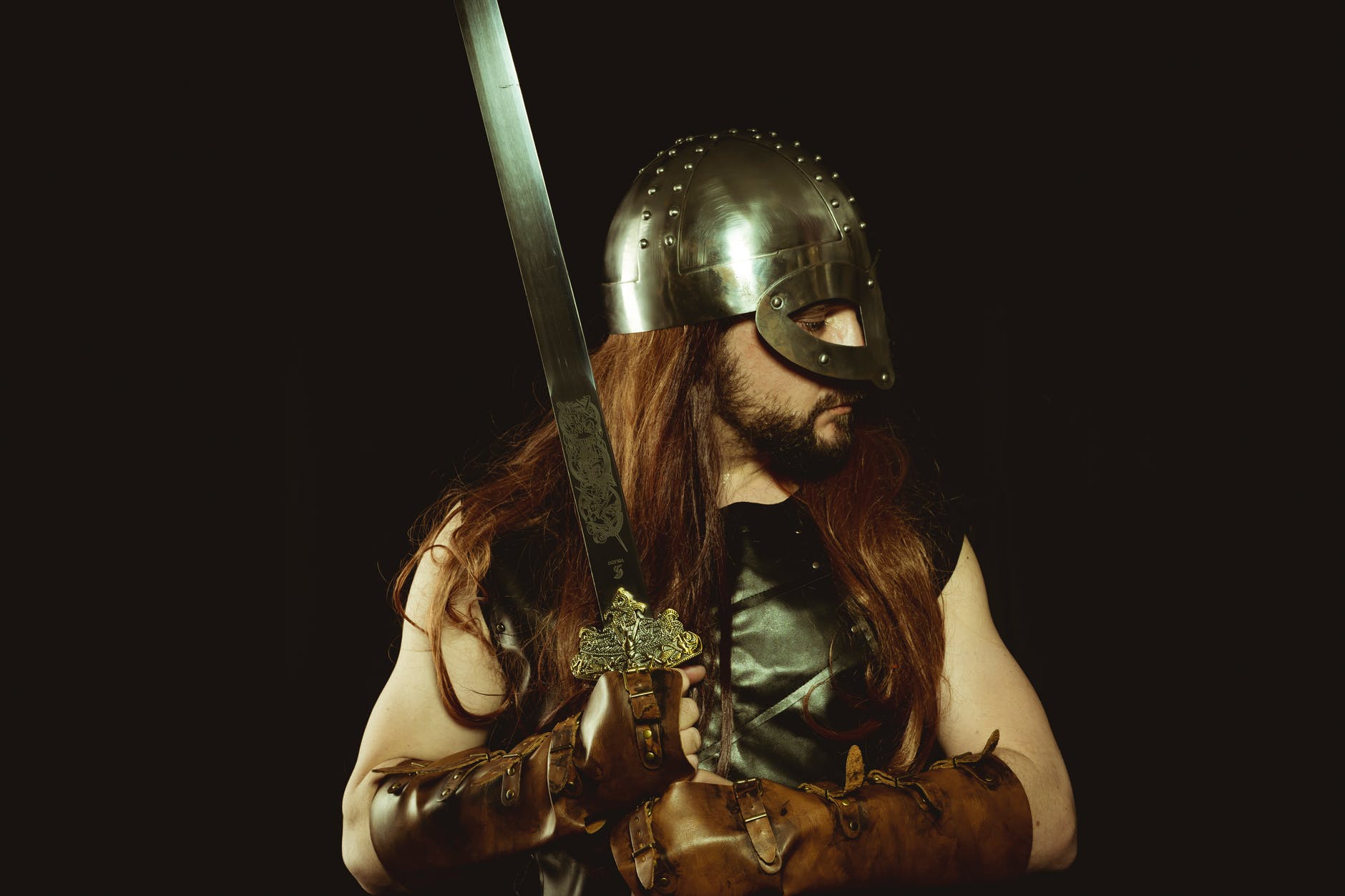
Modern interpretation of a Viking warrior: Photo by Fernando Cortu00e9s on Pexels.com

I remember having an interesting conversation with my martial arts mentor and teacher, Damon Smith, about what kept him interested in a martial arts over such a long period of time. He said that, for him, a marital art needed to contain weapons or he loses interest. While they might not be practical in the modern age, adding weapons to a martial art increases its difficulty level as well as its effectiveness hugely, providing a new physical and cognitive challenge in the process. And by ‘adding weapons’ I mean actually learning to fight with them, not just performing a solo form.

Of course, there is a long history of weapons usage in martial arts. In fact, many modern martial arts started off as weapons systems before transitioning into purely bare-hand arts in modern times. Weapons are found in almost all ‘traditional’ Chinese martial arts and consist of things like spears, nunchucks, swords, throwing darts and wooden staffs. European martial arts use quarterstaff, sword and buckler, amongst other things. The gladiators in the Colosseum in ancient Rome use swords, shields, tridents and nets.

But there’s one marital art that most people would consider a purely bare-hand grappling art, which I think should be more accurately categorised as a weapons system, and that’s Brazilian Jiujitsu, (or BJJ for short).

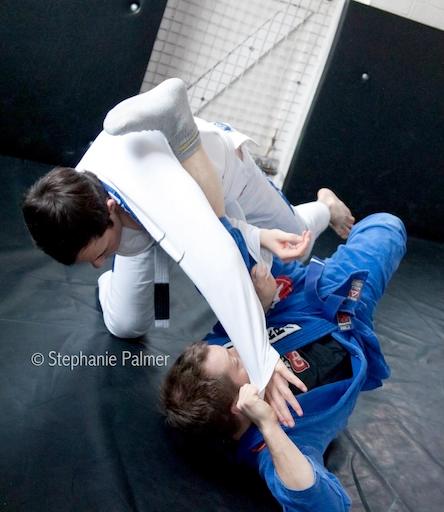
While most systems of Japanese Jujitsu train with traditional weapons you rarely see them shown in BJJ beyond basic defences to a few random knife or gun attacks, and we certainly don’t train to use things like swords or spears in defence or offense. However there is one weapon that we use all the time – the gi.

BJJ in a gi: Photo by Timothy Eberly on Unsplash

Jiujitsu was an import to Brazil from Japan, and adopted and taught by the famous Gracie family in Brazil in the early 20th century. It was originally practiced in the kimono, or “gi” as we call it today , and that is still how the majority of clubs train around the world, although the “no gi” or ‘spats and shorts’ version has been proving more popular in recent years.

The gi is a thick, and durable uniform that can stand up to tugging and wrenching without falling apart. It’s tied at the middle with a belt, which changes colour as you progress through the grades. For adults it goes from white to blue to purple to brown and finally black. There are belts after black, but most normal people don’t reach these.

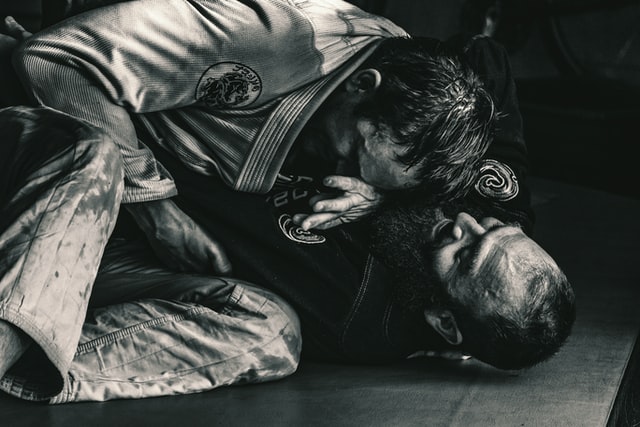
Choking with the gi from back control in BJJ:Photo by Samuel Castro on Unsplash

The gi doesn’t look like it, but it is actually a weapon. Chokes can be performed in BJJ with almost any part of your body. The famous triangle choke, for instance, uses the legs to shut off the bloody supply to the head, causing unconsciousness, unless the person taps first. However, when you’re wearing the gi the number of chokes available increases massively. Chokes using the collar can be performed from almost any angle. You can also wrap the lapels of your gi, or their gi around the neck to create a choke.

Attempting a collar choke while rolling in BJJ: Photo by Samuel Castro on Unsplash

Soft weapons, like the rope dart in Chinese martial arts, have long been respected in martial circles for their efficiency and the gi is no different. In the hands of a skilled exponent of the art, the gi becomes simply another weapon with which to attack. While some people might consider that ‘cheating’ and no use for ‘the street’, there are plenty of others who point out that most people wear clothes when they go outside their house (and usually in their houses too), so these skills are transferable to real life situations.

There are plenty of videos online showing how gi chokes can be done even on somebody wearing a t-shirt:

I’ve stuck with Jiuitsu for 11 years now myself. and I think a large part of the attraction is the gi and the huge number of possibilities it offers. And while I favour a basic collar and sleeve grip when playing guard myself, there are whole systems of BJJ guard playing dedicated to intricate lapel grips, popularised by famous practitioners like Keenan Cornelius, the most famous of which is his Worm Guard:

The gi offers the same level of cognitive challenge that using a weapon does in other martial arts. And while Brazilian JiuJitsu takes the use of the gi to new levels, I think the same could be said about other grappling arts that make use of clothing, like judo and Mongolgian wrestling. Modern judo has become all about the grip fighting, for instance, and a good grip on the opponent’s clothing can give you a real advantage in arts like Mongolian wrestling.

There are downsides to fighting with the gi of course. Firstly, the damage to your fingers is real, especially as you get older. Too much gripping of the gi really takes it out of your fingers, especially once your grip gets twisted and your opponent is trying hard to break it.

The gi game tends to be a little bit slower-paced as well, since just having one grip somewhere on somebody can stop an attack completely. But while some people find that frustrating, to me it’s just another problem to solve, and more brain-tingling fun to keep training the mind as hard as the body.

Kung Fu and firearms

“Western enthusiasts often feel impelled to strip away these religious trappings and construct a version of the martial arts that is neither simple gymnastics nor religion, but emphasizes true hand-to-hand combat skills. The question remains, is this an authentic understanding of the martial arts?”

Charles Holcombe, Theater of Combat (1990)

I think it’s important to bear in mind Charles Holcombe’s classic article, Theater of Combat, when thinking of Chinese martial arts.

One recurring trope that I encounter from, as Holcombe puts it, “Western enthusiasts”, (a label I would apply to myself) is the idea that the Chinese martial arts styles evolved as effective fighting systems in a purer time, before the use of firearms became widespread, and that they gradually went out of favour as practical self defence arts in the face of modern weapons, and turned their attention instead to the more lofty goals of attaining physical fitness, health and spiritual enlightenment.

The idea gives credence to the original version of these arts being purely pugilistic. It follows that once the evil West showed up with their firearms the martial arts needed to find some other way to survive, so it tended towards gymnastic displays or spiritual attainment. It’s a neat idea, but it doesn’t really hold sway with reality.

People forget that China is credited with inventing gunpowder and that the ‘older’ version of its martial arts was intricately embedded within a culture whose religious expression was revealed through performance at festivals and ceremonies, often officiated by a priest performing a ritual with a sword or a troupe of performing martial artists acting out conversations with the gods. 

Also, I think the “whiff of ancient mysticism” (as Judkins calls it) around the martial arts makes people think of them as being  incompatible with modern methods of warfare, like the gun. A popular theme within marital arts films, for example, is that of the introduction of guns destroying the old order, usually involving the death of an old master at the hands of a less skilled and resentful disciple who only had to pull the trigger. 

But, as Judkins explains, these media perceptions have twisted the truth:

“Historically speaking, this is totally backwards.  First the guns came, and then the modern martial arts developed.  What we see in China is quite similar to the puzzle that made life difficult for Perrin when he discussed Japan.

Firearms have been a fact of life in China since the 1300s.  At first they were difficult and expensive to manufacture, but the government employed large numbers of hand cannons, field artillery pieces and even massive rocket launchers from an early period.  If you are curious about what early military gunnery looked like you should check out the Fire Dragon Manual.  At the start of the Ming dynasty Chinese firearms were probably the most advanced in the world.  So what happened?”

Clearly there is more to this story of Kung Fu and firearms than we are aware. I’d recommend reading Ben’s full article: Forgetting about the Gun: Firearms and the Development of the Southern Chinese Martial Arts. and also his other article: Tools of the Trade: The Use of Firearms and Traditional Weapons among the Tongs of San Francisco, 1877-1878.

Enjoy!

Weapons of Chinese highbinders. 1900

Chinese martial arts masters in London,1981

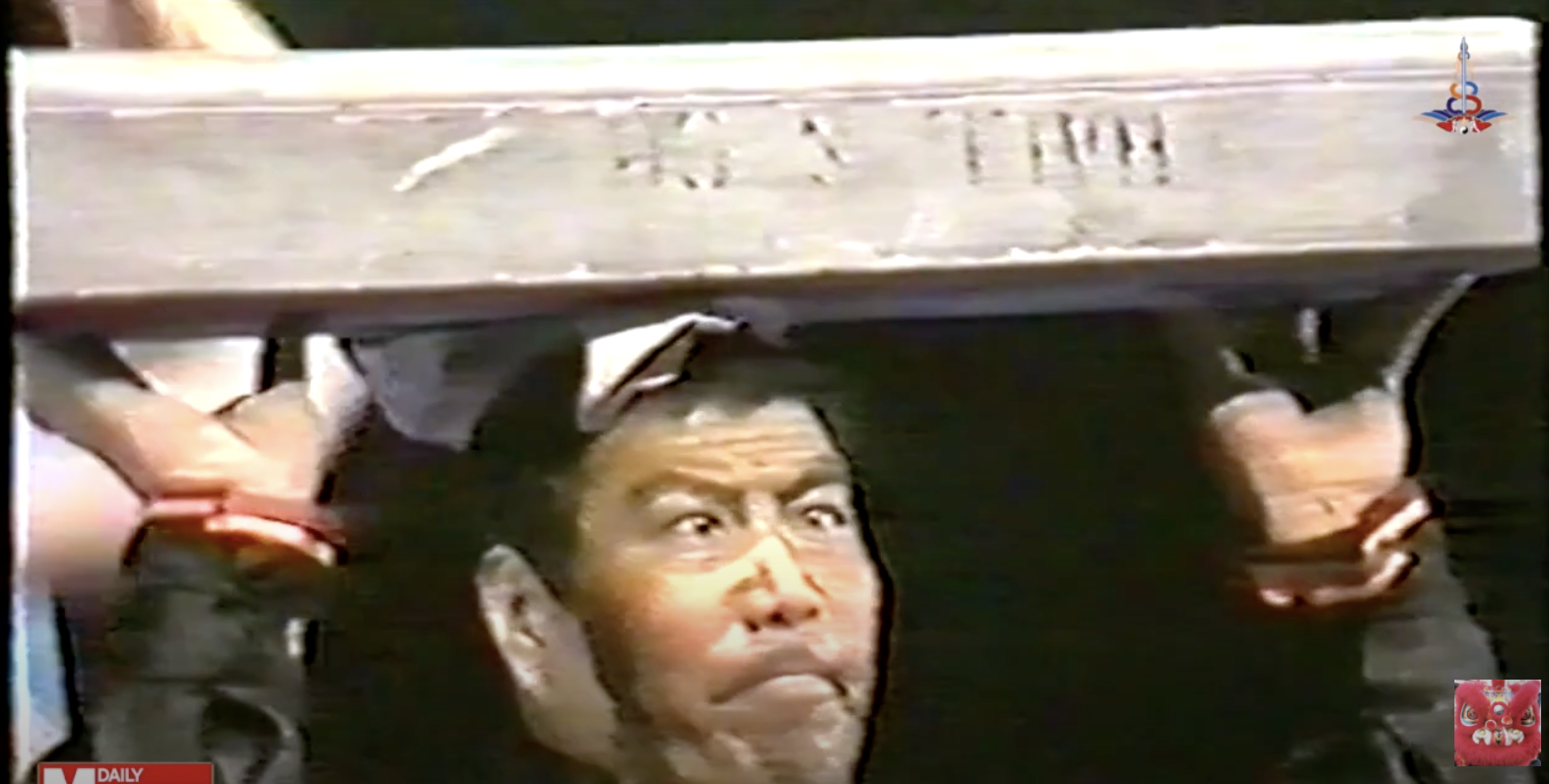
Back in 1981, the Daily Mirror sponsored the “Chinese State Wu Shu Company” to do a performance in London. It would have been completely forgotten by now except that they produced a one hour video tape of the event, sections of which have now been uploaded to YouTube. They’re worth a watch because they give a great insight into what “Wu Shu” was in 1981.

We tend to think of Wu Shu these days as being impressive martial-flavoured gymnastic type demonstrations, often with weapons. There is certainly some impressive “monkey cudgel” form and a staff form on show, but back in 1981 “Chi Kung” or “internal strength” demonstrations seemed to play a much bigger part than they do today. These days those sorts of breaking demonstrations have become more what you’d expect from the Shaolin Monks then Wu Shu athletes, who still put on those sorts of shows today (or at leat they did until C19).

The demonstrations from 1981 are serious, in that the masonry being broken over human bodies looks real. The sledgehammer that breaks it is thrown with gusto, but at the same time, there’s a comedy and performance element. Pretend shots of the sledgehammer are done by the performers to tease the audience and get a bigger reaction when the real blow lands. Traditional music is played. Here we can see the echoes of Chinese theatre (or opera), from which these traditions sprang.

Some of the preparations for the breaks are also very theatrical. As the performers do their chi kung to warm up I can see reflections of the “spirit possession” that convinced so many “boxers” in 1899 that they could become invulnerable to bullets in the Boxer Rebellion. The practitioners seem to wrap their bodies in invisible armour.

In the West we very quickly seem to dismiss these sorts of demonstrations as “circus tricks”, which implies they are fake in some way. But the masonry looks real to me. These don’t look like the deliberately weakened bricks, so often seen in these demonstrations. That looks like a regular British kerbstone being broken over his head, for example!

The 1981 demonstration stands as a great historical document of what the “Wu Shu” brand was in 1981, as China was starting to open up to the West, and before the Shaolin brand split off with the internal strength demonstrations and the Wu Shu brand took the athleticism to new gymnastic heights.

Why are Bear and Eagle always together?

A nice email from Paula asks: 

“I am curious to find why Bear and Eagle are always together. Have you come across or know of any reasoning behind this?

Thank you in advance for your time!”

This is a good question – if you practice Xing Yi you’ll notice that all the animal forms are practiced as individual animals, yet Bear (Xiong) and Eagle (Ying) are often mixed together as something called a “harmonious fist” (He Quan). (Although you also find them as separate links too). There are a few reasons why this is so.  

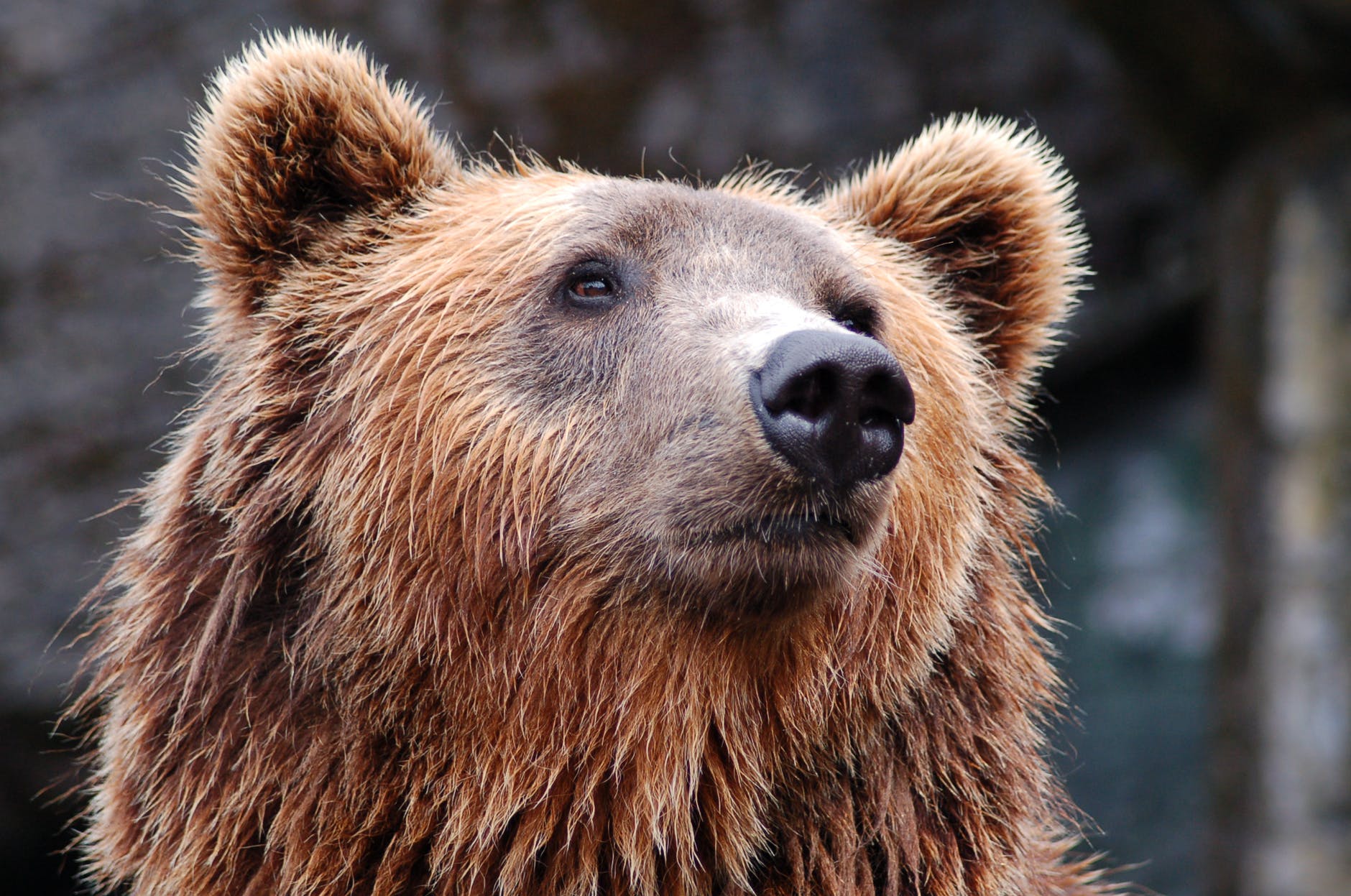
Photo by Rasmus Svinding on Pexels.com

Firstly, although Xing Yi has no particular connection to Taoism, it does make use of the concept of Yin and Yang. All the animals have Yin aspects and Yang aspects – this can be most clearly seen in something like snake, where the yin aspects are represented by the pythons – crushing, choking and coiling, and the yang aspects are represented by the vipers – quick, darting and venomous.

In Bear and Eagle, each animal represents an extreme of the postures found in Xing Yi – Bear should be the most extreme Yin (softer, heavier, shorter posture) and Eagle the most extreme Yang (hard, powerful and big). Bear is only ever Yin and Eagle is only ever Yang. So, to have a balance of Yin and Yang, both are practiced together to produce the optimum fighting strategy.

Bear is used at close range, rolling on and around attacks through your structure and position the attacker should naturally lands on the end of your blows. Think of slipping a jab in boxing and landing an uppercut. In contrast, the Eagle actively goes out to strike the opponent using long piercing strikes at a longer range. So, as a strategy they work well together. 

That’s the most basic reason.

Secondly, 英雄(hero) and 鷹(eagle)熊(bear) have the same pronunciation in Mandarin and Cantonese. This may just be a coincidence.

Now we can slip into the more esoteric reasons. This is something I’ve only ever heard from my teacher, but it makes no difference to the first theory, so let me present it.

There is an animal native to China and Japan called the Bear Eagle (Xiong Ying). In the west we call it the Mountain hawk eagle. (Spizaetus nipalensis in Latin.)

From Wikiepdia: “ it is usually perceptibly bulkier and more massive than most other members of its genus. It is seemingly the largest member of the 10 currently recognized species in the genus Nisaetus, notwithstanding the recently recognized Flores hawk-eagle (Nisaetus floris) (which was separated from the changeable hawk-eagle).”

You can see its powerful legs in this picture. I always like the little tuft it has on its head.

The bear eagle gets it’s name from the way it will grapple with prey on the ground – a bit like a bear. So this single animal represents both qualities. If you believe that the Xing Yi animals were derived directly from observing nature (which was the thrust of the Li movement in the Song Dynasty) then it’s possible that the hunting and fighting tactics of the Mountain Hawk eagle were studied to produce what we have handed down to us in Xing Yi. It’s an unprovable theory, but there you have it.

Ultimately, it doesn’t matter to me if you think of the Xing Yi animal as representing a separate bear and an eagle, or a mountain hawk eagle. It’s all the same thing, and you can gain a lot of insight into the Xing Yi link by observing all 3 animals. Sadly, YouTube is probably your best bet for that these days.

Humans are the only animals with chins

An interesting article from the Atlantic about how only humans have chins. Nobody knows exactly why really, but there are competing theories. At least if you get attacked and eaten by a lion you can shout “you chinless wonder!” at it before you die.

It made me think about the use of the chin in martial arts. In many ways a chin could be considered a disadvantage, as the jaw is where you want to hit somebody “square on the jaw” if you want to knock them out, and the chin makes the jaw more accessible.

I also though about martial arts that make use the chin and the only one that comes to mind is BJJ. I find I use my chin a lot to hold people in place – a bit like a third arm – in top positions. It hooks over the shoulder nicely to stop people getting up when you’re behind them slightly. It’s not one of those techniques that is taught, it just happens naturally.

Chin chin!

Photo by Alexander Krivitskiy on Pexels.com

BJJ as therapy: Martial Arts Studies journal, issue 10 out now

Issue 10 of the (free) Martial Arts Studies journal is out now. This issue marks a 5 year anniverary for the journal. You should read it and support it, because it’s the most important journal we have for martial arts, and if, like me, you’re back in some sort of lockdown, what else are you going to do with your time? 🙂

Find out what’s in issue 10 at the Kung Fu Tea blog.

Amongst the delights contained within is a great article by my friend/teacher/student/Professor/Sifu/Guru Paul Bowman about finding Brazilian Jiujitsu (BJJ), falling in love with it and then having to give it up because of the COVID 19 Pandemic. It contains some great insights into why we practice martial arts there.

Here’s a quote that caught my interest:

“Since every challenging BJJ roll produces the feeling of a fight for life, the end of a session is like the aftermath of a near-death experience, with all of the attendant exhaustion, elation, and camaraderie that goes along with surviving such encounters. A BJJ saying goes, ‘if you don’t roll, you don’t know’. This has a range of possible meanings, but prime among them is that those who have never trained BJJ cannot begin to grasp its appeal, its feel, and its profound psychological and emotional effects. In a very real sense, BJJ can easily be regarded as a kind of therapy. The question is one of who it is that needs BJJ as therapy, and why.”

The contemporary condition (whether figured as modern or postmodern) has often been characterised as one permeated by sedentary media consumption, work-stress, insecurity, work/life imbalance, information overload, consumerism and indoor living. The so-called ‘developed’, ‘Western’ world of consumer societies, neoliberal policies and deregulated economies, are acknowledged to be the cradle of ‘diseases of affluence’. Part of the background noise of this environment is generalised anxiety.
One biological feature of chronic anxiety has been said to involve the constant low-level ‘running’ or ‘leaking’ of aspects of the sympathetic nervous system – manifesting in the anxiety-sufferer’s inability to ‘switch off’ feelings of stress and anxiety [Nestor 2020]. Activities that directly stress the mind and body – such as intense exercise and extreme experiences – have been connected with ‘correcting’ this constant ‘leak’. The argument is that they may do so by, in a sense, giving the body a dose of ‘real’ (physical and/or psychological) stress, which thereby ‘reminds’ the body what stress actually looks and feels like. This thereby allows the organism to ‘recalibrate’ and switch off anxiety-producing chemicals in the absence of ‘real’ physical stressors [McKeown 2015; Nestor 2020]. Short-term, low-level doses of the kinds of stimulation that would cause lasting damage or even death in prolonged exposure is called hormesis, or hormetic stress [Hof 2020].”

Great stuff.

Choy Li Fut’s 10 rules of conduct vs Ip Man’s 9 vs Cobra Kai’s 3

My last post about the various sayings (sometimes called “rules”) attributed to BJJ patriarch Carlos Gracie, and how they were actually copied from elsewhere lead me on to thinking about the 9 rules that Wing Chun grandmaster Ip Man created, perhaps in response to the well known 10 rules of Choy Li Fut, from the previous generation.

Sets of simple rules to follow help bind a style together and give the participants a sense of a shared identity. Even Cobra Kai has a short set of rules to be followed – “strike first, strike hard, no mercy”, and of course, “Cobra Kai never dies!” and “Defeat does not exist in this dojo!”. It seems that if you want to make your martial art a success then a short list of simple and easily followed rules is standard practice.

Oil Painting of Chan Hung.

Choy Li Fut was one of the first commercial martial arts in China – in fact, when Chan Hung (1806-1875) opened his first Kwoon in 1836, it was probably the first ever place where you could actually go and buy kung fu lessons. The concept of “martial arts” as we know them today – i.e. as a commercial enterprise – was unheard of at the time, and Chan Hung was an innovator in this respect.

Chan Hung’s Choy Li Fut was a combination of older family systems like Li Gar, Choy Gar and Hung Kuen, with the word “Fut” meaning Buddah, added out of respect for his religious beliefs. Choy Li Fut is known for its big circular techniques, twisting body and agile footwork.

Chan Hung himself lived an eventful life. He was hired as a coach for local militia (the butterfly knives found in Wing Chun and Choy Li Fut are a direct ancestor of the “two short swords” used in local militia training in the 1840s), and allegedly served in the Ching army, fighting the British at the outbreak of the Opium War.

By the end of the century Choy Li Fut had become the most popular martial art in Guangdong with schools in every major county and town in the province, dominating the other styles like Wing Chun and Hung Gar. But the progress of Choy Li Fut was far from plain sailing though. For example, all martial arts schools in the area were banned for a period of 10 years after the Red Turban rebellion around 1855. Choy Li Fut declined substantially on the mainland after the Communists took over in 1949. In Hong Kong, where it could still survive it was on an equal footing with other martial arts, and no longer in a dominant position.

Chan Ngau Sing (1864-1926)

One of the successors to Chan Hung was Chan Ngau Sing (1864-1926), who took over the Hung Sing organisation in the 1890s when it was still a very large organisation, but in decline. Chan would have been a rough contemporary of Chan Wah Sun, teacher of the famous Ip Man, and they would possibly have mixed in the same circles.

Chan Ngau Sing managed to revive the fortunes of the Hung Sing association, I think, because he was very good at marketing and managed to make Choy Lee Fut very appealing to the working class clientele of Guangdong. It was Chan who made martial arts more respectable for the average working class man by improving its image with innovations such as a 10 point code of ethics for his members:

Ten Points

  1. Seek the approval of your master in all things relative to the school.
  2. Practice hard daily.
  3. Fight to win (but do not fight by choice).
  4. Be moderate in sexual behavior.
  5. Eat healthily.
  6. Develop strength through endurance (to build a foundation and the ability to jump).
  7. Never back down from an enemy.
  8. Practice breathing exercises.
  9. Make the sounds (“Yik” for punches, “Wah” for tiger claws, “Tik” for kicks).
  10. Through practice you cannot be bullied.

They’re quite bullish. Ben Judkins did an interesting comparison between these 10 rules of conduct from Choy Li Fut and the much more moderate 9 rules that Ip Man created for Wing Chun, much later on, which read like an evolution of Choy Li Fut’s 10 points.

Ip Man and students, 1950.

Wing Chun’s 9 points:

  1. Discipline yourself to the Rules: Keep Sacred the Martial Morality.
  2. Understand Propriety and Righteousness: Love your Country and Respect Your Parents.
  3. Love Your Classmates: Enjoy Working Together as a Group
  4. Control Your Desire: Stay Healthy
  5. Work Hard and Keep Practicing: Never Let the Skill Leave Your Body
  6. Learn How to Keep the Energy: Quit Inciting a Fighting Attitude.
  7. Always Deal with World Matters with a Kind Attitude that is Calm and Gentle.
  8. Help the Elderly and the Children: Use the Martial Mind to Achieve “Yan”
  9. Follow the Former Eight Rules: Hold to the Ancestors’ Rules Sincerely.

While some of the rules seem identical to the Choy Li Fut 10, it’s interesting to note how bold statements like “Never back down” have evolved to become “Quit Inciting a Fighting Attitude”.

By the time of the (admitedly fictional) Cobra Kai dojo of the 1980s even these 9 rules were too long and complicatd. The marketing process had been refined down to just 3 simple rules.

Martial arts, if they are to survive, must change with the times. I feel that Chan Ngau Sing, Yip Man, Carlos Gracie and Sensei Johnny Lawrence of Cobra Kai, knew this very well.

The 3 main rules of Cobra Kai.

For more information about the history of Chinese martial arts in the Pearl River Delta in the 19th century, see Ben Judkins book The Creation of Wing Chun.

Beginning Tai Chi, in the Wu Chi stance

Photo by Aditya Chinchure on Unsplash

Stand in a place high up. Looking out over a valley, or the sea, or if you’re in a tower block then look out over the city. Don’t try to think and analyse what you’re looking at, just be open to it. See the place where the sky and land meet.

Open your body posture, holding the arms as if about to embrace an old friend. Let the breath enter the body and leave without any interference. Let the body breathe itself. Start to notice the breath as it goes deep inside you. Feel for the sound of your heartbeat. Get in touch with the rhythms of your breathing, of your heart beat and keep your internal focus there, while maintaining your external focus wide, on everything around you.

If you notice your mind has become caught in thought, simply return it to the body. Stand for as long as you want. Feel what happens to you as you enter a more natural state. You may start to feel a kind of inner strength.

This is the feeling you want to have in the Wu Chi position before you start the Tai Chi form.

How quickly you can enter that state depends very much on how much you’ve practiced it, what’s going on in your life and the state of your health. It’s much easier to achieve this state of Wu Chi in nature, without man-made things in your field of vision or man-made sounds polluting your ears. But if you’ve got a feel for it, then you can do it anywhere. Your body is after all a part of nature.

Tao Te Ching, chapter 49, translation by Stephen Mitchell

49
The Master has no mind of her own.
She works with the mind of the people. She is good to people who are good.
She is also good to people who aren’t good.
This is true goodness. She trusts people who are trustworthy.
She also trusts people who aren’t trustworthy.
This is true trust. The Master’s mind is like space.
People don’t understand her.
They look to her and wait. She treats them like her own children.

Photo by Fabrizio Conti on Unsplash

My first time sparring in BJJ

meBJJ

I was reminded recently of a blog post I wrote for Cook Ding’s Kitchen a few years ago about starting BJJ after years of doing Tai Chi. I just re-read it and decided it was ‘not too bad’, so I’m sharing it again here.

Here’s a quote about my first time sparring in BJJ.

We fist-bumped again and went for round 2. He then proceeded to act out a BJJ clinic on me. He was tapping me out using every sort of conceivable lock or choke hold I could think of at a rate of one tap every 2 minutes. And worse, he wasn’t even trying. I quickly realised he’d let me tap him the first time just to see what I could do. This went on for the full 30 minutes. It wasn’t a matter of being out-muscled – it was clear that he possessed a knowledge that I didn’t. I wanted to lie down, curl up and die after about 10 minutes, but something in me refused to give up and I lasted until the end of the class. The black belt running the class was keeping an eye on me, and expressed some concern about the curious wheezing noises my breathing was making and asked if I’d like to sit out, but my pride wouldn’t let me. I kept going until the end. It took me about 2 days to recover fully. My next class was the same, but this time the blue belt I fought was a smaller female, who repeatedly jumped on my back and tapped me out with chokes until time was up.

That was it, I was hooked.

There was a type of knowledge here I could learn, and it worked in a fight, and it didn’t matter if the other person was stronger than you. There were no forms, deadly techniques or imagining ‘what if’ scenarios. You were hit by reality from the first fist bump.


The importance of the Dragon to Xing Yi

black dragon roof ornament

Photo by Min An on Pexels.com

The Dragon is unique amongst Xing Yi animals because it is the only mythical one. Yes, I’m aware that some lineages of Xing Yi include a Phoenix as one of their 12 animals, but I think this is simply a mistranslation of Tai, a kind of flycatcher bird native to China. You sometimes also see it mistranslated as Ostrich, which is even stranger. You occasionally see Tuo translated as “water lizard”, or “water strider”, but it’s clearly a crocodile, another animal that is (or effectively was) native to China.

The question of why Xing Yi, whose animal methods are based on real, observable native animals, should include a Dragon we’ll leave until the end of this post, but for now, let’s look at its characteristics.

Dragon in San Ti Shi

The Dragon is one of the important animals in Xing Yi Quan because, together with Bear Shoulders, Eagle Claw, Chicken Leg, Tiger Embrace and Thunder sound, Dragon Body forms the famous San Ti Shi posture, (different lineages have slight variations on those, but they’re fundamentally the same).

san ti

San Ti Shi demonstrated by master Zhu Guang, credit Hsing Yi Leeds

Dragons in Chinese mythology have very flexible spines – they fall and rise through clouds with a long, flexible body that coils and rotates, twists and turns. You often seem them decorating Asian temple roofs, or spiralling around a pillar:

yellow and green temple

Photo by Elina Sazonova on Pexels.com

It’s the flexible nature of the spine that is the characteristic we seek to emulate in Xing Yi Quan. In Xing Yi the spine is characterised by a coiling action, a counter-rotation between hips and shoulders, that means the practitioner can easily generate power, or, always has the potential for generating power from all positions.

The typical Dragon Shape example you see demonstrated looks something like this one:

zhu

Dragon, demonstrated by master Zhu Guang, credit Hsing Yi Leeds


Notice how his posture is placing a lot of torque on the spine, and creating potential energy. The right shoulder pushes back, but the right hip pushes forward. That is what is meant by “dragon body” in our style.

(And just to counter some things I’ve read a few times: It is not about creating a ‘spinal wave’ that moves vertically up the spine – that’s not how spines are designed to express power in human beings if longevity is one of your goals. Force (jin) itself can move up the spine to the hands, but there’s no actual physical ripple or wave that should move up your spine, like a whip cracking. I have seen some styles of Chinese martial arts that do this – they crack their spines like a whip. Good luck with that when you’re 70 I’d say, but each to their own.)

Xing Yi and Xin Yi Liu He Dragon comparison

A question came up recently (which inspired this post) about how Dragon in Xing Yi can possibly be the same as Dragon in its sister art Xin Yi Liu He, since they look different.

My first response to that is, of course, they are the same. Not identical in outward expression, but the same root.

These two arts developed in different geographic locations, but they share a common root. Take monkeys as an example: In biological terms, all modern-day monkeys look different, but they share a common ancestor. You can tell they are related. While their colourings, their sizes and their behaviours may have evolved along different lines, they’re still belong to the same species. It’s the same with Xing Yi dragon and Xin Yi Liu He dragon.

One phrase my Xing Yi teacher liked was “one root, 10,000 endings”, so there can be infinite variations on a dragon posture, or sequence, but the root, the essence of what is being expressed, is the same.

Every lineage of Xing Yi has its own slight variation, but in Hebei Xing Yi you usually see Dragon expressed in that rising and falling squatting posture shown above.

Here’s a video of Mike Patterson showing some applications:

This is the posture that is not found in Xin Yi Liu He? Really?

First, I’d dispute that. Here are two videos I found quickly online that are very similar to the standard Hebei Xing Yi version. This one looks like a prototype for the standard Hebei move, ending in a similar squat:


And then there’s this one called “Dragon wags tail” from http://www.xinyiliuhe.net , which has a different stance, but the movement is virtually identical:


Perhaps the confusion happens because the most common “dragon” movement you see in Xin Yi Liu He is this one (that you see translated as variations of “dragon shakes its shoulders” or “dragon shoulder” or “dragon carries the shoulder pole”.)

It’s one of the “3 old steps”. I like that name. Again, it implies that the dragon is a fundamental quality to the art, which is what we say in Xing Yi. I’m speculating here, but perhaps in Xing Yi’s San Ti Shi we see the bringing together of these “old steps” into a single posture that is held and practiced without movement, but with the same internal feeling?

If you look at what is being practiced in the Xin Yi steps above you see the same qualities of dragon that we look for in Xing Yi – the flexible, rotating spine. On the inside, it’s the same thing. Also notice that his arms are being held in a way that resembles wings, like dragon wings?

Let’s look at some more dragon movements you find in other lines of Xing Yi beyond the usual rise/fall squat movement you see:

This is Zhang Xi Gui is the director of the Shan Xi Xing Yi Research School. Notice the same ‘wing’ shape to his arms?

Notice the different flavours of the dragon are there – the strategic leg placement to set traps and trip, the coiling body motion and the ‘wings’ and ‘claws’ feel in the arms.

It’s already clear there is more to the ‘dragon’ than just a single move. I’m trying to get to the point where I can convince you that dragon is a quality, not a move, that can be expressed in various different ways.

Dragon principles in Xin Yi Liu He

In terms of Dragon principles being expressed in Xin Yi Liu He the best video I’ve found is this one below.

Dragon is expressed all through this video and the teacher really goes into detail about the body actions. And again, it all matches with Xing Yi – the rotation of the spine, the actions of the hips and shoulders to create power that I talked about earlier.

I really like this video (despite whatever that young German man is doing to that tree 🙂 )


I hope that’s been enough to get you thinking. We need to stop thinking about Xing Yi animals as ‘this move’ or ‘that move’. It does this massive, practical, ancient and subtle art a huge disservice.

And going back to what I mentioned earlier – the other reason for the dragon being the only mythical creature in Xing Yi/Xin Yi’s animal styles?

Well, the dragon is the emblem of Yue Fei’s family and he is often illustrated with a dragon emblem on his robe:

yue fei

Qing dynasty illustration of Yue Fei By Unknown author – 清宫殿藏画本. 北京: 故宫博物馆出版社. 1994., Public Domain, https://commons.wikimedia.org/w/index.php?curid=57090030

Was Yue Fei practicing what we call “Xing Yi” today in his back yard? Of course not, but the ideas that underpin it? Then yes, he was. His army used these strategies very successfully in battles against the Jin army, but for (much) more of that story, see my podcast.